Is NOT the man or woman who makes no effort to better the condition of society an enemy to society—at least a passive one? Is not the ignoring of evil tantamount to giving it full leave to spread? What, then, shall we think of the vast number of men who accept conditions as they find them, and struggle merely for individual supremacy, closing their eyes to the sordid misery of their fellow human beings, to all the great pain of the common life? Do such men know what they are here for? I do not believe it. I can not believe that they have ever put this question to themselves—this question, which to answer shows the hollowness of the things most men strive for; shows that against all time-honored institutions of established injustice, to be true to the best that is in him, one must turn rebel.
And what is the rebel? What are his characteristics? Does not all history show that those who have dared to rebel in every age were the ones who made life possible for those whom temperament or weakness compelled to submit? It is always the rebels who extend the boundaries of human right, narrowing the confines of wrong and crowding it out of existence. It is the antagonism aroused by the real thinkers God has given to the world that has always been the lever of advance. And in the conflict begotten of the impact of this ethical power upon the inertia that makes for the continuance of anything that is, the world's sweetest lives, have gone out in violence.—Franklin H. Wentworth.
Stamps and Prayer
STAMPS Collections Bought. Best Prices. Send particulars. Fine old Mission Packets for sale. 100 varieties, 10c; 200, 30c; 300, 60c; 25 (special value) 15c. Postage 2c extra. WESTERN AGENCY, 528 13th St., Oakland, Cal.
PRAYER By A. T. Pierson, will bring new life and light into your church, missionary society and home. Price, $1.00 per 100
PACIFIC PRESS PUBLISHING CO. New York City Oakland, Cal. Kansas City, Mo.
FROM SOUTH AMERICA.
By Jean Vuilleumier
Papal Benedictions—The Marrying of Priests—South American Morals and Politics—The United States and South America.
IN his bull—In Dei Coetera—published in 1493, Pope Alexander VI. gave all South American countries to the kings of Spain and Portugal. Between fifty and ninety years ago, these same lands rebelled against their masters, constituted themselves into a number of republics, and made for themselves presidents. Recently, the pope sent to these presidents his apostolic benediction without a word about their sinful (?) usurpation of the lawful (?) authority of Spain. The church that "never changes nor errs" knows, however, how to submit to the inevitable.
This is illustrated in the matter of allowing priests to marry, which was presented to the pope by South American prelates at their Latin-American council last year. The matter is not settled yet, and it is not likely to be for some time, altho it is known that it was and is strongly urged by the archbishop of Mexico—Mgr. Santiago Subiria y Manzanera, and by others. Rome does not discuss things openly and on their merits. Things new, if they must come about, and there is no way out of it, come in on the sly, by dint of precedent and of tradition. When well established in custom, then comes a pontifical decree. Diplomacy, not principle, is the motto.
In the meantime, the scandalous lives of the clergy will go on. But that can well be allowed for a time yet, it seems, inasmuch as the people themselves have loose habits of living. Not long ago, in Peru, a priest was expostulating with a poor man for not getting the church to bless his matrimonial relations. That was before civil marriage came in and when the priest charged what he pleased for marrying. The man told him that he would state his reasons before the magistrate. They both repaired thither. The explanation of the poor man was: "When the priest, who is known to have two wives, shall get married, so will I."
This is a fair illustration of the moral, or rather immoral, situation. A large measure of the loose living must be attributed to the criminal advantage taken by the priesthood in absolutely refusing the people the marriage ceremony unless they are willing to stand their exorbitant charges. Fortunately, civil marriage is now making its way into our South American republics, notwithstanding the dire opposition of the church, which has made marriage a sacrament, and calls civil marriage a concubinage. This deters a great many from being content with a civil marriage. On the other hand, the priest expects to get a large sum of money if he performs the ceremony at all. The consequence is that all through these countries thousands of families are formed without the marriage ceremony. This sad condition tends to make this sacred relation a temporary arrangement, which either party can break at any time.
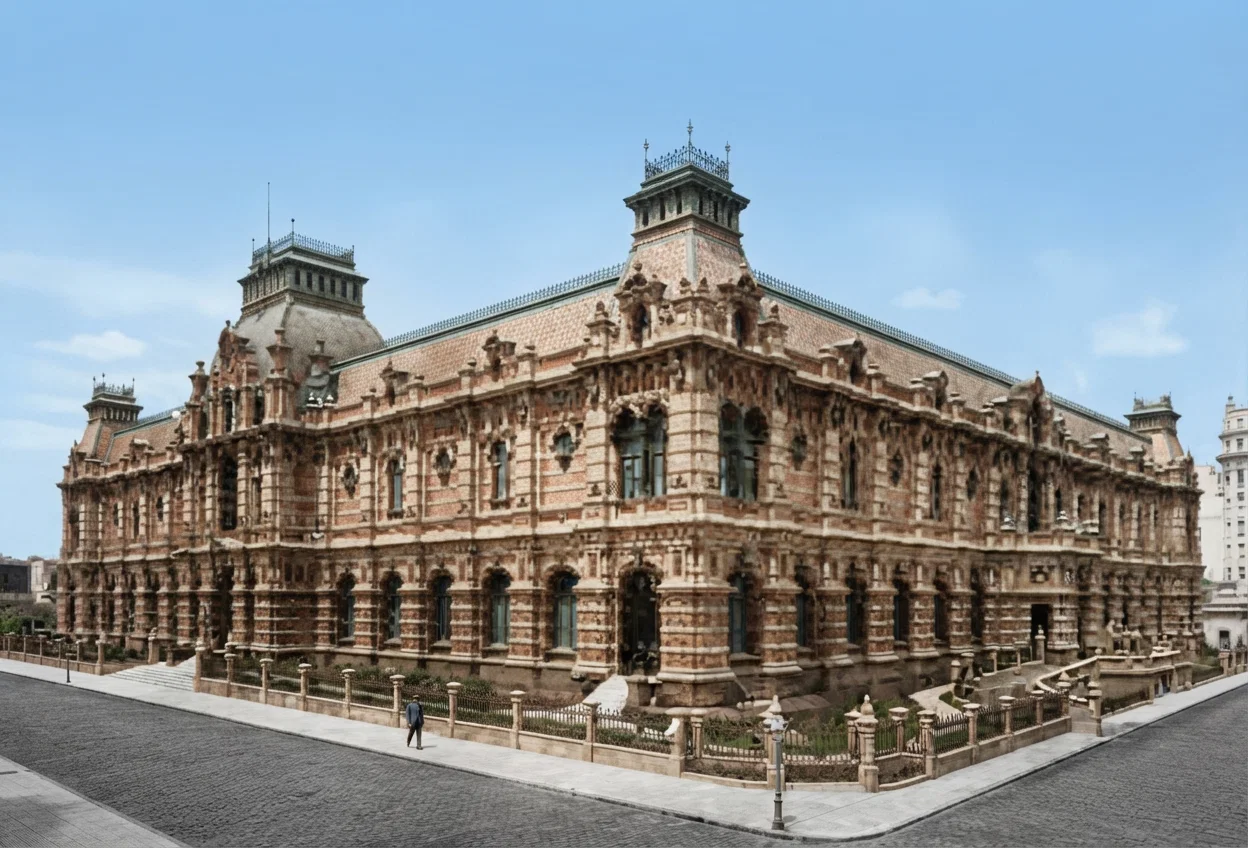
Water-Works, Buenos Ayres, Argentine Republic.
The same greedy spirit which has been shown by the clergy, and which has always characterized these South American countries, is manifested in their political life. It is not to be wondered at. How can people who have never been accustomed to think and act freely on the most solemn and pressing questions that can come to the human soul—those of eternity—be expected to relate themselves properly to the rights of the people and the legitimate restraints of government? Political life in South America offers a sad spectacle indeed. Revolution follows revolution, and brawl succeeds brawl.
The great thing in politics is public money for personal uses. To get rich in a short time and without working for it, seems to be the goal of political happiness. This spirit is greatly fostered by national lotteries. Those in power are filling their pockets as quickly as they can, for they know not how soon they may have to step out of office. At the same time, they shamelessly control public elections to keep their own party in power. When the greed and indignation of the opposing party or parties is sufficiently warmed up, then revolution breaks out, which often succeeds in overthrowing the party in power. No scheme is too scandalous or too impudent to use in making fortunes out of a struggling nation. In all South American countries, so far as I know, paper money, issued by the various governments at par with gold, is now at a fearful discount, the difference being pocketed by the politicians, and lost, of course, by the people.
Still, such is the vitality of these lands, that many improvements are made, and lofty public buildings are erected, such as the Buenos Ayres water-works, shown in the accompanying picture.
But what will they do for money when they enter the armed peace steeple-chase with European or other countries? Will they ever do it? Until of late there were no indications of this, and it was a question as to how they could be induced to do so. The difficulties between Chile and Argentine caused some ruffle and some war preparations, but that was all peaceably arranged some time ago. Just now, however, our great and noble northern neighbor, whose Constitution and civilization are universally considered here as the ideal to reach unto, seems to change her peaceful disposition and goes into the expansion and conquering business. South American peoples are not great moralists, altho susceptible to good examples; but they can see the mote in their brother's eye quickly enough, and they will not be slow in abandoning their uphill march toward civilization and peace when they see their great political example, the United States, apostatizing from her God-given task among the nations.
The recent visit of President Roca to Brazil, and the contemplated reciprocation of President Campo Salles by a visit to Buenos Ayres, where he will meet both Roca of Argentine; and Errasurriz of Chile, may be a straw indicating which way the wind blows, and a proof that these gentlemen have seen a broad hint of truth in Cecil Rhodes' prophecy that the final task of the United States is to govern all of South America.
It is a great pity for South America, a greater pity for the United States, and an awful pity for the entire world!
SUP WITH ME.
AND wilt Thou sup with me? My morsel hard,
My cup so bitter that my hand would fain
Put it aside untasted; wilt Thou come
Into this lonely dwelling of my heart,
Whence earthly peace and joy have taken flight,
And left it desolate? Then come, sweet Guest!
There's room for Thee, for there are none beside;
And if the dwelling be not swept so clean,
Nor garnished as I fain would have it, Lord,
Do Thou forgive; and while Thou dwell'st with me,
Meeten, and purify, and fit my soul
(E'en if with trouble, so it be Thy will)
To dwell in light hereafter, in that home
Where those Thou lovest shall sit down with Thee.
—Sunshine at Home.
Seeking Everlasting Things
"LET go transitory things and seek those that be everlasting."
Making Good Company of Oneself
“No MAN can avoid his own company, so he had best make it as good as possible.”
The Weight of Must and Ought
By Benjamin Ide Wheeler
MUST and ought have fifty times more stuff in them than might and could.—Benjamin Ide Wheeler.
"THE LIVING GOD."
By George Müller
HOW MANY times we find this expression in the Holy Scriptures! And it is just the very thing we are practically prone to lose sight of. We know that it is written, "The living God;" we may speak about Him as "the living God;" but in our daily life there is scarcely anything we practically so much lose sight of as the fact that God is "the living God," and that He is now whatever He was 3,000 or 4,000 years ago; that He has the same sovereign power, the same saving love toward those who love and serve Him as ever He had, and that He will do for them what He did for those 2,000, 3,000, 4,000 years ago, simply because He is "the living God," the unchanging One, the same as ever He was.
O, how, therefore, we should confide in Him, and in our darkest moments and in our greatest trials and in our heaviest difficulties and afflictions should never lose sight of the fact that He is still "the living God" and ever will be "the living God"!—Geo. Muller
INDIAN TERRITORY.
By Menta G. Powell
ACCORDING to estimates, the Indian Territory contains 70,000 Indians and 400,000 whites. Before the war the Indians in the Creek Nation held Negro slaves, and when the United States set the Negroes free the slaves of the Creek Indians were given the same privileges as their masters. From that time on the government has treated the former Creek Negro slave as though he were an Indian.
Now the population of this Territory are white people, Indians, Negroes, and the various mixtures. Sometimes the mixture is so various that I am unable to give a name that would properly represent it. But notwithstanding it all, the image of God is not entirely effaced; the Holy Spirit melts and tenders their hearts, and souls are won to Christ.
The government and various religious denominations have established, and for many years maintained, schools in various places in this Territory, till almost, if not quite, all who were born since about 1860 are able to read and write. Indeed, many are highly educated, and occupy important positions, such as teachers, preachers, business men, etc.
The laws have imposed such small taxes on the Indians that good wagon roads and bridges are almost unknown. But in other respects the Indians and mixed bloods are civilized, live as people do in the States, and enjoy all the privileges of modern civilization that their money will buy, or that their thinly-settled country will admit.
The tribal government of the Indians means much less now than formerly, and the Indians themselves think it only a matter of time till it will all pass away. The United States extends a protectorate; Federal Courts are established in several places, and try all criminal and civil cases. Muskogee is a modern-built city of some 4,500 inhabitants, and is the principal city for many miles around. Here is located a government prison, and to this place is brought all the prisoners for the northern half of Indian Territory.
There are about 260 prisoners in the jail in Muskogee, and, judging from the past and present and all the information I can gather here, on the ground, I would think that in the future the jail will contain even more prisoners. In many cases justice is tardy. Sometimes a prisoner is kept in jail two or more years before trial.
The jail officials and guards are gentlemanly and obliging to outsiders, and I suppose treat the prisoners fairly well. But their rations are prison rations, and not the luxuries of modern life. The jail is crowded to overflowing, and the prisoners are of all shades of color. Of course some innocent souls are there, suffering the pains of a prison life for months, awaiting the time of their trial.
Many of these prisoners can read, and our good papers are eagerly sought after. The Spirit of God is working on the hearts of a few.
MENTA G. POWELL.
OUR WORK AND WORKERS.
By Editor
THERE are now fifteen book canvassers at work in Colorado Conference.
A CAMP-MEETING is announced for July 12-22 at Blue Lake, Humboldt County, Cal.
THE baptism of seven persons at Corning, N. Y., is reported by Brother J. W. Raymond.
A NEW church organization has been effected at South Bend, Ind., with thirty members.
A CHURCH of twelve members has been organized at Fountain Head, Tenn., by Brother B. F. Purdham.
THE address of Brother Clarence Santee, the new president of California Conference, is 1045 Lick Avenue, San Jose, Cal.
THREE candidates were recently baptized at Alexandria, Ind., by Brother W. A. Ebert. They united with the church at Frankton.
A SABBATH-SCHOOL of eighteen members, at Amethyst, Colo., is reported by Brother G. W. Anglebarger, in Echoes from the Field.
A REPORT by Brother F. M. Roberts in the Indiana Reporter notes baptisms at Marion, Jonesboro, and Michael, nineteen candidates in all.
THE brethren at Grand Junction, Colo., are building a new house of worship. This is made possible by an increasing membership and consequent good courage.
TENT-MEETINGS in the interest of the Swedish people are being held in Denver, Colo., by Professor Wallenkampf and Brother Ahlquist, from Union College, Nebraska.
A SABBATH-SCHOOL was recently organized by Brother F. H. De Vinney, at Plattsburg, N. Y., with sixteen members. The Signs is recognized by the laborers here as an efficient help in the work.
BROTHER E. A. MERRELL, who has been connected with the work in Philadelphia for five years past, has accepted a call to labor in St. Louis. Brethren L. S. Wheeler and W. J. Fitzgerald are conducting tent meetings in Philadelphia, with large audiences.
WE are informed that fifty persons were baptized during the recent camp-meeting at Anoka, Minn. Four new churches were added to the conference, which had been organized during the past year. Just before the meeting, one was baptized at Redwood Falls and two at Pipestone, by Brother H. S. Shaw.
THE Indiana camp-meeting will be held at Sullivan, instead of Vincennes, as before announced, July 19-29. Suitable grounds could not be obtained at Vincennes for the dates announced. Two other camp-meetings will be held in the State,—one at Lafayette, August 16-26, and one at Muncie, September 6-16.
AT the annual meeting of Wisconsin Conference, held June 5-17, officers were elected as follows: President, W. S. Shreve; secretary, J. N. Anderson; treasurer, R. T. Dowsett. The tract society officers are: President, W. S. Shreve; vice-president, N. P. Neilsen; secretary and treasurer, S. D. Hartwell; State agent, J. V. Maas. Of the Sabbath-school Association, F. Stebbeds was chosen president, and Ida E. Thompson secretary and treasurer.
THE Battle Creek Sanitarium Training-School for Medical Missionary Nurses is an institution for the training of young men and women to engage in various lines of medical and philanthropic work on a Christian basis under the direction of a regularly organized missionary board. The school is evangelical but unsectarian in character. The Gospel is made the basis of all its work. No pupils are received in any branch for merely professional training; only those are received who give evidence of having a divine call to missionary effort along the lines which it is the purpose of this school to promote. For further particulars address, "Correspondence Department," Sanitarium Training-School, Battle Creek, Mich.
OUR INDIA FAMINE FUND.
By Editor
THE hearts of many are stirred, the purses of many opened, over India's needs, and contributions are pouring into India through various channels from all parts of England and America, and the readers of the SIGNS are not wanting. Last week we sent forward a draft of $1000 to be cabled to the editor of the Oriental Watchman to be used as wisely as possible for the suffering ones. We shall be glad to give his response to our readers.
Next week we will lay before our readers a fuller account of the Indian famines, present and past. We have received up to date (July 2) as follows:—
Previously acknowledged $977.05.
O. Fellows . . . . . . . $ 2 28
Gertrude R. Fortner . . . 5 00
Gilbert W. Bingham . . . 50
W. P. Randall . . . . . . 25 00
C. B. West . . . . . . . 1 00
Mrs. E. Swift . . . . . . 50
Adele L. Senger . . . . . 5 26
Sam Lingenfeltes . . . . 2 00
Geo. B. Hughes . . . . 10 00
Friend, Shannock, R. I. . 2 00
Mrs. J. Cook . . . . . . 3 35
Mrs. J. A. Kiltz . . . . 25
Wm. F. Mayers . . . . . 1 00
L. W. & Herbert Menzel. 5 05
Mrs. C. Bush . . . . . . 1 00
E. M. Cox . . . . . . . 25
Mrs. E. A. Dean . . . . 1 00
Sallie Cain . . . . . . 1 00
Lorena Fisher . . . . . 1 00
E. A. Edson . . . . . . 20
Geo. B. Moser . . . . . 2 00
Rosenburg S. S. . . . . 1 17
Ralph Mark . . . . . . 1 00
M. C. Reaser . . . . . . 50
Atwood S. S., Colo. . . 21 15
Mrs. N. C. Johnson . . . 1 00
A. Hawley . . . . . . . 1 00
S. J. Lasher . . . . . . 1 00
Mrs. C. M. Lasher . . . 50
F. Hallock . . . . . . . 50
Mrs. Fuchs . . . . . . 10
Mr. Edwards . . . . . . 15
Two little boys (A. T. C.) 5 00
C. H. Swab . . . . . . 10 00
Lizzie Shaffer . . . . . 25
Andrew Bloomingvist . . 1 00
James Schee & wife . . 50 00
H. N. Totton . . . . . $ 50
Sabbath-keepers, Mariposa, Cal. . . . . . . . . 1 00
John McMillan . . . . . 1 00
Elgin S. D. A. Church . 10 10
Mrs. Emily Hartley . . 3 00
C. E. Powers . . . . . . 2 00
E. Warren Fraits . . . . 1 00
Henry Manton . . . . . 1 00
Mrs. Maggie Boys . . . 1 00
Wm. W. Loomis . . . . 1 00
Mrs. A. Leatherdale &
son . . . . . . . . . 2 00
Sue M. Andrews . . . . 1 00
Kent S. D. A. Church,
Wash . . . . . . . . 19 90
Hoquiam S. D. A. Church,
Wash . . . . . . . . 8 00
Mrs. M. E. Hart . . . . 25 00
H. Q. Dye & friends . . 7 50
Martha Leny . . . . . . 1 50
Marshfield S. S. . . . . 4 25
Mrs. B. B. Bartlett . . 1 00
Miss Perry's S. S. class . 25
T. H. Watson . . . . . 2 25
Mrs. E. J. Abbott and
children . . . . . . . 1 00
W. J. Dunn & daughter . 1 10
Mr. & Mrs. F. H. Brooks. 2 00
John S. Webb . . . . . 50
Bingham Church . . . . 1 05
Jessie Smith . . . . . . 10
No name . . . . . . . 50
A friend and sister . . 1 10
No name . . . . . . . 15
Mrs. L. Rocke . . . . . 2 00
Grand total . . . . . . $1,244.76
PERIODICALS WANTED.
By Editor
SABBATH tracts and Signs wanted to help repair the breach, by Medical Missionary Henry Alfred Davis, Chunar, N. W. P., India.
LATE periodicals and tracts for missionary work, post-paid, by V. O. Cole, 230 Cedar St., Jackson, Tenn. Mrs. Ella Gray, 12 N. Spring St., Memphis, Tenn.
IT INSTRUCTS.
By Editor
THERE have recently come into our hands some expressions from readers of the Youth's Instructor which show that the paper is highly prized by the writers. An old subscriber and contributor, under date of June 1, says, among other things:—
Considering its size, the amount of excellent matter the Instructor contains is surprising. Judging from my own observation, I should say that the old take as much interest in it as the young.
A friend in New Hampshire says:—
My Instructor has been read by three families besides our own during the last year. It is a grand paper.
A Columbus, Ohio, Sabbath-school secretary writes:—
We all appreciate our good young people's paper very highly. When I distribute the Instructors in Sabbath-school, many an anxious eye follows me, to see if there will be enough to "go round." The notes on the readings for the missionary reading circle are especially helpful.
The secretary of the Sabbath-school department of the Tennessee River Conference writes:—
I do not like to have any one miss the Instructor. For some time I have been very busy, and must confess I neglected my reading to some extent. When I took up the Instructor, and began to read it through, I thought, "Why, the Instructor is so good, this must be a special number!" Then I began to read some of the back numbers, and found that they were all good. There is so much excellent instruction in the paper—so much that is helpful to me in the Christian life! Surely it is rightly called the "Youth's Instructor."
A number of good books are offered as premiums with the Instructor, both for new subscriptions and for renewals. A copy giving a list of these will be sent on request. Single subscriptions, 75 cents; discounts to clubs. Address all orders to the Youth's Instructor, Battle Creek, Mich.
15 "But when it was the good-pleasure of God, who separated me, even from my mother's womb, and called me through His 16 grace, to reveal His Son in me, that I might preach Him among the Gentiles; immediately I conferred not with flesh 17 and blood; neither went I up to Jerusalem to them which were apostles before me; but I went away into Arabia; and again I returned unto Damascus.
18 "Then after three years I went up to Jerusalem to visit 19 Cephas, and tarried with him fifteen days. But other of the 20 apostles saw I none, save James the Lord's brother. Now 21 touching the things which I write unto you, behold, before God, I lie not. Then I came into the regions of Syria and 22 Cilicia. And I was still unknown by face unto the churches 23 of Judea which were in Christ; but they only heard say, He 24 that once persecuted us now preacheth the faith of which he once made havoc; and they glorified God in me."
(SPECIAL NOTE.—This lesson, it will be noted, includes, for the sake of the connection, three verses that were in the last lesson. The student, however, and the teacher as well, should each time study from the beginning of the Epistle. Otherwise there will be at the close of the study, only a blur before the mind, instead of a distinct and vivid picture of the whole Epistle.)
SUGGESTIVE QUESTIONS.
What was it the good-pleasure of God to do for Paul?—"To reveal His Son in me."
For what purpose?—"That I might preach Him among the heathen."
From what time had God chosen him to this work?
Of what was the calling of Paul to the ministry a manifestation?—"God . . . called me by His grace."
What was necessary before Paul could preach Christ?
Was the revelation of the Lord through Paul a thing peculiar to him? See 1 Peter 2: 9.
As soon as this took place, what course did Paul pursue?
Whose society did he not seek?
Where did he go?
From Arabia where did he go?
How long after his conversion before he returned to Jerusalem?
How long did he remain there?
Which of the apostles did he meet there?
Where did he go from there?
How much acquaintance had he with the churches in Judea?
What was the only thing that they knew about him?
What did they do?
Altho Paul had no little intercourse with the apostles and the brethren; and had not learned the Gospel from them, how did he compare with them? See 2 Cor. 11: 5.
1. WHEN Paul came into conscious, personal connection with Christ, he conferred not with flesh and blood. But he was flesh and blood; therefore we learn that he did not take counsel with himself. Many a man who boasts of his independence of men, and his freedom from being led by human opinions, is nevertheless a slave to the opinions of one of the most dangerous men to follow—namely, himself. Taking Christ as counselor delivers us wholly from ourselves. Note the contrast between following the traditions of the fathers, and not conferring with flesh and blood.
2. CALL to mind the account of Paul's conversion, in Acts 9: 1-22. Note that as soon as his eyes were opened, three days after he saw the Lord in the way, he began to preach Christ with power. How could he do that so soon?—He had Christ in him; he knew the Lord, and had only to tell what he knew. That is all any preacher has to do, or should do.
3. REMEMBER, however, that Paul was not ignorant of the words of Scripture, even when he was a persecutor. He was brought up a Pharisee, at the feet of Gamaliel, a highly-esteemed doctor of the law. The Bible is the foundation of all true preaching. If Paul had not been acquainted with it, he could not so soon have confounded the Jews, proving that Jesus is the Christ. The Scriptures that one learns even as an unbeliever, form a basis for the Holy Spirit to work with in effecting his conversion, and can at once be used effectually by him as soon as his conversion enables him to see the true light in them.
4. "AFTER three years"—"after many days." In reading the record in the Acts of the Apostles we might hastily conclude that it was but a few weeks or months after Paul's conversion until he returned to Jerusalem, and we would not learn that he went into Arabia. Acts 9: 23 tells us that after many days Paul went up to Jerusalem; our lesson tells us that the many days were three years, and that in the meantime he went off by himself into Arabia.
5. ACTS 9: 23-26 tells us how Paul left Damascus to go to Jerusalem after the three years. The only other reference to his danger at that time and his escape from it, is 2 Cor. 11: 32, 33.
6. IF we had been living in Judea in the days of Saul the persecutor, we should most likely have looked upon him as a hopeless case. We would have said that, since he had heard Stephen's last inspired discourse, and therefore had had the light and rejected it, he was hardened beyond all possibility of being saved. We might have said some very hard things about him, and it is almost certain that we should not have thought it worth while to pray for his conversion. How little we know of the heart! Saul had had the light, but had not rejected it. God had not given him up. Who knows how many zealous preachers of the Gospel God has now among men who are fighting the truth? Let us lay this lesson to heart, and not say hard things of any, lest we be decrying one of God's chosen ones. And let us beware of thinking any case hopeless.
7. THE brethren in Judea, who had suffered from Saul's persecutions, altho they had never seen him, glorified God in his behalf, when they heard of his conversion. That was much better than carping about him, and expressing doubts about his sincerity.
28 "And it came to pass about eight days after these sayings, He took with Him Peter and John and James, and went up 29 into the mountain to pray. And as He was praying, the fashion of His countenance was altered, and His raiment 30 became white and dazzling. And behold, there talked with 31 Him two men, which were Moses and Elijah; who appeared 32 in glory, and spake of His decease which He was about to 32 accomplish at Jerusalem. Now Peter and they that were with him were heavy with sleep; but when they were fully awake, they saw His glory, and the two men that stood with Him. 33 And it came to pass, as they were parting from Him, Peter said unto Jesus, Master, it is good for us to be here; and let us make three tabernacles; one for Thee, and one for Moses, 34 and one for Elijah; not knowing what he said. And while he said these things, there came a cloud, and overshadowed 35 them; and they feared as they entered into the cloud. And a voice came out of the cloud, saying, This is My Son, My 36 chosen; hear ye Him. And when the voice came, Jesus was found alone. And they held their peace, and told no man in those days any of the things which they had seen."
Golden Text: "This is My beloved Son; hear Him." Luke 9: 35.
SUGGESTIVE QUESTIONS.
(1) What length of time has intervened between the event recorded here and the occurrences of the preceding lesson? V. 28. Note 1. (2) Where did Jesus take three of the disciples? Why these three only? Note 2. (3) What great change came over the Saviour as He prayed? V. 29. (4) Who talked with Jesus? What was their appearance? What was the subject of their discourse? Vs. 30, 31. Note 3. (5) What was the physical condition of the disciples at the beginning of the interview? What did they see when they were fully awake? V. 32. (6) What remark did Peter make as the heavenly visitants were about to depart? V. 33. Note 4. (7) What overshadowed and enveloped them? How did this experience affect the disciples? V. 34. (8) What came from the cloud of glory? What words were spoken in their hearing? V. 35. Note 5. (9) When the voice ceased speaking, what change took place? How far did a knowledge of these occurrences spread at this time? V. 36. Note 6.
NOTES.
1. About an eight days after.—Matthew and Mark say "after six days." There is no contradiction. "After six days" is about eight days after. So "after eight days" (John 20: 26) would be about nine or ten days after. The exact time is not a vital point.
2. The mountain.—The name of the mountain is not given, but, in view of the fact that Jesus was about this time teaching in the region of Cæsarea Philippi, it is generally believed that Hermon is the mountain referred to. This mountain is about thirty-five miles north and east of the Sea of Galilee. Peter, James, and John were chosen. They were to be with Christ in the Garden of Gethsemane, and of the twelve were the best prepared to comprehend the nature of Christ's kingdom and the view that was soon to be given them.
3. Moses and Elijah.—"Two men," not angels. They appeared in glory,—in their glorified bodies,—samples of the glory awaiting the whole family of the redeemed. "Moses upon the mount of transfiguration was a witness to Christ's victory over sin and death. He represented those who shall come forth from the grave at the resurrection of the just. Elijah, who had been translated to heaven without seeing death, represented those who will be living upon the earth at Christ's second coming, and who will be 'changed in a moment, in the twinkling of an eye, at the last trump,' when 'this mortal must put on immortality,' and 'this corruptible must put on incorruption.' Jesus was clothed with the light of heaven, as He will appear when He shall come 'the second time without sin unto salvation.' For He will come 'in the glory of His Father with the holy angels.' The Saviour's promise to the disciples [that some should see the kingdom of heaven] was now fulfilled. Upon the mount the future kingdom of glory was represented in miniature—Christ the King, Moses a representative of the risen saints, and Elijah of the translated ones."—Desire of Ages. "These men, chosen above every angel around the throne, had come to commune with Jesus concerning the scenes of His suffering, and to comfort Him with the assurance of the sympathy of heaven. The hope of the world, the salvation of every human being, was the burden of their interview."—Id.
4. Heavy with sleep.—By not overcoming the tendency to sleep, the disciples lost a portion of the conversation, and thus much that the Lord would have had them understand, especially as regards His death. But they heard and saw things marvelous to them, and received some enlightenment as to Christ's mission.
5. My beloved Son.—"My Son, My chosen," Revised Version. Three times in the history of Christ's public work there came forth this confirmatory message—at His baptism, at His transfiguration, at the cross—the divine approval all the way. What a glorious record! And the Lord would have every son live a record like unto that, to which is placed at any time the divine seal.
6. Told no man in those days.—Matthew and Mark record that Christ charged the three to tell no one until after His death and resurrection. They themselves did not as yet fully comprehend what they had seen; much less would any one else to whom they might tell it. After the resurrection, they, with others, would see far differently than at present. Then would be the time to bring forward these evidences of Christ's divine mission.
2,500 IN USE
By Joseph Lambert
Lambert's Nut Butter Mills
Are the original and only perfect nut grinders on the market, having stood the test of five years' general use. Ball Bearing, easily operated, make the finest kind of butter, warranted to give satisfaction.
Nut Butter is a valuable substitute for lard, cow's butter, and all animal fats, which are recognized to be injurious to the human system. Guide for Nut Cookery, a most valuable book of 450 pages, given with each mill. We make roasters and blanchers too. Write to-day for special prices on all kinds of health foods, nuts, and machinery. Specialties: Spanish and Virginia varieties of shelled peanuts. All orders promptly filled. Send to-day.
JOSEPH LAMBERT
336 W. Main Street Battle Creek, Mich.
VIRGINIA HOMES.
You learn all about Virginia lands, soil, water, climate, resources, products, fruits, berries, mode of cultivation, prices, etc., by reading the Virginia Farmer. Send 10 cents, for three months' subscription, to FARMER CO., Emporia, Va.
BAPTISM: Its Significance, Its Nature, and the Necessity for It. By E. J. Waggoner. Bible Students' Library, No. 79. Pacific Press Pub. Co., Oakland, Cal. 16 pp.; 2 cents.
BABY'S FIRST WARDROBE.
By Mrs. F. M. Kellogg
Hygienic patterns for complete outfit. Full directions for making, showing necessary material, etc., sent postpaid, upon receipt of 50 cents, together with a beautiful booklet on the proper care of infants.
Mrs. F. M. Kellogg,
Battle Creek, Mich.
38 Washington Street.
ROUND NOTES MADE EASY.
ANY one wishing to study the Round Note principle of music should get a copy of "Round Notes Made Easy." It is very simple and quickly understood. Don't fail to order.
We will give you a free scholarship of one year, including board, room, and tuition, in any one of the following colleges or academies:—
Battle Creek College, Battle Creek, Mich.
Union College, Lincoln, Neb.
Walla Walla College, College Place, Wash.
Healdsburg College, Healdsburg, Cal.
South Lancaster Academy, S. Lancaster, Mass.
Mt. Vernon Academy, Mt. Vernon, Ohio
Keene Industrial Academy, Keene, Texas
Southern Industrial School, Graysville, Tenn.
Upon the condition that you secure for us a certain number of yearly subscriptions for THE SIGNS OF THE TIMES, at one dollar ($1.00) each.
The number of subscriptions required to entitle you to a scholarship in Battle Creek College, Union College, Healdsburg College, Walla Walla College, South Lancaster Academy, Mt. Vernon Academy, and Keene Industrial Academy, is 140. One hundred subscriptions will entitle you to a scholarship in the Southern Industrial School, at Graysville, Tennessee. These subscriptions must be accompanied by the cash, $1.00 for each subscription, and must be sent to us direct.
If you are interested in securing an education without financial expense to yourself, write us for particulars and instructions. We are making you an offer of great intrinsic value,—an offer whose acceptance will mean much in your future usefulness, whatever your field of labor. Send to the schools named above for catalogs, and write us at once, in order that you may begin work without delay.
ADDRESS
# SIGNS OF THE TIMES
Subscription Department
Oakland, Cal.
VALUABLE TRACTS AND PAMPHLETS.
By Mrs. E. G. White.
Bible Sanctification.—A contrast between true and false theories of Bible holiness; 82 pages. Price, 10 cents.
Experience and Views.—Designed to cheer and encourage those who look for the soon coming of Christ; 111 pages. Price, 25 cents.
Benefits of Bible Study.—The design of this excellent tract is to awaken people to the importance of Bible study, and show the great benefits to be derived therefrom. Price, ½ cent.
Christ Tempted as We Are.—Full of instruction and encouragement to the tempted and tried. Price, 1 cent.
Christians' Privilege.—This number will inspire hope and courage to many a struggling and way-worn traveler to Zion. Price, ½ cent.
Elect of God.—Shows who are the elect, how and when they were elected. Price, ½ cent.
Home Missionary Work.—A compilation of inspired appeals in behalf of home missionary efforts. Every one should read and carry out its instructions. Price, 2 cents.
Justified by Faith.—The kind of faith necessary to justification, and how it accomplishes that end, are the principal thoughts in this most valuable tract. Price, 1 cent.
Privilege of Prayer.—Precious privilege, indeed! A privilege that few of us realize in its fulness! Yet we may. To enable all to become more intelligent upon this vital point, this tract is presented. Price, 1 cent.
Should Christians Be Members of Secret Societies?—This question is attracting world-wide attention. We have it answered in this tract from a Bible standpoint. Price, 1½ cents.
Sufferings of Christ.—This is an excellent number for the prejudiced and unconverted. Christ's fearful agony in the garden is depicted in a vivid manner. The true reason for this terrible suffering is also given. Price, 2 cents.
Way to Christ.—What is this way? Can it be found? Practical instruction is given along these lines. Price, 1 cent.
Pacific Press Publishing Company,
Oakland, Cal.
39 Bond Street,
New York City.
14-18 West 5th Street,
Kansas City, Mo.