WISHING to become acquainted with our work in the South American West Coast mission field, and to counsel with the laborers there concerning its future, I left Buenos Ayres at 10 P. M., February 21, on an overland trip to Valparaiso, Chile.
Unlike most of the South American countries, Argentina is a great, level prairie. I have never seen land anywhere so flat. I have traveled for a hundred miles, and more, without seeing scarcely a perceptible rise or depression in the surface anywhere. Such was the condition of the country during the first part of our journey. Not until we were about three hundred and sixty miles west of Buenos Ayres was there a noticeable upgrade and the first trace of timber. The timber was small and scattering, and, after about fifty or more miles, again disappeared, and with it came another long stretch of level country. At this point two mountains to our right were passed. Although the soil was apparently fertile, and the conditions generally favorable to agriculture, with the exception of a short distance west of Buenos Ayres, none of it is under cultivation. Stock raising is the only occupation. The territory is divided into large ranches, well fenced, and in these are large herds of cattle, horses, and flocks of sheep, and farther west mules and goats. These, together with some ostriches, a deer, wild fowl on a few shallow ponds, and an occasional house or village, were the only things to break the monotony of the scene. But one small stream was crossed from Buenos Ayres to the Andes. Argentina is a country capable of yielding immense wealth from agricultural pursuits, but as yet it has only been touched.
At 5:15 A. M., February 22, we reached Mendoza, a city of about forty thousand inhabitants, at the foot of the Andes Mountains, or Cordilleras, as they are called here. On reaching here, I learned that I must lay over twenty-four hours. The several companies transport the passengers across the mountains only three times a week; accordingly, I sought to make the most of it by writing, viewing the city, and making inquiries as best I could concerning the city and our trip across the mountains. It is not the most pleasant thing to travel among a people whose language one does not understand, whose methods of travel and business are strange, and who always seem ready to take advantage of a foreigner. To make sure, one feels inclined to make repeated inquiries with continual mental reservations.
In February, 1861, an earthquake shook all Argentina, and, in fact, all the southern part of South America. It was most severe and destructive along the east side of the Andes, and Mendoza was the greatest sufferer. Ten thousand of her inhabitants perished. As in the great earthquake of 1755 at Lisbon, the people sought refuge in the church buildings at the shrines of the virgin and the saints at the first shocks, only to share their ruin. Two churches, San Augustine and San Francisco, are still in ruins. Otherwise the traces of the earthquake have disappeared.
Grape growing is the principal industry in the country around Mendoza. There are hundreds of acres of the most beautiful vineyards. As it seldom rains there, the land is irrigated from the Mendoza River, a small stream issuing from the mountains. When storms do arise, they are usually of such severity that great damage is done to the vineyards, and to protect them cannon are12fired to scatter the storms. Peaches, pears, and figs also grow there. Just back of the city are the lofty, snow-capped Andes, which we must climb on the morrow.
A PATHLESS PASS
Promptly at 5:45 the next morning our train of three small coaches on a narrow-gauge track left the station to follow the narrow, winding Mendoza valley into the mountains. There were about thirty-five passengers, but these were divided between two companies under whose guidance and protection they were traveling; and after leaving the train, they divided into two separate parties. In our party there were, including guide and drivers, about twenty. English, French, Germans, North Americans, and others were represented in the party. Among them was a young German army officer on his way to Chile to instruct the Chileans in war tactics. By him I was informed that there were seven or eight German army officers in the Chilean service for purposes similar to his own, and that there were twenty-two Chilean officers in the German service for the purpose of the training. He predicted a bright future for Chile. Surely, the messengers of peace need to hasten to the aid of the people ere the sound of their voice is drowned by the din of war.
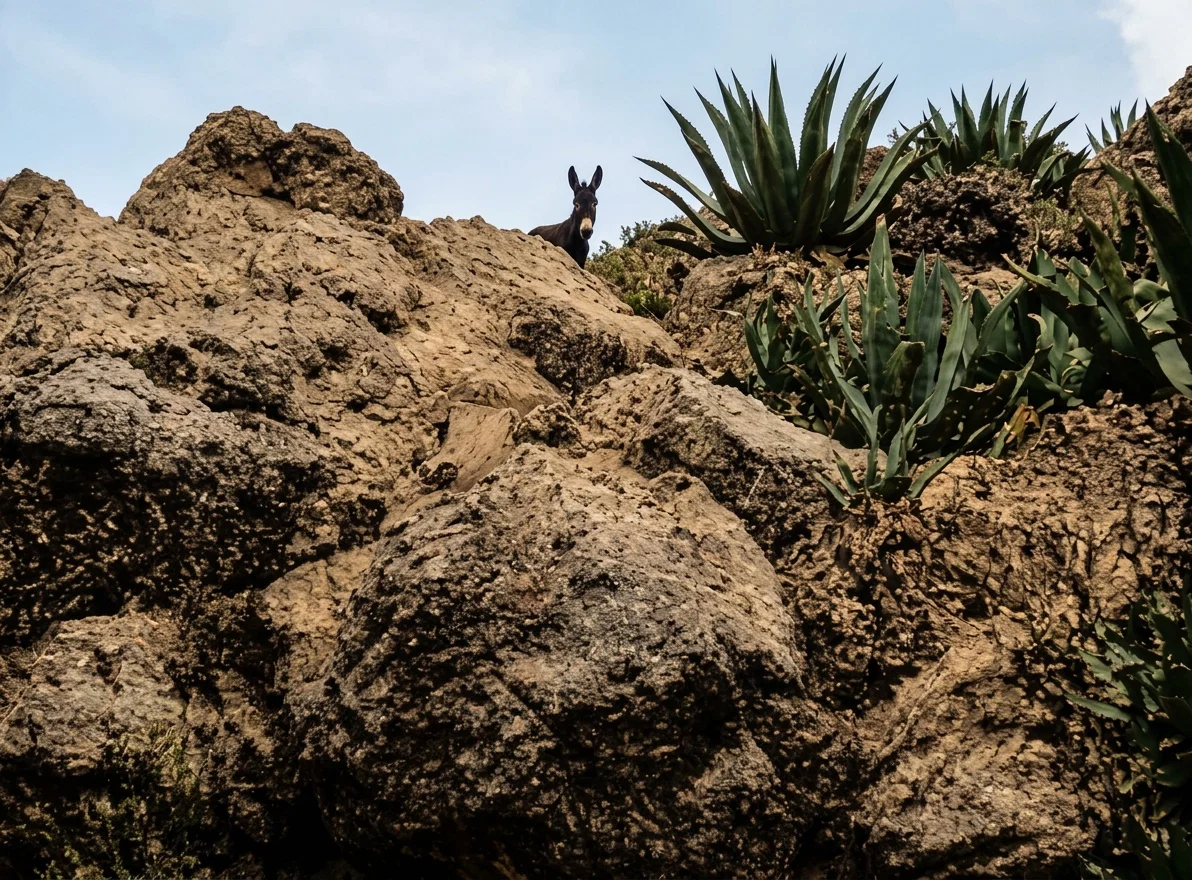
On either side were barren mountains, each successive one seemingly higher than the one before it, silent monuments of the majesty and power of their Maker. In places the ascent was so steep that a cog-wheel track was used. We passed a number of small stations; among them Punta Vacas (Point Cows), which we at once recognized by the cows in a triangular level patch of land in the mountains. At 1 P. M. we reached Puente Inca, the railway terminus. At this place the most of the passengers took refreshments in a hotel which constituted the place. There are a number of mineral springs of warm water here.
Without waiting for dinner, the baggage was at once loaded on to pack mules, and sent on ahead. In one hour the passengers proceeded on their journey in coaches, each drawn by four horses driven after the order of Jehu. In one hour we reached Las Cuevas. This station was composed of a number of mules driven into a corner, saddled and ready for the passengers. In fifteen minutes we were climbing a mountain, and in one and one-half hours we had again descended to the valley at La Cumbre at the foot of the mountain, the summit of which is the dividing line between Argentina and Chile, marked by a signboard with Argentina on the one side and Chile on the other. The grade is already made, and the train will soon run to La Cumbre within two or three miles of the Chilean border.
The ascent was very steep, indeed. It was a marvel how the mules would climb these mountains with their heavy loads. Two large, heavy trunks were carried by one mule. They were urged on, sometimes, as we descended on the other side, into a run. It was necessary to hold one's self in the saddle by holding to it with the hands. The mule I rode, a gray Palomito (little dove), seemed to be the slowest in the lot, and I had hard work to keep up. On ascending, one little girl took sick on account of the altitude. We soon passed the snow line. Our overcoats, which were a burden before, were a comfort now. With the altitude of 12,700 feet at the summit, and a good, strong wind blowing, the temperature was in marked contrast with that of the warm valley which we had left an hour or two before.
No sooner had we reached the summit, and the few Chileans in the party had cheered, “Viva Chile!” than we began the descent, which was much more steep and rough than the ascent. The skeletons of mules on the sides of the mountains indicated that they had made a fatal misstep. Once a lady slipped over the saddle horn, but held herself until she was helped back. As it was growing dark, the mules were urged on faster. The pack mules made many cross cuts where the passengers could not ride. A coach met us to take the ladies in the party the last hour's ride before reaching our stopping place. Nearly the whole distance that we went by mule back may be made by coach, but the coach road zigzags back and forth so that it makes it much farther. At 8:45 P. M. we reached El Juncal, a hotel on the way, where we were glad to rest for the night. Supper and lodging was only eight pesos, or about $2.60 in gold. At this place also the customs officers went through our luggage. The hotel, built against the mountains, with a beautiful, purling brook in front of it, was all there was to the place.
Many make this whole distance through the mountains on mules, which occupies five days. However, there are many dangers connected with it. The mountains are said to be infested with bandits, who are ready to hold up any lone traveler. I met a person in Mendoza who had crossed on foot. He was twice held up by robbers. Losing his way, he was without water until a large dog that he had with him died of thirst. His chapped lips and face still indicated the experience through which he had passed.
Along the way were great rocks, under whose projecting sides the travelers find a shelter for the night and from the elements. In some instances they were still asleep as we passed, or were cooking their meal on an open fire close by. Isa. 32:2 meant more to me than ever before,—“As the shadow of a great rock in a weary land.”
By six o'clock the next morning we were on our way again, for the first hour, by coach. A recent storm had washed out the way so that it was necessary to go on mule back one hour. After this, another hour by coach brought us to Salto Soldado, the end of the Chilean railway. Here we took the train, and, passing down the narrow valley with a beautiful, swift little stream by our side, and through two tunnels, one of which was curved, we reached Los Andes at 11:15 A. M., half an hour late. We were across the Andes, but not across the mountains. These are crossed only when one has reached the Pacific Ocean.
We transferred here to another road, and again at Llaillai, a little farther down. Passing down the valleys after a warm and dusty ride, we reached Valparaiso at 6 P. M., one hour late, glad to reach our destination, and to get a breath of the cool ocean breeze. As I came on a day when I was not expected, I found no one at the depot to meet me, but I soon found my way to the hospitable homes of Elders Ogden and Ketring, glad indeed to meet them in this distant land after their separation from us in Argentina four months before.
Buenos Ayres, Argentina.
General Notes
THIS is the hour for a far broader and more thorough missionary movement as related to the whole world and to the responsibility of the present generation, than has hitherto been known in the history of the church.
Missionary Linguistic Work in the Nineteenth Century
Within the present century more languages have been reduced to writing, more grammars, lexicons, and translations have been made into strange tongues by a handful of Christian missionaries, than by all the learned world besides.
Elder Reaser Reports Booth's Arrival at Cape Town
ELDER G. W. REASER writes from Cape Town: “Brother Booth and party arrived to-day [July 15]. We are glad to entertain them and provide for their accommodations in Natal while there. They will speak to our people here to-night, and probably several times in Natal.”
Buddhist Relics Carried from Siam to Japan
Not long ago certain relics, considered sacred and highly esteemed by the Buddhists, were brought from Siam to Japan with great ceremony, and on their arrival at Kyoto the whole road over which they were to be carried was covered with cotton cloth, twelve hundred pieces being used, costing about sixteen hundred dollars. This cloth was then supposed to be very sacred, and to have magical power, and after the procession had passed over it, was sold at a dollar a foot. The sum realized was something over sixty-eight thousand dollars.
Skull of Missionary James Chalmers Believed Found
WORD has just been received in London of the finding of a skull which is believed to be the skull of the late Mr. James Chalmers, who, it will be remembered, was killed and eaten by Papuan cannibals in New Guinea. Mr. Hunt, a missionary to New Guinea, found it, and carried it to Sydney. He also found the dispatch box of the veteran missionary, which contained his diary, written up to the eve of his massacre, also his will. Mr. Hunt thinks Mr. Chalmers and his companion met their horrible fate through arriving at a village, where, in consequence of the erection of some sacred building, a tribal cannibal feast was in contemplation.
Hawaii: Work and Conditions on Hilo Island
By C. E. Leland; Mrs. C. E. Leland
Hawaii
HILO.—We came to this island early in February, and found one family of three, and two sisters, members of the church, in need of much help. All are natives except one sister, who is so opposed by her husband that she or her children dare not attend our meetings.
We hold Sabbath meetings at the home of one of the native sisters, and canvass and hold Bible readings with the English-speaking people during the week.
It rains nearly every day, which interferes with our work materially; but the Lord has helped us to sell quite a number of books, and one excellent native lady, who has attended our meetings regularly, has accepted the truth. She is educated in English, and is quite a help to us in interpreting to the natives.
The island is devoted almost wholly to sugar plantations, the work on them being done by Portuguese and Japanese. Many of the Portuguese have large families, and seem willing to read and learn, but a laborer who could speak their language could do a good work by canvassing and holding Bible readings among them.
The climate is good, nights cool, with refreshing rains, and breezes from the ocean. The soil is not so fertile as on some islands of the group, although many fruits and vegetables are raised. Everything is high. Butter is from fifty cents to eighty cents a pound; milk, ten cents a quart; Irish potatoes, four cents a pound; eggs, forty cents a dozen; graham flour and corn meal, five cents a pound. All flour and feedstuffs are shipped from the coast, also dried and canned fruits.
The plantations are on the coast, the center of the island being mostly lava flow or ragged rocks. Owing to the prevailing rains, it is quite hard to get to these plantations without a covered conveyance in which to carry our books and periodicals.
We have the promise of a lot in Hilo for a church building, providing one can be built and dedicated free of debt. If we had such a building in which a school could be held, much good would result, as some of the white people are asking for a private school, and are willing to help support one.
We hope to be remembered by the brethren and sisters in the States, that the blessing and guiding hand of the Lord may ever be with us in our work.
We are all enjoying good health, and are of good courage in the Lord, and in his strength we go forth to win souls for the kingdom.
C. E. Leland,
Mrs. C. E. Leland.
South Africa
By D. F. Tarr
EAST LONDON.—For more than a year Mrs. Tarr and I have been seeking to bring the truth for this last generation before the people by canvassing, Bible work, and visiting. And since October, Sister M. E. Robertson has been ably assisting us in the work. By this means honest souls have been found. Some of these have decided to walk in the light, while others are deeply interested, and are searching the Scriptures to see if these things are so.
One afternoon we walked down to a retired spot near the mouth of the Nahoon River. There, surrounded by the grand hills, the green meadows, with the blue sky above and the placid waters at our feet, our hearts went out to the Creator, who has given commandment concerning the object for which we were at that time assembled, and who has set us the example by going into the water to be baptized.
The Lord drew graciously near as we listened to an impressive sermon by Elder Edmed, setting forth the privilege of those who follow their Master in this rite to receive the baptism of the Holy Spirit, which will enable them to pass through fiery trials with joy. At the close of the discourse, six souls were buried with their Lord in baptism. One sister, as she arose from the watery grave, was healed of physical infirmity by the power of the resurrection life. She now rejoices in the healing and keeping power of God.
On Sabbath also the Holy Spirit was manifestly near as the ordinances of the Lord’s house were celebrated, and the little company organized into a church. We praise the Lord for what he has wrought, and go forward with rejoicing that it is our privilege to be co-laborers with the Master in bringing salvation to our fellow creatures.
D. F. TARR.
Porto Rico
By A. M. Fischer
MAYAGUEZ.—God is blessing me in my labor. The children enjoy their school work. Four others have asked for admittance. It is true that the work looks as if it were only with the children, but I am visiting, and shall try to sell our books. I am putting forth every effort for the advancement of the message here. I have no other desire than to see the work hasten and souls brought to Christ.
This past week has been a good one to me. Friday I closed the school with a Bible talk and an illustration on the blackboard of our rebellious hearts. When I asked how many wanted King Jesus to reign within, twenty-seven hands were lifted. If the school continues to prosper after the others open, I presume we shall need better seating capacity.
My Spanish teacher seems much interested. He said, “I saw your church to-day, or where you worship.” “No,” I said, “you did not see my church; for we have none here.” “Why, it was the Protestant church, and you are a Protestant, aren’t you?” “Yes, I am a Protestant in every sense of the word;” and then I told him why it was not my church, and the difference between us and other churches. Text after text came to me, the Spirit of God gave me much freedom; and as I laid open to him the wonderful plan of salvation, he seemed amazed. The Spirit of God brought conviction to him. He questioned me upon baptism—I had not mentioned it—and upon the state of the dead, and when the Sabbath question came up, he said, “Believe me, Mrs. Fischer, I think you are right.” He also inquired where we held services and preached on these subjects. There are others standing right where he is. It is the same question, “Why haven’t you a preacher who can tell us these truths in our own language14?” He is reading now, and I have promised to hold Bible studies with him. If we only had a Spanish worker who could hold services!
MRS. A. M. FISCHER.
Jesus Died for Me
I LOVE to sing of that great power
That made the earth and sea;
But better still I love the song
Of “Jesus died for me.”
I love to sing of shrub and flower,
Of field, and plant, and tree;
My sweetest note forever is
That “Jesus died for me.”
I love to think of angels’ songs,
From sin and sorrow free;
But can the angels strike their notes
To “Jesus died for me”?
And when I reach that happy place,
From all temptation free,
I’ll tune my ever-rapturous notes
With “Jesus died for me.”
—Selected.
Central America
By H. C. Goodrich
BELIZE, BRITISH HONDURAS.—The Lord is blessing our work here by bringing precious souls to himself. Since our mission has been opened, four adults have taken their stand with us, besides several who are just deciding. The interest is increasing, and many more are asking to know what is truth. I called on one family who had not as yet attended the meetings, and one of the first questions asked was, Can we have a Bible study? I appointed one for the following evening, and found ten adults gathered to hear about the second coming of Christ. They seemed much interested, and last night some of them were out to meeting. The Lord is giving us favor with them, and we are praying that he will give us wisdom to use these opportunities so that we may meet some of these people in the kingdom of God. H. C. GOODRICH.
A. H. PIPER
By A. H. Piper
Raratonga
ARORANGI.—We opened our boarding school on Monday. The attendance at present is not what we expected, but this is owing to the fact that the children have not the proper clothing. However, they are to pay at the rate of ten shillings a year, bring their own food (uncooked), and pay also for necessary books, etc. I plan to have all the running expenses of the school, with the exception of Sister Gooding's salary, met by the receipts. The receipts will also help to pay the wages of a married couple, who will live on the place, and cook most of the food for the children, and make themselves useful in the general work.
We thought it best to put up a school building, and all the material is on the ground. The best thing about the school so far is that it is making friends for us. Doors are open to us in every village.
A. H. PIPER
Australia: Victoria Church Growth and Faithful Witness
By W. A. Hennig
Australia
VICTORIA.—Since coming to Australia, we have had many experiences that have led us to depend more fully upon God than we have in the past. The work is being retarded financially in some parts of the country by the prolonged drought, but in many respects we see much to encourage us. The Lord has blessed us in the work, and given us the privilege of seeing many precious souls accept the truth. After a series of meetings in one of the large suburbs of Melbourne, a church of thirty-seven members was organized, a large per cent of whom had never been connected with our people in any way. The church has not been organized more than three months, but its tithe has been about two hundred and fifty dollars.
In one of the western villages of this conference lived a sister with her parents, who were members of the Church of England. After many trials with an unfaithful husband, she went to her old home, expecting to remain in this world only a short time. Consumption was doing its certain work, but she was not afraid to die; for she had learned the meaning of the third angel’s message. Her burden was to get her people to see the truth, and accept it. When the time came that she thought it impossible for her to live many days, she requested the privilege of partaking of the Lord’s supper before the end should come. That was a precious season; for God came very near to the sick woman and to the whole family. Some meetings were held during the three days that we remained. Shortly after the sick woman was laid to rest, we had the privilege of baptizing her mother, one sister, and two brothers. Now another brother and his wife request baptism. There are many places where the people are calling for the truth, but there are so few to carry it to them.
This has been a good year financially to this conference. The running expenses have been paid, and hundreds of dollars of the debt wiped out. We appreciate the offerings that have been made by the brethren in America. We believe that God will bless every effort that is put forth to free the cause from debt, and the brethren here feel willing to do all they can. There has been a good increase in the tithe every quarter since we have been here, and we hope for the time when all who profess to love the Lord in this message will give to him his own in tithes and offerings. We are of good courage in the work.
W. A. Hennig.
Handley (Texas) Camp Meeting
By S. H. Lane
The time of this meeting was July 24 to August 3. Handley is a small village six miles from Ft. Worth, on the Texas and Pacific Railroad. An electric railroad connecting Ft. Worth and Dallas passes through Handley. The meeting was held in a beautiful grove belonging to the Electric Railroad Company. This company furnished the grove, lighting the same, also hauling all the camp equipage to and from Ft. Worth and Dallas. The grounds were supplied with water, and pasture was furnished free of charge for all the horses belonging to the campers, and round-trip tickets from Ft. Worth to Handley were sold for fifteen cents. On account of the liberality of the Electric Company, hundreds from these two cities attended the meeting. Many came in from the country, so the attendance of those not of our faith was large. There were one hundred and twenty family tents, occupied by fully seven hundred campers.
Texas has suffered seriously this season by a severe drought, which caused the wheat and corn crop to be almost complete failures. The drought continued up to within one week of the camp meeting, when copious rains fell in nearly every portion of the State. Cloud-bursts and floods became numerous, the rain continuing during the first week of the meeting. The incessant rains put the roads in an almost impassable condition for loaded teams, which prevented some from attending the meeting, and delayed others. The cotton, being to some extent a dry-weather plant, was not materially injured by the drought; and since rain has come, the crop promises to be an abundant one, the largest in years. Our brethren are of good cheer, and are in earnest to spread the truth by the sale of our literature; and the prospects for more canvassers in the field are excellent.
From the first, the meetings were good. We kept the special truths for these times before the people, and at the close of each evening meeting sold packages of our tracts; and as the people purchased them freely, it seemed much as it did years ago. The revival efforts were successful, and at times it seemed as if we were receiving a shower of the latter rain. Quite a number made a start in the Christian life for the first time. At the close of the meeting thirty willing souls were buried with the Lord in baptism.
The business meetings of the conference passed off harmoniously. Elder W. A. McCutchen was re-elected president of the conference. The laborers present from outside of the conference were Elders Rupert, Haffner, and Fields, and the writer. The educational work was presented ably by Professors Covert and Kunze and Sister Williams, and the sanitarium work was represented by Dr. Haskell, who now takes charge of the Keene Sanitarium.
Two were ordained to the gospel ministry. The occasion was a solemn one, witnessed by hundreds. There was an increase of three who received ministerial licenses. Eight hundred dollars was raised for home work and the Missionary Acre Fund, and Brother J. F. Bahler donated enough to purchase a new fifty-foot tent for the conference.
When the final meeting came, and the partings were said, all returned home feeling that the camp meeting of 1902 was a success on account of the blessing of the Lord which attended each service.
S. H. Lane.
Eastern Tennessee
By Wm. Lenker
Our work for the blessed Master is onward in this part of the State. Surely the angels of God go before us, and prepare the hearts of the people for the printed page. What a blessed privilege for poor mortals to have a part in carrying the glorious truth to those who are in midnight darkness!
This is Brother W. D. King’s first experience in canvassing; his success has been such as to be an encouragement to both of us. His orders have averaged about forty dollars a week, which is nearly one dollar for every hour that he has worked; and my orders have amounted to nearly one third more than his. This I consider good in this territory; for the last two years crops have been a failure, and this year they are not promising.
There is a large territory in this part of the State that has never been entered with the printed page, and its people are sadly in need of light and instruction on all the principles of present truth, especially those of health reform; for in this they are surely behind the people of Oriental heathendom. Their pale, sallow countenances plainly show the alarming extent to which they indulge in the use of drugs, narcotics, and stimulants.
Brother King and I will leave this field about the first of November. Are there not a number with whom the Spirit of God has striven time and again15to engage in the work? Do you hear him gently urging you? If so, delay no longer, but hasten to the front. The work will be hard; but the rich blessings in gathering the golden grain are correspondingly great.
If two brethren who have had little or no experience in canvassing for our literature will join us about the first of September, we will help them to get started in the work, and will give them some practical lessons in the field, so that by the time we leave this place, they will be able to go on with the work which we have begun.
The canvassers’ report from week to week shows few in this great South engaged in the work, and a portion of these putting in only a part of the time. This ought not so to be, and it is enough to stir every soul to zeal and activity, so that there shall be a pressing in from every church until the thinned ranks are filled to overflowing. What does it signify to us when we read in the REVIEW AND HERALD that of late many who are not of our faith are making application to sell the printed page of present truth? Is the Lord becoming weary of our tardiness? Is he beginning to call others to do the work which he has so long intrusted to us? Do not, brother, do not, sister, delay to enter the field. There is danger in delay. It is so good to work for Jesus! I know it by years of active service. I believe that it is possible for us to make the canvassers’ report show thousands of dollars of orders each week where it now shows only hundreds of dollars.
God requires of us to do all that it is possible for us to do, and it is no distant day when “the earth shall be full of the knowledge of the Lord, as the waters cover the sea.” In that glad time of harvest, if we have rusted from inactivity, shall we hear these good words said of us, “Who is she that looketh forth as the morning, fair as the moon, clear as the sun, and terrible as an army with banners?” WM. LENKER.
Washington, D. C.
By Lewis C. Sheafe; F. H. Seeney
Meetings began June 1, at the corner of Sixteenth and R Streets. The prospects were not very bright, and many obstacles were in the way; but all have been surmounted, an interest that reaches all parts of the city has been created and sustained. After the first week, the congregation has at no time been less than one hundred, and has often been fifteen hundred. We have seats for seven hundred. There are people standing every night. Thirty have signed the covenant, and eighteen have united with the church. Nine were baptized August 9. Others are waiting for baptism.
The congregations continue large, and are composed of people of different races. The message has a hold on them. We have been assisted in our efforts by a number of brethren and sisters. The people are aroused. They are reading, and are asking questions of us and of their ministers. Pray that the good work may go on.
Lewis C. Sheafe, F. H. Seeney.
Wahroonga Sanitarium and Sydney Vegetarian Café Progress
SYDNEY.—The main building of the Wahroonga Sanitarium is nearly completed on the outside. The finishings are now being put on. The treatment rooms are also well under way. We are pushing the work as fast as possible, and hope to be able to open up some time in September. Several months ago we opened a vegetarian café in Sydney. We had only five small tables. As we were much cramped for means and experienced help, we thought to start in a modest way, so as not to involve ourselves in debt. Since then the work has grown so rapidly that it has been necessary to enlarge our quarters. We are now serving over two hundred of the best people of Sydney daily.
Everything looks much more encouraging in the medical work than it did a year ago. Our little paper, the Australian Good Health, is having an excellent circulation. The small institution at Cooranbong, called the Health Retreat, is kept filled with patients. The Drs. Kress are doing good work in training for the new sanitarium.
Little Rock (Arkansas) Camp Meeting
By S. H. Lane
THIS meeting was held at the capital of the State. During a portion of May and June a tent meeting was held in the city, which was fairly well attended, and resulted in several accepting the truth, and a number becoming interested. Just before the date of the camp meeting, the tent was moved out of the city into a suburb, and a new interest created. The tent meetings were conducted by Elder Parmele, Brother Watts, and a Bible worker. In the suburb the tent was located near a grove by the side of a spring of clear, soft water. The same grove was secured for the camp meeting.
The camp meeting began July 10, and continued ten days. The attendance by our people was small, but good considering the few who live in the central part of the State. The attendance from outside was large in the evenings, and the people were interested. The street cars brought many to our meetings, who were benefited.
Among those who attended not only the evening meetings, but also the day meetings, was a gentleman and his wife, who, one year ago this summer, were patients at the Sanitarium. The writer happened to become partially acquainted with them there. They can scarcely say enough in public or in private in favor of the Sanitarium and the principles of health reform. Both now enjoy the best of health. At the close of the camp meeting, nothing would satisfy them only to take me to their own fine home, and for two days he spent his time in driving to all parts of Little Rock, and to points of especial interest near the city, driving to the tent each night, as the brethren desired me to speak to the people for the two nights I was there before I proceeded to the Texas camp meeting. As I visited with this family, I thanked the Lord that we have a noble institution that can and does make friends in all classes of society, especially among the more educated and wealthy.
Brother Green and his wife, and Dr. A. W. George and his wife, graduates of the Battle Creek Sanitarium, have started a sanitarium at Little Rock, which has seemingly been a success medically and financially. They have paid for all their house furnishings, rent, and many repairs, and are not in debt. They have many stanch friends and supporters among the better and wealthy class. Their work and patronage are increasing. To do what they have accomplished they have drawn no wages from the institution.
The revival effort at the camp meeting was heartily responded to by the people. Some reconsecrated themselves to the Master's work, and some started in the Christian life for the first time. At the close of the meeting nine were baptized. The Arkansas Conference held its annual session in connection with the meeting. All its meetings passed off pleasantly. Elder A. E. Field was re-elected president of the conference, which is free from debt, and has an increasing tithe. The tract society is encumbered by a large debt, but the brethren are of good courage, and are selling books, being determined to put forth more earnest efforts in the immediate future to dispose of more than ever before.
The ministers present from outside of the conference were Elders G. G. Rupert and G. F. Haffner and the writer. Brother Dixon, of the Kansas Conference, was present, and labored for the canvassing work in general, and the sale of “Christ's Object Lessons” in particular. When the final partings came, the brethren and sisters returned to their homes fully determined to do more the coming year for the advancement of the third angel's message in their State than they had ever done in one year. S. H. LANE.