THE true, plain path to success is well-doing,—not brilliant doing, but well-doing,—doing the work of life with a willing mind, a loving heart, with both hands, earnestly,—with diligence in getting good, being good, doing good. In this world all the grand prizes go to a few brilliant people. . . . But what a blessing it is to us, the dim million, to know that God recognizes patient merit, and that the grandest prizes of all are not kept for the brilliant, but for the faithful. Let us be content with our place and work, however coarse and common. . . . Let us feed our souls with high beliefs and hopes; let us talk to ourselves all the day long about glory, honor, immortality, eternal life; so shall our path of life, however lonely, be a royal pathway, brighter and brighter to a perfect day.—Selected.
First General Meeting in West Africa
By D. C. Babcock
D. C. BABCOCK
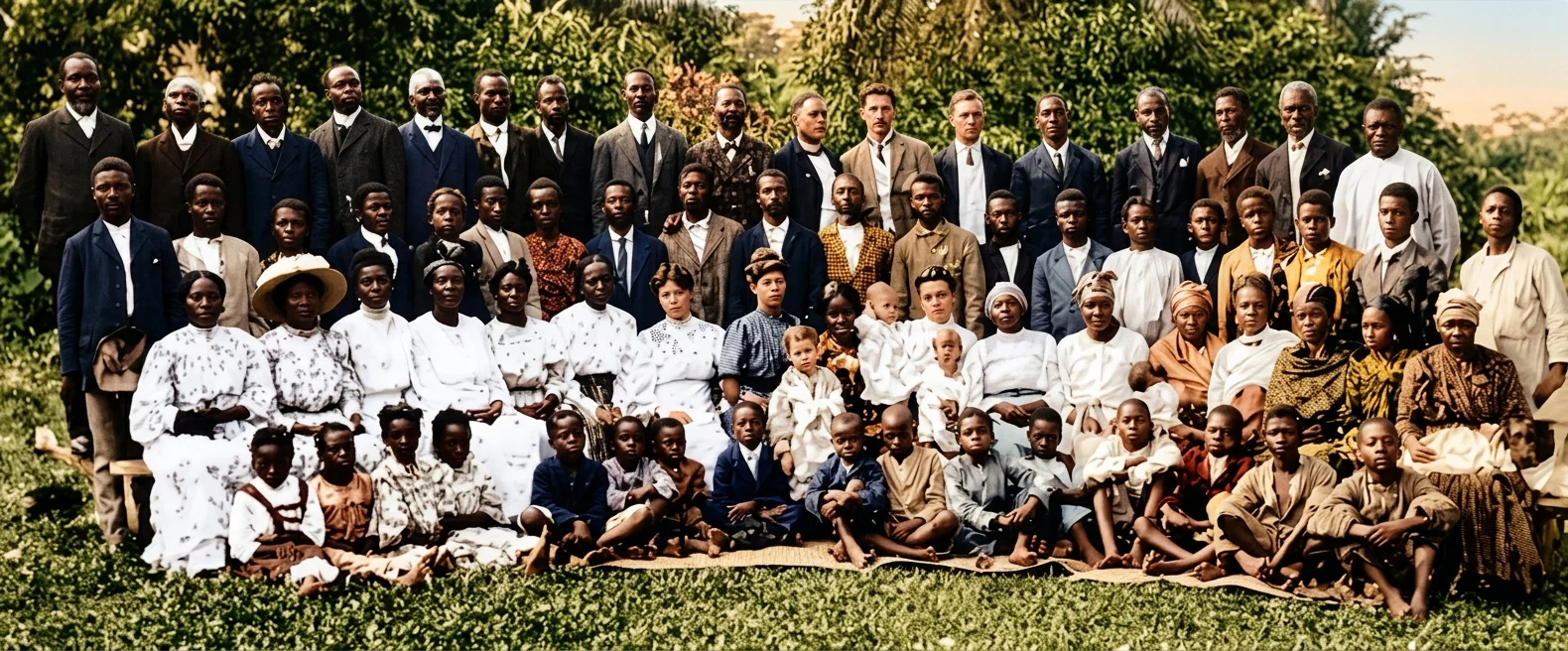
The memory of the last Sabbath of the first general meeting held by the workers of West Africa will probably never be erased from the minds of those present. The good Sabbath-school lesson prepared our hearts for the service following. The writer spoke a short time, dwelling upon what is expected of this people in the closing hours of the message,—how we must be separated from sin, separate from the customs and habits of the world,—and clothed in the clean, white garments of Christ's righteousness. Before a testimony was borne, opportunity was given for those who desired to consecrate all to God, to express this desire by rising. Almost the entire congregation immediately arose.
BELIEVERS ATTENDING WEST AFRICAN GENERAL MEETING
The general expression of the testimonies borne was that God had saved them that they might hear this last message. The review of life was not general, but specific. Many remarkable incidents were related; and as God's care was recounted, all centered on the thought of gratitude for an opportunity to hear this precious message. “That is why God spared me,” was the testimony of many.
Two incidents I must mention. One went back as far as 1898, when the speaker was a small boy (he is now only about eighteen). In that year occurred an awful massacre by the natives, when many thousands were brutally murdered. This young man told of their narrow escape through the thick jungles, with the enemy close behind, and, when they reached the river, where they would surely be overtaken, there was a boat ready for them to escape. He now saw why he had been spared. “God wanted me to have this message,” he said, “that I might carry it to others.”
Another young man related a narrow escape from death when his bicycle became unmanageable, and leaped over a wide trench several feet deep. He said, “I would be afraid not to give my heart to God, when I remember his wonderful care over me.”
The courage of our workers in West Africa is good; and hope is expressed by all. But we face millions to warn. The Macedonian cry comes from many places. Brother Hayford recently wrote me of a remarkable incident of a heathen and his wife, who, not long ago, came some distance to receive needed treatment. The effort had the desired effect; not only did the poor man receive strength in his feeble body, but he gladly received the word of life as well. He returned to his native village, sent home all his wives but one, and began to keep the Sabbath, teaching others of the true God. Now other villages around him are much interested.
A little more than one year ago, I was aboard a steamer coming up the coast, and saw five men on their way to prison for cannibalism. I took occasion each day to talk with them of a better life. They asked me for a paper telling who I was. When released from prison, they came at once to hunt me up, and to plead that our work might be opened among them.
Many similar incidents might be mentioned. Shall we press into the wide-open fields?
Freetown, Sierra Leone.
School Work in Mission Fields
By J. N. Anderson
J. N. ANDERSON
FOR a long time I have seen the need of school work in our foreign fields. The great importance, in fact, the absolute necessity, of this kind of missionary activity has come to be more apparent to me with the passing of time. I am now fully convinced that the future of our work in such fields as China depends more on the work of the school, in preparing young men and women as helpers, than on any other one line of missionary effort. Some of my reasons for coming to this conclusion I will herewith set forth:—
1. History witnesses to the fact that every religious movement has had its living voice, not only in its beginning, but all through its history. Not only must this voice be maintained, but it must be multiplied manyfold. I know of no way of effecting this end without the school.
2. In China there is always the possibility of the foreign missionary being compelled to leave the field. He must then commit to “faithful men, who shall be able to teach others also,” the truth he himself holds dear. The present political situation in China is such at this very moment that many thoughtful minds entertain fears that a serious uprising is just ahead. In such an upheaval there is nothing that is so easily removed as the foreigner.
3. In a land like China, where the language, customs, and manners of the people, and their highly organized and very complex civilization, differ so radically from our own, it must be seen that the foreigner is at a great disadvantage in many ways. However well he may acquire the language, however heartily he may enter into the spirit and ways of the people, he will nevertheless always be a foreigner. And as a foreigner, he will never fully meet the Chinese people. His influence, if it is to be permanent, his work, if it is to stand, must be intrusted to a class of men and women whom he has carefully trained, and inspired with his own hopes.
4. But, granting that the foreigner could enter fully into the national feelings of the people, and to all intents become one of them, and that he could become a permanent factor in the life of the nation, yet the fact would remain that he would in any case be supplanted, sooner or later, by the Chinese church. The spirit of independence which is sweeping over that empire will influence men in every walk in life; and the foreigner is unwise if he does not now plan with that in mind. He now has the opportunity of training men, who will supplant him more nearly according to his own ideas. In this I am not advising that we get ready to turn the missionary work of that great field over to the Chinese, and so withdraw the foreigner; but I do say that we should be prepared to commit our mission interests into the hands of the Chinese believers, if that time comes, in such a way that the cause will be safeguarded.
5. On general principles any cause needs well-informed and intelligent advocates. How often we see even a worthy cause weakened because its representatives are unqualified to speak in its behalf! Is our message worthy? Is it to take deep root, and abide all the storms that are sure to beat against it in the land of Sinim very soon in the future? Is there to be, under the blessing of God, a strong spiritual church, holding up the banner of the advent message? To these very pertinent questions we all say: “It must be so; the message is of God, and hence it must go forward, and do its work in that mighty empire.”13But as certain as it is that the message is of God, and that it will conquer, so certain it is that there must be efficient means employed in the accomplishing of this end.
6. It is not only in the matter of preparing workers that the school is an essential; it stands for the unification, the solidification, of all the work. It is in close and vital touch with all parts of the field, since its students are gathered from various places in the field. In this way the life, the power, of the school extends to all the work. And in such a land as China, where letters and literature are held in almost idolatrous honor, the power and influence of the school must be even more than in other lands. In this way the school becomes a positive factor in gathering converts as well as in training them to be its advocates. To the Chinese the school is the fountainhead of all knowledge, all religion, all government. All the history of China in the past gathers about the school. Does not this very fact give us a splendid door of entrance to the Chinese kingdom?
Takoma Park, D. C.
Babumohal, India
By W. A. Barlow
W. A. BARLOW
We returned from England last December, and have been blessed in seeing some precious souls take their stand for the truth among the Santals. Four young Santals were baptized by our dear Brother J. C. Little, who since has fallen asleep while on duty in his Master's service.
SANTALS BUILDING CATTLE-SHEDS ON BABUMOHAL MISSION
We have been busy translating from “Bible Readings,” and hope to have a Santal “Bible Readings” ready for the press before long, also a revised edition of our Santali hymn-book, in Roman characters. Brother Little printed our first hymn-book in the Bengali characters, but we need one in Roman characters. We have already translated into Santali the pamphlet on health subjects, written by Brother L. J. Burgess. This is greatly needed. July 30, Elder W. W. Miller paid us a visit, and organized the Santali church at Babumohal. Last January we organized a Sabbath-school, and God's blessing has rested upon it. We have a Santali superintendent.
Brother and Sister R. A. Leech are studying the language, and hope soon to be able to speak and take part in the Santali general work. The medical work is their special department. The new dispensary is about ready for use.
The French in the States and Canada
By G. G. Roth
G. G. ROTH
As our people have been informed, I have responded to a call from the General Conference Committee to come to the States to take charge of the French work in North America.
After counseling with the leading brethren, it was decided that it would be best for me to begin in the East, where we find many large, cosmopolitan cities, as New York, Boston, Providence, Worcester, etc., with thousands upon thousands of French-speaking people.
BAMBOO WORKERS
Arriving in August, I began my work with a tent effort in Woonsocket, R. I., a city of thirty thousand inhabitants, of whom twelve thousand are French. Here we have a French church, which needed some help. As the season was advanced, and we had no time to lose in searching, the location of the tent was not the best. The Irish people made us much trouble, especially as they could not understand the preaching. We had, during our five weeks' stay, some very good meetings. The Woonsocket church was reorganized, two new members were added, and some others are really interested in the truth.
In October, receiving a special call from Montreal, Canada, I visited that city. Of the one-half million inhabitants, three fourths are French. A few French families are interested in the truth. We should have there a French worker to unite in labor with Elder O. K. Butler, the English worker.
Last week I visited Lowell, Mass. One fourth of the inhabitants here are French. I gave several lectures in the homes of different families, and preached Sunday in one of the churches. I received an invitation to come again. The doors in Lowell are opened, and now is just the time for us to work there.
I have received calls from Worcester, Boston, Fall River, Manchester, and other places, and I shall visit these cities as early as possible.
We should have at once a dozen French workers to respond to these urgent calls, but we do not have them. Money is necessary to bring them from France and Switzerland, and sustain them in the field after reaching here.
If some reader feels a special burden for the French work, and would like to help with his means, the treasurer of the General Conference, W. T. Knox, Takoma Park, Washington, D. C., will be glad to receive any gift you wish to send.
Let us all pray for the long-neglected French work in North America. Our prayers, coupled with our gifts and consecration of life, will result in the salvation of many souls.
Grand Cayman
By Perry Alley
PERRY ALLEY
Once more we are called upon to witness to God's love and mercy — this time in keeping us through the destructive cyclone that swept over our little island, October 12, 13, uprooting trees, unroofing buildings, destroying the fruit crop, and carrying general ruin in its wake. All the plantations were destroyed. The sea became boisterous, filling streets at Georgetown with rocks and débris. Three tidal waves swept from Savannah to Newlands, driving several ships upon the rocks. Many along the shore had to leave their homes during the cyclone, because of the enormous seas and the rocking of their houses.
No lives have been lost here, but our hearts tremble for our loved ones away on the water. While some were filled with fear, others mocked, and with cursing and swearing wished for an earthquake to finish the destruction, saying that they will plant no more. But this is no time to manifest a defiant spirit against God, who has been so merciful to us.
What is the remedy for this attitude of discouragement and defiance?—The giving of the solemn truths for this time. The people of Grand Cayman need Jesus to dispel the darkness in their hearts. Our situation is deplorable. This is a hard place; but shall that keep us from doing the work? I believe this is the time to warn Grand Cayman of the impending judgment, with an earnest appeal to seek God's forgiveness.
Editorial
By Editor
The first published call to a missionary campaign with our literature ought surely to interest our readers.
Now, when a notice goes out “to the brethren and sisters,” it must go to many thousands, and ere it reaches all, must be given in many tongues. And we have many papers now by which to give the trumpet the certain sound.
It was not so in the early years. Within the time of active service of some still working among us, this whole cause has grown into strength, and spread abroad through the world. And with all our numbers and all the multiplied agencies, we need to remember that our individual responsibility to study God’s Word, and to work and pray for the salvation of others, is just as great as that which pressed upon each believer in those early days.
Our publishers often send out notices to the believers regarding periodicals and plans. Just here read our first publisher’s announcement, in the first paper, the Present Truth, of July, 1849. We can fancy with what eagerness the brethren responded. There are more of us now; but the field of operation has become much greater, and the times much more critical, since this first publisher’s announcement issued the call:—
Dear Brethren and Sisters: I hope this little sheet will afford you comfort and strength. Love and duty have compelled me to send it to you. I know you must be rooted and built up in the present truth, or you will not be able to stand “in the battle in the day of the Lord.” Eze. 13:5.
The time has come when we must be whole-hearted in the truth. Everything is to be shaken that can be; therefore those whose feet are not planted on the rock will be shaken all to pieces. Those only will be able to stand in the day of slaughter, who shall be found keeping the commandments of God and the faith of Jesus. It is no small thing to be a Christian. We must be pure in life and conversation here in time, if we would enter the Holy City.
The keeping of the fourth commandment is all-important present truth; but this alone will not save any one. We must keep all ten of the commandments, and strictly follow all the directions of the New Testament, and have living, active faith in Jesus. Those who would be found ready to enter the saints’ rest, at the appearing of Christ, must live wholly, wholly, for Jesus now.
This little sheet is free for all. Those who are interested in Present Truth, and esteem it a privilege, are invited to help pay the expense. I would publish in pamphlet form, but it would be a number of weeks before I could get out a pamphlet containing all I wish to write. I shall send out one thousand copies of this sheet; then arrange the matter of this and the following numbers, and have one thousand more of each number printed, to stitch together in pamphlet form, to distribute as they are called for.
Will some brother or sister in each place where this sheet is received, send me in plain writing the names and post-office address of all who are seeking present truth? Write soon. My post-office address is Middletown, Conn. In hope, James White.
The responses came in, and from one and another believer money came; and the little paper was scattered about in New England, New York, and on to Michigan. Then, after a year and four months, the REVIEW was established. And the call to sow the seeds of truth by the printed page still finds response in believing hearts.
The World's Christian Citizenship Conference
By C. M. S.
IN the report of a conference covering such a scope as did this, and packed so full of addresses and resolutions, it is impossible to touch more than a few of what seem to us the most striking features.
One of the most inexcusable of the many illogical deductions noted at this conference was that conveyed in the first address of Rev. T. P. Stevenson, on “The Moral Accountability of Nations,” in which, after declaring that “the nation needs a revelation from God,” he said:—
It [the Bible] is the sacred Book of the nation as well as of the church, the sacred Book of mankind; and there is no power that can lawfully interpose between the child that is being trained for citizenship and the voice of God, speaking in his holy Word.
The deduction is that if the state does not teach the Bible, it is interposing between the child and “the voice of God, speaking in his holy Word.” As a matter of fact, the very opposite is true. The state prevents any interposing between the child and the voice of God when it refuses to make religion a matter of law, and leaves the teaching of the Word of God to the Sabbath-school, and the home. Were the state to interpret scripture, and enforce its interpretation with the powers at its command, and teach the official dogmas through the public-school teachers, then there would be in very truth a power interposed between the child and the voice of God.
In the address of Rev. O. P. Gifford, of Boston, Mass., there was carried out the truly National Reform idea that men can not form true Christian characters unless their surroundings are favorable. This was the idea of the ancient ascetics, who left the habitations of men, and shut themselves up in caves and cloisters that they might have an opportunity to develop a Christian character. Christ sent not his disciples into convents or monasteries, but into the surging, throbbing channels of life's activities. Said Dr. Gifford:—
It is difficult for a man to live a personally religious life in an irreligious nation. It was difficult for our ancestors of the Roman empire to develop personal religion. Personal religion is directly dependent upon the life of the nation.
The fact of the matter is that the very highest type of personal religion has been developed under the most forbidding circumstances. In the midst of life's hurries and perplexities and even persecutions, the most stalwart Christian characters have been formed. The man who has truly a personal religion will be true to God in spite of all that human beings and demons can do. It is he whose religion is of the hot-house variety who quails under difficulties and opposition. Enoch, Moses, Abraham, Isaiah, Jeremiah, Daniel, and our Lord all developed their religious characters in irreligious nations. It was when the Roman government professed Christianity that the Dark Ages began; and wherever governments have espoused religion, character has molded into decay, and the religion of the mass has been a festering disgrace. He who can sail only with favoring winds will never anchor in the port of heaven.
In this address also was emphasized the untrue premise that if the state does not teach morality, the child can not be expected to distinguish between right and wrong. For what, then, stands the “Rev.” and the theological degree? What have the church and the home been doing if the youthful criminal goes to the jail and the gallows unwarned as to what is evil?
Dr. Gifford unintentionally spiked one of the guns of the National Reform propaganda when he declared that “the Lord's day is a day of rest because it is a day of worship.” It has been the effort of the National Reform Association to convince legislators that all they desired was a “civil rest day.” Certainly we15can not be charged with unfairness in declaring the “civil rest day” proposition an insincere one, when such men as Dr. Gifford and Dr. Crafts openly declare the religious character of the day.
In an address by Rev. Chas. E. Parker, a missionary from India, there was clearly taught one of the principles for which we have all along contended; that is, that Christianity thrives best when left completely to itself by the government. Dr. Parker said:—
We [in India] can not advise a change in the matter of the government favoring one religion above another. It helps the Christian missionary when he goes out to preach the gospel to the people if they can look to him as one who is advancing the real idea of Christianity, separate from the government. If the government were to favor the Christian religion above other religions, in the minds of Hindu and Mohammedan it would destroy the divine element in Christianity. It is a real help to the missionary on the field to be able to say that the government does not help us.
The conclusion of the Hindu and Mohammedan is correct if Christianity is dependent upon the help of human government in order to succeed in the world. Dr. Parker touched the most vulnerable and vital spot in the National Reform armor when he made that truthful observation. That Christianity has succeeded in spite of all that the most tyrannical governments could do, is proof positive that its actuating power is not human, and that it does not need governmental assistance.
Upon the matter of Sunday observance he made this observation:—
We feel that the sabbath day is not observed as it should be. This can not be really a matter for the government. It is more a matter for the individual, because the government, as a government, must remain neutral on matters of religion. . . . The British officials in India do what they do, or what they think is best, not because of religion, but because of justice.
And that is the true basis of human government. Religion must rest on its own worth, or its own power to appeal to hearts, or it has no business in this world.
Rev. James F. Dickey, of Berlin, Germany, spoke upon “The German Government and Christianity.” He lauded the union of church and state, and declared it founded on the rock of Scripture, “which recognizes Jesus Christ as the Prince of the kings of the earth, and calls on earth's rulers to be defenders and protectors of the church of the living God.” That papistical idea that the church must be defended and protected, and its interest advanced by secular means, is dominant, and doing its character-destroying work wherever religion is looked upon as a matter that can be regulated by human law. The inconsistency of the situation was admitted even by the speaker when he stated that in a portion of Germany a Roman Catholic ruler had to act as head of the Protestant churches of that district.
The aims of the conference will be treated in another article. C. M. S.
Disguised and Subtle Infidelity
By F. M. W.
The greatest menace to Christianity at the present day is the disguised and subtle infidelity working within the ranks of the professed church of Christ. Formerly, infidelity made an open onslaught against the Scriptures of truth. With contemptuous sneer, with ribald jest, and with fierce denunciation, it held up the mistakes of Moses, or the inconsistencies which it thought it had found in the Holy Scriptures, to the ridicule of its admiring followers. These efforts proving largely ineffectual, it has changed its course of operations and its method of attack, and insidiously and subtly has sought, during the last few years, to insinuate itself into the good graces of so-called Christians, and of men occupying prominent places in the Christian ministry. In the name of science, Higher Criticism, and natural Christianity, it has sought to undermine the very foundations of Christian faith. In the case of thousands it has too well succeeded. Of the results of these rapid and profound changes which have been leavening Christendom during the last two decades, we see with our own eyes evidence on every side.
In the Scriptures and in Christian experience there is a mingling of two fundamental elements, the human and the divine. Our fathers believed, and the Scriptures of truth plainly teach, that all transformation of human life and character has come through the operation of the divine and supernatural in religion. The so-called new school of Christian thought largely discounts the supernatural, and places emphasis upon the operation of the human. The tendency of all this is to exalt the creature instead of the Creator, to discount the merits of the divine Sacrifice, to make of Christ only a human model, and of regeneration a result of human striving, of education and esthetic culture, instead of a work wrought by the transforming grace of Christ.
In the December number of the Homiletic Review, E. G. Howard writes at length upon “The Changing Emphasis in Religion.” He analyzes the claims of the new school of religious thought, and shows, by liberal quotations from leading churchmen, the tendency and influence of the pernicious principles which are now being taught. To this excellent article we are indebted for the quotations which follow.
Says Prof. F. C. Burkitt, of Edinburgh:—
Modern science and modern Criticism, if they have not destroyed the real value of the Bible, have certainly shattered many popular beliefs about it. . . . We have abandoned the intellectual atmosphere of the older Protestantism, and we find ourselves in a position analogous to that of the church theologians of the third century.
Says Prof. W. Sanday, D. D., of Oxford:—
Fifty years ago a good Christian consulted the Bible as he might consult a law-book; he went to it as an authority from which there was no appeal, as a rule of life and conduct, and for a rule of faith. The Bible was authoritative for him because he regarded it as a sacred book. It was sacred because it was inspired. It was in a true sense the Word of God; the human authors wrote down what was put into their minds to write by the Holy Ghost. . . . The new school differs from the old in this, that the conception of the Bible as a law-book no longer seems adequate to it. It no longer starts from the Bible as a fixed text, written as it were on tables of stone. . . . It considers itself called upon to investigate the living process by which it came to be written, and never loses sight of the fact that the text itself is the product of life, with the characteristics of such a product.
Protestants after the Reformation stood as a unit, solidly committed to the inspiration of the Scriptures of truth. They recognized the Bible as the Word of God, divinely inspired. Says Prof. James Orr, D. D., of Glasgow:—
We have changed all that. Criticism has come in, with its scientific methods, to take the Bible to pieces for us, and show us its historical genesis. It has gone farther, and assailed a large part of its historical contents. It has converted most of the early history into legends; has torn the laws from their historical basis, and transported them to a later period; has assumed the text to have undergone extensive mutilation, manipulation, interpolation, at the hands of irresponsible editors. . . . The Book becomes a corpus vile, on the mangled form of which every new theorist delights to manifest his ingenuity. Historical works are dissected out among authors and redactors; prophetic books are shivered into fragments; Gospels are traced to “sources;” and hardly a statement or saying is allowed to stand in the multitude of conjectures in which it is smothered. This species of criticism has got into the church and schools of learning, with the result that faith in the reliability, the authority, the inspiration, of the Bible, is in many minds thoroughly upset, and an unhappy feeling of uncertainty in regard to the validity of the Scriptures is widely diffused among all classes.
This situation which Christianity is facing in its own ranks to-day is an extremely grave one. How can the church of God meet the foes assailing it from without, when its own ranks are divided?
As one writer expresses it,—16The parents are living on the spiritual inheritance of their fathers, and the children are drifting away. . . . Probably what the church is starving for is religion, the apprehension of a living God, who is here as much as he was in Abraham’s time or Paul’s. Men need as much now as in Jonathan Edwards’s time to feel the overwhelming calamity of sin in their own lives.
Even Puritan New England has not escaped the deadly results of this subtle working of infidelity. Says Dr. A. C. Dixon, now pastor of the Moody Church, in Chicago, but for some years a pastor in Boston:—
It is an alarming fact that there has come to some New England communities a disintegration and a degeneration of public morality which, according to Dr. Horr, who gave several summers to a careful study of the subject, has brought them down in moral tone below the mining-camps of the West. Degenerates in Western mining-camps are willing to acknowledge that they are bad; but not so with the degenerates in New England. . . . I am sure of this, that wherever the pulpits of New England have been untrue to the Bible and the deity and authority of Christ, in those places irreverence, profanity, immorality, and godlessness almost hopelessly exist. There has been a complete loss of the sense of sin, and with this loss of the sense of sin goes the indulgence of sin without protest from reason or conscience.
In the article referred to, Mr. Howard discusses the effects of this new Christianity upon evangelism in the home land and upon missionary operations among the heathen. He says:—
Is the new emphasis of the new evangelism better than the old? Do the fruits testify to greater power? If so, we have not heard thereof. We venture the assertion that the most fruitful evangelism of this day is that which exalts the offense of the cross, and proclaims its saving power. . . . The new emphasis undermines the missionary imperative.
Upon this latter point Dr. Zwemer, a leading missionary to the Mohammedan world, says:—
If religions differ only in degree and not in kind, if Mohammed and Buddha were sent of God as truly as John the Baptist, then we may put our reliance on the laws of spiritual evolution, and await God’s own time to evolve his own purpose for the non-Christian world. There is no urgency.
Concluding his article, Mr. Howard raises these pertinent questions:—
What results may we expect to follow in our mission work if the new emphasis is maintained? Can the world be evangelized either in this generation or in an eternity? Can a mere human Christ arouse his church to the required self-sacrifice? Or will the loss of the supernatural in our creeds, item by item, mean a loss of supernatural power in our work? . . . Subtly has this change come to be felt, not by the ministry alone, but by the members of our churches; and I doubt not that one of the mightiest causes of the seeming apathy and spiritual impotence of the church to-day is to be found in the change of emphasis in the beliefs and the preaching and teaching of our times. . . . But, doubtless, we all breathe the poison of the prevailing miasma, even though unconsciously, and find our sense of the presence and power of an almighty and ever-living God and of a risen, living Saviour dull, and to some degree, decadent.
By such teachings from so-called Christian pulpits and schools of theology is the enemy of truth preparing the world for the last great deception. Verily, we have reached the time when, even in the church of God, evil men and seducers are waxing worse and worse, deceiving and being deceived. The great professed church is fast filling up with errors and delusions, and is becoming drunken with the wine of Babylon. But in spite of the apostasy of the church, in spite of the machinations of the enemy of all righteousness, God still lives and rules. The Scriptures of truth are still the divine revelation of his will to his children. Jesus Christ still pleads as our great High Priest, and to every trusting soul he will show himself mighty to deliver from all the snares of the enemy. Men may scoff at the supernatural in religion; but he who takes the Word of God as the man of his counsel, he who has known in his own life the forgiveness of sins, and the transforming grace of Christ, knows for a certainty that the supernatural exists, because he has experienced in his own life its divine potency.
F. M. W.