SCIENTISTS and the common people are calling for demonstration in both the natural and the spiritual. People are tiring of tales about things that have never been done. But God does things, great things, by which the true God, Jehovah, may be known from all false claimants to that title.
In the works of creation, Jehovah has given a spectacular demonstration of his power, his wisdom, and his love; and there it stands for all eyes to see in sun, in star, in earth and sky,—a living, abiding witness.
But God has done more than this. He has wrought mightily in the deliverance of nations and individuals, and has recorded the history of these deliverances for the encouragement of all who read. God dried the waters of the Red Sea and7of Jordan, not only for the purpose of delivering Israel, but “that all the people of the earth might know the hand of the Lord, that it is mighty,” and that all the people of the earth might be led to fear God forever, and serve and obey him. Joshua 4: 24.
The Lord saw the affliction of Israel in Egypt. He heard their cry, and responded in the tender and touching announcement, “I know their sorrows; and I am come down to deliver them.” Ex. 3: 7, 8. The might and power of God, who could create and uphold worlds, was manifested in meting out justice, and delivering the oppressed.
To Moses he demonstrated his power to turn the rod to a serpent, and to bring leprosy upon him, and heal him instantly. These miracles Moses was to repeat in the presence of the king, as living credentials that he was the royal ambassador of the living God, sent to him with a living message, to which he must give heed.
But Pharaoh asked for evidence, demonstration; and it was given in plague and blood, fire and hail and death, until he was forced to admit, “I have sinned this time: the Lord is righteous, and I and my people are wicked.” Ex. 9: 27-29. “Against all the gods of Egypt” these judgments of God were directed. Ex. 12: 12.
“And Israel saw that great work which the Lord did upon the Egyptians: and the people feared the Lord, and believed the Lord, and his servant Moses.” Ex. 14: 31. And so should “all the people of the earth” see and know and believe the Lord. The record of this experience is for us. “For whatsoever things were written aforetime were written for our learning, that we through patience and comfort of the Scriptures might have hope.” Rom. 15: 4.
Elijah’s experience with Ahab and the prophets of Baal was one of the most striking demonstrations of the presentation of evidence of the existence and power of God that has ever been given. After the failure of the four hundred fifty prophets of Baal to obtain an answer to their petitions from their god, whom Elijah ironically suggested might be on a journey, or sleeping, and needing awakening, then came the answer by fire from the Lord, immediate, swift, convincing; the fire consuming the sacrifice, the stones, and the water. Jehovah was not sleeping. And when all the people saw it, they fell on their faces, and said, “The Lord, he is the God; the Lord, he is the God.” 1 Kings 18: 7-39. And so say we, and so he is forever.
Melrose, Mass.
He Leadeth Me
In pastures green?—Not always: sometimes He,
Who knoweth best, in kindness leadeth me
In weary ways, where heavy shadows be,—
Out of the sunshine, warm, and soft, and bright,
Out of the sunshine into darkest night.
I oft would faint with terror and affright
Only for this: I know he holds my hand;
So, whether in a green or desert land,
I trust although I can not understand.
And by still waters?—No; not always so;
Ofttimes the heavy tempests round me blow,
And o’er my soul the waves and billows go.
But when the storm beats loudest, and I cry
Aloud for help, the Master standeth by,
And whispers to my soul, “Lo, it is I.”
Above the tempest wild I hear him say:
“Beyond the darkness lies the perfect day;
In every path of thine I lead the way.”
So, whether in the hilltops high and fair
I dwell, or in the sunless valley, where
The shadows lie,—what matter? He is there;
And more than this, where’er the pathway lead,
He gives to me no helpless, broken reed,
But his own hand, sufficient for my need.
So where he leads me I can safely go;
And in the blest hereafter I shall know
Why in his wisdom he hath led me so.
— Selected.
The Depth of Mercy
By MRS. LUCY WELCH
MRS. LUCY WELCH
In giving the law the Lord not only tells who is speaking, but he tells also his relation to those addressed. He says: “I am the Lord thy God, which have brought thee out of the land of Egypt, out of the house of bondage.” He appeals to their gratitude: he brought them out of Egypt, out of the house of bondage.
That law was not spoken for ancient Israel alone. Every word is spoken to us as well. The Lord says to you and to me, “I have brought thee out of the land of Egypt, out of the house of bondage.” What is symbolized here by Egypt?—We all know that Egypt represents sin, and well do we remember our bondage to sin. With the apostle Paul we have cried, “O wretched man that I am! who shall deliver me from the body of this death?” But, thank God, we found a Deliverer. The Lord says, “I have brought thee out of . . . bondage.” How closely does he unite the law and the gospel! In giving the law he first calls attention to the gospel,—the bringing out of bondage. Not by our own works, not by keeping the law, but by accepting the provisions of the gospel, did we find peace with God.
Let us notice what the Lord says a little farther on in that same law: “I the Lord thy God am a jealous God, visiting the iniquity of the fathers upon the children unto the third and fourth generation of them that hate me; and showing mercy unto thousands of them that love me, and keep my commandments.” He is speaking to his own people,—to those whom he has delivered from the bondage of sin. In thus speaking of his manner of dealing with the human race, he mentions two classes,—those who do iniquity, and those who keep his commandments; those who hate him, and those who love him. But who are those who love him and keep his commandments? “All have sinned.” “There is none that doeth good, no, not one.” Yet we find that not all are under condemnation. Of some the Lord says that they love him and keep his commandments. The righteousness of Christ has been imputed unto them, and the law witnesses to that righteousness. Those who had been transgressors of the law are now counted as loving God and keeping his law.
Upon whom does he visit iniquity?—Upon the children of those who hate him and do iniquity. Unto whom does he show mercy?—Unto the children of those who love him and keep his commandments. Notice closely; he visits iniquity unto the third and fourth generation; he shows mercy unto thousands of generations. O, the goodness of God! Did he visit but iniquity, the earth had long ago been without an inhabitant. What greater incentive to holy living could God give to man? It is not great intellect, it is not great physical strength, it is not vast possessions; the promise is to him who loves God and keeps his commandments. He it is who most blesses mankind. Man can not know, he can not measure, the influence of one godly soul. But the Lord knows, and that soul will not lose its reward.
Again, in the fifth commandment we find a recognition of the gospel and its work for man. Here we are commanded to honor our parents, that our days may be long in the land which the Lord our God gives us. What land has God promised us? If we read the Bible carefully, we shall see that even to Israel it was not simply the earthly Canaan that God promised. In the book of Hebrews we are told that anciently God's people sought “a better country, that is, an heavenly: wherefore God is not ashamed to be called their God; for he hath prepared for them a city.” In Romans we learn that to Abraham and his seed was promised the whole earth; and the apostle says that if we are Christ's, we are Abraham's seed, and heirs according to the promise.
O, the goodness and mercy of God! The transgressor of his law may be pardoned, and, through the grace of Christ, be recognized by that law as loving God and keeping his commandments, and as being heirs of the heavenly Canaan.
Takoma Park, D. C.
The Letter and the Spirit
By James Taphouse
JAMES TAPHOUSE
“Who also hath made us able ministers of the new testament [or covenant]; not of the letter, but of the Spirit: for the letter killeth, but the Spirit giveth life. But if the ministration of death, written and engraven in stones, was glorious, so that the children of Israel could not steadfastly behold the face of Moses for the glory of his countenance; which glory was to be done away,” etc. 2 Cor. 3:6, 7.
This scripture has been the subject of much controversy; and many, to evade the keeping of the fourth commandment, are teaching that the law engraven in stones was done away at the cross; but Paul’s argument in this chapter is one of the strongest vindications of the perpetuity of the law of God to be found in the Bible. It will be noticed that the old covenant is not once mentioned in this chapter, but the apostle is comparing, by contrast, the ministration of the letter, of death, and of condemnation, with the ministration of the Spirit, of life, and of righteousness.
What is the ministration of the letter?—It is the execution of the penalty of the law; for Paul says, “The letter killeth.” But he also declares that the ministration of death was glorious. Wherein did its glory consist?—In ministering death, not upon the guilty sinner, but upon an innocent and sinless victim, chosen as a substitute to take the sinner’s place. Thus the ministration of death was glorious, in that it was a revelation, in figure, of God’s appointed remedy for the transgression of that which was written and engraven in stones; and Jesus voluntarily submitted to the dreadful agonies of its ministration, which he did not deserve, that he might bestow upon us the gift of righteousness, which we do not deserve. He voluntarily submitted to the condemnation of the law, that the righteousness of the law might be fulfilled in us. Rom. 8:3, 4. A life equal in value to that of8all created intelligences had been poured out; and now God could be just, and the justifier of all who believe in Jesus. Rom. 3:26.
After speaking of the glory of the ministration of death, the apostle continues: “How shall not the ministration of the Spirit be rather glorious? For if the ministration of condemnation be glory, much more doth the ministration of righteousness exceed in glory.” 2 Cor. 3:8, 9. What is the ministration of the Spirit, or righteousness?—It is of the writing of that which was engraven in stones upon the hearts of believers by the Holy Spirit (Heb. 10:15-17), declaring them to be epistles of Christ, known and read of all men. 2 Cor. 3:2, 3.
Had it not been for the blindness of their minds, the children of Israel might have looked upon God’s glory in the face of Moses, and steadfastly viewed the promised Saviour as the end of that which was to be abolished by the sacrifice of himself. 2 Cor. 3:13. “Who hath abolished death, and hath brought life and immortality to light through the gospel.” 2 Tim. 1:10. Paul says that “until this day remaineth the same veil untaken away in the reading of the old testament.” 2 Cor. 3:14. “Nevertheless when it shall turn to the Lord, the veil shall be taken away.” Verse 16.
Ancient Israel, because of the blindness of their hearts, in the reading of the old testament, could not see Jesus as their deliverer from sin; so likewise many of God’s professed people to-day have the veil upon their hearts in the reading of the new testament, and while claiming to believe in Jesus, they do not see that “in his life the law appears, drawn out in living characters;” that in the gospel is revealed the keeping of the commandments of God; and that the faith of Jesus is the supply of law-keeping power to every believer. Rom. 1:16, 17.
Under the influence of the heavenly anointing, that which was written and engraven in stones will be recognized as the divine portrait of the character of Jesus; and so we all, with unveiled face, reflecting as in a mirror the glory, or character, of the Lord, are transformed into the same image, from glory to glory, even as from the Lord, the Spirit. 2 Cor. 3:18, R. V.
San Francisco, Cal.
The Divine Godhead
By M. E. Steward
God, the Father
M. E. STEWARD
“Acquaint now thyself with him, and be at peace.” Job 22:21.
THERE are three Beings in the Godhead: God, the Father; Jesus Christ, the Word; and the Holy Spirit. “These three are one.” 1 John 5:7.
3. “Who is like thee, glorious in holiness, fearful in praises, doing wonders?” Ex. 15:11.
We may and should know much of God.
1. Through the knowledge of him “are given unto us all things that pertain unto life and godliness.” 2 Peter 1:3.
2. “Wisdom and knowledge shall be the stability of thy times, and strength of salvation.” Isa. 33:6.
3. “This is life eternal, that they might know thee the only true God, and Jesus Christ, whom thou hast sent.” John 17:3.
We may learn of God from three sources:—
1. From nature. Rom. 1:20. “The heavens declare the glory of God.” Ps. 19:1. “The earth is full of thy riches.” Ps. 104:24-32.
2. From the Bible; from the life and character of Christ, who was just like his Father; and from the law of God, which is a transcript of God’s character. The Saviour and the law, like two golden threads, run from the beginning to the end of the Bible.
3. From his dealings with individuals and nations, from our own personal experiences, and from all his providences.
1. “God is love,” not God has love. 1 John 4:8. His nature is love. The love of Jehovah is universal. “His tender mercies are over all his works.” Ps. 145:9. It is unchangeable. “With whom is no variableness, neither shadow of turning.” James 1:17. He is self-denying. God gave his well-beloved Son to become a man, knowing the possibility of the failure of his flesh to endure the tests to which it must be subjected.
2. God is just. He “will by no means clear the guilty.” Ex. 34:7. In himself there is not the slightest deviation in any way from the exact right.
3. God is holy. Rev. 4:8. Holy means wholly, referring to sacred things. God is all goodness; he is constantly working to bring about good. He is “wholly” kind, compassionate, and magnanimous. “I am the Lord which exercise loving-kindness, judgment, and righteousness, in the earth; for in these things I delight, saith the Lord.” Jer. 9:24. The object of one’s delight is a reflection of his nature. “Who is like thee, glorious in holiness, fearful in praises, doing wonders?” Ex. 15:11. Angels, with master minds, veil their faces in his presence. Yet, wonderful condescension! “when we pray, our God loves to have us call him Father.”
God is a person.
1. Said he at creation, “Let us make man in our image, after our likeness.” Gen. 1:26.
2. “There is a natural body, and there is a spiritual body.” 1 Cor. 15:44. God has a spiritual body. “God is a spirit.” John 4:24.
3. Christ was the express image of his Father’s person. Heb. 1:3.
Man’s attitude toward God.
1. To the wrong-doer God is an object of aversion, a terror, and will yet be a consuming fire. Heb. 12:20.
2. To the righteous he is altogether lovely, “the chiefest among ten thousand,” the dearly loved and loving Father.
“How dread are thine eternal years,
O everlasting Lord!
By prostrate spirits day and night
Incessantly adored.”
“Yet I may love thee too, O Lord!
Almighty as thou art;
For thou hast stooped to ask of me
The love of my poor heart.”
“Only to sit and think of God,
O, what a joy it is!
To think the thought, to breathe the name,
Earth has no higher bliss!”
Sanitarium, Cal.
Give Us a Little Reviving
By Arthur L. Manous
ARTHUR L. MANOUS
ALL through the history of God's people there have come times when their spiritual zeal has waned, and his work has lagged as a result. Sometimes they would realize their condition, and would cry out to God for a revival of faith and zeal. In response to their cry, God would send relief. This at times came speedily. “After two days will he revive us,” the prophet once said.
God's ear is not heavy to-day, that he can not hear the sincere prayer of the contrite and humble heart; for he dwells with such, “to revive the spirit of the humble, and to revive the heart of the contrite ones.” Isa. 57:15. “They that dwell under his shadow shall return: they shall revive as the corn, and grow as the vine.” Hosea 14:7.
Precious promises! And now, in view of the many calls for workers in various parts of the great harvest-field to-day, both at home and in the regions beyond, let us cry to God in anguish of heart that he will “give us a little reviving;” yea, that he will revive us individually—“revive me.” Ezra 9:8; Ps. 138:7. And, too, let us plead with God, in the words of the prophets of old: “O Jehovah, revive thy work in the midst of the years, in the midst of the years make it known,” “that thy people may rejoice in thee.” Hab. 3:2; Ps. 85:6.
Spartanburg, S. C.
The Power of Speech
By Worthe Harris Holden
WORTHE HARRIS HOLDEN
LIKE tiny feathers, blown now here, now there,
And then at last upon the earth descending,
So are the little words the lips may bear,
The wind of scorn or zephyr love attending.
Nay, more; they are the white-fleeced thistledown,
If bearing seed the cruel curse to spread;
Or else the winged seed by maple sown,
That shade may shelter many a sun-scorched head.
Though 'tis so tiny,—this wee word of thine,—
Withhold it not; for 'tis a talent given;
And, winged by prayer, 'twill lend a solace here,
And God will garner what it yields, in heaven.
Then scatter words of cheer, of hope, of love,—
The little seeds that every one may sow,—
And heaven's zephyr, blowing from above,
A hundredfold of blessing will bestow.
Portland, Ore.
The Cold-Air Bath
By A. C. Ames, M. D.
A. C. AMES, M. D.
Most people know, at least by hearsay, of the tonic effects of a daily cold-water bath in the morning upon rising. Many have tried it, and have experienced its benefits. A few make a regular practise of it; but the majority, owing to the absence of the necessary facilities or the inconvenience of providing them, neglect this valuable health builder. To such let me suggest a substitute that any one can use, even those too feeble or too timid to try the cold-water bath; namely, the cold-air bath. While not a complete substitute, it has many of the desirable effects of a cold sponge-bath or a cold plunge.
To take a cold-air bath, remove the clothing immediately upon arising, and rub the body all over vigorously for a few minutes with the bare hands. The room should be cold. One not accustomed to this should begin in a warm room, and gradually become accustomed to more cold and a longer exposure.
When one sleeps with the windows wide open when there is frost outside, and then, on arising in the morning, can take this treatment for several minutes, without being chilled, he will begin to realize that he is getting good from it, and that he will not take cold from any ordinary exposure. At such a temperature one will shiver a little at first, and the skin will roughen up like goose-flesh; but vigorous rubbing will stop the shivering, and the skin will become smooth and pink, with a sensation of glowing warmth that will make one feel that clothing is almost unnecessary.
Without thinking of it, the person taking a cold-air bath will find himself breathing deeply, filling every air-cell of his lungs, perhaps many that have not been filled since the last similar treatment. Every function of the body will be exalted, and he will start out for the day ready to meet and conquer difficulties, and not at all with the listless, tired feeling of one who sleeps with his windows closed, who dresses quickly, without allowing the cool air to touch his body, and who goes to work “more tired than when he went to bed.”
Young children, old persons, and those of feeble circulation, can not stand as much cold as those who are more vigorous; and no one should expose himself to such a degree of cold that he can not produce a warm and comfortable feeling by a vigorous rubbing of the body; but as long as that can be done, there is nothing to fear.
Don’t fail to try the cold-air bath.
Mountain Grove, Mo.
Whose Boy?
SOME years ago the late Horace Mann, the eminent educator, delivered an address at the opening of some reformatory institution for boys, during which he remarked that if only one boy was saved from ruin, it would pay for all the cost and care and labor of establishing such an institution as that. After the exercises Mr. Mann was asked:—
“Did you not color it a little, when you said that all the expense and labor would be repaid if only one boy was saved thereby?”
“Not if it was my boy,” was the solemn and convincing reply.
Ah! there is a wonderful value about “my boy.” Other boys may be rude and rough; other boys may be reckless and wild; other boys may seem to require more pains and labor than they ever will repay; other boys may be left to drift uncared-for to the ruin which is so near at hand; but “my boy”—it were worth the toil of a lifetime and the lavish wealth of a world to save him from temporal and eternal ruin. We would go the world around to save him from peril, and would bless every hand that was stretched out to give him help or welcome. And yet every poor, wandering, outcast, homeless man is one whom some fond mother called “my boy.” Every lost woman, sunken in the depths of sin, was somebody’s daughter in her days of childish innocence. To-day somebody’s son is a hungry outcast, pressed to the very verge of crime and sin. To-day somebody’s daughter is a weary, helpless wanderer, driven in the paths that lead to death. Shall we shrink from labor, shall we hesitate at cost, when the work before us is the salvation of a soul?—Not if it is “my boy;” not if we have the love of Him who gave his life to save the lost.—Common People.
Investing in Boys
By Edmund C. Jaegar
EDMUND C. JAEGAR
If there is one thing in this world that I desire more than another, it is the friendship of boys and girls. Such friendships present many opportunities for molding the young mind.
“Delightful task! to rear the tender
thought,
To teach the young idea how to shoot;
To pour the fresh instruction o’er the
mind,
To breathe the enlivening spirit, and to
fix
The generous purpose in the glowing
breast.”
During the past year my lecture work in the public schools and elsewhere has given me a wide acquaintance among boys and young men. Many of these acquaintances have grown into friendships which are fast and genuine, and what counts most, mutual. Boys, especially during the period of adolescence, long for companionship. They are lonely, and need some one in whom to confide. Too often home is the most lonesome place in the world to them; and this because the parents do not understand the boys’ desire for trust and confidence. A realization of this need has led me to try to make myself an older brother to these boys; and surely they have not lacked in appreciation. Hardly a day passes that they do not come to me for counsel and advice. They tell me their trials,—of things their parents know nothing about; of their longings for better things,—longings of which their pastors and teachers do not hear. The tramps we take to the hills, and the long walks on pleasant afternoons, afford wonderful opportunities for friendly companionship.
I owe it to these boys to give to them the gospel, and I earnestly desire to do my utmost to set in their minds ideals that will eventually lead them to the city of God.
It is my custom to spend much time daily at the public library in study. Often these boys come to me with the question, “What shall I get to read?”10I recommend the best books in the library; but I always feel sorry that I am not able to give them books that, while interesting, will plant seeds of divine truth in their hearts. I have a few such books, and these I often lend; but the supply is limited. The boys seem eager to read the books, and with little trouble I could keep as many as two hundred in circulation all the time. It is surprising, the amount of reading that children do. Why not supply them with the best?
I desire to establish a permanent library of children’s books, to lend to these boys. Would you not like to co-operate in this missionary undertaking? I can promise you results.
There are in many homes a number of good, wholesome books lying useless and idle on the shelves,—their good words imprisoned in their wooden or leathern boxes, waiting to be opened up, and capable of teaching and helping and inspiring these dear children. I entreat those who have such books to consider this wonderful opportunity of serving the Master. Should any desire to co-operate in this work by mailing to my address suitable books for the loan library, I can assure them that their kindness will be appreciated. Good, clean copies of the Youth’s Instructor are also needed. As I often meet as many as five hundred children in a day, you will readily see that I can use many copies. Life and Health is also much appreciated by the young men.
Sweeter than the voices of angels would it be to you if, when the Master gathers his children, one of these boys should meet you and say,—
“You guided my footsteps toward heaven;
You told me of Jesus, the Way.”
Riverside, Cal.
Salt-Rising Bread
On the night before baking, take half a cupful of corn-meal, and a pinch each of salt and sugar. Scald this with new milk heated to the boiling-point, and mix to the thickness of mush. This can be made in a cup. Wrap in a clean cloth, and put in a warm place overnight. In the morning, when all is ready, take a one-gallon stone jar, and into this put one scant cupful of new milk. Add a level teaspoonful of salt and one of sugar. Scald this with three cupfuls of water heated to the boiling-point. Reduce to a temperature of one hundred eight degrees with cold water, using a milk-thermometer to enable you to get exactly the right temperature. Then add flour, and mix to a good batter; after the batter is made, mix in your starter that was made the night before. Cover the stone jar with a plate, put the jar in a large kettle of water, and keep this water at a temperature of one hundred eight degrees until the sponge rises. It should rise at least an inch and a half. When it has risen, mix to a stiff dough, make into loaves, and put into pans. Do not let the heat get out of the dough while working. Grease the loaves well on top, and set the bread where it will be warm to rise. After the loaves rise, bake in a medium oven for one hour and ten minutes. When you take the loaves from the oven, wrap them in a bread-cloth.—Selected.
The Father in the Home
By Della T. Lutes
TRY to get the child’s point of view in daily matters, and then, when a crisis comes, and he needs your advice, counsel, judgment, if he can not reach to your judgment, he will trust you sufficiently to accept it, and act upon it, waiting until he can measure it with his own. If you antagonize him by trying to beat down his opinion with your own, you will only arouse his hostility against you; and though you may prate to him for a thousand years about the “ingratitude of a thankless child,” and quote, “How sharper than a serpent’s tooth,” until you are dumb, he will turn a deaf ear to you, and you may be thankful if you turn him not against you and your teachings forever. “Fathers, provoke not your children to wrath,” is a Biblical injunction that the great majority of parents quite overlook in their zealous search for quotations to fling at the helpless heads of their offspring. You are one individual, he is another. Each has equal rights, and each is bound to maintain them to the best of his ability. In the greater number of cases the man has the best of it by virtue of superior force.
You can lead your boy to heaven or you can drive him to hell by the crook of your finger; therefore it behooves one to know how to crook it, for though you pound his flesh to a jelly, you can never conquer him, and he will escape you at the earliest opportunity.
Men are handicapped in winning the affection of their little ones by lack of caressing manners, easy dropping of endearing epithets, those manifold ways of attraction which the woman has always at her command. Men are more reserved by nature, and find it difficult to express themselves, even to those whom they love best. This, however, can be overcome in a father’s relations with his boys by entering into their games and sports, by talking with them about the things they are interested in, by being a boy with them. The masculine nature, even in infancy, will respond to its kind; and the father who can play marbles, spin a top, fly a kite, pitch a ball, “part his hair in the middle,” and laugh at mother for not baiting her own hook, has nothing to fear from his sons. His daughters may easily be won by little tendernesses, acts of devotion, thoughtfulness, a kiss; for even the littlest of daughters is a woman at heart.
A father’s position in his family ought to be a particularly sacred one. He is to his little flock what the Heavenly Father is to the universe. His home is his universe. He builds it, provides for it, nourishes, shields, guards it—and should have a considerable hand in its government. He should be the “court of last resort,” the supreme court, the judge, counselor, adviser. He has it in his power to be a despot or an adored sovereign. If he is the right kind of father, he will lead his children to God by suggestion—in the bearing of a name in common. There will be but a step of trust between the father of the earthly home and the Father of the heavenly home. If he is a pure, abstemious, righteous man, not even the purity of women will so appeal to his sons as the strength of purity in manhood. His position in his family should be one of dignity and high calling, tempered with justice, made tender with love, holy with responsibility and selflessness. He should never, under any circumstances, be made a bug-bear to his children through a threat or a fear. He should represent to them the wisdom of the serpent combined with the tenderness of the dove. He should be regnant upon the throne of his home.—Della T. Lutes, in American Motherhood.
The Story of a Word
At first it was only a little cross, selfish thought in Johnny West’s heart. If the heart had been full of love to God, the thought wouldn’t have had any room there. Johnny had never asked God to give him a clean heart, and this naughty thought was only one of many that were always making trouble for him and for others.
The thought grew very rapidly, and somehow slipped into Johnny’s mouth, and when it reached his lips, it changed into a word—a loud, hateful, cross word to his baby sister.
Although it was only a word, it made the baby cry, and brought a shadow to his mother’s face.
“O my son!” she said, “how can you speak so to your little sick sister?”
Johnny went to school, and was very unhappy. He wished that he might call back the word. But no! The swiftest horse could never overtake it. It was going on and on. And God knew that it belonged to Johnny West.
Johnny went home at noon. His mother was very pale.
“The baby is worse,” she said.
Johnny bent over his mother’s lap and kissed the baby. She was such a pretty baby, and had just learned to walk! When she saw Johnny, she was afraid of him, and turned with a little cry toward her mother.
Johnny went out and sat on the kitchen11doorstep, and wondered why the sun didn’t shine any brighter. It seemed as if that word was between him and the sunshine.
That night the baby died. When Johnny saw the sweet, still face, and tiny, cold hands, he cried as if his heart would break. But tears could not bring back the little sister.
“O mama!” he sobbed, “if she will only come to life again, I will be so good to her. O, if I hadn’t said that word!”
“God will forgive the word if you are sorry, my son,” replied the mother.
“But it will always hurt!” moaned Johnny.
And, though he started that day to be a better boy, and lived many years doing good, his heart often ached, even when he became an old man, over the word that was once but a selfish thought. —Selected.
Don’t Worry So
By Alice Allen
Don’t hurry so. Just wait, keep cool.
Your plans are all upset?
Ah, well, the world whirls on by rule,
And things will straighten yet;
Your flurry and your fret and fuss
Just make things hard for all of us.
Don’t worry so. ’Tis sad, of course;
But you and I and all
Must with the better take the worse,
And jump up when we fall.
O, never mind what’s going to be;
To-day’s enough for you and me!
—Alice Allen.
Central America
By H. C. GOODRICH
H. C. GOODRICH
SABBATH, August 6, in company with Brother C. F. Innis, I arrived in Port Limon, Costa Rica. As our steamer stopped at Bocas del Toro a few hours, we had opportunity to attend Sabbath-school, at the close of which I gave a talk on Christian courage. Brother Innis gave a missionary talk in the afternoon.
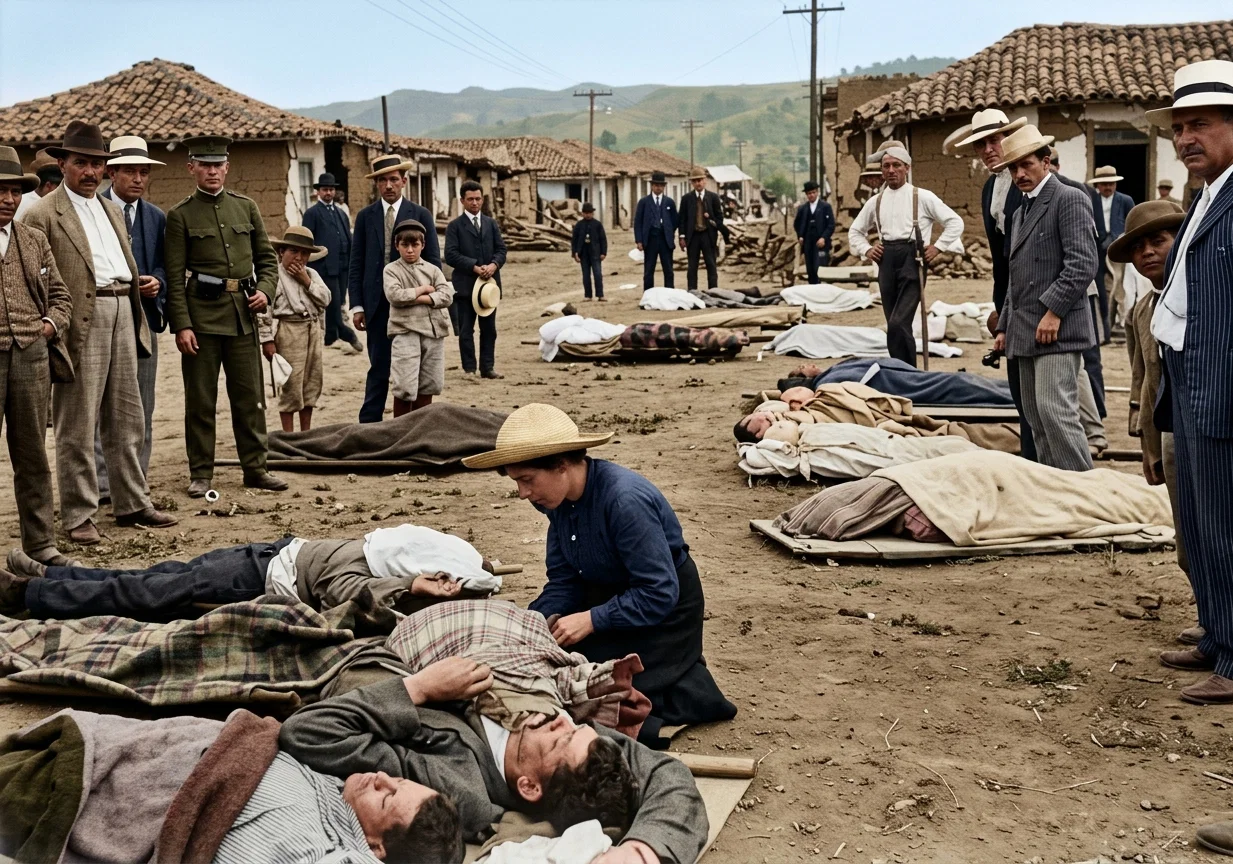
THE DAY AFTER THE EARTHQUAKE AT CARTAGO
Cartago, one of the chief cities of Porto Rico, and lying forty-five hundred feet above sea-level, was entirely destroyed on May 4 of the present year, and more than a thousand persons were killed. The beautiful peace palace, built by Andrew Carnegie for the peace congress, at a cost of a million dollars, was utterly destroyed. What a lesson this should be to those who are looking forward to a world-peace, when the nations will learn war no more! At a time when the palace of peace was nearly completed, then sudden destruction came, and there was no escape. God's people should be alert and watchful, able to read the signs of the times, that they may escape the utter destruction that will soon overwhelm the world.
At San Jose we were cordially received by Brother and Sister J. B. Stuyvesant, who made us very welcome at their home for the two weeks of our stay in that city. They have rented a little hall in a central place, where public meetings are held three times each week. Besides this, they handle four hundred copies of El Centinela, and are selling many Spanish books. The meetings were of a practical nature, full of the power of the Spirit of God. Hearty confessions were made by some who had made mistakes; six were baptized; and a church of nineteen members was organized. We left them full of courage, and with a determination to work for the Master.
Coming to Pacuarito, where there is a church of fifty-seven members, widely separated, Brother Innis organized a class of four or five canvassers. One of this company has succeeded well, reporting more than a hundred orders in a single week. This church was much encouraged, and began with a renewed determination to look for a place in the Lord's work, and to do faithfully that which needs to be done.
From here Brother Innis returned to Cristobal, to look after the book work, while I spent a week with the little company of believers in Estrada. We were granted the use of the public-school building for our meetings. These were well attended, and a good interest was manifested. One person was baptized. As this was the first baptism ever witnessed at this place, I gave a little talk on the subject at the water-side. Some, with tears, said, “This is the truth.” Two, a mother and her daughter, began from this time to keep the Sabbath.
September 13 I again reached Port Limon, where we have a church of more than fifty members, and a church building which stands as the result of Elder H. L. Mignott's work here. A tract and missionary society was organized, a club of two hundred fifty copies of Watchman12was taken, and a supply of tracts was ordered.
Sabbath, September 17, I took passage on a little sloop for Cahuita, twenty miles down the coast, where I found a good interest to hear the truth. Several have begun to keep the Sabbath as a result of reading our papers. Three were baptized. It was a precious season. Rings and other jewelry were laid aside, and every one had some tithe to pay. Brother A. E. Connor has gone to follow up this interest, and we hope, in time, to see a church organized here.
Cristobal, Canal Zone.
Just a Word Helps
By Young Evangelist
A YOUNG girl was passing an aged aunt one day, when she suddenly stopped, laid her hand gently on the white head, and said: “How pretty your hair is, Aunt Mary!”
The simple words brought a quick flush of pleasure to the wrinkled face, and there was a joyous quiver in the brief acknowledgment of the spontaneous little courtesy.
A young man once said to his mother: “You ought to have seen Aunt Esther to-day, when I remarked, ‘What a pretty dress you have on, and how nice you look in it!’ She almost cried, she was so pleased. I hadn’t thought before that such a little thing would please her so.”
“I never expect to eat any cookies as good as those you used to make, mother,” said a bearded man one day; and he was shocked when he saw her evident delight in his words; for he remembered that he had not thought to speak before for years of any of the thousand comforts and pleasures with which her skill and love had filled his boyhood.—Young Evangelist.