Your ShelfYour Projects

Signs of the Times, Vol. 39, No. 46.

Signs of the Times

Signs of the Times

Nov 26, 1912

Pacific Press Publishing Association · Mountain View, California · Nov 26, 1912

Signs of the Times

The President's Thanksgiving Proclamation

"By the President of the United States: "A Proclamation: "A God-fearing nation, like ours, owes it to its inborn and sincere sense of moral duty to testify its devout gratitude to the All-Giver for the countless benefits it has enjoyed. For many years it has been customary at the close of the year for the national executive to urge upon his fellow countrymen to offer praise and thanks to God for the manifold blessings vouchsafed to them in the past and to unite in earnest suppliance for their continuance.
"The year now drawing to a close has been notably favorable to our fortunate land. At peace within and without, free from the perturbations and calamities that have afflicted other peoples, rich in harvests so abundant and industries so productive that the overflow of our prosperity has advantaged the whole world, strong in the steadfast devotion of the heritage of self-government bequeathed to us by the wisdom of our fathers, and firm in the resolve to transmit that heritage unimpaired, but rather improved by good use, to our children and our children's children for all time to come, the people of this country have abounding cause for contented gratitude.
"Wherefore, I, William Howard Taft, President of the United States of America, in pursuance of long established usage and in response to the wish of the American people, invite my countrymen, wheresoever they may sojourn, to join, on Thursday, the 28th day of this month of November, in appropriate ascription of praise and thanks to God for the good gifts that have been our portion and in humble prayer that His great mercies toward us may endure."

"IF YE WILL INQUIRE, INQUIRE YE."

This Inquirers' Department is conducted for the purpose of helping those who are studying the Bible. The answers are oftentimes only suggestive. They are never to be considered infallible, only as they agree with the infallible Word. The writer who may answer them does not consider that his opinion is infallible. He will simply give the best that he has, and plead with the inquirer to search the Word. Such questions only will be answered as, to the editors, seem to minister to the good of the readers and to the mission of the paper. We can not answer repeatedly in the same volume questions upon the same scripture. The name and address must accompany question, not for publication, but as an evidence of good faith, and that answer may be made by letter if deemed advisable. No letters are answered which do not contain the name of the writer. It is well always to enclose stamp for reply.

3920 — The Falling Away

Please explain in your "Question Corner" 1 Tim. 4:1-4. O. R.
The passage reads as follows, from the Revised Version: "But the Spirit saith expressly, that in later times some shall fall away from the faith, giving heed to seducing spirits and doctrines of demons, through the hypocrisy of men that speak lies, branded in their own conscience as with a hot iron; forbidding to marry, and commanding to abstain from meats, which God created to be received with thanksgiving by them that believe and know the truth. For every creature of God is good, and nothing is to be rejected, if it be received with thanksgiving: for it is sanctified through the Word of God and prayer."
Note the following: First, it is not to "last days" that the apostle particularly refers, but to "later times" than when he wrote,—"subsequent seasons," some versions render it; that is, any time during the Christian dispensation these things shall be manifest.
Secondly, the things of which he speaks shall be among those who fall away from the faith, those who turn from faith in the Lord Jesus, and try to work out by their own plans and schemes a righteousness which is accepted by God.
Third, they are led to do this by seducing spirits and doctrines of demons, "through the hypocrisy of men that speak lies, branded in their own conscience as with a hot iron." That is to say, hypocritical men, for their own gain, will teach doctrines of demons, and so lead people away, those whose hearts have fallen away from the faith. To our mind, this has been met in the great apostasy of the Christian dispensation. One of the noted doctrines of demons is that man possesses life and immortality entirely apart from God. That is, he is immortal. It was taught by the master of all the demons in the Garden of Eden,—"Ye shall not surely die." This has been used to foster a belief in purgatory, and saint worship, and all the other related doctrines; and it has resulted in the building up of great systems, notable among which is that of the Roman Catholic Church. This does not mean that thousands of these people are not honest, but it does mean that the beginning of it was a departure from the faith, and a trusting in man and in man-made schemes, rather than the simple teaching of the Word of God.
Fourth, among the teaching will be that of forbidding to marry. Note the celibacy of the priesthood. "And commanding to abstain from meats,"—literally, foods. Note the various fasts,—enforced fasts and mandatory fasts,—in the Roman Catholic Church. The word from which "meats" comes is "bromaton,"—any kind of food, food which God created to be received with thanksgiving by them that believe and know the truth.
Fifth, then the general statement follows, that "every creature of God is good, and nothing is to be rejected, if it be received with thanksgiving: for it is sanctified through the Word of God and prayer." Now there may be souls that will take this as an indication that the child of God ought to eat anything, and has a license to eat anything or drink anything that the carnal soul may lust for; but the true child of faith will connect with this text just such ones as 1 Cor. 10:31, that "whether therefore ye eat, or drink, or whatsoever ye do, do all to the glory of God." He will study to know what God has sanctified, or set apart, in His Word as the best of food. He will want to know what will glorify God. This, in brief, is an explanation of these first four verses. See it much more fully expanded in the book entitled "Questions and Answers."

3921 — Redeemed from the Curse

I do not understand Gal. 3:10, 13. Would you please explain these scriptures? S. H.
The scriptures read, "For as many as are of the works of the law are under a curse: for it is written, Cursed is every one who continueth not in all things that are written in the book of the law, to do them." Verse 10. "Christ redeemed us from the curse of the law, having become a curse for us; for it is written, Cursed is every one that hangeth on a tree." Verse 13.
The curse of which the apostle speaks is that of the wages of sin, or death. Rom. 6: 23. All those who are of the works of the law are those who are seeking justification by obedience themselves; but this the apostle tells us is utterly impossible, for "all have sinned, and come short of the glory of God." All who are in the world are guilty before God, because all have sinned. Rom. 3:19, 23. Consequently a man who utterly ignores Christ, and seeks by his own works to perfect character, simply brings himself under the curse, because he stands for himself, and his own works are imperfect. He has come short of God's glory, he is a sinner and therefore subject to death, and must receive at last the wages of sin. He certainly has not continued in all things that are written in the book of the law. And therefore verse 11 is true, that no man is justified by the law, and that the only way that man can live just before God is by faith; but the man who is seeking to justify himself by works, certainly does not have faith in the Lord Jesus Christ, through whom only we can be justified.
But God knows our condition, and in His great love and pity gave Christ Jesus our Lord to die in our behalf. Christ redeemed us from the curse of the law, having become a curse for us. In the words of 2 Cor. 5:21, "Him who knew no sin He made to be sin on our behalf; that we might become the righteousness of God in Him." And so Jesus died in order to save us from the curse, and carried out that statement in Deut. 21:23, of dying and hanging upon a tree in our behalf. He hung there for our sins; but in that death for our sins, He redeemed us from the sin, and the redemption is ours if we accept it by faith. And He did that in order "that upon the Gentiles might come the blessing of Abraham in Christ Jesus; that we might receive the promise of the Spirit through faith." Verse 14.

3918 — Backsliding

Does Heb. 10:26-31 mean that if we have a knowledge of the truth and backslide, there is no forgiveness?
No, it does not. Some of the strongest pleas that there are in the whole Word are made to backsliders. Read Jeremiah chapters 2 and 3. Read the whole of Hosea, in which God pleads again and again with backsliding Ephraim. The conditions presented in the above scripture show not simply a backsliding, but an utter turning away from the only means that God has of reaching souls — His Spirit-filled Word and the Lord Jesus Christ. There is hope for the backslider. Listen: "Who is a God like unto Thee, that pardoneth iniquity, and passeth by the transgression of the remnant of His heritage? He retaineth not His anger forever, because He delighteth in mercy. He will turn again, He will have compassion upon us; He will subdue our iniquities; and Thou wilt cast all their sins into the depths of the sea."

3919 — Who Gave the Law?

Will you please give me the proof that Christ was the one who spoke and wrote the law.
John 1:1-3 is very clear evidence regarding this,—"In the beginning was the Word, and the Word was with God, and the Word was God. . . . All things were made through Him, and without Him was not anything made that hath been made." In other words, Christ has been the Word of the Godhead to the world and to the universe. He was the one, therefore, through whom God gave the law, and all the instruction to the children of Israel. Again, Acts 7:37, 38: "A Prophet shall God raise up unto you from among your brethren, like unto me." That Prophet, of course, was Christ. "This is He that was in the church in the wilderness with the Angel that spake to Him in the Mount Sinai, and with our fathers: who received living oracles to give unto us." That Angel was God's Angel, the Angel of Jehovah, Michael, our Lord Jesus Christ, of whom the Father said, "My name is in Him." Ex. 23:21. Again 1 Cor. 8:6: "Yet to us there is one God, the Father, of whom are all things, and we unto Him; and one Lord, Jesus Christ, through whom are all things, and we through Him." That is, all things come through the Lord Jesus. Therefore He must have been the one who gave the law to Moses and through whom God wrote it on the tables of stone.

3922 — Within Thy Gates

Is it right to let thrashers, that own their own machines and hire their own help, thrash on your farm on the Sabbath?
No, not if you are running the farm. If that farm is rented to some one else, of course that individual practically owns that farm during that length of time. But if you are in control of the farm, the commandment applies to all "within thy gates." It is in a way saying to the world that while I don't work myself, I am employing others to do it. We do not see how it could be possible for one to hire his thrashing done, even tho he did it by the job, without having his mind upon it during that time, and the commandment very clearly covers the point.

3923 — The Seven Last Plagues

Can one tell whether he will be saved, or not, when the plagues begin to fall? Will the first plague, the noisome and grievous sore, have any effect on God's people?
According to the 91st Psalm, God's children will be saved from the fearful plagues that fall upon the earth; and this is also indicated in Revelation 14, 15, 16. Certainly when the plagues begin to fall, God's children will know that they are safe. They will suffer by seeing others suffering. There will be more or less suffering all through the time of trouble, but the plagues themselves will not fall upon them. "Only with thine eyes shalt thou behold and see the reward of the wicked. Because thou hast made the Lord, which is my refuge, even the Most High, thy habitation; there shall no evil befall thee, neither shall any plague come nigh thy dwelling." Every sin will be confessed. Every wrong thing will have gone beforehand to judgment, and the righteousness of Christ will cover all. There will be doubtless feelings of deep unworthiness, feelings sometimes of almost despondency. They will cry, as did Jacob at the brook Jabbok, "I will not let Thee go, except Thou bless me." In the language of Jer. 30:7, "It is even the time of Jacob's trouble; but he shall be saved out of it."

3924 — The Drying Up of the Great River Euphrates

Will you please explain Rev. 16:12, "And the sixth angel poured out his vial upon the great river Euphrates; and the water thereof was dried up, that the way of the kings of the East might be prepared"? Who are the kings of the East?
H. G. W.
The river Euphrates, it is generally understood, typifies the land through which that river flows, the great Euphrates Valley, terminating in the Gulf of Persia. That land is at present held by Turkey nominally, in broader term perhaps by Germany, who holds a concession for a railway down through the Euphrates Valley extending to six miles on either side of the river. The drying up of that river, it is generally held, will be the destruction of the power that controls that valley. If the power that holds that valley were a strong power, they would prevent the kings of the East from passing over to the great war of Armageddon which will be fought out in its final conflict in Palestine. The kings of the East doubtless are the kings of the great Oriental nations. They may include Japan, China, and India. Evidently they are made up of those great heathen Oriental nations which will be at the last great battles to be fought in the great world center of Palestine.
Schedule for the Week Ending December 7, 1912

Schedule for the Week Ending December 7, 1912

Schedule for the Week Ending December 7, 1912
Sunday December 1 Hebrews 3, 4
Monday " 2 " 5, 6
Tuesday " 3 " 7
Wednesday " 4 " 8; Jer. 31:31-40
Thursday " 5 Hebrews 9; Psalms 120, 121
Friday " 6 Hebrews 10
Sabbath " 7 " 11

Signs of the Times

"Even as we have been approved of God to be entrusted with the Gospel, so we speak; not as pleasing men, but God, who proveth our hearts."

EDITORIAL

Let Us Give Thanks

EVERY day of the Christian should be a day of thanksgiving. It is an inspired exhortation, "In everything give thanks," and the encouraging assurance, "for this is the will of God in Christ Jesus concerning you." 1 Thess. 5:18. That is, it is God's will that we shall give thanks, not at stated times, or when prosperity's tree is loaded with benefits above our head; but "giving thanks always for all things unto God and the Father in the name of our Lord Jesus Christ." Eph. 5:20. We may safely do this, for the God of infinite love will gather up the all things of good or ill, of temporary blessing or bane, and make for His thankful, trusting child a composite of eternal good.
"Let us give thanks" "at all times." To do this we must be Christians. Our faith must bring Christ Jesus to our souls a present help. It must bridge the empty coal bin and flour box, hide the worn shoes and ragged clothes, shut out the hatred and malice and envy and wrong of this old world, tunnel the dark grave, and vision God's great beyond of eternal right and might, of eternal justice and mercy, of eternal peace and glory.
Americans in general have cause to be grateful, and together, as invited by President Taft, let them give thanks. He that "offereth praise glorifieth Me," says our heavenly Father.

Sabbath Day Miracles

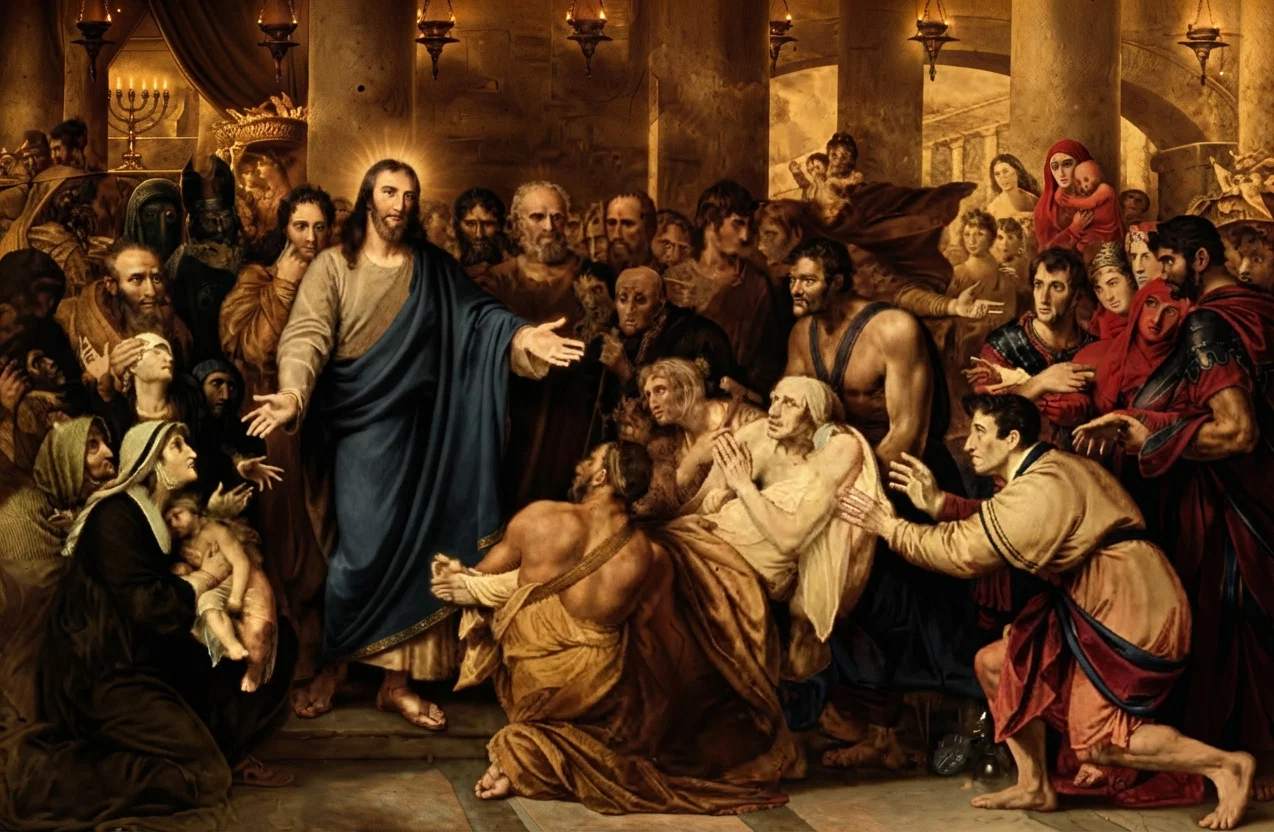
THE Sabbath day service in the synagog at Capernaum, which the devil sought to destroy, resulted in glory to God, and the spread of the gospel message. From that service Jesus, with James and John, the sons of Zebedee, went at once to the home of Simon and Andrew, brothers. Simon's mother-in-law lay sick of a fever, which shows that Simon (Peter, or Cephas) was a married man, and that Jesus did not refuse to call him, on this account. Nay, more, Simon was among the first called. Later it seems that his wife accompanied him in his apostolic labors. See 1 Cor. 9:5. It is certainly clear that the Lord does not demand celibacy on the part of His great laborers. Peter's wife's mother was doubtless a widow, making her home with her daughter. The home was that of humble fishermen, the two brothers seemingly sharing it to save expense. But it was into such homes that Jesus delighted to enter.
JESUS HEALING ALL WHO CAME TO HIM
THE Master no sooner came into the house than they told Him of the sick one. We do not know whether He was asked to visit her, or whether He signified His intention. It matters little. As soon as the opportunity offered, He came to the bedside, "took her by the hand, and raised her up; and the fever left her." The power of God in His touch neutralized the poison of the disease, obliterated its germs, cooled the burning skin, and moistened the parched tongue. The relieved one seems to have recognized that the strength and healing was from God, and she immediately began to use it in His service,—she "ministered unto them." Life and health are blood-bought blessings. "Ye are not your own." All you have and are belongs to God. He may not have healed you, but He has preserved you in health and strength. Use them for Him. Not always will the privilege be ours.
SO PASSED that Sabbath day. Jesus would use it in doing good. That was God's purpose in giving it. But the people, blinded by ignorance, their minds perverted by tradition, would not even come to Him in whom they felt was the power of God, to be healed upon the Sabbath day. Tradition and early erroneous teachings were stronger than clamoring bodily ills and soul hunger.BUT when the evening came, “when the sun did set,” the Sabbath day ended, and the first day of the week, the first toward another Sabbath, had come, and then the people came and brought to Him all that were sick, and them that were possessed with demons, and all the city was gathered at the door of the humble home. Jesus took no affront because they did not come to Him before. He met them where they were, welcomed with open-handed blessings those who came, healed them “that were sick with divers diseases, and cast out many demons; and He suffered not the demons to speak, because they knew Him.” Did He heal them all? Mark says “many,” but He healed all who came, we learn from Matthew and Luke; He cast out the demons with a word, and laid hands on the sick and healed them, every one. “Himself took our infirmities, and bare our diseases,” said the prophet more than six centuries before. The fruition of hope deferred had come, the Prince of Life had come to the land of misery and death, not to destroy nor to condemn, but to comfort and to heal. In His own life He had conquered the enemy, and His own life projected into theirs would conquer there.
WHY did He rebuke the demons who confessed Him?—Simply because they did confess Him. He wanted no acknowledgment from them. His cause was in no way helped by such advocacy. God’s cause never is. Sinners and hypocrites may teach the theory of the truth, but they never impart its life. Their message brings no relief to hearts in need, no hope to hearts in despair, no comfort to hearts that mourn. Luke tells us that the demons confessed Him to be the Son of God. He silenced them. He showed that they were not of Him. Paul had similar experience when a demon-possessed maiden followed him and Silas many days, declaring, “These men are servants of the most high God, who proclaim unto you the way of salvation.” Acts 16: 16-18. But the gospel of God needed no such help. Nor has it since. It is the saddest thing in Christendom that latter-day delusions call themselves Christian and yet deny the essentials of vital Christianity. They are a hindrance to true, vital Christianity.
JESUS CHRIST is the same, dear reader, “yesterday, and to-day, and forever.” He is the Saviour from sin, the Healer of disease, to-day. Let the sick go to Him with all the heart, open the life to His life, yield all to Him, and receive the healing power of the Spirit of God. Always when it is for His glory and the good of the sick soul, He will heal, if faith will grasp the healing power.

Peace and Peace—Which?

IF there is a planet in the solar system which needs a reign of peace, that planet is the earth. From one end to the other it is wars and rumors of wars, preparations for war, colossal expenses for war in time of peace, while in Southeastern Europe nations are locked in a deadly struggle, with all the attendant circumstances and consequents, death and wounding, starvation and pestilence, hatred and malignancy, ravage and revenge untold; and it may involve all Europe and the world in the same conditions.
The demons of Apocalyptic vision are abroad among the kings of earth (Rev. 16: 14); the cry of the prophet meets fulfilment and demonstration, “Prepare war, wake up the mighty men” (Joel 3: 9-12); and the fearful Armageddon of divine prediction draws on apace.
Yet men long for peace. They talk for peace, write for peace, pray for peace, hold conferences and congresses for peace, effect local, national, and international associations in the interests of peace, and all are largely futile. All churches are ostensibly for peace.
A recent great international meeting has just closed in Switzerland. It is noted in another column, with the comments of a Catholic journalist thereupon. That journalist also presents a solution for the world’s peace, the Roman Catholic remedy. That remedy is that at the head of the world’s congress of peace shall be the pope as supreme arbiter.
It is, it seems to us, under present conditions, the only solution of the world problem.
Protestant churches or Protestant nations can not assure peace; they are not united in the first place; they have no definite peace plan; they are limited in scope and power and influence.
Nothing can be expected from the great historic Oriental religions.
The Roman Catholic Church is recognized as Christian—whether so or not—by practically all the great Protestant denominations, and by all so-called Protestant nations. They recognize her power, her greatness, her influence. In a work of this kind—effecting the world’s peace—recognition on the part of the great nations would bring about a world-wide recognition.
The nominal head of Christendom will be made the chief arbiter by the nominal Christian powers, with headquarters in the chief nominal Christian city in the historic nominal Christian land of the world.
That nominal head is the pope of Rome. The nominal Christian powers are the European nations, the last confederacy that unite to restore again the beast régime of church and state.
That land is the historic Holy Land, little Palestine. That city is Jerusalem, where the Christ preached and wrought miracles and suffered and died; historically and traditionally, with its surroundings, the holiest spot on earth.
For divine prophecy declares this.
The last confederacy of European kings will unite to give their power and authority to the beast régime—the union of church and state, essential to the full-fledged Papacy—till the words of God shall be fulfilled. See Rev. 17: 12, 13.
The nominal head of all this Babylonian world confederation, the Papacy, shall say, as her temporal power is restored, “I sit a queen, and am no widow, and shall in no wise see mourning.” Rev. 18: 7.
The seat of this confederation will be at Jerusalem; for “many peoples [“many nations,” Micah 4] shall go and say, Come ye, and let us go up to the mountain of Jehovah, to the house of the God of Jacob; and He will teach us of His ways, and we will walk in His paths: for out of Zion shall go forth the law, and the word of Jehovah from Jerusalem. And He will judge between the nations [the pope claims to be God’s special representative on earth], and will decide concerning many peoples; and they shall beat their swords into plowshares, and their spears into pruning-hooks; nation shall not lift up sword against nation, neither shall they learn war any more.” Isa. 2: 3, 4.
Do not forget, in reading the above prophecy and the parallel one in Micah 4, that it is the “many peoples” and “many nations” that say this. Divine inspiration does not say it; the Holy Spirit declares that the “peoples” shall say it. And they are already organizing to rehearse the song, preparatory to the time when the troublesome papal-Italian question of temporal sovereignty and absolutely independent jurisdiction will be settled by bestowing upon the Papacy Jerusalem and its traditionality thrice-hallowed environs.
This is world peace by a world confederation—religious tho it be—based on compromise, expediency, selfish ambition, and departure from God. It can not, and therefore will not, last; for—it is inspiration again—“When they are saying, Peace and safety, then sudden destruction cometh upon them, as travail upon a woman with child; and they shall in no wise escape.” 1 Thess. 5: 3.
For when the great siren of the nations, satisfied and satiated with fulness of power and honor, “saith in her heart, I sit a queen, and am no widow, and shall in no wise see mourning,” “therefore in one day shall her plagues come, death, and mourning, and famine.” Rev. 18: 7, 8.
It will be thought that the world’s peace will heal the wounds and ravages of sin; but earth’s ills are not cured, and her toll of death and grief continue unabated, for men’s hearts are still carnal, and the world in its patched-up peace is still in rebellion against the great Jehovah and His holy law.
For tho the ruler of that confederacy be chosen by universal world suffrage, and upheld nominally by the great powers of the world, yet, despite all human calculations, he shall come to his end, and none shall help him.
“There is no peace, saith my God, to the wicked.” Isa. 57: 21.
Yet, reader, there is peace, God’s peace, to the individual soul, to all individual souls, that will look beyond all of the earthly and accept of God’s Advocate in His way. Listen: “Therefore being justified by faith, we have peace with God through our Lord Jesus Christ.” Rom. 5: 1. Our arms of rebellion are laid down, our carnal mind surrendered. Rom. 8: 7.
This is that of which Jesus said, “Peace I leave with you, My peace I give unto you:not as the world giveth, give I unto you.” John 14: 27. In tranquillity or strife, in quietness at home or in the prison cell, God’s peace abides.
For God’s peace is not based on compromise of great truths, of essential Christianity—on rebellion or disobedience against God’s holy law. It is not based on policy or expediency; in Jesus Christ, “the work of righteousness shall be peace; and the effect of righteousness quietness and assurance forever.” Isa. 32: 17. If you walk in God’s peace here, you shall in that better day delight yourselves in the “abundance of peace.”

Goodness Shines Unseen

“TRUE goodness is like the glowworm in this—that it shines most when no eyes but those of heaven are upon it.”

Purpose, Not Talent

WHAT men want is not talent, it is purpose; in other words, not the power to achieve, but the will to labor.—Bulwer-Lytton.

Sanctification

Is It Instantaneous or Progressive?

THERE is a deal of controversy over this question that it seems to us need not be. There are those who hold that sanctification is a definite work, following conversion or justification, an act of faith, instantaneous in operation. Some contend that it makes the man sinless, and so holds him. It is by some counted "a second blessing."
Others hold that sanctification is a progressive work, covering the years of Christian experience after conversion, and that the soul never knows when that is reached.
The testimony of the Word is worth more than all human conjecture or human experience. The term "sanctification" is found in our English version six times, as follows: In 1 Cor. 1:30 Jesus is said to be our sanctification as He is our redemption; in 1 Thess. 4:3 we learn that "this is the will of God, even your sanctification;" in the next verse it is said that each one should "possess his vessel in sanctification and honor;" in 2 Thess. 2:13 it is said that we are chosen "to salvation through sanctification of the Spirit and belief of the truth;" practically the same thing is stated in 1 Peter 1:2.
The root meaning of the verb is, to separate from the common, to set apart to a sacred use. So God sanctified the Sabbath, or separated it from the common days, and set it apart to a sacred use.
As applied to man, it has a double sense. So far as the will, the purpose, the yielding, is concerned, the work is instantaneous. So every Christian who wins eternal life, sometime gives himself and all his powers to God. That critical moment of his decision is instantaneous; but the carrying out of that decision is a lifelong work. Chosen "through sanctification of the Spirit and belief of the truth" means a life-work in the holy channel of God’s leading.
This sanctification does not imply perfection. "The saints" at Ephesus, "the sanctified" at Corinth, were not perfect, as Paul’s epistles clearly show; but the purpose was perfection, and the purpose was being worked out in character.
It is worthy of note, in these few suggestions, that these saints never so designate themselves. Paul calls others saints, but never himself. God would have called His "servant" thus, we may believe; but Paul clearly declared that he was not perfect, but was pressing on. Phil. 3:7-14.
We are sure that the fullest impartial investigation will clearly show that sanctification is instantaneous as regards purpose, will, decision; progressive as regards the life-work of the Christian. So it worked out in all the Biblical children of God; we know of no improvement on the old way by modern methods or theories. God’s plan presents hope, perseverance, growing power in Christ Jesus, with no boasting save in the cross.

Our Bible Reading

Life Only in Christ

1. What is man by nature?
A sinner. “For all have sinned, and fall short of the glory of God.” Rom. 3:23.
2. Man being a sinner, to what is he doomed?
“Therefore, as through one man sin entered into the world, and death through sin; and so death passed unto all men, for that all sinned.” Rom. 5:12. “For the wages of sin is death.” Rom. 6:23.
3. Then can man find hope in himself or his fellows?
“None of them can by any means redeem his brother, nor give to God a ransom for him.” Ps. 49:7.
4. But does not life come to men when they die?
“His breath goeth forth, he returneth to his earth; in that very day his thoughts perish.” Ps. 146:4.
5. In whom, then, is our only hope of life?
“For God so loved the world, that He gave His only-begotten Son, that whosoever believeth on Him should not perish, but have eternal life.” John 3:16.
6. How emphatic is this made in another scripture?
“He that believeth on the Son hath eternal life; but he that obeyeth not the Son shall not see life, but the wrath of God abideth on him.” John 3:36.
7. In what, then, may the believer rejoice?
“And the witness is this, that God gave unto us eternal life, and this life is in His Son. He that hath the Son hath the life; he that hath not the Son of God hath not the life. These things have I written unto you, THAT YE MAY KNOW THAT YE HAVE ETERNAL LIFE, even unto YOU THAT BELIEVE on the name of the Son of God.” 1 John 5:11-13.

The Blessing of Breaking

INTO every life, if it is to be a broad, sympathetic, and useful life, must come some struggle, some sorrow, some tragedy, which will, so to speak, break the man or the woman in pieces, and humble and crush to the very earth. That tragedy may be voluntary, the death of the old man, the immolation, the sacrifice of him upon the cross. If we are not willing thus to yield ourselves, God in His infinite love for us shatters our idol, dissipates our hopes, permits sickness, perhaps death, perhaps utter discouragement and defeat, to fall upon us or our households. Financial and business trouble may come. He may permit us to fall into open, disgraceful sin.
What we shall get out of the awful lesson depends upon how we take the trouble, and to whom we go for succor,—whether we try to patch over the holes of our pride, hide it from us, drown it in drink or pleasure, or whether we take it to God in all its fulness and sinfulness, and let Him heal the wounds, and bind up the broken heart, and fill with His own presence the vacancy sorrow has made. Christ is the great Stone upon which we can fall and be broken, and out of that brokenness find healing; or we may go on until the great judgment time comes, and we will find that the Stone itself will grind us to powder which will be blown away into utter nothingness. He longs that we shall yield ourselves to the breaking, to the death of the old man. He will make us a better man or woman, if we will but learn the lesson of our own utter nothingness, and His own infinite fulness, which awaits our simple faith.

Look Up and Lend a Hand

Look up and not down, forward and not back, out and not in, lend a hand.—Edward Everett Hale.

A Catholic Paper on the Peace Congress

The Rome correspondent to the "Western Watchman," in the issue of that paper of October 24, referring to the Peace Congress at Geneva, says:
"It is past at last, and peace to his ashes; for the International Peace Congress, which closed its sessions at Geneva the other day, proved to be merely something worse than the barren fig-tree. The press of Europe has laughed at it. The Catholic and antireligious newspapers have looked in expectation of some good result from the much lauded Peace Congress; but the whole affair has proved to be nothing else than a sounding brass and tinkling cymbal.

More War

"An International Peace Congress has been established. But what period brought us more war than the past dozen or so years?
"The Russo-Japanese war rivaled pagan struggles in its rivers of blood; then came the Boer war in South Africa to 'stagger humanity;' France and Germany were not, for a time, far from a struggle within the past two years; and to-day is the anniversary of the commencement of the Italo-Turkish war for Tripoli. Rather a pretty record for the Hague!

The Catholic Remedy

"But the question is, What might have saved the institution from becoming the huge fiasco that it now certainly is? There is one power that could probably have brought success to its banner. When the veto of Italy, seconded by Holland (the course of which Holland has long since repented), excluded from the Hague conference the vicar of the Prince of Peace, it sounded the death knell of what otherwise might have been fraught with excellent results to the Dreadnought-building powers."
It will be seen, from this last paragraph, what Rome’s method, and only method, is of establishing peace, and that is to place at the head of the nations the pope. According to the Scripture, that will come. Peace will be declared. But when that supposedly worldwide Peace Congress comes, then the Holy Scripture declares sudden destruction comes with it. 1 Thess. 5:1-3.

Do Not Excuse Bigotry

THINK not the bigotry of another is an excuse for thine own. It is not impossible that one who casts out devils himself may yet forbid you so to do.—John Wesley.

Learn to Live Forever

“LEARN as if to live forever; live as if to die to-day.”
Continue reading: God's Message for To-Day