Signs of the Times, Vol. 34, No. 8

The Greatest of All

Signs of the Times

Feb 19, 1908

Pacific Press Publishing Company · Mountain View, California · Feb 19, 1908

The Greatest of All

“Thou shalt love the Lord thy God with all thy heart, and with all thy soul, and with all thy mind.” —Matt. 22 : 37.

The Greatest of All

(I Corinthians 13, American Standard Revised Version)
If I speak with the tongues of men and of angels, BUT HAVE NOT LOVE, I am become sounding brass, or a clanging cymbal. And if I have the gift of prophecy, And know all mysteries and all knowledge: And if I have all faith, so as to remove mountains, BUT HAVE NOT LOVE, I am nothing.
And if I bestow all my goods to feed the poor, And if I give my body to be burned, BUT HAVE NOT LOVE, It profiteth me nothing.
LOVE suffereth long, and is kind; LOVE envieth not; LOVE vaunteth not itself, Is not puffed up, Doth not behave itself unseemly, Seeketh not its own, Is not provoked, Taketh not account of evil; Rejoiceth not in unrighteousness, But rejoiceth with the truth; Beareth all things, believeth all things, Hopeth all things, endureth all things.
LOVE NEVER FAILETH: But whether there be prophecies, they shall be done away; Whether there be tongues, they shall cease; Whether there be knowledge, it shall be done away. For we know in part, and we prophesy in part; But when that which is perfect is come, That which is in part shall be done away.
When I was a child, I spake as a child, I felt as a child, I thought as a child: Now that I am become a man, I have put away childish things.
For now we see in a mirror, darkly; But then face to face: now I know in part; But then shall I know fully even as also I was fully known.
But now abideth FAITH, HOPE, LOVE, These three; And the greatest of these is LOVE
“For this is the love of God, that we keep His commandments: and His commandments are not grievous.” —I John 5 : 3.

With Our Inquirers

“If ye will inquire, inquire ye.”
[All questions to this department will be answered which to the editors will seem to minister to the good of the readers and to the mission of the paper. The same question can not be answered repeatedly in the same volume. The name and address must accompany question, not for publication, but as an evidence of good faith, and that answer may be made by letter if deemed advisable. It is well always to enclose a stamp for reply.]

2388.—Palmistry; Spiritualism.

Would you kindly give me your opinion of palmistry? Does the scripture, 1 Cor. 12: 10, refer in any way to this? Is not this power from Satan where the person is a Spiritualist or non-Christian? Can it be depended upon? M. R.
Palmistry is a mere matter of shrewd guessing, and all who attempt to read character by palmistry alone certainly can not be depended upon. Of course the hand shows somewhat of the character of one's work, of the way in which the hand has been used, by the lines and wrinkles, form, shape, and so on, and observations and guesses can be made on account of it. But it is not a science in any way, and is not to be depended upon at all. It is like a half-dozen other things of this sort, that single out some one feature of the human frame or physiognomy and endeavor to read the character. It is about the same as telling fortunes by tea-leaves. And yet the devil uses all these things to turn men away from the only true forecast of character which there is in the world; for there is a true forecaster of character, and that is God's word; and it matters not what one's antecedents may have been, if he gives himself to God and allows Him to work in him, he will develop character which shall shine forever; and on the other hand, one may show the very best palms and features and yet if he ignores God and His truth, according to that word, he will be lost. 1 Cor. 12: 10 has absolutely no reference to palmistry or any other subterfuges of Satan. The gifts mentioned there, the working of miracles, prophecy, discerning of spirits, and speaking with tongues, are among the gifts which God bestows upon His children thru the Spirit.

2389.—Under the Law.

Kindly explain Gal. 5: 18. L. S.
The scripture reads: “But if ye are led by the Spirit, ye are not under the law.” The law over us holds us in condemnation. Christ saves us from that condemnation of the law. Rom. 8: 1. In other words, He sets us free from the law of sin and death, so that we are no longer under the law, but under grace. Grace is ministered to us by the word and Spirit of God, and that grace leads us to work in harmony with God's law and fulfil the righteousness which the law requires of us. Rom. 8: 4. God's Spirit is in harmony with God's law, so that it can be said of one who walks in the Spirit that against such there is no law. Gal. 5: 23. Therefore those who are led by the Spirit are not condemned by the law; they are in harmony with the law; for it is the office of the Spirit to write the law upon the heart, within the mind. Heb. 8: 10. Again, in Gal. 5: 16, “Walk by the Spirit, and ye shall not fulfil the works of the flesh.” The works of the flesh are sinful, as shown by the verses that follow, but to be led by the Spirit is to do just what the law declares, as shown from verses 22 to 24. The fruit of the Spirit is love, but the apostle declares, “This is the love of God, that we keep His commandments; and His commandments are not grievous.” 1 John 5: 3.

2390.—Matter of Time.

1. Do Adventists keep their Sabbath from sunset to sunset because the days were thus marked at creation? 2. When and by whom was the present system of marking the time from midnight to midnight established? 3. Was it done for convenience' sake? 4. Was it wrong to mark the time as the days are now marked off? 5. If Adventists kept their Sabbath from midnight to midnight, would it not be admitting that the seventh part of time would do just as well as the seventh day?
1. Seventh-day Adventists keep the Sabbath from sunset to sunset, as do the Seventh-day Baptists and all true Sabbath-keepers. God gave the sun to rule the day, and the day begins at sunset. This is shown not only in Genesis 1 but also in Matt. 8: 16; Mark 1: 32; Luke 4: 40; and Neh. 13: 19. See also Lev. 23: 32.
2-4. According to the best authorities the present method of reckoning the day came from Egypt to Rome, and was established for astronomical reasons. Yet astronomers at the present time mark from midday to midday. Of course any man had the privilege of marking time as he wished, but the week was of God's establishing, and so changes in it that changed God's worship were not right.
5. Neither Adventists nor other true Sabbath-keepers could keep the Sabbath from midnight to midnight, because that would be keeping only three-fourths of the Sabbath. Of course, if they were willing to concede that much, they might just as well concede it all. The test of God's word is this: “Ye shall not add unto the word which I command you, neither shall ye diminish aught from it, that ye may keep the commandments of the Lord your God which I command you.” Deut. 4: 2. It would be utterly impossible for any people or any individual to keep the commandments of God who would add to or subtract from His commandments. Just as soon as we do this we become breakers of the law, and that which we add to the law or take from it indicates that we feel ourselves wiser than the Lawgiver.
Note also the spiritual advantage of beginning according to God's plan. Then God's children, if they are true Sabbath-keepers, have their work all done, they are in readiness to welcome the Sabbath when it comes; they enter upon its sacred moments with reading of the word and prayer and meditation on the works of God and His goodness. When it closes they can take proper leave of it in the full control of all their senses. But not so when the day begins and ends at midnight. They go to bed with the cares of life upon them; they wake with something of the same thoughts with which they retired. God's way is always the best way.

2391.—Shut from the Tree of Life.

Please explain Gen. 3: 22. It seems by the word that the Lord did not want Adam to partake of the tree of life and live forever, and why? Was it because Adam did not repent? R.
Adam was debarred from the tree of life when he sinned, doubtless before he repented. If God had permitted him to forever eat of the tree of life, he would have been a perpetual sinner, kept alive by the tree of life. In God's great mercy, sin bears its own punishment, death, and it is not in the Lord's purpose to prolong life in order that man may continue in sin. Therefore man was shut out from the tree of life, lest he should put forth his hand and eat and live forever. If man had known that he would thus live forever, he would continue in sin. Cut off from this source of life, man was bound to die in consequence of his sin, and that very thing would lead him to God, the Source of life.

2392.—The Tithe.

The Bible in several places defines the tithe as one-tenth of the increase. Please explain if this does not mean for one to deduct his necessary living expenses before taking out the tithe. E. A. A.
We do not so understand it. If you will turn to Lev. 27: 32 you will see one of the ways they had of reckoning the tithe. The herd itself was brought out and passed under the rod, the rod marking off every tenth one of the herd, and that tenth should be holy. The tithe of the increase was upon the actual increase of the fruit of the ground or of the flock. One's own living was to come from the nine-tenths, “the tithe is the Lord's.” Nine-tenths He gives to man. If the way suggested was the manner of tithing, the Lord's cause would certainly have very little, because many expend all that they make, their living expenses eat up what they receive. They would not be acknowledging God's right in any way. Of course if a man works a farm on shares, the share of the owner of the farm is taken out before the product is tithed. If one rents, the owner of the farm must be paid the rent before the product is tithed. That belongs to the owner of the farm; but one does not take out his own time or living before he tithes the increase.

2393.—Age of the Antediluvians.

Please explain Gen. 6: 3, the one hundred twenty years. I do not understand this, as men lived to be much older than one hundred and twenty years after that. M. G.
The one hundred twenty years did not mark the age of human life, but the period of human life before the Flood, evidently from the time the Lord warned Noah of the coming Flood; He fixed the time between His message to Noah and the Deluge at one hundred twenty years; that is, there would be one hundred twenty years more to the Deluge, during which time God would give all upon the earth the privilege of repenting. The age of human life continually decreased after the Flood, so that from Noah to Abraham man's life decreased from 950 years to 175, and in the days of David to three-score and ten.

2394.—One or Two Demoniacs.

In Matt. 8: 28 there are said to have been two demoniacs which met Jesus in the country of the Gergesenes, while Mark 5: 2 and Luke 8: 27 mention but one.
Both evidently refer to the same event. Matthew mentions the exact number. One of these may have been much more violent and much more prominent than the other, so much so as to cause one almost to lose sight of the second. It is the very violent one that Luke and Mark mention, while Matthew classed them both together. It will be noticed that neither Mark nor Luke says there was only one.
2395.—S. F.—Deut. 14: 26— We would say that the permission given in this scripture must be understood in connection with other things which God Himself has given. Take, for instance, the various parts of that 14th chapter of Deuteronomy. When God's people stood in the light, it would not be possible that they should lust after the things that were wrong. The strong drink of ancient times is not to be compared with the poisonous preparations which are used at the present time. We should compare every such passage as this with Proverbs 23. God wants His people to rejoice, and this was one of the times when they would gather together and rejoice, but if they were standing in the light they certainly would not go to unseemly excess.
2396.—A. O. G.— There seems to have been in the early days of creation week a cloudy condition in the atmosphere when the waters were divided, some of them deposited upon the earth, the others hanging in watery clouds above the sky. When these were removed the fourth day, the sun shone out in its glory. We know no reason to regard the light of those first days as different from the light of the days which followed. At the present time the light is dim as compared with what it will be when the new earth appears. We are told that then the light shall be as seven days and the light of the moon as the light of the sun.
2397.—D. F. L.—Gen. 11: 26; Acts 7: 24.— A question upon this was answered recently in this department. The question should not in fairness be “How can these things be harmonized?” but rather “How can they be made to agree?” Abraham is mentioned first in Genesis 11; still he may have been the youngest son after all. A reason why he should be mentioned first is that the promised Seed should come thru him. One or two simple suppositions, to which the text is not at all contrary, will make these matters quite plain.

Christ the Teacher and Healer

By Mrs. E. G. White

The Healing of the Leper.

Of all the diseases known in the East, the leprosy was most dreaded. Its incurable and contagious character, and its horrible effect upon its victims, filled the bravest with fear. Among the Jews it was regarded as a judgment on account of sin, and hence was called “the stroke,” “the finger of God.” Deep-rooted, ineradicable, deadly, it was looked upon as a symbol of sin.
By the ritual law the leper was pronounced unclean. Whatever he touched was unclean. The air was polluted by his breath. Like one already dead, he was shut out from the habitations of men. One who was suspected of having the disease must present himself to the priests, who were to examine and decide his case. If pronounced a leper, he was isolated from his family, cut off from the congregation of Israel, and doomed to associate with those only who were similarly afflicted. Even kings and rulers were not exempt. A monarch attacked by this terrible disease must yield up the sceptre, and flee from society.
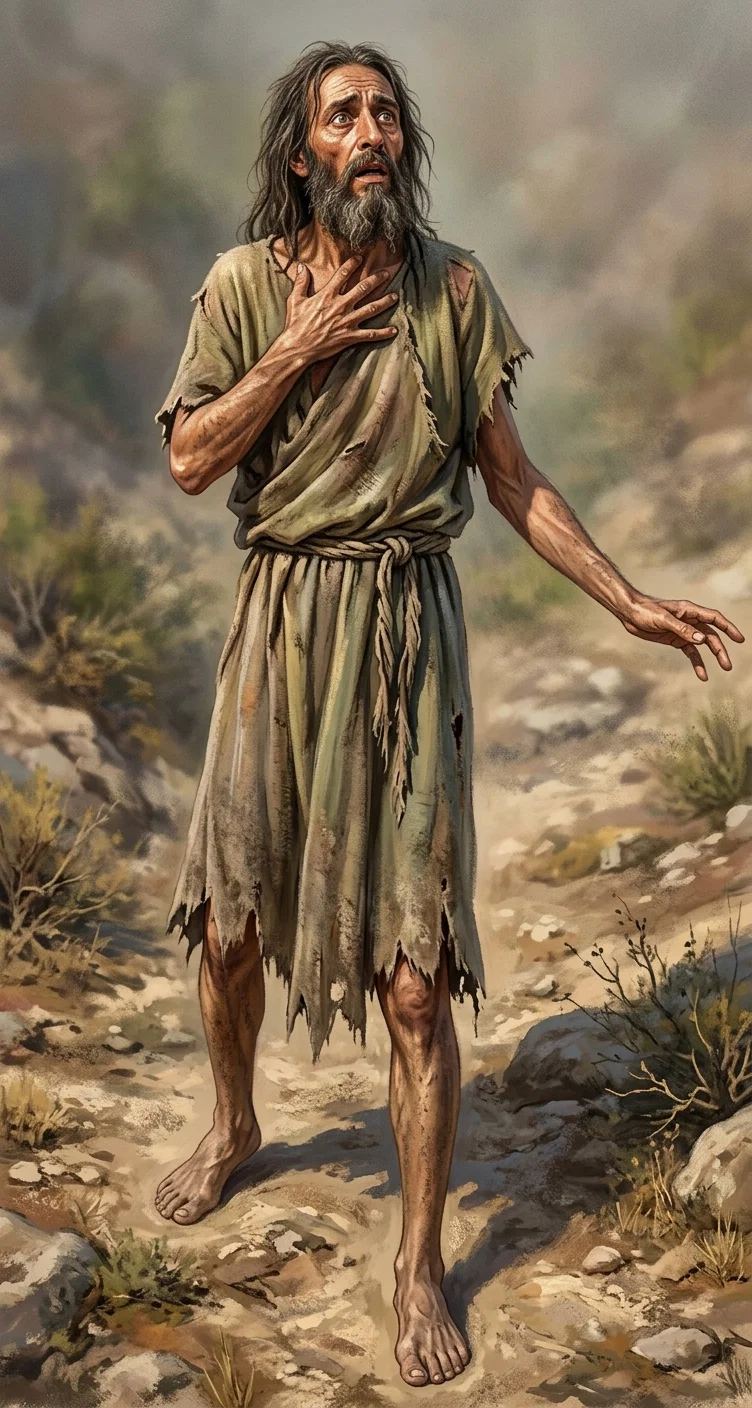
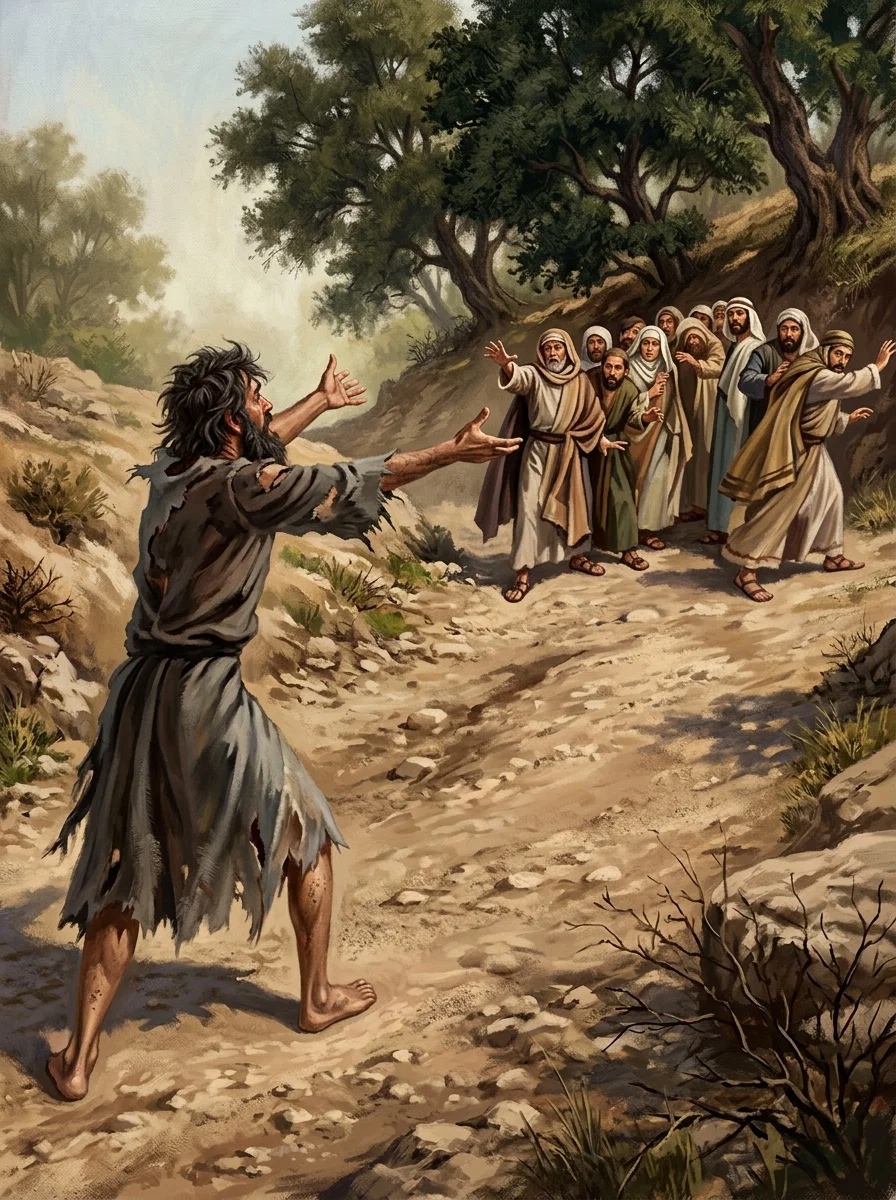
Away from his friends and his kindred, the leper must bear the curse of his malady. He was obliged to publish his own calamity, to rend his garments, and sound the alarm, warning all to flee from his contaminating presence. The cry, “Unclean! unclean!” coming in mournful tones from the lonely exile, was a signal heard with fear and abhorrence.
In the region of Christ’s ministry were many of these sufferers, and as the news of His work reached them, there was one in whose heart faith began to spring up. If he could go to Jesus, he might be healed. But how can he find Jesus? Doomed as he is to perpetual isolation, how can he present himself to the Healer? And will Christ heal him? Will he not, like the Pharisees, and even the physicians, pronounce a curse upon him, and warn him to flee from the haunts of men?
“At sight of him the people fall back. Some try to prevent him from approaching Jesus, but in vain.”
He thinks of all that has been told him of Jesus. Not one who has sought His help has been turned away. The wretched man determines to find the Saviour. Though shut out from the cities, it may be that he can cross His path in some byway along the mountain roads, or find Him as He is teaching outside the towns. The difficulties are great, but this is his only hope.
Standing afar off, the leper catches a few words from the Saviour’s lips. He sees Him laying His hands upon the sick. He sees the lame, the blind, the paralytic, and those dying of various maladies, rise up in health, praising God for deliverance. His faith strengthens. Nearer and yet nearer he approaches to the listening throng. The restrictions laid upon him, the safety of the people, the fear with which all men regard him, are alike forgotten. He thinks only of the blessed hope of healing.
He is a loathsome spectacle. The disease has made frightful inroads, and his decaying body is horrible to look upon. At sight of him the people fall back. In their terror they crowd upon one another to escape from contact with him. Some try to prevent him from approaching Jesus, but in vain. He neither sees nor hears them. Their expressions of loathing are lost upon him. He sees only the Son of God, he hears only the voice that speaks life to the dying.
Pressing to Jesus, he casts himself at His feet with the cry, “Lord, if Thou wilt, Thou canst make me clean.”
Jesus replies, “I will; be thou clean,” and lays His hand upon him.
Immediately a change passes over the leper. His blood becomes healthy, the nerves sensitive, the muscles firm. The unnaturally white, scaly surface peculiar to leprosy disappears and his flesh becomes as the flesh of a little child.
Should the priests learn the facts concerning the healing of the leper, their hatred of Christ might lead them to render a dishonest sentence. Jesus desired that an impartial decision be secured. He therefore bids the man tell no one of the cure, but without delay present himself at the temple with an offering before any rumors concerning the miracle should be spread abroad.
Before the priests could accept such an offering, they were required to examine the offerer and certify his complete recovery.
This examination was made. The priests who had condemned the leper to banishment testified to his cure. The healed man was restored to his home and society. He felt that the boon of health was very precious. He rejoiced in the vigor of manhood and in his restoration to his family. Notwithstanding the caution of Jesus, he could no longer conceal the fact of his cure, and joyfully he went about proclaiming the power of the One who had made him whole.
When this man came to Jesus, he was “full of leprosy.” Its deadly poison permeated his whole body. The disciples sought to prevent their Master from touching him; for he who touched a leper became himself unclean. But in laying His hand upon the leper, Jesus received no defilement. The leprosy was cleansed. Thus it is with the leprosy of sin,—deep-rooted, deadly, impossible to be cleansed by human power. “The whole head is sick, and the whole heart faint. From the sole of the foot even unto the head there is no soundness in it; but wounds, and bruises, and putrefying sores.” But Jesus, coming to dwell in humanity, receives no pollution. His presence was healing virtue for the sinner. Whoever will fall at His feet, saying in faith, “Lord, if Thou wilt, Thou canst make me clean,” shall hear the answer, “I will; be thou clean.”
In some instances of healing, Jesus did not at once grant the blessing sought. But in the case of leprosy, no sooner was the appeal made than it was granted. When we pray for earthly blessings, the answer to our prayer may be delayed, or God may give us something other than we ask; but not so when we ask for deliverance from sin. It is His will to cleanse us from sin, to make us His children, and to enable us to live a holy life. Christ “gave Himself for our sins, that He might deliver us from this present evil world, according to the will of God and our Father.” And “this is the confidence that we have in Him, that, if we ask anything according to His will, He heareth us: and if we know that He hear us, whatsoever we ask, we know that we have the petitions that we desired of Him.”

The Law of Rest in the Healing of Disease

By G. D. Ballou, for Many Years a Devoted Student of Physical and Mental Therapeutics

Miracles and Gifts of Healing.

IN former articles it has been shown that the law of rest is the natural, heaven-appointed remedy for nearly all human ills. Let it be repeated that this does not mean simply the law of sleep or of physical recuperation, but the law of that complete repose in the care of God expressed in the words, “Rest in the Lord;” “Commit thy way unto the Lord,” etc., which, when grasped, takes all the care and worry and fretting and anxiety out of men, and women, too, and gives to every one a happy burden of all life’s duties both toward God and toward men.

Proper Relation to Law.

When one’s ways are committed to the Lord, God’s moral law will be respected, and all the suggestions of natural law in God’s word will also be respected as far as comprehended. He who does this will be as careful to take care of this life as he knows how to be, knowing that the gift of a future life will depend solely on how this life has been used. So the true, well-instructed Christian will have a religious care for the laws of health and will appeal to them for the relief of common ailments as far as he knows. Thus will he fulfil the law of resting in God and committing all his ways to the Lord. And he will trust also in the Lord that He will bring to pass fully all that is for our good and His glory in this life. Psalm 37. See also Matt. 11: 28-30 and Rom. 8: 28. Such is a life of faithful obedience, but, sad truth, it is comprehended by but few.
In this it is proposed to show where the laws of health, of which the law of rest is chief, cease to be fully effective in the treatment and cure of disease, and where miracles properly begin. But let us inquire first, What is a miracle? It may be a suspension of natural law, as when the Red Sea and the River Jordan were walled up until Israel passed over, or when the iron “did swim.” It may be an acceleration of natural law, as when at Cana water was changed into wine. It may be a direct act of creative power, as when the cruse of oil and the barrel of meal did not fail, or when the loaves and fishes were increased to feed the multitude. It may be a lifting of the curse for the violation of natural law, as in the cure of leprosy, fever, or palsy, and the removal of the effects of other diseases.

Naaman’s Disgust at the Remedy Prescribed.

Most of the human family to-day are like that general-in-chief of the Syrian army, Naaman. When told to bathe in Jordan seven times, he went away in a great rage. He said, “Behold, I thought, He will surely come out to me, and stand, and call on the name of the Lord his God, and strike his hand over the place, and recover the leper.” 2 Kings 5:11, 12. He wanted to see a demonstration. Bathing was altogether too tame for him.

The Miracle at Cana.

But I want to know what one to-day would see if he should see a miracle. What would he see? Suppose we had the miracle of Cana repeated. There are the water-jars, and there are the drinking-cups. There is the water, and here, after it is drawn, is the wine. Is water any new thing? Is wine anything new? But the shortening of the process! you say. Yes, but did you see the process, or the power back of it? Out in nature you see far more of the process. It takes several months out in the vineyard to turn water into wine, and you can see much of the various steps all the way. This abnormal desire to see something surprising and startling stands right in the way of our becoming acquainted with natural processes.
We hide our eyes from the continuous daily, hourly, and momentary manifestations of divine energy all about us, especially in regard to our own bodies, and then we demand of the Lord that He interpose His divine power in a new and startling way to make up for our failure to observe the every-day laws of life.

Applying the Proper Remedy.

To illustrate: Some earnest Christian soul has a headache. It may be due to cold feet and a lack of water in the blood or it may be due to some drug taken, like tea or coffee. Now why not take this case to the Lord and ask Him to interpose His power to relieve the oppressed nerves of the brain? Seems to me the common sense thing to do would be first of all to warm the feet and at the same time dilute the blood with water hot or cold, as is most palatable, quit the use of the drug and give the powers of life God has already placed in the body a chance to do their work naturally and easily in washing out of the brain the accumulation of poison which caused the ache.

Gifts of Healing.

The gift of miracles is as distinct from the gifts of healing (see 1 Cor. 12: 8-10, 28, and read carefully) as are any of the other gifts of the Spirit. The gifts of healing are, as the writer understands it, the special enlightenment given in the correct application of natural laws and principles to the cure of disease. They may be in nowise more miraculous than any other enlightenment of the understanding by the Spirit of God.
But miracles have to do with ailments which from ignorance of, or neglect of, or inability to use natural means are beyond the gifts of healing. There is nothing miraculous about the rest of faith. This was the normal condition of man. This resting in the Lord and committing our ways to Him, let me repeat, leads the way directly to a proper use of all the other essentials to life, which are included in sunlight, air, water, food, clothing, and exercise. Now, when one’s way is committed to the Lord, he has adopted the plan of having God’s way in everything. So such an one will soon be led to know how rightly to appreciate these blessings on which life depends. He will not be slow in learning to eat and drink and breathe right, how to clothe himself, how to use his physical powers and how to rest them.

Using the Natural Law.

When one heeds the injunction, “Whether therefore ye eat, or drink, or whatsoever ye do, do all to the glory of God” (1 Cor. 10: 31), he shows acquiescence with the will of God expressed both in moral and natural law, and the latter as well as the former is written in God’s word, at least in principle. Such an one, as shown in the former article, may learn to apply the natural law, so as to be free from all ordinarily curable maladies. But some of the saved ones, as well as others among the sons of men, have gone in the way of physical transgression until paralysis, or blindness, or some incurable malady has become fixed upon them, or perhaps some infection of poison has overtaken them, or the result of some hereditary trouble. Here now is the demand for miracles, and this is the time and place for men to call on the Lord to do special work, if it can honor His cause and name. In the ordinary maladies it is most proper for the servant of God to ask for wisdom in the use of natural means for the recovery of the sick, and to ask His blessing upon the use of the means which His Spirit has directed His people to use. In the incurable cases we may expect miracles to be wrought where the church and the individual are in harmony with the mind and Spirit of God. But let it be remembered that in the working of miracles the same law of rest, the true rest of faith and sweet submission, must still hold sway, as found in the Gethsemane prayer, “Nevertheless not as I will, but as Thou wilt.” In regard to the use of means in curable diseases, we have the example of Isaiah ordering the fig poultice for Hezekiah’s boil. It was a good thing then, and it is a good thing to-day, and no miracle was required to effect a cure. In a few of the incurables, like Naaman’s leprosy, where the prophet ordered seven baths in Jordan, and the case of the blind man whose eyes Jesus anointed
with the clay, tho we can see no curative quality in that particular use of the means, we may justly conclude that the use of means is sanctioned. The anointing with oil in James’ directions (James 5: 14, 15) is another evidence that the use of means is approved, tho we may not in this case see the relationship between disease and remedy any more than we see the power which works the cure.
Now while we have tried to make plain the relationship that exists between the exercise of the gifts of healing and miracles, it may be proper and safe to say further that the Lord has not set the example of interposing miracles to take the place of proper remedies in the treatment of curable cases by natural means. The records would indicate that nearly every miracle was wrought on a hopeless case. We do not mean to say that we think that God would not interfere miraculously for any case where there was excusable ignorance of natural remedies or inability to use them.
(Concluded Next Week.)

A Perfect Law.

“The law of the Lord is perfect.” Ps. 19: 7. “Love is the fulfilling of the law.” Rom. 13: 10.
Whose hand so truly guides the earth and heavens,— Controlling many million worlds as one? What law so perfect—not a system wavers; No star can fail nor any shining sun? Ah! One has formed them who is strong and mighty;
’Tis He who sitteth in eternity. Before Him all the earth appears as nothing; He holdeth in His hand the mighty sea! A perfect law? aye, perfect as its Maker; Beginning ere our world had seen the light; Existing with the King before all kingdoms— Eternal as His throne of living white, He ruleth earth and heaven who is Holy; His name—His law—His character is Love. Creation’s pulse beats ever at His bidding: Creation hears His word—who reigns above. FLORA E. YERGIN.

The Joy of Sabbath-Keeping

Sabbath-Keeping.

CHRIST gave us a perfect example in Sabbath-keeping. His life stands forth reflecting the peaceful light and glory of heaven in the keeping of the Sabbath, against the dark background of Jewish unbelief, bigotry, and meaningless rites and ceremonies. The Saviour of men brushed these human traditions aside in His heroic work of giving to man once more the Sabbath in its original purity. It cost the Saviour His life to do so. The Son of God counted not His own life too precious to accomplish not only the work of preserving the Sabbath as a part of that holy law which was, according to His own word, to remain unchanged while heaven and earth should stand, but as well that the manner in which it was to be observed should be cleansed from all human defilement of tradition. It was the deep-seated hate incurred by His persistent works of healing on the Sabbath-day, that ultimately accomplished His being nailed to the cross. This being true, the Sabbath question is certainly one of no small moment. And over it the last battle in the great controversy between good and evil, righteousness and sin, will be waged.

The Joy of Sabbath-Keeping.

To the child of God the Sabbath will become more and more precious. It is something of deeper meaning than the laying aside of His work. It will, indeed, be a day of holy joy and pleasure to him. It truly becomes a delight. True Sabbath-keeping never can become irksome. If in our experience this is true, something is wrong. We are not keeping the Sabbath, but the day on which it comes.
It is possible to so observe the Sabbath that the character of selfish man is reflected, rather than the character of a loving heavenly Father. This is done by fixing the eyes on the ceremonies which may come into the service of God on that day, instead of seeing Him who is invisible—the Lamb of God which taketh away sin.

The Object in Giving the Day.

The object of God in giving to man the Sabbath was to keep him in perfect accord in character with Himself. In Eden, when the Sabbath was first given to man, Adam and Eve had not lost their innocence. Their lives were unstained by disobedience. Upon the Sabbath they would have come into the very presence of God, and become more and more one with Him. They would have entered deeper and still deeper into the unfathomable purposes of His great creative love. But sin put its blackened hand upon the scene. Eden was lost, innocence gone, and the door to sin opened thru which the flood-tide of misery and wo was to rush into our world.

Preserved Despite Difficulties.

Notwithstanding this, God preserved to the race His Sabbath. Thru that He designed, thru His beloved Son, to again come near unto the race. No wonder that the enemy of all righteousness opposed with desperate hate every attempt of the Son of God to restore to man this greatest gift of God’s love to man outside of the Son Himself. This day of all days, when the invisible God comes near His people upon earth, is fraught with special blessing. God designs to reveal Himself to the humble worshiper in an especial manner upon this day, restoring to him strength to win god-like character, lost thru sin and disobedience. No wonder that Satan, the adversary, should interpose his Satanic presence at the gateway leading to such untold blessedness, and seek to turn men and women aside from the true Sabbath by introducing a spurious rival,—a day God never has blessed, nor ever will, for man’s day of holy rest and worship. Yes, it is not to be wondered at that such a fierce conflict was waged over the Sabbath with the Son of God Himself, and renewed again here at the end of earth’s present history. Ah! friend, dost thou acknowledge Jesus for thy Redeemer? The seventh-day Sabbath stands forth as a sign or pledge of His power as Creator to redeem. Will you turn your back upon that?
T. E. BOWEN.

What Mean Ye by This Service?

Why goest thou unto the house of prayer? What findest thou to edify thee there? What do its walls to thy affections mean? Why is thy face within its portals seen?— What mean ye by this service?
O child of God, let not thy service be That men, not God, may thy devotions see; Drift thou not downward with the flowing tide, Let not within men’s hearts the thought abide, What mean ye by this service?
But O be faithful, child of God, be true, Thy consecration constantly renew; Go thou within the house of prayer with praise, Thy voice to God in adoration raise;— This be thy only service.
MAX HILL.

Praise the Lord for His Merciful Kindness

“O, PRAISE the Lord, all ye nations; praise Him, all ye people. For His merciful kindness is great toward us; and the truth of the Lord endureth forever. Praise ye the Lord.”

The Word of God.

THE Bible is God’s revelation of His will to mortal man. It contains everything that is essential, and nothing that is non-essential to the salvation of His human creatures on this earth. It presents the plan that will save them from sin and consequent misery, and that will bring them to moral perfection, well-being, and happiness while in the present state of probation, and finally to their eternal reward hereafter. The interpreter of its teachings should so thoroly study its pages that when he reads a passage of Scripture, every other text calculated to throw light upon its meaning will appear to the mental vision, enlarging the scope and intensifying the importance of its application.
It is as tho a man going into a house, upon entering a blue room, touches a spring which opens other rooms revealing every shade of blue; then, stepping into a green room, perceives in like manner every shade of green, and so of all the different colors of the spectrum.
Every word of Scripture being inspired or inbreathed by the Holy Spirit, one who is well instructed therein is always and necessarily instructed by the Holy Spirit. He who is not instructed and guided to an understanding of the Bible by the Holy Spirit is sure to be misled in his reading by the adversary of souls.
Learning is very helpful; much individual and independent thought is requisite; but a close relationship to the writer, and an intimate connection with the Author of divine revelation is absolutely indispensable to a safe guidance in comprehending the will and mind of God.
He who has written a book can generally tell what it means. The Spirit which inspired the Book can infallibly reveal its meaning. But he who would know the truth must search for it as for hidden treasures. If we have the mind of Christ, the Holy Spirit will show us the deep things of God.
If any man have not the Spirit of Christ, he is none of His; and only those who are led by the Spirit are the sons of God. If we are sons, then are we heirs, and if heirs of the promise, our heirship is thru a knowledge of the truth, which sets us free. God’s word is the truth which sets us free from the bondage of corruption, and opens to our enraptured vision the gates of immortal existence.
Let us then, in our study of the Bible, add to our faith and virtue, knowledge; but let it be knowledge of the hidden wisdom of God, imparted by His Spirit, which can show us the way to the city; not the knowledge which man’s wisdom teacheth, which is foolishness. May the glory of the Lord, which is the light of the eternal city, rest upon us as we study His sacred word.
ALBERT H. DARROW.

The Good Wife and Her Christian Ministry

“THE good wife will want to take her place among the best women in comeliness of person and dress, in the grace of hospitality, and in her ministry to the distressed and sorrowful.”
Continue reading: The Sabbath—The Day—The Duty