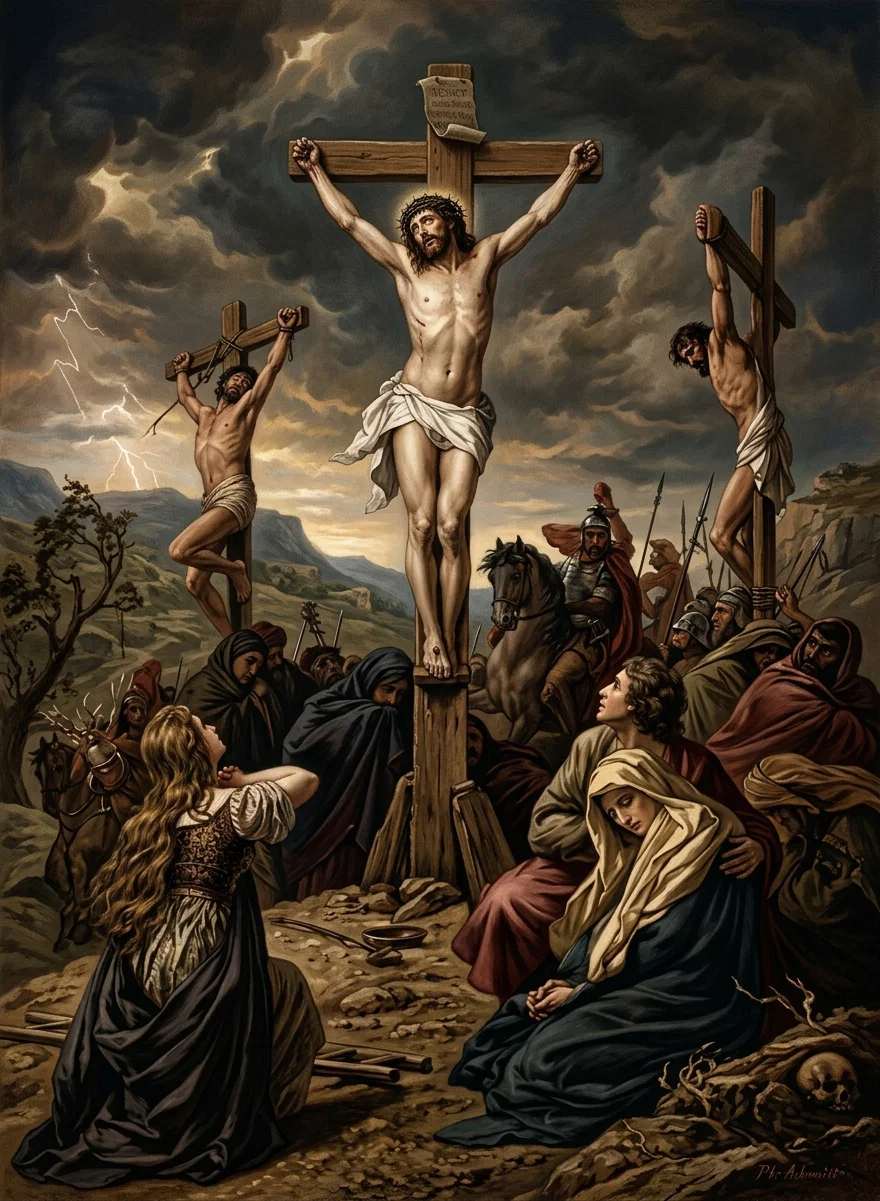
NOTE.—Mark the position of the Sabbath law in the middle of the Decalogue, that recognized compendium of all morality. If it were placed at the beginning or end of the law, man might say that it formed no part of that wonderful document; that it was added by men, was ceremonial in its nature; that it did not stand on the same basis as the other nine precepts, etc. But Divine Wisdom, anticipating all these attempts to belittle the Sabbath, placed it in the very heart of that law; therefore before the impious hands of sacrilege can reach it, three moral walls guarding our duty to God on the one side, and six moral laws guarding our duty to humanity on the other side, must be broken down before the citadel of the Sabbath commandment can be reached. It, like all the others, is eternally moral.
Questions on the Law.
2. What shows that the Sabbath is not at this time a new institution?
“REMEMBER the Sabbath day.”
3. What are we to remember?
“The SABBATH DAY.”
4. For what purpose are we to remember it?
“To KEEP IT HOLY.”
NOTE.—It is therefore evident that the day, the DAY of the REST (for Sabbath means rest), is not made holy by man’s keeping. Man’s keeping does not make it holy; man is to keep holy that which God has made holy.
5. What day of the septenary cycle, or week, is the Sabbath?
“The SEVENTH day.”
6. Whose Sabbath is the seventh day?
“The seventh day is the Sabbath of the LORD [Jehovah] thy God.”
7. What made it the Sabbath, or rest, of Jehovah?
“In six days the LORD made heaven and earth, . . . and rested the SEVENTH DAY.”
8. When did God thus rest?
“Thus the heavens and the earth were finished. . . . And on the SEVENTH DAY God ended [‘finished,’ A.R.V.] His work which He had made; and He RESTED on the SEVENTH DAY from all His work which He had made.” Gen. 2:1, 2.
NOTE.—It is said that God finished His work on the seventh day, because the making of the Sabbath was the rounding-out of that week’s work for man. God’s rest on that day was a part of His week’s making. His rest upon that day of the cycle made that day of the cycle His rest day to all eternity; for the fact of the rest could not be set aside. The rest was a step which Divine Wisdom felt necessary in the institution of a holy rest day.
9. What did He do after resting?
“WHEREFORE the LORD BLESSED the Sabbath DAY, and HALLOWED it.”
“And God BLESSED the SEVENTH DAY, and SANCTIFIED it; BECAUSE that in it He had rested from all His work which God created and made.” Gen. 2:3.
Whatsoever God shall bless can not be reversed. Num. 23:20. He blesses, that the thing blessed may be a blessing. Gen. 12:2. So will God’s Sabbath prove to him who receives it.
NOTE.—“Sanctify” means to set apart to a holy or sacred use, to separate from the common. The sons of Aaron were flesh and blood like their brethren, but God sanctified them, set them apart, separated them from the other tribes unto the priesthood. Ex. 28:41. Mount Sinai was composed of rock and earth like other mountains, but God separated it unto Himself, and made it holy. Ex. 19:23, 12, 13. This sanctifying the Lord did by command; so also He sanctified the Sabbath. Note also that it is THE DAY, ever the DAY, not one day in seven, not a seventh part of time, but the seventh DAY.
NOTE that it was made 2,500 years before there was a Jew, and given to generic man, the head of the race, and hence was for all the race, even as the earth was for all the race.
Memorial and Sign.
11. Of what, then, is the Sabbath a memorial?
“He hath made His wonderful works to be remembered.” Ps. 111:4.
12. How long shall His memorial remain?
“Thy name, O LORD, endureth forever; and Thy MEMORIAL, O LORD, THROUGHOUT ALL GENERATIONS.” Ps. 135:13.
NOTE.—If men had ever been mindful of God’s Sabbath, earth would never have known an idolater. The Maker of heaven and earth would have been kept in constant remembrance.
13. Of what, then, did the Sabbath become a sign?
“And hallow My Sabbaths; and they shall be a sign between Me and you, that ye may KNOW that I am the LORD [Jehovah] your God.” Eze. 20:20.
14. Of what else is it a sign?
“Moreover also I gave them My Sabbaths, to be a sign between Me and them, that they might know that I am the LORD THAT SANCTIFY THEM.” Eze. 20:12.
NOTE.—The only power which can make holy and save the sinner is creative power; therefore the Sabbath becomes a sign of redemption as well as a memorial of creation. God created mankind; He redeems His Israel, His people, out of Egyptian bondage. Therefore to the redeemed the Sabbath comes as a twofold token of creation and of redemption. Compare Ex. 20:11 with Deut. 5:15. The power of redemption is creative power. Eph. 2:10; 2 Cor. 5:17. Even so God made known to His people the fulness of the Sabbath on Mount Sinai. Neh. 9:13, 14.
Jesus and the Sabbath.
15. How did Jesus regard the law of which the Sabbath is a part?
“Think NOT that I am come to DESTROY the law, or the prophets: I am NOT come to DESTROY, but to fulfil. For verily I say unto you, Till heaven and earth pass, one JOT or one TITTLE shall in NOWISE pass from the law, till all be fulfilled. Whosoever therefore shall break one of these least commandments, and shall teach men so, he shall be called the least in the kingdom of heaven: but whosoever shall do and teach them, the same shall be called great in the kingdom of heaven.” Matt. 5:17-19.
“It is easier for heaven and earth to pass, than ONE TITTLE of the LAW to FAIL.” Luke 16:17.
NOTE.—A “jot” is the smallest letter of the Hebrew alphabet. A “tittle” is a distinguishing point of a letter. To fulfil a moral law is to do it. Gal. 6:2. Christ kept the law and died that we might be redeemed to keep it.
16. What works did He say were allowable on the Sabbath?
“It is LAWFUL [according to the Sabbath law] to do well on the Sabbath days.” See Matt. 12:1-12.
17. How did He spend the Sabbath day?
“As His CUSTOM was, He went into the synagog on the Sabbath day.” Luke 4:16.
18. How did His teaching and example affect the women who accompanied Him, even after His death?
“They returned, and prepared spices and ointments; and RESTED the SABBATH DAY according to the commandment.” Luke 23:56.
The First Day of the Week.
19. How many times is the first day of the week found in the New Testament?
NOTE.—Read all these texts. Mark that these scriptures were written all the way from thirty to sixty years after the resurrection, not one of them calls the first day of the week the Sabbath, or a holy day, or the Lord’s day, nor are we told to observe it as a sacred day or in memory of anything. The first six texts refer to the same first day, the one on which Jesus rose from the dead. The seventh text (Acts 20:7) is part of a record of a meeting held on what would be our Saturday night (for the day began at evening), and the next morning Paul spent the light part of that first day in travel. The last text (1 Cor. 16:2) is instruction from the apostle not to take a public collection in the meetings, but that each one was to lay BY HIMSELF, at home, what he could afford to give, that it might be ready when the apostle came. There is an entire absence of Sabbath atmosphere or precept about these scriptures, but rather the opposite.
20. How did His disciples regard the first day of the week?
“They came unto the sepulcher, bringing the spices.” “Two of them went that same day to a village called Emmaus, which was from Jerusalem about threescore furlongs” (seven and one-half miles). Luke 24:1, 13.
21. In any of their gatherings did they meet to celebrate His resurrection?
“And they, when they had heard that He was alive, and had been seen of her, BELIEVED NOT. After that He appeared in another form unto two of them, as they walked, and went into the country. And they went and told it unto the residue: NEITHER BELIEVED THEY THEM. Afterward He appeared unto the eleven as they sat at meat, and UPBRAIDED THEM with their UNBELIEF and HARDNESS OF HEART, BECAUSE THEY BELIEVED NOT them which had seen Him after He was risen.” Mark 16:11-14. See also Luke 24:36, 37, 41.
22. Why did they come together (John 20:19) on the close of this day?
It was the common “abode” of “Peter, and James, and John, and Andrew, Philip, and Thomas, Bartholomew, and Matthew, James the son of Alphæus, and Simon Zelotes, and Judas the brother of James.” Acts 1:13.
The Lord’s Day.
23. How many times does “the Lord’s day” occur?
“I was in the spirit on the Lord’s day.” Rev. 1:10.
NOTE.—This is the only time in the Lord’s Book that the term “Lord’s day” occurs. That text, or its context, does not tell us what day is the Lord’s day. We must learn that from other Scriptures in the Lord’s Book.
24. What day does the Lord call His?
“If thou turn away thy feet from THE SABBATH, from doing thy pleasure on MY HOLY DAY.” Isa. 58:13.
25. What day is the Sabbath?
“The seventh day is the Sabbath of the Lord thy God.” Ex. 20:10.
26. Of what day does Christ call Himself Lord?
“The Son of Man is Lord also of the Sabbath.” Mark 2:28. (According to the Lord’s Book, then, what day is the Lord’s day?)
The Teaching of the Apostles.
27. What is sin?
Jesus died to save men from sin, from the transgression of the law. Matt. 1:21; Titus 2:14. He therefore died to make men law-keepers, Sabbath-keepers, worshippers and servants of God.
“Sin is the transgression of the law.” 1 John 3:4.
“Nay, I had not known sin, but by the law: for I had not known lust, except the law had said, Thou shalt not covet.” Rom. 7:7.
“Whosoever shall keep the whole law, and yet offend in one point, he is guilty of all. . . . Now if thou commit no adultery, yet if thou kill, thou art become a transgressor of the law.” James 2:10, 11.
28. For what did Christ come?
“And ye know that He was manifested TO TAKE AWAY OUR SINS; and in Him is no sin.” 1 John 3:5.
“This is the love of God, that we keep His commandments; and His commandments are not grievous.” 1 John 5:3.
30. What, then, will faith do in our hearts?
“Do we then make void the law thru faith? God forbid; yea, we establish the law.” Rom. 3:31.
31. What will God’s people do in that world to come?
“For as the new heavens and the new earth, which I will make, shall remain before Me, saith the Lord, so shall your seed and your name remain. And it shall come to pass, that from one new moon [month, Rev. 22:2] to another, and from one SABBATH TO ANOTHER, shall all flesh come to worship before Me, saith the Lord.” Isa. 66:22, 23.
The Sabbath Law.
“Remember the SABBATH DAY, to keep it holy. Six days shalt thou labor, and do all thy work; but the SEVENTH DAY is the SABBATH of the LORD thy God; in it thou shalt not do any work, thou, nor thy son, nor thy daughter, thy man servant, nor thy maid servant, nor thy cattle, nor thy stranger that is within thy gates; for in SIX DAYS THE LORD made heaven and earth, the sea, and all that in them is, and RESTED the SEVENTH DAY; WHEREFORE the LORD BLESSED the SABBATH DAY, and HALLOWED IT.” Ex. 20:8-11.
Obedience to Law.
By Chas. G. Finney
UNNECESSARY legislation is invalid legislation. Unnecessary government is tyranny. It can in no case be founded on right. It should, however, be observed that it is often, and in the government of God universally, true that the sovereign, and not the subject, is to be the judge of what is necessary legislation and government. Under no government, therefore, are laws to be despised or rejected because we are unable to see at once their necessity, and hence their wisdom. Unless they are palpably unnecessary, and therefore unwise and unjust, they are to be respected and obeyed as a less evil than contempt and disobedience, tho at present we are unable to see their wisdom. Under the government of God there can never be any doubt nor of course any ground for distrust and hesitancy as it respects the duty of obedience.—Rev. Chas. G. Finney.
Vanity Versus Moral Aspiration
By Henry Ward Beecher
VANITY makes us wish to be superior to others; moral aspiration, to be superior to ourselves.—Henry Ward Beecher.
Christ and the Law.
On Matt. 5:17, Wesley has the following note; the scripture in Italics, the comments in Roman:
“Think not—do not imagine, fear, hope, that I am come—like your teachers—to destroy the law or the prophets. I am not come to destroy—the moral law—but to fulfil—to establish, illustrate( and explain its highest meaning, both by My life and doctrine.”
The first part of the fourth chapter of Romans was considered in the study last week. In those first verses of the chapter it was learned that Abraham found righteousness from God thru faith. The “law of faith” that brought this righteousness was considered, showing that God has provided a “law of faith” that is as definite in its operations as any of the so-called “laws of nature.” Verses nine to twelve of this fourth chapter tell the condition that Abraham was in when he received the gift of righteousness, and read as follows:
“Is this blessing then pronounced upon the circumcision, or upon the uncircumcision also? for we say, To Abraham his faith was reckoned for righteousness. How then was it reckoned? when he was in circumcision, or in uncircumcision? Not in circumcision, but in uncircumcision: and he received the sign of circumcision, a seal of the righteousness of the faith which he had while he was in uncircumcision: that he might be the father of all them that believe, tho they be in uncircumcision, that righteousness might be reckoned unto them; and the father of circumcision to them who not only are of the circumcision, but who also walk in the steps of that faith of our father Abraham which he had in uncircumcision.”Rom. 4:9-12.
The foregoing verses form a strong basis for hope to every individual that is born into this world. God did not require Abraham to become perfect before He bestowed the blessing of righteousness upon him. But it was right while he was in the condition of a sinner, it was while he was in uncircumcision, that he received the gift of righteousness.
Unless men can be helped as sinners, there is no hope for them, “for all have sinned, and fall short of the glory of God.” Rom. 3:23. Many a person has sunk into despair beneath his load of guilt and sin, feeling that he could not be saved for the reason that he had been so sinful. It appears to him that his life has been so dark with the deeds of unrighteousness that he can never approach the throne of God’s grace to ask for pardon and cleansing. He tortures himself continually with the question, Can God extend His salvation to one who is so blackened by sin as I am?
God sends His word to every soul. That word reveals His perfect and glorious righteousness, and causes the sinner to feel his load of guilt. As this load of sin rises before the sinner it has the tendency to cause an indescribable despair, and if we are not careful, Satan will come in right at this time to discourage and dishearten the one whose mind is made to see and feel the enormity of sin. Satan’s effort is first to keep people thinking that sin is not so very bad; he tries to have us think that we have not been very wicked after all. But when God’s law reveals the sinfulness of sin, and shows it in all its hideous enormity, then he turns his tactics and tries to have us feel that we have been indeed so very wicked that there is no cleansing for us. He would impress us with the idea that we are absolutely without hope in the world.
But observe how successfully Satan is met by the promises of the Lord. “But to him that worketh not, but believeth on Him that justifieth the ungodly, his faith is reckoned for righteousness.”Rom. 4:5. “For while we were yet weak, in due season Christ died for the ungodly. For scarcely for a righteous man will one die: for peradventure for the good man some one would even dare to die. But God commendeth His own love toward us, in that, while we were yet sinners, Christ died for us.”Rom. 5:6-8. God takes the ungodly man who repents, and justifies him—He makes him righteous. God takes the man who is weak, He takes the man while he is yet a sinner, and commends His wonderful love by giving His Son to die for the hopeless and helpless erring one.
In another one of his epistles, the apostle Paul says:
“Faithful is the saying, and worthy of all acceptation, that Christ Jesus came into the world to save sinners; of whom I am chief: howbeit for this cause I obtained mercy, that in me as chief might Jesus Christ show forth all His long-suffering, for an ensample for them that should thereafter believe on Him unto eternal life.”1 Tim. 1:15, 16.
Christ Jesus came into the world to save sinners. He did not come to save righteous men, for the simple reason that they would not need salvation; they had never been lost. But there are no men righteous by nature in this world, for “all have sinned, and fall short of the glory of God.” And so all this wonderful, abounding love of God is bestowed upon men while they are yet sinners, and all for the purpose of leading them to forsake their sins and come to Him for the satisfaction and joy that there is in His righteousness.
Abraham’s faith, then, came to him while he was in uncircumcision, and this was all for the purpose, according to the text quoted at the beginning of this article, “that he might be the father of all them that believe, tho they be in uncircumcision, that righteousness might be reckoned unto them.”
God knew beforehand all the difficulties that would surround the man who is loaded with sin. He knew that when he would try to break away from that sin he would be held in chains that it would seem impossible to break, and so the Lord surrounds the sinner with a wealth of promise. He shows him that he can not make himself righteous in order that he may be fit to come into the presence of God; but on the other hand, the Lord stands ever ready to reckon His own righteousness unto the one that believes, and this righteousness that the Father Himself furnishes makes the adequate preparation of character that is presentable in the court of the Eternal.
We can never reason out how the Lord can take a sinner and make him righteous. We can not reason out how the Lord can do away with all of a man’s past life and place in its stead the perfect life that Jesus lived. Neither can we reason how it is that a grain of corn and a grain of wheat and a grain of barley and an acorn may all be planted in exactly the same soil and have exactly the same conditions, and yet each will produce its kind perfectly. The acorn produces the oak, and the grain of wheat produces a stalk of wheat by a law that never fails or varies. How can this always be the case when the soil and the air and the moisture that surround these seeds are exactly the same? We may place the grain of wheat or the acorn in any soil that we like and each will always produce its kind. Changes of soil or climate do not change the unalterable law that whatsoever we sow we shall also reap. But if we ask how this can be, we do not find any man wise enough to answer or to even give a surmise as to the “how” of it.
No more can we tell how the Lord can take the sinner and thru faith produce within him a perfect character, and thus fit him to dwell eternally with the “saints in light!” We may not know how it can be, but we can have the blessed knowledge that it is so. And that is the experience that each one of us should seek. We should gain the reality of the knowledge, and in the endless development of the knowledge of Christ in the great circuit of eternity we may have time to find out something about how it is done. T.
Studies in the Book of Daniel
God the Judge
The Feast of Belshazzar.
By His prophet Jeremiah the Lord declared that with the second generation from Nebuchadnezzar the end of Babylon would come, and the great empire which had spoiled the nations should be spoiled of them. Jer. 27:7. The fifth chapter of Daniel, our present study, records the termination of that kingdom, which had, to a greater or less extent, molded the world from the time of its founding by Nimrod. Gen. 10:8-10; 11:1-9.
Nebuchadnezzar closed his glorious reign, a converted man, in the year B.C. 561. He was succeeded by his son, Amil-Marduk (servant of Marduk), the Evil-Merodach of the Bible, whose brief reign ended in B.C. 560. The chief thing of note recorded of him is that he, in the first year of his reign, took the Hebrew king, Jehoiachin, out of prison and extended to him royal favor. 2 Kings 25:27-30; Jer. 52:31-34. For this he seems to have aroused the wrath of the hierarchal, or national, party, and he fell a victim to assassination.
The plot to assassinate was devised by Nergal-shar-usur (Neriglissor), and executed at his command. He had been an influential9man at court early in the days of Nebuchadnezzar’s reign. He had married one of the great king’s daughters, and was therefore brother-in-law to Evil-Merodach, whose death he caused and whom he succeeded. The tablets indicate that he had been prominent in affairs of commerce and diplomacy. He was a devout idolater, expending large sums in building and repairing the temples of the gods. He lived in the palace of Nebuchadnezzar, and followed that great king in his works of improvements. Notwithstanding his prayers for long life, which he has left on record, his reign ended in B.C. 556. He was succeeded by his son, Labashi-Marduk (Laborosoarched), who was but a mere child. A conspiracy was formed against the youth, and he was killed at the end of nine months. Thus retribution was quickly visited upon the house of Neriglissor.
The conspirators chose as a king Nabonadius, “a man of distinguished position,” a native Babylonian, and a man of piety even beyond those who preceded him. His energies seem to have been exhausted in the building and restoration of temples, going oftentimes to the original foundations, finding on the foundation bricks the names of the first builders. The affairs of state and defense of his kingdom seem to have been secondary matters. As Rogers puts it: “In the crucial hour of his country’s history, his whole thought was of gods, not of men. He would save gods, men might save themselves as best they might.” One of his chief works was the rebuilding of the temple of the sun—E-babbara—in Sippar, in honor of his sun-god Shamash.
During the last three years of his reign, which closed in B.C. 538, he associated with himself as joint ruler, Bel-shar-usur (Belshazzar), his son by a daughter of Nebuchadnezzar. For years the captious, unbelieving critics had contended that Daniel’s record had no foundation for naming Belshazzar as the last king of Babylon. Those who believed the Bible had endeavored to identify him with Evil-Merodach and Nabonadius. But tablets left by Nabonadius, containing prayers of his, show the Scripture record to be correct. Belshazzar’s last year marks the close of the great empire of Babylon.
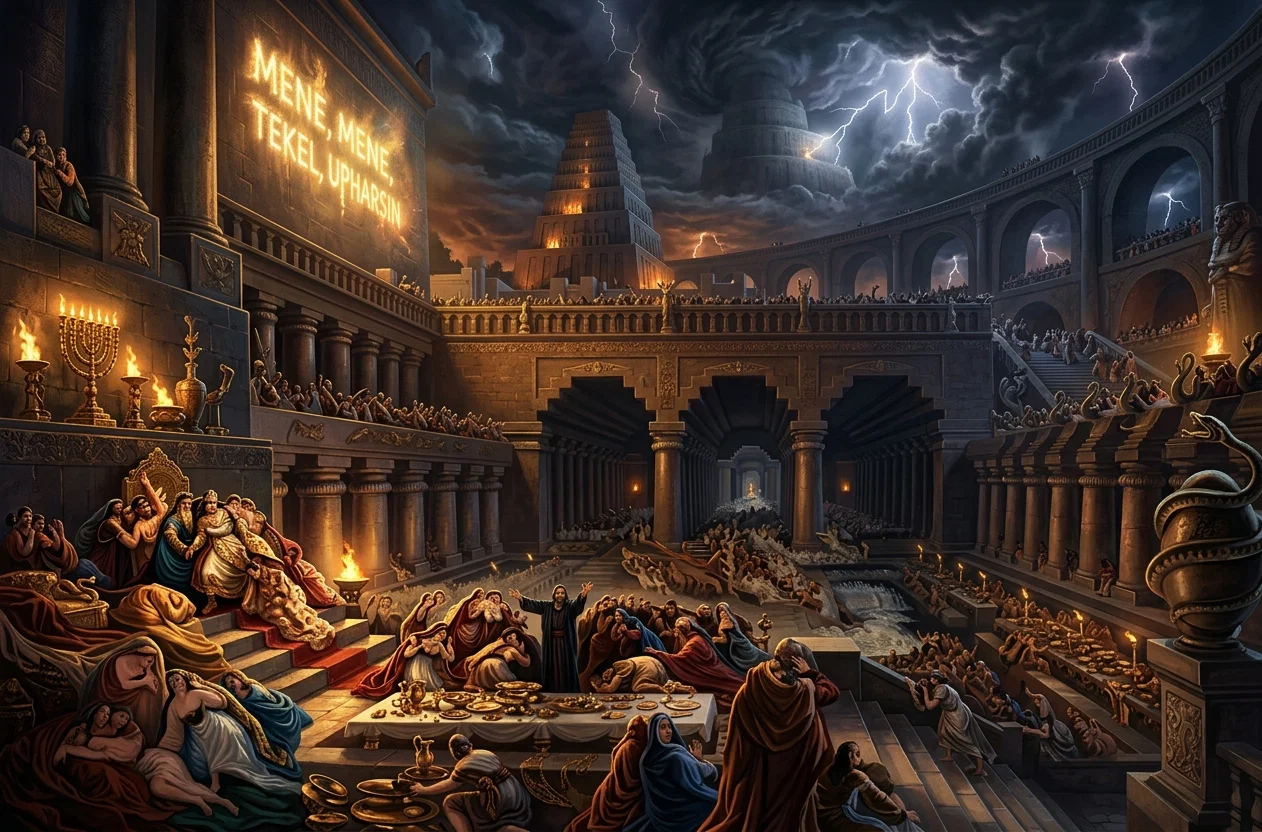
Belshazzar’s Feast. J. Martin.
Two Opposite Examples.
Belshazzar’s great feast to a thousand of his lords was evidently at a great festival of the gods. The degeneracy of Babylon is clearly indicated by this royal revel. Four and one-half centuries before, the wise king of Israel had written: “Wo to thee, O land, when thy king is a child, and thy princes eat in the morning! Blessed art thou, O land, when thy king is the son of nobles, and thy princes eat in due season, for strength, and not for drunkenness!” Eccl. 10:16, 17. The exemplification of that truth on its good side had been before Babylon from the beginning of the reign of Nebuchadnezzar in the course of the four young Hebrews, notably Daniel, who had occupied such prominent positions in the empire. Pure and untarnished in character, noble and generous and upright in all conduct, uncontaminated by the corruptions and plots and counterplots of the empire, these men from their youth had stood forth shining examples of sobriety, temperance, and righteousness.
In Belshazzar was exemplified the opposite side. No greater curse can come upon a land than to have its young men reared in wealth and ease and idleness and debauchery. When that time comes, that land is near its fall. Such a time had come to Babylon; and her king was leading in the revelings and licentiousness of gross nature-worship. Lifted up in his drunken, bestial madness, he commands that the holy golden and silver vessels taken from the temple in Jerusalem should be brought, that he and his nobles, wives, and concubines might drink to the gods of Babylon. In this sacrilegious act of the profanation of the sacred vessels, to which no other king of Babylon had presumed, Belshazzar filled up the cup of Babylon’s iniquity, and demonstrated her unfitness to reign longer. There were nobles at that feast, doubtless, who had heard the interpretation of Nebuchadnezzar’s dream (Daniel 2), it was only about threescore years before—but they remembered it not. There were great men present who saw the great golden image, the fiery furnace, and the manifestation of the power of that God10they were then dishonoring,—less, probably, than fifty years previous,—but they heeded not the lesson. There were many more at that lascivious feast of Tammuz and Ishtar who knew of Nebuchadnezzar’s seven years’ humiliation under the hand of the Most High, and the king’s subsequent royal proclamation,—it was but three decades in the past,—but they protested not at the sacrilege of the king and his courtiers. The holy candlestick was filled and lighted (Dan. 5:5); the holy vessels were filled with wine drunk to the impure rites of the Babylonian Adonis and Venus. The revel was at its height; all were mad with reckless mirth.
The Divine Sentence.
All at once, over on the palace wall, before the candlestick, are seen fingers,—only fingers,—writing, in letters of light, words which the king can not read, but which he feels foretell his doom. Only four words are written, but the erstwhile mad revelers are pale and trembling. Wise men are called, but they can neither read nor interpret the blazing words which are burning themselves into the now sobered king’s heart. A promise is made that he who interprets them shall be clothed in royal purple, shall bear the gold chain of authority, and shall be third ruler in the kingdom.
It required more than human wisdom to interpret the divine sentence. In God’s providence Daniel was again brought forward by Nitoeris, the queen-mother. He told in brave faithfulness of how God had warned Babylon thru Belshazzar’s ancestor, Nebuchadnezzar; of how that mighty king had, in his humiliation, been forced to acknowledge all this; yet, in the face of all these great facts, which Belshazzar knew, he had not only not learned the lesson, but had lifted up his puny self against that God who ruled in the kingdom of men, and upon whom he was dependent for his very breath. God had warned Babylon of its certain doom. Belshazzar had placed himself upon the judgment-seat and defied God. Now God had come to judgment on Babylon. “And this is the writing that was written:
“MENE, MENE, TEKEL, UPHARSIN.”
Only four words, but how pregnant with meaning. Literally translated, they read,—
NUMBERED, NUMBERED, WEIGHED,
DIVISIONS.
And this is the interpretation:
“God hath numbered thy kingdom, and brought it to an end.”
“Thou art weighed in the balances, and art found wanting.” “Thy kingdom is divided, and given to the Medes and Persians.”
The whole lewd feast of Belshazzar is so forcibly and beautifully expressed by the poet, that we feel constrained to here repeat it:
“Belshazzar is king, Belshazzar is lord;
And a thousand dark nobles all bend at his board;
Fruits glisten, flowers blossom, meats steam, and a flood
Of the wine that man loveth runs redder than blood.
Wild dancers are there in a riot of mirth;
With a beauty that maddens the passions of earth;
And the crowds all shout till the vast roofs ring,—
‘All hail to Belshazzar, Belshazzar the king!’
“‘Bring forth,’ cries the monarch, ‘those vessels of gold
Which my father brought forth from the temple of old.’
They are brought, and before him the vessels all shine;
And they bow unto Baal, and they drink the dark wine,
While trumpets all bray, and loud cymbals ring,—
‘All hail to Belshazzar, Belshazzar the king!’
“‘But what cometh? look! without menace or call,
What writes with the lightning’s bright hand on the wall?
What pierces the king like the point of a dart?
What drives the bold blood from the cheek to the heart?—
‘Chaldeans, magicians, the letters expound!’
They are read, and Belshazzar is dead on the ground;
For the Persian is come on the conqueror’s wing,
And a Mede’s on the throne of Belshazzar the king.’”
The revel is over. The army of Medes and Persians, under Cyrus, the great conqueror, seems not to have then been with it, is at the gates. Yes, more; they are even then marching into the city, with no leaders, no army to resist them. Nabonadius is at Borsippa where he surrenders. At Babylon, the very night of the shameless feast, Belshazzar is slain.
Darius the Mede.
The record continues. “And Darius the Mede received the kingdom, being about threescore and two years old.” Verse 31, A.R.V. Who Darius is, is a query over which there has been, and is, as much discussion as was waged over Belshazzar. In Dan. 9:1 he is said to be “the son of Ahasuerus, of the seed of the Medes, which was made king over the realm of the Chaldeans.” He has been identified with a half dozen, more or less, but there is no settled evidence outside of Scripture as to his existence. Some of the critics have declared that no such person reigned in any such power as indicated in Daniel; but we may rest assured that the record of Daniel will be as certainly vindicated as in the case of Belshazzar. As far as now known, the facts seem to be these:
1. Ahasuerus is identical with Astyages, king of the Medes, the grandfather of Cyrus.
2. Astyages was especially noted for his cruelty and inhumanity. When Cyrus came to the throne of Persia, he revolted, and in conjunction with Tigranes of Armenia, and the many foes of Astyages in his own government, defeated the Median king, and united the two kingdoms.
3. In a most politic way Cyrus did not assume the throne of Media at once, but to win the Medes, placed the son of Astyages, Cyarxes II, on the throne, or some other Median prince, called by Daniel, Darius.
4. This action of Cyrus is indicated by Dan. 9:1, which states that Darius was made king; and Dan. 5:31, that he received the kingdom.
5. He was then sixty-two years old, having no heirs. When he died, Cyrus became ruler of both kingdoms. Whatever light there is yet to be thrown upon the question, the Bible believer may be assured that the Scriptures will be confirmed.
The Lesson.
This chapter has its great lesson: “Jehovah judgeth among the nations.” He as truly is the Judge of every soul. Men may deny it; men may hide it from their eyes; they may shut it out of their hearts by greed and lust and pleasure; but sometime, sooner or later, the hand of God will write upon the palace wall of every sinful, impenitent soul,—
NUMBERED, WEIGHED, WANTING.
Now, the blessed, golden now, is the time for all to examine themselves whether they be in the faith. Cast out the sin. Let every soul, let the church of Jesus Christ, empty from the holy vessels of God’s cleansing and choosing the wine of Babylon’s fornication, and let God fill them with the water of life. Let those who profess to be Christ’s disciples cast from them the idolatrous feasting of Babylon’s gluttony and lewdness, and feed upon the pure word of God. The great Jehovah waits to be gracious; but soon will He send the Righteous One. Are you ready for His sentence? You may be ready, clothed in the righteousness of Jesus Christ.