Your ShelfYour Projects

Signs of the Times, Vol. 36, No. 12.

BE BRAVE

Signs of the Times

Mar 24, 1909

Pacific Press Publishing Association · Mountain View, California · Mar 24, 1909

BE BRAVE

By ELIZA H. MORTON
O heart so weak and selfish, Fearful of pain, This life is not all gladness And oft again You'll bask within the sunlight, Feel beating rain. Be brave to-day, Be brave alway.
Beat back the clouds of darkness, The drifting sand, And struggle through the billows To solid land: So shall the palm of victory Be in thy hand. Be brave to-day, Be brave alway.

Question Corner

[All proper questions on Bible and history will be answered on this page as soon as possible after receiving them. This will sometimes mean a month or more. We can not promise to reply to the same question often. Let those who ask read other answers; they may find reply to their own. Always enclose stamp if answer is required. Those outside our Bible Band, please enclose ten cents. This does not begin to meet expenses oftentimes. “Foolish . . . questions avoid.”]

2779.—Tithing and Conscience.

When a man’s conscience does not permit or prompt him to contribute a tenth as above mentioned, are we to conclude such a one has an unenlightened conscience? How may individuals become enlightened to that end? F.
Simply by the word of God. “To the law and to the testimony; if they speak not according to this word, it is because there is no light in them.” “Why call ye Me, Lord, Lord, and do not the things which I say?” The word of God, if it is worth anything at all, is worth all that it professes to be. It is designed to lead us beyond our own human conscience, our weak human selfishness, our own human desires and limitations. In this respect it differs from all the so-called natural religions which are built upon man’s desires and man’s ambitions. The word of God, if man will follow it, leads him continually out from himself into new fields. God has given instruction to be followed. The only way to do with a conscience that does not see that, is to bring it to God’s word; let the conscience take that word home and be molded in harmony therewith. That is the way we test our watches and our clocks, by standard timepieces. The clock would run along just as joyfully and gleefully, striking the hours out of tune with the standard without any trouble at all. Still we would not allow it; we would say the only way for that clock to do is to fall into line, be turned back or turned forward as the case might be. So we would say to the soldier who is marching outside of the orders of his captain. He might say that his conscience did not trouble him if he were out of step, or out of line, or behind, or crowding ahead, but he would be told that his soldier conscience must conform to the orders of his captain. Surely if that be true in human things, how much more ought it to be in things divine?

2780.—Traditions. 2 Thess. 2:15.

What is meant by “the traditions which ye have been taught, whether by word, or our epistle,” in 2 Thess. 2:15? A. P.
The Greek word means “transmission.” That is, something handed on. The source of the tradition is the real question, and not the mere word itself. The traditions which the apostle Paul wanted the Thessalonians to remember was what had been taught them by himself, and the word of God. It was not that tradition of which Jesus speaks in Matthew 15, which made void the word of God. And there is no ground whatsoever in the text for the contention of the Roman Catholic Church, that tradition is equal to Scripture. Tradition must be tested by the Scripture.

2781.—As the Lord Hath Prospered.

Does the apostle Paul’s admonition as given in 1 Cor. 16:2 conflict with the teaching of some that it is the duty of church-members as Christians to give a tenth to the work of the Lord of earnings or income? Does it not remain with the individual church-member to judge of his or her prosperity and the measure thereof? F. F. F.
We do not see how 1 Cor. 16:2 conflicts with the duty of tithing. The thought of the tithing is that the tithe is not ours; “the tithe is the Lord’s.” That is no matter of our giving at all. We do not give what belongs to some one else. The man who runs a farm on shares does not give to the proprietor of the farm his share. The man who observes the Sabbath of the Lord does not give to God a seventh part of his time. That belongs to God. The tithe belongs to the Lord. He tests man in a twofold way; by time and by means. If man meets these tests, he will almost invariably meet the other tests which may come.
The giving of 1 Cor. 16:2 is another matter, in which a man is giving of his own and which he was to “lay by himself” from week to week as he was able, so that when the apostle came for the missionary gatherings he could receive what was held for him. There are those who think that the text pertains to the tithe itself, but it seems to us very clear from other Scriptures that it was a free-will offering.

2782.—The First Day of the Week.

Please explain John 21:19. One says, “Early in the morning,” the other, “In the evening of the same day.” Now if the Sabbath commenced at sundown, how could it be the same day? M. L. W.
The first verse of the chapter refers to the early morning of the first day of the week. There were two evenings of the day. See Ex. 12:6, margin, “between the two evenings.” The first evening coming at 3 o’clock; the last evening at sunset. When the first evening arrived, the day was spoken of as evening. On the evening of that day just before sunset doubtless the disciples gathered together. It really was not until the next day began that Jesus met with them. You will see how this is by reading the 24th chapter of Luke. Two disciples went down to Emmaus the afternoon of that day, and there Jesus was made known to them in the breaking of bread. Then they returned and met with the twelve who were gathered together at Jerusalem. When they first gathered together it was doubtless in the closing hour of that first day, but when Jesus met with them they had already passed over into the second day of the week.

2783.—Idle Songs.

Please tell me if the singing of idle songs is mentioned in the Bible, and where. Are all songs that are not sacred called idle songs? If so, is it wrong to sing any other songs than sacred songs? 343.
Idle songs, doubtless, are covered by such expressions as Matt. 12:36: “Every idle word that men shall speak, they shall give account thereof in the Day of Judgment.” And Eph. 5:4, “Nor filthiness, nor foolish talking, nor jesting, which are not befitting.” There are songs of excellent sentiment which could not be called idle songs, the singing of which is elevating and the music good. Singing such songs as “America,” for instance, at the proper time and place could not be considered singing idle songs. Songs of home, and songs of ennobling sentiment, sung on proper occasions, would not be considered idle, foolish songs. There are songs which are made up of idle, foolish, senseless words, and the enlightened conscience of a Christian ought to tell him that such songs should be let alone. In such matters “silence is golden.”

2784.—Authorship of the Pentateuch.

Kindly state authorship of Genesis, Exodus, Leviticus, Numbers, and Deuteronomy. These are usually ascribed to Moses, but there seems to have been some written by others. F. S. D.
The greater part of all of these books was doubtless written by Moses, as generally ascribed to him, and yet there are some things which would indicate that a later hand added some things, as Moses’ death, for instance, which may have been written by Joshua, perhaps by Eleazar the priest. Parts of these books may have been from other writings which Moses embodied in his. There seems to be evidence that this is the case. That does not vitiate it in any way. We have the authority of inspiration for it all.
We are aware of the composite authorship which the critics give it, the patch-quilt pattern which the polychrome Bible makes of it, a great deal of which is absurd, and is so considered by some of the very best critics. Some of it is on the supposition that one has only one style in writing, that certain words he would not have used, etc. There is no question whatever, but many of the laws in these books were recognized by nations around Israel; that would be true in the very nature of the case. The laws to Israel were, however, vastly superior. When God gave these scriptures to Israel, He selected with His laws those providential dealings with His children which would leave on record for them the most useful lessons for all time to come. These books were first of all given by the guiding hand and inspiration of the Spirit of God, and the one largely through whom they were given was Moses, with perhaps some additions by Eleazar, or Joshua, after Moses’ death.

2785.—Lazarus.

  1. Was Lazarus the first man that Christ raised from the dead? Mr. Sunday says he was.
  2. Did Christ mean Lazarus the brother of Martha and Mary in the parable of the rich man and Lazarus?
J. J.
No, Lazarus was not the first man that Christ raised from the dead. Luke 7 gives us a record previous to the resurrection of Lazarus in the raising of the son of the widow of Nain. Luke 7:11-17.
Secondly, the Lazarus who was raised from the dead is not the Lazarus of the parable of the rich man and Lazarus. The Lazarus who was brother of Martha and Mary seems to have been the son of a wealthy Jew, and was not poor or in such a condition as the Lazarus of the parable was. The Lazarus of the parable is simply a typical case, and is so considered by good Bible expositors. Jesus used two persons as types of the Jews and Gentiles. The rich man the type of the Jew who felt himself rich in everything spiritual, and who classed the Gentile as the very opposite, and Lazarus representing the Gentile who was hungry for the spiritual riches which Christ would give. The name Lazarus may have been used by our Lord because of its meaning—“Whom God aids.” Lazarus in Greek is the same as Eleazar in Hebrew.

2786.—Seeing God.

All these expressions concerning the seeing of God are very easily comprehended if we will but understand that those passages which speak of “no man hath seen, or can see God,” are spoken of God’s revealing Himself in His transcendent glory, as He really is. Gen. 32:20 refers to Christ the representative of the Father, but appearing to Jacob as an angel. His form was revealed in that of a servant, the angel. In Ex. 24:10, 11 God was seen, but not His face; and here, too, it was probably Christ as the representative of the Godhead. They beheld not that of God, His face, which reveals His ineffable glory. Compare this passage with Ex. 33:20-23. No man has beheld God’s transcendent glory. He could not look upon it and live.

2787.—Descendants of Canaan.—W. S.

Gen. 9:25-28 is a prophecy of what would come to Canaan’s descendants because of the character which they inherited from their father. It was not something which God said He would cause, but a prophecy of what would logically follow. This has been manifest through all the centuries in the enslavement of the dark race—descendants of Canaan. Japheth was the one from whom the white race came. Shem was the one from whom came the Assyrians and other great races, but as they passed away, Japheth took their place and so became the dominant race.

2788.—W. S.—Matt. 11:12.

The meaning of Matt. 11:12 is simply a statement that only the tremendously earnest (those of whom Jesus says in another place “strive to enter in at the strait gate”) would truly enter in. “Agonize” is the Greek word. Those who agonize to enter in, those who are willing to put forth effort themselves in seeking God, would be the ones who would give up everything, break through everything, cast off everything that hindered, in order that they might win God.

“Blessed Are the Meek”

By Mrs. E. G. White
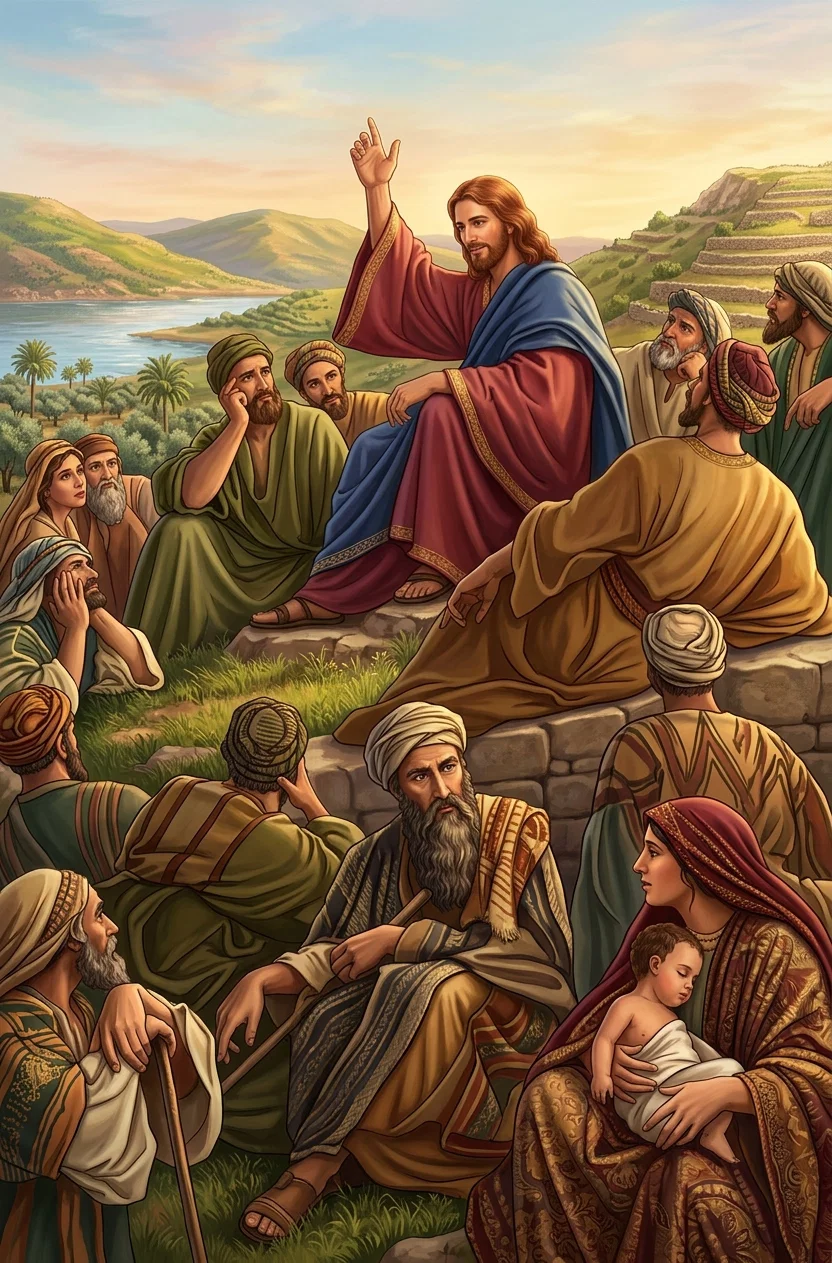
THE SERMON ON THE MOUNT.
THROUGHOUT the beatitudes there is an advancing line of Christian experience. Those who have felt their need of Christ, those who have mourned because of sin, and have sat with Christ in the school of affliction, will learn meekness from the divine Teacher.
Patience and gentleness under wrong were not characteristics prized by the heathen or by the Jews. The statement made by Moses under the inspiration of the Holy Spirit, that he was the meekest man upon the earth, would not have been regarded by the people of his time as a condemnation; it would rather have excited pity or contempt. But Jesus places meekness among the first qualifications for His kingdom. In His own life and character the divine beauty of this precious grace is revealed.
Jesus, the brightness of the Father’s glory, thought “it not a thing to be grasped to be on an equality with God, but emptied Himself, taking the form of a servant.” Through all the lowly experiences of life He consented to pass, walking among the children of men, not as a king, to demand homage, but as one whose mission it was to serve others. There was in His manner no taint of bigotry, no cold austerity. The world’s Redeemer had a greater than angelic nature, yet united with His divine majesty were humility and meekness that attracted all to Himself.
Jesus emptied Himself, and in all that He did, self did not appear. He subordinated all things to the will of His Father. When His mission on earth was about to close, He could say, “I have glorified Thee on the earth: I have finished the work which Thou gavest Me to do.” And He bids us, “Learn of Me; for I am meek and lowly in heart.”
“If any man will come after Me, let him deny himself,” let self be dethroned, and no longer hold the supremacy of the soul.
He who beholds Christ in His self-denial, will be constrained to say, as did Daniel, when he beheld One like the sons of men, “My comeliness was turned in me into corruption.” The independence and self-supremacy in which we glory, are seen in their true vileness, as tokens of servitude to Satan. Human nature is ever struggling for expression, ready for contest; but he who learns of Christ is emptied of self, of pride, of love of supremacy, and there is silence in the soul. Self is yielded to the disposal of the Holy Spirit. Then we are not anxious to have the highest place. We have no ambition to crowd and elbow ourselves into notice; but we feel that our highest place is at the feet of our Saviour. We look to Jesus, waiting for His hand to lead, listening for His voice to guide. The apostle Paul had this experience, and he said, “I am crucified with Christ; nevertheless I live; yet not I, but Christ liveth in me; and the life which I now live in the flesh, I live by the faith of the Son of God, who loved me, and gave Himself for me.”
When we receive Christ as an abiding Guest in the soul, the peace of God, which passeth all understanding, will keep our hearts and minds through Christ Jesus. The Saviour’s life on earth, tho lived in the midst of conflict, was a life of peace. While angry enemies were constantly pursuing Him, He said, “He that sent Me is with Me; the Father hath not left Me alone; for I do always those things that please Him.” No storm of human or Satanic wrath could disturb the calm of that perfect communion with God. And He says to us, “Peace I leave with you; My peace I give unto you.” “Take My yoke upon you, and learn of Me; for I am meek and lowly in heart, and ye shall find rest.” Bear with Me the yoke of service for the glory of God and the uplifting of humanity, and you will find the yoke easy, and the burden light.

A Destroyer of Peace.

It is the love of self that destroys our peace. While self is all alive, we stand ready continually to guard it from mortification and insult; but when we are dead, and our life is hid with Christ in God, we shall not take neglects and slights to heart. We shall be deaf to reproach and blind to scorn and insult. “Love suffereth long, and is kind; love envieth not; love vaunteth not itself, is not puffed up, doth not behave itselfunseemly, seeketh not its own, is not provoked, taketh not account of evil; rejoiceth not in unrighteousness, but rejoiceth with the truth; beareth all things, believeth all things, hopeth all things, endureth all things. Love never faileth.”
Happiness drawn from earthly sources is as changeable as varying circumstances can make it; but the peace of Christ is a constant and abiding peace. It does not depend upon any circumstances in life, on the amount of worldly goods, or the number of earthly friends. Christ is the fountain of living water, and happiness drawn from Him can never fail.
The meekness of Christ, manifested in the home, will make the inmates happy; it provokes no quarrel, gives back no angry answer, but soothes the irritated temper, and diffuses a gentleness that is felt by all within its charmed circle. Wherever cherished, it makes the families of earth a part of the one great family above.

Do Not Retaliate

Far better would it be for us to suffer under false accusation than to inflict upon ourselves the torture of retaliation upon our enemies. The spirit of hatred and revenge originated with Satan, and can bring only evil to him who cherishes it. Lowliness of heart, that meekness which is the fruit of abiding in Christ, is the true secret of blessing. “He will beautify the meek with salvation.”
“The meek shall inherit the earth.” It was through the desire for self-exaltation that sin entered the world, and our parents lost their dominion over this fair earth, their kingdom. It is through self-abnegation that Christ redeems what was lost. And He says we are to overcome as He did. Through humility and self-surrender we may become heirs with Him, when the “meek shall inherit the earth.”
The earth promised to the meek will not be like this, darkened with the shadow of death and the curse. “We, according to His promise, look for a new heavens, and a new earth, wherein dwelleth righteousness.” “There shall be no more curse, but the throne of God and of the Lamb shall be in it; and His servants shall serve Him.”
There is no disappointment, no sorrow, no sin; no one who shall say, I am sick; there are no burial trains, no mourning, no death, no partings, no broken hearts; but Jesus is there, peace is there. There “they shall not hunger nor thirst; neither shall the heat nor sun smite them; for He that hath mercy on them shall lead them, even by the springs of water shall He guide them.”

The Great Threefold Message

By Roderick S. Owen

IV. “Fear God.”

As was shown in the previous article, the everlasting Gospel of this message is the Gospel of the kingdom, which must be preached in all the world for a witness unto all nations before the end can come. As the angel preaches this Gospel, he says: “Fear God, and give glory to Him; for the hour of His judgment is come.” Rev. 14:7. There is no lack of fear in the world to-day, but it is not the fear of God, hence the need of this admonition, Fear God.
The Saviour in speaking of the days just before His second coming, said: “There shall be signs in the sun, and in the moon, and in the stars; and upon the earth distress of nations, with perplexity; the sea and the waves roaring; men’s hearts failing them for fear, and for looking after those things which are coming on the earth.” Luke 21:25, 26. To-day is this scripture fulfilled before our eyes.
May 19, 1780, God gave the great sign in the sun. This sign was given in such a remarkable manner that it not only fulfilled the Scripture, but has passed into history as “The Dark Day.” On that day the sun was indeed darkened and became black as sackcloth of hair in fulfilment of God’s word. Rev. 6:12. The night following, God gave the sign in the moon, for it became as blood and did not give its light. Rev. 6:12. On Nov. 13, 1833, was witnessed the great meteoric shower, when the stars fell to the earth “even as a fig-tree casteth her untimely figs, when she is shaken of a mighty wind.” Rev. 6:13.
These are in the past, but following these was to be upon earth distress of nations, with perplexity; the sea and the waves roaring; men’s hearts failing them for fear, and for looking after those things which are coming upon the earth. Are these things present to-day?

Evidences of Fear.

“Distress of nations.” Where is the nation to-day that is not facing perplexing questions, both internal and external? Anarchy, socialism, unions, strikes, and such like, within; envy, jealousy, and suspicion, with constantly changing combinations of nations without. To the eye of the observer the slightest move on the part of any nation produces marvelous changes in the national kaleidoscope of Europe and the world. Old perplexities are intensified, new ones produced, and the hearts of nations are filled with fear. Where is the king or potentate to-day upon whose head the crown does not rest uneasily? Where is the ruler who does not realize that the red-handed assassin may any day cross his pathway and lay him low?
Anarchy, surcharged with hatred, fired with zeal, and rendered reckless by indifference to life, is thirsting for the life-blood of the head of every government of earth to-day. So kings’ hearts are failing them for fear. Well may they double their guards and increase their precautions, for in hidden form and oft in friendly guise, the foe is ever seeking them.
Cyclones, devastating storms, and destructive fires are marking out their trails of ruin upon the earth. Furious gales and tidal waves are doing their work of destruction upon the sea. Murder, theft, and robbery are abroad in all lands. Graft sits enthroned and admired. Fraudulent speculation, inflated values, and stock gambling abound. To-day gold is god; and avarice its prime minister. Ambition is the shrine at which many worship, horror the victim, and the masses the devotees. In the face of all these things men’s hearts are failing them for fear and for looking after the things that are coming upon the earth. This fear is finding expression in various ways. Fear of the elements builds cyclone cellars, and earthquake and fireproof structures. In the financial world it demands the best securities for money values, places heavy insurance upon property, and questions the honesty of all. In the social world it organizes societies, forms combines, unions, and federations. Why do capitalists combine against labor? Why are trade unions formed among the toilers? Why is it that almost every branch of business and every line of work have their local organizations, while these in turn are federated with kindred lines of pursuit? The primary reason for all this is found in the fact that men are afraid of what is coming on the earth.

God’s Message of Fear.

In the midst of all this prevailing fear, the message of God is to be heard declaring: “Fear God, and give glory to Him; for the hour of His judgment is come.” The prophet Isaiah, in chapter 8:9-14, after speaking of the confederacies of these last days, says to God’s people: “Neither fear ye their fear, nor be afraid. Sanctify the Lord of Hosts Himself; and let Him be your fear, and let Him be your dread. And He shall be a sanctuary.” And if we are the children of God, why should we fear what they fear? For stormy wind, raging seas, and crumbling earth, are but fulfilling His word. And thieves, robbers, murderers, angry mobs, or even armies of earth, can go only so far as our heavenly Father permits, and surely that is no farther than is for our good. For all things work together for good to them that love God.
The prophet Malachi in speaking of these days said, “Then they that feared the Lord spake often one to another; and the Lord harkened, and heard it, and a book of remembrance was written before Him for them that feared the Lord, and that thought upon His name.” Here we see that those who fear God will talk often to each other. But of what will they talk? Surely of that of which they think. And the text says they think upon His name. So they will talk of His name. But what is His name? His name is Creator, “Who hath measured the waters in the hollow of His hand, and meted out heaven with the span, and comprehended the dust of the earth in a measure, and weighed the mountains in scales, and the hills in a balance,” with whom “the nations are as a drop of a bucket, and are counted as the small dust of the balance: behold, He taketh up the isles as a very little thing.” He calleth all the stars by their names, and bringeth out their hosts by number, so that not oneof them faileth; He made the heavens and the earth, the sea, and the fountains of waters; and He rested on the seventh day, and blessed the seventh day, and sanctified it, and constituted it the memorial of His creative power. Yes, they will talk of His power in creation, of His love in redemption, of His goodness in their daily experiences in His word, of His truth as it is revealed to them. They will think and talk of His character, for His name is His character; and as they thus think and talk, the Lord harkens and hears, for it pleases Him, because by thus beholding they become changed “into the same image from glory to glory.” For “as a man thinketh in his heart, so is he.” As God’s children thus form their characters after His own, He has it written down in His book of remembrance to their credit; “and they shall be Mine, saith the Lord of Hosts, in that day when I make up My jewels; and I will spare them, as a man spareth his own son that serveth him.”
Yes, when the cities of earth shall fall, when the mountains shall be cast into the midst of the sea, when the earth shall be moved out of her place, and the heavens shall depart as a scroll when it is rolled together, not one of God’s children shall be lost, for He shall gather them as jewels, and set them in the crown of His love, where they shall shine as stars in the brightness of the firmament forever.

The Great Day of the Lord

By Marvin Herrick Brown

V. The Earth Made New.

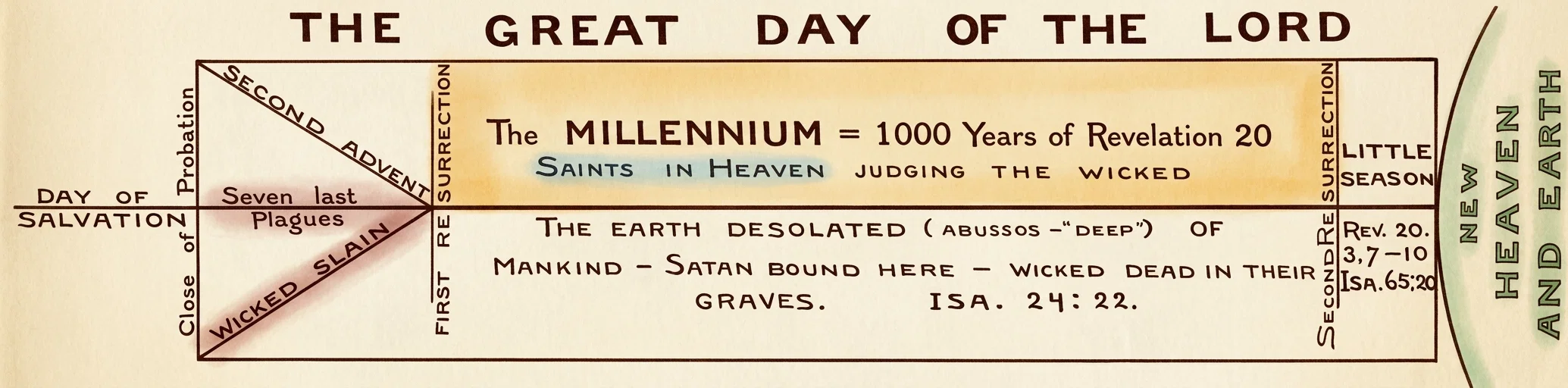
We have found that the great day of the Lord is a day of wrath, of retribution, of destruction, for the enemies of God. It begins with the close of probation, the day of salvation. The first event in the day of the Lord is the pouring out of the seven last plagues, the wrath of God without mixture of mercy. This covers a period of one year. Under the sixth plague the nations are gathered to the battle of Armageddon, and under the seventh plague that great battle is fought. Rev. 16:12-19; Jer. 25:30-33; Rev. 19:11-21.
Then the Saviour comes with power and great glory, and the wicked who were not cut down by the plagues nor slain in “the battle of that great day of God Almighty” (Rev. 16:14), will be consumed with the spirit of His mouth, and destroyed by the brightness of His coming (2 Thess. 2:8). He also takes the saints home with Him, and they reign with Him a thousand years in the heavenly city. At the end of the millennium the wicked are raised from the dead, and Satan gathers them from all parts of the earth to lay siege to the New Jerusalem. A period of time, “a little season” (Rev. 20:3),—how long, the Scriptures do not reveal,—is consumed in this gathering and the preparation for the capture of the city.

The Close of the Great Day.

The great day of the Lord closes with the utter destruction of Satan and all his evil host in the lake of fire, from which arise, in Edenic purity and loveliness, new heavens and a new earth, wherein dwelleth righteousness. 2 Peter 3:10-13. Then the following scriptures will be fulfilled: “The righteous shall inherit the land, and dwell therein forever.” Ps. 37:29. “Wait on the Lord, and keep His way, and He shall exalt thee to inherit the land; when the wicked, are cut off, thou shalt see it.” Verse 34. The stone of Dan. 2:34, 35 then becomes a great mountain, and fills the whole earth. This stone, which represents the kingdom of
God, breaks in pieces the great image, which symbolizes earthly kingdoms, and they are swept away. Verses 44, 45. Christ and His people will then “reign on the earth,” “under the whole heaven.” Dan. 7:27; Rev. 5:9, 10. Then “all the earth shall be filled with the glory of the Lord.” Num. 14:21. It will also “be filled with the knowledge of the glory of the Lord, as the waters cover the sea.” Hab. 2:14; Isa. 11:4-9. Then the kingdoms of this world become the kingdoms of our Lord, and of His Christ (Rev. 11:15), and the meek shall inherit the earth (Matt. 5:5).

The Curse Removed.

Ever since the fall of man by disobedience in Eden, the earth has been under a curse for man’s sake. Gen. 3:17-19. The way of the transgressor is hard. God, in His love and mercy, has ordained this, so that man might be encouraged and blessed in well-doing, and chastised and afflicted in pursuing a course of sin and rebellion against God. The object of this is that man would find the pathway of evil so thorny that he would choose the pathway of life. The crown of thorns, placed upon the Saviour ’s head, was emblematic of the fact that He took upon Himself the curse pronounced upon the ground for man’s sake, as well as the sins of men, which He bore on Calvary’s cross. Matt. 27:29; 1 Peter 2:24.
Jesus came “to seek and to save that which was lost.” Luke 19:10. Satan overcame man, and caused him to sin, the wages of which is death. Rom. 6:23. Man also lost his home as well as his life. By His death, Christ not only purchased man from the realm of sin and death, but He purchased the home, the possession, and the dominion which was lost by sin. Micah 4:8; Eph. 1:13, 14. When sin and sinners are destroyed in the lake of fire, the curse upon the earth is removed, and the purchased possession is redeemed, brought back to its Edenic purity and loveliness, and the redeemed of the Lord inherit it. For this reason, when the Saviour calls His people to inherit the earth, He says, “Come, ye blessed of My Father, inherit the kingdom prepared for you from the foundation of the world.” Matt. 25:34. God’s original purpose in the creation of the earth was to have it inhabited by righteous people. He “created it not in vain.” Isa. 45:18. The entrance of sin with its bitter experiences and profitable lessons, will only continue for a brief period, as compared with eternity, and can not thwart the eternal purpose of God. Eph. 1:9-14.
When the lake of fire has done its work of destruction and purification, there will come forth new heavens and a new earth, wherein dwelleth righteousness, according to God’s promise. Isa. 65:17-19; 66:22, 23; 2 Peter 3:10-13. Then there will be “no more curse.” Rev. 22:3. The curse never extended beyond this world, and when it is made new, the curse will be forever removed, and all sorrow and pain and death will be banished from God’s universe. Rev. 21:1-5.
As righteous Noah and his family were borne safely in the ark through the flood of waters from the world that then was, to the earth which now is (2 Peter 3:5-7), so the redeemed righteous will be safely sheltered in the New Jerusalem from the flood of fire which will envelop the earth while the heavens and earth which are now, are made new in God’s crucible, becoming the new heavens and the new earth, wherein dwelleth righteousness. Verses 7, 10-13; Heb. 1:10-12; Rev. 21:5.

A Clean Universe.

Then God will have a clean universe, and “every creature” in all His wide dominionwill swell the glad anthem of praise recorded in Holy Writ. “Blessing and honor, and glory, and power, be unto Him that sitteth upon the throne, and unto the Lamb, forever and ever.” Rev. 5:13.
From the Scripture evidence presented, we know that the great day of the Lord begins with the close of the day of salvation, or the end of probation. The following events occur during that great day:
  1. The decree of Rev. 22:11 marks its commencement.
  2. The pouring out of the seven last plagues. Revelation 15 and 16.
  3. “The battle of that great day of God Almighty,” called “Armageddon.” Rev. 16:13, 14, 16.
  4. The great earthquake. Verse 18.
  5. The second coming of Christ.
  6. The resurrection of the just. 1 Thess. 4:16; 1 Cor. 15:22, 23.
  7. The millennium; the saints reigning with Christ in heaven (Rev. 20:4), the wicked all dead; Satan bound (Verses 1-3).
  8. The second resurrection. Satan loosed. Verses 3, 5 (first part), 7.
  9. Satan’s last, desperate effort against God and His saints. Verses 8, 9.
  10. Satan and all the wicked consumed in the lake of fire. Verses 9, 10, 14, 15.
Thus the day of the Lord, the day of retribution, closes, and we are assured that the destruction in the lake of fire, called in Nahum “an overrunning flood,” will “make an utter end: affliction shall not rise up the second time.” Nahum 1:2-10. The new heavens and the new earth will ever remain before the Lord. Isa. 66:22. Like His immortal, redeemed people, they will never pass away. They will constitute an everlasting kingdom. Dan. 2:44; 2 Peter 1:11; Luke 1:32, 33. Shall we share its joys and blessings throughout eternity? It is our privilege.

What It Costs to Follow Christ.

“Ho, every one that thirsteth, come ye to the waters, and he that hath no money; come ye, buy, and eat; yea, come, buy wine and milk without money and without price.” Isa. 55:1.
THE first thought expressed in this verse is that the plan of salvation does not depend upon wealth or upon poverty, but upon one’s thirsting for it. “Ho, every one that thirsteth, come ye to the waters, and he that hath no money.” All may come to Jesus, the Fount of Life, and drink. Tho we are poor in this world’s goods, we may come. If fortune has blessed us with heaping measure, we have no advantage over the poorest of God’s creatures. Every one who thirsts may come.
Christ left His home in heaven and came to earth to save all those who hunger and thirst for righteousness; and our salvation depends upon accepting His salvation. Are we thirsting for life through Jesus? If so, He bids us, “Come.” He offers us salvation free. We must realize our sinful condition, our weakness, and then fly to Him. Before the hand reaches out to pluck the delicious fruit, the heart’s desire goes forth. Neither does the hand hold the vessel at the fountain to catch its flow, until the mind realizes the need of drink. Nor will the soul reach out after God, until it sees and feels the need of spiritual drink.
We must come to the place where we can see ourselves as we are,—poor, weak, helpless creatures of dust, wretched and unworthy,—then God will help us. Then He will minister to us His strength, and the beautiful garment of righteousness that comes with the putting away of sins.
“Buy wine and milk without money and without price.” Why does the scripture say “buy,” if it is without money and without price? God’s word will explain. “And it came to pass, that, as they went in the way, a certain man said unto Him, Lord, I will follow Thee whithersoever Thou goest.” Luke 9:57. The Master answered: “Foxes have holes, and birds of the air have nests; but the Son of Man hath not where to lay His head.” Verse 58. Even the wild beasts have places to hide from tempest and storm, and the fowls of heaven have nests where they nestle their young; but the Creator of these things, when He came to redeem man from sin and bring him back to God, had no place that He could call home. And thus Christ revealed to this man that it means sacrifice to be a follower of Jesus.
To follow Jesus will cost worldly fame and honor. But compare this world with the things God has in store for those who love Him. To be a follower of Jesus cost Moses all the riches of Egypt. “By faith Moses, when he was come to years, refused to be called the son of Pharaoh’s daughter; choosing rather to suffer affliction with the people of God, than to enjoy the pleasures of sin for a season; esteeming the reproach of Christ greater riches than the treasures in Egypt: for he had respect unto the recompense of the reward.” Heb. 11:24-26. He esteemed the work that God had called him to do of so great importance that he left all this worldly fame and went out to suffer hardship with the people of God. Moses did not receive the favor of Heaven with no sacrifice on his part; neither can we.
Abraham, when called to leave his father’s house and go out unto a land which he should afterward receive for an inheritance, went out, not knowing whither he went. God calls now as then. Is the sacrifice too great for us? Jesus says, “Whosoever he be of you that forsaketh not all that he hath, he can not be My disciple.” Luke 14:33. Will we walk by faith and obey, as did Abraham? “In the way of righteousness is life.”
M. E. EMERSON.
Kolo, Basutoland.
Continue reading: How Obtain the Spirit?