I was talking with a mother one morning last summer, when her baby girl awoke and came down the stairs fretting as babies will when they first awake. The mother took the little one in her arms, and asked cheerily: “What are you going to be to-day, darling?” Instantly the little face brightened, and the baby lisped, “All smiles and sunshine, mama.”
Ah! wise little mother, what a lesson you are teaching that precious one, and what a lesson for older people. If we would only learn to awake with the resolution that for just one day we would be all smiles and sunshine, how much brighter this world would be, for it is only one day at a time, remember, and even if we failed at times, surely the days when the sun shines cheerfully for part of the time are better than those of continual gloom.
We need to be constantly reminded that we were put into this world for the purpose of making it brighter and better, and our lives are failures in God’s sight if we go about with long faces, and never a smile or cheery word for those whose lives touch ours. Then let us resolve each morning when we awake, that for the day we will try to be “all smiles and sunshine.”—Lulu Linton.
The Homespun Web
“The fabric of life is a homespun web.
Each weaver fashions his own;
The warp and the woof are of God’s own giving,
But the ‘filling in’ of the daily living
Is the weaver’s choice alone.
Then choose bright threads for the homespun web,
As the shuttle is daily thrown.”
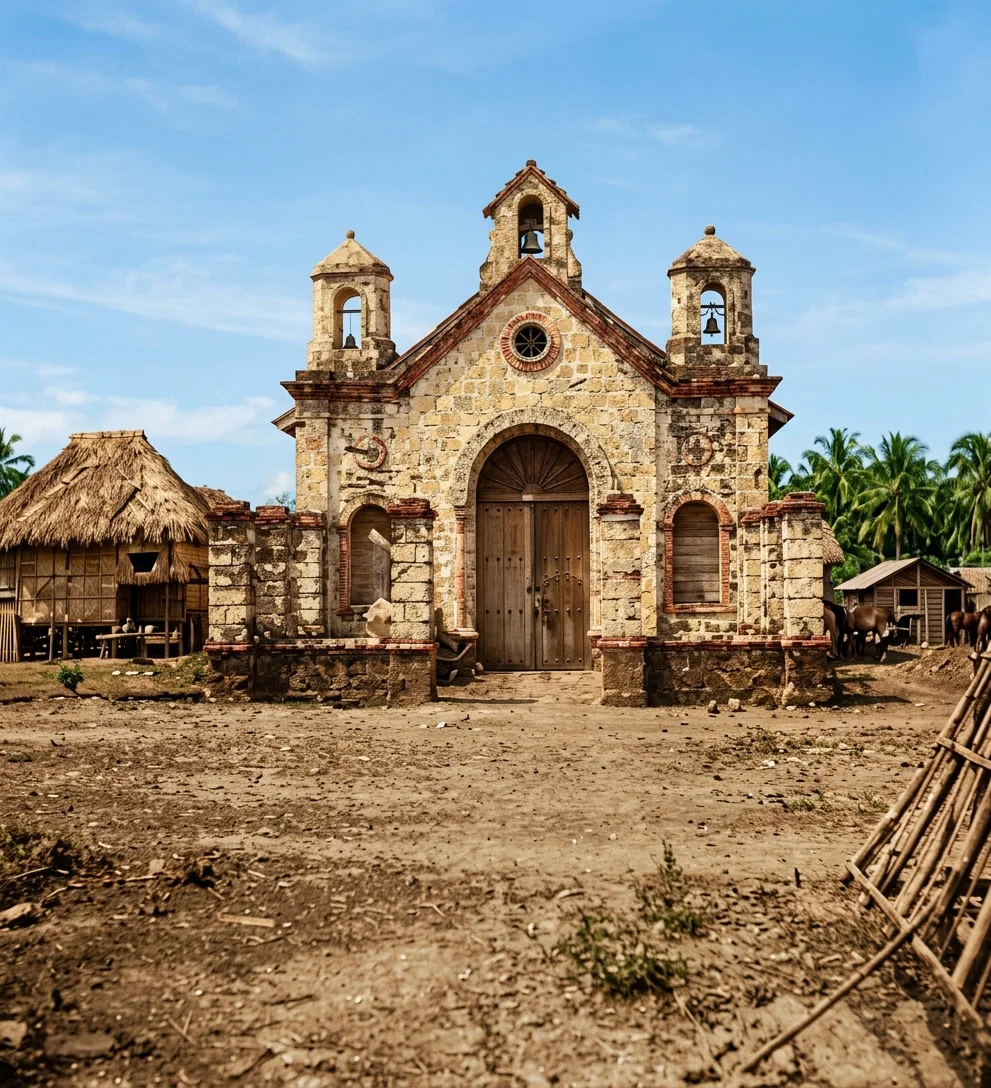
Old Church at Camp Dewey, P. I., at one time the headquarters of Aguinaldo.
THE AGLIPAY SCHISM IN THE PHILIPPINES.
[Under the above heading the Literary Digest of May 21, gives the following condensed account of this noted revolt from Catholicism in the Philippines. It is a part preparation of the field for the pure Gospel. The article from the Digest follows:—]
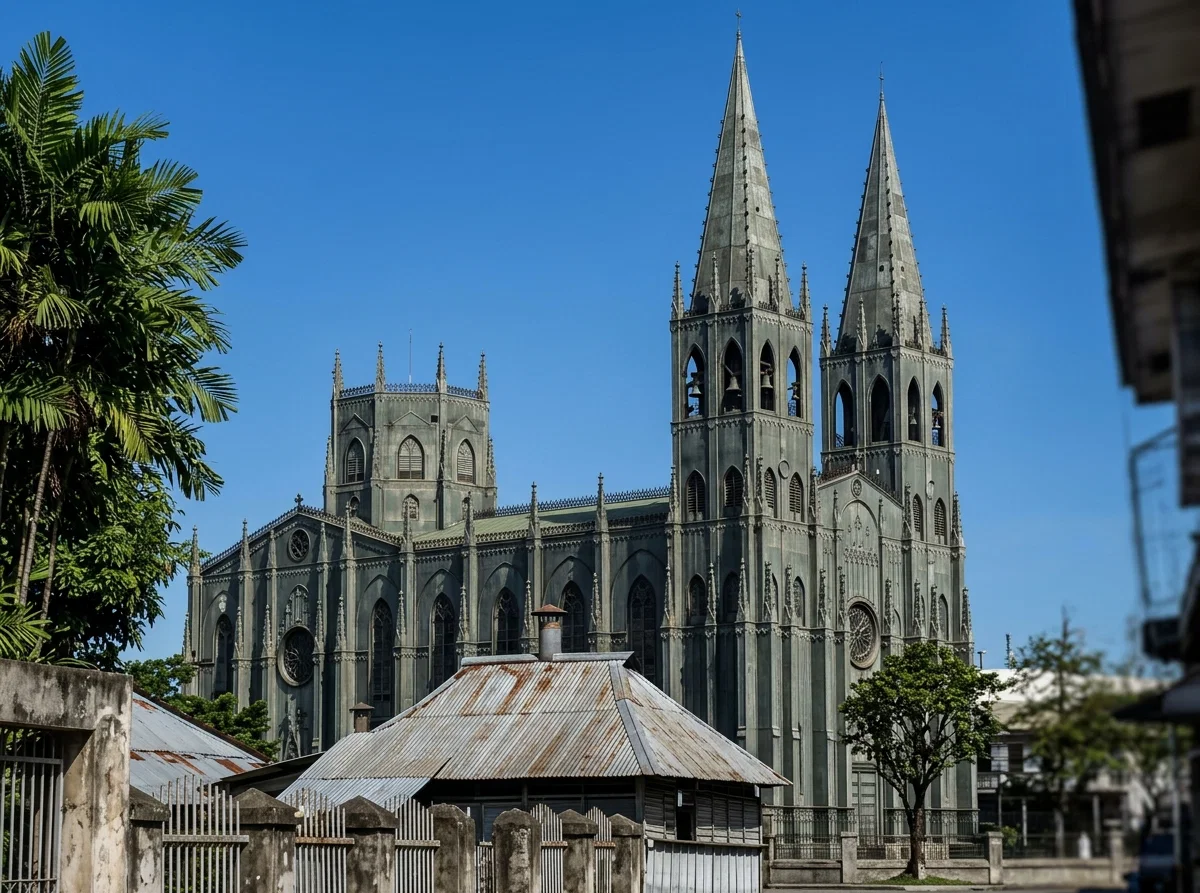
San Sebastian Church, Manila, P. I.
Mr. James A. Le Roy writes a concise account of the trend and development of the Aglipay schism in the Philippines which resulted in the formation, some eighteen months ago, of the “Independent Philippine Church.” It is significant to note, he comments, to what an extent Protestant ideas have crept into the organization, the ritual, and even the doctrine of this new church. The writer supports his statement with data from the church’s official publications. Before proceeding to this comparison, however, he gives (in the Independent, New York, April 28) a résumé of the facts leading up to the present situation, which we quote in part:—
The schism was first proclaimed on August 3, 1902, in a meeting arranged by the Workmen’s Union, the organization through which Isabelo de los Reyes had begun his semi-socialistic propaganda, which was rather more than suspected of being primarily an anti-government agitation, regardless of proclaimed principles. The feasibility for his ends of an anti-friar agitation, which should assert as a national cause the rights of the native clergy, may readily be seen. Reyes had associated with him certain of the more independent native priests, chief among them the excommunicated Father Aglipay. Reyes, however, was more radical than his chief associates, who, after the former had flung his defiance of the Catholic Church to the winds, took counsel of prudence, and did not at first care to go to the extreme of proclaiming their rebellion against the authority of the pope. Aglipay sheltered himself with his old advisers, the Jesuits, who, of course, counseled submission; and Reyes was left to conduct what schism there was for nearly two months as an adjunct to his agitation among the proletariat (which about that time landed him in jail). Aglipay’s brethren among the native clergy of North Ilocos have always been the most independent-minded of their kind, and it was here that the schism finally was formally launched early in October as a definite anti-Rome movement among the native clergy, one of their number being consecrated bishop. The formal inauguration of the new church took place in Manila, on Oct. 22, 1902.
The new church first formulated its position, Mr. Le Roy tells us, in a series of “Fundamental Epistles.” The first of these dealt with the question of the ordination of bishops; the second with the “friar question,” and with Archbishop Alcocer’s anathema against the schism. So far, we read, no announcement had been made as to doctrine, except that the dogma of the Roman Catholic Church would be retained. In Epistle III., however, Mr. Le Roy finds something more implied than a mere renunciation of obedience to the pope. We quote his comment and citations:—
Along with orthodox Catholic disquisitions as to the nature of divinity, went such a statement as: “Once having valorously thrust off the burdensome religious servitude of four centuries of mystery and medievalism, let us also have the virility to think with our own minds . . . with the natural reason which we have received directly from the generous hands of the Creator.”
The worship of the saints and of the Virgin is not to be relegated, but they shall not have a place before the members of the Trinity itself. Outlining the sublimity of a conception of God based upon modern science, and its revelation as to the universe, the Epistle says: “Calmly compare now, dear brothers, the sublimity of these profoundly great and venerable ideas about the true God, with the overwhelmingly gross paltriness of the absurd marvels that are attributed to the miracle-working saints, like the wandering one, who, showing his repugnant ulcers, is said to cure the pest; the holy friar who brings back lost things, and provides sweethearts, . . . and other superstitions which, at the cost of the gravity of our holy religion, the Romanists have invented.”
And a little further along Protestantism spoke quite plainly thus: “Instead of certain books of religious exercises wherein abound so many impostures, and attempts at erotic declamations to the female saints, written by lazy, neurasthenic friars fasting from flesh, give to the faithful the immortal and only Book of God which is the Bible, wherein they will learn to adore Him as they ought, and to follow rules of life adjusted to the desires of our Creator, and to the laws of nature contrary to which we can never go.”
In Epistle IV. the idea of lay participation in the management of the church and its propaganda was outlined; and in Epistle V. the pope was attacked in answer to his bull on the Philippines, issued in December, 1902.
By February, 1903, Mr. Le Roy continues, the bishops of the new church already numbered more than a dozen, and the Supreme Council had been organized. The latter put forth the “Doctrine and Constitutional Rules.” Of these we read:—
The first part contains the doctrine. Chapter I. declares the object of the Independent Philippine Church to be as outlined in Epistle III., stress being laid upon the restoration of God’s “most Holy Word” in the worship of Him, and upon the necessity for freeing consciences from all “anti-scientific scruples against the laws of nature.” Furthermore, the aim is announced to “reconquer the rights and prerogatives of the Filipino priesthood.” Chapter II. contains an orthodox profession of faith in one God, and in His manifestation through the Trinity.
Religion, rightly conceived, is declared to be too serious to countenance image worship, and the necessity for perfecting the individual intelligence so as to comprehend the Divinity is reiterated. These declarations of the chapter in question are noteworthy: “The immortal and only Book of God is the Bible, and in it we ought to learn to worship Him as is fitting; to glorify Him, as we see in the Psalms; to pray to Him as the divine Master Himself teaches. And in the Bible we find also salutary rules of life, both private and social, rules that will bring us well-being as well in this life as in the next.”
“In all that is not contrary to the pure Word of God, to nature, to the sciences, and to right reason, we follow the same belief as the Romanists.”
Worship and rites, declares the next chapter, shall be the same as those of the Roman Church “except where it has falsified the Biblical teachings with simoniacal and deceitful ends in view.” In the temples the Protestant practise of having all seated should be followed, instead of having the women squatted on dirty floors, often covered with saliva. On the altars the “saints and Virgin are to be put at one side, and the symbols of the Trinity in the center.” The priests shall give especial attention to the reading of the Bible in the services, for which purpose the Book of Job is particularly commended. Prayers are to be “short and simple,” and not made up of the useless repetition of Ave Marias, “which excites the13imagination, stifles fervor, and induces sleepiness.”
The special festivals in honor of saints are not condemned, but more particular pains should be taken to celebrate the days of the Saviour, and ten Ave Marias should not be said to one “Our Father.” Prayers, moreover, should be said in the local dialect, and mass should also be celebrated in the dialect, its features being explained to the congregation as it proceeds.
The rules of life, as laid down in Chapter IV., are to be followed primarily the commandments as they were interpreted by Jesus. Charity to our fellows is the first duty, and these rules of life are for all the days of the week, as well as for Sunday. Another duty of man is to perfect his intelligence. We should praise and defend “philanthropy, justice, honor, arms, labor, and the sciences.” The dignity of work is proclaimed, as it is in the “inexhaustible law of well-being.”
The second part of the document consists of the rules for the government of the church. The Bishop Maximus (Obispo Maximo) is to consult with the Supreme Council on all important matters, the council being composed of bishops, and certain selected presbyters nominated by the Bishop Maximus. . . . The interesting feature of this part of the document is its proclamation of communism as the ideal of the new church. The “abolition of property, the communism of possessions” was proclaimed by Jesus, yet had only made progress in notable degree during the past century; hence the new church, while holding this as its ideal, must yet not attempt to put it into practise at one blow.
This feature, Mr. Le Roy believes, was introduced into the document by Isabelo de los Reyes, who had lived among the socialists of Spain and Italy and the ideas upon which he has been seeking to arouse the Filipino proletariat. Reyes is the editor of the daily organ of the new church, La Iglesia Filipina Independiente, Revista Católica (The Independent Philippine Church, a Catholic Review). He disclaims complete acquiescence in the “Doctrine and Constitutional Rules,” says Mr. Le Roy, and “declares himself to be in favor of the marriage of the priests, and of the abolition of the confessional, and have no belief in hell.”
MAXIMUS
By Adelaide Procter
I HOLD him great who, for love's sake, Can give with generous, earnest will; Yet he who takes, for love's sweet sake, I think I hold more generous still.
I bow before the noble mind That freely some great wrong forgives, Yet nobler is the one forgiven Who bears the burden well, and lives.
It may be hard to gain, and still To keep a lowly, steadfast heart; Yet he who loses has to fill A harder and a truer part.
Glorious it is to wear the crown Of a deserved and pure success; He who knows how to fail has won A crown whose lustre is not less.
Great may be he who can command And rule with just and tender sway; Yet is diviner wisdom taught Better by him who can obey.
Blessed are those who die for God, And earn the martyr's crown of light; Yet he who lives for God may be A greater conqueror in His sight.
—Adelaide Procter.
HOW THE GOSPEL CAME TO PANG YENG.
By H. G. Underwood
BY H. G. UNDERWOOD, D.D.,
Some few years ago, during one of the many political upheavals and turmoils in Korea, where the patriot of to-day is the rebel of to-morrow, and in turn is apt to be the patriot of the day after, a number of officials were sentenced to banishment for life to various islands on the coast of Korea. Among these was an official who belonged neither to the highest nor lowest ranks, but at the same time one who had not sufficient influence at court to cause his sentence to be commuted. His son-in-law had sometime before become a Christian, and had often spoken to his father-in-law of God, of Christ, of sin, and of salvation. The old gentleman had politely listened to what had been said, but it had really had no effect. On his sentence to banishment, his son-in-law inserted a copy of the Scriptures in his baggage, and the official went down to what was likely to be his lifelong island home.
The island to which he was banished is called “Pang Yeng,” or “White Wing,” and is on the west coast of Korea, about thirty miles from the mainland. It is opposite the well-known country of Kang Yun, where there are several large and flourishing, self-supporting Presbyterian Churches, centering around the Presbyterian Church of Sorai. After arriving at the island, the official was led to read his Bible, for the sake of passing away the time. It was not long before he became convinced of the truth of what the Bible said, and anxious that its new truth should be known to his new neighbors, and to the people of the island. He began to tell them, as fully as he could, of the new religion, of the new faith, of the new hope that he found in the Bible, and he told them that if they wanted to know the truth they would better cross over by boat to the village of Sorai, and inquire further from an elder in the church there, named Saw Kyeng Jo. He also told them that they had a number of books that would throw light upon the subject. So, taking money for the purchase of books, some islanders crossed over to the mainland, and paid a visit to the church at Sorai. The people of the congregation gladly received them, entertained them as long as they were willing to stay, and, having provided them with books, sent them home. Most earnest were their requests for a teacher. Pressure of work, however, prevented Jo or any of the leaders from going over to the island, but frequent visits to the mainland were made by the islanders in search of more light. Gradually a number of believers were gathered together, with the official as their leader.
About two years after the first visit, Elder Saw, with one or two others, was enabled to visit the island. It was the fall of 1899, and a large number of the islanders had completed preparations for the annual offerings to the deity that the people believed presided over their destinies. A large amount of food had been gathered together, beer had been brewed, stronger liquor distilled, and a large number of pigs brought together for the sacrifices. All was ready at the time when Jo landed. The few Christians had done their best to oppose the preparations, and they hailed the coming of Elder Saw as of one sent from God. Taking him to the concourse of people that had assembled for the sacrifices, they besought for him a hearing. This was willingly given by the islanders, and, after a few words of prayer, Elder Saw addressed them in his strong, forceful, Korean manner, pointed out the uselessness of what they were doing, and gradually led them to see the real sin which they were about to commit. The presence of the Holy Spirit was so manifested that they at once said: “What must we do to be saved?” The beer and liquor was speedily poured into the sea; the pigs that had been proposed as a sacrifice for heathen deities were sold for food, and the money was handed over to the company of Christians as the first funds toward the erection of a church for the worship of the true God. A large proportion at once destroyed every vestige of heathen worship, and asked for instruction as to how they should worship God.
Brother Saw spent a number of days in their midst, instructing them in the truth, and when he returned to the mainland he had seen the beginning of the preparations for the foundation for a Christian church, the building committee accompanying him in the boat to make the necessary purchases. It must not be thought that all these people are earnest Christians (many of them still are in heathen darkness), but they are feeling for the light. Some have seen a little light, and are firmly trusting in the Lord Jesus Christ as their Saviour, and we believe that He who has begun a good work in them will also complete it.
All up and down the coast of Korea there are a large number of islands on which there is a large opportunity for work among the primitive inhabitants. There is a wide door through the length and breadth of Korea to-day, and the Koreans are realizing more and more the uselessness of their old heathen worship; they are feeling after the true God, and it is the privilege of the church of Christ to-day to give this Gospel to them.—Missionary Review.
THE LANGUAGES OF THE PHILIPPINES.
Dr. Wolcott Calkins says the tedious work of creating a literature may have been necessary in the South Sea Islands. Is it necessary in the Philippines? I asked Professor Guerrero how many languages and dialects are spoken in the archipelago. Nearly one hundred! And he enumerated ten which will be heard in a constant babel in St. Louis: Negrito, Acta, Moro, Bicol, Ifugao, Pangasinan, Pampang, Tagalog, Ilocano, Mangyan, and Visayan. Our American teachers have not attempted to learn these tongues, nor even Spanish. The children have learned English all the more rapidly for having no medium. Why should not our missionaries follow, instead of preceding, the public schools, and begin with children who have learned enough English for hymns and Bible teaching? Our own language in the Philippines, taught without expense from the funds of the churches, may prove to be the most effective missionary agency in the twentieth century.
And the Philippine primary school will be one of the most interesting exhibits at St. Louis. A rustic school-house will be erected. Miss Pilar Zamora, the only native Filipino who has ever taught in the normal school at Manila, has explained to me her methods of conducting this model school for about fifty children of the native families here. Many of them know Spanish, her own language. She may be able to speak a few of their dialects. But not a word will ever be used in the school except English. You will all be able to see how rapidly so easy and perfect a language as ours can be acquired without a medium. And you will see how the age-long prejudice against the name of Christian will begin to disappear among the little barbarians. She assures me that when they go home in December they will all read fairly well, most of them will speak and understand, and the brightest of them will write intelligently.
In a few years there will be a million pupils in the public schools. Parents will learn English from their children, and in evening schools. Shall our Protestant missions follow these public schools, gather the children into Sunday-schools as soon as they learn English, and all the people who also learn English into churches where the missionaries can begin to preach the Gospel without delay?
This is the most urgent missionary question to be studied at St. Louis. It may be that the eagerness of men and women, as well as children, to learn the best language in which the everlasting Gospel was ever proclaimed; an eagerness which you will observe among both Catholics and the pagan Filipinos here, will prove to be a signal fulfilment of prophecy, when a mighty angel shall come down from heaven arrayed with a cloud, and a rainbow on his head; and he shall stand upon the sea and upon the land, and shall lift up his hand and shall swear by Him that liveth forever and ever that there shall be no more delay!—Christian Work.
OUR WORK AND WORKERS.
In connection with the recent camp-meeting at Loup City, Neb., eight candidates were baptized.
At Algona, Iowa, June 18, an aged mother and her daughter were baptized by Brother E. G. Olsen.
May 28, six candidates were baptized at Norfolk, Neb., by Brother J. J. Graff. He also reports the baptism of seven persons at Grand Island during May.
At the meeting of the Ontario Conference held at London last month, Brother A. O. Burrill, of New York Conference, was chosen president. During the meeting seven persons were baptized.
Writing from Vicksburg, Miss., Brother N. B. King reports the baptism of three candidates on the 18th ult., and that others were soon to follow. Brother King lost all his household effects by the recent great fire in Yazoo City. His wife was sick at the time, and had a narrow escape.
In the Southwestern Union Record, Brother N. P. Nelson reports that “seven miles from Devall’s Bluff [Ark.] the brethren have pitched a tent in which meetings are conducted by Brethren Ryles, Defreeze, and Devereaux. Ten have taken their stand for the truth and united with the church, and three others have been baptized.” He also notes that “a colored Methodist minister has accepted the truth.” The Arkansas brethren are planning to build an industrial training-school on forty acres of land near Lake Village.
Brother L. D. Santee writes, “We have closed our local camp-meeting at Wheaten, Ill. While the attendance was not large, the meeting was a good one. Brother S. N. Haskell was with us two days, and Brother Wm. Covert, president of the Wisconsin Conference, was with us the entire time. As we had no business in connection with this meeting, the brethren had a good opportunity to seek the Lord. The meeting lasted ten days, and the attendance of our people each Sabbath and Sunday was about three hundred. During the week many were compelled to be away on business. In addition to the help that I have mentioned, all our own conference ministers were here. Brother Covert’s testimony was, ‘It is the best camp-meeting that I have ever attended in Illinois.’ Twelve were baptized, several others waiting to be baptized in their home church. We all enjoyed the meeting, and return home with renewed courage, determined to ‘work till Jesus comes, and then be gathered home.’”
WANTED FOR MISSIONARY WORK.
(Always prepay postage.)
Signs, Review and Herald, Youth’s Instructor, and tracts. Address, George E. Tack, Cumberland, Md.
NOTICE
S. H. NOEL, of Davenport, Iowa, desires Nos. 1, 3, and 7, Vol. 1, of the “Bible Training-School.” Address him, with price, as mentioned above.
(23) “In the thirty and first year of Asa king of Judah began Omri to reign over Israel, and reigned twelve years: six years reigned he in Tirzah. (24) And he bought the hill Samaria of Shemer for two talents of silver; and he built on the hill, and called the name of the city which he built, after the name of Shemer, the owner of the hill, Samaria. (25) And Omri did that which was evil in the sight of Jehovah, and dealt wickedly above all that were before him. (26) For he walked in all the way of Jeroboam the son of Nebat, and in his sins wherewith he made Israel to sin, to provoke Jehovah, the God of Israel, to anger with their vanities. (27) Now the rest of the acts of Omri which he did, and his might that he showed, are they not written in the book of the chronicles of the kings of Israel? (28) So Omri slept with his fathers, and was buried in Samaria; and Ahab his son reigned in his stead.
(29) “And in the thirty and eighth year of Asa king of Judah began Ahab the son of Omri to reign over Israel: and Ahab the son of Omri reigned over Israel in Samaria twenty and two years. (30) And Ahab the son of Omri did that which was evil in the sight of Jehovah above all that were before him. (31) And it came to pass, as if it had been a light thing for him to walk in the sins of Jeroboam the son of Nebat, that he took to wife Jezebel the daughter of Ethbaal king of the Sidonians, and went and served Baal, and worshiped him. (32) And he reared up an altar for Baal in the house of Baal, which he had built in Samaria. (33) And Ahab made the Asherah; and Ahab did yet more to provoke Jehovah, the God of Israel, to anger than all the kings of Israel that were before him.”
Golden Text.—“Righteousness exalteth a nation; but sin is a reproach to any people.” Prov. 14: 34.
SUGGESTIVE QUESTIONS.
(1) Who began to reign in Israel when Asa had reigned in Judah thirty-six years? How long did Omri reign in Israel? Verse 23. Note 1. (2) What prominent place did he buy? What did he build there? What name did he give to the city? Verse 24. (3) What is said of Omri’s course as king? Verse 25. (4) In whose way did he follow? How did God regard this course? Verse 26. (5) Where were the rest of Omri’s acts written? Verse 27. (6) When Omri died where was he buried? Who reigned in his stead? Verse 28. (7) In what year of the reign of Asa king of Judah did Ahab take the throne of Israel? How long did Ahab reign? Verse 29. (8) What was the character of his reign? Verse 30. (9) How did Ahab’s character compare with that of Jeroboam? Whom did he take for a wife? What did this alliance lead him to do? Verse 31. (10) What prominence did Ahab give to Baal worship in Samaria? Verse 32. (11) In what other manner did he exalt Baal before the people? How did all of Ahab’s course compare with that of his predecessors? Verse 33. Note 2.
NOTES.
1. Omri came to the throne just fifty years after the division of the kingdom. From the time of Jeroboam, who “made Israel to sin” there was a gradual going from bad to worse. Jeroboam’s son Nadab reigned but two years, when he met a tragic death (1 Kings 15: 25-31), and the prophecy of Ahijah (ch. 14: 7-11) was fulfilled. Baasha, who slew Nadab and reigned in his stead, did no better, although he enjoyed a reign of twenty-four years. He followed “in the way of Jeroboam,” and the prophet Jehu predicted for him and his house the same end that befell the house of Jeroboam. Ch. 16: 1-4. His son Elah repeated the history of Nadab in that he reigned but two years and met death by violent hands; also in that his murderer destroyed all his house and took the throne. Verses 8-13. But Zimri, the murderer of Elah, only reigned seven days, when the army declared Omri king, and came in force to the capital. When Zimri saw them, and understood the import, he burned the palace and perished in the flames. Verses 15-20. This brief retrospect brings us to the subject of the lesson. It should be noted that the one good reign of Asa, king of Judah, spanned those of all these wicked kings of Israel, as he came to the throne two years before the death of Jeroboam. Ch. 15: 9, 10; 14: 20.
2. While Omri did worse than all the kings of Israel who had gone before him, walking in the way that Jeroboam had laid out for the people, Ahab did still worse. He counted the sins of Jeroboam “a light thing.” He married a heathen woman whose father’s very name was Ethbaal (with Baal), and she seems to have had complete control of Ahab. While Jeroboam started the evil course of Israel in a way more blasphemous and more daring than any predecessor had ventured to go, those who came after him went to even greater lengths. And such is the natural course of sin. It is like the noisome weeds that grow luxuriantly, without special cultivation, in the most barren soil. The only remedy is to have it thoroughly uprooted, washed away by the blood of Christ. “Sin is the transgression of the law” (1 John 3: 4), but “the blood of Jesus Christ ... cleanseth us from all sin” (ch. 1: 7). “Being justified by faith, we have peace with God through our Lord Jesus Christ.” Rom. 5: 1. Then “the just shall live by faith” (ch. 1: 17); having come into covenant relation with God, His law is written in the heart (Heb. 8: 8-10), and “sin shall not have dominion” (Rom. 6: 14). “The carnal [fleshly, unconverted] mind” can not keep the law of God (ch. 8: 7); it can not keep from sinning, and even afterward it can do so only through faith in Christ, who alone is “able to keep you from falling” (Jude 24). This keeping is “by the power of God through faith.” 1 Peter 1: 5. “Faith cometh by hearing, and hearing by the Word of God.” Rom. 10: 17. See, also, Luke 10: 25-28; John 17: 17; James 1: 21-25.
Lesson V.—THE JUDGMENT MESSAGE.
(Study for Sabbath, July 30.)
GENERAL NOTE.—The line of prophecy commenced in chapter 12, closed with the fifth verse of chapter 14, with a description of the overcomers in the redeemed state. A new line of prophecy is now introduced. The prophet begins with the hour of the judgment impending, and emphasizes the Gospel message which will be given as specially applicable to the solemnity of that time; a period just before the coming of the Lord.
In connection with this study, read the chapter entitled, “The Judgment,” in “Testimonies for the Church,” Vol. 4, pages 384–387.
QUESTIONS.
1. For what event are the messages of Revelation 14 to prepare the world? Verse 14. What will any effort to detract from them bring upon us? Rev. 22:19. Note 1.
2. What symbol is used to introduce this line of prophecy? What did the angel proclaim? What shows the message to be world-wide? Rev. 14:6. Note 2.
3. What startling Gospel message does he bear? How is the message heralded? To whom are we directed to give glory? Who alone should be worshiped? Verse 7.
4. Which precept of the Decalogue is specially suggested by the wording of the message? Ex. 20:8–11.
14. What was the result of rejecting this last message? Rev. 14:8.
15. What solemn decree will follow the close of the work in the heavenly sanctuary? Rev. 22:11.
16. Do you know how far the solemn investigation of this great tribunal has proceeded? What emphasis does this lend to the need of being wholly prepared now? Note 5.
WANTED
STRONG, healthy Adventist ladies and gentlemen, to take the nurses' course, and soon prepare themselves for usefulness. Write for particulars.
QUEEN CITY SANITARIUM,
Kalamazoo, Mich.
BURLINGTON TREATMENT ROOMS.
The Burlington treatment parlors have made arrangements to have Dr. Ball (formerly with the N. E. Sanitarium) make regular visits to its patients each week, thus affording, with our present facilities, all the requisites of a small sanitarium at home. We are thoroughly equipped with all the necessary apparatus to do effective work, and with our increased help feel free to give the attention of the Vermont people once more to our work here in Burlington.
Those desiring information as to prices, rooms, railroad connections, etc., address the manager, H. F. Litchfield, 308 N. Main Street, Burlington, Vt. Telephone, 358-11.
Medical communications sent to Dr. C. F. Ball, 80 Crescent Street, Rutland, Vt. Telephone 52-4.
Three Times a Day to CHICAGO
THE ONLY DOUBLE TRACK RAILWAY between the Missouri River and Chicago.
THREE TRAINS DAILY via the Southern Pacific, Union Pacific, and Chicago and Northwestern Railways.
OVERLAND LIMITED, Vestibuled. Leaves San Francisco at 10.00 a. m. The most luxurious train in the world. Electric lighted throughout. Buffet smoking cars with barber and bath. Booklovers’ Library, dining cars, standard and compartment sleeping cars and observation cars. Less than three days to Chicago without change.
EASTERN EXPRESS, Vestibuled. Leaves San Francisco at 6.00 p. m. Through Standard and Tourist sleeping cars to Chicago. Dining cars, free reclining chair cars.
ATLANTIC EXPRESS, Vestibuled. Leaves San Francisco at 9.00 a. m. Standard and Tourist sleepers.
Personally Conducted Excursions
WEDNESDAYS, THURSDAYS and FRIDAYS
The best of everything
R. R. RITCHIE, G. A. P. C.
CHICAGO & NORTHWESTERN RY.
617 MARKET ST. (PALACE HOTEL) SAN FRANCISCO
OR S. P. COMPANY’S AGENT
Excursion Rates
ST. LOUIS
Round-trip Excursion Tickets to St. Louis and Chicago on sale July 1, 2, 7, 8, 13, 14; August 8, 9, 10, 18, 19; September 5, 6, 7, 8, and October 3, 4, 5, 6, at the following rates:
To St. Louis — $67.50
To Chicago (Passing one way through St. Louis) — 72.50
Return limit, three months; stop-overs allowed on both going and returning trips.