Your ShelfYour Projects

Review and Herald, Vol. 92, No. 36.

God Understands

Review and Herald

Jul 22, 1915

Review and Herald Publishing Association · Washington, D. C. · Jul 22, 1915

God Understands

It is so sweet to know, When we are tired, and when the hand of pain Lies on our hearts, and when we look in vain For human comfort, that the heart divine Still understands these cares of yours and mine.
Not only understands, but day by day Lives with us while we tread the earthly way, Bears with us all our weariness, and feels The shadow of the faintest cloud that steals Across our sunshine, ever learns again The depth and bitterness of human pain.
There is no sorrow that He will not share, No cross, no burden, for our hearts to bear Without His help, no care of ours too small To cast on Jesus; let us tell Him all — Lay at His feet the story of our woes, And in His sympathy find sweet repose.
— Selected.

Health First — Safety Follows

The beautiful August or War versus Disease number of our National Health Magazine, Health and Temperance,—formerly Life and Health,—really excels the July issue, and is sure to have a wide circulation.
ORIGINAL WAR PICTURES present the brighter side of the present world conflict—relief organizations working in the wake of the armies, to save life, to restore health, and to prevent disease.
Space forbids detailed account of the interesting departments in this month's issue. The Mother in the Home—doctor's advice for hot weather troubles; How to Make a Fireless Cooker, and recipes for fireless cooking; The Temperance Movement, and the latest news, cartoons, etc.; Questions and Answers department for subscribers, treatments for various ailments, etc.—all these go to make up this excellent number. Begin your subscription with the August issue, or send at once to your tract society for a supply.

HEALTH AND TEMPERANCE

Washington, D. C.

“Protestant Magazine” for August

A CRUCIFIX AS A PREMIUM. As an inducement to subscribe to a Roman Catholic magazine, the publishers offer to the editor of the Protestant Magazine a certain crucifix, which, when properly blessed, will grant various indulgences from sin. We quote one paragraph in reply:—
“To such depths of heathenism has a professedly Christian church fallen, and this easy way of avoiding the punishment which the Roman Catholic Church teaches is justly due to every sinner is offered as a sort of premium with every subscription to a dollar magazine in enlightened America in the year 1915!”
You should read the whole article.
A ROMAN CATHOLIC EDITOR ASKS the editor of the Protestant Magazine to show what are the Roman Catholic Church’s “un-American political doctrines.” The editor of the Protestant Magazine, “acting upon the basis that the editor of the New World really desires to secure the information of which he is evidently in much need,” gives him and all Protestant readers the proof in the August issue. It is worth reading.
Address your tract society, or,—
THE PROTESTANT MAGAZINE Washington, D. C.

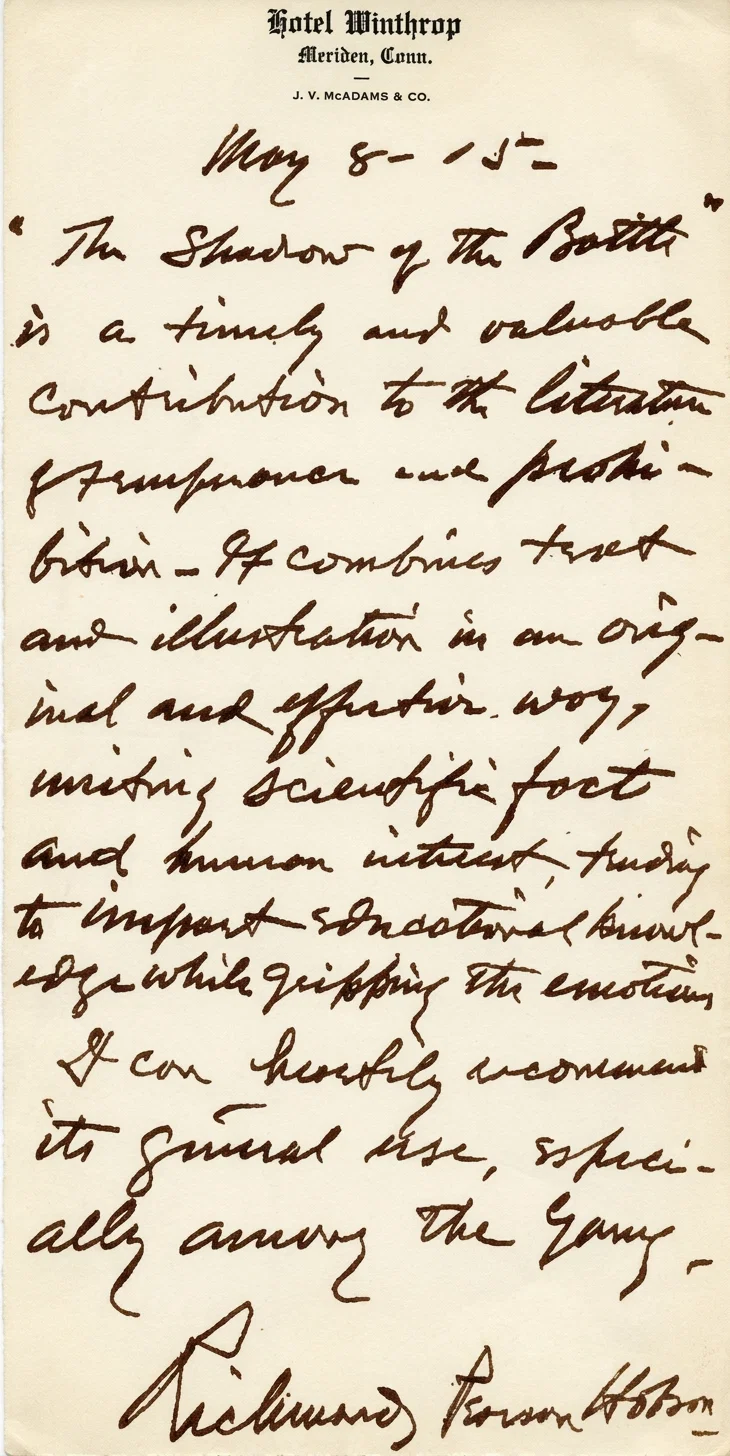
The Shadow of the Bottle

THE greatest campaign book in behalf of temperance yet published. Every page contains a strong argument against the saloon, illustrated by 65 cartoons that are “true to life.” No one can see these cartoons, or read a page of the book, without being impressed with the awfulness of the drink habit. It should be placed in every home. Read what others say of it.
If there is one thing needed more than another, it is that people get help on the temperance question. Surely this book will appeal to the people. There ought to be a good sale for it at a time like this. We will do what we can to get it before the people.—Elder H. S. Shaw, President of the Western Canadian Union Conference.
“The Shadow of the Bottle” is a new temperance storybook of 128 pages, with an illustration on every other page. I have just read this book and commend it most highly.—R. L. Davis, Superintendent Anti-Saloon League, North Carolina.
“The Shadow of the Bottle” is a splendid presentation of the saloon proposition, and I hope it will have a large sale. We will do what we can to put it in line.—C. W. Crooke, Superintendent Anti-Saloon League, Florida.
One State Anti-Saloon League has ordered 3,000 circulars of this book to be sent to its members with a personal letter from the State superintendent, and has purchased 200 books. Another State League has ordered 100 books.
Thus our friends are helping us in this work of temperance reform. Now is the time to give it a wide circulation while the country and the world is stirred up on the subject.
The book is issued in two styles; paper, 25 cents; cloth, 50 cents.
ORDER FROM YOUR TRACT SOCIETY

The Book of the Law

MRS. E. G. WHITE
THE silent yet powerful influence set in operation by the messages of the prophets regarding the Babylonian captivity, did much to prepare the way for a reformation that took place in the eighteenth year of Josiah's reign. This reform movement, by which threatened judgments were averted for a season, was brought about in a wholly unexpected manner through the discovery and study of a portion of Holy Scripture that for many years had been strangely misplaced and lost.
Nearly a century before, during the first Passover celebrated by Hezekiah, provision had been made for the daily public reading of the book of the law to the people by teaching priests. It was the observance of the statutes recorded by Moses — especially those given in the book of the covenant, which forms a part of Deuteronomy — that had made the reign of Hezekiah so prosperous. But Manasseh had dared to set aside these statutes; and during his reign the temple copy of the book of the law, through careless neglect, had become lost. Thus for many years the people generally were deprived of its instruction.
The long-lost manuscript was found in the temple by Hilkiah, the high priest, while the building was undergoing extensive repairs in harmony with King Josiah's plan for the preservation of the sacred structure. The high priest handed the precious volume to Shaphan, a learned scribe, who read it, and then took it to the king with the story of its discovery.
Josiah was deeply stirred as he heard read for the first time the exhortations and warnings recorded in this ancient manuscript. Never before had he realized so fully the plainness with which God had set before Israel “life and death, blessing and cursing” (Deut. 30: 19); and how repeatedly they had been urged to choose the way of life, that they might become a praise in the earth, a blessing to all nations. “Be strong and of a good courage, fear not, nor be afraid,” Israel had been exhorted through Moses; “for the Lord thy God, he it is that doth go with thee; he will not fail thee, nor forsake thee.” Deut. 31: 6.
The book abounded in assurances of God's willingness to save to the uttermost those who should place their trust fully in him. As he had wrought in their deliverance from Egyptian bondage, so would he work mightily in establishing them in the Land of Promise, and in placing them at the head of the nations of earth. To Israel of old had been given the assurance: “There is none like unto God, . . . who rideth upon the heaven for thy help, and in his excellency on the skies. The eternal God is thy dwelling place, and underneath are the everlasting arms.” Deut. 33: 26, 27, R. V.
The encouragements offered as the reward of obedience were accompanied by prophecies of judgments against the disobedient; and as the king heard the inspired words, he recognized in the picture set before him conditions that were similar to those actually existing in his kingdom. In connection with these prophetic portrayals of departure from God, he was startled to find plain statements to the effect that the day of calamity would follow swiftly, and that there would be no remedy. The language was plain; there could be no mistaking the meaning of the words. And at the close of the volume, in a summary of God's dealings with Israel and a rehearsal of the events of the future, these matters were made doubly plain. In the hearing of all Israel, Moses had declared: —
“Give ear, O ye heavens, and I will speak; and hear, O earth, the words of my mouth. My doctrine shall drop as the rain, my speech shall distill as the dew, as the small rain upon the tender herb, and as the showers upon the grass: because I will publish the name of the Lord: ascribe ye greatness unto our God. He is the Rock, his work is perfect: for all his ways are judgment: a God of truth and without iniquity, just and right is he. . . . “Remember the days of old, consider the years of many generations: ask thy father, and he will show thee; thy elders, and they will tell thee. When the Most High divided to the nations their inheritance, when he separated the sons of Adam, he set the bounds of the people according to the number of the children of Israel. For the Lord's portion is his people; Jacob is the lot of his inheritance. He found him in a desert land, and in the waste howling wilderness; he led him about, he instructed him, he kept him as the apple of his eye.”
But Israel “forsook God which made him, and lightly esteemed the Rock of his salvation. They provoked him to jealousy with strange gods, with abominations provoked they him to anger. They sacrificed unto devils, not to God; to gods whom they knew not, to new gods that came newly up, whom your fathers feared not. Of the Rock that begat thee thou art unmindful, and hast forgotten the God that formed thee.
“And when the Lord saw it, he abhorred them, because of the provoking of his sons, and of his daughters. And he said, I will hide my face from them, I will see what their end shall be: for they are a very forward generation, children in whom is no faith. They have moved me to jealousy with that which is not God; they have provoked me to anger with their vanities: and I will move them to jealousy with those which are not a people; I will provoke them to anger with a foolish nation. . . .
“I will heap mischiefs upon them; I will spend mine arrows upon them. They shall be burnt with hunger, and devoured with burning heat, and with bitter destruction: . . . for they are a nation void of counsel, neither is there any understanding in them. O that they were wise, that they understood this, that they would consider their latter end! How should one chase a thousand, and two put ten thousand to flight, except their Rock had sold them, and the Lord had shut them up? For their rock is not as our Rock, even our enemies themselves being judges. . . .
“Is not this laid up in store with me, and sealed up among my treasures? To me belongeth vengeance, and recompense; their foot shall slide in due time: for the day of their calamity is at hand, and the things that shall come upon them make haste.” Deut. 32: 1-10, 15-35.
These and similar passages revealed to Josiah God's love for his people, and his abhorrence of sin. As the king read the prophecies of swift judgment uponthose who should persist in rebellion, he trembled for the future. The perversity of Judah had been great; what was to be the outcome of their continued apostasy?
In former years the king had not been indifferent to the prevailing idolatry. “In the eighth year of his reign, while he was yet young,” he had consecrated himself fully to the service of God. Four years later, at the age of twenty, he had made an earnest effort to remove temptation from his subjects by purging “Judah and Jerusalem from the high places, and the groves, and the carved images, and the molten images. They brake down the altars of Baalim in his presence; and the images, that were on high above them, he cut down; and the groves, and the carved images, and the molten images, he brake in pieces, and made dust of them, and strowed it upon the graves of them that had sacrificed unto them. And he burnt the bones of the priests upon their altars, and cleansed Judah and Jerusalem.” 2 Chron. 34: 3-5.
Not content with doing thorough work in the land of Judah, the youthful ruler had extended his efforts to the portions of Palestine formerly occupied by the ten tribes of Israel, only a feeble remnant of which now remained. “So did he,” the record reads, “in the cities of Manasseh, and Ephraim, and Simeon, even unto Naphtali.” Not until he had traversed the length and breadth of this region of ruined homes, and “had broken down the altars and the groves, and had beaten the graven images into powder, and cut down all the idols throughout all the land of Israel” (2 Chron. 34: 6, 7), did he return to Jerusalem.
Thus Josiah, from his earliest manhood, had endeavored to take advantage of his position as king to exalt the principles of God's holy law. And now, while Shaphan the scribe was reading to him out of the book of the law, the king discerned in this volume a treasure of knowledge, a powerful ally, in the work of reform he so much desired to see wrought in the land. He resolved to walk in the light of its counsels, and also to do all in his power to acquaint his people with its teachings, and to lead them, if possible, to cultivate reverence and love for the law of heaven.
But was it possible to bring about the needed reform? From all that he could learn from the reading of the volume before him, Israel had almost reached the limit of divine forbearance; soon God would arise to punish those who had brought dishonor upon his name. Already the anger of the Lord was kindled against the people. Overwhelmed with sorrow and dismay, Josiah rent his garments, and bowed before God in agony of spirit, seeking pardon for the sins of an impenitent nation.
At that time the prophetess Huldah was living in Jerusalem, near the temple. The mind of the king, filled with anxious foreboding, reverted to her; and he determined to inquire of the Lord through this chosen messenger, to learn, if possible, whether by any means within his power he might save erring Judah, now on the verge of ruin.
The gravity of the situation, and the respect in which he held the prophetess, led him to choose as his messengers to her, the first men of the kingdom. “Go ye,” he bade them, “inquire of the Lord for me, and for the people, and for all Judah, concerning the words of this book that is found: for great is the wrath of the Lord that is kindled against us, because our fathers have not hearkened unto the words of this book, to do according unto all that which is written concerning us.” 2 Kings 22: 13.
(To be concluded)

Christian Science

Mind Cure—No. 6

Christian Science

GEO. D. BALLOU
CURES by means of Christian Science are wrought through a system of mental diversion or preoccupation. Minds that have been harassed by doubt, fear, remorse, anxiety, or any other depressing sentiment, are attracted by the promise of cure, begin studying its occult formulas, are astonished but not shocked by its wonderful system of negations, begin to believe its doctrines, and forget their former troubles and depressed moods. This mysterious, occult, sometimes silent appeal to troubled minds is the most powerful human means conceivable, in many cases, for producing changes in the depressed conditions of a disturbed mind and nervous system.
This appeal to the love of the marvelous is with many minds almost irresistible. There can be no more subtle, quiet demand for a change of moods than the methods used in both the words and the manner of these Christian Science healers. Wonder, surprise, and astonishment are the temporary antidotes for worrying and agonizing. One cannot agonize and wonder at the same time.
Let the man of cool scientific mind who undertakes to find the meaning of the things he reads, begin to peruse a copy of “Science and Health,” which is the foundation of Christian Science; if he persists in this effort for fifteen to thirty minutes, the chances are that he will have a headache for racking his mind to find some sane, sensible meaning where there is none. Let another of sentimental, imaginative mind begin to read the book when troubled with headache from worry and fretting, and in all probability this headache will cease within thirty minutes. The cause of these diametrically opposite results is very simple. This last mind did not attempt to fathom the mystical import of what was read, but just began to wonder, and kept right on wondering, What does it all mean? how does the reading of this book heal the sick? how can all these wonderful cures come about? As a result, the mind finds relief from its previous anxieties.
There is nothing more supernatural or miraculous about this than that water will quench thirst, or fire warm the body, or food satisfy the bodily hunger. A state of rest comes into the soul because the troubles are forgotten. Anything else which will gain the attention of a distracted mind and win its confidence until nature can rally from the injuries done by adverse moods will accomplish the same physical results. As before said, a journey through a new country; a visit from a loved and trusted friend who brings new, pleasant thoughts and moods; the assurances of a good physician; and a hundred other things will work the same physical results without the mysticism or false doctrine.
The limitations of the power of Christian Science is seen when attempting the cure of blood poisoning, typhoid fever, smallpox, cancer, and other malignant diseases without other than mental remedies. The use of all physical remedies is ignored. Failures are ascribed to the patient because he did not surrender his mind fully and get in touch with the Christian Science metaphysical idea of God.
It is not unusual to see a patient who is stricken with locomotor ataxia or some other equally incurable disease, greatly relieved, and most hopeful expectations are aroused of a full and perfect cure. But later on, perhaps after a year or two, the Christian Science practitioner finds that some malign influence in the family or neighborhood is hindering further progress. The cause of the improvement is clear. Probably half or two thirds of the symptoms in the case presented in its early stages were due to the mental agony of the patient over his condition. These are removed by the absolute assurance of Christian Science, but the diseased condition, due to some specific poison in the blood, slowly progresses toward a fatal termination.

Evil Influence

The doctrine of a malefic influence, called by this cult “malicious animal magnetism,” is remarkably out of place among the “all good” things that God created. In spite of the claim of Christian Scientists that God is the creator of all that we call evil, and therefore all evil is good, they found it necessary to invent this theory of a malign influence to account for the failures of Christian Science. It seems very remarkable that in spite of the fact, in their theory, that there is no devil, yet this cult confesses that it is confronted with an evil force that is as hard or harder for them to manage than was the personal devil as they found him in the creeds and in the Bible. Christian Science made an effort to get rid of the personal devil, but in this malefic influence they have invented a demon as attenuated and ethereal as the god whom they teach. So now they have a pantheistic devil and a pantheistic god.
Are these people sincere?—Most assuredly they are. It is not men's motives we are dealing with, but the application of the law of rest. The fascinationof the mysterious, and the undefined idea that whatever is accomplished for the sick by other than visible means must be miraculously divine, is very generally prevalent. The result is that whatever is accomplished is taken as evidence that a miracle has been wrought, and that every Christian Science doctrine is true, because it is supposed that the cures grow out of the doctrine instead of resulting from the state of rest and temporary peace that has been brought into the soul by this system of mental diversion. Other faiths and doctrines could accomplish similar physical results in their adherents if held with the same expectation, cheerfulness, courage, and hope.
Indeed, this same kind of work has been going on in a quiet, unobtrusive way all through the ages. Physicians have used it, and ministers have used it, and priests have used it, and the friends of the sick have used it, and many a soul has been saved from premature death just by the hope and cheer that has come from getting the thoughts diverted from the depressing topics that pulled it down. But little has been said concerning these cases. They were such natural results that no one of repute has thought to make himself famous by proclaiming them as divine, and that he had the exclusive agency for dispensing such healing power.

Creative Power Lacking

Jesus of Nazareth, who was with the Father before the foundation of the world, was joint Creator of the universe. It was he to whom the Father said, “Let us make man in our image, after our likeness.” His mission to earth was to demonstrate that creative power could undo all the work of the usurper and reveal the tender mercies of Jehovah, and thus restore man's confidence in his Creator. And he did not dispense the grace of God for gold. He said to his disciples, “Freely ye have received, freely give.” Now, if Christian Science is the representative of Jesus on earth, let it speak the creative word of healing to the palsied and the maimed, to the lepers and the syphilitic, and to those born blind and deaf. Let creative power be seen putting new eyes into the empty sockets, and let flesh-and-blood limbs take the place of artificial ones. There is plenty of this work to be done, and now is the opportune time. Let something appear besides the partial removal of adverse mental causes and the temporary results that follow. But, reader, you will never see any manifestations of creative energy from this cult. How can its adherents exercise creative power when they have denied the very existence of a Creator?

The Conflict

There is a conflict between good and evil, between righteousness and sin, between life and death; between sickness and suffering on the one hand, and health on the other. He who thinks to end the conflict by denying the existence of evil and sin and sickness, will eventually find himself conquered, and bound hand and foot.
He who can deceive himself into believing contrary to the evidence of his senses and reason, shows enough skill and perseverance and will power to conquer every evil thing in life and rise superior to nearly every form of sickness, without having to deny the existence of these things.
A man may have this system inculcated fully into his life and yet know nothing of that spiritual rest that comes from full spiritual fellowship with the personal Creator. He may talk “Christ” and “truth” and “life” and the “allness of God,” and be an agent for healing the sick, and yet not be acquainted with the personal Saviour who now sits at the right hand of his personal Father in the heavenly sanctuary. Heb. 8:1, 2. Trusting in divine power and so-called “truth” apart from a personal acquaintance with the personal Creator, will save no man. There is but one thing that will do away with the “old beliefs” and “errors of mortal mind” for the Christian Scientist, or with sin and all its consequences for other people, and that is a personal, living acquaintance with the Creator and his Son Jesus. This only will end the conflict.

“Discerning the Lord’s Body”

AUGUSTA C. BAINBRIDGE
READING slowly and prayerfully the eleventh and twelfth chapters of First Corinthians, with kindred texts in Ephesians and Colossians, we have a heavenly picture of the church of Christ on earth. Christ is the head, and his people are members in particular. Christ is the head of all, yes, the head of every individual soul.
In this is seen not only Christ’s love for his church, but the love and care of each member for the others. Never in the history of the world was this care needed more than it is now. We are all passing through severe trials, which by God’s grace, will prepare us to pass through more severe ones in the near future. These, as polishing tools, are fitting us to stand when our dear Lord appears.
Satan is busier than ever. If he were allowed to have full control of the physical world, not one Seventh-day Adventist would be alive to welcome the Lord when he comes. Accidents, sickness, diseases, afflictions of various sorts, and persecution would lay every waiting saint in the grave.
Besides that, with his deceit and lying wonders he would enter Christ’s body, the church, separate members one from another, and destroy the faith of God’s elect, if he could. But praise to the Lord God of heaven and earth, Jehovah reigns! He reigns and all who will may come under his gracious rule and be safe. Much of our safety in body and soul depends upon our holding fast to one another.
The members of our physical body are dependent on the head for direction. When all these members hear and heed these directions, they work in beautiful order, and there is harmony in the body. Will it not be the same in his body, the church? Where this is not so, we find division in the body, spiritual sickness, and bodily sickness, too. In 1 Cor. 11:30 we read, “For this cause [not discerning the Lord’s body, see verse 29] many are weak and sickly among you, and many sleep.” These verses tell us that many of the sicknesses among us and many of the untimely deaths in our ranks, are due to our failure to discern the Lord’s body. This means not only the broken body and shed blood typified in the bread and wine at the Communion table, but through these Him, our Head, and his children, our brethren and sisters in the church, as members of his body.
If we would learn the lesson of the text, we must learn to see, through the eyes of love, how absolutely we are dependent on one another in Christ. We need one another, just as the eye needs the foot, and the hand needs the head, and vice versa. It would be impossible for the body to be in health, or even fully alive, if the members were out of harmony with one another, or worked against one another.
In the church, Christ, the Head, feels the need of every member. Should one seemingly rather unimportant member be spiritually sore or ailing, he wills that the other members work together with him to restore such a one. We can each see that he needs every member, and filled with his love, we shall feel that we need every member. When we see one ill, there will spring up in our hearts an earnest intercession for the healing of his hurt; because Christ and the church have need of him.
Since this world is the only place where there will be such weak and feeble ones, it will be the only place where we shall ever have a chance to show compassion or tender pity such as the Master has shown toward us.
We read that God has “tempered the body together” (1 Cor. 12:24, 25), that we “should have the same care one for another.” Let us “press together” and care for one another, with love, suffering with one another’s suffering, rejoicing in one another’s joy.
We are living in most solemn times. God by his Spirit is preparing a people for translation. There will be in that prepared company perfect accord. There will not be one who does not love every other member of Christ’s body with an intense heavenly love.
If our physical bodies are to be kept in health through the trying scenes of the time of trouble that we are just entering, this heavenly love must be abiding in us.
Sometimes we may find ourselves saying of another: “I have no need of him. I have nothing against him, and wish him no harm. He may go his way, and I shall go mine. I have nothing in common with him.” Saying that, we havebeen saying just what the Word of God says that one member cannot say of another member of the Lord’s body, “I have no need of thee.”
It is not a question of holding spite or grudges; that is impossible with those who expect to go all the way with the Lord Jesus to the holy city. There is a deeper experience than getting rid of grudges. We need to get away from the spirit of independence that would cause us to feel that we could get along without any member of the body. When we find this spirit of independence in our hearts, we must make a quick journey back to Calvary. It may mean, too, a drawing very near to the member that we had so coolly shut out. It may mean a confession and a prayer meeting of two members with the Head. That will result in spiritual health in place of soul sickness.
Let us heed Paul’s message from the Master, and learn how to discern the Lord’s body. So shall we be of one accord, and so can we ask in faith for the blessed baptism of the Holy Spirit that we so much desire.
Los Angeles, Cal.

Reasons for Thankfulness

M. G. HUFFMAN
God expects thankfulness on our part. “Be ye thankful,” are the words of Scripture. “Offer unto God thanksgiving,” says the psalmist. “With thanksgiving let your requests be made known,” says Paul. “Let us come before his face with thanksgiving,” says David; and many like texts are in the blessed Bible. In the former dispensation, numerous sacrifices were required, among which was a thank offering. And in the days of David, the Levites were required every morning and evening to thank and praise the God of Israel.
There is a multitude of reasons why we should be thankful. The following are some of them:—
1. The dearest thing on earth—the privilege to live and work for God—is ours. For in him we live, move, and have our being.
2. We have numberless blessings, both temporal and spiritual. God gives us food, raiment, shelter, health, and strength. In Europe, at the present time, millions of little fatherless children and thousands of widowed women with little babes are suffering the pangs of hunger and the tortures of bereavement and suspense. But how about us here in the United States of America? Probably none of us really know what it is to be hungry. Are we as grateful as we should be to the Giver of our mercies for even the so-called common blessings of life?
3. Has not every believer in the third angel's message reasons for sincere thanksgiving to God that when this truth came to him he was enabled to accept it, and not reject it, as so many thousands now living have done?
4. Have not we as a people reasons for much gratitude to God that he has spared the lives of so many of his aged ministering servants to be witnesses in this closing work?
5. Should not we be thankful that so many of our young people, full of life and enthusiasm, are entering into this work to assist in carrying the everlasting gospel to earth's darkest corners? With clear minds and consecrated hearts and bodily vigor, how many hundreds of both sexes are entering the gospel field as ministers, teachers, editors, canvassers, physicians, nurses, Bible workers, and to serve in other ways!
6. Have not we as a people great reason for thankfulness for what God has done and is doing by way of opening up avenues through which this blessed truth can reach all nations in this generation?
7. We ought to be devoutly thankful to God that, while we have sailed as it were over tempestuous seas of obstacles and opposition, we were not stranded on the rocks on the one hand, nor grounded on the shoals of discouragement on the other.
8. And while the various winds of theological error have been and are still blowing from different points of the compass, and while those who have gone out from the main body are still trying to draw away disciples after them, we can thank the Lord that the spiritual church of God, the pillar and ground of the truth, of which Jesus our Lord is the head, is being fitly framed together, and is growing into an holy temple; and thank God that the main body is standing firm.
9. Are we sufficiently thankful to God, that, running parallel with this message, the spirit of prophecy has been manifested in the remnant church, and that today his handmaid still lives?
10. Can we ever be sufficiently thankful for God's great plan of salvation? This gospel of the kingdom has now belted the globe in its onward march, as it is being sounded to every nation, kindred, tongue, and people. The apostle Paul had a view of what was being accomplished by the gospel for the Jew and the Gentile in his day, and exclaimed, “Thanks be to God for his unspeakable gift.” This inexpressible gift is more fully set forth in that well-known text, John 3:16, where it is stated that “God so loved the world that he gave his only begotten Son, that whosoever believeth in him should not perish, but have everlasting life.” Did any one ever see in any book, or chiseled on stone, or anywhere else, a word so small that contained so much salvation, comfort, or hope as the word SO in this connection? “God so loved the world.” May we not be thankful, and glad also, that the great controversy between good and evil is soon to be concluded? and have we not great reason to thank God that notwithstanding the fact that nearly all the great nations of the world are now in deadly conflict, the United States of America is practically at peace? We ought to be grateful and praise God that while the conflict is on in Europe, he is giving his servants success in pushing forward the last message of mercy in those warring nations, and many are accepting the truth for this time.
Personally, I do thank the Lord for the present truth, which came to me thirty-seven years ago, and which for the past thirty years I have been publicly proclaiming in many States. I rejoice that the Lord has seen fit to bless my efforts to the salvation of many souls for whom Christ died. Everything points to the fact that we are almost home. We can thank the Lord that his great clock of time will soon strike the appointed hour, and that the Lord Jesus Christ will then come to receive his waiting people to himself. “Even so, come, Lord Jesus.”

The Kind of Zeal We Need Today

ERNEST LLOYD
IMPORTANT events thicken about us so fast, and the scenes are shifted with so strange a rapidity, as to impress us with the fact that the great drama of earth is drawing to a close. Europe never presented such a spectacle before, and the situation calls for the most profound attention on the part of every Seventh-day Adventist. Thrones are tottering; change is written everywhere; but the kingdom of our Lord shall triumph over all.
It remains for us, upon whom the last days have come, to prepare ourselves by seeking a fresh baptism of the Holy Spirit for greater power and greater faithfulness in witnessing to the final message of warning and mercy here in the homeland. God is calling upon us to redeem the time, because the days are calamitous. All heaven is in earnest over the condition of the present evil world. We must now unite an earnest spirituality with increased activity in our missionary efforts to reach the unsaved about us.
No Christian can afford to wait or hesitate in a time like the present. “God calls for individual zeal, not waiting for others. He calls for closet zeal, not mere platform stimulus. He calls for prayerful zeal, not self-sufficient activity. He calls for serious zeal, not levity. He calls for self-denying zeal, manifested in a willingness to surrender all. When such zeal pervades our churches, when each Christian apart, and each family apart, shall take up the work of the kingdom with Christlike solicitude; when the missionary fire is kept burning by his Spirit upon the altar of our hearts, fed by experience and meditation, and fanned by prayer; when our trials press not so heavily upon us as does the burden we carry for the souls out of Christ,—then will the Spirit of God be poured out upon his people, and we shall see the power and glory of the living God manifested in turning many to righteousness.” Let us be earnest in prayer, in faith, in labor, and in hope, and who can tell but the day of great blessing is near?

A Great Requirement

God requires that his people who give to the last generation of sinners the last message of salvation, shall be a people who represent the principles of his kingdom. It is no small requirement; and in human strength it is an utter impossibility, but in God there is strength sufficient to make it possible. It will do us no good to know simply that the strength is there. It must be drawn upon to the extent of our needs. To a people that are among the smallest of earth God has given a work that might well appall the strongest people in the world. Only in his strength is success possible, and we cannot expect that strength while we nurture iniquity. If ever a people was called upon to deny “ungodliness and worldly lusts,” and “live soberly, righteously, and godly, in this present world,” it is this people. Only thus can God make us a power for the accomplishment of his purpose, or crown us victors when his work is done.
C. M. S.
Continue reading: In Touch With the Field