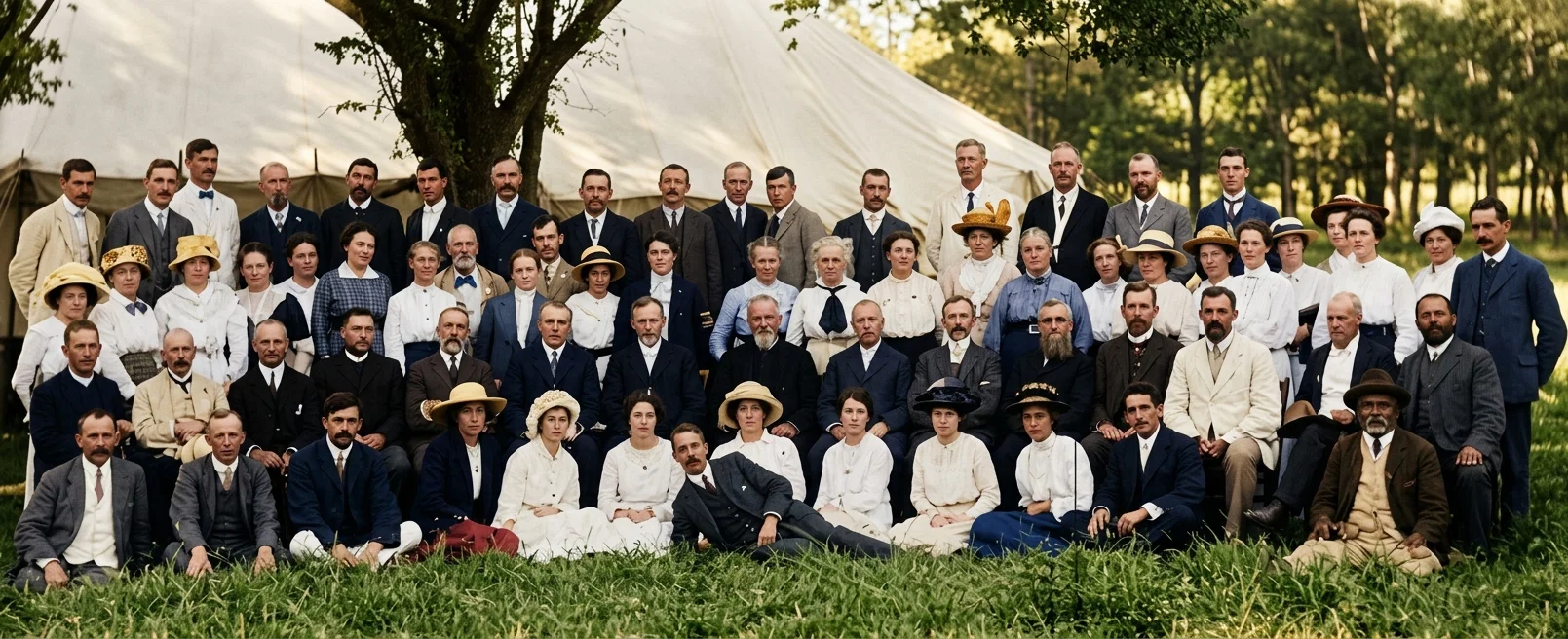
The largest gathering of Seventh-day Adventists ever held in South Africa, the brethren tell us, was the meeting of the South African Union Conference, held as a camp meeting, in Durban, Natal, in April.
It was preceded by a workers' institute, opening April 7, and continued from April 15 to 26, followed by several days' further meetings in continuation of the councils of conference workers and missionaries.
Twenty-nine years ago, at the General Conference of 1886, the first call from South Africa was presented. Australia and New Zealand had been entered just before, and we had a growing work in Europe. Many will remember the reading of Africa's call in the Tabernacle at Battle Creek that day. Brethren wept for joy as that word came from Brethren G. J. Van Druten and Peter Wessels, of the African diamond fields region, that there were Sabbath keepers in Africa longing to have workers sent out to preach the message of truth, more precious than diamonds and rubies. Then Elders D. A. Robinson and C. L. Boyd were appointed to South Africa, with several associate workers.
These twenty-nine years have swiftly passed. They have been years of expansion in South Africa. The two brethren who made that first call were not with us at the conference; but I met them both at Cape Town, and found them rejoicing in the message, and glad for what has been seen in South Africa since they sent the call for help.
Here in the Durban conference were gathered about three hundred and fifty representatives of the work. Thirty-four churches are spread through the field, from the Cape to Central Africa, beyond the Zambesi and the regions of Lake Nyasa; while the one mission station not represented by a delegate—the Tanganyika Mission, just being opened by Brother and Sister J. C. Rogers—is about eighteen hundred miles north of the Cape, where our first workers landed twenty-eight years ago.
Up and down this vast region the tiny jets of light are shining in the darkness—far separated in some areas, but with the points of light slowly and surely increasing in all parts of the continent.
WORKERS AND BELIEVERS AT THE SOUTH AFRICAN UNION CONFERENCE, DURBAN, NATAL
Three conferences occupy the southern portion,—the Dominion of South Africa,—while the mission fields of Rhodesia and Nyasaland were at this conference organized as a union mission under the union conference.
Twenty-nine years ago the call came. Today there are twenty-nine hundred members in the Sabbath schools of South Africa. Here was our first missionary effort to the heathen; and today, 727 of the church membership of South Africa are in the ten churches on the mission stations. In the mission schools now operated, about 3,000 young Africans are under instruction.
This is almost enough of figures. While looking over the work of these twenty-nine years, we must bear in mind the fact that the entire white population of the union is only about that of Philadelphia—a million and a quarter people, spread over an area of nearly two thousand miles from north to south. This helps to measure properly the labors represented in the fruitage springing up. In this population equal to that of one of our cities we find three conferences, twenty-four churches, nearly a thousand members, with institutional and departmental work merging into a union conference that added three hundred to its membership during the last term.
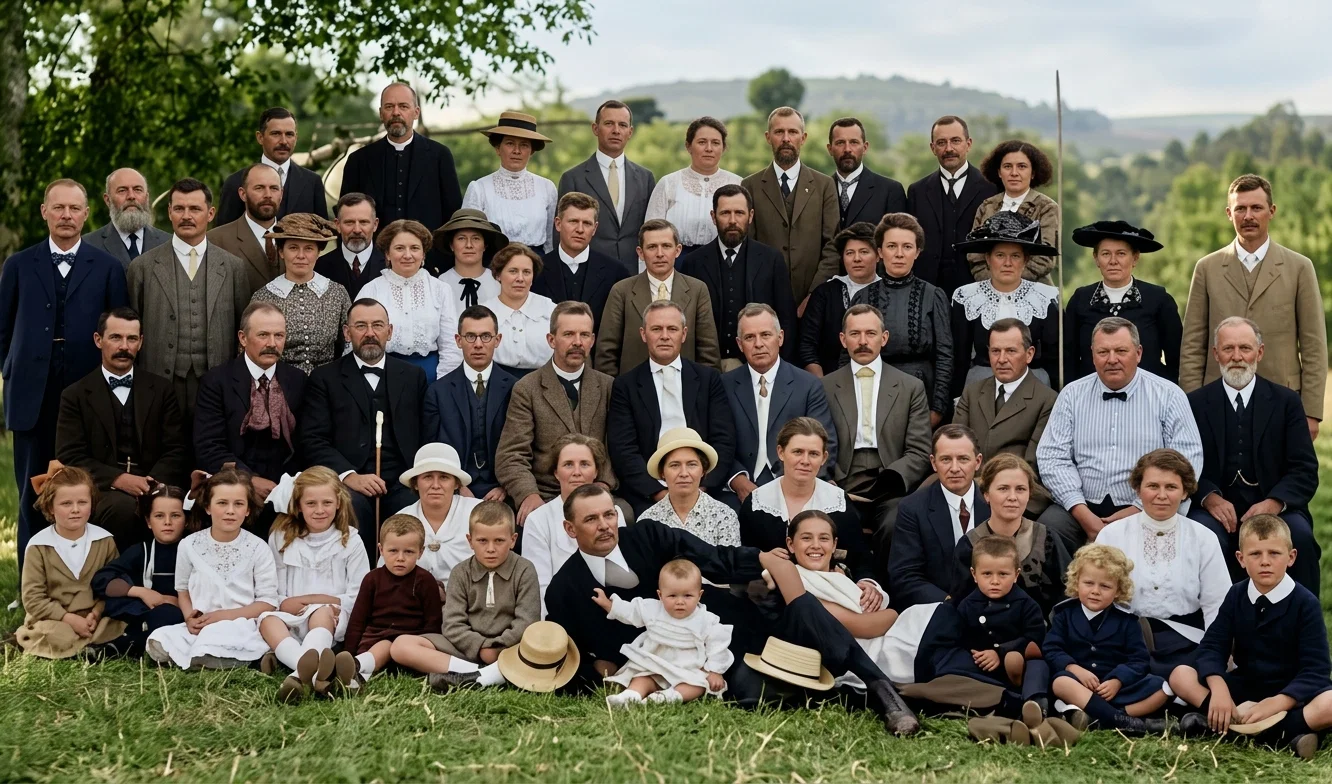
Yet the keynote of the union conference was consecration to God for yet more determined soul-saving work. It was a good old-fashioned camp meeting, with all the inspiration of the new time. These brethren and sisters love this third angel's message, and seek God and put away sin, just as the believers do in the older fields. The presence of the Dutch brethren, and their meetings in the “Dutch tent” in the intervals between the united services, gave the camp meeting the very aspect of the meetings in our Middle West, where services in the various languages are held.
The three conferences held their annual meetings during the union conference. Though we were twelve hundred miles from the headquarters of the Cape Conference, over seventy delegates were present in the sessions of that conference.
The officers in each conference were reelected—H. J. Edmed (Cape), W. S. Hyatt (Natal-Transvaal), O. K. Butler (Orange Free State).
Elder W. B. White was elected president of the union conference. The Lord is blessing Brother White in leading out in the work here. The workers' meeting was a profitable time, and the round-table conferences of the missionaries were a blessing not only to the workers from the missions, but to all the brethren and sisters who thronged these meetings. The instruction in the workers' institute was given mainly by Brethren White, Edmed, Hyatt, and the writer, other brethren also taking part.
The pressure of reports from the world-wide field forbids giving details. It was a blessed meeting. Souls found the way of victory by surrender. A number rejoiced in the marked manifestation of God's power to heal serious bodily infirmities. It was a good place to be.
The newspapers accepted full reports,13supplied by Elder I. J. Hankins, and our brethren are planning to push the circulation of the printed page. During the last two years, as reported by Brother G. H. Clark, over $20,000 worth of our books have been sold, and the English and Dutch paper—the Sentinel—has been given a large circulation since the outbreak of the war. Eight months ago the regular subscription list of these papers stood at 275 copies only; now it is over 4,000, and the brethren are aiming at 10,000 subscribers. Of several specials from 30,000 to 70,000 each have been sold.
There is a waking up in South Africa, both in the world and in the church, and reports from every side showed that the Lord is indeed pouring out his Spirit upon all flesh.
Often these believers wished that greetings be sent to the believers in North America, with thanks for the help that has been sent. These dear brethren and sisters are with us for the finishing of the work. Their children are entering the work in both English and Dutch fields and in the mission stations. The camp meeting Sabbath school set a mark for missions of $50 a Sabbath for the three Sabbaths; the people enthusiastically put double this into the envelopes. Their hearts beat true to the message, and God's providence has given us a splendid base in this dominion—with its Dutch and English population and its open Bible—for the great work that is to be done for the English- and Dutch-speaking colored people of the provinces, and the vast native populations of many tribes and tongues.
Durban.
A Visit to the South Side of Guatemala
By J. B. STUYVESANT
(Continued)
J. B. STUYVESANT
SUNDAY, after a hard morning’s work with the books and papers at Santa Lucia, we take the train for Retalhuleu, where we must pass the night and take another train in the morning for the port of Ocos, on the Mexican line, which will be the most distant point we shall visit. Early in the morning we are again rolling along through a rich and beautiful, but mostly uncultivated country, stretching from the grand old mountains on our north to the sea, and away beyond our view to the south.
For traveling companions we have several Mexican gentlemen who have been obliged to forsake their homes and property and flee, on account of the terrible revolutions in Mexico. One of them, we are told, is the alcalde (mayor) who with much bravery defended the Americans about Tapachula, and saved many lives from the angry mobs when the American forces landed in Vera Cruz. Although very rich, he has been obliged to leave all and flee for his life, and we are told that several of his valuable farms have been confiscated. Thus we are reminded that the day is not far off when all the treasures of this world will have to be forsaken by those who have spent their lives in accumulating them, and only that which is deposited with the Lord will be of any further use to us.
The last twenty miles of our ride is very hot and dusty. We arrive at the port about 4 P. M., and it takes less than five minutes to convince us that we would better leave again in the morning. The town is built upon a bank of deep sand, and consists of three large frame buildings used as customhouse and barracks, of railroad offices and hotel, several small board shanties which serve as stores, a small hotel, and a number of huts built of upright canes and thatch roof.
As soon as we can make ourselves tidy we are out at work, and by dark Mrs. Stuyvesant has put papers in all the houses. By working until about nine o’clock, and getting at it again by dawn in the morning, I am able to take subscriptions for the monthly Signs and Watchman from the American hotel keeper and the American consul, and to sell several copies of “His Glorious Appearing” and “The Coming King” in Spanish. The consul, who is also the railroad superintendent, gives us passes to the next town, and orders “The Coming King” in English. We are too late in the evening and too early in the morning to see the commandant in his office, but he comes to see the train leave, and we sell him “The Coming King” as the train is starting.
This was a very important port and served a rich coffee district before the railroad from Guatemala and the other ports was connected with the one here. One can still see the remains of a fine iron pier extending into the sea. In 1902 the volcano Santa Maria blew out on one side, covering the country to the west with a deep layer of sand, which fell for several days. Much of this sand was washed down the river, which empties at Ocos, and formed a large bar, cutting off the pier from the shore. Part of it was destroyed, and all was rendered useless. Freight is now landed by lighters near by.
Arriving at the Ayutla station about 10 A. M., and finding no conveyance, we are obliged to walk to the town, about two miles distant; and as it is very hot and the dust several inches deep, we are weary, dusty, and wet with perspiration when we reach the hotel with our hand luggage. Here we meet our Mexican traveling companions again, who are waiting for an opportunity to reenter Mexico.
MINISTERS AND DUTCH BELIEVERS AT THE SOUTH AFRICAN UNION CONFERENCE
This is a border town. The terminal of the Pan-American railroad in Mexico is just across the river in the little village of Mariscal. There are several hotels in Ayutla, and here we meet other refugees. At present there is a gap in the railroad of about two miles, but they are now building the line into the town, which will enable passengers to make better connections when Mexico settles down and trains can run again. The houses here, like those in Ocos, are nearly all of upright canes, with dirt floors and grass roofs. Mrs. Stuyvesant distributes many papers, while I secure the commandant’s subscription for Las Senales, and sell a few books.
After visiting Cuatepeque, we go back to Retalhuleu and enjoy a Sabbath of rest. Early Sunday morning we are on our way to the port of Champerico, where we have just two hours to work. This place is a little larger than Ocos, and has more business. The little houses are of lumber instead of cane. As it is on a low bluff, the ground is solid and the sand absent. Here and on the train we sell several books and magazines, and distribute many papers.
Returning from this place, we go to San Felipe in the evening, where we must leave the railroad. Before daylight the next morning the stage coach calls for us, and we begin our climb of the steep grades for Quezaltenango. The scenery is grand as we wind higher and higher up the sides and in behind Mt. Santa Maria, sometimes shut in by the mighty hills, and then coming out on a bold point, from which one can look many miles south toward the sea. After a hard, steady climb of about twenty-four miles, we reach our destination just before dark, and go to a hotel.
This is one of our largest and best cities, having about 20,000 inhabitants,14many nice buildings, and a fresh, cool climate. It has an altitude of between seven and eight thousand feet.
(To be concluded)
A Missionary Tour in the Far East
By J. E. FULTON
Japan
J. E. FULTON
After leaving the coast cities of China, our first port of call in Japan was Nagasaki, a city of considerable size and importance. As we came to anchorage, we could see the large docks and ship-building yards, and hear distinctly the busy hammers working in the building of ships. At this place some of Japan’s first-class war and merchant vessels have been built.
Here we came in sight of Japan for the first time. The harbor is excellent and the scenery beautiful. The country is mountainous, and the hillsides and valleys are well cultivated. In the city move the busy throngs, and we looked with interest at their odd ways and peculiar dress. We were also interested in the neat little houses and the well-kept little stores. There are many curio shops, especially of tortoise-shell-wrought articles. Many of these are very artistic and beautiful.
The people of the Sunrise Kingdom are small of stature, but sturdy, and are a very wide-awake people. They are exceedingly polite, and very cleanly in their dress and habits. The ordinary Japanese coolie may have old clothes, but they are clean; and he is often seen sitting in his jinrikisha during an idle hour, reading a book,—perhaps trying to study English.
Kobe was our next port of call, a most beautiful city. Here our work has made an entrance, and Pastor Hoffman is located at this place. In Kobe we have a small private sanitarium in charge of Dr. Noma, a Japanese lady physician. She is assisted by a staff of nurses, one of whom was trained at the St. Helena Sanitarium. This little institution is doing a good work. A branch sanitarium has been started in the large city of Osaka, twenty miles distant, so that the influence of the work is widening.
On arriving at Tokio we found the general meeting in progress. We were happy to meet our workers there, some of whom were old friends and schoolmates. The meeting was a good one, and the people showed appreciation of the word spoken. The counsel and instruction given the brethren by Pastor Daniells was of great value, and we feel sure its effects will be lasting. On the Sabbath a number of the workers were led to consecrate their lives more fully to God for the finishing of the work.
The message has moved slowly in Japan; but as our workers determined to go forward with more faith and activity, doubtless more results will be seen.
While greatly enlightened in the things of this world, the Japanese are in great darkness as regards the truth of God. Her people bow down to dumb idols, and but few have found the light.
While in Tokio, a number of us visited a leading temple in that city. Thousands were flocking to it, so that it was with difficulty that we approached it.
As we entered the temple, crowds were bowing at the shrines. A great receptacle in front of the leading idols received the offerings of the worshipers. Many who came to bow before these gods of wood and stone, and to mumble their prayers, could not get near, and so threw their offerings over the heads of the crowd that were before them. But the hopper of the huge offering box was made large enough so that no coin was lost. Great numbers of coins were cast in while we were there. Large sums must be thus collected in the course of a day.
Many sick and weakly persons turned to another shrine, where was a god of aged appearance. We were told that when the sick approach this god, they rub the part of the god’s body corresponding to that part of their own that is diseased; and so it appeared from what we saw. Many were rubbing the god with their hand and then passing the same hand over the body, here and there. The constant rubbing has greatly disfigured the god, parts being quite worn off by the tens of thousands who yearly worship there. Many others were worshiping still another god inclosed in a wire cage. Written prayers were tied to the cage. How one wishes to be able to teach the people a better way!
But while some of these nations of the Far East still grope in the darkness of superstition, they are making great advancement along some lines. Lands long shut up in their exclusiveness and conservatism, have opened their doors to Western thought and commerce, and are fast learning the ways of the enlightened nations of the world, so far as pertain to the things of this world. This is especially so with Japan. She has rapidly aped Western civilization. Only a generation ago Japan was little known to the world, being satisfied with the civilization of her ancestry, and caring nothing for what the Western nations were so ready to give her. But suddenly Japan awakened from her centuries of slumber, and has emerged from her aged conservatism. And awakening, how quickly she runs her race! Her ports are opened to the world, and rapidly has her trade grown. Japan, sitting for a while as a diligent student, has proved herself as apt as she is diligent. She received much, and now stands ready to give in return.
Today a wonderful civilization has grown up in Japan. She is no longer dependent on the foreigners as her educators; for now schools, colleges, and universities in Japan, conducted by Japanese, give to her youth an education in the things of this world, comparing favorably with the best. Great industries have been built up. Factories abound throughout the empire. Her mercantile fleet trades in all parts of the world. Some of her passenger steamers are floating palaces, and have been built in Japan by Japanese. She has built up one of the strongest navies in the world.
Japan has been figuring largely in the affairs of this world, and there is no doubt that the Sunrise Kingdom will have much more to say in the affairs of the Far East in future days. The Chinese are at present greatly depressed at the advantages Japan has taken over certain territory and rights in China. While peace reigns in the Far East at the present time, it is clearly to be seen from the ominous clouds now and then arising, that Christian workers must hasten on with God’s work.
While we are thankful for what has been gained for the message in Japan, let us pray that God may give us many more of these bright, progressive people.
Out Into the Jungles to Help
By MRS. P. GIDNEY
MRS. P. GIDNEY
ABOUT five o’clock, on the evening of March 19, Mrs. Wood was called by a tall, urgent Mohammedan to go to see a very sick woman, away off in a small village on the side of the mountain, quite a distance beyond a large river.
I was glad for the privilege of accompanying her on this errand of mercy. We had both worked hard all day, had not taken our evening meal, and the Sabbath was approaching. But we were told the poor woman was in a dying condition, and we felt that for the love of Christ and the souls he died to save, we must go in spite of our weariness or the lateness of the hour. The man who came for us promised to take us part way by rowboat, and the rest of the way by bullock cart, and said we should be back by midnight without fail.
We started for the village in a pony cart. We had to travel across country over very rough, stony roads for about four miles, and then through jungles until we came to a wide, swiftly flowing, deep, salt river. This we had to cross after dark in an old-fashioned sort of boat, merely a log dug or burned out. We almost held our breath as the man paddled us across, but we were about our Father’s business, and knew his angels would watch over and care for us.
We had passed green fields, with all sorts of vegetables. Now and then we saw several poor huts and many children playing about. Then we passed several large, well-painted native houses, and near by were heathen pagodas, and usually a well. The banks of the river were a beautiful tangled mass of palms, vines, and all sorts of wild flowers, sending forth their pure fragrance and scenting the air with heavy perfume. Only the splash, splash of our boatman’s paddle broke the silence as we glided gently on through the twilight.
A bullock cart and driver were waiting for us on the other side. To make us more comfortable, the owner had put a15mattress in the springless cart, and we had reason to appreciate this thoughtful act. We found this road much rougher than the first one. The dark, chilly mantle of night was fast settling down upon us, as we were tossed about without mercy from one side to the other of that old country cart. With all our experiences, our muscles were not hardened to such treatment. In this fashion we rode five miles.
About nine o’clock we reached the home of our patient. We found thirty-five or forty native women huddled in the small house, and the patient, in pain and anguish, screaming and moaning like a maniac. Mrs. Wood’s first work was to send the people out, and then she turned her attention to the sick woman, the young mother of a child but a few hours old. She had a high fever and was wild with delirium.
Mrs. Wood at once gave her some medicine, and then, kneeling beside her bed, prayed that God our Father in the name of Jesus would immediately help and deliver. In a few minutes the woman was soothed to sleep. Truly the Lord blessed the means and answered our earnest petition.
Then stepping out into the open air, we found a large company of sick people waiting to be treated at that late hour of the night. Several were attended to, and then we said we must return.
The people learned that we had not taken any food, so they brought some milk, eggs, and unleavened bread. When we had eaten this light lunch, it was nearly midnight, and we started for home. The road was dark, and we had to go through that long, lonely jungle without a single lamp. Only the beautiful, bright stars were shining in the dark blue sky. We were grateful for these.
We decided to return another way and save ourselves part of the trip by cart. But to our surprise, we had to make nine miles by bullock cart over the roughest kind of road, crossing two rivers in the small hours of the morning, with the bullocks up to their middles in the water.
We reached Titralli station at 1:30 A. M. Everything had been dark and dismal, and we were glad to be near signs of civilization again. We were very tired and our bodies ached, so we laid ourselves down and tried to sleep till train time. Suddenly we heard the rumbling of wheels, and grasping our medicine bag and hats, we scrambled into that friendly train. In a moment we were off to sleep again, and slept until we reached Kalyan, at about five o’clock. Then we had to go in search of a pony cart to take us to the mission. We reached our quiet home at 6:30, where friends awaited us with a hot bath and some refreshment. And now the good news comes from that little heathen village, that the poor woman who was so sick is a well and happy mother. All the people of that village know that we love them, and are their true Christian friends.
Youthful Kings
By MRS. D. A. FITCH
MRS. D. A. FITCH
As one reads the record of the kings of Judah, he may well be surprised at the youthful, even childish age at which some of them began to reign. Four of them, Jehoash, Josiah, Manasseh, and Jehoiachin, were made kings at ages ranging from seven to twelve years. As to the fitness of a boy of that age to guide the ship of state we are not to decide. If the Lord did not so order it, he certainly permitted it, and evidently for some good purpose.
There are some things he now permits which he fain would change for the good of all concerned. In many families infantile kings are reigning with a degree of rigor equaled only by that of Rehoboam, son of Solomon. From the age of a few days to the time of the maturity of their children many parents are in complete subjection to their sons and daughters. One wise and aged woman said of the present time: "You need not tell me there is no family government in these days. I say there is; but it is in the hands of the children." One has no need to observe very closely to be convinced of the truthfulness of this statement. It is too sadly true.
* For this state of affairs the parents are at fault. The child, being pampered, petted, and then again threatened with a punishment never administered, learns he can usually have his own way in almost everything, and therefore soon avails himself of the privilege. To keep peace in the home the parent submits once, twice, and thrice, until the whole place is thoroughly ruled by the children.
Much might be written concerning the importance of parents' having a high standard regulating the affairs and behavior of their family, so that there shall be happiness in the home, no friction in the neighborhood, no wrong example in the church, and finally the entire family in the dwelling place where Jesus reigns.
A Letter to a Younger Sister
By MARTHA E. WARNER
MARTHA E. WARNER
MY DEAR ALICE: In your last letter you wrote: “I am busy from morning till night, yet my work is never done. Send me something to help me.”
Perhaps the reason your work is never done is because you lack system. Many young housekeepers, confronted with the responsibilities and cares of a home, become confused and discouraged when the work piles up, and their strength seems insufficient for their many tasks. We all admire a capable house-mother, who is able to “turn off work,” and keep her home and her family in order. But sometimes the fact is overlooked that good household management is not all in swiftness or in strength; much of it is in a well-thought-out plan, a careful systematizing of work and time. In my reading lately I have noted some paragraphs that may be a help to you:—
“System is everything. The lack of appreciating order and system in the arrangement of family matters leads to destructiveness and working to great disadvantage.
“God tests and proves us by the common occurrences of life. Oh, how important it is that faithfulness in little things characterize our lives, and that we ever bear in mind that angels of God are taking cognizance of every act!”
With the thought in mind that you are doing the work of God, take time to plan out a daily schedule of your work for the week.
“Some who are engaged in domestic labor are always at work; it is not because they have so much to do, but they16do not plan in such a way as to have time. They should give themselves a certain time to accomplish their tasks, and make every move tell. You should have regular hours for rising, for praying, and for eating. One hour wasted in the morning is lost never to be recovered. Do but one thing at a time, and do that well, finishing it before you begin a second piece of work. Every one is required of God to execute the work assigned him with thoroughness and dispatch.”
Do not fret because some one else is doing a greater work than you. Just thank God for the work he has given to you, and remember that “by earnest, conscientious faithfulness in everything, earth may be brought nearer heaven, and precious fruit may be borne for both worlds.”
Clintonville, Conn.
Let Us Give Thanks
By Marianne Farningham
For the discipline of sorrow,
For the angel of distress,
For the unseen hands that draw us
Into greater blessedness;
For the lips that close in silence,
For the strong hands clasped in prayer,
For the strength of heart that suffers,
But sinks not in despair;
For the penitence and patience
That are meek beneath the rod,
And for hope’s glad resurrection,
We give thee thanks, O God.
For the hope that right shall triumph,
For the lifting of the race,
For the victories of justice,
For a coming day of grace;
For the lessons taught by failure,
Learned in humbleness and pain;
For the call to lofty duties
That will come to us again,
For the hope that those who trust in God
Shall not be put to shame,
For the faith that lives in all the world,
O God! we praise thy name.
— Marianne Farningham.
Home Life Department
By Mrs. I. H. Evans; Miss Lora E. Clement
Conducted by Mrs. I. H. Evans, Takoma Park, Washington D. C.
Assisted by Miss Lora E. Clement
Through the columns of this department, hints will be given on all matters pertaining to the home life. Short articles and letters are solicited from home makers, telling of their everyday experiences,—their joys and sorrows, their failures and successes.
The Influence of Prayer
By MRS. H. E. SAWYER-HOPKINS
MRS. H. E. SAWYER-HOPKINS
Harry was a motherless lad of seventeen. He had been carefully reared, and when left without a mother's companionship, with his father away much of the time, home life became rather monotonous. He fell into the habit of associating with young people whose influence was not the most helpful, and soon a noticeable change came about in his life.
An aunt who had charge of the household, quickly noticed the difference in his attitude. She mentioned the matter to his father, and they decided to have special seasons of prayer each day for the boy. Soon the father was called to a distant part of the State, and he arranged for his family to follow when their property was sold. Left alone with her nephew, Aunt Ellen carried a heavy burden for his welfare, and spent much time seeking the Lord in his behalf. The knowledge that he was reading novels caused her much anxiety, and she felt the need of divine wisdom in dealing with him. Often while about her work, a voice seemed to say, “Pray for Harry.”
One evening at worship the way opened for her to mention the matter of good and bad reading. Harry seemed impressed, but there was no radical change in his deportment, and his aunt still carried her burden of prayer. Finally some of the books the boy had been reading came into her hands when he was near, and she talked with him kindly about the mental injury they would do him. He said candidly that he had not realized this, and offered to get the horse and return them.
Several days later Harry said, “Aunt Ellen, I am going to read the Bible through. Will you read with me?” Of course she was glad to do this. But during the week she was made sad to find that he was still spending time reading objectionable books. Noticing her sad expression, Harry inquired the cause. When she finally told him that she had found the books he had told her he would return, he explained that they belonged to the city library, and at the first opportunity he took them back, and brought home others which he handed to her for inspection. She could find no fault with these; but knowing the lad's love for reading, she pleaded with God that he might be saved from the tempter's snare.
The next Sabbath Harry attended church. It was a warm day, but he seemed glad to take the seven-mile drive, and went alone. His aunt learned afterwards that he took part in the social meeting, expressing his earnest desire to be a true Christian. He spent the afternoon at home reading his Bible and other religious literature. As they took a walk at the close of the Sabbath, Aunt Ellen spoke of the beauties of the new earth, and he asked, “Do you suppose I can have a home there?” Upon receiving her assurance, he expressed an earnest desire that he might do something to be worthy of such a home. The boy was really anxious to do right, but like many another youth, he needed guidance along the right way.
The following days showed a great change in his life. He was really in earnest; but whenever anything was said about their joining his father, he would exclaim: “I don't want to go a bit! I cannot be a Christian there, I know I cannot. There are strong influences drawing one to the world, and I cannot withstand them. O Auntie, I do not want to go!”
One Thursday morning Harry started to take home a borrowed horse. He begged his aunt to go with him, but she could not leave her work, and urged him to wait until the first of the week. However, he seemed anxious to go, and mentioned going swimming in the pond, remarking: “It's fifteen feet deep in the center. Wouldn't it be awful if I should get in there?” His aunt told him to be very careful. As he seemed to think he must do the errand that day, he started out about ten o'clock. He had not been gone long when a voice seemed to say to Aunt Ellen, “Pray for Harry.” As she did not drop her work, this charge was repeated again and again. Finally she knelt in prayer, telling the Lord that she would leave the boy in his hands, and then the burden of prayer rolled away. As evening came, she wondered why he stayed so long, and presently the neighbors came to tell her that Harry was drowned.
At first it seemed that she could not have it so. Then the thought came that he must have been prepared, for early in the morning she had committed him to God's care, and trust in an all-wise Father's plans filled her heart. Again and again she claimed the promise that the eye of the Lord is ever upon those who trust him. And she came to believe that removal to the city where his father was located might have proved Harry's eternal ruin. Truly God moves in a mysterious way, but men are frequently his chosen instruments.
* Loma Linda, Cal.
Behavior
Behavior is a mirror in which every one displays his image.—Goethe.
Why We Have School at Home
By MRS. MARY EVANS-CLARKE
MRS. MARY EVANS-CLARKE
WHEN our little ones came to us, we accepted it as our privilege and duty to protect them, as far as possible, from the temptations of the present day.
A large family lived near us whose older children were in the village school. When small, they attended Sabbath school, and while still young united with the church. But as they entered the higher grades in school, and made friends with those who cared nothing for religious things, they gradually lost their love for the truth. When childhood days were hardly passed, they had slipped from us, and are now in the world and of the world. The younger children of the family were placed in our schools, and are now workers in the cause we love. Did it pay to make the sacrifice needed to keep these children in our schools? Surely church schools pay. How can we run the risk of losing our children to the truth we hold dear by placing them under the teachings of the world?
Two years ago ours were the only children of school age in our church, so we had to have a home school or none. Our boy was seven in December, but not until the next summer did the director visit us. He was very kind, and we told him our plans to have a home school for a few years. We were two miles' distant from the schoolhouse, and no other children lived on that road.
He asked several questions about our plans, and finally suggested that I could teach the children by getting a certificate. We were surprised at that, as he had caused another Sabbath-keeping mother quite a little worry three years before.
We thought of having a girl for the housework, so I could give my time to the children. However, we gave up that plan as we could find no suitable girl for the housework, which is always abundant on a farm. Children are with the hired helpers, both in the house and outside, and are greatly influenced by them. A teacher would feel a burden to have her influence uplifting, and perhaps a paid helper in the kitchen would not. Again, the wages for a hired girl are about the same as for a teacher, but the running expenses of the home are usually increased when the housework is turned over to a girl. Expense and difficulties are to be met whichever course is followed; but though this is true, we cannot afford to expose our children to the alluring influences of the world.
In our own family we decided to hire a teacher for the school year. A pleasant upstairs room was fitted up with the necessary appliances, and as far as possible given the air of ‘school.’ Regular hours were kept, and the interest of the children never flagged.