MONDAY, March 15, the chairman of the Religious Liberty Bureau and the writer left Washington, D. C., for a nine-days' trip to New England. Tuesday evening, March 16, we spoke at a mass-meeting at Hartford, Conn.; the next day we attended a hearing at Albany, N. Y., where thirty Sunday bills have been introduced during the present session of the legislature; following this, we conducted a two-days' religious liberty institute with the students of the South Lancaster Academy, and later held meetings at Boston, Melrose, and Springfield, delivering, in all, twenty-eight addresses during the trip.
The mass-meeting at Hartford was held in Unity Hall, and was fairly well attended. It was reported that six State senators were present. The speakers of the evening were Elders C. H. Edwards, president of the Southern New England Conference; W. R. Andrews, religious liberty secretary of the conference; C. S. Longacre, religious liberty secretary of the Atlantic Union Conference; K. C. Russell, and the writer. Many strong and convincing arguments were20made in the five addresses delivered, which we have since learned made a good impression on some who were present.
One particularly interesting case connected with this meeting came to our attention. During the meeting, we noticed a bright, intelligent young man, whom we took to be a reporter, sitting near the front, taking notes of all that was said. After the meeting was over, and Elder Russell and I had gone to the station to take a late train for Albany, this young man came to us and sought an interview. He stated that the question of Sunday enforcement by law had come up for consideration in his home church, the Episcopalian, and that he was to take the negative side of the question in a discussion to be held in the church a little later. That morning he had gone to the town library to see if he could find some work against Sunday legislation to aid him in preparing his argument, but was informed by the librarian that there was nothing in the library of the character he wished. Upon looking over the morning paper, however, he noticed an announcement of our mass-meeting at Hartford in the evening, and he at once decided to attend this. He had to travel about ten miles by train to do so, but he seemed to feel well repaid for his pains. We had a pleasant talk with him, and supplied him with some literature, took his name and address, and are now corresponding with him.
During the day previous to the mass-meeting, we spent some time at the large library in the State capitol building, looking up and copying off the old Connecticut Sunday “blue-laws” as far back as 1721.
The following day, Wednesday, March 17, a hearing took place at the capitol on the various Sunday bills which have been introduced into the Connecticut Legislature this session. A strong effort, headed by the mayor of Hartford, and supported by the mayors throughout the State, has been made to liberalize the present Sunday laws of the State, and also to secure such amendments to these as would bring about uniformity in their operation. One measure introduced, like the Johnston Sunday bill, contains thirty exceptions, over one half of the bill being devoted to these. On account of the hearing at Albany coming on the same day, Elder Russell and I could not attend the hearing at Hartford. The brethren who did attend it did not get an opportunity to present any arguments, but were permitted to ask questions, and by this means were enabled to make clear the nature of the proposed legislation.
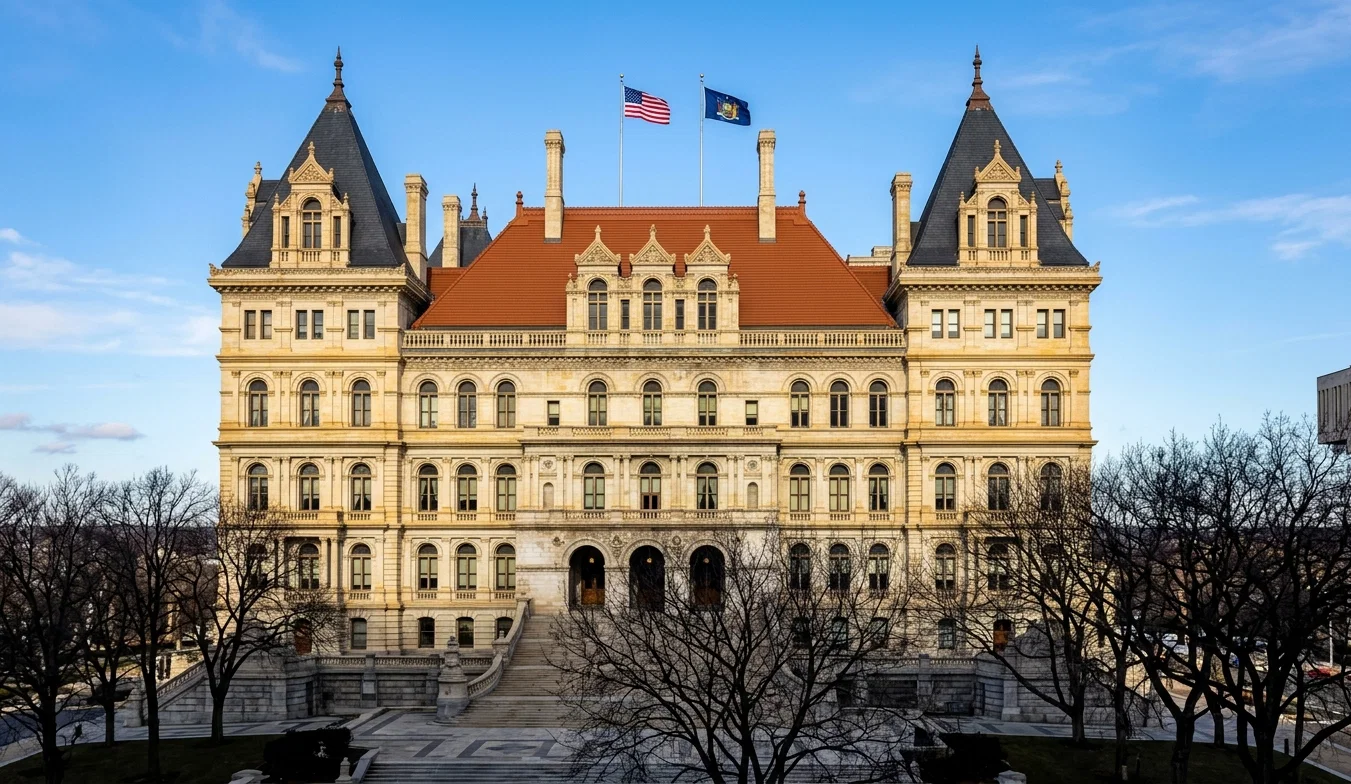
THE STATE CAPITOL, ALBANY, N. Y.
The hearing at Albany took place Wednesday afternoon, March 17, and was a particularly interesting and lively affair. It was held in the capitol building, before the committee on codes, and continued for over four hours. An unprecedented number of Sunday bills had been introduced, thirty in all, and in order to consider all of these, hearings had been set for three successive Wednesdays, this being the first. Through the courtesy of the chairman of the committee, and some wise planning on the part of Elder A. J. Clark, who has been looking after matters in the interest of religious liberty at the State capital this winter, we were permitted to speak upon any of the bills at this hearing, and deal with the question of Sunday legislation in general. Many of the measures introduced were for liberalizing the present laws, and reducing the fines and penalties; some were for making them more stringent; and some to amend the exemptions touching the observance of the seventh day, particularly in the interests of the Jews. The latter were introduced by Jews, there being no less than five Jews in the present membership of the Assembly.
Fully two hundred persons were present at the opening of the hearing. The retail grocers, who appeared in large numbers, asked for legislation requiring the closing of shops and prohibiting trade on Sunday, on the ground that the opening by some while others closed was “unfair competition.” They said: “We don’t believe in this thing of keeping stores open on Sunday. We are going to stand by our American flag, and we want a clean Sunday. All creeds should submit to the American principle that no unnecessary work shall be done on Sunday. Sunday opening keeps employees away from church. What we want is the enforcement of law.”
Against a measure known as the McGrath Sunday baseball bill, prominent clergymen and churchmen from all over the State appeared in full force, including Rev. W. S. Hubbell, of the New York Sabbath Association; Rev. Dr. Ward, Presbyterian, of Buffalo; Prof. A. N. Housted, of the State Normal College, Albany; Mr. Farrell, of the Christian Endeavor, of Albany; Rev. Fred J. Tower, of Rochester; Dr. Laidlaw, of the federation of the churches, of New York; Rev. Dr. Wood, representing, as he claimed, the Baptists of North America; Mr. W. I. Sotherton, of the Brooklyn Sunday-school Union; Canon Chase, of Brooklyn; and Mr. Robins, of the State Sabbath Union.
Dr. Hubbell marshaled the church forces against the bill, reading letters from the Catholic archbishop of New York and leading Protestant representatives, protesting against it.
Dr. Ward, claiming to represent all the Protestant churches of western New York, presented letters of protest from Bishop Walker, Episcopal; and Bishop Colton, of the Catholic diocese of Buffalo. He said he did not oppose the bill on religious grounds, but because Sunday baseball tended to “demoralize the youth, and break down the American sabbath and American citizenship.” He emphasized “the necessity of preserving the sanctity of Sunday,” and said that “this is the only day that is given to religious and moral instruction.”
Mr. Streibert said: “I believe that in this country the majority conscience should be respected, and not the minority conscience.”
Mr. Martin, of the Secular League of New York, was the first to speak of the un-American principle involved in Sunday legislation. He said, “I do not speak against the church, but against the church interfering in matters of politics.”
Although the committee had been together nearly four hours when we began speaking, we were given about forty-five-minutes' time, and a very respectful and attentive hearing, the chairman, when we suggested cutting our remarks short, asking us to continue, and remarking that they were interested in what we were saying. Elder Russell spoke first, followed by the writer, then Elder F. H. DeVinney, president of the New York Conference, and Elder Clark. A good impression, we believe, was made upon the committee. During the hearing, over thirty speakers took part, and thirty-five speeches were made.
At the close of the hearing, Canon Chase requested an interview with us. He stated that he agreed with much that we had said, but thought us mistaken in some of our ideas, and sought to set us straight by citing the “Christian nation” decision of the Supreme Court of the United States. We soon convinced him that he would not himself subscribe to all the decisions that had ever been rendered even by this august body, and that the decision referred to, and all religious legislation included, was contrary to the Christian and Protestant idea of civil government, and in direct conflict with the spirit and express terms of the national Constitution itself.
At the station, as we were taking the train for South Lancaster, a man who had been at the hearing and listened to all the arguments presented, came to us,21and, after stating that he was a Presbyterian, said, “You gentlemen who spoke last were the only ones who spoke straight on the question,” which showed that some, at least, who were present were able to discern the difference between truth and error.
We spent a most interesting two days at South Lancaster, giving instruction on religious liberty principles twice daily before the entire body of students at the academy, and holding one evening service in the church, which was largely attended.
Our meetings at Boston, Melrose, and Springfield were likewise well attended, and we believe good was accomplished by them.
On our return we visited an eighty-acre farm near Concord, Mass., recently purchased by Elder F. C. Gilbert as a home for converted Jews: not far away is the battle-field where the first forcible resistance to British aggression on American soil was made, April 17, 1775, by the “embattled farmers,” afterward known as “minute men,” who “fired the shot heard round the world.”
W. A. C.
Field Notes
Two persons were recently baptized at La Junta, Colo., and one at Rocky Ford.
---
ON Sabbath, March 6, three candidates were baptized and received into the church at Duluth, Minn.
---
FIVE members—three men and two women—have been added to the church at Santa Cruz, Cal., as a result of efforts put forth there.
---
BROTHER J. I. Taylor reports that he has recently baptized three persons, two of whom joined the church at Houston, Tex., and the other at Waco.
---
BROTHER I. G. Knight, reporting from Kansas, says: “I visited the Holton church, and found them active in home missionary work, five having been added to their number since I was there last.”
---
THE work among the Koreans in Sacramento, Cal., the past year has been very encouraging. One young man was baptized during the month of January; he is the second to accept the truth. Three more intend to be baptized in the near future.
---
A LETTER from Brother J. A. Minner, who has been holding meetings at Fargo, Kan., says: “I have been conducting meetings here since February 7. Some have taken a firm stand to keep all the commandments of God. Several are studying the question seriously. I think I shall be able to leave a Sabbath-school of ten or twelve adults. We have nine who have signed a covenant to obey.”
Christian Liberty
Reports, Notes, and Comments Pertaining to theCurrent History of the Rights of Conscience
Conducted by the Religious Liberty Bureau
K. C. RUSSELL. . . . . Chairman
W. A. COLCORD. . . . . Secretary
Proposed Religious Legislation in Congress
By K. C. R.
It was hardly to be expected that any religious measures would be introduced during the special session of Congress which convened March 15 for the purpose of revising the present tariff law. The usual standing committees of the Senate, however, were appointed, and on Monday, March 22, Senator Johnston of Alabama, introduced a Sunday bill which is an exact copy of the Johnston Sunday bill which was passed by the Senate during the last session of Congress, but not acted upon by the House.
Although the standing committees of the House have not been appointed, yet a joint resolution has been introduced by Mr. Sheppard, of Texas, providing for an amendment to the Constitution of the United States by prefixing to the preamble the words, “In the name of God.” This is in effect the same resolution which was introduced in the Senate during the last session of Congress, which was not acted upon. There will be no opportunity to consider this resolution, which was referred to the committee on the judiciary, until the regular committees are appointed.
Thus another opportunity is before us to enlighten the people concerning the principles of religious liberty. Petition blanks are now being prepared, which our people can use in securing the signatures of those who are opposed to the proposed legislation. All should unite in obtaining the largest number of signatures to these petitions that have ever before been secured against any similar measures.
K. C. R.
Current Mention
— The monthly statement of the public debt shows an increase during the month of March amounting to $3,088,574.
— Admiral Cervera, who commanded the Spanish fleet at the battle of Santiago, died at Puerto Real, Spain, on April 3.
— The Central American governments continue to mobilize their troops, and it is felt that another war involving four of these states will soon be declared.
— In the burning of the Hamburg-American steamer “Altenburg,” at Havana, Cuba, on March 30, fourteen persons are reported to have lost their lives.
— The census bill, which was vetoed by President Roosevelt, as one of the last official acts of his administration, was passed again on March 18, but short of the provisions to which the former president objected.
— The United States and Canada have decided to limit the amount of water that may be taken from the Niagara Falls for power purposes. The power companies on the Canadian side are limited to 36,000 cubic feet a second, and the companies on the American side to 20,000.
— There are certain questions of disagreement between Japan and China over Manchurian matters which China desires to bring before The Hague tribunal for arbitration. Japan disagrees to the proposition because, she claims, the powers of diplomacy have not been exhausted to bring about a settlement.
— Georgia’s system of leasing convicts to various industrial concerns came to an end on April 1. The system had been in vogue for forty years, and many charges of cruelty have been made against it from time to time. An investigation into these charges was started some time ago by the governor. It is declared that the system was abolished because of the colossal graft and shocking cruelty revealed by the investigation.
— King Leopold of Belgium has offered a prize of $5,000 for the best treatise on aerial navigation.
— The last symbol of American authority in Cuba was removed on March 31, when the American garrison at Camp Columbia, Havana, lowered its flag and embarked on two American transports for Newport News, Va.
— A despatch from Bluefields, Nicaragua, states that the sloop “Kearsarge” went down in a storm on March 22 while on her way from Monkey Point to Greytown, and twenty of the twenty-nine persons on board were lost.
— Eight negroes were killed and twenty wounded in a race war at Henrietta, Okla., on March 25. One of the deputy sheriffs was the only white man wounded. The negroes fled to their cabins and refused to be arrested.
— The president of the Bethlehem Steel Company announces that his company has practically closed a contract with the government of Argentina for the building of two of the largest size battle-ships, each to cost $10,000,000.
— According to daily press reports, wireless telephony has not proved an unqualified success on the battle-ships. It has been impossible to send messages except over short distances, and then only when the wireless telegraph was not in operation.
— On April 3 the city of Fort Worth, Tex., was visited by the most serious conflagration of its history, which swept through the residence, church, hospital, and business district of the city, resulting in a loss estimated at between four and five million dollars.
— A company has been formed in Germany to lay a submarine cable connecting Germany with her colonies. The entire length of the cable will be 7,000 miles, and the first section from Borkum Island, Germany, to Teneriffe, Canary Islands, is to be finished this year.
— A despatch from Japan states that the Japanese government has issued a decree forbidding the importation of any of Count Leo Tolstoi’s works, and ordering that all of these works now in Japan be seized and confiscated. The reason for this decree is said to be that Tolstoi’s works are of a character “to demoralize youth.” It is doubtless Tolstoi’s teachings against war to which the Japanese government takes exception. It is his teaching upon this point that has made his works so objectionable in his homeland, Russia.
— The Servian government April 1, made formal submission to the demands of Austria-Hungary, and the danger of war over Austria’s annexation of Bosnia and Herzegovina is thought to be averted. In this formal submission, made in the capital of Servia on the date mentioned, Servia declares that her rights have not been violated by the annexation of those states, and that she accepts the powers’ decision to annul paragraph 25 of the treaty of Berlin. She therefore agrees not to protest against Austria’s annexation of those states. She agrees to maintain peaceful relations with Austria-Hungary. She agrees to return her military forces to their normal conditions and discharge her reservists and volunteers, also to prevent the formation of independent troops or bands.
— The two piers of the Havana Central Railroad, at Havana, Cuba, were burned on March 29, entailing a loss of $1,000,000.
— In a local option election for Clark County, Ohio, on March 29, the county voted out the saloons. This closes ninety-seven saloons and three breweries.
— The pension bills passed by the Sixtieth Congress have increased the pension budget by about $1,000,000. Since the year 1865 there has been paid in pensions the sum of $3,654,653,365. This is in addition to the cost of maintaining the pension bureau and pension agencies.
— The new twenty-million-dollar bridge connecting New York City and Long Island City was informally opened to pedestrians and vehicles on March 30. This bridge, including its approaches, is 7,424 feet in length. The clear height of the bridge above mean high water is 135 feet, and the height of the towers above the bottom chord is 185 feet. The bridge contains four trolley tracks, two elevated railroad tracks, two floors, a roadway fifty-three feet wide, and two foot-walks each fifteen feet wide.
— A few weeks ago an Italian detective in the employ of the police department of the city of New York was killed in Sicily while making investigations into the operations of the Italian secret societies. The Italian police have made no headway whatever in the work of capturing the murderers, in spite of the fact that the detective was killed in a public place. It is quite openly charged that the Italian police are themselves in fear of the secret societies, and dare not enter actively into the work of capturing the assassins for fear of losing their own lives.
— The reason for Servia’s final submission to the annexation of Bosnia and Herzegovina and to the demands of Austria-Hungary is now manifest. Servia was depending upon Russia to assist her in case of war; but it was known that Germany was supporting Austria-Hungary. The crisis was reached in the negotiations when Germany peremptorily demanded that Russia withdraw her encouragement from Servia and acknowledge Austria’s annexation of the two provinces. This must be done within twenty-four hours, or Germany would invade Russia. The Russian minister, Isvolsky, asked for time to consult the other powers; but this was refused, and he was given to understand that a large force was already mobilized on the Polish frontier. The minister called an emergency council, and it was agreed to yield to Germany’s demands. The bringing to light of this transaction has greatly stirred England, and a movement is now on foot to hasten the construction of battle-ships, that she may be prepared against the time when Germany makes some such demand of her. It is felt that this move on the part of Germany will result in the formation of a strong alliance against her on the part of Russia, France, and England. The Russian people feel deeply chagrined over the matter, especially in view of their previous humiliation at the hands of Japan. Germany’s method of settling the Balkan question has thus added another irritant to the European situation and made more certain a general European war.
Important Notice!
By I. H. Evans
THE next session of the General Conference of Seventh-day Adventists will be held at Takoma Park, Washington, D. C., from May 13 to June 6, 1909. The opening meeting will be held Thursday morning, May 13, at half-past ten o’clock. Every delegate should be present at the first meeting.
How to Reach the Grounds
In Washington all railroads enter the new union station.
Passengers on the Baltimore and Ohio Railroad, should check their baggage to Takoma Park, D. C.
All passengers on other than the Baltimore and Ohio Railroad, should check their baggage to Washington. On arriving at the union station, they should buy a ticket on the Baltimore and Ohio Railroad to Takoma Park, D. C., which will cost nineteen cents. On this ticket they should recheck their baggage to Takoma Park.
Baltimore and Ohio trains leave Washington for Takoma Park at the following hours: Daily, except Sunday, 8:20 A. M., 12:35 P. M., 3:30 P. M., 5:45 P. M., 7:00 P. M., 11:30 P. M.; daily, 5:05 P. M.; Sunday only, 9:15 A. M., 1:30 P. M., 7:35 P. M., 10:15 P. M.
Those arriving in Washington at a time of day when there is no train to Takoma Park, can perhaps save time by taking a street-car.
In front of the union station take a car marked “Treasury,” “Mt. Pleasant,” or “Georgetown.”
When paying fare, ask for a transfer to Ninth Street.
Upon reaching Ninth Street, transfer to any car marked “Takoma Park,” or “Seventh and Florida Avenue.” If you board a Seventh and Florida Avenue car, you will transfer at the Loop to a Takoma Park car, remaining on any car marked Takoma Park until you reach the end of the line.
There will be at Takoma Park, at both the Baltimore and Ohio depot and the street-car line terminus, a member of the reception committee, to give directions in reaching the Seminary grounds, where the Conference will be held.
Conveyances will be provided to transfer both passengers and baggage to the encampment.
Transportation to the grounds from Takoma Park, will be provided at the following prices: Passengers, 10 cents; trunks, 15 cents; handbags, 5 cents.
Information concerning the location of both delegates and visiting brethren, who have previously made arrangements for their entertainment, can be obtained from the members of the reception committee at both Washington and Takoma Park stations.
Passengers desiring their baggage transferred to the quarters assigned them, may surrender their checks for baggage to the reception committee, paying for the transfer of the same, receiving in turn a camp-claim check.
Hand-baggage may be taken on the street-cars.
Tents and Rooms
Lodgings will be provided either in tents or in buildings.
The tents will be floored, and furnished with cots, mattresses, pillows, chairs, small rough table, pail, tin wash-basin, and cup. All other articles required, such as all bedding, linen, towels, soap, mirror, etc., must be furnished by the occupants.
An abundance of covering should be brought, as there may be cold nights during the meeting.
All curtains for dividing the tents should be brought by those who desire them.
Do not forget that the General Conference will not have bedding to sell or to rent. The General Conference will not be able to supply any articles further than those mentioned above.
The General Conference Office building and the Takoma Park school building will be opened for the accommodation of guests. Rooms in these buildings will be supplied with cots, mattresses, pillows, and chairs. All other requisites must be supplied by those who occupy the rooms.
The tents will be located on the Seminary grounds, where the Conference will be held.
The General Conference Office building and the Takoma Park school building are about one mile from the Seminary grounds.
A charge will be made for tents and rooms in the above-mentioned buildings at the following rates:—
Tent and Room Rates
For 2 persons .......... $4.50 each
For 3 persons .......... 3.66 each
For 4 persons .......... 3.25 each
For 5-8 persons ........ 3.00 each
For more than 8 persons 2.75 each
These rates will be the same whether a person stays a portion or the whole of the time of the General Conference session.
Some furnished private rooms can be secured. The rental of such rooms will range from two to five dollars a week for one person. An additional charge is generally made when two persons occupy the same room.
Board
The foreign mission delegates will be boarded in the Seminary dining-hall. All other delegates and visiting brethren who desire, can obtain board in the dining pavilion.
The boarding will be conducted on the European plan,—that is, each person will be free to select his dietary, and pay for such food as he orders. By this plan each person can economize at his own option.
Those occupying tents may board themselves if they prefer.
Cooking food will not be allowed in rooms. There will be a store at which breadstuffs, fruits, nuts, vegetables, etc., can be secured at market prices.
Delegates having a preference for a room or a tent, and all visiting brethren who expect to be supplied with room or board by the General Conference, and those who desire furnished rooms in private homes, should write at once to Elder G. A. Irwin, Takoma Park, D. C., stating accommodations preferred and required.
It is anticipated that there will be a large attendance at the coming General Conference session, hence it will be absolutely necessary for the committee on arrangements to know beforehand for whom accommodations must be provided.
Those failing to write must not be disappointed if, on arrival, they do not find themselves satisfactorily provided for.
Again we urge all to write immediately concerning sleeping accommodations and board.
Let churches and individuals remember that missionary maps of the world will be for sale. Delegates will be glad to act as agents in supplying any one desiring the same.
In behalf of the committee,
I. H. EVANS.
The April “Watchman”
By Editor
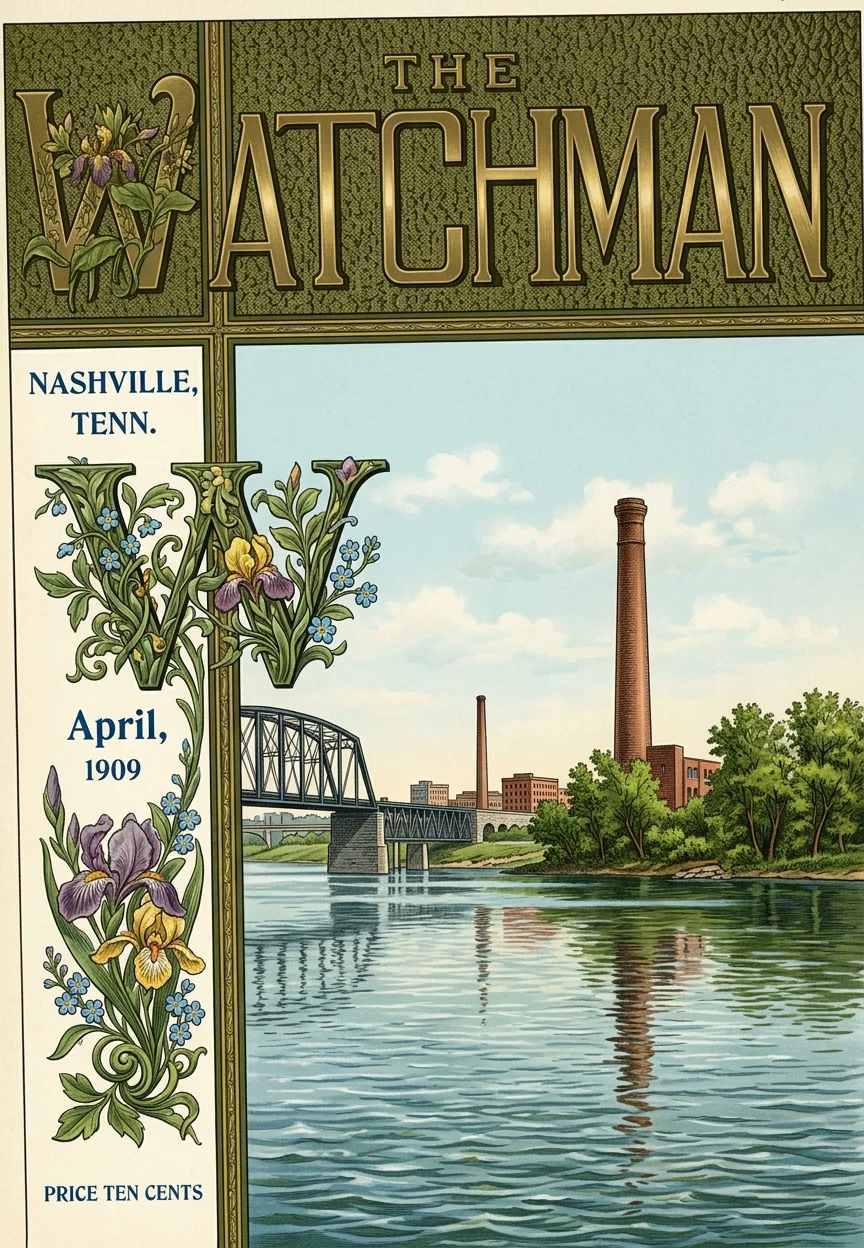
The April number of the Watchman comes from the press in a neat and attractive dress, while its pages are filled with the choicest articles and most striking illustrations.
FACSIMILE OF FIRST COVER PAGE
The large number of terrible catastrophes which have occurred in recent years forces the question on every thinking mind, “Why are disasters on the increase?” This question is given the consideration it deserves in the April Watchman. Another question discussed is, “Is This a Christian Nation?”
A correspondent who has been at the scene of the great Italian earthquake writes on the significance of that event, and tells how the Catholic Church is seeking to turn it to account in the interest of their religion. The discussion of the “Day Line” is another interesting feature of this number. Its mystery is fully explained.
An interesting experience is that told by a correspondent recently from Washington; he was present at the Congressional hearing given to the Johnston Sunday bill, which, until its final defeat, attracted unusual interest at the nation’s capital.
There are many other articles, covering a wide range of subjects, in which the inspiration of heavenly truth is so woven that all who read will be pleased and profited. Here are some of the titles:—
“Is the Sunday-School Giving up the Study of the Bible?”
“Why Protestants Protest.”
“God in the Constitution.”
“An Atheist Answered.”
“A Great Religious Movement.”
“The Supremacy of Conscience.”
“Will the Earth Be Burned Up?”
“‘Face’” (A letter from China).
Scores of active persons in every State should engage in the distribution of this excellent number. Will you?
Prices
Single copy, 10 cents; 5 to 24 copies, to one address, each 5 cents; 25 to 499 copies, to one address, each 4 cents; 500 to 1,000 copies, to one agent, each 3½ cents. Address the Southern Publishing Association Twenty-fourth Avenue North, Nashville, Tenn.
NOTICES AND APPOINTMENTS
Canvassers' Institutes for 1909
COLUMBIA UNION CONFERENCE
Foreign Mission Seminary, Takoma Park, D. C. ................. April 2-16
Mount Vernon (Ohio) College, Mount Vernon ................. April 16-30
LAKE UNION CONFERENCE
West Michigan, Cedar Lake ................. April 8-18
Indiana, Beechwood Academy ................. April 8-18
Emmanuel Missionary College, Berrien Springs, Mich. ................. April 18 to May 2
Publications Wanted
By Editor
[SPECIAL NOTICE.—We learn that objectionable literature is being sent in response to these requests, and urge all to examine with special care any periodicals or pamphlets received outside of our well-known denominational publications. Be sure that the literature which you distribute teaches the truth. Those responding to requests for papers should send only clean copies, neatly folded, securely wrapped, and fully prepaid.—Ed.]
Mrs. Jane E. Harris, 521 Senate St., Columbia, S. C., Signs, REVIEW, and Life and Health.
Albert Weeks, Smith's Creek, Mich., REVIEW, Signs, Watchman, Life and Health, and tracts.23
Julia W. Jenson, 3 Lenora St., Worcester, Mass., periodicals for free distribution.
W. R. Lamb, Napa, Cal., a continuous supply of denominational papers and tracts for free distribution.
Tom C. Hege, Fayetteville, N. C., continuous supply of REVIEW, Signs, Life and Health, Watchman, and tracts.
H. I. White, R. F. D. 6, Box 92, South Austin, Tex., Signs, Watchman, and other literature suitable for missionary work.
E. J. Harvey, Box 851, Winnipeg, Manitoba, a continuous supply of Signs, Life and Health, Watchman, Liberty, Instructor, Little Friend, and tracts.
Mrs. Charles S. Drury, Carterville, Ill., wishes to thank those who have sent her literature, and would like a continuous supply of Little Friend, Instructor, Watchman, Signs, and Life and Health.