The State Progressive Spiritualists’ Association of Missouri held its annual convention at Kansas City, Mo., February 24-26. At this convention there were present Dr. George B. Warne, of Chicago, president of the National Spiritualists’ Association; Dr. Thomas Grimshaw, of St. Louis, a leading Spiritualist lecturer; and others. The meeting, though locally confined within State lines, was entirely representative of the national organization, both as to views and as to members.
The writer was present, and by careful observation and some investigation of certain conditions, is well satisfied of one thing: Spiritualism as an organization, as an organized force influential and growing in numbers—is slowly but surely dying. Of this there can be no doubt. As a psychic force, a belief, a religion, if it may be called such, Spiritualism is rapidly gaining ground, gaining its many converts under other more plausible and attractive hypotheses, marching under far more pleasing and attractive banners.
The association speakers could point to no increase in its numbers, boast of no remarkable accomplishment of its present-day mediumship, show no satisfactory increase of its financial ability or social strength. Chiefly, the work of the convention was an apologetic defense of the disputed character of its mediums and propagandists in general, a plea for the future existence of the organization and for the loyal adherence of its members to first principles. It is unmistakable that Spiritualism sees in the Psychical Research Society of Prof. James H. Hyslop, and his work, an able competitor in the business of “seeking familiar spirits,” “from the living to the dead;” a serious menace to the very life of the organization of the Spiritualists. But the association takes the most hopeful view possible; it predicts that all these will yet come together upon an indistinguishable plane.
Dr. Warne said: “Professor Hyslop and his confrères are not so very far away from us. Our ways are nearly parallel to-day, but like the lengthening reach of rails, they meet and continue on together in the distance. I plead with you to be just a little patient; wait, for Professor Hyslop is nearer our side of the line than many of you think. . . . Professor Hyslop has asked us to turn over to him the phenomena and the scientific side of our belief, and attend solely to the ethical, mental, and moral side of Spiritualism. Spiritualism has chosen those through which it should be made known to the world. It was not the scientist. It was the lowly and untutored mind to whom the first revelation that has brought about this great revelation of the thinking world was given.”
Thomas Grimshaw, leading lecturer and trustee of the National Spiritualists’ Association, said: “We are not Spiritualists because of something we have been taught to believe. It is a matter of personal experience. Death is not the end, but the beginning, of life. These phenomena of communicating with those who have passed into the other world are true phenomena; and if you have not experienced them, it is your misfortune.”
I think some considerable significance will be attached to the following statement by Dr. Grimshaw: “The Psychical Research Society is doing much to disarm the suspicion of the general public by their study of the phenomena that attend the Spiritualistic seance, in the same way that they pursue their studies of physical phenomena.”
In this connection, that is an intensely interesting statement found in “Great Controversy:” “It is true that Spiritualism is now changing its form, and, veiling some of its more objectionable features, is assuming a Christian guise. But its utterances from the platform and the press have been before the public for nearly forty years, and in these its real character stands revealed.” These teachings can not be “denied or hidden.”
The president of the National Spiritualists’ Association said: “The propagation of Spiritualism may be taken entirely out of our hands by others receiving communications from the spiritual world.” And this, in the opinion of the writer, is just what is being done. Professor Hyslop’s work and that of others is taking out of the hands of the Spiritualists’ society the work both of demonstration and of propagation,—taking the11same deceptive, soul-destroying work, arraying it in doctrinal robes of white, and sending this ancient theory of the “immortality of the soul” forth upon the “wings of light.” It conquers the nations, and if it were possible, would deceive the very elect.
Dr. Warne called attention to the fact that W. T. Stead, the famous London editor and writer, and “universal peace” advocate, was a Spiritualist, had written a book entitled “How I Know the Dead Return,” and had stated to him (Dr. Warne), while visiting at his home in Chicago, that he writes through the influence of Miss Frances Willard and a former noted Chicago woman, and that he always converses with his dead friends once every week. “Christian Science, New Thought, Theosophy, etc., are all sciences that have sprung from Spiritualism,” said Dr. Warne. Those, I am sure, who have carefully compared the doctrines and beliefs of these modern “isms” will quite agree with Dr. Warne.
That Spiritualists have not changed their attitude toward the Bible, denying, in fact, that it is of divine origin, appears from the many utterances made at this convention. For instance, the president of the National Spiritualists’ Association said: “Matthew Arnold, the great English critic, once said: ‘The first requisite to knowing anything about the Bible is to realize that the men who wrote it, not only could err, but that they did err. The Bible is a humanly edited book, and there is no department of human effort which it touches in which it is infallible. It is full of high hopes, unrivaled poetry, and damnable morality.’”
To recapitulate: the Missouri organization of Spiritualists regards Spiritualism as a religion that will yet take the place of, and become more popular than, the Christian religion; in its hymn-books reference is made to “angels” and “spirits,” but none to God and Christ; its medium lecturers prayed to Lucifer, and the “god of nature,” but not once to God or Christ; the convention denied the divinity and vicarious atonement of Christ; it ridiculed the Bible. It is the same ancient philosophy born in the garden of Eden,—“Thou shalt not surely die,”—and in its new and brighter garb, in its multifarious forms so distinctly separate from that heretofore known as Spiritualism, feared, despised, and ridiculed,—as Christian Science, New Thought, Theosophy, Psychical Research, Emmanuel Movement, etc., the doctrine of Spiritualism, which is the doctrine, the very essence of the doctrine, of the “natural immortality of the soul,” will honeycomb society, permeate the churches, “deceive the nations.” In fact, Spiritualism—in these many new forms and phases, so seductive and pleasing,—will deceive, and finally control, all whose names are “not written in the book of life.”
It is worthy of mention that the Spiritualists were welcomed to Kansas City in a public address delivered by the mayor of the city. The newspapers had very little to say about the convention, with the exception of one journal that gave a reasonably fair report. Before adjourning, a number of resolutions were adopted, chief of which was one relating to the building of schools to teach Spiritualism and mediumship, and the putting of books on Spiritualism and psychical research in the public libraries.
The following extract from the spirit of prophecy is worthy of thought in this connection:—
“When Protestantism shall stretch her hand across the gulf to grasp the hand of the Roman power, when she shall reach over the abyss to clasp hands with Spiritualism, when under the influence of this threefold union our country shall repudiate every principle of its Constitution, as a Protestant and republican government, and shall make provision for the propagation of papal falsehoods and delusions, then we know that the time has come for the marvelous workings of Satan, and that the end is near.”
College View, Neb.
Earnestness
By L. F. STARR
L. F. STARR
In the preaching of the gospel, earnestness is indispensable. A lazy, lifeless, indifferent method of speech will rob any message of its power. All preachers can not be learned or eloquent, but no man whom God has sent should lack earnestness, and earnestness and intensity are more effective than eloquence or oratory. But earnestness is not simply, noise. A man may rave and rant and still not be in earnest. Howling and screaming are no proof of sincere interest or conviction. A man running a mock auction will sometimes bawl and scream, and yet his head is cool, and his only object is to gain money. A whisper may be far more earnest than a scream, and it may tell deeper feeling and more intense desire, but a man who should train himself to speak in whispers would lose much of his power.
When any man begins to shape his words and regulate his tones, he is liable to become artificial. The man who is thoroughly in earnest, may find that his style needs pruning and criticizing, but such criticism should be kindly administered by his best and most intelligent friends. But the man must not be cramped; he must have something to say, and liberty to say it; and until his whole soul is aroused to the conviction of the truth and the importance of the things he declares, his words will be of little worth. Sheridan, the actor, once said, “I like to go and hear Rowland Hill because his ideas come red-hot from the heart.” But the heart must burn from within, or these burning words can never be spoken. No graces of oratory, no skill of elocution, will take the place of the positive conviction of those who know the truths which they speak, and see the danger against which they warn men. The apostle Paul ceased not to warn men “night and day with tears,” and those who desire that their words shall be effective must remember that we must be affected ourselves by the things we speak in order to affect others by them.
Takoma Park, D. C.
The Sure Word of Prophecy
By R. D. QUINN
R. D. QUINN
There is nothing more certain in all this world than the “more sure word of prophecy.” Whosoever truly believes and builds upon that word can never fail or be deceived. Every great movement under God with which human agencies have been connected since the days of Noah, has been in direct fulfilment of prophecy; for, “Surely the Lord God will do nothing, but he revealeth his secret unto his servants the prophets.” “By faith Noah, being warned of God of things not seen as yet, moved with fear, prepared an ark to the saving of his house, by which he condemned the world, and became heir of the righteousness which is by faith.”
The deliverance of the children of Israel from Egypt and their occupation of the land of promise were in direct fulfilment of the prophecy made to their father Abraham centuries before, that in the fourth generation they would come into possession of that land: “And it came to pass at the end of the four hundred and thirty years, even the self-same day it came to pass, that all the hosts of the Lord went out from the land of Egypt.” When the fulness of the time came, men found their place in prophecy, and went forward.
The great movement which preceded Christ’s first coming was in fulfilment of prophecy. When the priests and Levites asked John the Baptist who he was, he12spoke with absolute certainty as to his identity, mission, and work. His reply was: “I am the voice of one crying in the wilderness, Make straight the way of the Lord, as said the prophet Esaias.” His work and message had all been outlined centuries before, and when he came on the stage of action, he found his place in the plan of God, and fulfilled his high commission.
When Jesus Christ began his public ministry, and there was delivered unto him in the synagogue the book of the prophet Esaias, he turned to the prophecy which briefly outlined his life-work, and read it aloud. Then “he began to say unto them, This day is this scripture fulfilled in your ears.” He said, “In the volume of the book it is written of me.” Christ found himself spoken of in the Scriptures, and it was the “more sure word of prophecy” that declared his connection with heaven. He searched the Scriptures daily, knowing that they testified of him. Everything that happened to Jesus Christ while in this world was foretold in prophecy, and that is why he said that all things must be fulfilled which were written in the law and in the prophets and in the psalms concerning him. John the Baptist and Christ spoke and taught with authority. They had definite convictions, based upon the more sure word of prophecy, as to who they were, and what they were to do and be. Their teaching was in the power and demonstration of the Spirit, and it moved the people. What could they have done in an unbelieving and scoffing world with a mere theory of what they ought to be, or what the prophecy had foretold that they would be?
Now to the central thought that is before us. Is it not likewise true of us that in the volume of the book it is written of us? Is it not a fact that more has been written concerning the character and work of the remnant church than of any other people who have lived upon the earth? “Whatsoever things were written aforetime were written for our learning,” and also “for our admonition, upon whom the ends of the world are come.” The work we are to do, and the character we are to develop, are clearly outlined in the “more sure word of prophecy.”
It has cost something to fulfil the prophecy in the past. It cost Noah all his earthly possessions and one hundred twenty years of faithfully witnessing for God in the midst of a crooked and perverse generation. It cost Moses the throne of Egypt and the highest honors this world could bestow. It cost John the Baptist his head, and the Saviour of the world a cruel death upon the cross. It has cost a great deal to make history and to fulfil prophecy. There is still before us the high and exalted privilege of being instruments in the fulfilment of prophecy.
The prophecies of Revelation that point to the final completion of God’s eternal purpose will not be accomplished without great personal sacrifice, and the surrender of our all to God,—time, talent, and means upon the altar of loving service. But the reward will be in proportion to the sacrifice we make.
And now let us ask ourselves these living questions: Have we counted the cost, and are we willing to pay the price? Have we that faith in the “more sure word of prophecy” yet to be fulfilled that we will now definitely take our stand anew upon the word that declares that the everlasting gospel shall be preached to every nation, kindred, tongue, and people, and that this generation shall see the end? If so, let us heed the counsel of the True Witness to the Laodiceans, and read our experience by the triumphs of faith in Rev. 14:12: “Here is the patience of the saints: here are they that keep the commandments of God, and the faith of Jesus.”
Bozeman, Mont.
Dost Thou Steal?
By C. B. STARR
C. B. STARR
“Does who steal?” did you inquire? “Thou that preachest a man should not steal”—the man who believes and teaches the ten commandments. “Thou that makest thy boast of the law, through breaking the law dishonorest thou God?”
But you say, “Whom do you mean?” We mean the man who is stealing, and yet at the same time is teaching that men should not steal; the man who abhors idols, and would be shocked at the intimation that he was an idolater. “Thou that abhorrest idols, dost thou commit sacrilege?” Sacrilege is stealing holy things belonging to the sacred service of God. So it is holy stealing, or rather, unholy stealing of holy things, that persons are in danger of doing who profess to keep the law of God. You will find all this discussed in Romans 2.
Do you know of anything that God has especially set apart for his service, for the support of his servants and service, that the people are in danger of stealing? If you do not, you might find it in Lev. 27: 28-34; Malachi 3; and Hebrews 7. It would seem that Seventh-day Adventists who love the law are in danger on this point.
Wahroonga, N. S. W., Australia.
The Happy People
By W. E. LUKINBEAL
W. E. LUKINBEAL
“Happy is that people, whose God is the Lord.” Ps. 144:15.
HAPPINESS is universally desired. Men of all ranks and stations are earnestly seeking it. The general inquiry is, Who will show us any good? To this, one replies: “Seek it in bags of gold, in the riches of the world; money answereth all things.” Another replies: “Seek it in the path of human greatness and earthly glory.” A third says: “You will find it in the avenues of pleasure, or the soft luxurious walks of worldly enjoyment.”
What is the result? The poor deluded soul tries each of these remedies; and instead of finding his anguish removed, the feverish excitement is increased, and he is more dissatisfied and wretched than ever. True religion opens the only door to real happiness, and sweetly whispers the sentiment of the text, “Happy is that people, whose God is the Lord.” They are happy in the enjoyment of the divine favor. In his favor is life. His loving-kindness is better than life. God is their friend, their affectionate Father. He loves them with an unbounded and inconceivable love. They are his delight, his jewels; and he will “spare them, as a man spareth his own son that serveth him.” They are happy in the possession of divine peace. They have peace with God through Christ Jesus their Lord. “The peace of God, which passeth all understanding, shall keep your hearts and minds through Jesus Christ.” Besides, they have peace of conscience, possess the spirit of peace, and are at peace with all mankind.
They are happy, in being entitled to all the privileges of adoption. They have the family name, family costume, access to the family table; and they have all the family dignities, immunities, and privileges. They are happy in being interested in all the precious promises. These all belong to them—temporal promises, of food, raiment, preservation, and guidance; promises which relate to the dwellings and families of the righteous, to their posterity, to the work of their hands, to their basket and store; promises of all the arrangements of providence, promoting their well-being; the promises of angelic ministration, of supplies of grace, and of all the good they can possibly need. 2 Peter 1:4.
They are happy in the enjoyment of the Spirit of God. The Spirit of God dwelleth in them, as a spirit of adoption, as their comforter and guide into all truth, as the earnest of the glory that shall be revealed. Rom. 8:9-18. They are happy in the prospect of eternal glory. To this glory they are called; for this glory they have a title and a growing meetness; and they know in whom they have believed, and that he will keep what they have committed to him against that day. They know that to live is Christ, but to die, eternal gain. They are looking with joy and glowing hope for the coming of the great God, even Jesus Christ, who shall come to be magnified in his saints, and admired and loved by all them that believe. 2 Thess. 1:10.
The happiness of the people of God extends to all places. In secret, in public, at home, and abroad, they are always in God's presence, and his watchful eye is over them. It extends to all times, — times of prosperity or adversity, health or sickness, life or death, time and eternity. It extends to all their need, in every possible variety of condition and circumstance. He watches, blesses, and supplies all their need, so that they may be happy in him all the day long; and he also gives them songs in the night. It is happiness which is permanent. The world can neither give it nor take it away; for God is their sun, shield, refuge, strength of their heart, exceeding great reward and portion forever.
Let the people of God rejoice in the loving-kindness of the Lord. They may, indeed, exult in God, and rejoice evermore.
Spokane, Wash.
The Great Temptation
IT is not easy to know when we are being confronted with our greatest temptations. For the really great temptations of life are great because they do not seem to be temptations at all. President Frost, of Berea College, Kentucky, calls attention to this truth when he says that he used to suppose a great temptation was the temptation to commit a great sin. As he grew older, he says, he came to realize that “a great temptation is not when one is faced with the choice between something very good and something very bad. It is when one is faced with the choice between something very good—and something better.” The man who never falls into great sin may fall day after day through life in failing to choose the “something better,” and thus utterly fail in making of his life that which God had planned for him. Let us pray for strength to meet the great temptation. — S. S. Times.
Austria
By J. WOLFGARTEN
J. WOLFGARTEN
“The Lord hath done great things for us; whereof we are glad.” The readers of the REVIEW may be interested to know what progress the last message of mercy is making in this dark land. After we had organized our society during the latter part of December, 1907, we began in the early part of January of this year [1908] with our public lectures. There was a small attendance at first, but after a while it became larger, until an average of fifty or sixty friends and enemies were present. The Lord ever held his protecting hand over us; and “if God be for us, who can be against us?” Up to the end of September, we were permitted to baptize fifteen souls. Several others are preparing to be baptized sometime during the coming November [1908]. Brother F. Gruber assisted me in the work.
The last of June I visited Gratz, the capital of Styria. This city has over one hundred fifty thousand inhabitants. We have here six believers in the present truth. I made some preparations for the work we were to undertake during the autumn. While in Gratz, the riots of 1890, the students took place. Late in the evening, the students seeking for liberty, protested in a street gathering against the attacks and encroachments of the clerical faction.
On July 2 I was permitted to baptize a dear soul in the Danube. This sister had previously heard the truth in Germany. Linz is the capital of Upper Austria, and has more than eighty thousand inhabitants. The sister who was baptized is the only Adventist in that province.
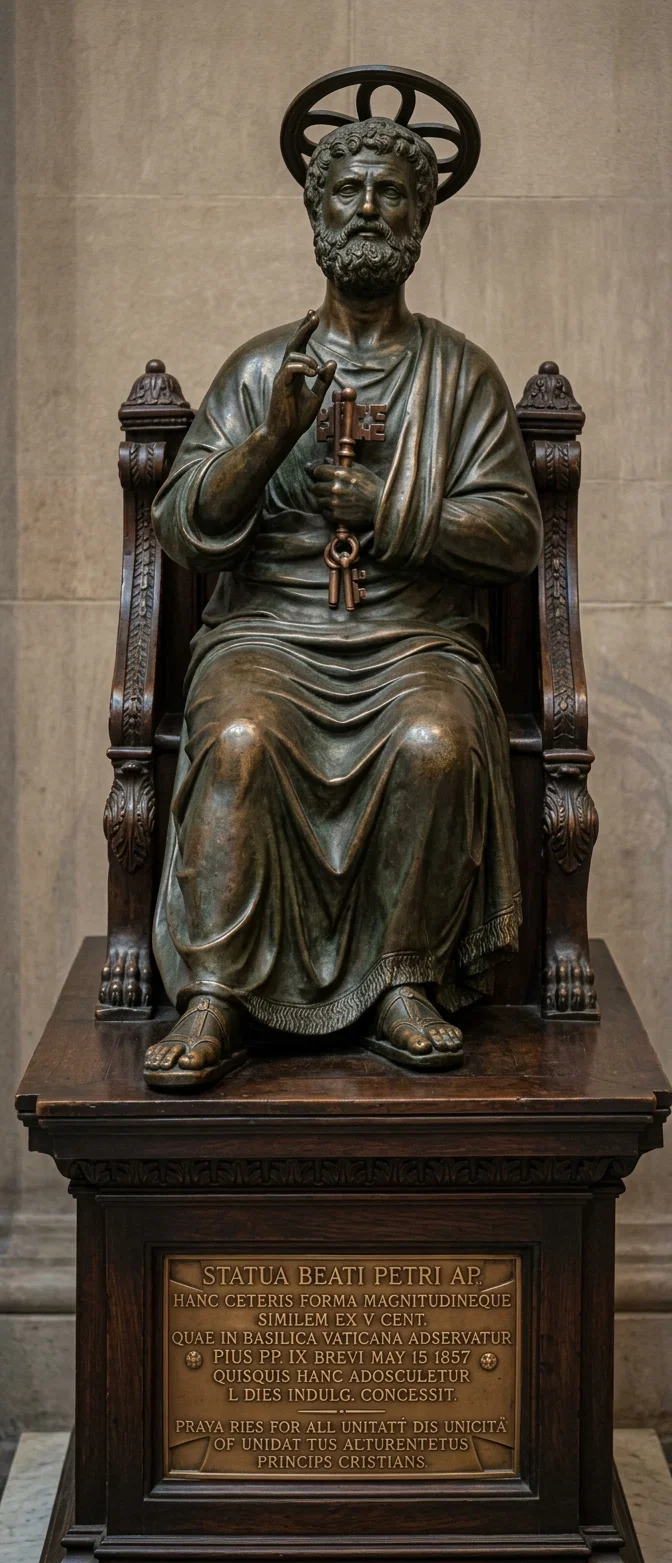
In the newly built cathedral at Linz, there is a statue of St. Peter, with the following inscription: “This statue of the holy Peter is of the same shape and size as the one that comes down to us from the fifth century and is venerated in St. Peter’s at Rome. Pope Pius IX, in a brief of May 15, 1857, granted an indulgence of fifty days to all who devoutly kissed the foot of this statue of St. Peter, and prayed for the unity of the Christian princes, and for the extirpation of heresies, and for the exaltation of the holy church. Pope Leo XIII granted a similar indulgence on April 24, 1890, for all times to come, to the believers who venerated the statue of the holy Peter in the cathedral at Linz in the same way.”
STATUE OF ST. PETER, IN LINZ CATHEDRAL
Soon the day must come when a better gospel will be preached in this city, where Catholicism reigns supreme, in order that the upright in heart may be led out. Brethren, remember in your prayers the work that must be done in these dark places; for the “effectual fervent prayer of a righteous man availeth much.”
At present I am holding lectures in Gratz, which are well attended, but I will give a report of these later on.
Please send the Hausfreund to your relatives and acquaintances, your friends and enemies, in this country, and let us have their addresses if we are to look them up.
One Who Loves Me
By Margaret R. Radcliffe
I KNOW not what is before me,
And why should I care to know?
Some One that I know and who loves me
Is on the path I go.
True, the sunlight high above me
Is hidden by clouds hung low;
But I'm sure the One who loves me
Is holding the clouds just so.
Yes, the path looks rough beyond me—
With bramble and brier and stone;
But One who watches and loves me
Will not let me walk alone.
It is true, night falls about me
So silent, so strange and still;
But the One is near who loves me,
My safety is in his will.
The light that pierces the darkness
Is Judah's lantern, I know;
But the Christ is there beside me—
Close to me, kneeling low.
The day brings trial and sorrow,
Brings agony, pain, and loss;
But Jesus, my King and my Saviour,
Near me, beareth my cross.
—Margaret R. Radcliffe.
T. E. BOWEN
By T. E. BOWEN
The Relation Between the Local Church and the Distant Fields—No. 4
T. E. BOWEN
Mission Finances
All are familiar with the different funds, such as annual, midsummer, ten-cent-a-week, First-day, and Sabbath-school, which go to make up the incoming offerings to missions. These funds are kept separate on the books of conference and union treasurers, also designated by their different names at the General Conference treasury. But, inasmuch as all the missions must be cared for in common, these different funds are united into one general mission fund upon the books of the Mission Board, from remittances which are to be made to the different mission treasuries. In case offerings are specified to certain fields, these are carefully accounted for, so that they shall be used in the field designated. Some may get the impression that because of the large amounts coming into the mission treasury, some bank here in Washington must have a tremendous amount in its vaults, because of the deposits made by the Mission Board. But this is not the case. Often the bank balance in favor of the Mission Board treasury is not so large as that carried by some of the union, or even local, conference treasurers. By this it should not be gathered that our work is on the verge of insolvency. This is not true. But while large amounts are coming in, there are also large remittances going out, so there is no hoarding of funds anywhere, but a healthy inflow and an outflow to the treasuries of the needy mission fields. Only the demand is usually much greater than the supply.
The Prompt Forwarding of Funds
Every church treasurer is expected to make it a special point to get into the hands of the conference treasurer all funds intended for the general work, by the close of each calendar month. This enables the conference treasurer to close his books with the month. Then he is asked to send the tithe due the union, and the general offerings to go to the Mission Board, to the union treasury by the tenth of the next month, so that on that date each union conference treasurer can forward all funds designed for the general work to the General Conference treasurer. This plan works well, and by this system, if all the treasurers are prompt, it will be seen that funds paid into the local church treasury quickly go on to the general treasury.14In this way each local and union conference is able to keep an accurate account of all funds raised in its territory, whether used in local or general work. This is as it should be, because much confusion results by sending donations direct from local churches to the Mission Board, hoping thus to save a little time. Rather than hastening matters, such a course hinders; for it becomes necessary to report back such offerings to the conference from which they come.
On to the Missions
Each year, at the meeting of the General Conference Committee or Mission Board, a budget of mission field appropriations is made up. This is necessary. Some approximate estimate of what will be expected from the general treasury for the year ahead must be made. To arrive at this, the local committees in charge of the different mission fields, like China, India, Africa, etc., are asked to make out a careful estimate of the money they will need from the Mission Board treasury during the ensuing year, to pay their workers and carry on the work in their field, above that which they will be able to raise in the field itself. These estimates are sent by the superintendents in charge of the different mission fields, to the treasurer of the Mission Board, and they are carefully and prayerfully considered, item by item, field by field. From these the yearly appropriation, or estimate for the whole field, is made up, and voted by the General Conference Committee, at its annual meeting. The appropriation for each mission field is then divided by the treasurers into twelve parts. This gives the amount due each mission treasury, such as India, China, Africa, etc., from the Mission Board treasury each month. The treasurer then makes it a point to see that this remittance is promptly forwarded, month by month, to the different treasurers appointed by the mission committees to receive and disburse the funds in their respective fields.
Mission Field Audits
The workers in the missions, whether sent out by the Mission Board, or native workers employed by the mission committee, are under the direction of the local mission committee in charge of the field, as are workers in any other local field, their time and expenses being reported to the local mission committee, which appoints an auditing board to examine into the merits of the work of each individual laborer, determining the rate of salary he is to receive. These audits are then forwarded to the Mission Board for final adjustment.
In missions not large enough to have an executive committee, the Mission Board appoints a superintendent, whose duty it is to receive all the monthly reports of labor from any other workers connected with the mission. These he passes on to the treasurer of the Mission Board direct, with any instruction or suggestions he may have to make, and these reports are audited by the Mission Board, in its general audit at the close of the year.
Conclusion
In brief, this gives the simple method by which our work is being carried on throughout the entire world,—a perfectly organized work, yet simple and effective in every detail. Each part subject to and dependent upon some other part, the work “increaseth” and groweth up into its living head. May God increase it more and more, until the church shall have completed its work in the earth. Although tardy, let us rise up as “one man,” and finish the work given us to do, that Jesus may come and take unto himself his own from every kindred, every tribe, and every people.
Takoma Park, D. C.
Among the Tamils in South India
By J. S. JAMES
J. S. JAMES
After an absence of six months from the immediate presence of the Tamil Sabbath-keepers, we are now among them again, and have taken up our duties with a fresh supply of strength and courage. My long absence from this place was due to the slow return of that physical fitness and vigor so necessary for work on the hot plains of India. At this writing I feel quite like myself again, although occasional nervous headaches warn me that I must be more careful now than before I was stricken with the sun. Since my departure from here, I have kept in close touch with various members of this society through correspondence, and find on returning that their interest has in nowise abated.
The closing days of 1908 and the first week in 1909 were spent in attending our general meeting in Lucknow. This was a feast of good things to us, not having had such a privilege for two years. Here we greeted our colaborers, and were made glad by the presence of some new workers from the home lands. How merciful and good the Lord has been to us the past two years in granting us all this privilege of meeting together once more.
This meeting was one of great significance to me. I never saw anything just like it before. Instead of spending time in devising some way whereby we could push the work forward, our chief concern was how we could supply the men and means to fill the openings and bear some of the many responsible burdens that have thrust their intolerable weight upon us. Instead of God's work being “pushed,” the tables have turned, and God's people need “pushing,” that they may keep pace with the ever-increasing momentum of this closing message. O that our people at home could view the needs of these dark lands, and faintly grasp the greatness of the task which lies yet unfinished before them! Why are there not more strong men and women on their way to our relief? Scores should be on the field right now, studying the language and learning the customs of the people.
Our local situation here in Tinnevelli district seems to demand a forward movement all along the line. Plans are now being drawn for the erection of a mission bungalow at an early date. In addition to this, some provision must be made for a dispensary, and the equipment of the same with facilities for work. Last year I occupied the school building belonging to these people, but found living there to be extremely difficult, as well as dangerous. This year we have the free use of half the same building for our dispensary. Our residence this year is a mile from the real sphere of our labors, but we are in much better quarters. We hope to be in property of our own by another year, where we may overcome many difficulties that now confront us.
OUR TEMPORARY DISPENSARY, SOUTH INDIA
One of our pressing needs at present is some conveyance for going about among the various villages of the district, and to and from the railway, twenty-three miles distant. The latter journey requires a full night, which makes it necessary to provide a vehicle in which one may lie down and sleep. A good cart and two strong bullocks is the most convenient and economical means of travel in this country. One hundred dollars would purchase the entire outfit. Is there not some one at home who would esteem it a great blessing and privilege to give the sum necessary to buy the same? Would not such a donation bring a blessing to the giver?
We feel especially thankful for the timely help furnished us in the arrival of Miss Belle Shryock. It so happens that Miss Shryock, Mrs. James, and myself took our training at the same time in the Battle Creek Sanitarium, and to be associated together again in the closing work of this message on this side of the earth is a great pleasure. The people here received her very kindly, and already she has entered upon some of her duties with interest and devotion. Much of the medical work is thus transferred to other shoulders, which gives me more freedom to turn my attention to the development of other important kinds of work.15
Educational men and women, attention! We call loudly for a man and his wife to give their time to the education of these young people. Who will step forward from the ranks and volunteer? Those who come should expect to master the language, and lend a willing hand to various kinds of pioneer work. If the wife could teach needle work and music, it would be very helpful.
The powers of darkness still continue their work of opposition here, which is a sure indication that there are some jewels to be gathered out; but thus far no perceptible check has been put to our efforts to establish our work in these quarters. The oldest son of the founder of the Sabbath-keeping sect has recently published two long articles in a Tamil newspaper against us, of a very slanderous and defamatory nature. “We can do nothing against the truth, but for the truth,” is finding a literal fulfilment in his efforts. Everybody knows his statements are void of truth.
The extreme hot weather is only a few weeks off, and this, together with the responsibility of building under difficult circumstances, will be very trying to our nerves. Then, too, the rains failed this season, and as a result famine stares many in the face. This condition means suffering and sickness to many, and consequently an increased amount of medical work for us. We greatly desire your prayers, that we may be sustained and blessed in doing the Lord's work among these people. Pray, and send us help.