Your ShelfYour Projects

Signs of the Times, Vol. 38, No. 47.

Thanksgiving

Signs of the Times

Nov 28, 1911

Pacific Press Publishing Association · Mountain View, California · Nov 28, 1911

Thanksgiving

By T. E. Morgensen
Behold what God hath wrought! Let's count His blessings, brought To us, within our reach, from day to day. Perhaps disguised they came; They're blessings just the same, All sent from God in His good time and way.
Things may not always please; In flowery paths of ease The saints of God have very seldom trod. The things which seem to mar Our pleasures, often are The greatest blessings, sent to us from God.
Could we but understand, And see the loving hand Of God, the giver, we should thankful be, And praise Him more and more, For blessings yet in store For us, in time and through eternity.
Receive, O God, we pray, Our thanks and praise to-day For all the blessings Thou hast kindly given. Grant that we faithfully May serve and honor Thee Through life, and meet to praise Thee more in heaven.
Tygh Valley, Oregon.

"IF YE WILL INQUIRE, INQUIRE YE."

This Inquirers' Department is conducted for the purpose of helping those who are studying the Bible. The answers are oftentimes only suggestive. They are never to be considered infallible, only as they agree with the infallible Word. The writer who may answer them does not consider that his opinion is infallible. He will simply give the best that he has, and plead with the inquirer to search the Word. Such questions only will be answered as, to the editors, seem to minister to the good of the readers and to the mission of the paper. We can not answer repeatedly in the same volume questions upon the same scripture. The name and address must accompany question, not for publication, but as an evidence of good faith, and that answer may be made by letter if deemed advisable. No letters are answered which do not contain the name of the writer. It is well always to enclose stamp for reply.

3068—Kings and Priests

If the saints are to be kings and priests, and reign with Christ one thousand years as kings, over whom will they reign, and as priests for whom shall their ministrations be offered? W.
Pre-eminently, God's children will reign over the greatest tyrant that the universe ever knew—sin, and over the awfullest consequences that the universe ever knew—death. That will be true of them all. In this world they have been servants to sin, slaves to death, under this awful bondage during all the time that sin has reigned. There they will be free, sons and daughters of the Most High, and He is King of Kings and Lord of Lords. Therefore His children will be kings, because they are His children.
As regards priests, we get an entirely wrong idea of the fulness of the word "priest." We connect with it, always, that of sacrifice. This is the Roman Catholic idea, that a priest must always offer a sacrifice; but that is not the essential meaning of the word, in any way. Our Lord was the great Melchizedek Priest of the universe before sin ever entered; and the head of every unfallen world is a priest to that world. Our Lord has an everlasting priesthood that will continue beyond the reign of sin, throughout eternity. And so all His children will be priests under Him, ministering in whatever way the wisdom of God may direct. A part of that ministry may be the examination of the judgment records in heaven during the thousand years. They are serving God, and in that service to God they are priests of His, it matters not what the service may be. During that very time they may be ministers to the visitors from other realms in God's universe. We do not know how extensive that may be. We can accept the statement which the Lord makes in His Word.
What is said of the thousand years is said of eternity as well, and of this life too; because we read in Rev. 1:6, as in the Revised Version, "And He made us to be a kingdom, to be priests unto His God and Father; to whom be the glory and the dominion forever and ever." See also 1 Peter 2:9, where God's children are called a "royal priesthood." Rev. 5:10 also declares that God has made them to be "a kingdom and priests," and they are to reign upon the earth looking forward to the time when sin shall be utterly banished. Therefore are they kings; first, because they are children of the King of Kings; and secondly, because they reign over sin and death. And therefore are they priests; because they are children of the great High Priest of the universe, Christ Jesus our Lord; and secondly, because they minister for and with Him. And ministry means service.

3010 — The Sabbath for Israel

If the Sabbath is a law for the Gentiles and the church, why do the Scriptures say, with precision, it is a law and a sign for Israel in the past and in the future? Ex. 31:13-17; Eze. 20:12, 13. If for the church, cite Biblical passages that ordained it.
Question to Seventh-dayists.
Let us say to our readers as emphatically as we can, that God has no promise for the Gentiles in His Word at all, only as they become Israel. The Gentile as a Gentile is utterly without hope, and so God's Word repeatedly declares. For to Israel pertain "the adoption, and the glory, and the covenants, and the giving of the law, and the service of God, and the promises; whose are the fathers, and of whom is Christ as concerning the flesh, who is over all." Rom. 9:4, 5.
Our Lord Jesus Christ was of the stock of Israel. So were all the prophets, and all the apostles; and Jesus Himself declares, "Salvation is of the Jews." John 4:22. The very term "Israel" is of spiritual significance. It was given to Jacob because he prevailed with God, and means "prevailer with God." "Thy name shall be called no more Jacob [supplanter], but Israel: for thou hast striven with God and with men, and hast prevailed." Gen. 32:28. Only those who have thus prevailed with God can ever keep God's Sabbath; for the Sabbath is holy, and only holy men can keep a holy thing. God does not declare that the Sabbath shall be sanctified by our keeping it. He has already sanctified it. We are to keep it holy as He has made it holy, and the only way it can be kept holy is by having a holy heart. Our Lord Jesus Christ declared, when the young man came to Him, "Keep the commandments." Matt. 19:17. The apostle Paul declares: "Do we then make void the law through faith? God forbid: yea, we establish the law." And the writer of Hebrews tells us that under the new covenant, God's law, the law which existed in Jeremiah's day, six hundred years before Christ, is written in the hearts of His children. Heb. 8:8-12. But the Lord does not leave outside the Gentile, called by Him "the stranger." And here is one of the promises which the Gentile may appropriate: "Also the foreigners that join themselves to Jehovah, to minister unto Him, and to love the name of Jehovah, to be His servants, every one that keepeth the Sabbath from profaning it, and holdeth fast My covenant; even them will I bring to My holy mountain, and make them joyful in My house of prayer." Isa. 56:6, 7. Without that covenant relationship with Israel, the apostle Paul declares that men have no hope, and are without God in the world, alienated from the commonwealth of Israel, and strangers to the covenants of promise. Eph. 2:12. It is only Israel that shall be saved. In that glorious city which God shall give to His children, there are twelve gates, and those gates are named after the tribes of Israel; and all who pass through those gates, in God's plan, will pass in as members of one of the tribes. For Israel shall be saved with everlasting salvation. It is utter folly to ask a man to keep the Sabbath of the Lord who does not know the Lord. Nobody can compel one to keep the Sabbath who does not know God. What folly it is for men to attempt it!

Content Missing

3066—Testing the Spirits

Please explain 1 John 4:1-3. What are the spirits spoken of, and what is meant by "testing the spirits"? R. A. B.
The spirits spoken of include every one who may teach anything pertaining to life, moral or immoral. It does not necessarily mean that these spirits are manifest in beings without human bodies. The Bible teaches us that there are two great opposing forces in this world. The center of one is our Lord Jesus Christ; of the other, Satan. Our Lord Jesus Christ works through His own children, His chosen servants, His Word. His Spirit is everywhere, pleading with men to turn to Him, to turn from evil. On the other hand, Satan works through his agents, his angels of evil, wicked men. Sometimes he brings his influences to bear entirely apart from human agency in suggestions to temptation. Against all these John warns us: "Believe not every spirit, but prove" whatever may come to us, and however it may come to us,—and especially if it comes to us as an angel of light. Satan is the great deceiver of the world; he "deceiveth the whole world." And "many false prophets are gone out into the world;" these are moved by the wrong spirit. One of the tests which the apostle gives is right here: "Hereby know ye the Spirit of God: Every spirit that confesseth that Jesus Christ is come in the flesh is of God." Now one of the false doctrines of Satan is that Jesus Christ is in every man, always, without regard to faith or man's condition, and all that man has to do is to recognize that Christ is there. They call it sometimes "the divine immanence." The apostle tells us that Christ comes in the flesh, and He comes by faith. See Gal. 2:20. Now every spirit that confesses that—that Christ comes into the flesh, through faith in God, according to God's own plan of salvation—is of God, of course; but every spirit that confesses not Jesus, is not of God, and that is quite evident. The one great test which God has given us, which includes all other tests, is His holy Word. "To the law and to the testimony; if they speak not according to this word, it is because there is no light in them." Isa. 8:20.

3067 — When He Shall Come

Please explain the meaning of 2 Thess. 1:10, "When He shall come to be glorified in His saints, and to be admired in all them that believe." W.
It seems to us that the text is quite clear as it is. Christ will be glorified in His saints when they shall be changed to His own likeness. Just the same as the clear glass prism separates the white light into the marvelous beauty of the prismatic colors, just so the redeemed host will reveal the multiform beauty of the white light of righteousness in our Lord Jesus Christ. Just the same as the perfect body is expressive of the perfect mind, so the beauty and glory of Jesus as the head of the church will be manifest in that church itself. And of course when He comes in all His marvelous glory He will be admired, or better, as the American Revised Version has it, He will "be marveled at in all them that believed." His glory will be beyond all conceptions they have ever had of His glory. It will be noted that there is a parenthetical clause in verse 10. The sentence closes with the verse, "marveled at in all them that believed in that day"—that is, in the day of His coming. Then our Lord will look upon His people—the travail of His soul—and be satisfied, and His people will say, "Lo, this is our God; we have waited for Him, and He will save us."

3609 — Bywords

Does it become a Christian to exclaim "Gracious!" "Goodness!" or "Mercy!" when something annoying or surprising is said or done?
We think it is a great deal better, always, under all circumstances, to eschew bywords of every sort and kind. There are many who are called profane men who do not take the name of God in vain because of anything that they have against God. They simply do it through foolish habit, and nothing else. Really, it is taking what might almost be called God's name in vain in the use of such terms as above given. God is gracious, that is His attribute, pre-eminently. He is the eternal Goodness; that also is pre-eminently His attribute, for only God is good. It does not add force to conversation, nor any particular emphasis to what we are saying, to intersperse it with bywords. "Let your communication be, Yea, yea; Nay, nay: for whatsoever is more than these cometh of evil."

Epistles of Philippians, Ephesians, and Colossians

Schedule for Week Ending December 9
Sunday December 3 Romans 14-16
Monday " 4 Philippians 1-4
Tuesday " 5 Ephesians 1-3
Wednesday " 6 " 4-6
Thursday " 7 Colossians 1-4
Friday " 8 Philemon 1; 1 Timothy 1-4
Sabbath " 9 1 Timothy 5, 6; Titus 1-3
This week's reading covers the epistles of Philippians, Ephesians, Colossians, Philemon, Timothy, and Titus. The epistle to the Philippians was written by the apostle Paul while in prison in Rome. Philippi was an important town of Macedonia, on the great highway from east to west, named by Philip II of Macedonia after himself. In Paul's time it was a Roman colony. And here the apostle Paul suffered; but he found a devoted church, who sent him means again and again. It seems more like a letter from the heart than any of the other epistles of Paul.
Ephesians is one of the deepest of all the epistles of the apostle, opening to us the great things of God. From the lack of the personal greetings to the church itself, where the apostle stayed so long, it seems to have been a general epistle to various churches. It sets forth Christ as the great Head of the church.
Colossians, some think, was written before Ephesians; some place it after. It deals with the same general subject, altho not so fully, as does the Ephesian epistle. It was written to the Christians in the city of Colosse, situated in Southwest Phrygia, on the great trade route to the sea. It seems to have been founded by the apostle Paul's fellow worker, Epaphras perhaps. It seems to have been known to the apostle only by report. It points out the wickedness of the philosophy which some sought to ingraft upon the church.
Philemon seems to have been a friend of the apostle Paul, and the occasion of this epistle was that a slave of Philemon's had run away and had been converted, and Paul returns him again to his master, not as a slave alone then, but as a brother. Seemingly he gives him a new name, or at least brings into prominence the name which he bore, Onesimus, "profitable."
The epistles of Timothy were written to an assistant and companion of Paul's, who had been trained by a faithful mother and grandmother. Both epistles contain most important instruction to the minister and servant of God, the first written about the year 64 or 65, and the second about the year 67, the last of the apostle's writings.
Titus also was a fellow laborer of the apostle Paul, and accompanied that great soldier of the cross in many of his journeys. He was a Gentile Christian, and he was one upon whom the apostle placed various responsibilities in the organizing of churches and setting things in order; and the epistle pertains to such instruction, containing some very precious passages indeed.

"Your Reasonable Service"

By Mrs. E. G. White
"I BESEECH you therefore, brethren, by the mercies of God, that ye present your bodies a living sacrifice, holy, acceptable unto God, which is your reasonable service. And be not conformed to this world: but be ye transformed by the renewing of your mind, that ye may prove what is that good, and acceptable, and perfect, will of God." We are not our own. By creation and by redemption we belong to God. The clay out of which we are formed is His production; and "hath not the potter power over the clay?" Not only this, but we have been bought with a price, even "with the precious blood of Christ." The great Master Artist alone is the rightful owner of the work of His hands; and He has a claim on our willing service; "for in Him we live, and move, and have our being."
"The earth is the Lord's, and the fulness thereof; the world, and they that dwell therein." The cattle upon a thousand hills are His; all the gold and silver belong to Him. He has made men the stewards of His goods. To some He has entrusted special talent; to others worldly possessions. All have some capacity of usefulness. These talents are given that they may be used to honor and glorify God. He claims our time, for it is His. Our strength should be used in His service; our intellect and our means should be given willingly to Him.
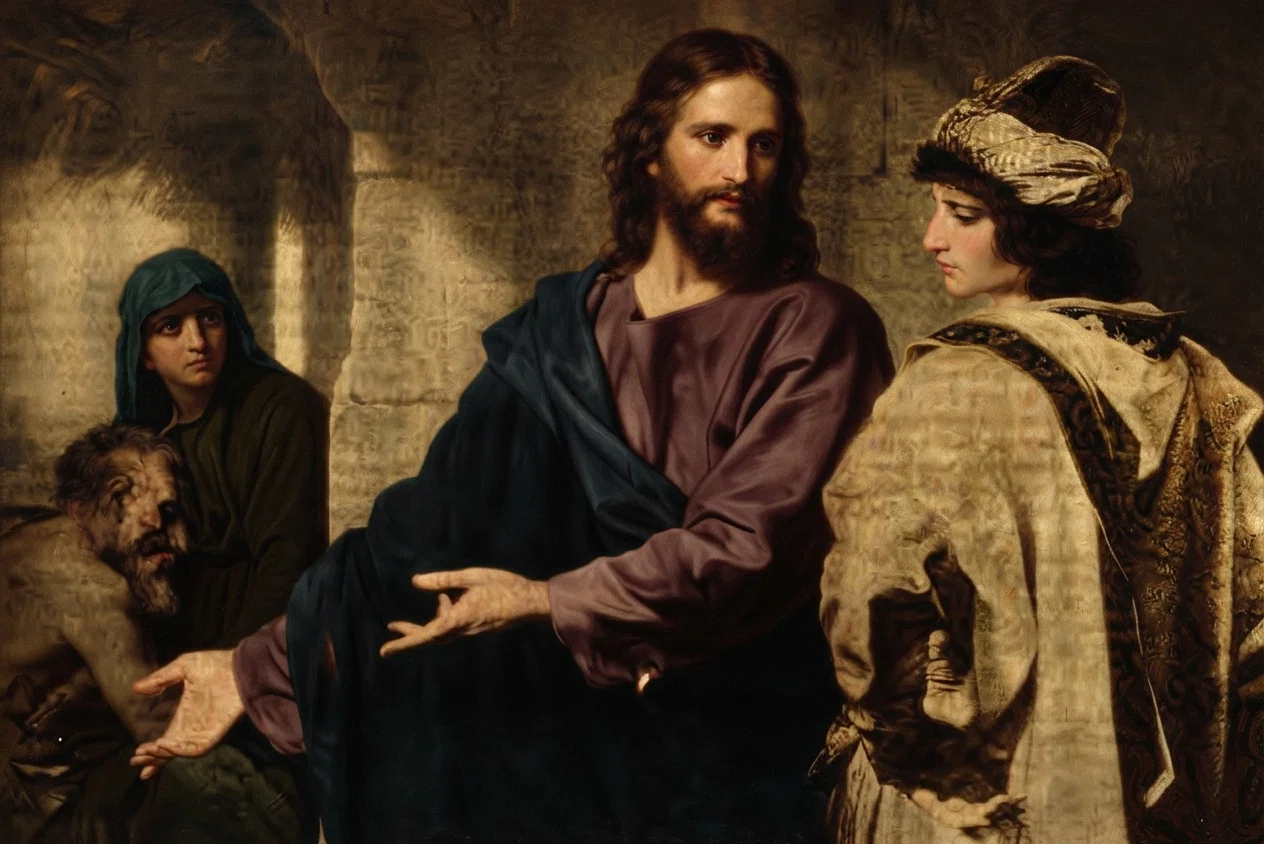
Jesus and the rich young man, one of Hofmann's masterpieces. Note the earnest, searching look in the face of the Master, the doubt and hesitation on the part of the young man. See the earnest, longing woman who is hoping for relief for her sick husband. There is a mighty sermon in the picture. Is the Master speaking to you?

Talent Not Given Indiscriminately

God has not given men talents capriciously. He who knows all things, who is acquainted with each one, has given to every man his work. Those to whom He has entrusted much are not to boast, for what they possess is not their own; it is lent them on trial; and the greater the endowment, the greater the returns required. Day by day God is testing men, to see whether they will acknowledge Him as the giver of all that they have. He watches to see whether they will prove themselves worthy of eternal riches. The use they make of their precious endowments, decides their destiny for eternity.
Of all the gifts that God has bestowed upon men, none is capable of being a greater blessing than the gift of speech. With the tongue we convince and persuade; with it we offer prayer and praise to God; and with it we tell others of the Redeemer's love. God would have us consecrate this gift to His service, speaking only such words as will help those around us. And if Christ rules in our hearts, our words will reveal the purity, beauty, and fragrance of a character molded and fashioned by Him. But if we are under the guidance of the enemy of all good, our words will echo his sentiments. Watch well your words. Consecrate your gift of speech to the Lord's service; for He will one day require it at your hands.

Responsibility of Influence

Every one of us exerts an influence on those with whom we come in contact. This influence we have from God, and we are responsible for the way it is used. God designs that it shall tell on the side of right; but it rests with each one of us to decide whether our influence shall be pure andelevating, or whether it shall act as a poisonous malaria. Those who are partakers of the divine nature exert an influence that is Christlike. Holy angels attend them on their way, and all with whom they come in contact are helped and blessed. But those who do not receive Christ as their personal Saviour can not influence others for good. Whatever their station in life, they carry with them an influence that Satan uses in his service. Such lose all hope of eternal life themselves, and by their example lead others astray. Guard well your influence; it is "your reasonable service" to place it on the Lord's side.
God also entrusts men with means, not to be used selfishly. He desires that His gifts be used to help those who need assistance. He gives men power to get wealth. He waters the earth with the dew of heaven and with the showers of refreshing rain. He gives the sunlight, which warms the earth, awakening to life the things of nature, and causing them to flourish and bear fruit. Is it too much for Him to ask for a return of His own?

The Test of Misfortune

God permits misfortune to come to men, adversity to try them, in order that He may test those whom He has placed in more favorable circumstances. If His stewards are faithful, He declares them worthy to walk with Him in white. But if they use His gifts solely for their own benefit, it will be said to them, "If therefore ye have not been faithful in the unrighteous mammon, who will commit to your trust the true riches?"
Many, instead of consecrating their means to God's service, look upon their money as their own, and say that they have a right to use it as they please. Like the inhabitants of the Noachic world, they use God's gifts in their own service. Even some who profess to know and love the Lord do this. God has revealed His will to them. He has called upon them to surrender all that they have to Him; but the love of the world has perverted their will, and hardened their heart. They refuse to obey Him to whom they owe all that they have. Regardless of His call, they clasp their treasures in their arms, forgetting that the Giver has any claim upon them. Thus the blessings given by God are turned into a curse, because a wrong use is made of them.
Christ understood the danger of the love of money; for He said, "How hard is it for them that trust in riches to enter into the kingdom of God!" He looked with sorrow upon the enthusiasm shown for the things that perish, and, lifting the curtain that veiled eternity from view, He declared, "Seek ye first the kingdom of God, and His righteousness." "Lay not up for yourselves treasures upon earth, where moth and rust doth corrupt, and where thieves break through and steal; but lay up for yourselves treasures in heaven, where neither moth nor rust doth corrupt, and where thieves do not break through nor steal." To-day He calls upon us to give close attention to our eternal interests. He would have us subordinate every earthly interest to His service. "For what shall it profit a man," He asks, "if he shall gain the whole world, and lose his own soul?" God's right to our service is measured by the infinite sacrifice He has made for our salvation. "Behold, what manner of love the Father hath bestowed upon us, that we should be called the sons of God." For our sake Christ lived a life of sorrow and privation. He was pure and holy, yet on Him was laid the iniquity of us all. He gave relief to the afflicted; yet He Himself was "a man of sorrows, and acquainted with grief." With a touch of His hand He healed the sick; yet He suffered grievous bodily pain. He cast out demons with a word, and delivered those bound by Satan's temptations; yet temptations such as have never beset any man assailed Him. He raised the dead by His power; yet He suffered the agony of a most horrible death.
All this Christ suffered for us. What are we giving Him in return? He, the Majesty of Heaven, submitted patiently to scorn and insult. Can we complain if the service of God requires patience and self-denial? He who laid the foundations of the world consented to become a servant for our sake, and with His own footsteps smoothed the rough path for our feet. Should we look upon any sacrifice as too great? Should we hesitate to render to God our reasonable service?

Trade upon Our Talents

There is no religion in the enthronement of self. God asks us to be true to Him, to trade upon the talents He has given us, that we may gain others. His will must be made our will in all things. Any departure from this standard degrades our moral nature. It may result in lifting us up, in enriching us, and in seating us beside princes; but in the eyes of God we are unclean and unholy. We have sold our birthright for selfish interest and gain, and in the books of heaven it is written of us, Weighed in the balances of the sanctuary, and found wanting.
But if we regard our talents as the Lord's gifts, and use them in His service by showing compassion and love toward our fellow men, we are channels through which God's blessings flow to the world; and at the last great day we shall be greeted with the words, "Well done, good and faithful servant; thou hast been faithful over a few things, I will make thee ruler over many things; enter thou into the joy of thy Lord."
Time, laden with precious, golden opportunities for serving the Lord, is fast pressing into eternity. Dear reader, are you improving these opportunities as they pass? You can not afford to slight them; for you must stand before the judgment-seat of God, to answer for the deeds done in the body. Do your words cheer and encourage those who come to you for help and comfort? Does your influence strengthen those with whom you associate? Are your possessions faithfully given to the Lord?
Consecrate yourself to-day to the Lord's service. Remember how brief is the period of life allotted to you. Say not presumptuously, "To-day or to-morrow we will go into such a city, and continue there a year, and buy and sell, and get gain." God may have different plans for you. You have no lease of life in which to carry out your own purposes. Life is but a vapor that "appeareth for a little time, and then vanisheth away." You know not how soon your hand may lose its cunning, your step its firmness. Cast your care upon the Lord, and on no account allow the things of the world to separate you from Him. Consecrate all you have and are to Him. This is but "your reasonable service." Do not delay; for there is peril in a moment's delay. A few more years at the longest will be yours to work for the Master, and then the voice which you can not refuse to answer will be heard, saying, "Give an account of thy stewardship."

His Boundless Love

I know not where His islands lift Their fronded palms in air; I only know I can not drift Beyond His love and care. —Whittier.

A Physician’s Tribute to Bible Reading

I WISH my voice could reach every doctor in the land when I urge them to take the Bible and study it. Don’t be afraid of the “higher criticisms.” I used to have theories in regard to the Bible, but I have none now. I simply know, as I know that food nourishes my body, that the Bible is meat and drink for the spirit.
Great as have been the marvelous advances in medicine and science, greater during our lifetime than in thousands of years before, we are on the eve of still greater things. I firmly believe we are soon to learn the cure for that awful disease—cancer. Don’t let the intoxication of the wonderful progress in material things and the hustle and hurry of this age lead you into forgetting the things of the Spirit and the example and religion of Jesus Christ. True religion and the Bible is the only philosophy of life that always works. The really successful physician is the one who recognizes the spiritual element as the one vitally necessary thing in his life and profession.
After an active experience and practise of thirty years, I unhesitatingly declare to you that the example and religion of Jesus Christ is the one thing that ennobles and purifies; that gives a man a broad outlook and a broad love for his fellow men.—Dr. Howard A. Kelly, of Johns Hopkins University.

The Burmese Elder’s Tithe

I, Elder Loong Nan Mano, beg to show my gratitude for a certain matter. Last year I agreed with a man to work my land, he to receive one half and I one half of the produce. Some two weeks after the rice had been planted, two kinds of disease appeared on it. After these had gone on for a considerable time, Ai Noi, the man who was working the land, came and told me, “We shall not be able to eat any rice from that field this year; the neighbors’ rice is also the same way.”
Then I, Elder Nan Mano, set myself to pray and to beg of the Lord Jesus that He would be pleased to help according to His power; and I begged that I might offer a tithe of the produce to the Lord. Thus I prayed every day. After some time, the man Ai Noi came again and told me, “Your rice crop has already become beautiful.” The people talked about it, wondered how it came about, and were astonished.
When the rice had been reaped and thrashed, Ai Noi and myself got from that field, which took three baskets of seed, one hundred baskets each, besides what was given to hired helpers. I therefore dedicate to the Lord five rupees.—Selected.

Christian Science

III—Its Philosophy in the Light of Reason and Revelation

I will praise Thee; for I am fearfully and wonderfully made: marvelous are Thy works; and that my soul knoweth right well. My substance was not hid from Thee, when I was made in secret, and curiously wrought in the lowest parts of the earth. — David.
Matter or body is but a false concept of mortal mind. This so-called mind builds its own superstructure, of which the mortal body is the grosser portion; but from first to last the body is a sensuous human concept.—Mrs. Eddy.
O the uninitiated, the greatest difficulty that presents itself in Christian Science is its antagonism to demonstrable science and the intelligence communicated through the instrumentality of the senses. It is essential, in accepting Christian Science, that the history of all material progress be repudiated, and that all the accredited experiences of man be stamped as false. To accept its philosophy is to admit that all knowledge which has been accredited in the past, is proved to be only an ignis fatuus, luring the world on into swamps of direst deception and fraud, from which entanglement the only emancipation is to disavow all the materialistic evidences of reality, and to accept the dogmatic theories of Christian Science.

Arbitrary Assumptions

The premises of Christian Science philosophy are based on the following hypotheses: God is all in all. God is good. Good is Mind. God, Spirit, being all, nothing is matter. Life, God, omnipotent Good, deny death, evil, sin, disease.—“Science and Health,” page 113.
These propositions Mrs. Eddy styles as the fundamentals of divine metaphysics. A little farther on she adds:
The divine metaphysics of Christian Science, like the method in mathematics, proves the rule by inversion. For example: There is no pain in Truth and no truth in pain; no nerve in Mind and no mind in nerve; no matter in Mind and no mind in matter; no matter in Life and no life in matter; no matter in Good and no good in matter.

Conclusions

From these arbitrary assumptions, are drawn the following conclusions: Matter is made up of suppositious mind force.—Id., page 310. The objects cognized by the physical senses have not the reality of substance.—Id., page 310. The science of Mind deals with disease as error and heals with Truth.—Id., page 318. The science of Mind disposes of sin.—Id., page 473. A sick body is devolved from sick thoughts believed.—Id., page 260. Disease and death proceed from fear and false beliefs.—Id., page 260. The senses are deceptive. Evidences received through these are not to be accepted. See pages 274, 275.
Concerning the enmity between such deductions and the senses, the following explanation is offered:
Divine Science reverses the false testimony of the material senses and thus tears away the foundations of error. Hence the enmity between Science and the senses, and the impossibility of attaining perfect understanding until the errors of sense are eliminated.—Id., page 273.
In carrying out these propositions to their logical conclusion, note the following: One disease is no more real than another. All disease is the result of education, and carries its effects no farther than mortal mind maps out the way.—Id., page 176. Heredity is not a law.—Id., page 178. If a dose of poison is swallowed through a mistake, and the patient dies, . . . does human belief, you ask, cause the death? Even so; and as directly as if the poison had been intentionally taken.—Id., page 277.
It would appear, from this admission, that Mrs. Eddy’s accepted adage, “Where ignorance is bliss it is folly to be wise,” will not apply to instances of taking poison unawares. But as Marsten observes, “No dilemma can be awkward to a Christian Scientist or in any way unsettle his equipoise;” for she explains in the next sentence, that it is the general evil reputation that poison has gained, or the preponderance of evil opinions prevailing concerning it, that causes the death.

Arbitrary Glossary

A very important adjunct to the book “Science and Health” is its glossary. It is undoubtedly furnished in anticipation of the needs of the uninitiated. As the words Mrs. Eddy is obliged to use do not, on account of the unconventionality of her vague and elusive philosophy, convey the thought she would express, the author of the book has been obliged to construct, or more correctly stated, conjure up a dictionary furnishing the “scientific” definition of many terms as used by her. And as she has the utmost contempt for reason, she also has very little regard for rules of etymology, and therefore uses the freest license in giving the meaning of many of these words. Here are a few samples of definitions as found in her book “Science and Health,” chosen from the glossary and other chapters: Matter; — sensation in the sensationless. Man; — an illusion. Death; — an illusion. Education; — a cause of disease. Knowledge; — the origin of sin, sickness and death. Hygiene; — ignorance of bliss.
But notwithstanding the material aid of this glossary and the resourcefulness of Mrs. Eddy, she is frequently hampered for the want of words which will both express her ideas in harmony with her philosophy and still be sufficiently intelligent to be grasped by the senses, which senses, she affirms, do not exist in reality. But far from despairing, the situation does not seem to perturb her, nor is she disconcerted by the many palpable contradictions occasioned by the conflict of her philosophy with the stern reality of things. Where the situation demands it, she simply “plays fast and loose” with language. At this she is an adept; for as Mark Twain observes, “Why should a prophetess take pains to be accurate?”

Her Use of Words

The following explanation concerning the use she makes of words is very interesting:
Usage classes both evil and good together as mind, therefore, to be understood, the author calls sick and sinful humanity “mortal mind,”—meaning by this term, the flesh opposed to spirit,—the human mind and evil in contradistinction to divine Mind, or Truth and good. The spiritually unscientific definition of mind is based on evidences of the physical senses, which makes minds many; and calls mind both human and divine. Mortal mind is a solecism in language and involves an improper use of the word mind. As mind is immortal the phrase, mortal mind, implies something untrue and therefore unreal; and as the phrase is used in teaching Christian Science it is meant to designate something which has no real existence.—“Science and Health,” page 114.
It is apparent that “mortal mind” is a much used and a very handy term in the vernacular of Christian Science. Sin and sickness, according to this philosophy, do not exist, therefore it will not do to call sin and sickness by such terms; but as sin and sickness must be dealt with, “mortal mind” is the term to use in designating them. It would seem that a very pertinent question that might be asked right here is, If sin and sickness do not exist, why use any term to designate them?

Christian Science Logic

Perhaps as good an illustration as can be furnished of Christian Science logic is found in the following anomalous reasoning:
Because the muscles of the blacksmith’s arm are strongly developed, it does not follow that exercise did it, or that an arm less used must be fragile. If matter were the cause of action, and muscles, without the coöperation of mortal mind, could lift the hammer and smite the nail, it might be thought true that the hammering enlarged the muscles. But the trip-hammer is not increased in size by exercising. Why not, since muscles are as material as wood and iron?

Another:

Gustatory pleasure is a sensuous illusion, an illusion that diminishes as we understand our spiritual being and ascend the ladder of life. This woman learned that food neither strengthens or weakens the body — that mind alone does this. . . . Teach them that their bodies are nourished more by Truth than by food.
Such reason is certainly climbing the heights of absurdity; and this philosophy Mrs. Eddy and her coreligionists are pleased to call science. “Metaphysics” is another term she employs to designate her philosophy. This latter term I would suggest as more fitting. If the author of such a burlesque on common sense as “Science and Health” presents had been content to employ the term “metaphysics” in designating her philosophy, many would not feel the provocation sufficient for contention. Metaphysics as a science has never had a very enviable reputation. But to call her reason-impeaching sophistry by the time-honored title of “science,” appears too much of an outrage upon an educated and enlightened world to allow to go unchallenged.

The Best and Dearest Book

Parents, I urge you to make the Bible the sweetest, the dearest book to your children; not by compelling them to read so many chapters each day, which will have the effect of making them hate the Bible, but by reading its pages with them, and by your tender parental love so showing them the beauty of its wondrous incidents, from the story of Adam and Eve to the story of Bethlehem and Calvary, that no book in the home will be so dear to your children as the Bible; and thus you will be strengthening their minds with the sublimest truths, storing their hearts with the purest love, and sinking deep in their souls solid principles of righteousness, whose divine stones no waves of temptation can ever move.— A. E. Kittredge.
Continue reading: Studies in Daniel