The cry is, Reform, reform, reform! The projects for reform are legion, and the ideas of reform are as numerous as the would-be reformers. Yet amidst it all, “evil men and seducers . . . wax worse and worse, deceiving, and being deceived.” Strange as it may seem, many professed Christian leaders are rallying their followers under the banner of reformed politics. Let us, say they, reform the municipalities and the state with our votes; let us make Christ King by our votes. It is our duty to rule the bad people of the world.
One of the theories of this “Christian citizenship” movement is stated by a contemporary as follows:—
“Partisan politics in municipal affairs is destined to be subordinated to the larger interests of the city. The tendency is to govern the city on business principles rather than partisan politics. There is no more necessity for introducing politics into the civic management than there is to manage a corporation or a business concern by political methods.”
To the casual reader this sentiment has a very catching sound. Politics has come to be regarded as a kind of reproach, while business is still supposed to be the synonym of honest practicability. But just here is hidden the dextrous hand of the arch deceiver. For the nonce, “business principles” is a sort of “siren song,” but it lures to the same old political results. The sentiment quoted above is (unwittingly) deceptive, because it is based upon the supposition that “business principles” are all right, while as a matter of fact the business principles of these times are about as corrupt as the political customs. This is especially true of the great corporations, through whose “business principles” most of the municipal politics is already controlled. In fact, it is the business principles of these corporations that is causing the greater part of the financial distress which the masses are suffering at the present time. When the theory of conducting municipal affairs on business principles shall have been nominally adopted, it will be found that it is the business principles practiced by leading business men and corporations that will prevail. In short, it will be politics by another name. The character of the current business methods, especially in the larger municipalities, is pertinently described by the following report of a recent speech of Mayor Swift, of Chicago, at a banquet:—
“Who is it that comes into the common council and asks for such privileges? Who is it who are accused of offering bribes for such franchises? I tell you, these questions come home. Talk about anarchy; talk about breeding the spirit of communism! What does it more than the representative citizens of Chicago? Your high-toned business men, your patriotic men, your prominent citizens of Chicago, are the men who knock at the door of the council and ask for illegal franchises. It is not the common people. Who bribes the common council? It is not men in the common walks of life. It is men in your own walks of life, sitting by your firesides of your clubs. Is it men in the common walks of life who demand bribes and who receive bribes from the hands of the legislative bodies or9the common council?—No. It is your representative citizens, your capitalists, your business men. Who is responsible for the condition of affairs in the city of Chicago?—Your representative business men. If an assessor grows rich while in office, with whom does he divide?—Not with the common people. He divides with the man who tempts him to make a low assessment, not the man who has the humble little house, but the capitalist and the business man. These are plain words, but they are true.”
Inasmuch as many of the larger business enterprises are owned or managed by professed Christians, of course the influence of their “Christian citizenship” will be a prominent factor in the coming “municipal reform” on “business principles.” And they will be satisfied, especially if they are elected to office, to have the municipal affairs conducted in the manner in which they conduct their own business. This may be deemed reform from the standpoint of such Christians (?) as look upon Christianity as a scheme for aggrandizing human government, and placing professed Christians in temporal control of their fellow-men; but Christians who know that all true reform is through the Gospel of Christ, and the operation of his Spirit in the individual heart, will not be lured into any political-business substitute as a means of reform in these last-day “perilous times.” The reform message of God for this time is, “Fear God, and give glory to him; for the hour of his judgment is come.” Rev. 14: 7. The business principles of the last days, and their results, are thus foretold by the Lord’s prophet:—
“Go to now, ye rich men, weep and howl for your miseries that shall come upon you. Your riches are corrupted, and your garments are moth-eaten. Your gold and silver is cankered; and the rust of them shall be a witness against you, and shall eat your flesh as it were fire. Ye have heaped treasure together for the last days. Behold, the hire of the laborers who have reaped down your fields, which is of you kept back by fraud, crieth; and the cries of them which have reaped are entered into the ears of the Lord of Sabaoth. Ye have lived in pleasure on the earth, and been wanton; ye have nourished your hearts, as in a day of slaughter. Ye have condemned and killed the just; and he doth not resist you.” James 5: 1-6.
And what is the duty of the Christian under such circumstances? Is it to raise a cry of “municipal reform,” by means of Christian politics? Is it to start a campaign of overthrow by the physical power of the Christian arm? Immediately following the above is the true counsel to the “brethren”:—
“Be patient therefore, brethren, unto the coming of the Lord. Behold, the husbandman waiteth for the precious fruit of the earth, and hath long patience for it, until he receive the early and latter rain. Be ye also patient; stablish your hearts; for the coming of the Lord draweth nigh. Grudge not one against another, brethren, lest ye be condemned; behold, the Judge standeth before the door.” Verses 7-9. W. N. G.
THE GOSPEL OF PEACE(?).
One paper comes to us with a note on “Chicago’s Fighting Parsons,” wrought up over Cuba’s wrongs, and it is declared that they are counseling American interference “even though it should involve the United States in a war with Spain.” It is Dr. Barrows who is thus reported. This paper declares of these ministers that “they are doing their utmost to stir up the spirit of pugnacity, and they are doing it openly and officially as servants of the Prince of Peace;” and the same editor truly remarks:—
“They have a right, with every person of humane instincts, to show sympathy for the oppressed, but their method of doing it may well be called in question. A war with Spain might be the firebrand of a universal conflagration. And surely the teachers of the Gospel of ‘peace on earth, good-will to men,’ should not be the first to counsel war between two great powers, with all its attendant horrors.”
Another Chicago minister, Rev. Geo. H. Grannis, in some verses in the Advance, takes for his subject of laudation “The Driving of Jehu,” and closes thus:—
“Drive, Christian; thou too art anointed and sealed.
The kingdom of darkness before thee shall yield.
Invisible hands guide the reins as we wheel
Toward the goal set before us by Immanuel.”
If this means anything, it means that the “Christian” is to burn, lay waste, and mercilessly slaughter his opposers, as did Jehu. But the Christianity which will do this will, like Jehu after his victory, turn to the worship of the calves. It is an interesting model for nineteenth-century Christianity. Read it in 2 Kings, chapters 9 and 10. “But Jehu took no heed to walk in the law of the Lord God of Israel with all his heart.”
Another crusade poet, Rev. J. S. Perry, thus breaks out in the Independent, and is given first place in that paper, with this “gospel”:—
“O, for an hour of Cromwell,
For a leader brave and grand,
To guide the wrath, and point the path,
Of a mighty Christian land;
To heed the cry of innocent blood,
To blush for the world’s disgrace,
With hand to deal a blow of steel
In the murderous Moslem’s face!”
These, with boys’ brigades in our Sunday schools, and many other things, show the drift of Christianity back toward the Dark Ages, and he has read history in vain who can not see it. We sympathize with the distressed, downtrodden, persecuted of every land and clime and race. Our heart becomes horror-stricken at the cruelties perpetrated in various parts of earth, but it is not the Gospel of Christ to preach revenge. When Peter would begin a crusade for his Master, the Perfect One, Jesus, said: “Put up again thy sword into his place; for all they that take the sword shall perish with the sword. Thinkest thou that I can not now pray to my Father, and he shall presently give me more than twelve legions of angels?” Matt. 26: 52, 53. “Vengeance is mine; I will repay, saith the Lord.” Rom. 12: 19. “For the weapons of our warfare are not carnal.” 2 Cor. 10: 4.
A STORY FOR BOYS.
“We have had a good many boys with us, from time to time,” said Mr. Alden, the senior member of a large hardware establishment on Market Street, Philadelphia, “as apprentices, to learn the business. What may surprise you is that we never take country boys, unless they live in the city with some relative who takes care of them and keeps them home at night; for when a country boy comes to the city to live, everything is new to him, and he is attracted by every show-window and unusual sight. The city boy, accustomed to these things, cares little for them, and if he has a good mother, he is at home and in bed in due season. And we are very particular about our boys, and before accepting one as an apprentice, we must know that he comes of honest and industrious parents.
“But the best boy we ever had is now with us, and a member of the firm. I used often to say to him: ‘Jones, your memory is worth more than a gold mine. How do you manage to remember?’”
“‘I make it my business to remember,’ he would say. ‘I know that if I can remember a man and call him by name when he comes into the store, and can ask him how things are going on where he lives, I will be very likely to keep him as a customer.’”
“And that was the exact case. He made friends of buyers. He took the same interest in the purchasers that he took in the store, and would go to no end of trouble to suit them, and to fulfill to the letter everything he promised.
“Well, affairs went on this way until he had been with us eleven years, when we concluded to take him in as a partner. We knew that he had no extravagant habits, that he neither used tobacco nor beer, nor went to the theater. He continued, as at the beginning, to board at home, and even when his salary was the very lowest, he paid his mother two dollars a week for his board. He was always neatly dressed, and we thought it10was very probable that he had laid by one or two thousand dollars, as his salary for the last two years had been twelve hundred dollars. So when we made him the offer to become a partner in the business, and suggested that it would be more satisfactory if he could put some money in the firm, he replied:—
“‘If ten thousand dollars will be any object, I can put in that much. I have saved out of my salary nine thousand four hundred dollars, and my sister will let me have six hundred.’”
“I can tell you I was never more astonished in my life than when that fellow said he could put in ten thousand dollars, and the most of it his own money. He had never spent a dollar, or twenty-five cents, or five cents, for an unnecessary thing, and kept his money in a bank, where it gathered a small interest. I am a great believer in the Bible, you know, and I always kept two placards in big letters up in the store. On one was this text, ‘He that is faithful in that which is least is faithful also in much;’ and on the other, ‘A man diligent in his business shall stand before kings; he shall not stand before mean men.’ And Frank Jones’ success was the literal fulfillment of those two texts. He had been faithful in the smallest things, as in the greatest ones, and diligent in business. ‘That kind of a boy always succeeds,’ concluded Mr. Alden.—Wide Awake.
“MUST STAND TOGETHER.”
By H. F. Phelps
“Church People Could Then Control Politics, Says Rev. Morgan.”
The above are the headlines of a report of another of the series of Sunday mass-meetings which are now being carried forward in the various churches of the city of St. Paul, Minn., under the auspices of the Christian Citizenship League, as appeared in the St. Paul Daily Globe of Jan. 14, 1896. The “Rev.” Addison Moore plead for “Christian citizenship,” and revealed the real intent of the movement in the following words:—
“The vital fact of this movement is that Christ is to be made a more potent factor in the government of nations. The troubles agitating this and other countries to-day are those finding their origin in a lack of Christ in their affairs. Bring the influence of Christian citizens to bear upon lawmakers and public men of the nation, states, and municipalities, and it will not be long before Christ will be crowned King in the hearts of men, as he has already been crowned King over the angels.”
And thus do these modern reformers declare more and more clearly their intention of crowning Christ as King of the nations, even against his will. The disciples once set out to crown Christ as King, and he withdrew himself from them, and departed into a mountain alone. John 6: 15. And afterward in plain language he told them, “My kingdom is not of this world” (John 18: 36), thus to convince them, and all others who, as they were, are now looking at spiritual things after a worldly manner.
The “Rev.” Mr. Morgan was the next speaker, who thought “the reason why the Sunday-closing law is not enforced is strictly a matter of politics.” As evidence that the churches might control in politics as a match against the saloons, he related that a prominent politician not long ago went to the root of the matter by saying, “When we can depend upon the church people for votes as well as we do upon the saloon-keepers, then you can have anything you want.”
And so the politician is ready to sell himself into the hands of the church party, if only he can keep his position and reap the spoils of office; and the churches are fast reaching that state of union where they can give their support to political wire pullers, if only they can elevate their man-made Sunday. And by this union she will become “the cage of every unclean and hateful bird,” all the time proposing to crown Christ as King of the nation. But when they awake from their dream, they will find that Christ is not with them, but that he has departed from them. H. F. PHELPS.
ANGELS’ FOOTPRINTS.
Every little kindness,
Every deed of love,
Every little action
Prompted from above,
E’en a cup of water
In His great name given—
These are angels’ footprints,
Leading up to heaven.
Every little sacrifice
Made for others’ weal,
Every wounded brother
That we strive to heal,
E’en a word of kindness
To misfortune given—
All are angels’ footprints,
Leading up to heaven.
Then let angels lead us
Whereso’e’er they would;
Even let them teach us
What is for our good;
May they cross our pathway
When from heaven they roam;
Let us follow after
Footprints leading home.
—Our Dumb Animals.
CALENDAR OF THE FRENCH REVOLUTION.
By H. Morse Stephens
BY PROF. H. MORSE STEPHENS.
The idea of revolutionizing the calendar and renaming the months and days, and thus acting on the minds of the poorer and rustic classes, was familiar to the French people long before the convention took the matter in hand and directed the Committee of Public Instruction to draw up a scheme of a Republican calendar. The committee appointed a commission, consisting partly of its own members and partly of eminent men of science, including Lagrange, Lalande, and Monge. Romme was elected reporter, and on Sept. 20, 1793, he laid his report before the convention. He first insisted on the illogicality of the various months containing different numbers of days, and proposed that for the future the Republican year should contain twelve months of thirty days each.
It was proposed that the twelve months of the Republican year should begin from September 22, and that from September 17 to 21 should be the complementary days. Next he discussed the question of the division of the months. A week of seven days would not fit, so each month was divided into three decades of ten days each. Romme suggested the following names for the months to replace the former Latin designations: The months of the Republic, Unity, Fraternity, Liberty, Justice, Equality, Regeneration, Reunion, Oath of the Tennis Court, Bastile, People, and Mountain. The five ordinary complementary days were to be called Adoption, Industry, Gratitude, Paternity, and Old Age; while in every leap year was to be a sixth complementary day, the Revolution. For names of the ten days of the decades, Romme proposed that the first day should be Level day, from the symbol of equality; the second Leap day, from the symbol of liberty; the third Cockade day, in honor of the national colors; the fourth Pike day, from the weapon of a free man; the fifth Plow day, from the implement of agricultural wealth; the sixth Compass day, from the instrument of industrial wealth; the seventh Sheaf day, indicating the force which is created by union; the eighth Cannon day, from the instrument of victories; the ninth Oak day, the oak being the emblem of generation and the symbol of social virtues; while the tenth was to be Repose day.
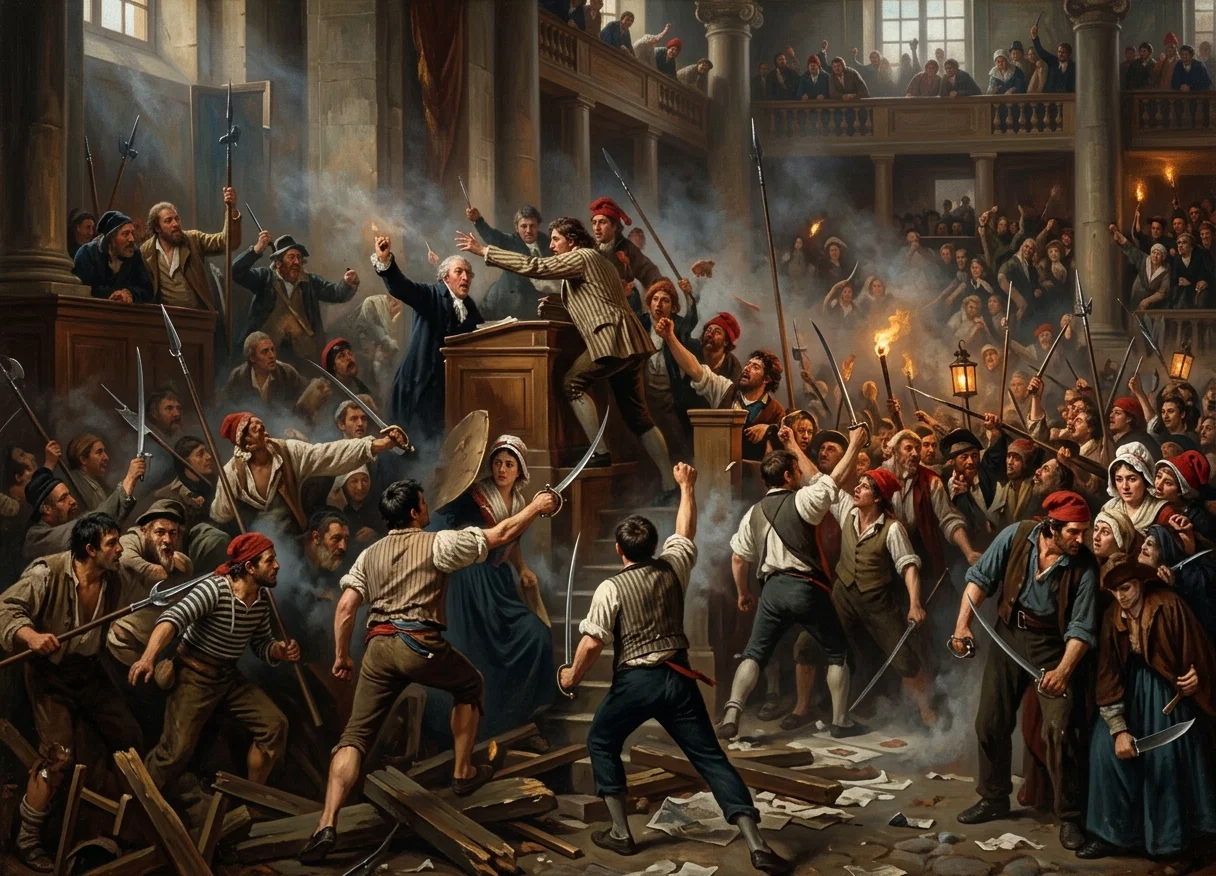
SCENE IN THE FRENCH REVOLUTION.
Romme’s report came up for discussion on Oct. 5, 1793. His arrangement of the years, months, and decades was accepted; but his names for the months and days were severely criticized. It was resolved that the days of the week should be called Primidi, or first day; Duodi, or second day; Tridi, or third day, up to Décadi, or tenth day; while the months were to be called simply, first month, second month, etc. Thus, on October 7, the Moniteur bore upon its title-page the date: “16th day of the First month of the Year II of the French Republic.” This manner of dating was not popular. It was then determined to give new names to the months. No attempt was made to name the days of the decades; but the Committee of Public Instruction was directed to propose names for the months corresponding to natural seasons, not to historical events. Fabre d’Eglantine took this matter in hand, and on the third day of the second month of the Year II, Oct. 24, 1793, he presented his report. It was discussed and adopted on the following day by the convention. The first month, which ran from September 22 to October 21, was called Vendémiaire, the month of the Vintage; the second month, October 22 to November 20, Brumaire, the month of fogs; the third, November 21 to December 20, Frimaire, the month of frosts; the fourth, December 21 to January 19, Nivôse, the month of snow; the fifth, January 20 to February 18, Pluviôse, the month of rain; the sixth, February 19 to March 20, Ventôse, the month of wind; the seventh, March 21 to April 19, Germinal, the month of buds; the eighth, April 20 to May 19, Floréal, the month of flowers; the ninth, May 20 to June 18, Prairial, the month of pasture; the tenth, June 19 to July 18, Messidor, the month of harvest; the eleventh, July 19 to August 17, Thermidor, the month of heat; and the twelfth, August 18 to September 16, Fructidor, or the month of fruit. The five complementary days were given the alternative names of Sans-Culottides, and were dedicated to Virtue, Genius, Industry, Opinion, and Gratitude. The sixth, in leap year, was to be celebrated as a special feast every fourth year in honor of the Revolution. After the report was adopted, the Moniteur appeared with the following lengthy date on its title-page: “Octidi, première décade de brumaire l’An II. de la République une et indivisible (27 Octobre 1793, vieux style).” This was far too elaborate for ordinary use. The days of the decades soon dropped out of memory, and days of the month only were used. For some time it was the regular custom to insert the Gregorian date in brackets after the Republican date, but this was forbidden during the Reign of Terror, and it is necessary to translate the dates of that period into the common, ordinary dates of the Christian calendar.—Yale Review.
SENSITIVE PAPER.
The Boston Advertiser learns that a French photographer lately invented a process by which a bit of ordinary paper—the leaf of a book, for example—can be made sensitive to the light without affecting the rest of the page. Acting on this hint, the French war minister has begun to take portraits of conscript and recruits on the paper, which gives their height, complexion, age, etc.; and the cheapness and swiftness of the operation, which is already in use in the French army, is something remarkable.
It costs only one cent to get two copies of a portrait of Jacques Bonhomme—one for his individual register and the other for his muster roll—and so rapid is the process that in a few hours a whole regiment can be so photographed. The soldiers file along one by one, and each sits for three seconds in the photographic chair, and the thing is done.
They even mark the man's regimental number on his breast with chalk, and thus get a complete identification of him in case of desertion or death, or when a discharged soldier presents his claim for pay or a pension. If such a system had been in use during our civil war, the Pension Bureau would not now be paying out so many thousand dollars a quarter to deserters, bounty jumpers, and other sham heroes of the Union army.—Selected.
HE KNOWETH ALL.
By Faith Farleigh
BY FAITH FARLEIGH.
O tired heart, He knoweth all
The long, hard way;
He knows what shadows, like a pall,
Darken thy day!
He sees life's earliest violets fade,
The sunlight falter from the glade,
The desolations storms have made,—
He knoweth all.
He sees each hope that fades and dies
Like autumn leaves,
And watches o’er in loving wise
Each heart that grieves.
He heeds the faintest soul that prays,
And, though He leads in unknown ways,
Thou mayest trust Him for the days
Who knoweth all.
—Golden Rule.
BASUTOLAND, AFRICA.
By S. N. H.
Basutoland is a small tract of country, as may be seen from the map of South Africa, bounded on the north and west and southwest by Orange Free State, Cape Colony just touching on the south, on the northeast by Natal, and east by Griqueland East. It contains about 10,000 square miles, and 250,000 natives. The Drakensberg range of mountains runs through the eastern portion, and the entire country is very mountainous, with the richest valleys I have ever seen in any country outside of some portions of Illinois and Iowa. It is rich black loam for a number of feet deep, and will respond to the slightest and most superficial cultivation. It seemed strange to go through a heathen country and see the natives plowing with the latest improved American plows, and also to see huts of all shapes and sizes with dooryards inclosed with a brush fence about eight feet high, and as clean as a brush broom could make it; also to note the entire absence of the red mud or yellow ocher paint so common among the natives of all tribes. It is a characteristic of the heathen natives to build their huts round, covered with thatch or mud, and no windows. But here there were more huts built of brick than anything else, and some of stone, with windows as in European houses.
There are no other natives in Africa that have such a thirst for knowledge and education as these. They are not so very brilliant, but are fast gaining intelligence, for they are determined to have an education. In all of the mission schools they have found it absolutely necessary to have them work at some laborious work at least two hours a day, for their health. I have seen them in every place where their schools were established, as soon as it was light, walking book in hand studying their lessons. They are natural linguists, and so are all natives. The French missionaries from the Paris Evangelization Missionary Society are the principal missionaries there. They have 14 regular mission stations and 141 out-stations. At Morija, where is located the head mission, they have a normal school, where over one hundred boys are in attendance. In all of their schools, missions and out-stations, they reckon over ten thousand in attendance. Considering that these are continually changing, especially at the out-stations, it is estimated that at least fifteen thousand are annually taught to read and write.
At Thaba Bosiga there is a training school for girls, where they are educated to sew, wash, cook, and do all kinds of domestic work. At Quintin, on the south, there is also a training station for boys, who learn how to build houses of stone and brick, making the brick and taking the stone from the quarry, hewing and squaring it ready for building. At these training stations they learn to read and write, but do not receive advanced education as at the regular mission schools. These out-stations are conducted by the native converts, while the regular mission stations are in charge of Europeans.
Another feature of the natives is that nearly all of them wear European dress, in part at least, but in some way they will have the blanket on the outside. That much of their old customs clings to them, like some of the fashions on our sisters. In nearly every village there are those who can read and write, and usually there can be found those who speak English. So a person could get along with them quite well if he knew a few words of the native language.
The French first began mission work among them in 1833, and about 1863 the Roman Catholics went there and began work, and since then the English Society for the Propagation of the Gospel. These are all of the different denominations in that field. The Romanists claim 2,000 converts, while the French missions claim 10,000 or more enrolled church members. It is through these missions, especially the French, that the effect of civilization is seen all through the country. Judging from what I saw and heard, this is a field ripe for our work. It is far in advance of any other tribe in South Africa. Why our attention has not been called to it before is a wonder to me.
Already some of our publications are being translated in the Susuto language, and if we had some one who could go with one of the natives who was converted, from village to village, and take the truth to them, and live right with them, without stopping to establish a mission, I believe we would gain the favor of the masses, and many would be led to embrace the truth. Then publish a paper in the Susuto. There is one paper now published in that language, with a circulation of about eight thousand, mostly among the Basutos themselves. It is issued fortnightly, at Morija, where they have a publishing house. Many of the natives are competent translators.
They are not idolaters in the sense in which we use the term, but are worshipers of their ancestors, or of the Shinto belief. They think there is no need of even worshiping these unless it be in time of drought or sickness, or when they have hard storms; then they send for their witch doctors to prescribe. The prescription is usually after divining with the bones or examining the entrails of an antelope or other animal. The antelope must be of a peculiar color, and be caught in some peculiar way, and the stomach taken out, and the contents strewed upon the dead ancestor's grave, together with a ceremony asking him to be still and let them alone, or something of like nature.
Polygamy is also believed in and practiced among them, which is more general among the chiefs. This is one of the greatest hindrances to the mission work.
There is a heavy fine for importing liquors into the Basuto country; so the common people do not drink; but the chiefs get smuggled liquor in some way, and they drink. The people are principally vegetarians, living on wheat, kafir corn, and mealies, which are ground and make nice bread. They also eat flesh when an animal dies of itself. They make kafir beer from meal with hot water poured upon it and left to sour; this is both food and drink. When it is very strong, it will intoxicate.
In many of the heathen villages they set out trees so they present a cozy appearance. They have no bridges. The common way of traveling is on horseback, and a Basuto pony will climb where any cow will, and is seen sometimes where any goat can go. They never sell any land, so there are no Europeans in the country save those who go there as missionaries or tradesmen. These first get a permit from the chief, and then, if for trade, they obtain a license from the English. They are under the Home Government. The people were once under the colony which delivered them from the Dutch Boers, but the colonial authorities tried to force them to put down their arms, or rather deliver them up to them, and this made another war, when they defeated the colonials and became free. They then appealed to the Home Government and obtained protection. They are a social people, and they like nothing better then to be visited, when they will sit down and talk in a sociable manner.
S. N. H.
WHAT IT COST A BENGALI.
By Ada Lee
BY MRS. ADA LEE, CALCUTTA, INDIA.
We enjoy reading stories of the bravery of the early Christians, but we are now in the midst of scenes just as interesting.
A few months ago an educated Bengali gentleman, who is a doctor by profession, and a high-caste Hindu, came to see Mr. Lee, and talk to him about the Christian religion. He told us his father had often prayed with him, and used to say he was a Christian, but did not wish to stir up opposition by being baptized, and died without doing so; but his son feels he must come out from among the heathen, and therefore asked for baptism. His wife desired to come with him. Soon the persecution began. What this man has endured during the last three weeks baffles description.
First his patrons were turned against him, and he was left with only a small monthly allowance for his services in a benevolent institution. The next step was to go and take his wife from him by force. Their little child was very ill at the time, but his wife bribed an old woman to carry a note to her husband in which she begged him not to allow them to get the child—that she might the sooner escape and come to him. But while he was out, they beat the doorkeeper and stole away the child.
His father-in-law then came to him and promised him 5,000 rupees if he would give up his own house and go with him. This he quietly but firmly refused. His persecution then increased in violence. Mobs surrounded his house and spent the night taunting him and throwing stones into his house. They hooted at him, calling him a “beef-eating Christian,” and an outcast, and filled his doorway with old bones.
A young man working with us went in to pray with him a few evenings ago. They barred the doors while they knelt down and asked God’s help and strength. Soon the mob surrounded the house, and our coworker only escaped by the doctor slipping him out, and, jumping on his bicycle, he shot through the crowd and was gone before they could hurt him.
The doctor is doing all he can to get his wife, but she is imprisoned in a room in her father’s house, and every attempt to reach her has failed. He has now gone to law with the matter, and it is not certain what can be done. In all he is so gentle—yet firm and brave—that he has won the confidence of us all. The latest word from him to-day is that the mob had broken in and beaten him with clubs until he is so sore and swollen that he can hardly move. These men are now bound over for six months to keep the peace. We are indeed anxious about his wife. Her people would rather see her die than become a12Christian, and might murder her if she attempted to escape.
Read this through thoughtfully, and who will think it easy for these people to become Christians? Pray with us that this man may be kept through these fiery persecutions, and his wife and child be allowed to return to him. And as you pray, ask yourself before God how much it has cost you to be a Christian. Have you done all God would have you do to send the Gospel to these millions of Bengali people?
O, the power of the Gospel where it is taught in these homes! And how many hungry hearts we find among the people as we go in and out—yet many all about us have never heard of Jesus! Are we guiltless? O, that our people at home could see this great harvest field, ready for the sickle! Shall we not be among the reapers?—Union Gospel News.
WAITING
By Walter P. Buckley
BY WALTER P. BUCKLEY.
We are waiting for the coming
Of our blessed Lord and Saviour;
We are waiting for the dawning
Of the morning bright and clear;
We are waiting for the opening
Of our Master's hidden treasure;
We are waiting for the gathering
Of the friends and loved ones dear.
Our dear Saviour, he has told us
Of his coming here again;
It will be a day most glorious
When he is made known to men.
And we know he has a treasure
Waiting for our entrance there,
When we with loved ones gather
In the home so bright and fair.
Jackson, Mich.
OUR GENERAL AGENTS.
Argentine—Mary T. Westphal, Casilla del Correo, 481, in care of Sociedad de Tratados de Argentina, Buenos Ayres, Argentine Republic, S. A.
Arkansas Tract Society—H. Clay Griffin, Van Buren, Ark.
Atlantic Tract Society—T. A. Kilgore, Sec., 43 Bond St., New York City, N. Y.
Australia—Echo Publishing House, North Fitzroy, Victoria.
California Tract Society—1059 Castro St., Oakland, Cal.
Canada—Mrs. A. E. Taylor, 294 Maria Anne St., Montreal, Quebec, Sec. Quebec Tract Society; Marien Klaiber, 194 Brock Ave., Toronto, Ontario, Sec. Ont. Tract Society; and Int. Tract Society, 268 Crawford St., Toronto, Ontario.
China and Japan—A. La Rue, International Tract Society, Queen’s Road 219, Hongkong, China.