Conducted by MILTON C. WILCOX
Professor of Biblical Exegesis of the Faculty of the College of Medical Evangelists
Loma Linda, California
NOTE.—This department is for the purpose of helping Bible students. Answers must of necessity be brief, often only suggestive, never exhaustive, never infallible only as they agree with the infallible Word. Such questions only will be answered as seem to the editors to minister to the mission of the paper. Questions of the same import can not be answered repeatedly in the same volume. Name and address must be given, not for publication, but as evidence of good faith and to insure reply by letter if thought best. It is well always to enclose stamp, not stamped envelope, unless answer is desired by letter alone.
Will you please give me a full exposition of Col. 2: 16? Is the word in the original Greek for "sabbath" the same as that used when referring to the seventh-day Sabbath? S. C.
To answer the last question first, the word "sabbath" in Col. 2: 16 comes from the same Greek word that "Sabbath" is generally translated from. It is also in the same form in the Septuagint in Ex. 20: 8-11. But this does not alter the meaning of the text. The word "sabbath" is used for yearly sabbaths as well as weekly. The real point is just this,—that the seventh-day Sabbath, the weekly Sabbath, God's memorial of creation (Gen. 2: 2, 3), is not "a shadow of things to come." All shadows have to do with sin and the putting away of sin, and have all come in consequence of sin. Before sin entered, man needed no shadow to point forward to something better; and the seventh-day Sabbath was instituted then. But when sin entered, man needed a Saviour; and all the various sacrifices and feasts and symbols and ceremonies which followed sin, came in to point men to the only One who is able to take away sins.
And these sabbaths of which Paul was speaking to the Colossians were shadows of things to come, the body of which was Christ. There were ceremonial sabbaths, days in which no work was done, and ceremonial feast-days in connection with these sabbaths. Read carefully Leviticus 23, where these various yearly sabbaths and feast-days are mentioned. Note also that the third verse has to do with the seventh-day Sabbath. "It is a Sabbath unto Jehovah in all your dwellings." Then Moses goes on and names all the various yearly sabbaths and feast-days till we come to the thirty-eighth verse, and then he tells us all these various days are "besides the Sabbaths of Jehovah." That is, they stand out in contradistinction to the Sabbath of the Lord.
There is another consideration in connection with this passage in Col. 2: 14-17 worthy of note, and that is the real point of the apostle's teaching. He is speaking to Christians, those whom God redeemed and re-created in Christ Jesus. They had been placed upon the true foundation of God's word. It was the apostle's desire that they should be rooted and built up in Christ. Our Lord was that Word personified—a commandment keeper. And those rooted and established in Christ by faith are also commandment keepers. Therefore, being justified by Him and received by Him, sins cleansed by Him, no man should judge them, no man should condemn them. In other words, bringing it home personally, whatever men may say, do not let us feel condemned by them, even though we are not walking in the ordinances of men. God's path of commandments upon which grace has placed us may lead us away from all the traditions of the church in the past, and contrary to all human laws in the present. Let not these things trouble us. Go forward, looking to Christ and to Him alone. We are not to be led away by false philosophy, we are not to be puffed up by the fleshly mind, but the Christian is to hold fast the Head. And he who truly and intelligently holds fast the Head, Christ Jesus our Lord, will be a commandment keeper—not to earn salvation, but because of Christ's life within him. These are the great lessons that we should gather from the passage.
41 — ENCOMPASSING THE CITY OF JERICHO
Did the Israelites encompass the city of Jericho on the Sabbath? L. C. L.
Clearly they did, because they encompassed the city seven days. The last day may have been the Sabbath. We do not know. They were simply worshiping God as they were marching around that699city and obeying God's command. They did not fight. They did not break down the walls of the city. God's invisible armies, the angels, were doing that. It is lawful to do God's work on God's day. The commandment is against doing our own work. See Isa. 58: 13.
42 — "END OF THE LAW FOR RIGHTEOUSNESS," ROM. 10: 4
Please explain Rom. 10: 4 so as to show definitely the meaning of "the end of the law." S. C.
The one who has faithfully studied the book of Romans up to Rom. 10: 4 will have no question about the meaning of "the end of the law." We go back to the very first chapter. Chapter 1 shows that the world is condemned, that the only hope is the gospel of Christ; chapter 2, that the Jews stand with the Gentiles,—that although they have "the form of knowledge and of the truth in the law," still they have transgressed it. Chapter 3 brings both of them together; tells us that all the world is guilty before God, condemned by the law. And that chapter closes with the great thought that only by faith can we be justified, because no law can justify its transgressor. Chapter 4 shows how Abraham found relief by believing in God; chapter 5, that faith brings us peace and justification and hope. Chapter 6 discusses baptism and what it ought to mean to the sinner,—that his sins are buried, but his whole life is yielded to Christ; that now he lives the new life in Christ Jesus. But the new life must be just such a life as Christ led, and Christ kept all God's commandments. Chapter 7 is a further development of it, showing that it is not the law that is bad, but it is the sinner that is bad; and the law, having no salvation in itself, drives the sinner who longs to be saved, to the Lord Jesus Christ. Therefore, while the sinner has no hope in the law, he finds it in the grace of Christ.
Chapter 8 is an amplification of that glorious freedom in Christ. It expressly tells us that the only mind that is at enmity with God and against God's law is the carnal mind, which can not be subject to God's law. And it brings before us the acme of Christian experience,—love to God; and love is exemplified in obedience to God's law. I John 5: 3.
Chapter 9 carries the same thought further,—that the Jews sought righteousness by their works, not by faith. And Rom. 10: 4 is a climax to the argument that has been presented before,—that the very thing the Jews sought and could not find, is found in Christ Jesus our Lord; that Christ is the end of the law for righteousness. "End" is not used to mean the limit, or the last of a thing. It does not mean that the law is no more when we come to Christ. "End" is used in the sense of object, just as James says, "Ye have heard of the patience of Job, and have seen the end of the Lord" (James 5: 11)—that is, the object of the Lord in afflicting Job.
It is a sad thing, is it not, that the text should be used to justify sin,—to teach that when we reach the Lord Jesus we may disregard His law? But the text does not say that Christ is the end of the law for transgression. It is not the object of the law that we may break the law, but Christ is the end of the law for righteousness. The law drives us to Christ, that in Him may be found the righteousness which the law demands. To that righteousness the law witnesses, as we are told in the twenty-first verse of the third chapter. That is, the righteousness that we have through our Lord Jesus Christ is witnessed by the law to be correct. The man who is made righteous will keep the righteous law.
Can you give us an interpretation of Ezekiel 38 and 39? It seems to picture the last days. W. H. W.
Those chapters do and they do not picture the last days. There are some conditional prophecies in God's word, which would have been fulfilled in the past if God's people had complied with the conditions. All the latter part of Ezekiel is prophecies of this kind. God would have delivered His people from all their enemies, and there would have been built the wonderful sanctuary which is described in the last part of Ezekiel. To our minds, chapters 38 and 39 go with that description.
The conditions on which the Lord makes His promises are stated very fully in Jer. 18: 8-10. There are some things in these prophecies, however, that will without question be fulfilled in the last days, whether the Jews had regard for them or not. Some of the predictions perhaps relate to the end of the thousand years. They can only be fulfilled then. Some of the details will not be fulfilled at all; for instance, the burning of the weapons, the burial of the dead, the cleansing of the land. Eze. 39: 9-16. All that would have been true, of course, in the days of Israel. That was the kind of weapons they used then—wooden arrows and bows, and spears and handstaves. Fires could be made of them; and in the great slaughter that might have followed, the other things would have been fulfilled. That will not be true of modern weapons, or of the last great war; for then, according to Jeremiah 25, the slain of the Lord shall be from one end of the earth to the other, and they shall not be buried.
The best way to get an understanding of these passages is to take into consideration the conditions on which they were made—what would have been done had Israel been faithful to God; secondly, that what of the prophecies remained to be fulfilled must be fulfilled in harmony with the conditions existing upon the earth. Some of the events foretold, will occur before Christ comes the second time, and some of them in the last great battle, which will be fought on the other side of the thousand years, as outlined in Revelation 20. The limits of this department will not allow further development.
Does this verse refer to the evening of the first day, such as our present Sunday evening, or the first part of the second day, counting Biblically, or is it the dark part of the first day—on our Saturday night? H. A. B. R.
It clearly refers to the evening of that first day, running from the closing hours of the first day into the first part of the second day. The day began and closed at evening. In order to get an understanding of this it will be necessary to read what the different evangelists say regarding that day, and also to have an understanding of the Bible evenings.
The Jews recognized two evenings. See Ex. 12: 6, margin. When the sun began to decline, about three o'clock in the afternoon, the first evening began. Of course it closed with the day—the evening belonging to that day; but it merged into the evening of the next day, or the first part of the next day.
That whole first day had been spent in various ways by the disciples. Most of them were still in doubt regarding our Saviour's resurrection. Luke tells us that on the afternoon of that day two of the disciples went down to Emmaus—a distance of seven and one half miles from Jerusalem; that on the way down there Jesus joined them. They did not reach Emmaus until toward evening (Luke 24: 29), when the day was far spent. Jesus went in to eat with them. Just how long He stayed before refreshments were prepared, we do not know; but He sat down to the table with them, took bread, blessed it, broke it, and gave to them, and then they knew Him. But He immediately vanished out of their sight. Then "they rose up the same hour, and returned to Jerusalem"—seven and one half miles. The first day must have been past then, and the beginning of the second day had come. So when Jesus met with the disciples, as recorded in John, the second day had begun.
The disciples had gathered together in the closing hours of the first day; but when Jesus came to them, the first day had passed, and the second day had begun. Thus His meeting with them was not on Sunday, but on the day which followed. This is evident from Luke 24: 37-39. The night was then on; and when Jesus appeared, they supposed that it was an apparition. Compare also Mark 16: 14.
The disciples had not met together to celebrate the resurrection of Jesus. They had met together because that was their common abode (Acts 1: 13), and Jesus upbraided them for their unbelief when He met them. There is nothing in this meeting, or in any other meeting of Christ and His disciples, that established a new Sabbath or made any change in the Sabbath of the Lord.
I note in a book written by Pastor Russell that he uses the word "presence" in place of the word "coming" in Matt. 24: 27. He says the Greek word parousia has been incorrectly translated as "coming," and should be "presence." C. B. J.
We would advise our correspondent to secure the little tract "The Manner of Christ's Coming," published by the Pacific Press, price 1 cent, in which all these various words that have to do with our Lord's coming are considered. Pastor Russell is right as regards the occurrence of the word, but his use of it is utterly unscriptural. That our Lord has been dwelling here upon the earth, or that His literal presence has been here upon the earth, for a number of years, is utterly contrary to the word of God. Out of the wrong idea of parousia has grown what is called the view of "the secret rapture," in which it is contended that Christ comes in secret before He appears in the clouds of heaven, some contending that during this time He gathers home to Himself His "elect," His bride, and that when He comes He brings these with Him. But there is nothing whatever to indicate that the parousia is a secret coming or a secret presence. Take, for instance, 1 Thess. 4: 15, 16, where the term parousia is used: "For this we say unto you by the word of the Lord, that we that are alive, that are left unto the coming ["presence," parousia] of the Lord, shall in no wise precede them that are fallen asleep. For the Lord Himself shall descend from heaven, with a shout, with the voice of the Archangel, and with the trump of God: and the dead in Christ shall rise first."
Certainly there is nothing indicative of a secret coming in this passage. "The voice of the Archangel," "the shout," and "the trump of God" clearly show that it is not a coming in the stillness of spirit to a few only. The very heaven will resound with the trumpet, and the surpassing glory will pierce to the very tombs.
Pastor Russell and some others have made the mistake of using the terms which relate to our Lord's coming as distinct events. There are three—parousia, apokalupsis, and epiphaneia, but they all relate to the same event. The first word has to do with His presence—the coming of the Lord Himself. The second means "disclosure," "revelation." The world has known Christ after the flesh. They have looked upon Him as a man. He will be revealed as the Son of God when He comes. The third means "forth-shining"—the wonderful glory that will be manifest when Christ appears. He was here in humility when He came before. His glory was veiled in humanity. There was nothing about Him that men would desire. But when He comes the second time, it will be in all the glory of the Father and the holy angels with Him. His presence will be the revelation of the Son of God, the forth-shining of the eternal glory. There is a wonderful beauty in the use of all these terms as applying to Jesus at His second coming. We have two of them used in 2 Thess. 2: 8 referring to the wicked one. It says, "Whom the Lord Jesus shall slay with the breath of His mouth, and bring to naught by the manifestation of His coming"—by the forth-shining of His presence. And that will be His apokalupsis, or disclosure.
The little tract mentioned discusses the subject quite fully.
A STRANGE CONCLUSION
By John O. Corliss
WRITING on the proposed one-day-of-rest-in-seven law appearing on the initiative ballot for November 3, a correspondent of a local paper presents a paragraph as follows: "What is a free government? Answer: It is a government in which every man not only respects his neighbor's opinions, but he is willing to grant to him the (Golden Rule) same rights which he so highly values for himself."
That is divine doctrine, and if lived out among men, would provide the highest type of society, equal to that of the loftiest form of moral ethics. But the next sentence, designed as explanatory, befogs the whole issue. It is this: "How is this secured to the citizen in a democratic form of government? Only one way possible — by submitting to a majority vote."
CAN MAJORITIES ENFORCE THE GOLDEN RULE?
The "Golden Rule" is a law of heaven, and is supposed to be enforced by the direct influence of God's Spirit on the heart. How, then, can a majority of human votes give force to that which only God is supposed to regulate by a heavenly, mysterious influence? Is not this unwarranted interference with the program of heaven? Is it not an attempt to enforce a heavenly rule upon men whether they desire to have it so or not, and that by a majority vote of men many of whom have never themselves yielded to the call of God to give Him the heart? What right have a majority of that sort to prescribe morals for their fellow men? Finally, is that doing by the minority as such majority would have done to them, were they in the place of the minority? No one can truthfully affirm it. On the other hand, such doings are entirely contrary to the Golden Rule, being born, as they are, of sheer selfishness.
A RIGHT TO IT WITHOUT A LAW
In the matter of Sunday rest, every one has the right to it without a law regulating its observance. One may go to church or refrain from such attendance. He may ride or walk for healthful exercise, or sit in the shade and read, — all this without any legal restrictions. What further rights can one ask for, which civil law could promise? One thing alone a civil law along this line could do, and that is, compel the minority to follow the religious course of the majority, simply because that majority wills it. But this is not the prerogative of a human majority, for the reason that Heaven has not vouchsafed that right to one body of men over another, no matter how much more numerous they may be than the others.
The American Declaration of Independence also declares that all men were created free and equal, and have been endowed with certain inalienable rights, among which are life, liberty, and the pursuit of happiness. Why, then, not be good Americans, and maintain the integrity of that immortal document, by which this nation became free from the arbitrary dictation of potentates, who claim to rule men by divine right? J. O. C.
SYSTEMATIC BIBLE STUDY
The psalmist declared, "Thy word have I hid in mine heart, that I might not sin against Thee." Ps. 119: 11. For the purpose of having God's word hidden in our hearts and impressed upon our minds, it is very desirable that we become constant, daily readers of the sacred Word. We should read the Book, and meditate upon it. As we read it, it becomes the most interesting volume that we can find. In fact, it becomes so fascinating that we desire it before every other book, because it is the word of the living God.
Read three chapters each week-day, and five on the Sabbath.
Among Lions in Their Native Jungles
By Ross C. Porter
Actual Experiences with the King of Beasts — Marvelous Deliverances of Active Missionaries Pioneering in Africa
By ROSS C. PORTER
THE writer of this article was in charge of our work in Africa for a number of years, and hence writes from the standpoint of his own experience and personal observation. When attending our General Conference in Washington, D. C., last year, he was asked to make his headquarters in China and take the oversight of our work in the Asiatic Division, and he is now in that field.
WHEN we decided to open a new mission station in northwest Rhodesia, it was necessary to travel two hundred miles by ox team from Livingstone, the terminus of the government railway, to the locality in which it was thought best to open the work.
LION'S NIGHT VISIT
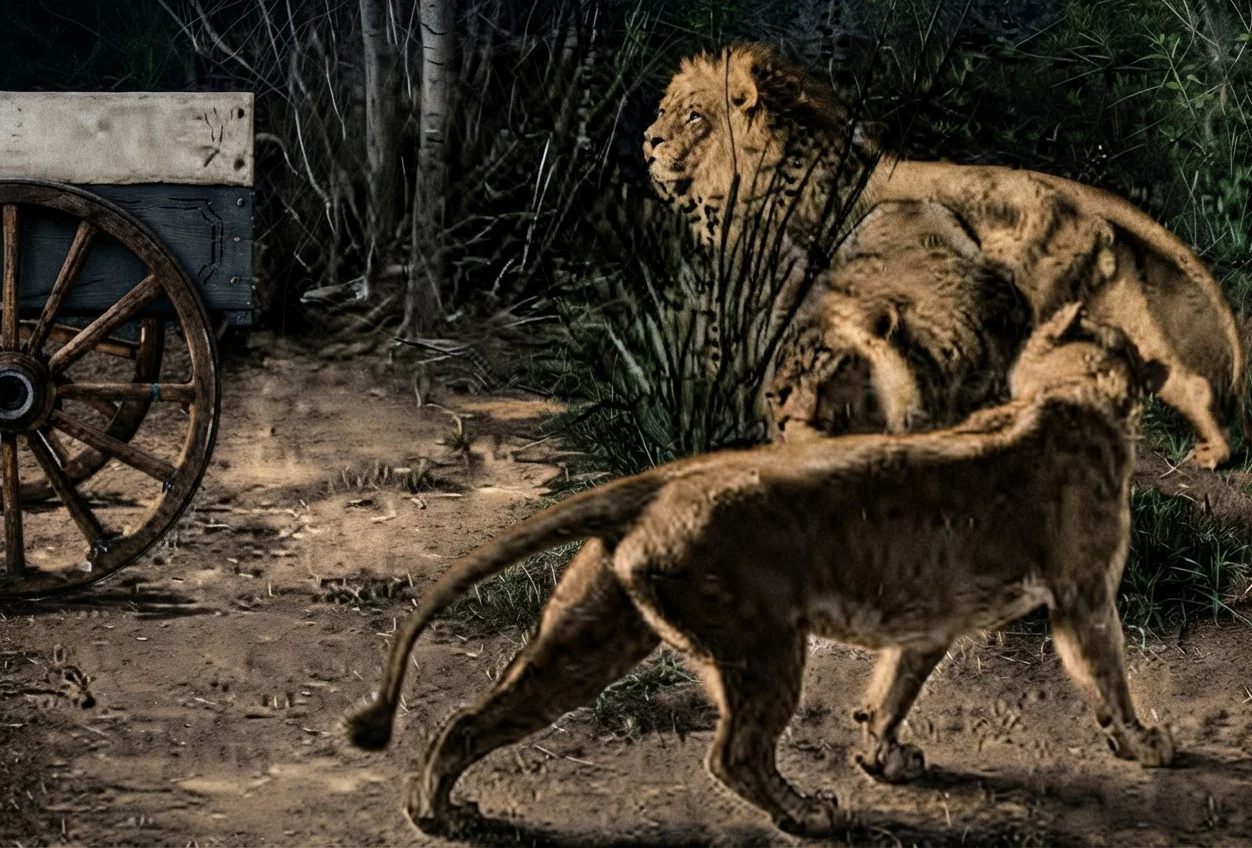
Camping in the wagon was customary in pioneer life in that country, and our missionary and his family followed the usual custom. One night, in crossing a river where there was no road, the oxen, being tired, were unable to pull the wagon from the river. It was an undesirable place to camp, as there was a jungle along the bank, which makes a convenient hiding-place for lions. But the wagon was fast, and it seemed that there was no alternative; so spreading their bed upon the sand near the wagon, the missionary and his wife were soon asleep. The next morning, they found the footprints of a lion within twenty-five feet of their heads. It had come that near, and looked them over, then turned away without disturbing their slumbers. In this circumstance they had the assurance of divine protection, which was an encouragement to them on their mission.
On reaching the location for which they started, they found five thousand acres of farm and grazing land, watered by two river branches forming a junction upon it, and in the center there bubbled a famous spring of pure cold water, which was sufficient to irrigate abundantly twenty acres of as fertile and beautifully situated land lying just below it, as could be found in the country. Here the mission farm was staked, and after the price was learned from the government, 5,000 acres was purchased at sixteen cents an acre.
On visiting the station, I was invited by two Catholic fathers, who were operating a mission two miles away, to come and dine with them. I accepted the invitation, and in company with our mission superintendent, visited their mission. While at dinner, we talked of the progress of mission work in Rhodesia, and of its early history, and the conversation finally turned to experiences in the development of the two stations that were represented in our party.
HOW THE CATHOLIC FATHERS VIEWED IT
I was intensely interested in the statement of the Catholic father who related the providential way in which our mission site had been taken from them and given to us. The story as told by Father Moran, and confirmed by Elder W. H. Anderson, our superintendent, follows:
"We had come to this locality some months in advance of your superintendent, spied out the land, selected the farm you now occupy, staked it, returned to Livingstone, and made application to the government for the location. Afterwards we met the commissioner of railways, who is a Catholic, and were informed that we had made a mistake in our location, as the government was just beginning the survey of an extension of the railway up another valley, forty miles distant from our location.
"Acting upon his advice, we canceled our application for the choice location you now occupy, made a trip up the other valley, located our station, and returned to Livingstone to make application for it to the government. Before we sent in the application, the railway commissioner informed us that he had just received notice from the government surveyors that they had completed their survey of the road-bed, and they were going over into the valley forty miles distant, and they would survey back down that valley in hopes of finding a more desirable location for the road.
"Again acting upon the commissioner's advice we hastened back to restake the location we had canceled. When within one day's drive of the place, we camped for the night near another camper who was headed for Livingstone. During the evening, we learned that our camp neighbor was your superintendent, and that he was just returning from having staked the same farm for a mission station that we were hastening to secure. An overruling providence had taken the place from us and given it to you. Providence seems to favor your mission enterprise more than ours."
It was an undesirable place to camp, as there was a jungle along the bank, which makes a convenient hiding-place for lions.
After I had related this story before a large audience in a camp-meeting in Los Angeles, California, last year, the government surveyor for the South African railways stepped forward, and handing me his card, confirmed the story of the changing of the railway survey, and added, "I was the government surveyor in that expedition." The railway now runs across the corner of our mission farm.
A LION CROUCHED BEFORE HIM
While on this pioneer journey, Elder Anderson was one evening walking behind the wagon, rifle in hand, expecting to shoot a deer for the native boys' supper, when he was suddenly confronted by a lion. The beast was in a crouching position, and within springing distance of the wagon trail. It was too close range to shoot with safety, as a wounded lion at that distance is most ferocious.
He had little time for thought. Either he must act or the lion would. His two fearless dogs — boar hounds — were at his side awaiting orders. He gave them the word, and they bounded toward the lion as if it were a domestic animal.
With two bounds one landed upon the lion's back and began biting at its groin. With three bounds the other dog caught the ferocious beast by one of the hind legs. Surprised by the daring advances of the dogs, the lion turned to fight them, and the missionary escaped to the wagon after firing a couple of shots into the air to intimidate the lion.
The dogs soon came up, and Elder Anderson was greatly surprised to find that no trace of wounds could be found on either of them.
After traveling four miles, thinking they were a safe distance from danger of attack by the lion, they camped for the night. They tied all the oxen to the wagon chain, and while eating their supper the lion came up, stealing its way in the darkness. The oxen sprang up, and swung around to the wagon for protection.
In the middle of the span were a yoke of untrained two-year-old bullocks; and as they were unaccustomed to this hasty swing, the one on the outer side of the chain pulled out too hard, and breaking his halter, circled out from the others.
Immediately the lion caught him by the neck, and throwing the young ox, weighing only about six hundred pounds, over his shoulder, made off with him about thirty rods, where he lay down and enjoyed his evening feast.
As it was dangerous following a lion after night, and as he had sufficient with which to satisfy his hunger, they anticipated no further danger and retired and slept undisturbed.
THE PROSPEROUS WORK ESTABLISHED
Our Barotseland station has since developed a strong training school for teachers and evangelists, and a regularly organized system of outstations encircles a large sec13tion of northwest Rhodesia. These outstations are conducted by trained native teachers and evangelists. They receive monthly visits from the foreign superintendent, or his assistant, in order to keep the work up to a proper standard. As the foreigners have the language, the occasions of these visits are made times of special evangelistic effort, which often results in the conversion of a number of the heathen people who reside in the vicinity of the outstation.
It is not unusual that persons walk hundreds of miles to enroll as students in our mission schools. The Barotseland Mission is now entirely self-supporting.
Visiting some of these outstations in company with the superintendent and his wife, we went into camp one night, and found that we were followed by a large animal, either a lion or a leopard. Although we arranged for the camp-fires to be kept burning, the boys on watch were soon fast asleep. Twice during the night we were aroused by the oxen springing to their feet and swinging around to the wagon for protection. This is always an indication that some animal has approached too close.
STUDYING THE LION FROM A TREE TOP
The following night, the superintendent and the writer climbed a tree under which a lion had secreted a seven hundred pound eland cow, in order that we might study the movements of the king of beasts in his native home. He approached the place soon after dark for his first feed. We could hear him coming at a distance of twenty-five or thirty rods by the deep grunt that he gave every few paces.
He came against the wind. The old hunters say that a lion always travels against the wind when seeking his prey. The reason is that he may scent animals in his way before they are aware of his approach.
He lay for about an hour within seventy-five feet of our hiding-place before venturing to eat his evening meal. We could hear his deep breathing, otherwise there was not a movement or a sound to be heard. When he arose in grass four feet high and moved around to the carcass and lay down to eat, his movements were as noiseless as those of a cat. When he began eating, the strong ribs of the eland were crushed as readily as a dog would crush the bones of a fowl.
His second visit was at the midnight hour as accurately as the cockcrowing. He came this time as before.
The third visit was at three o'clock, with cockcrowing precision. But the moon had arisen, and this time there was not the slightest sound of grunt or purr to announce his approach. He was more shy under the moonlight. He was within seventy-five feet of us, unobserved, with both of us watching for his coming, under the clear moonlight, at the precise moment that he arrived. At the slightest sound of clearing my throat, he bounded away, and for two hundred rods we could hear him springing with rapid strides to a place of safety.
VERY SHY OF THE LIGHT
From this experience, we learned that light is a great means of protection from wild animals. They seldom attack in the light unless wounded or driven to do so by extreme hunger, or by being driven into a corner and pressed. It is not the embers of a camp-fire that keep them in abeyance, but the light. Lanterns will serve the same purpose as the camp-fire, and there is less danger of their going out through neglect, leaving the sleeping campers exposed to the danger of attack.
THE LION'S MOUTH WAS CLOSED
As a rule, when making this round of the outstations, lions were seen. Sometimes they seemed determined to make trouble, but our missionaries were always protected.
One afternoon when Mr. C. Robinson, then assistant superintendent, was traveling on foot, looking up a site for a new station, he saw a path leading into some tall reed grass where appeared to be a spring. Being very thirsty, he turned aside into this path and found a cooling spring, drank, then started back toward the trail.
He had but started when he was confronted by a fierce-looking lion facing him directly in his path. His boys, carrying his gun, ammunition, and equipage, had fallen behind a short distance, so he was unarmed.
He was singing when he turned in to the spring, and he continued singing after drinking, as he turned toward the trail, so met the lion with a song. He had passed very close to the beast, which, driven by hunger, had doubtless hidden by the spring, watching in daylight for his prey.
The boys, coming up from the other side, and seeing the missionary unarmed, exposed to such danger, quickly threw down the guns and camp equipage, and nimbly climbed trees for safety. From their safe retreat they watched, expecting to see the missionary slain by the lion. When they saw him walk steadily forward toward the king of beasts, continuing to sing a hymn of praise to God, and saw the lion quietly turn around as he approached, and leave the path, so that the missionary passed in safety, they said surely the Lord had closed the lion's mouth, as in the days of Daniel.
PROPOUND IMPRESSION ON THE NATIVES
Their report of this experience produced a profound impression upon the natives. The missionary felt that it was an evidence of God's care for His work and workers, when He sends them forth with the closing gospel message.
THREE THOUSAND CONVENE
Our British Central African station has a regular attendance of two hundred students at the main station, with one thousand eight hundred in attendance at its thirty-eight outstations. Three thousand convene each Sabbath to worship God under the influence of that station and its outstations.
These are only a sample of the work of our mission stations in the dark continent. From the deadly West Coast, through German East Africa and British Africa, British Central Africa, Belgian Kongo, North and South Rhodesia, Basutoland, Zululand, Kaffraria, and the South African colonies, our line of missions are steadily pouring forth their rays of heaven-sent light. Their advance is extraordinary. It can be explained upon no other basis than the triumphant march of the final advent message on its mission to every nation and kindred and tongue and people.
Book Notices
By Editor
"THE MAKING OF THE BIBLE," by Albert E. Dunning, D. D. The Pilgrim Press, Boston, New York, London. 75 cents net.
This little volume is helpful in the facts which it gives. To the young Bible student these will be of great advantage. It is unfortunate, however, that interspersed with these facts and the analyses which are given of the various books, there are suggestions of the unwarranted conclusions of "higher criticism." The book is colored with the "higher critic" idea all the way through. The human side is constantly in evidence, and but little is said of the divine side. The book is nicely printed. The maps are good.
"THE SEVEN CARDINAL VIRTUES," by James Stalker, D. D., professor of church history, United Free College, Aberdeen. Price 35 cents. Hodder and Stoughton, New York and London.
In this little volume, Dr. Stalker has set forth what he believes to be the seven cardinal virtues, — wisdom, courage, temperance, justice, faith, hope, love. It follows a former volume on "The Seven Deadly Sins," in which seven sins of peculiar virulence were treated. This volume does not imply that there are not other virtues, but that around these virtues and upon these virtues all others revolve and hinge. Under "Wisdom," for instance, is "A Vision of the Ideal," "The Finding of the Way," "A Lesson to Be Learned," and this lesson is that we must know and obey the laws, we must walk in God's way. It is an excellent little volume, full of real helpfulness to not only young but old.
Sanitarium Cooking Oil
"THE OIL OF QUALITY"
Pure Cotton Seed Oil direct from refinery. Sweet, wholesome, and delicious. 4 1-gallon cans, $3.60; 5-gallon can, $3.90; 2 5-gallon cans, $7.70; 30-gallon barrel, $20.80; 50-gallon barrel, $32.75. Cash with order. Sanitarium Cooking Oil Co., Louisville, Kentucky.
THE THREE BEST WAYS
BETWEEN
California and the East
The CENTRAL ROUTE
Less than three days to Chicago
The SOUTHERN ROUTE
All rail or via the palatial Southern Pacific steamers between New Orleans and New York
The SHASTA ROUTE
Via Portland or the North
The best of equipment and service
Protected throughout by automatic block signals
INQUIRE OF ANY AGENT, OR
MR. C. S. FEE
General Passenger Agent
San Francisco, California