Signs of the Times, Vol. 41, No. 44.

TRAVEL IN INDIA
Earlier text: TRAVEL IN INDIA

Trying to Correct a Prophet

THE prophet was very aged, and very feeble, and almost blind; and the strange thing he did may have been attributed to one or more of these causes.
Joseph had been very particular to place the elder of his two sons at the right of their grandfather, and the younger at the left, in order that the aged man might put his right hand on the head of the elder boy, and thus give him preeminence. But instead, the prophet crossed his arms, and laid his right hand on the younger boy.
The boy's father apparently thought that the patriarch's dimness of sight had caused him to mistake Manasseh for Ephraim, and he essayed to correct the supposed error. Not only did he state to Jacob which was the elder of the boys, but in his anxiety to remedy what seemed to him a lamentable blunder, he even took hold of the venerable man's hand, and lifted it from Ephraim's head, to place it upon the head of Manasseh.
But he encountered unexpected resistance. Though the prophet specially loved this son, and though he even realized that Joseph had himself received miraculous revelations of the will of God, yet with the dying seer these considerations counted for nothing compared with the delivery of the message divinely committed to him.
In reply to Joseph's statement, he said, "I know it, my son: I know it." His seemingly queer course had not been due to a misapprehension. Though his eyes were dim, he possessed more than human perception. And future generations testified that Jacob did not err when he signified that the younger of Joseph's sons would excel the older.
If we could understand fully the reason for every manifestation of the mind of the Infinite, verily we must be wiser than Egypt's prime minister. But to claim such wisdom would be to prove our lack of it. Rather let us acknowledge that we are neither qualified nor authorized to censor the messages sent from heaven to earth, nor are we warranted in concluding that any feature which is not clear to our finite minds, is due to the defective faculties of the prophet.
ADELAIDE D. WELLMAN.

"Ask, and Ye Shall Receive"

A DEFINITE promise, is it not? John the evangelist informs us that God's word can not be broken. The psalmist records the following words: "Delight thyself also in the Lord; and He shall give thee the desires of thine heart. Commit thy way unto the Lord; trust also in Him; and He shall bring it to pass." And Mark teaches, "What things soever ye desire, when ye pray, believe that ye receive them, and ye shall have them."
If the word of the Lord is as King David declared,—"Who forgiveth all thine iniquities; who healeth all thy diseases,"—what prevents prayer from being answered in restoration to health? Is it lack of faith to take God at His word?—Not always. Listen to John: "This is the confidence that we have in Him, that, if we ask anything according to His will, He heareth us."
Have we not been instructed to answer our own prayers as far as we can? Perhaps one of nature's simple remedies is the most needful thing for some at this time. It may be the first step, accompanied with prayer that it be blessed to our good.
Sometimes an answer is delayed as a test to our faith. Again, when human help fails, "our necessity is God's opportunity." Paul sought the Lord thrice for removal of an affliction. Hear the answer the great Restorer gave to Paul's request: "My grace is sufficient for thee: for My strength is made perfect in weakness."
Thus it may not always be the will of the great Benefactor to grant us the desires of the heart in the matter of healing. He knows best. Let us have confidence that He who understands our needs better than we understand them, "doeth all things well." MRS. H. E. SAWYER-HOPKINS.

The Sabbath of To-Day

It Was Made for All Men—Prophecies of the Foreigners Who Would Keep It—A Reformation Predicted

By WILLIAM COVERT
As the Sabbath was made for man, we must logically conclude that it was primarily made for all men, and therefore we believe that it was to be observed by all men as long as God's arrangement for men and days should last. Such a plan would be in eloquent harmony with the character of God, which never changes. This would be so entirely like the eternal way, that we surely believe God wanted it to be the way.

THE GRAMMAR OF IT

A noun used without a limiting word, as the noun "man" is used in the text that says, "The Sabbath was made for man" (Mark 2:27), usually applies to every person or thing belonging to the class to which it refers. The Sabbath was not made for any specific man, but for all mankind. This text is like the one which says, "Man that is born of a woman is of few days." Job 14:1. This statement is made regarding all men. So in the text that says, "The Sabbath was made for man," we have language that in its construction includes all men. What God did in making the Sabbath was without question done for all men.
The Sabbath then made was given to the man who was made when the world was created. And the day of the week upon which the Lord rested when the world was made, was assigned to man for the Sabbath day. Therefore the conclusion is unavoidable that the Sabbath was to be as widely extended over the earth as was the dwelling-place of men. The Sabbath is to abide on the earth as long as man dwells on it. Then the nature of the blessing associated with the Sabbath day is of a character to bless all men alike, without any distinction as to race, dispensation, or place.

HERE BEFORE SIN CAME

The Sabbath was here before sin came; and therefore it will be here after sin is gone. There is a prophetic chapter on the Sabbath question (Isaiah 56) which tells of Sabbath-keeping foreigners, or strangers, who will join themselves to the Lord, and get an everlasting name that shall never be cut off. Then that people will keep the Sabbath everlastingly.
That chapter also tells of a people who, in their preparation to meet the Lord at His coming, will keep the Sabbath, and will refrain from doing any evil. Isa. 56:1, 2.
The same class of commandment keepers is described in Rev. 14:5, 12. The promises in these predictions are made to those who obey God, both Jews and Gentiles.
One verse says, "Blessed is the man that doeth this, and the son of man that layeth hold on it; that keepeth the Sabbath from polluting it, and keepeth his hand from doing any evil." Isa. 56:2. The proffered blessing is to the man who meets the requirements, regardless of race or country. The conditions specified are Sabbath keeping and refraining from doing any evil. The chapter describes a people and a work at a time when Sabbath keeping is a distinguishing mark of loyalty to God, and it is therefore blended in a special message for that time.

GIVEN FOR A SIGN

God anciently called the attention of His wavering people to the Sabbath commandment, and said, "I gave them My Sabbaths, to be a sign between Me and them, that they might know that I am the Lord that sanctify them." Eze. 20:12. He is doing the same thing again; and some portions of Isaiah 56 describe a reformation on the Sabbath question, that is to precede the coming of the Lord. Yet the chapter also has a general application, in which it refers to God's work in saving men, from the time it was given, to the end of this age. It makes special mention of the "sons of the stranger," that join themselves to the Lord, to serve Him," and says of these strangers, or Gentiles: "Every one that keepeth the Sabbath from polluting it, and taketh hold of My covenant; even them will I bring to My holy mountain, and make them joyful in My house of prayer: their burnt offerings and their sacrifices shall be accepted upon Mine altar; for Mine house shall be called an house of prayer for all people. The Lord God which gathereth the outcasts of Israel saith, Yet will I gather others to him, beside those that are gathered unto him." Verses 6-8.

THE CALL OF THE GENTILES

This scripture foretells the call of the Gentiles and their acceptance of Christianity. Christ, in giving John 10:16, adopted Isa. 56:6-8, and said: "Other sheep I have, which are not of this fold: them also I must bring, and they shall hear My voice; and there shall be one fold, and one shepherd."
Christ does not mention the Sabbath keeping as does Isaiah; but Christ is speaking of the same work that Isaiah is describing. God's people are to constitute one fold, although they are to be gathered from every nation, tongue, and people when Jesus comes. Rev. 14:6, 12.
The devout worshiper of God, until the time when Christ caused the sacrifices and the oblations to cease (Dan. 9:27), offered through the typical system; but since the sacrifice of Christ, the instructed worshiper comes to the Father by way of the cross.

PREDICTED SABBATH REFORMATION

The fifty-eighth chapter of Isaiah is another Old Testament Scripture which speaks prophetically about Sabbath keeping in the Christian age. In this chapter, the prophet tells of the great need of a reformation in Sabbath observance. The remedy advised is for God's people to get in line with the good way which prevailed many generations ago. So to them he says: "Thou shalt raise up the foundations of many generations; and thou shalt be called, The repairer of the breach, The restorer of paths to dwell in. If thou turn away thy foot from the Sabbath, from doing thy pleasure on My holy day; and call the Sabbath a delight, the holy of the Lord, honorable; and shalt honor Him, not doing thine own ways, nor finding thine own pleasure, nor speaking thine own words: then shalt thou delight thyself in the Lord; and I will cause thee to ride upon the high places of the earth, and feed thee with the heritage of Jacob thy father; for the mouth of the Lord hath spoken it." Isa. 58:12-14.

THE SABBATH DISREGARDED

There is a fearful lack concerning Sabbath sacredness in the church, which nothing short of the divine presence can restore. The right day should be chosen—the seventh day; and it should be kept according to the commandment. Not only should the true Sabbath day be observed, but the keeping of it should be according to the commandment. The real object of the Sabbath is to give honor to God in keeping it. And the heart must be so warm that there will be a delight in the soul, while we are filled with the presence of God, which blesses the hallowed memorial of the Creator.
True Sabbath keeping is not an irksome task, but a divine joy, which refreshes the soul, and makes the obedient long for the return of the blessed rest day.

"As the Stars"

THE promise that "they that be wise shall shine as the brightness of the firmament; and they that turn many to righteousness as the stars," has comforted many a teacher. As one writer has said, "They shall shine as the stars,—not Atlantic coast stars, but desert stars, Babylonian stars, where one can see so many more than here. They shake their wondrous firelight down into your face, and fairly dazzle your eyes. You shall shine as the stars, as bright and as long."
The follower of Christ will be wise,—a teacher, leading other souls to Christ, that they in turn may shine as the stars, until the whole earth and the universe of God is lightened with the dazzling splendor of the redeemed host. Eliza H. Morton.

Seek the Lord While He May Be Found

"SEEK ye the Lord while He may be found, call ye upon Him while He is near: let the wicked forsake his way, and the unrighteous man his thoughts: and let him return unto the Lord, and He will have mercy upon him; and to our God, for He will abundantly pardon."

Is there a Conflict in This?

JAMES wrote, "Ye see then how that by works a man is justified, and not by faith only." James 2: 24.
Paul wrote to the Romans, "Therefore we conclude that a man is justified by faith without the deeds of the law." Rom. 3: 28.
James was speaking of the work of faith, for he said that faith without works is dead. Abraham believed God; and when he revealed his faith by proceeding to offer his son, his faith was counted for righteousness. His works made his faith acceptable.
Paul was considering another phase of the subject. The law to which he refers is the law that points out sin. This law, having once revealed sin in the individual, can not justify his transgression of it, even though he may attempt to keep the law.
These are two different kinds of works. One must be performed before the individual can be justified; the other can not be performed by a person who has not received justification through faith in Christ.
ALLEN MOON.
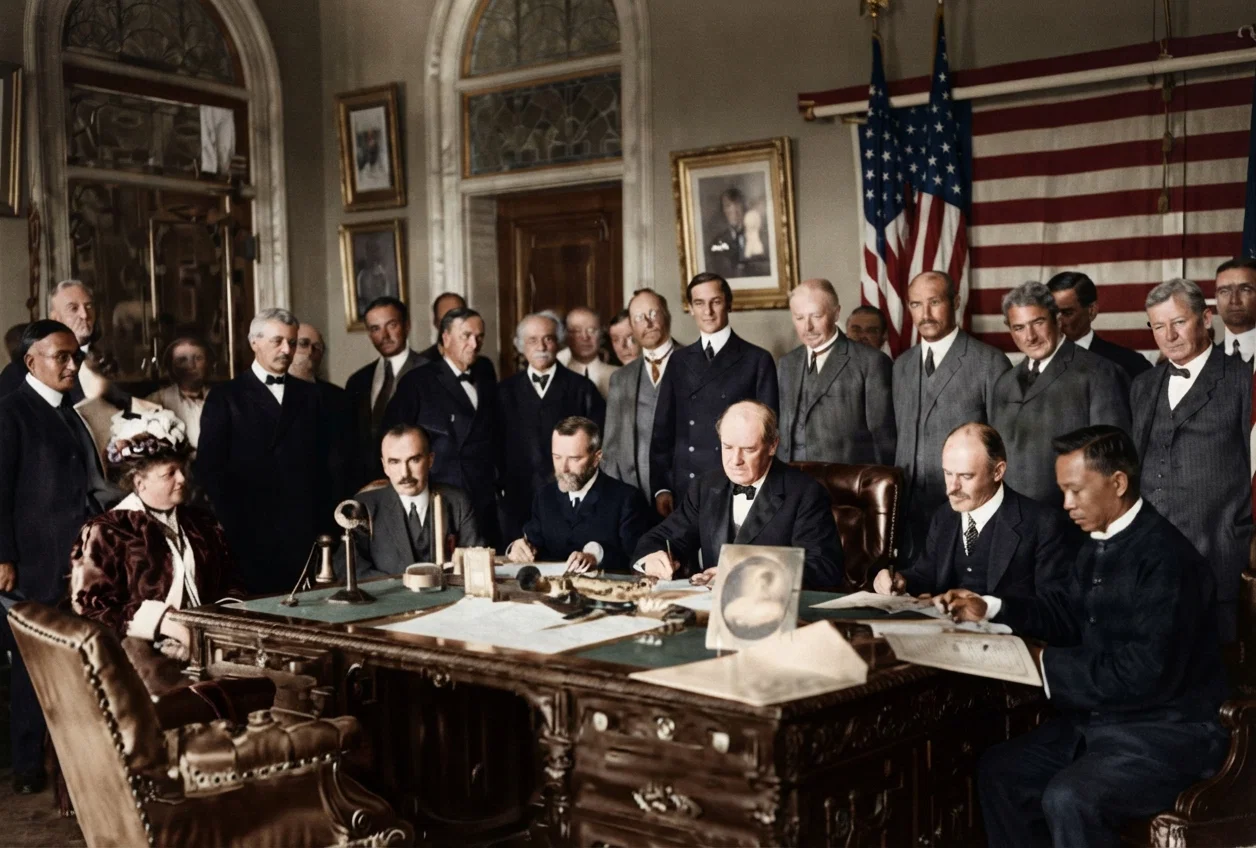
SECRETARY OF STATE BRYAN SIGNING PEACE TREATIES BETWEEN THE UNITED STATES, FRANCE, GREAT BRITAIN, SPAIN, AND CHINA

Fire on These Flags if You Dare

A True Story of the Cuban War of 1867
By F. A. ALLUM
THE following true story relates to a man who went from England to America, and thence to Cuba. He had not been in Cuba long before the Cuban war of 1867 broke out, and he was arrested as a spy. He knew nothing about what he was arrested for, as he could not understand a word of Spanish, which is the language spoken in Cuba. He was court-martialed and ordered shot. When he realized his peril, he sent for the American and English consuls, and laid the case before them.
The consuls looked into the case, and found that he was perfectly innocent. They went to the Spanish authorities, and endeavored to secure his release; but the Spanish officers said: "He has been tried by our law, and found guilty. The law must take its course, and the man must die." There was no submarine cable then, hence the consuls could not telegraph to their governments, and they had not time to write and get an answer back.
When the morning set for the execution came, the condemned man was brought out. A grave had been dug, and a coffin placed beside it, and the man took his seat upon the coffin. Then the black cap was pulled over his head. There stood the Spanish soldiers, awaiting orders to fire; but at that moment the American and English consuls rode up, and jumping from their carriage, ran and wrapped the Star-spangled Banner and the Union Jack around the man, and turning to the Spanish officer, said, "Fire on these flags if you dare." He did not dare. There were two great governments back of those flags.
My friends, what is the government of the island of Cuba when compared with the government of heaven? Every man born into this world has sinned against the government of heaven, and transgressed the law of God; and the Bible, the law by which all will be tried, says, "The wages of sin is death." Therefore every man who has not applied for protection through the merit of the sacrifice of Christ, stands in the same perilous condition that this Englishman occupied. You, dear reader, are virtually sitting on your coffin beside the open grave, and soon sin will draw the black cap over your face, and death will take your life — your eternal life.
But you ask, Is there no way of escape, no hope for me?
Listen! This is what the Bible says: "We must all appear before the Judgment-seat of Christ; that every one may receive the things done in his body, according to that he hath done, whether it be good or bad." "Now then we are ambassadors for Christ, as though God did beseech you by us: we pray you in Christ's stead, be ye reconciled to God. For He hath made Him to be sin for us, who knew no sin; that we might be made the righteousness of God in Him." 2 Cor. 5: 10, 20, 21.
If you will but accept Christ as your Saviour, God will forgive all your sins, and the following text will in your case be fulfilled: "He brought me to the banqueting house, and His banner over me was love." S. of S. 2: 4. God and Christ will wrap the flag of mercy around you, and sin and death will no longer have power over you; for "the gift of God is eternal life through Jesus Christ our Lord." Rom. 6: 23.

God Is Love

THOMAS SPURGEON once said: "I like the spirit of the man who, having a large vane to tell which way the wind blew, cut in the zinc of which it was made, 'God is love.'" O, to learn this lesson well! If the wind blows from the south, "God is love." If it blows from the north, "God is love." If it blows from the west, "God is love." Aye, and if we have that bitter cold east wind which is good for neither man nor beast, "God is love," just the same.
M. A. H.

MOHAMMEDANISM AND CHRISTIANITY AS SAVIORS

Noted "Divines" Who Think the Bible Plan Not the Only One—They Say Mohammed's Teaching Will Save Too—Bible Warnings Against Such Apostasies

In an article on "The Great Religions of Asia," by the Rev. J. T. Sunderland, which appeared in a recent number of the Indian Review, published in Madras, India, is found the following:

IS IT BETTER THAN CHRISTIANITY?

"There are elements in Mohammedanism which seem peculiarly to fit it to reach, to interest, to impress, and to elevate peoples in low conditions of civilizations. It is even a question whether it is not better adapted to the needs of such peoples, and whether it can not do more for them, than Christianity—at least than Christianity in either its Roman Catholic or its orthodox Protestant form. Certain it is that Mohammedanism is one of the most intensely living, earnest, and aggressive religions of the world."

HOW SAD THAT A MINISTER SHOULD TEACH IT!

How sad it is that one who professes to be a representative of the "glorious gospel of the blessed God," a minister of His abounding grace, one who professes to believe—as is most clearly taught in the Scripture—that Jesus of Nazareth is man's only Saviour, should ever confess that "it is even a question" whether Mohammedanism "is not better adapted to the needs of such peoples, and whether it can not do more for them, than Christianity"!
Certain it is that he who makes such a statement, be he minister of the gospel or what not, knows nothing of the saving power of our Lord Jesus Christ. He has never tasted of the waters of life, has never been "delivered from the bondage of corruption into the glorious liberty of the children of God."

UNIVERSAL DISEASE AND BUT ONE REMEDY

Sin is a universal disease, for which there is but one remedy. The great Physician is the only one who can administer that remedy. "Neither is there salvation in any other: for there is none other name under heaven given among men, whereby we must be saved." Acts 4: 12.
The people of India, like those in all other parts of this sin-cursed world, need the help of Jesus—man's only Saviour. If Mohammedanism could save the lost, then Jesus died in vain.

A PROMINENT SIGN

One of the prominent signs of the second coming of our blessed Lord is the wide-spread and rapidly growing belief that man is his own Saviour; that the account of the fall of man as recorded in the book of Genesis is simply a "beautiful story with a heavenly meaning"; that the Bible is an Oriental book, and therefore we can not depend on it.

THE PREACHER'S INFIDEL UTTERANCES

The paragraph following the one previously quoted from the Indian Review reads thus:
"We in this country commonly think of Mohammedanism as being intellectually paralyzed, as having no sympathy with free inquiry or science, or the progressive spirit of the Western world. There is some truth in our thought. Mohammedans, like Christians, are fettered, burdened, spiritually bound, by belief in the infallibility of a sacred book. They believe that their Koran contains all wisdom, much as the majority of Christians believe that the Bible contains all wisdom. This tends to keep their eyes turned constantly to the past, and to make them distrustful of new truth. But Christian peoples are gradually shaking off the fetters which belief in an infallible book has placed upon their minds."
Undoubtedly belief in the infallibility of a sacred book would fetter the mind of the author of the article quoted, even as Eve felt fettered by the infallible command, "Of the tree of the knowledge of good and evil, thou shalt not eat of it: for in the day that thou eatest thereof thou shalt surely die." It must be confessed that there are a large number who are thus fettered.

THEY REJECT HIS WORD AND RIGHTEOUSNESS

The prophet Isaiah, in speaking of conditions that would prevail "in the last days," tells of some who say, "We will eat our own bread, and wear our own apparel: only let us be called by thy name, to take away our reproach." Isa. 2: 2; 4: 1.
The word of God is the bread of the Christian, the righteousness of Christ his apparel, and he is baptized into the name of the Father, the Son, and the Holy Ghost. Luke 4: 4; Isa. 61: 10; Matt 28: 19. But these of whom the prophet speaks reject the word of God and the righteousness of Christ; and thus while they bear the name of Christ, their course belies their profession.

IS THERE ANOTHER NAME?

Again this same India writer says: "From the study of these religions, with their sacred books, their great teachers, and their devout saints, we shall learn—we are already beginning to learn—how small and narrow is the thought that there is only one true religion, and that the rest are false; that only those who follow in the path of that one religion are acceptable to God or can be saved, while all the others are enemies of God and must be lost."
This is not altogether unlike the declaration of the archdeacon of Westminster and chaplain of the House of Commons, the venerable Basil Wilberforce, D. D., of London, England, as follows:
"The people of God, remember, are not a select and privileged few, but the totality of the members of the human race, in all ages, everywhere, and always, for 'there is one body and one spirit.'"
The foregoing were the closing words in an article entitled "The Story of the Sabbath," which appeared in the Sunday Circle, of London, England, February 1, 1908. Unfortunately, these sentiments are not confined to a few to-day, but are entertained by large numbers of those who bear the name of Christ.

THE PLAIN WORDS OF THE ETERNAL

The words of Scripture, apparently forgotten by so many, are clear and plain, and are not susceptible of any other than the most literal interpretation. They teach that "the wages of sin is death." Rom. 6: 23. "Be not deceived: God is not mocked: for whatsoever a man soweth, that shall he also reap. For he that soweth to his flesh shall of the flesh reap corruption; but he that soweth to the Spirit shall of the Spirit reap life everlasting." Gal. 6: 7, 8. "Enter ye in at the strait gate: for wide is the gate, and broad is the way, that leadeth to destruction, and many there be which go in thence: because strait is the gate, and narrow is the way, which leadeth unto life, and few there be that find it." Matt. 7: 13, 14.

THE ONE AND ONLY SAVIOUR

To believe that in the religion of Christ is revealed the only way of salvation, that Jesus is the only Saviour, and that all other religions are false, and all who trust in them for salvation willbe sadly disappointed in the great day of Judgment, may seem to the worldly wise as "small and narrow"; but it is most emphatically the teaching of the Saviour of the world, who said, "I am the way, the truth, and the life: no man cometh unto the Father, but by Me." John 14: 6. "There is one God, and one Mediator between God and men, the man Christ Jesus; who gave Himself a ransom for all." 1 Tim. 2: 5, 6.
It would not be so serious if the individuals who utter such sentiments were the only ones affected by them; but, unfortunately, they too often come from those who, as in the above instances, are set as watchmen upon the walls of Zion, shepherds of the flock of God. The words of the Saviour are surely applicable in such cases: "They be blind leaders of the blind. And if the blind lead the blind, both shall fall into the ditch." Matt. 15: 14.

WILL NOT ENDURE SOUND DOCTRINE

The apostle Paul by inspiration said: "The time will come when they will not endure the sound doctrine; but, having itching ears, will heap to themselves teachers after their own lusts; and will turn away their ears from the truth, and turn aside unto fables." 2 Tim. 4: 3, 4, R. V. Undoubtedly the apostle was writing of conditions that would obtain in the last days.
In the chapter preceding this last quotation, he says: "This know also, that in the last days perilous times shall come." Then follows a long list of sins, the last of which is, "having a form of godliness, but denying the power thereof: from such," he says, "turn away." 2 Tim. 3: 1-5. Then comes the solemn injunction: "I charge thee therefore before God, and the Lord Jesus Christ, who shall judge the quick and the dead at His appearing and His kingdom; Preach the Word; be instant in season, out of season; reprove, rebuke, exhort with all long-suffering and doctrine." 2 Tim. 4: 1, 2.
Surely the last days have come, and perilous times are upon us.

A WORD TO OUR READERS

We send no papers from this office to individuals without pay in advance. When persons receive copies without ordering them, they are sent by other parties, and we can give no information in regard to them. Persons thus receiving copies of the SIGNS are not indebted to the office, and will not be called upon to pay for them. Please read the papers you may receive, and hand them to your friends to read.

DATE OF EXPIRATION

The SIGNS wrapper bears date of last issue due on your subscription. Unless renewed in advance, paper stops with expiration date.
If herewith is an order-blank, you will know you have overlooked sending renewal. You will not wish to miss a single issue. Back numbers often can not be furnished.

SCRIPTURE QUOTATIONS

Our authority for the doctrines we teach is the Bible. Quotations are usually from the King James Version or the American Standard Revised.

SUBSCRIPTION RATES

Three months ............................... $0.50 Six months ................................... .90 One year (50 numbers) ..................... 1.75 With "Questions and Answers" ............ 2.00 With Bible Atlas (maps only) ............ 2.25 With Bible Atlas (maps and text) ...... 2.50 With Bible Dictionary ...................... 2.50
1. One new yearly subscription and one renewal, or two new, sent at one time, $3.00.
2. Two new yearly subscriptions and one renewal, or three new, sent at one time, $4.00.
3. Three new yearly subscriptions and one renewal, or four new, sent at one time, $5.00.
Five or more copies to one person, six months, each $0.60.
Five or more copies to separate addresses, six months, each $0.65.
Weekly and Monthly SIGNS one year, $2.25.
G. C. HOSKIN, Circulation Manager.
Continue reading: Question Corner