Pacific Press Publishing Association · Mountain View, California · Aug 13, 1912
"IF YE WILL INQUIRE, INQUIRE YE."
By Editor
This Inquirers' Department is conducted for the purpose of helping those who are studying the Bible. The answers are oftentimes only suggestive. They are never to be considered infallible, only as they agree with the infallible Word. The writer who may answer them does not consider that his opinion is infallible. He will simply give the best that he has, and plead with the inquirer to search the Word. Such questions only will be answered as, to the editors, seem to minister to the good of the readers and to the mission of the paper. We can not answer repeatedly in the same volume questions upon the same scripture. The name and address must accompany question, not for publication, but as an evidence of good faith, and that answer may be made by letter if deemed advisable. No letters are answered which do not contain the name of the writer. It is well always to enclose stamp for reply.
It would be well for us if we would first of all consider that the distinction between clean and unclean meats is not made by man, but by the Lord, that He did not do this arbitrarily,—that is, that they are not simply unclean because the Word has told us they are unclean, but in their very nature they are unclean, and God has told us that; that is, they are not good for man; nor would He have them for sacrifice. See the list given in Leviticus 11 and Deuteronomy 14. But the Jews had come to make almost everything of the mere ceremonialism of the law in the days of our Lord. If a man did certain washings, and abstained in certain ways from meats, and a thousand other different things, that made him righteous before God. It is this thing which our Lord strikes against in Matthew 15 and in Mark 7. He wishes to show His children that primarily and fundamentally the heart must be right before God. If the heart was right, all things else would be right. That is the lesson which Paul teaches in Romans 14—"for the kingdom of God is not meat and drink; but righteousness, and peace, and joy in the Holy Ghost." Verse 17.
The expression found in 1 Cor. 10:25 has nothing to do with the clean or unclean animals, but simply as to whether the meat has been offered to idols or not. The Jew might go to the shambles and buy his meat, or the Christian might. He would probably buy only that which he believed to be right. The real question was not as to the kind of animal from which the meat came, but had it been offered to idols or not?
Our Lord also knew that there would come a time when the gospel would go to Gentiles. It would go to those who in the very nature of the case could not follow the laws of Jewish ceremonialism. It would find men who had no other food to eat, perhaps, except unclean food, that is, from unclean animals. It would find men here and there in the different parts of the world whom, if that thing were made prominent as the Jews made it, it would have cut off from the very gospel of Christ; and therefore that law concerning clean and unclean meats was abolished as a law. But the Lord also knew that there would go with the teaching of His gospel, teaching concerning man's physical being, and that man as he studied God's Word would learn that the Lord Himself had made a distinction between meats clean and unclean. He would learn further that in the very beginning God gave no animal food at all for man to eat, and that when the manna fell from heaven there was no animal food in connection with that. And he would learn, and science would demonstrate, that better than all flesh food is the food which comes from the earth in the way of vegetables and grains and fruits and nuts, and therefore that man ought to seek to live according to the very highest law given in 1 Cor. 10:31, "Whether therefore ye eat, or drink, or whatsoever ye do, do all to the glory of God."
Now to the man who did not know, pork might be a proper thing to eat; but to one who is enlightened by both Scripture and science, could pork be a proper diet? Could one lead himself to believe, in the light of Scripture and science, that he is glorifying God in living upon the flesh of swine, one of the most corrupt and diseased animals used for food on the face of the earth? Thousands upon thousands who have once used it, and have had, in the old-time expression, their blood filled with humors and constant breaking out of skin diseases, and trouble in various ways, have found upon abjuring the diet a much better state of health, clean, fair skin, and blessing in every way. The writer of this note has had thirty years of experience apart from the pork diet. He had a score of years of experience with the pork dietary. He would not go back to the old bill of fare for anything which this world could offer. He finds far greater delight and strength and clearness of mind and ability to endure in the simple diet of fruits, grains, nuts, and vegetables, and he believes that such a diet as that gives glory to God. Now if we will take into consideration the reason that God had in making distinction between clean and unclean animals, if we will take into consideration the fact that that gospel of the Lord would go to all people, and to those who could not at first abide by these rules, we will see the reason of the laws given in Leviticus and Deuteronomy, and also the lifting of those prohibitions by the apostle, as the gospel was going to the great, multitudinous Gentile world. But we will also see that in the light of that tremendously forcible text, 1 Cor. 10:31, he who has the light on the diet question from both Scriptures and science will want to conform just as far as lies in his power to the original bill of fare which God has Himself given and approved. The "Signs of the Times" recommends it because it knows from long experience that it is the best, and it wants its readers to have the best.
3826 — Michael
Could Michael have been properly called "the only-begotten Son of God" except by personification before He was born of a human mother? J. W. C.
We do not understand that the expression "the only-begotten Son of God" refers to our Lord as a human being. It would seem as if John 3:16 would exclude this: "God so loved the world, that He gave His only-begotten Son." The giving was not when He was born of a woman; the giving was that He might be born of woman. The giving was not when He became Michael; the giving was that He might become Michael, that He might step down, down, down, taking upon Him, first the nature of angels, next the nature of humanity; and so going clear down to the lowest step which could be taken, death, that when He ascended He might fill all things. See Eph. 4:8-10.
What is implied in that "only-begotten Son of God" we do not know. We could not understand if it were told us. That is a part of the great mystery of godliness. But just how or why He is called that we do not know. In some way, in some sense, the Father is preeminent. This is indicated in various scriptures, and yet Jesus says, "I and My Father are one." Read also 1 Cor. 15:24-28. But this only-begotten Son of God who proceeded forth and came from the Father was given, and given for sinners, given in the beginning, the Lamb of God slain before the foundation of the world; and true to that purpose, "when the fulness of the time came, God sent forth His Son, born of a woman, born under the law," that we might receive the adoption of sons. And so the only-begotten Son of God was truly Michael, just the same as He was truly Jesus.
3823 — Take Heed How Ye Read
By Editor
A subscriber writes us: "In the special religious liberty number of the 'Signs,' No. 1, I note the following question in the 'Question Corner': 'How many angels fell with Satan?' The answer is given, 'We do not know.'" And then our critic says, "If you will look in the 'Spirit of Prophecy,' volume 1, page 22, you will find a more satisfactory answer."
Evidently our critic did not read the question through in the "Question Corner," or did not note the question answered. The question asked was, "How many angels fell with Satan?"— not what proportion, as the answer especially notes; for the answer in the "Question Corner" gives a definite proportion. The expression in the "Spirit of Prophecy" does not give anything definite. It simply tells us "nearly one half," and one third is nearly one half. There is only the difference of a sixth. But the expression in Revelation 12 would quite clearly intimate that one third of the angels fell. But how many this one third was we have no means of knowing. We know that of the two thirds that were left it is said they were "ten thousand times ten thousand, and thousands of thousands," called in Hebrews 12 "an innumerable company."
3825 — Obedience to a Sunday Law
By T. R. Henderson
Ought Christian Sabbath-keepers to obey Sunday laws? Is it always the duty of men to be law-abiding? T. R. H.
It is the duty of men always to be law-abiding unless the law conflicts with one's duty to God. The whole principle is set forth in the answer of the apostles, "Whether it be right in the sight of God to harken unto you more than unto God, judge ye." Acts 4:19. "We ought to obey God rather than men." Acts 5:29. Jesus said, "Render unto Caesar the things that are Caesar's, and to God the things that are God's." These are the principles that ought to guide all men, whether it be regarding Sunday laws, or any other law. There are oppressive laws which do not interfere with our duty to God. They make hardship for men. It is better for the Christian to obey such a law than it is to rebel; but if that law demands that man shall pay obeisance to a false religion which shall demand homage to a counterfeit institution to the true, to an ordinance of man in the place of the command of God, we can say with the apostles of old, that "we ought to obey God rather than men." Then he should not resist the law; he should simply do as Daniel did when he was commanded to pray to no other God save the king,—go about his duties the same as if the law were not in existence. No Christian is a rebel against civil government. He is simply loyal to God; and if that means disloyalty to the civil government, it is because the government has set itself against God, and the Christian's disloyalty is simply an incident, and not an object. His object is to obey God. If the government is wrong, incidentally he may disobey the government.
3827 — The Seven Times
By Editor
Kindly give an explanation of the third book of Moses, 26:27, 28. What is the meaning of the "seven times"?
The expression "seven times" is mentioned several times in this chapter. It is sometimes said to refer to seven different years, and these years, of 360 days to the year, meaning 2,520 days or literal years; but that is not the thought of the expression at all. One reading the text will see that it is not that God is going to punish seven times and then seven times more and then seven times more. That is not the thought. The thought is, sevenfold, that is, to the very fulness. Seven is the number of completion. The term in the original simply indicates seven, or sevenfold. The Hebrew word is used in the sense of sevenfold. See Gen. 4:24 — Cain punished sevenfold. It is used in most cases simply as a number. Spurrell renders "sevenfold" each of the four times where the expression occurs in this chapter. The clear, evident meaning of the expression is that on account of their sins God would visit upon them full and complete punishment.
3828 — Man's Purposes — "Man Proposes; God Disposes"
By Editor
In Ex. 10:29 it says that Moses said to Pharaoh, "Thou hast spoken well, I will see thy face again no more," and in chapter 12:31 it says that Pharaoh called for Moses and Aaron by night, and they came to him. Is not this a plain contradiction?
No; Moses meant that he would not call upon Pharaoh, or seek an interview with him again. Again and again Moses had gone to Pharaoh himself to ask him to let God's people go. Pharaoh dismisses him abruptly, and tells him not to come again, and Moses tells him that he will not. That is all that is implied in his words. Moses simply meant that so far as he was concerned he would not again seek the face of Pharaoh. Moses was not giving a prophecy of the future; he was just simply stating what his purpose as God's servant was concerning it. There is a possibility, of course, of his being mistaken, but so far as his own will was concerned, and his own choice, he would not see Pharaoh again. When he did see the king again he was especially sent for by the king. The king sought Moses, and not Moses the king. When Moses said, "I will see thy face again no more," God's work for Pharaoh in those respects was over.
Our readings are wholly in Matthew, beginning with Matthew 3, and closing with Matthew 8, mostly on the wonderful Sermon on the Mount, Matthew 8 covering the story of some of the marvelous miracles of Christ. Psalms 84-87 conclude the week's readings. The first two and the last are psalms of the sons of Korah, and the third a prayer of David.
EDITORIAL
By Editor
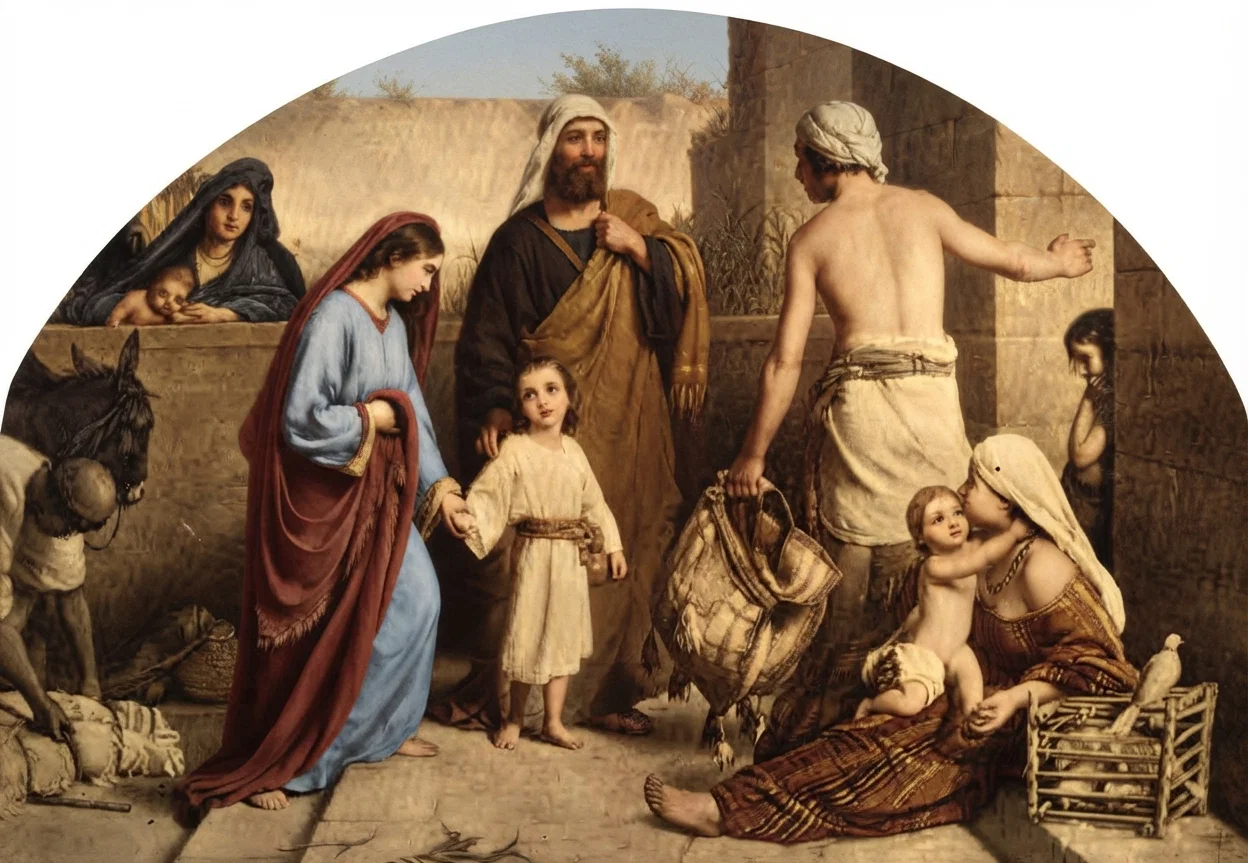
The Child Jesus
THERE is but one sentence in all the Gospels which refers directly to the child life of Jesus. Together Matthew and Luke tell of His birth, of the worship of the humble shepherds, the circumcision of the Boy at eight days of age, His presentation in the temple, the prophecies of the aged Simeon and Anna, the adoration of the
Magi, the flight into Egypt, and the return to Nazareth of Galilee to the home of Joseph. Then comes the one pregnant sentence regarding His childhood days, "And the Child grew, and waxed strong, filled with wisdom: and the grace of God was upon Him." Luke 2: 40.
THE place where our Lord spent His childhood and youth was most favorable. He was born of the Jews, a preeminently religious people, possessed of the books of God's revelation, and with a wealth of tradition of His dealings with them providentially. His early life was not spent in Jerusalem nor in Judea, dominated as this section of Palestine was with a hollow, su-
perstitious, hypocritical, narrow pharisaism, and set over against that was the wickedness and immorality of the Romans. The parents of Jesus were simple, hard-working people in an ordinary Galilean village, where the best type of Judaism prevailed. The Holy Scriptures had taken stronger hold of the simpler, freer Galileans, and the traditions of the rabbis and doctors had less power with the people.
THE education afforded the children of the time was excellent. It began in the home, and was supplemented by the Levites in the synagog schools. It is generally agreed that the Holy Scriptures were made the basis of education up to the age of ten years. The education was therefore deeply religious. The sacred books were faithfully taught according to the instruction given in Deuteronomy 6, and the teachings and revelations committed to that people faithfully carried out. Jesus probably learned these at His mother's knee, who in faithfulness met the task which God had imposed upon her. This education included the whole Old Testament canon. Whether or not He attended the synagog schools the Scriptures do not tell us; but He learned in His study of the Scriptures, in all probability, the Hebrew, the Greek of the Septuagint, and the language of common conversation among the Jews, the Aramaic.
HOME LIFE AT NAZARETH
W. C. T. Dobson
THE education of Jesus did not include the barren, speculative philosophies of India, Greece, Egypt, or Rome. Doubtless these philosophies may have good things, but the good things were perverted by the false. It has been truly remarked that in morals and religion Judaism was to be the teacher,
not the taught. The education of the world's Teacher in His childhood was therefore drawn from the revelations of God's will through the Old Testament. He learned of Adam in his paradise home, of the fall of man, of the Deluge, of the confusion of tongues at the tower of Babel, of the call of Abraham, of the bondage in Egypt. In His childish receptivity He saw the great deliverance, witnessed the great Red Sea and the Jordan open, stood before the cloud-enswathed mountain, and amidst the reverberations of thunder, the flashes of lightning, and the roar of furnace heard the Ten Words of the great Decalogue. He saw the wonderful organization and order of Israel's4camp, and in the midst of that camp the pillar of cloud by day and pillar of fire by night, leading God's host to victory.
THEN, too, the Boy learned from nature. It has been said that the very configuration of Palestine was ordered of God, that it might be used in the greater enforcement of His revealed truth. From the snowy heights of Hermon to the Dead Sea there were lessons. Mountain and valley, tree and flower, from the cedar of Lebanon to the lily of the valley, had been enshrined in Hebrew literature and had been made teachers in religious things. Through them all God spoke to the heart of the receptive Child.
ANOTHER great fact in His education was a trade. Jewish children were not trained to a life of idleness, shiftlessness, worthlessness. The Jews possessed the splendid custom of teaching each one a trade. What a blessing it would have been if the peoples who know the Bible had followed the custom! Whether the future man ever uses the trade in after-life or not, its acquirement has taught him the use of hand and eye, the proper proportion of part and whole, the discipline of restraint and labor, the strength and manliness to overcome difficulties, to deny self for duty, and to make even weariness a delight and accomplishment. And we may be sure, as the Child wrought at the little tasks given His untrained fingers, or walked with His mother in the clear starlight of Galilee, or sat at the frugal meal, He was taught diligently by precept and example the great truth of God's law as inculcated by Moses, the man of God. In this way the Child Jesus grew and waxed strong, filled with wisdom, or, literally, becoming filled with wisdom as He grew, and the grace of God was upon Him. A demonstration of this we have in the later record of His boyhood and young manhood.
BUT what a lesson is here for parents! What mighty opportunities for God go unimproved, what trifles take them from the most important education of their children, the moral and religious! They are willing that the child mind shall be filled with folly indescribable, building into the fiber of its character gross perversions of great moral truth, and utterly wrong conceptions of the object of life, and the fruitage is seen in the multiplying hosts of perverted boyhood and young manhood of our schools and cities of to-day. The training of the child begins on the part of the parents before he is born, and especially with the mother, and should be begun with the child from the moment of its birth. In the injunction, "Train up a child in the way he should go," the word "train" means to narrow, to confine, to dedicate to that way. The Hebrew word is rendered "dedicate" in Deut. 20: 5. If it was important that a man dedicate to a holy family use for God his house, how infinitely more important it is that parents should dedicate their child to God, and do all in their God-given powers to hold him to that way! We do not mean by this as to trade, pursuit, profession, but as to moral purpose and character, and let that character glorify God and manifest their devotion in whatever honored vocation of life he may choose. Parents and teachers may study with infinite profit the education taught by the Book and demonstrated in the life of the Child Jesus.
W.
The Rev. Dr. G. L. Tufts on the Sabbath Question
By Editor
WE do not particularly refer to Dr. Tufts as a man, or personally, but simply because he stands as a representative man regarding the Sabbath question. He is an accredited secretary of the Lord's Day Alliance, having its headquarters in New York City. Dr. Tufts is a secretary of that Alliance for California. He is strenuously working to secure a Sunday law in this state. He endeavors to back up his demands for a Sunday law by Scripture, and is therefore speaking throughout the state on the various phases of the question.
Sunday night, June 30, he spoke at a union meeting of the St. Helena Protestant churches in the Methodist church, and our quotations which we may make here are from a verbatim report taken at the time. We wish to note two points in this article: First, the speaker declared that "the Sabbath is an institution, and not a day, and can be applied to any day of the week." He says, "If it is especially blessed of the Lord and made a holy day it becomes a holy Sabbath." Further he says:
"There is no such language in all God's Word commanding you and me to keep the seventh day of the week as a holy day, and as the Sabbath day, and those who so teach are simply reading into this law language that is not there, such as no court would allow; and so I say, in no place, from the beginning of Genesis to the conclusion of Revelation, is it commanded men that they shall keep the seventh day of the week, that is, the day we call Saturday in our common language, as our sacred day, our holy day, the day in which we must meet in order to worship, if we keep God's commandments."
Now in the first place, the Sabbath is of the Lord's institution. The record of that institution is given in Gen. 2: 2, 3. It tells us that the great and all-wise God deemed it necessary to take three distinct steps in the making, or instituting, of the Sabbath day: He rested on that day, He blessed that day, He sanctified, or set apart that day. He did not rest on no day in particular; He did not bless no day in particular; He did not sanctify no day in particular. That, in the very nature of the case, could not be done. He rested on a particular day; and just as long as facts remain facts, it is true that God rested on the seventh day of that septenary cycle which we call the week, and the day upon which He rested He blessed and sanctified. And there it stands, and forever will stand, until we shall have His word that He has removed the blessing and the sanctification from it.
That that day was the seventh day of that cycle, He demonstrated, according to the record in the 16th chapter of Exodus, by a threefold weekly miracle for forty years, showing that only one day of the cycle—not any day of the cycle, but one day only—could be observed as the Sabbath; and when men who seemed to have the same idea that Dr. Tufts has, that any day would do just as well, went to gather manna on that day, the Lord said to them: "How long refuse ye to keep My commandments and My laws? See, for that the Lord hath given you the Sabbath. . . . So the people rested on the seventh day."
When God spoke His eternal law from heaven, not simply for Jews but for all, He placed a command guarding that day in the very heart of that law, so that men must pass over three eternal barriers of moral precept on the one side and six on the other, before they could get to that Sabbath commandment to change it. He declared in that commandment: "Remember the Sabbath day, to keep it holy. Six days shalt thou labor, and do all thy work: but the seventh day is the Sabbath of the Lord thy God," and then the law refers to the institution of the Sabbath as the proof of its setting apart. See Ex. 20: 8-11.
Note that the Lord does not command, Remember the Sabbath day to make it holy, but "to keep it holy." Man in God can keep holy what God has made holy, but man can not make holy that which God has not made holy. Now the commandment does not say, "The seventh day of the week," but the Scriptures of truth, inspired of the Spirit, fix it so clearly that no court would have any trouble whatever in deciding that the "seventh day" of the law meant the seventh day of the week. We read in Matt. 28: 1, "In the end of the Sabbath, as it began to dawn toward the first day of the week;" and in Mark 16: 1, 2, "And when the Sabbath was past, . . . very early in the morning the first day of the week." What do we learn from this? — The simple fact that the Sabbath comes just before the first day of the week, and therefore it must be the seventh day of the week according to the Scriptures. And that Sabbath, the seventh day of the week, was, according to Luke 23: 56, "the Sabbath day according to the commandment." Therefore the inspired comment fixes the Sabbath to the seventh day of the week. No one contends that there must be an absolute meeting together in order to keep that day holy. The day is to be kept holy to God.5Secondly, Mr. Tufts, leaving the thought that any day is holy, or that the Sabbath commandment applies to any day, says:
"And it is a fact, a notable fact, that Jesus, after His resurrection, appeared only upon the first day of the week, so far as the record goes; that is, of the ten appearances of our Lord to His disciples, six of them at least were upon the first day of the week." "Paul taught very clearly that they were to come together on each first day of the week, literally translated, and bring their offerings to God as the Lord hath prospered them; and so in many of the passages throughout the New Testament after the resurrection of our Lord we find it indicated that it was this day, the day of the resurrection, the greatest day in the life of Christ on earth, that the disciples met for their worship."
One can but wonder if Dr. Tufts presumed on the ignorance of his audience regarding these loose and reckless statements. The first day of the week is mentioned just eight times in the New Testament. Six of those times it refers to the one day, the day on which Christ rose from the dead, the day in which He tried to convince His disciples that He was indeed risen.
These six passages, to the reader who is interested, are as follows: Matt. 28: 1; Mark 16: 2, 9; Luke 24: 1; John 20: 1, 19. All these passages refer to that same first day. The disciples did not meet together on that day, not until the day had drawn to a close, and they all met in their common abode. Acts 1: 13. They were disturbed, distracted, divided, confused, perplexed, over the reported resurrection of Jesus. One or two of them may have believed that He was risen from the dead. Some had heard from the women that He had risen. But in a general way all of them were unbelieving. Our Lord did not meet with them until the evening of that day, really when that day had passed according to Bible reckoning, for the day begins at sunset; and then He "upbraided them with their unbelief and hardness of heart, because they believed not them which had seen Him after He was risen." Two other disciples journeying to Emmaus, seven and a half miles from Jerusalem, on that day, tell Jesus Himself of their disappointment in His death: "We trusted that it had been He which should have redeemed Israel: and beside all this, to-day is the third day since these things were done." And He tells them that they were "fools, and slow of heart to believe." But after making Himself known to them He leaves them, and they go back to the disciples, who are met together in their common abode, and tell them that they have seen the Lord; and Jesus then appears, but "they were terrified and affrighted, and supposed that they had seen a spirit." Luke 24: 37.
To use such passages as these about the amounts given concerning that first first-day, in which our Lord was endeavoring to assure His disciples that He was risen, as evidence that that day was a sacred day, it seems to us is an utter misuse of the words of Holy Writ. Everything indicates it was a common, ordinary, secular day, and the disciples so understood it, and our Lord did not even give it the semblance of a sacred day by calling His disciples together upon that day, but met with them after the day was over, and reproved them for their unbelief.
Mr. Tufts says that there are many passages "throughout the New Testament after the resurrection of our Lord," where "we find it indicated that it was this day, the day of the resurrection, the greatest day in the life of Christ on earth, that the disciples met for their worship." There is one passage, only one, in the whole New Testament, that records a religious meeting on the first day of the week, and that was the evening of that day, which, according to Bible reckoning, was our Saturday night. The record is found in Acts 20, and the day is mentioned in verse 7. The rest of that day was spent in ordinary, common labor, in travel. That meeting would probably not have been mentioned at all had it not been for the noted miracle which Paul wrought on that occasion. One record of a meeting is certainly a very slim foundation for first-day sacredness.
The only other time that the first day is mentioned in the New Testament is 1 Cor. 16: 1, 2, and there a secular duty is enjoined. Paul asks the churches to "let every one of you lay by him in store," "upon the first day of the week," that there be no gatherings when he should come. Every translation that we have examined carries the idea that that laying by was not in a general assembly of the people, in a general contribution-box or plate, or church treasury, but by himself in his own house. After the Sabbath was over, and the week’s expenses were in the past, the man could better tell what he could spare for the poor at Jerusalem.
These scriptures, Mr. Tufts would have us believe, lay a foundation for first-day sacredness, or first-day observance. And in the four pages of manuscript of his talk before us he has no better argument. Let the reader found his faith in the Word of God and in the example of our Lord Jesus Christ.
Chains of Association
ONE thought suggests another. One thing brings to mind some other thing. Some familiar time or place recalls something associated with it. Home is made dear by its old associations.
Following this mental law, two Scotchmen returning to California from their native land longed to take something from the old associations. One carried with him the thistle, the other the honey-bee. And thus some parts of California became infested with thistles and blessed with honey-bees.
An Englishman sailing for New York wished to continue the old association of the little brown sparrow hopping about his door. In this way the little creature was introduced into America.
Christ used this mental law in the prophecy of the betrayal by Peter. He said that before the cock crowed twice, Peter would deny Him thrice. In making the prophecy, He showed with what minutiae divine Providence foresees and prepares. But more than that, the denial was associated with the crowing of the cock. And when the whole incident came out just as Christ foretold, it helped Peter to remember and recover himself. As the cock crowed the second time, by the law of association, he turned his eyes upon the Christ. Jesus at that psychological moment was looking in sadness but in love at Peter.
The sacrament of the Lord’s Supper is based upon the same mental law. We have had associated for us by the Lord Himself the bread and wine with His body and blood. As we in solemnity see the first, we think of the last. We are taught by the association. We are reminded of the higher by means of the lower. Thus we mount by the steps of the tangible up into the home of the spiritual.
On the same principle the Sabbath institution is founded—six days of labor and one day of rest to remind us of the six days of creative work in the first week of time and the ensuing rest on the part of the Creator. As the day weekly recurs, by its association it reminds us of the One who has the power and wisdom and goodness to provide ever for His creatures, because of what He did on that first cycle of time.
The law is a broad one, and has many incidents in every life to show its power and universality.
Once a convict was converted by seeing a piece of matting of the same pattern as that in the little church in England where he worshiped with his mother when a boy.
An outcast, seemingly, is abandoned to vice and sin. She meets a child carrying a bunch of cowslips, violets, and lilacs. Old associations visit the memory. A tender chord is touched. Her innocent past comes back. Overpowered by the contrast, conscience is awakened, and reform follows.
As I sat one evening in my living-room, studying my Bible, with my mother near, in a city in the Middle West, a drunken man came into the room. He wanted a dime, and in return offered to clean my hat. It was nine o’clock at night. I gave him my hat, and he stooped over it and began his work. Suddenly he burst into tears. Then he told of how once he had earned money—not by cleaning hats; of his opportunities; and of his dear old mother,—all called to mind by the associations of the moment. "Money, tho," he exclaimed, "isn’t what I want."
A slave to drink, from a family of wealth and influence, himself a graduate from an Eastern university, he had disgraced himself and his family. But there was still hope and welcome waiting him in the old home.
He explained that the son and the mother sitting in the quiet and happiness of the room had called to him in an irresistible manner. He would change his life. He would write to his mother. He would go home.
What a bond associations become to uplift or to degrade!
Sin associated with anything makes it a sacrament, so to speak, of evil. Good associated with anything makes that a sacrament of holiness.
Good associations will bring to us no whisper of aught that is evil. All life will be a sacrament of God. What an ideal! O that we may attain to it!
But some men can not even smell the odor of yeast without, through the law of association, being driven to the debauchery of lager-beer. A look, a word, associated with impurity, will drive others into the depths of vice.
What chains we forge when we form associations! Let them all be chains that hold us to the good.
But if we are bound to some low and evil thing, there is a way out.
Christ came to break every yoke, and to let the oppressed go free.
He will link you up with all good associations.
The Power of the Received Word
To BE benefited, we must receive the Word. Our way and will must be submitted to God’s way and will as expressed in His Word. We must yield to do His precepts, yield to have His promises fulfilled in us, yield to accept in gladness His warnings, reproofs, and admonitions, and then His Word will come into our heart with the same creative power manifested in the creation of the heavens and earth. In other words, we must empty ourselves of self for Christ’s sake, and Christ, the Life and Light of the world, will come in and fill us with His fulness. Then, instructed by the Spirit through His Word, will His creative power be manifested in facts to the world. Then will the chaos of sin give place to the cosmos of righteousness, and the beauty of the Lord our God born within our hearts will be seen upon us, and all our works will be established. Let the light of Christ into the heart, and it will shine out. Plant the good seed, and water it by the showers of divine grace, and it will bear fruit of itself which will glorify God. Get the principle within, and that will develop all the facts without.