Is the missing link in the conveniences for making nut butter
No nut mill is complete without one. Reduces labor nearly one-half. Will remove the skins and thoroughly clean 15 pounds of peanuts in five minutes. Weight, boxed for shipment, 20 to 25 pounds.
Regular price, $7.50. But in order to quickly introduce these machines, we will make a special introductory price of $5.00.
Good until July 30.
Send money by Post-office Money-Order, Express Money-Order, or Registered Letter. Be sure to write name and address plainly. Address
B. B. NEWMAN, 503 Harrison St., Tampa, Fla.
TESTIMONIALS
TO ALL WHOM IT MAY CONCERN:—
I had the privilege of witnessing B. B. Newman's Peanut Blancher in operation. An ordinary water bucket full of nuts was blanched in about five minutes. The work was thoroughly and satisfactorily done. I can heartily recommend the machine to any who are in need of such an instrument.
243 So. Boulevard, Atlanta, Ga. Respectfully, Jno. A. Brunsan.
For the blanching of peanuts I have never seen anything to equal Newman's Perfection Peanut Blancher. I have seen the skins removed from twelve quarts of peanuts in five and one-half minutes, the work being done perfectly. It is self-feeding and can be operated by a child.
C. P. Whitford. Box 508, Orlando, Fla.
Healing Faults Instead of Hiding Them
If we took as much pains to heal our faults as we do to hide them, they would soon be ended.—Ram’s Horn.
BATTLE OF THE CENTURY
WHY and how the Papacy received the “deadly wound,” and how that wound is now being healed :: A book of eighty pages, paper covers, thirteen illustrations, one colored map :: :: :: :: Price, only Ten Cents
PACIFIC PRESS PUBLISHING CO.
OAKLAND, CAL. :: 11 W. 20TH ST., NEW YORK CITY
18 WEST FIFTH STREET, KANSAS CITY, MISSOURI
“HAS THE JUDGMENT ALREADY COMMENCED ON THE LIVING?”
Is a question often asked. A question which is of the greatest importance to every soul. It is made as clear as day in chapter twenty-three of
GREAT NATIONS OF TO-DAY
This book contains 257 pages, is bound in paper covers, is illustrated with nine original pen drawings and five maps. The price is Twenty-five Cents, post-paid.
PACIFIC PRESS PUBLISHING CO.
*Oakland, California
11 West Twentieth Street, New York City
18 West Fifth Street, Kansas City, Mo.*
Choose Ye This Day.
Presents in an impressive manner the fact that it is ours to choose whom we will serve, and represents what will be the result of our choice. A. G. L. No. 14. 50 cents per 100.
PACIFIC PRESS PUBLISHING CO.
New York City Oakland, Cal. Kansas City, Mo.
CHILD WIVES OF INDIA.
By Georgia A. Burrus
It is the custom of infant-betrothal and child-marriage that entails the greatest amount of suffering upon Hindu women, and is the cause of hundreds of thousands of child widows. Indian custom demands that every respectable family should secure husbands for their girls at the earliest possible age. It frequently happens that girls of seven or eight are given in marriage to men old enough to be their grandfathers. The younger the girl is married the better, and the age of the husband does not matter. The great majority of girls in this country are married before they are twelve years of age, an immense number before they are ten, and many even at a much earlier age. It is said that in Bengal, out of every one thousand girls between five and nine years of age, 271 are married; and that twenty-eight in one hundred are wives or widows at an age when, if they were in Europe or America, they would be in the nursery or infant school.
The immense amount of suffering and disease arising from this cruel custom of child-marriage can not be estimated. What is likely to be the physical condition of both mother and child, when the former herself is but a child of twelve or thirteen, and even more a child in all true knowledge? Think of a child being called upon, at an age when she should be playing with dolls, to undertake the education of children of her own, and perhaps be the mother of a large family before she is twenty years old! It would be marvelous indeed if the young wife were not broken down in health by such a constant physical and mental strain.
At sixteen years of age these wives of India are not so large, strong, or well-matured as most American girls are at ten. A little Hindu girl of ten looks like our girls of five or six. Imagine such a child given over to a man forty or fifty years old, who has neither love, kindness, nor humanity in his heart for her, and who deliberately tortures her to such an extent, that to avoid him she attempts to destroy her own life, as is often the case, by drowning herself in the nearest tank, well, or river, or by swallowing a dose of opium!
The scene that occurs when one of these child wives is sent away to her husband's home is oftentimes heart-rending, and the child tries in every way to delay her departure as long as possible. Child tho she is, she knows only too well the fate that awaits her.
While passing along the street one day, my attention was attracted by the piercing screams of a child whom a number of people were trying to get into a closed conveyance. On inquiring the cause of the disturbance, I was told that the child had been married and was being sent away to her husband's home. The child was clinging to her mother's feet, and imploring in heart-rending tones, “O mother, mother, don't send me away from you. I can not go there; I will die if you send me away.”
Mothers have said to me, “Mem, it breaks our hearts to part thus with our children; but what can we do? It is our fate. God has made us women. We must submit.”
Surangini was the joy of her mother's heart, and the brightest, happiest girl in our school. At the age of ten she was married, and shortly after was sent away to her husband's home. Think what a prospect for a little girl, taken away from her parents and playmates, handed over to a man old enough to be her father, whom she had never seen, wholly at the mercy of an unknown mother-in-law, who in all probability will find nothing but fault with her, and punish her in the most cruel manner imaginable. And in all her trouble, no sympathizing friend to whom to turn, no ear to listen to her grief. No wonder the poor child dreaded it; but there was no help for her, for after marriage there is no place on earth for a Hindu woman but her husband's home, and the only salvation for her is to live and die under his roof.
In a few months' time Surangini returned for a visit to her mother, and the change that had taken place in the bright-faced, happy girl was heart-breaking. Child tho she was still in years, her childhood was past forever. Never can I forget the sad, hopeless look on that child's face, as her mother related to me the story of her suffering, and the abuse she received in her mother-in-law's house.
As I write these lines, I have just returned from a visit to one of these child wives, with one of our nurses. Three months ago this girl gave birth to her second child, the elder being now three years old. Since that time she has never known a well day; and in all probability, if she recovers at all she will be an invalid for life.
One mother said, when asked if she had any children, “I had one little girl, but she died one week after her marriage; and I am so glad she is dead, for now she can suffer no more.”
I do not say that all Hindu wives are thus mistreated. There are Hindu men and women whose hearts are tender and kind; whom to know is to love and respect. There are good mothers-in-law, and homes where little-girl wives are loved and treated tenderly; but for every one such home there are ten thousand of the character I have described.
Calcutta, India. GEORGIA A. BURRUS.
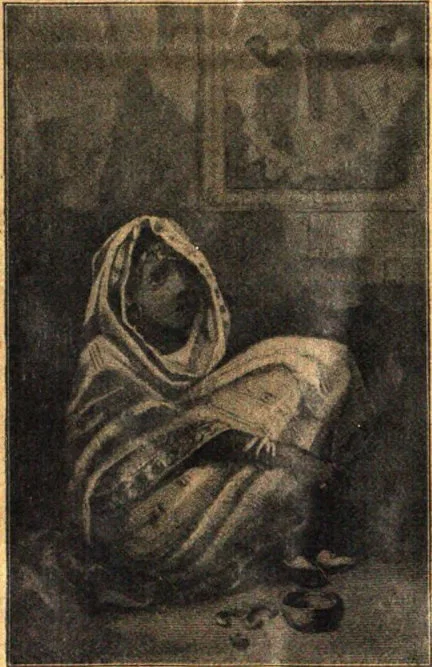
A Child Wife.
A Bride of Eight.
“They beat me when I cried for my mother.”
MISSION WORK IN THE NEW HEBRIDES.
By John G. Paton
FORTY-TWO years ago I found myself in the South Sea Islands. The natives were cannibals with no knowledge of the love and truth of God. Five missionaries had preceded me. The first two were killed and eaten by the savages, and the other three killed by them. My own life was attempted some thirty or forty times, until at last there was no hope of maintaining our ground, and only by escape could we hope to save even our life for future service for the Master.
On one occasion Mr. Mathewson, a missionary, and his wife, sent word to me that they were without English food, weak, sick, and dying, and unless I could get to them they must perish. I could get no one to go with me, the dangers were so great. I sent some food by natives, and afterward went to inquire about it, when the chief seized his club, and threw a stone at me. It did not strike me, and I rushed to him, and threw my arms about his neck. He brandished his club, but my head being so close to his head prevented the club striking me.
These are the times when we need a personal Saviour—a living Christ with whom we walk from day to day. We missionaries must believe in prayer, and in answer to prayer. We have no police to fall back upon, no government there. And we need none; for Jesus has “all power in heaven and in earth,” and He can make all things, animate and inanimate, serve His purpose.
I escaped from this island, and returned home, where by God’s blessing I obtained a new vessel and six more missionaries for the work. I then returned to the island with them; and the natives were astonished. They said: “How is this? We stole all he had, and he laid one after another of his own in the grave. But he returns with more. There is no need to come to trade, but to talk of13worship. If their God gives them blessings we have not, let us hear all about their God, and by and by we may worship Him, and He may give us after a while the blessings He gives them.”
We occupied new ground there, and the work has been going ever since. One white missionary has been murdered since that time.
These islands number thirty in all, and are supposed to have a population of from 80,000 to 100,000. They are not annexed to any country, are under the control of no government, and are therefore the hunting-grounds for traders seeking cheap labor traffic.
When we go to these islands, we have not a word of their language. We look at each other, make signs, and smile. So we meet, and so we part. When I first went there, I used to listen to the sounds and compare the circumstances, in order to try to understand what was meant by the various sounds. One day I saw two men coming up. One lifted something, uttering certain sounds. I thought it was intended for the query, “What is this?” I then picked up something and repeated what he had said. They were much pleased, and answered me. By asking, “What is this?” and pointing to various objects, I began to get an introduction to their language by their replies. After a while we began to put it into written form; a most difficult task, but so necessary.
We can do nothing among them until we first give them a portion of God’s Word. It moves the human heart as nothing else can. They always ask, “Is that your word, or the Word of Jehovah God?” If it is our own advice, it goes for nothing; but if we say it is the Word of Jehovah God, there is no opposition.
The first conviction is that God is their Creator, and in consequence they are responsible to Him. As soon as they get such a conviction, they fear Jehovah, and have a dread of doing anything that would displease the great God. For this reason we try to get portions of Scripture into their own language. Thus we teach them to read and understand the Word of God in their own tongue. As soon as they become acquainted with it, their minds become changed, cannibal traits are laid aside, and they imitate the missionary in everything, and so come to consecrate their hearts and lives to God. We now have twenty-two languages [in the New Hebrides] reduced to written form, in which we have printed at least portions of the Word of God.
The more we study the Word of God to give the true translation to the natives in their own tongue, the more convinced are we that it is the inspired Word of God, from the first verse of Genesis to the last of Revelation. We missionaries accept the Scriptures on their own divine authority. “Thus saith the Lord!” “The Lord spake unto Moses;” “The Lord said unto Samuel!” and “Holy men of God spake as they were moved by the Holy Ghost,” is quite enough for us. Jesus Christ also witnessed to its inspiration: “One jot or one tittle shall in no wise pass from the law, till all be fulfilled.”
If you want a new evidence for the inspiration and power of the Holy Book, you have it in the mighty results of its teaching. Look at the heathen everywhere; they seem tired of their idolatrous worship, superstitions, and bloody rites, and they desire something more satisfactory and enduring, which can only be secured by the Word of God. That statement, “And I, if I be lifted up, will draw all men unto Me,” is being fulfilled more than ever to-day. It has not become antiquated, but it still “is the power of God unto salvation to every one that believeth.”
There still remain at least 40,000 cannibals whom we have never yet reached. If I had Scripture to believe that without the Gospel the heathen would be saved somehow, I would not face such difficulties. But the Word says distinctly, “Where there is no vision, the people perish.” JOHN G. PATON.
THE FATHER'S PITY
By Margaret E. Sangster
Thru woof of gloom and sorrow,
Thru warp of pain and tears,
There flashes bright a silver thread
Amid the flying years;
For as the Father pities
The children of His love,
So, with compassion failing not,
God watches from above;
And sees our need and weakness,
And not in vengeful wrath
Sends down the dark calamity
That blocks the tangled path;
But ever wise to guide us,
And ever full of love,
A Father's tender pity seeks
To draw our thoughts above.
Life hath its desert shadow,
Its interspace of tears;
And yet a sunburst often breaks,
And scatters swift our fears;
For as a father pities
The children of his love,
So God, our Father, watches us
With pity from above.
Our feeble frame He knoweth,
Remembereth we are dust;
And evermore His face is kind,
His ways are ever just.
In evil and in blindness,
Thru darkened maze we rove,
But still our Father leads us home,
By strength of mighty love.
—Margaret E. Sangster.
The Joy of Living
“O GIVE me the joy of living
In the world where God lives, too,
And the blessed power of giving
Where men have so much to do;
Let me strive where men are striving,
And help them up the steep;
May the trees I plant be thriving
While I sleep.
“On the fields of the Master gleaning,
May my heart and hands be strong;
Let me know life's deepest meaning,
Let me sing life's sweetest song;
With some faithful hearts to love me,
Let me nobly do my best;
And at last, with heaven above me,
Let me rest.”
Scholarship Offer.
By Editor
A LARGE number are inquiring about our scholarship offer, and several who have entered upon the work of securing the scholarship are having success.
Our offer in brief is this: For 100 new yearly subscriptions to the SIGNS OF THE TIMES we will give free board, room, and tuition for a school year in any of our colleges or academies.
We will be glad to hear from any who desire to attend college. Send for our leaflet giving full particulars of our scholarship offer. Address SIGNS OF THE TIMES, Mountain View, Cal.
OUR WORK AND WORKERS.
Dr. J. H. Kellogg arrived in this city on the 18th ult., and spoke three times at the workers’ institute which followed the camp-meeting.
AN audience of 600 men recently listened to a discourse by Brother J. F. Bahler in the penitentiary at Huntsville, Texas. He and his wife distributed a large number of tracts, which were gratefully received.
A SECOND church has been organized in New York, the charter members being former members of the first church. The meeting place is at Eighth Avenue and Twenty-third Street. This forms another nucleus for the ingathering of souls.
BROTHER E. E. MILES reports in the New England Gleaner that he has just received a letter which “tells of eleven persons having received the truth, directly or indirectly, as the result of the selling of one book by a New England canvasser, and these eleven persons were in seven different families in five States.”
THE Gospel Herald, published at Nashville, Tenn., as a missionary paper for the southern field, has been materially enlarged. It is an eight-page monthly, issued at the low rate of 25 cents a year. A fund is being raised for its circulation in the field for which it is designed. Address Southern Missionary Society, 1025 Jefferson Street, Nashville, Tenn.
MRS. C. C. LEWIS, of Keene, Texas, says in the Reporter, that “the library committee of Cleburne has given us a book case, and asked us to fill three shelves now, and after that we can put in as many books as we wish. We must fill three shelves as soon as it is open, to hold the case. The cases have been ordered, and they are expecting them to come every day. The brethren at Keene have responded very liberally, and have donated 59 books. The cases hold from 10 to 30 books according to the size of the books.”
THE illness of our workers in Matabeleland, Africa, is a matter of sorrow on the part of their brethren and friends. Brother F. L. Mead writes to the Missionary Magazine that he has had three attacks of fever. His son Walter has had two, and his wife and daughter each one attack. The only ones who have escaped are Brother Chaney and Sister Green. Even the natives are having the fever. The mortality was so great among the people of Buluwayo that the undertakers were unable to take care of the dead promptly. It is gratifying to know that our people were likely to all recover. Their hygienic manner of life no doubt greatly aided them in the battle with the dread disease.
TO THE Advocate of Christian Education Brother T. B. Buckner writes from Montgomery, Ala.: “Our school for colored children, which began its second school year October 1, with forty-five pupils, has since increased to sixty-eight. Several applicants have been refused for lack of room to accommodate them. We are fitting up another room, expecting an assistant teacher. Brother W. G. Buckner, and friends, of Hanford, Cal., have sent us several hundred pounds of nice fruit, for which we are very thankful. We ask our friends in the North and East to help us out in any way they desire,—with clothing, or beans, or any other produce. All can be used to help the poor children and their parents. Please prepay all freight charges clear thru.”
THE good camp-meeting in this city closed with a grand social meeting early Monday morning, the 17th ult. From first to last it was an extraordinary occasion, even the business meetings manifesting much of the presence of the Holy Spirit. The camp occupied two large blocks of ground, a public street with double car-line passing thru the center. Many times the large pavilion was packed to overflowing, while side-meetings in a half dozen smaller meeting tents were almost continuous. On Sunday, the 16th, fifty persons were baptized in the baptistry of the Oakland Church. About twenty others were accepted for baptism, deferring the ordinance until arriving at home. It was decided to divide the conference, and form a new conference in Southern California. This new organization will be effected at a meeting to be held in Los Angeles in the fore part of August. A committee was appointed to effect a division of the conference property. Officers of the existing conference were elected as follows: President, Alonzo T. Jones; Secretary, M. H. Brown; Treasurer, Pacific Press Publishing Co.; Executive Committee, A. T. Jones, M. H. Brown, J. O. Corliss, M. C. Wilcox, M. C. Cady, T. J. Evans, C. N. Martin, W. C. White, H. G. Thurston. An institute for the benefit of all classes of conference workers, continuing two weeks, was held on the camp-ground at the close of the main meeting.
Limp Leather Edition
By Editor
THE UNEXPECTED DEMAND for Testimony for the Church, Vol. 6, in limp leather, has exhausted our stock, but another edition is being hurried through, and will be ready shortly.
The above prices include prepayment of postage, but there will be no further discount allowed, as the proceeds above cost of publishing and handling are for the relief of the Christiania Publishing House.
Address Your TRACT SOCIETY
THE FRONTISPIECE IN
Christ Our Advocate
gives a bird's-eye view of the tabernacle as it was pitched in the wilderness, and the relation of each of the twelve tribes to it :: This in itself will be a great help to both teachers and students of the present Sabbath-school Lessons on the sanctuary :: Price of pamphlet complete, Ten Cents
Pacific Press Publishing Company
Oakland, Cal. :: 11 W. 20th St., New York City
18 West Fifth Street, Kansas City, Missouri
THE PROPHETIC GIFT IN THE GOSPEL CHURCH.
For nearly fifty-six years ‘the spirit of prophecy’ has been manifested through Mrs. E. G. White. Those who have for a long time been in the truth are quite intimately acquainted with the workings of this gift. But many who have come into the truth in the last few years know little about it, and some hesitate to accept it as from the Lord. Others who have not yet fully accepted the truth are inquiring into these manifestations and desire to read something which will give them the information they seek. All of these classes will, therefore, welcome Elder J. N. Loughborough’s new pamphlet, entitled The Prophetic Gift in the Gospel Church. Elder Loughborough has been privileged to see Sister White in vision nearly fifty times, during an acquaintance of forty-eight years, and writes of what he knows. In this book are given nine points of similarity between Mrs. White’s visions and those described in the Bible; six points of comparison in the practical work of true visions; and lastly, seven rules for discerning true prophecies. Thus twenty-two Bible tests are brought to bear on the visions, and the results of his investigations are fully given. The Prophetic Gift in the Gospel Church is issued as No. 104 of the Bible Students’ Library. It contains 118 pages, and the price is fifteen cents. It is now ready. The general interest in this subject ought to insure the booklet a wide circulation.
Golden Text.—“In the beginning God created the heaven and the earth.” Gen 1:1.
26 “And God said, Let us make man in our image, after our likeness; and let them have dominion over the fish of the sea, and over the fowl of the air, and over the cattle, and over all the earth, and over every creeping thing that creepeth upon the earth. 27 And God created man in His own image, in the image of God created He him; male and female created He them. 28 And God blessed them; and God said unto them, Be fruitful, and multiply, and replenish the earth, and subdue it; and have dominion over the fish of the sea, and over the fowl of the air, and over every living thing that moveth upon the earth. 29 And God said, Behold, I have given you every herb yielding seed, which is upon the face of all the earth, and every tree, in the which is the fruit of a tree yielding seed; to you it shall be for meat; and to every beast of the earth, and to every fowl of the air, and to every thing that creepeth upon the earth, wherein there is life, I have given every green herb for meat: and it was so. 30 And it was so. 31 And God saw everything that He had made, and, behold, it was very good. And there was evening and there was morning, the sixth day. 1 And the heaven and the earth were finished, and all the host of them. 2 And on the seventh day God finished His work which He had made; and He rested on the seventh day from all His work which He had made. 3 And God blessed the seventh day, and hallowed it; because that in it He rested from all His work which God had created and made.”
SUGGESTIVE QUESTIONS.
(1) After what image did God propose to make man? What exalted position was man to have? Verse 26. Note 1. (2) Besides creating man in the image of God, what other feature is mentioned? Verse 27. (3) What did God do for the man and woman as soon as they were created? What did He say to them? Verse 28. Note 2. (4) What provision was made for the man’s food? Verse 29. (5) What was given to the other creatures for food? Verse 30. Note 3. (6) What was the condition of everything that was made? On what day was the work completed? Verse 31. Note 4. (7) Was there anything created besides the earth? Ch. 2:1. (8) What did God do on the seventh day? Verse 2. Note 5. (9) What did God do for the seventh day after resting upon it? Verse 3. Note 6.
NOTES.
1. Image of God.—An image implies a similarity of form. Likeness usually embodies the same idea, but it is sometimes applied to immaterial things, as traits of character. As man was made “upright” (Eccl. 7:29), we are to understand that he was to bear the image of God both in form and character.
2. Replenish.—Replenish not only means “to fill again,” but it is also defined “to fill to the utmost capacity.” The Hebrew word from which “replenish” is translated literally means to “fill completely,” and some of the very best modern translations render it so.
3. Original Food.—It is very clearly set forth that God did not intend that any creature should live by taking the life of another creature. The man’s diet was to be composed of fruits and grains, and the food of birds and animals of all kinds was limited to vegetable substances. The resort to flesh food was the result of sin, and not of necessity. It will be noticed that after the flood, when flesh-eating was specially permitted by the Lord, the duration of human life was immediately reduced by one-half, and by Abraham’s time it had fallen away to less than one-half of the age of those born immediately after the flood. Again, by the time of the kings of Israel the life of man was only about half the duration of the life of Abraham and Isaac. It would seem that the permission to eat flesh was for the purpose of shortening sinful life, long life in sin having proved a curse to the race. The longer men live in sin, the worse they become. When Israel covenanted to keep the law of God, He gave them manna for food, and had they proved faithful they would have again enjoyed long life; but they apostatized, and demanded flesh food, and again became victims of disease.
4. The days of creation were days marked by the evening and the morning; and the fifth and sixth of these days were measured by the sun. God’s illimitable resources are shown in the fact that the four former days were measured without the sun, but that is no proof that they were any longer than the fourth and fifth days. The sun is not the “source of light,” as some “scientists” claim; it is only a lamp, or light-bearer. Light existed before the sun.
5. “Finish,” in verse 2 (“ended” in the common version), is used in the sense of ceased. God did no work on the seventh day, as we learn from the fourth commandment; hence the command, “In it thou shalt not do any work.” The commandment is explicit, “In six days the Lord made heaven and earth, the sea, and all that in them is.” See Ex. 20:8–11.
6. The Seventh Day.—Thus early in the history of earth the seventh day was especially distinguished from the other days. First, God rested upon it, and enjoyed the contemplation of His great work. That made it different from all the other days, for in them He worked. Then He “blessed” it, and “sanctified” it. Thus He still further distinguished it from other days. In sanctifying the seventh day God set it apart for a holy purpose. He set it apart to be observed because He had rested upon it. By whom was it designed to be observed, or kept holy?—“The Sabbath was made for man.” Mark 2:27. It was made for man when there was but one human pair, the progenitors and representatives of the whole race. God’s way of making a Sabbath is to rest upon it, then to bless it and sanctify it, or make it holy. He never has done this with any other day than the seventh day. The Sabbath was made in the beginning, once for all. It is a memorial institution, designed to cause men to pause and contemplate the wonderful works of God, and to praise Him for His goodness and wisdom and power. When men assume to set up another sabbath, on the plea of a different purpose, we may well inquire, “Who hath required this at your hand?” See, also, article entitled “God the Creator of All Things,” on page 7 of this paper.