Papal Claim to Have Changed the Sabbath—Many Protestants Acknowledge Her Authority—Will Unite to Enforce Her Mark Under Penalty of Death
World-Wide Boycott Predicted
By A. R. BELL
This is the fourth of A. R. Bell’s series of articles on that interesting part of the book of Revelation which forecasts the persecuting power to arise just before the second coming of Christ.
His first article presented the struggles of the church as disclosed in the twelfth chapter of Revelation. His last two articles, together with the one this week, have been studies in the thirteenth chapter of Revelation. These studies in the thirteenth of Revelation tell of the “deadly wound” that was inflicted upon the papacy. They show how that “deadly wound” was to be healed through the apostasy of Protestantism, and how Protestantism in this nation will lead the world in forming an “image” to the beast, and in enforcing the “mark” of the beast, as set forth in the article this week.
His article next week will be the first of three on the fourteenth chapter of Revelation, and will give the view the prophet had of the mighty message of warning that God sends against the great apostasy which will, in this enlightened age, throw conscientious men and women into the cruel persecutions of the Dark Ages.
The dark picture, however, is eclipsed by the glorious hope that the climax which brings an everlasting end to all tyranny comes through the personal appearance of the Lord and Saviour Jesus Christ. EDITOR.
“AND he causeth all, both small and great, rich and poor, free and bond, to receive a mark in their right hand, or in their foreheads: and that no man might buy or sell, save he that had the mark, or the name of the beast, or the number of his name.” Rev. 13: 16, 17.
SHE SWINGS TO THE PAPACY
From a government founded upon the principle that a man’s relation to his God is a matter belonging alone to the man and to his God, and that his right of conscience is inalienable, this nation will identify herself, in both principle and practice, with the papacy; and like the papacy, she will trample liberty in the dust, and force men into bondage.
Notice how this will be done. Men in every station and walk of life will be compelled to receive a mark (verse 16), which we are told, in verse 17, is the mark of the beast. The receiving of that mark will signify that the one receiving it acknowledges the authority of the beast and the image by his obedience to their claim or demand. Thus the claim becomes the mark, or token, of the papacy’s power and authority.
WHAT IS HER MARK?
What, then, is Rome’s claim? What is the mark of her authority and power?
Rome claims to be the true church, all-powerful. She claims to have power over the consciences of men, and to command them under sin. Listen for a moment or two to some of her utterances:
“We declare, say, define, pronounce it to be necessary to salvation, for every human creature to be subject to the Roman pontiff.” — Decretal of Boniface VIII.
“We confess that whatever new thing the pope ordains, whether it be in Scripture or not in Scripture, and whatever he commands, is true, divine, and salvific, and therefore ought to be held by lay people in greater esteem than the precepts of the living God.”
“We confess that the pope has power of changing the Scripture, and of adding to it, and taking from it, according to his will.”—Streitwolf’s “Collection of the Confessions of the Church of Rome.” Göttingen.
“God punishes more severely the disobedience of the rules of the church, than He does for the transgression of His own commandments.”—Priest Mahoney, Spokane, Washington, sermon, April 18, 1914.
Writing of the second coming of Jesus Christ, the apostle Paul said: “That day shall not come, except there come a falling away first, and that man of sin be revealed, the son of perdition; who opposeth and exalteth himself above all that is called God, or that is worshiped; so that he as God sitteth in the temple of God, showing himself that he is God.” 2 Thess. 2: 3, 4.
Surely the foregoing utterances—and they could be multiplied greatly—make the papacy fit the prophetic mold, as that system is represented by its head, the pope.
A prophecy in Daniel, speaking of this same power, says, “He shall think to change the times and the law.” Dan. 7: 25, R. V. And he claims to have done this very thing, and puts the change of God’s law by himself in evidence as proof that he has power to command men under sin. Note the following:
“Q. How prove you that the church hath power to command feasts and holy days?
“A. By the very act of changing the Sabbath into Sunday.”
And the papal power declares that by keeping Sunday, Protestants “acknowledge the church’s power to ordain feasts, and to command them under sin.”—“An Abridgment of Christian Doctrine,” page 58.
In another work, answering this very question concerning the power of the church “to institute festivals of precept,” which, in other words, are “authoritative commands,” she answers:
“Had she not such power, . . . she could not have substituted the observance of Sunday, the first day of the week, for the observance of Saturday, the seventh day, a change for which there is no Scriptural authority.”—“A Doctrinal Catechism,” page 174.
One of their priests, some years ago, lecturing on this matter, declared: “The Bible says, ‘Remember the Sabbath day, to keep it holy.’ The Catholic Church says: No! By my divine power, I abolish the Sabbath day, and command you to keep holy the first day of the week. And, lo, the entire civilized world bows down in reverent obedience to the command of the holy Catholic Church.”
CLAIMS SUNDAY AS THE MARK OF HER POWER
Surely, then, does Rome set Sunday up as the mark of her power. It stands as evidence, on her part, that she has power to change God’s law, and to command men under sin. As the mark of the beast, this institution, Sunday, will be forced upon men by “the image of the beast.” See Rev. 13: 16. The image of the beast, we have seen, is the apostasy of Protestantism in our own land, that will lead this nation to repudiate her principles of civil and religious liberty—the secret of her greatness.
In their proposed “religious amendment to the constitution,” the great Protestant church organizations, as shown last week, want to “set up God’s law,” and have the government “lay its hand on any religion that does not conform to it.” And they have threatened that dissenters “must abide the consequences.” They have interpreted the law of Jehovah. One of their spokesmen said, “In the Christian decalogue, the first day was made the Sabbath by divine appointment.” Of course, this self-appointed “God’s spokesman” has not given us any proof of his statement. Methinks that when he spoke, he expected the people to believe that God spoke, just as the late Priest Phelan, editor of the Western Watchman, speaking of the pope, has said, “What the pope says, is accepted as the word of God.”
PROTESTANTS PROPOSE TO UNITE WITH THE STATE
And what do the men of this great combination propose to do when they get their “religious amendment”? Listen: “We propose to incorporate in our national constitution the moral and religious command, ‘In it (the Sabbath) [meaning Sunday, of course] thou shalt do no work.’ . . . And by external force of sheriffs we propose to arrest and punish all violators of this law.” Instead of winning men from their transgression to obedience to God, they become a spiritual despotism, to drag dissenters before the tribunal of another Inquisition.
And concerning the enactment and enforcement of Sunday laws, they have said that “a mighty combination of the churches of the United States could win from Congress, the state legislatures, and municipal councils, all legislation essential to this splendid result.”
CHURCH AND STATE UNITED THROUGH SUNDAY LEGISLATION
Through Sunday legislation, church and state will be united. Religious bigotry will again arise. Sunday will become the test as to whether or not a man is a Christian. Like the carping hypocrites in Christ’s day, these misguided religionists will cry, “This man is not of God, because he keepeth not the Sabbath day;” and men will suffer persecution in spite of the fact that their daily walk and conversation are in perfect harmony with the law of God, which those same religionists will have professedly incorporated into the law of the land.
True religion carries with it a love unfathomable; but a Sunday law carries with it “bonds and imprisonment.”
“And he spake as a dragon,” Rev. 13: 11. “And he exerciseth all the power of the first beast before him.” Verse 12. “The image of the beast should both speak, and cause that as many as would not worship the image of the beast should be killed.” Verse 15. “And he causeth all . . . to receive a mark; . . . that no man might buy or sell, save he that had the mark.” Verses 16, 17. Here is foretold a boycott, as well as the extreme penalty of the law. In their mad zeal, men will themselves resort to violation of the law in seeking to compel others to be obedient to the law.775
WILL INAUGURATE A BOYCOTT
As evidence that this is in their mind, and that, too, in the very mold in which the prophecy sets it, note the following, as expressed by one of their “God’s spokesmen”: “In the Christian decalogue, the first day was made the Sabbath by divine appointment. But there is a class of people who will not keep the Christian Sabbath unless they are forced to do so; but that can be easily done. . . . If we say we will not sell anything to them, we will not buy anything from them, we will not work for them, or hire them to work for us, the thing could be wiped out, and all the world would keep the Christian Sabbath.”
MAKE SUNDAY THE TEST
Sunday practically is to be the test as to whether or not a man is fit to live. Sunday, the mark of the beast, the institution of “the man of sin,” the counterfeit Sabbath, will be forced upon men. The master hand of the enemy of all righteousness is at work. He inoculated the church with his virus, and the papacy arose. Out from the darkness and tyranny of papal rule came the Reformation, and the founding of this nation. But the end is drawing on. God is preparing a people for the glorious appearing of Jesus Christ. A last supreme effort is inaugurated to overthrow that work and destroy God’s remnant. (See Rev. 12: 17, and the study in the SIGNS of November 23.) Every force at the command of Satan is set in operation to lead the church astray. Worldliness comes in like a flood. Piety and principle seem to be flung to the four winds, and “a form of godliness, but denying the power thereof,” is the outcome. 2 Tim. 3: 1-5. The ways of the papacy are imitated. Forms and ceremonies are on the increase everywhere. Many of the customs and institutions of Rome are incorporated into the Protestant church. She is fallen.
But out of that last apostasy, God calls a remnant. Led, through study of God’s word, to see God’s law as His measuring rod of character in the Judgment, preparation for which they are seeking, they see the binding claim of the fourth commandment as well as the other nine. They see the seventh-day Sabbath, and yield obedience. They see the Sunday sabbath as the institution of “the man of sin,” and turn away from it.
SUPREME CONFLICT JUST AHEAD
Another supreme effort is inaugurated. Another campaign is on. Somehow upon the church dawns the idea that the reason for all the ungodliness that is sweeping her and the world off their feet, is disregard for Sunday. The thing is contagious. A great Sunday movement begins. It carries everything before it, except this remnant who are keeping God’s Sabbath. Their fidelity to God is interpreted as stubbornness. Their faithfulness to principle is called fanaticism. They are the difficulty in the way of the triumph of the church, and are blocking the way to complete Sunday sacredness.
The machinery of the government is called into play. The remnant are charged with rebellion by the government, and as the enemy of God by the church. The realm of conscience is again invaded, and persecution follows.
Dear reader, the struggle is on. The crisis is before us. The Sunday movement, so far as Satan is concerned, has but one object —the destruction of God’s remnant.
MEN DECREE, BUT GOD OVERRULES
But men reckon without taking God into consideration. Men may decree, but a divine Providence overrules. The prophet’s attention is called to another scene. He sees a redeemed host with the Lamb upon Mount Zion. They sing a song that no one but them, either in heaven or in earth, can sing. It is the song of their own experience.
God interferes in the plans and purposes of men. At the very moment of their expected triumph, the Deliverer comes, and God’s remnant are saved from the wrath of men.
The remnant stand the test of the Judgment. There is no guile in their mouth, and “they are without fault before the throne of God.” Kept from the defilement of tradition and error, the unbiblical doctrines of a fallen church, God’s children are shown as virgins, not defiled, and are called “the first fruits unto God and to the Lamb.” And as the special trophies of His grace, they “follow the Lamb whithersoever He goeth.” See Rev. 14: 1-5.
“All These Things Are Against Me”
By C. L. Taylor
By C. L. TAYLOR
READ again the title of this article. Think carefully of every word. “All these things are against me.”
Notice, please, the three principal words,—“things,” “against,” and “me.”
What things are pointed out? Who is “me”? And why are things “against” this “me”?
The story is found in Genesis. It is the story of Jacob. The reader will remember that Jacob’s sons had sold young Joseph into Egyptian slavery, and afterward they deceived their father into believing that Joseph had been slain by wild beasts. He will remember Joseph’s experience, and how, through faithfulness to God, he finally became prime minister in the great world kingdom of Egypt. He will recall the journey of Jacob’s sons when they went into Egypt for bread; and that Simeon was left bound, and the message sent that Benjamin must accompany the brethren on their next trip. The placing of the money in the mouths of the food sacks will not be forgotten.
The brethren have returned to their father. They are telling him of what has befallen them, and that Benjamin must make the next journey with them; and while thus speaking, they find the money in their sacks—a fact which must stamp them all as thieves.
Then it is that the father’s heart breaks. In the agony of his great grief, he cries out, “All these things are against me.”
HIS GREAT MISTAKE
But were they?—Ah, no! He had made a great mistake. He had failed to recognize his Father’s handwriting. He thought he saw the productions of an enemy’s pen.
And seeing only the dictations of satanic agencies, he abandoned himself to sorrow.
This seemed to be Jacob’s experience all his life. When Joseph was first taken from him, he saw nothing but the circumstances of trouble; and turning away from all who would extend sympathy, “he refused to be comforted; and he said, For I will go down into the grave unto my son mourning.” Gen. 37: 35.
WAS THINKING OF HIMSELF
Jacob saw only the visible things. He looked “at the things which are seen.” 2 Cor. 4: 18. And thus it was that his “light affliction” worked not glory, but distress and anguish and darkness.
Listen to his words: “Me have ye bereaved of my children: Joseph is not, and Simeon is not, and ye will take Benjamin away: all these things are against me.” He saw himself, he saw his boys, he saw what had been done, he saw what was about to be done. He was abused, the boys had done wrong, the circumstances were ill, the future promised evil.
But these very things were identical with those which Joseph had been obliged to meet. Yet Joseph met them and saw them in a manner which brought him comfort and edification. He saw in all of them the handiwork of God; and as a result, he went ever onward and upward, daily drinking at the fountain of God’s pleasure, daily assimilating the glory of the divine. Joseph looked at the things776“which are not seen.” He saw God, and was changed into the divine image. To him, those same “all things” worked together for good. Nothing was against him; all was for him.
THE JOY THAT HE MISSED
In after years, Jacob came to see and understand. See Gen. 48: 15, 16. But, oh, how much of joy and peace and satisfaction he had missed! For twenty-two long years, he carried the weight of sorrow over Joseph’s supposed death. He mourned, and mourned, and mourned. For twenty-two years, at least, he counted himself the creature of semi-fate. For nearly a quarter of a century, the tendency of his experience was down rather than up. And all because he could not see God standing in the shadows.
ARE YOU IN SORROW?
My dear friend, are you passing through deep sorrow, and do you feel as did the psalmist when he said, “All Thy waves and Thy billows are gone over me”? Are you almost overwhelmed? If so, just recall that God is keeping watch. Your experiences are His providences. He is always nearest when He seems farthest away.
It is in your time of trouble that you should expect to behold Him. It is while the fire of trial burns most fiercely that He will reveal Himself to you. Look for “the form of the Fourth” (Dan. 3:25) while you are still in the furnace. He will surely indorse your faith.
The greatest joy in this poor sin-cursed earth is that of seeing God during trouble.
What is the message of the handwriting of to-day? Do not hurry. Take time. Pray. If at first your tear-blinded eyes cannot see, let the dear Lord use the divine handkerchief of trust to wipe away the tears, and, reading, you will discover a blessed missive of comfort and consolation.
Things are not against us. Every cloud is big with mercy. Let us be joyful and trustful, and make Rom. 8: 28 our word in every dark hour.
Peace and War
By Mabel Corine Craker
By Mabel Corine Craker
Do you know of a song that to man is so sweet,
Or of one that such comfort its accents can bring,
As that caroled by angels in stillness of night,
When the manger of Bethlehem cradled earth’s King?
Ah, the few lowly watchers on Judah’s lone plain
Stood amazed when the place shone with gildings of
light!
Yet how little they dreamed, as they heard the glad tones,
That all heaven stooped low in the hush of that night!
Yes, the seraphs in glory more tender became,
As their ears caught the theme of that fervent refrain;
For its keynote promulged the Omnipotent One,
And its sequel held peace and good will in its strain.
And though war dip the earth in his caldron of blood,
Though he still the brave hearts that have stood for the
right,
Yet his hand fails to sever the bond which was formed
When our Saviour brought peace in the calm of the night.
Though the billows of strife rage in fury without,
And you long to be free from sin’s weight and life’s care,
Know that Heaven’s attention is instantly gained
When a suppliant pleads for forgiveness in prayer.
He who lives in communion alone with his God,
Daily rests in the peace that o’ershadows his soul.
He well knows that his Captain each breaker foresees,
And has pledged to direct his frail bark to its goal.
Then rejoice, fainting one. There’s no time for distrust.
Soon the King in His glory your gloom will dispel;
And if true to your neighbor, yourself, and your God,
Then in peaceful abodes you’ll eternally dwell.
Strength for Each Day
“WHEREVER in His providence God has placed you, He will keep you. ‘As thy days, so shall thy strength be.’ Deut. 33: 25.”
What Becomes of the Wicked?
By W. A. Gosmer
Will They Burn Eternally in Hell? — They Come Up in the “Second Resurrection”
Satan Marshals Them to Their Eternal Doom — The “Second Death”
A Universe Cleansed, and Rejoicing in Triumph
By W. A. GOSMER
This is the fifth and last of Professor Gosmer’s articles on the relation of man to the question of immortality. In his previous articles, he has shown that the doctrine of the natural immortality of the soul was borrowed by the Christian church from the pagan world, the immortality of the soul being a doctrine universally accepted by all heathen nations of which we have any history. He has shown that the Bible teaches clearly that there is no hope of immortality for the wicked, that the only way in which fallen man may secure an immortal existence is by accepting the gospel of the Lord Jesus Christ. He has presented the Bible doctrine of the resurrection as the great door of hope for those who have fallen asleep in death. His article this week, dealing with the final destiny of the wicked, presents the Bible teaching upon the subject, and logically follows the articles that have preceded.
EDITOR.
FROM the Scriptural proof presented last week, it must be unmistakably evident that “there shall be a resurrection of the dead, both of the just and unjust.” Acts 24:15. The question naturally arises, What will become of the unjust—the wicked? “The righteous shall inherit the land, and dwell therein forever” (Ps. 37:29), according to the promises of God to the fathers. Gen. 15:14-17; 26:3; Heb. 11:9-16. The earth, re-created, cleansed, and purified, will be the happy abode of those who in this life become heirs of promise through faith. Rom. 4:16. But “where shall the ungodly and the sinner appear?” 1 Peter 4:18.
THE RIGHTEOUS RESURRECTED
Like everything else in God’s great plan, the fate of the lost has its proper setting, its time and place. Stated in regular order, the events immediately preceding the destruction of the wicked are, the second advent, the first resurrection, the translation of the living righteous, the millennium and the judgment of the wicked, and the second resurrection.
At Christ’s second coming, “the dead in Christ shall rise first.” 1 Thess. 4:16. “This is the first resurrection. Blessed and holy is he that hath part in the first resurrection: on such the second death hath no power.” Rev. 20:5, 6.
The first resurrection has to do only with “the dead in Christ,” the righteous. The wicked shall be slain “with the brightness of His coming.” 2 Thess. 2:8. “The slain of the Lord shall be at that day from one end of the earth even unto the other end of the earth: they shall not be lamented, neither gathered, nor buried.” Jer. 25:33. But they are not then finally destroyed. For a thousand years following the second advent of Christ, the earth lies waste. Darkness and desolation reign supreme. See Revelation, chapter 20.
THE MILLENNIUM SPENT IN HEAVEN
During this millennial period, the saints are with Christ in heaven, sitting in judgment upon the wicked dead and the fallen angels. Says the record: “They lived and reigned with Christ a thousand years.” “And judgment was given unto them.” Rev. 20:4. “Do ye not know that the saints shall judge the world?” “Know ye not that we shall judge angels?” 1 Cor. 6:2, 3.
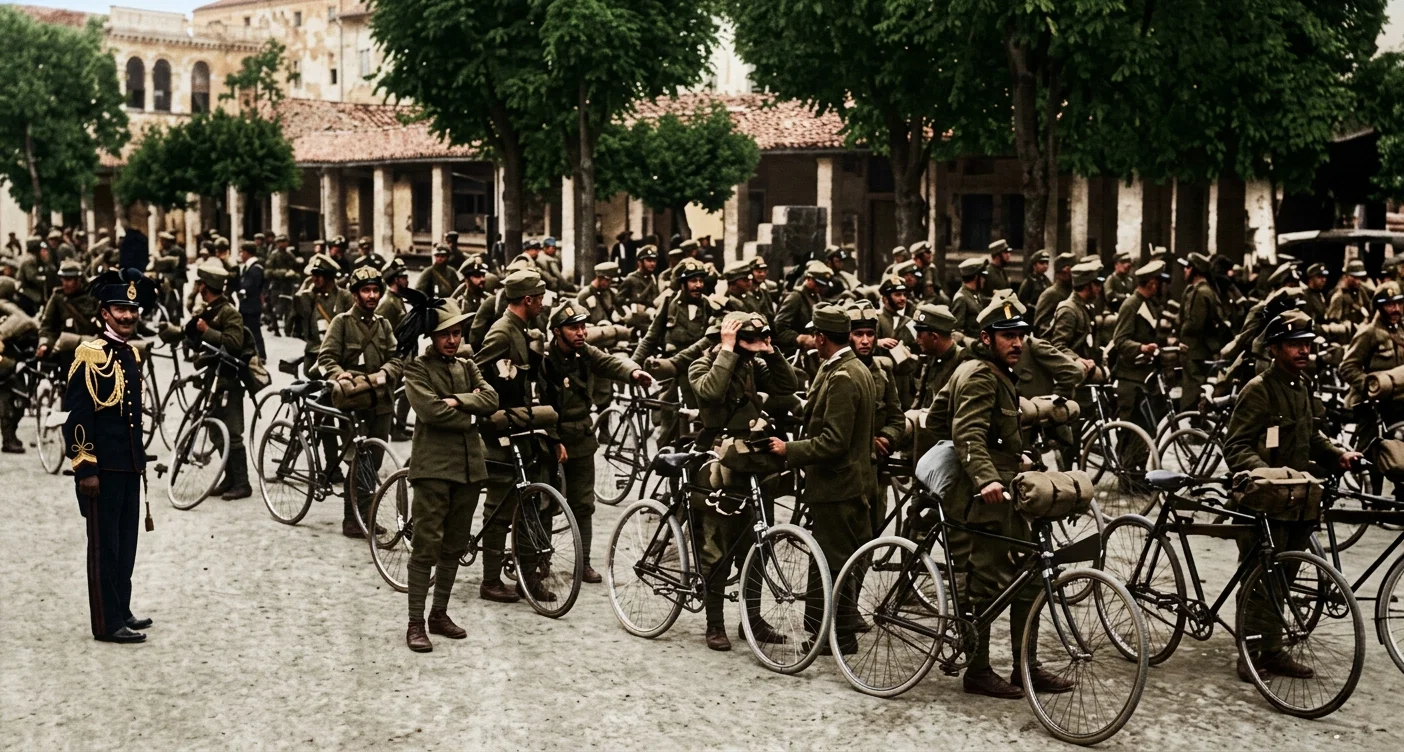
CYCLE CORPS OF YOUNG MEN IN THE ITALIAN ARMY
During the thousand years, Satan is confined to this world, bound by “chains of darkness” (Rev. 20:1-3; 2 Peter 2:4), and by reason of the fact that humanity has disappeared from the earth; for the righteous are in heaven, and the wicked are all slain. At the end of this period, the holy city, New Jerusalem, descends from heaven. Christ, angels, and saints accompany it. Rev. 21:2; Zech. 14:4, 5. Then occurs the second resurrection, and subsequently, the “second death,” or the utter destruction of the wicked.
SATAN MARSHALS HIS ARMY
Satan, being loosed from his prison by the resurrection of the wicked, places himself at the head of the mightiest host ever marshaled in battle array. They go “up on the breadth of the earth.” Rev. 20:9. It is the last desperate struggle of the prince of darkness, his final act in the great drama of the ages. He goes forth “to deceive the nations,” who have come forth from their dusty beds. He leads them to think that they can take the city by storm; for their number is “as the sand of the sea.” Verse 8.
Acting upon the mighty impulse, they compass the camp of the saints about, and the beloved city; and fire comes down from God out of heaven, and devours them. Verse 9. Thus are fulfilled the words of the ancient prophet, “When the wicked are cut off, thou shalt see it.” Ps. 37:34. Ages before, it had been written concerning Satan: “I will bring thee to ashes upon the earth in the sight of all them that behold thee. All they that know thee among the people shall be astonished at thee: thou shalt be a terror, and never shalt thou be any more.” Ezek. 28:18, 19. See Heb. 2:14.
BURNED UP AS STUBBLE
That is the time foretold by Malachi: “For, behold, the day cometh, that shall burn as an oven; and all the proud, yea, and all that do wickedly, shall be stubble: and the day that cometh shall burn them up, saith the Lord of hosts, that it shall leave them neither root nor branch.” Mal. 4:1.
These scriptures point to the utter annihilation of sin and sinners. Both root and branch — Satan and his followers — are consumed. As stated in the plainest possible terms, the wicked are “devoured,” “burned up.” They are compared to chaff and stubble (Isa. 5:20-24), to burning fat (Ps. 37:20), and other combustible materials. Peter speaks of the “perdition of ungodly men.” This implies utter destruction. And finally, says the seer, “They shall be as though they had not been.” Obadiah 16.
NO EVER BURNING HELL
It is difficult to see how a person could be as though he had not been, and still be living on. Anything that never was, surely cannot now exist. Therefore to be as something that never was, is most emphatically nonexistence. Then without the existence of the sinner, there can be no ever burning hell, no eternal torment. In the glad new creation that follows the destruction of the wicked, “there shall be no more death, neither sorrow, nor crying, neither shall there be any777more pain: for the former things are passed away.” Rev. 21:1-4. How could pain be said to be no more, if hell fire were still tormenting its victims?
A final proof that the doctrine of eternal torment is entirely without foundation, is the universal chorus, or ascription of praise and adoration, which ascends to God and the Lamb after the conflict of the ages is over: “And every creature which is in heaven, and on the earth, and under the earth, and such as are in the sea, and all that are in them, heard I saying, Blessing, and honor, and glory, and power, be unto Him that sitteth upon the throne, and unto the Lamb forever and ever.” Rev. 5:13. This scripture can be understood only in the light of a universe made free from sin; for after the “former things” have been forgotten, from the depths of the universe, from the heavens above, and from the earth beneath, from the sea, and from the habitable spheres “under the earth”—in fact, from all places in the Redeemer’s vast dominions—there is heard only one exultant note of universal harmony, the paean of everlasting praise.
THE PRIZE FOR “WHOSOEVER WILL”
Toward that “far more exceeding and eternal weight of glory,” that day of immortality and endless peace, our longing hearts are turning. Its hidden glory is now veiled from our mortal sight and comprehension; for now “we know in part.” “Now we see through a glass, darkly; but then face to face.” For “it is written, Eye hath not seen, nor ear heard, neither have entered into the heart of man, the things which God hath prepared for them that love Him.” 1 Cor. 2:9.
Dear reader, the promises are sure, and the prize is worthy of our highest endeavor, “The Spirit and the bride say, Come. . . . And let him that is athirst come. And whosoever will, let him take the water of life freely.”
The Principles of Divine Punishment
By Calvin P. Bollman
Punishment from God Is Not Retributive — Punishment Comes More as a Consequence, and Not for Revenge
By CALVIN P. BOLLMAN
RETRIBUTIVE punishment is punishment involving retribution, or payment for injury done or sin committed. It presupposes that by the injurious or sinful act, the offender has incurred a debt, which he must liquidate either by the payment of something of value, or by some kind of suffering. But this is not at all the divine idea of punishment.
CONSEQUENTIAL AND NOT REVENGEFUL
Divine punishment, or judgment, when not corrective, is always consequential,—never revengeful. God does not hold an account against the sinner. He does not take revenge upon him. “The wages” or result “of sin is death”; and the so-called “divine threatenings” are only announcements of the inevitable results of transgression. Said the Saviour: “God sent not His Son into the world to condemn the world; but that the world through Him might be saved. He that believeth on Him is not condemned: but he that believeth not is condemned already, because he hath not believed in the name of the only-begotten Son of God. And this is the condemnation, that light is come into the world, and men loved darkness rather than light, because their deeds were evil.” John 3:17-19.
BOATING ABOVE THE NIAGARA
It is like a boating party of thoughtless, inexperienced persons on the Niagara River above the falls. Left to themselves, they will drift to certain destruction. A friend on the shore tries to alarm and arouse them to action, but his warnings are treated only as idle words. Ropes are thrown to them, but they refuse them, and drift on. A megaphone is brought into requisition, and they are told, in stentorian tones, that unless they speedily avail themselves of the means offered for their salvation, they will be overwhelmed in the rapids, and dashed to pieces in the falls.
Who could say that those who are trying to save them are threatening them?—Certainly no one. And if, despite warning and entreaty, they were finally lost in the raging waters, who would attach any blame to their friends, or to nature, or to God, for the disaster?—Nobody. Every one would realize that they had suffered only the inevitable result of their own course. So it is with those who refuse to turn away from sin. They just as inevitably and necessarily perish as do those who brave the power of the mighty Niagara.
SEEKING TO RECONCILE MAN
Christ’s death was not for the purpose of reconciling God to man, but of reconciling man to God. “God so loved the world, that He gave His only-begotten Son, that whosoever believeth in Him should not perish, but have everlasting life.” John 3:16. The plan of salvation was not devised to provide a sacrifice upon which the wrath of God against sin might be visited, while the sinner was permitted to escape; but it was and is a plan for the destruction of sinful flesh without destroying the whole race of Adam.
“The wages of sin is death” (Rom. 6:23), not in a retributive sense, but as a necessary consequence. It is something that comes in the very nature of things. God Himself could not make it otherwise without changing His own nature and ceasing to be the holy being He is.
WOULD NOT DESTROY THE RACE
In the fall, not only the race, but every individual in the race, became tainted with sin. Must the race, then, be destroyed?—Nay, verily; divine wisdom and infinite love devise a plan whereby victory is wrested from defeat. By becoming Himself human—by being Himself made flesh—the divine Word would cause to spring forth and develop not only in the race, but in each believing unit of the race, a new spiritual man, begotten by the eternal Spirit, but truly man; who by divine grace would overcome sin in the flesh, and be clothed finally with eternal life.
It is as though a florist had, by his skill, produced a beautiful rose. A jealous enemy, seeing the rose, seeks to destroy the work of his rival by inoculating his creation with the germs of a fatal plant disease. But when the deadly fungus begins to show itself—when the rose begins to droop—the florist says: “I will not destroy the rose. I will save it. Many of the individual flowers must perish, but the plant as a whole shall be saved.” By injecting into it his own life, he gives the shrub strength to overcome the disease finally. From time to time, buds, flowers, and even branches that do not respond to the new life are cut off; but a new plant is developed, new buds and flowers are formed, not apart from the old, but interwoven fiber by fiber with it, the old passing away, as does wood in the process of petrification, until at last the old is entirely gone, and only the new appears.
THE NEW CREATURE IS A NEW CREATION
It is in some such way as this that the “new man,” the “new creature,” or “new creation,” the “spiritual mind,” develops. What Christ did, was to overcome sin in human flesh; and this He still does in the flesh of every soul who is fully submitted to Him.
Everything that is sinful must die. The “old man,” the “carnal mind,” is sinful, and can never be otherwise; for “the carnal mind is enmity against God: for it is not subject to the law of God, neither indeed can be.” Therefore the “old man,” the carnal, or fleshly mind, must die. The only question is, When, and under what circumstances? If the will surrenders to God, a new life springs up in the soul. There is a “new creation,” or “new creature.”
The work of the “new creature,” the “new man,” is to “crucify” the “old man,” to “mortify” the carnal nature. These two natures cannot exist together on terms of equality; one must dominate the other. If the carnal dominates, the spiritual soon dies; and if the spiritual dominates, the carnal dies, is crucified, mortified, and cast out. In any case, death is the portion of the carnal, or natural man. The only question is as to the time of this death. Will the spiritual nature assert itself, and by the potent aid of the Holy Spirit and the power of the divine Word, destroy the carnal, or fleshly, during this probationary life, or will the spiritual surrender to the carnal, and finally perish with it in the lake of fire? In any event, death is the portion of the “carnal mind.” The “old man,” the “stony heart,” dies.
THE VICTORY WON FOR US
So did Christ die; and had there been of Him only the human flesh, the tomb would have held Him forever. But during His thirty years or more of human life, He had developed a perfect human character, a character that the Father could perpetuate in His kingdom; and because of this perfect character, this perfect righteousness, “it was not possible that He should be holden” of death. Therefore He came forth from the grave a victor over death. Nor is this all. Having gained this victory in His own human flesh, He has the right to do the same thing in our human flesh. The victory that Christ gained in human flesh nineteen hundred years ago, He not only imputes, but He imparts, to all who yield to Him and co-operate with Him in it. As many as do not do this, finally perish, just as naturally and just as inevitably as does he who in the rushing torrent of the upper Niagara, without oars and without strength, refuses all aid; and the punishment, the death that comes to them, is not inflicted in revenge by a slighted sovereign. It is not retributive in the sense of balancing an account, but comes as the necessary consequence of a course voluntarily taken and persistently followed until there is no remedy. Even He who is infinite not only in love, but in justice, could not ordain it otherwise. “He cannot deny Himself.”
No Regret for Sacrifice in Heaven
By Mary Lyon
In heaven we shall never regret any sacrifice, however painful, or labor, however protracted, made or performed here for the cause of Christ.— Mary Lyon.