LAST summer the Mexican Mission Committee held a meeting in the city of Queretaro. A few items of general interest may be worthy of mention by way of description of this city.
Although situated on both lines of the National Railway, which traverses the table-lands of central Mexico from the United States border to Mexico City, and having a population of approximately forty-five thousand inhabitants, yet, aside from an electric-light system, and a very crude street-car service, for which diminutive Mexican mules supply the motive power, Queretaro is doubtless contemporary in appearance and architecture with Jerusalem or Damascus in the time of Christ.
Its streets, paved with cobblestones, average from twenty to twenty-five feet in width. It is said to have forty Catholic churches, many of them being gems of art in beauty of construction and interior decoration. It has always been regarded by Protestants as one of the ultra-Catholic cities of the republic.
ITS GREAT STONE AQUEDUCT
Queretaro is famed for its charming setting in the midst of fields of alfalfa, verdant twelve months of the year, from which nine crops are cut in a single season. It is also noted for its extensive orchards, laden in season with the fruits of the temperate zone, as well as those of the subtropics. These alfalfa fields and luxuriant orchards are irrigated by water flowing from four mammoth springs, which burst forth from the earth some five miles from the city, their united volume forming a small river.
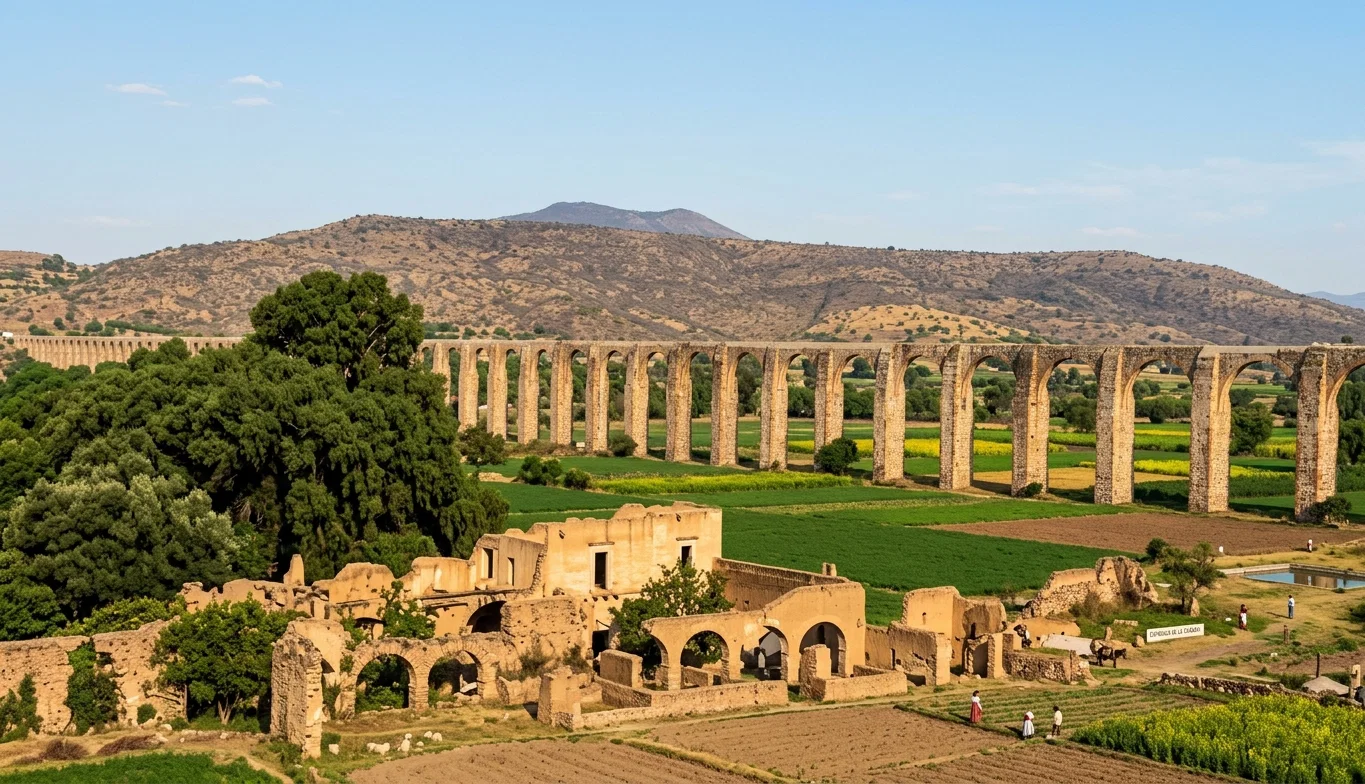
A special feature of beauty and interest in the immediate vicinity of Queretaro is its great stone aqueduct, about a mile in length, by means of which the city is supplied with water, which is distributed from the highest point of land within the city to twenty pools, or fountains, where the women gather, as in Bible times, to carry away water in earthen jars for domestic use. This aqueduct is the largest and most remarkable of its class in all North America, and is famous in Mexico, as were the “pool” and the “conduit” built by King Hezekiah in Palestine more than seven centuries before Christ, and which “brought water into the city” of ancient Jerusalem. 2 Kings 20:20.
The aqueduct system, which was the8only method formerly known of conducting a stream of water across a depression, has many examples in Mexico. The one at Queretaro, we were told, is supported by columns twelve feet square, is constructed of solid masonry, some of them reaching a height of sixty-five feet.
While Queretaro, as to climate, fertility, and beauty of environment, is, to the writer, the most charming spot of the vast table-land district of Mexico, it is likewise one of the most interesting places in the republic from the viewpoint of its thrilling history. It was here that the ill-fated emperor, Maximilian, brother of Francis Joseph, the present ruler of Austria, made his last stand against the indomitable Juarez, and, being vanquished by the latter, was imprisoned, court-martialed, and with two of his leading generals, Miramon and Mejia, taken to the hill of the bells, “cerro de las campanas,” and shot by eight Indian soldiers, June 19, 1867.
This event is one of the saddest in the history of the republic. Maximilian, considering his cause hopeless, had abdicated the throne and set out for Europe, but was overpersuaded by the Catholic Church party to return—to his sad fate. The crude coffin in which his lifeless body (now resting in Austria) was borne away from the scene of the execution is exhibited in a room in the capitol building at Queretaro devoted to the relics of what may, with propriety, be called the Maximilian tragedy. In this room the visitor may sign his name in the great visitors' register, which lies on the same table on which was signed the death-warrant of the emperor.
The coffin, or box, which held the remains of one of the proudest of earth's monarchs, still plainly shows the stains of his life-blood and the imprint of his hand, bathed in the crimson which gushed from his mortal wounds.
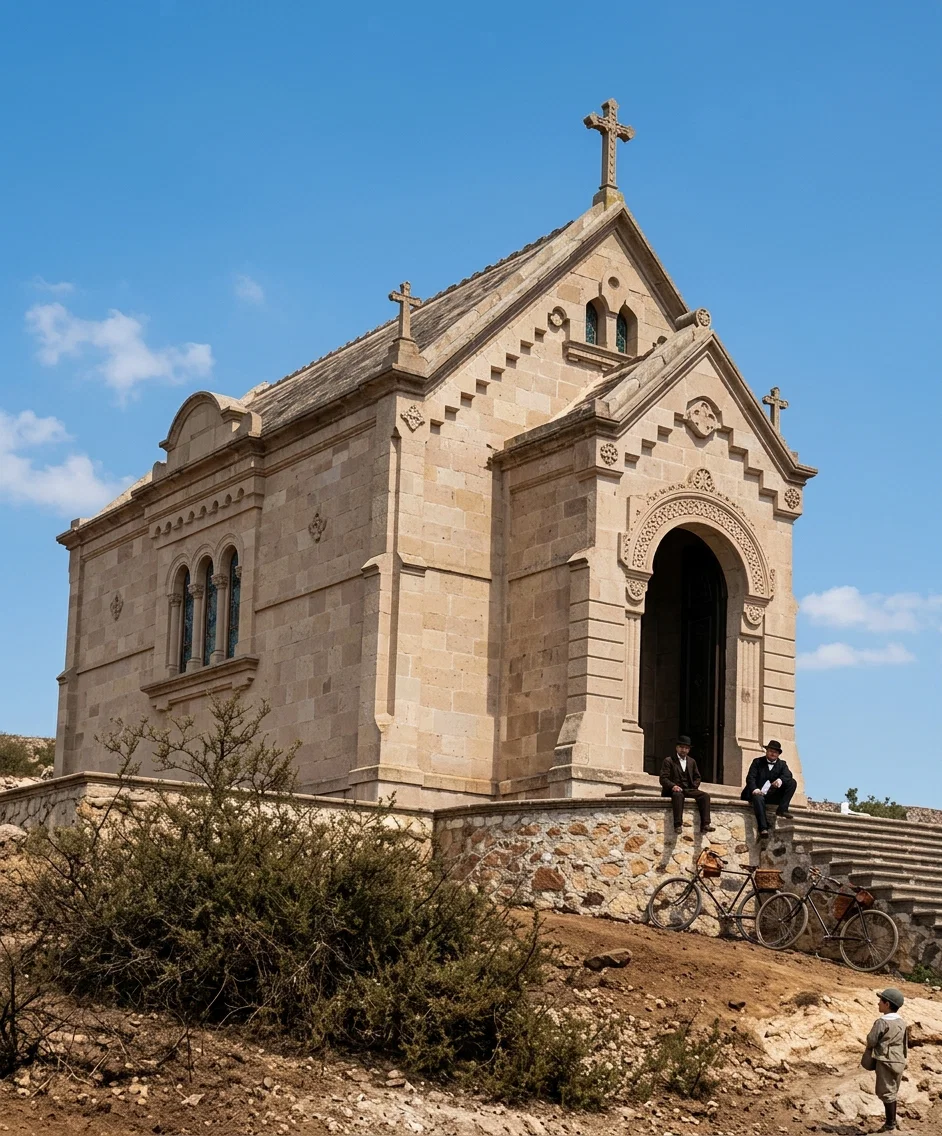
A beautiful chapel, “Expiatoria,” built with the hope that the nation might expiate the crime of slaying Maximilian, now marks the spot where the dreadful deed was done.
Tacubaya.
THE MAXIMILIAN TEMPLE
South America
By J. W. Westphal
J. W. WESTPHAL
WHILE our brethren and sisters are giving of their means toward the $300,000 Fund, of which $35,000 will go to South America, they will no doubt be interested to learn what the money is to be used for, and how much is needed. We asked for $27,000, to be distributed as follows: For the Brazil printing plant, $5,000; the Brazil school, $5,000; the River Plate printing plant, $5,000; the school, $5,000; the sanitarium, $8,000; Chile school, $3,000; West Coast printing plant, $2,000; and the West Coast Indian work, $4,000. Since the West Coast printing work is united with the publishing work in the River Plate field, the $2,000 for that work will be divided between the River Plate printing work, which now belongs to the whole Spanish, South American field, and the Chile Conference, for the establishment of its tract society.
The oldest South American institution which will receive help from this fund is the River Plate school. This school was begun when brethren were few in the field. A brother gave forty acres of land, and others gave different amounts in cash. The school was started twelve miles from the nearest river port, and nine miles from the nearest station. The country is an undulating prairie, and, although well cultivated and sowed to small grain, is but sparsely settled.
The school was planted here because there was not means enough to establish it in a more expensive locality. Only three or four rooms could be erected in the beginning, and to these one room after another has been added, as means could be secured. It can easily be seen that it was impossible to build a desirable dormitory in this way for a school. We have never been able to add a most necessary porch; and as no room is connected directly with the dining-room and the kitchen, the matron, teachers, and students must all pass through sunshine and storm, heat and cold, in any move from their rooms. Owing to our effort to erect a building for school purposes, 50 x 50 feet, and two stories high, work on the old building, which is greatly in need of repairs, has perforce ceased entirely.
No debts were incurred until the new building was started; but the attendance and the crowded condition of the school demanded that we do something to provide room for the students and teachers. At the same time it became necessary to enlarge the farm, which we did by the purchase of eighty acres of land, the school now having one hundred twenty acres. Our present indebtedness is about three thousand dollars. This is not large, but it is more than any school ought to have. Our brethren have given liberally of their means in order to secure this result.
However, our greatest difficulty is the incompleteness of nearly everything. The schoolrooms are unceiled; the entrance is unplastered; the partitions in the upper story are imperfect. The seats are, for the most part, roughly constructed seats such as are made for a tent. There is practically no library, and helps for study are few. The rooms are crowded, six and sometimes seven persons being forced to occupy a single room. There is no office. The dining-room is too small, as is also the kitchen; but we have not been able to carry out a plan made to increase their size. Chairs must be carried to and fro between the dining-room and the class-rooms. We have no means to start any industries. Owing to a severe drought, there is no prospect of a crop from the farm this year.
With the exception of a smaller school in Chile, this is the only school in South America for the training of workers for the Neglected Continent. The enrolment this year is over one hundred, a number of whom are preparing to enter the work. Five thousand dollars will secure only a few of the many dire necessities of the school. I am sure if our brethren could see the need as we see it day by day, their donations for this purpose would be gladly and liberally given.
Buenos Aires, Argentina.
World-Wide Mission Notes
The Hon. Oscar S. Straus, American Ambassador to Turkey, has succeeded in obtaining a decision from the Turkish cabinet by which all foreign religious, educational, and benevolent institutions are exempted from certain provisions of the Ottoman law. This decision affects about three hundred American organizations, freeing missionary institutions from numerous restrictions, and permitting them to acquire and hold property in their own name.
Our two mission stations in Basutoland are organizing for better service. The Kolo Mission will be operated as a dairy farm in connection with the school and evangelistic work, and the Emmanuel Mission as a fruit and vegetable farm in connection with its public work. Brethren M. E. Emerson and H. C. Olmstead are experienced workers; so we believe that these stations, in addition to being an object-lesson for those whom they are established to benefit, will soon be largely self-supporting.
Elder W. H. Anderson reports the following, after visiting the out-schools in Barotseland, South Africa, on returning from his furlough to the United States: Number of schools, including home station, eight; number of students attending, 226; oxen at out-schools, forty-three; other cattle, fifty-one. In nearly every instance the mission farm is fully supporting the school work. Thus God is richly blessing the effort to impart light and help to the dwellers in this part of the great Dark Continent.
“From Greenland’s icy mountains” comes the glad word that the light of the gospel is breaking upon its shores. On the west coast, in a stretch of country reasonably fertile and pleasant, dwell about eleven thousand Eskimos. The gospel has obtained a strong foothold here; but the light of the third angel’s message, proclaiming the joyful news of the soon-coming Saviour, has not yet penetrated this region. The east coast is visited once each year by a ship from Denmark, bringing supplies to a missionary stationed there. Sometimes the ship is delayed during August by pack-ice, then Missionary Rosig must live solely upon walrus meat for a time. Sometimes his family are compelled to remain in bed to keep warm, as fires can not be built because of the fierce winds. But spring comes, even in Greenland, and then the sun quickly dispels the great white banks of snow. If people can live in Greenland, missionaries can live there also. And the people need the truth.
Old Errors Revived
By William Ambrose Spicer
CHRISTENDOM is filling in the prophetic outline of the second of Isaiah. The “many people” are talking of exulting the Lord’s house to the mountain tops of national favor and support; and while the war-clouds are gathering, there is talk of coming peace, and of beating swords into plowshares, as the prophet said. Verses 2-4.
More and more, also, we see Christendom being “replenished from the East.” Verse 6. The old Eastern philosophies are coloring religious thought everywhere. A Buddhist writer, noting this, says of the Eastern doctrine, “Its thoughts are stealing unseen through the whole West.”
The Word of God gives the warning for these times when old errors are reviving under new forms; and in the definite advent message and movement we have the Lord’s answer to the delusions of the last days. A striking word, just in harmony with the Scripture warnings, was spoken by the spirit of prophecy fifteen or more years ago:—
Prophecies are being fulfilled, and stormy times are before us. Old controversies, which have apparently been hushed for a long time, will be revived, and new controversies will spring up; new and old will commingle, and this will take place right early.
It is more than interesting, it is highly instructive as well, to note how errors that have come in recent years to test and try us, and to draw away unwary or self-confident souls, are but a revival of errors that were met in the early days of the advent movement.
That spiritualistic philosophy of God in the tree and in the grass, that we heard much of a few years ago, was also abroad in the early days. In the REVIEW of March 2, 1852, a Brother Patten and wife recorded their return to the faith after a sad experience with error and apostasy. They wrote:—
In short, the fire of Spiritualism soon burned up the person of Jesus, the heavenly Jerusalem, and all the glories of heaven. We began to talk about God and heaven in us.
And in those times Elder James White wrote down the unscriptural character of the pantheistic doctrine in vigorous words, as in the following (from the REVIEW of June 18, 1861):—
God is in heaven. This we are taught in the Lord’s prayer: “Our Father, which art in heaven.” But if God, who is in heaven, is as much in every place as he is in any one place, then heaven is also as much in every place as it is in any one place, and the idea of going to heaven is all a mistake. We are all in heaven. And the Lord’s prayer, according to this foggy theology, simply means, Our Father, which art everywhere, hallowed be thy name. Thy kingdom come, thy will be done on earth, as it is everywhere.
Another unscriptural teaching that has in recent years led some out of the truth into a confused mysticism, is based on the idea that Christ, at his ascension, took up his priestly ministry in the most holy place of the heavenly sanctuary. This has been one of the ideas of popular theology, set forth by commentators who do not understand the truths of the sanctuary and its cleansing. It is not strange that such should err in the matter; but it is sad that any who have ever known the way of the sanctuary truth, in the light of fulfilling prophecy in the advent movement, should be led astray by such a doctrine.
In the earliest days of our work the brethren were meeting this error by the clear Word of God. In fact, in Volume I, of the Advent Review—the paper that preceded this REVIEW AND HERALD—was reprinted an article by O. R. L. Crosier, himself a First-day Adventist, dealing with the common First-day Adventist idea, that Christ entered the most holy on his ascension. Their argument was based on the Authorized Version of Heb. 9:8, “the holiest of all,” and on Heb. 6:19, “within the veil.” That old-time article said of these scriptures:—
The word in chapter 9:8 [and] 10:19, is hagion, “of the holies,” instead of the “holiest of all;” and shows that the blood of Christ is the way, or means, by which he, as our High Priest, was to enter both apartments of the heavenly tabernacle. Now if there be but one place in the heavens, as many say, why were there two in the figure? And why, in applying the figure, does Paul speak of two? Perhaps those who “despise the law” and “corrupt the covenant of Levi” can explain this; if not, we advise them to abide by Paul’s exposition of the matter.
Chapter 6:19, 20, is supposed to prove that Christ entered the holy of holies at his ascension, because Paul said he had entered within the veil. But the veil which divides between the holy and the holy of holies is “the second veil” (chapter 9:3); hence there are two veils, and that in chapter 6, being the first of which he speaks, must be the first veil, which hung before the holy, and in Exodus was called a curtain. [In the Greek Septuagint of Ex. 26:37 it is called the same as in Heb. 6:19.] When he entered “within the veil, he entered his tabernacle, of course the holy, as that was the first apartment; and our hope, as an anchor of the soul, enters within the veil, i. e., the atonement of both apartments, including both the forgiveness and the blotting out of sins.
Whether Heb. 9:8 is rendered “holy place,” as by the American Standard Revision, or “holy places,” as by other translators, one thing is undebatably sure,—no one can limit the reference to the “most holy.” And all these chapters show that the apostle is writing of Christ’s full ministry in the two apartments of the heavenly sanctuary, then present and future, from the time when he entered upon it with his own shed blood to the end, when he comes “the second time without sin unto salvation.”
In interpreting the phrase “within the veil,” in Heb. 6:19, advocates of this theory have insisted that it must mean within the second veil; whereas Heb. 9:3 shows that when Inspiration in the book of Hebrews wishes to specify the second veil, it says “second veil.” No one can arbitrarily add “second” where Inspiration refuses to say it. Moreover, in this sixth of Hebrews the context does not suggest any distinction as between the antitypical ministries in the two apartments, but rather the whole priestly service of our Advocate, who entered heaven for us, veiled from mortal eyes, just as the earthly priest, in his daily and yearly ministry, entered the sanctuary through the first veil, and was veiled from the eyes of the congregation without.
This old Advent Review reprint went on to point out the fact that when the high priest entered the second apartment of the typical sanctuary, it was the time of the cleansing of the sanctuary. Therefore, to infer that Christ entered upon the antitypical ministry of the most holy place at his ascension, is necessarily to assert that the time of the cleansing of the sanctuary began at his ascension. And this is utterly to contradict the great historic prophecies of Daniel 8 and 9, “Unto two thousand and three hundred hundred days; then shall the sanctuary be cleansed.”
Again and again in our earlier days these ideas were shown to be unscriptural. In the REVIEW of July 7, 1853, Elder J. N. Andrews reviewed an argument in a First-day Adventist paper to the effect that Christ’s ministry in the first apartment of the heavenly was before the first advent, and that on his ascension he entered upon his ministry in the most holy place. After showing that the theory was mainly based on10a mistranslation of Heb. 9:8, Elder Andrews wrote:—
The typical dispensation had an earthly tabernacle with two holy places, and a ministration in both those holy places. That tabernacle was the pattern of one in heaven, consisting also of real holy places; and that ministration in those holy places was “the example and shadow” of Christ’s more excellent ministry in the true tabernacle of God. Now there is not the smallest ground for question—that we can see—as to the point when the sanctuary of the first covenant was superseded by that of the new, and the ministration of the one sanctuary done away by the existence of the more excellent ministry in the other. Heb. 9:1-12; 8:1-5. Now we ask, in view of these facts, On what principle is the fulfilment of a large part of the shadow of good things to come, located in the very period of that shadow? On what principle of interpretation can it be shown that the antitype of the daily ministration existed contemporary with that type, and ceased with it?
One of three positions seems to be before the Herald: (1) To say that the ministration in the first apartment typified nothing; or (2) to say that it met its antitype contemporary with its existence as a type; or (3) to say, with us, that the shadow of good things to come, as presented in the ministration of the two holy places, must meet its antitype, since our High Priest has become a minister of those good things to come in the greater and more perfect tabernacle. The first of these positions charges God with folly. The second involves the absurdity of making the type and antitype exist parallel with each other. The third view, we believe, is consistent with itself, and in harmony with the whole Bible. . . .
The next argument of the Herald is drawn from verses 25, 26: “Nor yet that he should offer himself often, as the high priest entereth into the holy place every year with blood of others; for then must he often have suffered since the foundation of the world; but now once in the end of the world hath he appeared to put away sin by the sacrifice of himself.” From this text, the Herald argues that Christ at his ascension became the antitype of the priest in entering the holiest. To this we answer that instead of the ministration in the second apartment, it is the yearly round of ministration in both apartments that Paul here places in contrast with the work of Christ in the true tabernacle. In verse 24, the holy places (plural) are set in contrast with the true holy places. In verse 25, where Paul contrasts the work in the typical tabernacle with that in the true, the same word, holy places, plural, is used, though in our version it stands in the singular. But Macknight and the Douay Bible both give it in the plural. It follows, therefore, that it is the yearly round in the two holy places, as in chapter 10:1, and not the work in the holiest, merely, that Paul thus places in contrast with the work of our Lord in the true tabernacle. This shows that the antitype of the work in both the holy places is to be found in the work of our Lord since his ascension. The two holy places (verse 24) have corresponding holy places in the true tabernacle. The work in the typical holy places (verse 25) has its corresponding work in the true holy places. The work in the earthly tabernacle was repeated once a year. But our great Sacrifice is slain once for all, and once for all completes his round of ministration in the true tabernacle.
Thus, as we turn over the records of the early days of the message, we see our brethren wielding the sword of the Spirit, the Word of God, against the same errors that now and then reappear in our own time, with variations. Old errors are being revived, and new controversies will arise. If such did not appear, there would be lacking one of the signs that show that we have reached the time of shaking and of the latter rain. But that time has come. And the definite advent message, which rose when the hour of the cleansing of the sanctuary came, according to the “sure word of prophecy,” goes speeding on its way with light and joy and saving power for all who heed it. W. A. S.
The World's Unrest
By F. M. W.
The world to-day is like a troubled sea. The spirit of unrest and disquietude has taken possession of the hearts of men. Look where we will, we see springing up with active growth the seeds of disintegration and strife. The old-time spirit of simplicity and rugged integrity is giving place to the excitement and superficial living of a fast age. Barriers which heretofore have held in check the passions of men have been broken down; and, actuated by the wild spirit of the age, license is mistaken for liberty, and the promptings of conscientious principles are giving place to the impulses of selfish desire.
This departure is everywhere apparent. We see it in the weakening of the marriage relation. It is manifest in the religious life of the people. The Scriptures of truth are being discarded. There has been a wide departure from the old-time simplicity of faith. The question raised by Pilate, “What is truth?” is heard from every quarter; and that, too, with direct reference to some of the fundamental principles of Christianity, which the church of God considered long since forever settled.
This spirit of degeneracy is seen in the business world in the wild rush for wealth,—wealth to be obtained by any means and in the quickest way. It is seen in the corruption which has crept into nearly every State and municipal administration. But while this spirit of change and unrest is seen in these more quiet phases, its most striking exhibition is witnessed in national and international affairs. Every government has foes without and foes within seeking its overthrow. It is the time foretold by our Saviour in his great prophetic discourse,—the time of “men’s hearts failing them for fear, and for looking after those things which are coming on the earth.”
Careful observers on every side note these conditions, and comment on their significance.
The editor of the United Presbyterian, in its issue of October 13, speaks of the strikes, lockouts, and riots to be found in some of the cities of the United States, and then adds:—
This is not local. The same conditions prevail in Great Britain. A very large proportion of those employed in factories, mills, and yards are idle and angry. In more stable and more severely policed Germany, riots have led to bloodshed. In France, although to a less degree, the unrest is disturbing prosperity and progress. Spain trembles as with the premonitory shocks of an earthquake. The murmuring of discontent is heard from other European states, like the wailing of a troubled sea. Everywhere the complaint is against wealth, luxury, pride, arrogance, and cruel domination. Different, and yet equally ominous, is the discontent in the far East. There it is a struggle between ages. The East is passing through revolutionary changes, and is almost delirious with a new spirit. It asserts in an unmistakable tone its independence of the West, by whose intrusion it has been awakened from the quiet of ages. At the same time there is a resistance to the new order, that intensifies the feeling against the foreigners. In the near East there are equally important changes in the overthrow of the old order and the introduction of the regenerating forces. The Mohammedan world is rousing itself to a most aggressive policy, creating a spirit of discontent and resistance to the point of readiness to break out in revolution.
From this picture the editor looks forward with hope to a happy working out of these difficult problems through the united efforts of the Christian churches. We would indeed that the great professed church of Christ were in a position to-day, where, amid the babel of voices, it could strike a note clear and distinct, and could issue a rallying call to the nations of men. But, alas! the church itself has succumbed to the spirit of the age. The seeds of disintegration have taken root in her, the same as in the unprofessing world; and its baneful fruit is manifested in the spirit of Higher Criticism and other evil sophistries, which strike at the very root of faith in God and confidence in the Scriptures of truth. The great Christian church, as constituted, stands weak and powerless before the moral and social evils which are threatening the disruption of society. It needs itself a regeneration before it can undertake a work of reform for the world. “Ichabod” is written over its sanctuaries.
But there is this comforting thought in the midst of this warfare of opposing forces: God still lives. Though rejected by the multitude, and wounded in the house of its friends, the Word of God is still a living Word, and that Word11will work effectually in the heart of every true and sincere believer. To-day God is speaking to the hearts of men; his Spirit is abroad in the world. He is sending to his professed church a message designed to heal her wounds, even the message of his soon coming. This message, this event, is the only remedy for the ills of the present time.
Conditions will grow worse; men will depart farther and farther from God; the causes for unrest will continue to multiply. Everything that can be shaken will be shaken. But in the midst of it all, and out of the confusion and strife, out of the doubt, uncertainty, and darkness, God will bring a people who will make him their hope, and who will find in him and in his Word, abiding trust. Let this be our hope in the times before us, and let us point men to the Word of God as the only anchor which will hold them in the storm and stress of these evil times. We may not save the nations, nor yet the great multitude. We may not reform the great professed, but backslidden church, nor be able to regenerate society in general. But under God and through his grace, we may save individuals. Everywhere are hearts longing for light. These are to be the objects of our efforts. These we are to point to the great Source of light.
“God is our refuge and strength, a very present help in trouble. Therefore will not we fear, though the earth be removed, and though the mountains be carried into the midst of the sea; though the waters thereof roar and be troubled, though the mountains shake with the swelling thereof. . . . Be still, and know that I am God: I will be exalted among the heathen, I will be exalted in the earth. The Lord of hosts is with us: the God of Jacob is our refuge.”
F. M. W.
The Father's Care
By Charles C. Belgrave
CHARLES C. BELGRAVE
CHILD of my tenderest, loving care,
Though darkness oft my face may hide,
My hand shall be outstretched to thee,
My arm unseen shall be thy guide.
In sore temptation’s trying hour,
When Satan’s wiles thy soul ensnare,
Doubt not the presence of my power,
But trust thou to my loving care.
By scenes of grief and wrong distressed,
By friends forsaken and alone,
My strength shall give thee peaceful rest,
I will not let thee go forlorn.
Then faint no more in unbelief;
Trust thou my love, know my way best;
Thy heart shall find a sweet relief
If thou but on my promise rest.
O Lord! increase my faith in thee,
That I may place my hand in thine;
Whate’er the path of life may be,
To know, to trust thee is sublime.
Mount Vernon, Ohio.
Traveling and Visiting Among Believers
By George O. States
From Elder George O. States
During the past summer my health has so improved that I have traveled considerably over the country, distributing papers and tracts, visiting our people, and occasionally meeting with them on the Sabbath. On Sunday, September 18, I left my Cedaredge (Colo.) home, going to Delta, where I spent three days distributing literature. Wednesday, September 21, found me among my dear Colorado brethren and sisters on the camp-ground at Grand Junction. I enjoyed meeting many to whom I had presented the truth, and whom I had baptized, so many years ago. But it was more than my weak nerves could stand, and Sabbath evening I was quite ill. I decided to follow the doctor’s advice, and locate in a lower and damper climate. Thursday morning, September 29, found me at the hospitable home of Elder J. L. Edgar, in Flint, Mich. Brother Edgar was the first minister with whom I labored after receiving my first license, twenty-eight years ago. I remained there, visiting around with him, and talking over the wonderful spread of the message since I was baptized by Elder James White over fifty years ago.
October 3, I was in Saginaw, where I remained a week visiting our people, some of whom I knew more than forty years ago. I was glad to find them still firm in the truth, although, like myself, showing the infirmities of age. October 11, I arrived at the home of my brother, who was baptized with me. I am now located in the country five miles from Whittemore, Iosco Co., Mich., not far back from Saginaw Bay.
Brethren, God’s work is going, and nothing can stop it. Men holding responsible positions may drop out and fail, but the ranks will be filled up, and organization will prove a success. The message is of the Lord, and nothing can hinder its progress. I wish I might go out and help swell the loud cry; but if the Lord sees I can do more good in a quiet way, I desire to be patient, and quietly submit to my lot. “For this thing I besought the Lord thrice, that it might depart from me. And he said unto me, My grace is sufficient for thee: for my strength is made perfect in weakness. Most gladly therefore will I rather glory in my infirmities, that the power of Christ may rest upon me.”
Walla Walla College Fire
By M. E. Cady
A FEW moments after midnight, October 13, the inhabitants of College Place were awakened by the ringing of the college bell. A look from the windows revealed the heavens lighted up in the vicinity of the college. In a short time, friends, patrons, and neighbors reached the college grounds, and found the teachers and students battling with the flames emerging from the boiler house and the laundry just above it.
The fire was discovered by students living in the young men's dormitory, adjacent to the laundry. The smoke awakened some of the young men, who at12once gave the alarm of fire. When first seen, the fire had gained such headway that both the boiler house and the laundry were enveloped in flames, which were soon leaping high against the rear end of the young men's dormitory. It was plainly to be seen that unless Providence intervened, the college building and two dormitories were doomed, as these buildings are all connected, the dormitories forming two wings to the main college building.
Immediate steps were taken to remove pianos, organs, furniture, and clothing from the dormitories and the college building. While some were doing this, others, with hose and pails, were pouring water upon the flames and against the rear end of the dormitory to prevent, if possible, its taking fire.
For nearly three hours, heroic efforts were put forth to quench the flames. Early in the struggle the wind changed squarely about from the west to the east, bearing the flames away from the building instead of against it. This made it possible for those handling the water with pails and hose to take positions where they could dash water on the wall of the dormitory. In spite of every effort, the bricks became so heated that fire started in the rear rooms on the first, second, and third stories; but wherever it appeared, it was quickly extinguished by those working inside.
If it had not been for the new artesian well, which furnishes water pressure of fifty-six pounds to the square inch, our facilities for fighting fire would have been almost nothing. Another providential circumstance was the falling of heavy iron-work upon the main pipe connecting with the boiler, which caused it to break, and allow the steam and water, under high pressure, to escape from the boiler, thus aiding greatly in quenching the flames. While heroic work was done, some working in very dangerous positions, it is evident that all our efforts would have been fruitless had not He who has control of the elements come to our aid.
At four o'clock the young ladies moved their clothing and furniture back into their dormitory. Some of the young men remained on duty, watching the smoldering fire, that it should not break forth anew, while others wrapped themselves in blankets on the lawn, and waited for the light. There was no spirit of complaining, but all were grateful that the loss was no greater. No lives were lost, and no physical injury was sustained by any one. This was a cause of deep gratitude.
There was no school Friday, but the bell rang as usual at 9:30 A. M. for chapel exercises. Nearly all were present, and gratefully united in singing "The angel of the Lord encampeth round about us." A Scripture reading followed, Psalms 46 and 124 being read, showing that God is the refuge of his people. While this is so, the thought was expressed that everything should be done to provide facilities to protect the property and buildings the Lord has erected by the sacrifice of his people, and which are so necessary for the training of workers to bear the last message to the world. All seemed desirous of learning the lesson from this experience that God would have us learn. The rest of the day was spent in restoration, as far as possible, and in preparation for the first Sabbath. The Sabbath was a good day, — a day of reconsecration to God, and of gratitude for his tender watch-care over his children and this institution.
The extent of the loss has been placed at $10,400, but is covered by insurance. The college is now connected with the Walla Walla lighting plant, so that everything is moving along pleasantly, as the weather is mild and agreeable. School has reopened, and the usual program is being carried forward.
Truly "God is our refuge and strength, a very present help in trouble."
M. E. CADY.
Religious Liberty in Korea
It was feared that the extension of Japan’s sovereignty over Korea would cause embarrassment to the Christian missions in that country. It is gratifying, therefore, to learn that the resident-general, Viscount Terouchi, has made the following favorable statement with reference to the government’s attitude toward religion:—
Freedom of religion will always be respected, and I am ready to extend due protection and facilities to the propagation of all religious doctrines, provided they do not interfere with politics. I am one of those who fully appreciate the good work of foreign missionaries; and as we have the same object in view as they, ‘the improving of the general conditions of the people, their work will by no means be subject to any inconvenience. I need scarcely say that all the vested rights of foreign residents will be fully respected.