Christian Churches Training Men for Carnal Warfare.
The Glasgow Herald of some time since prints a letter from Field Marshal Lord Roberts to Lord Meath “on the subject of training to arms of the youth of the nation.” Lord Meath advocates for this purpose an extension of the Boys’ Brigade and Church Lads’ Brigade. Lord Roberts is a vice-president in the Brigade work, which, by the way, started in Glasgow, Scotland, twelve years ago. After telling how, in his opinion, it helped the boys to be clean, orderly, etc., Lord Roberts says:—
“With regard to the extension of the movement and its being assisted by the State, as you suggest, it would, in my opinion, be scarcely possible to spend the public money for a better or more patriotic purpose, provided the movement is kept strictly undenominational. . . . The habits of order, obedience, and regularity instilled into the members of the Boys’ Brigade are as valuable in civil as in military life; and even if any large proportion of them do not join the ranks, they would form a considerable section of the population on whom we could draw in the event of a national emergency.”
All of which means that the forces of the church, the professed spouse of the Prince of Peace, are to be used by the State to educate men for fratricidal strife, to destroy life, not to save it. Yet this is just what the Boys’ Brigade work is doing now. We need only to say that this is not Christ’s work. “For the Son of man is come not to destroy men’s lives, but to save them.” “For the weapons of our warfare are not carnal, but mighty through God.” “Wherefore, take unto you the whole armor of God.” These things show, not that the world is changed, but that the church has changed.
How Much Farther?
One of our book canvassers, a lady, giving her experience in an Iowa town, says:— “I canvassed at the house of a Protestant minister, who told me they were organizing libraries in all their churches. The pastors select the books they wish their members to read, and instruct them not to buy books of any book agent.”
How much farther will such pastors have to go before they land in Rome? Liberty of investigation and freedom in research should be accorded to everybody. And Protestant ministers, above every one else, should stand up for this inalienable right.
WOMAN’S LOT IN AFRICA.
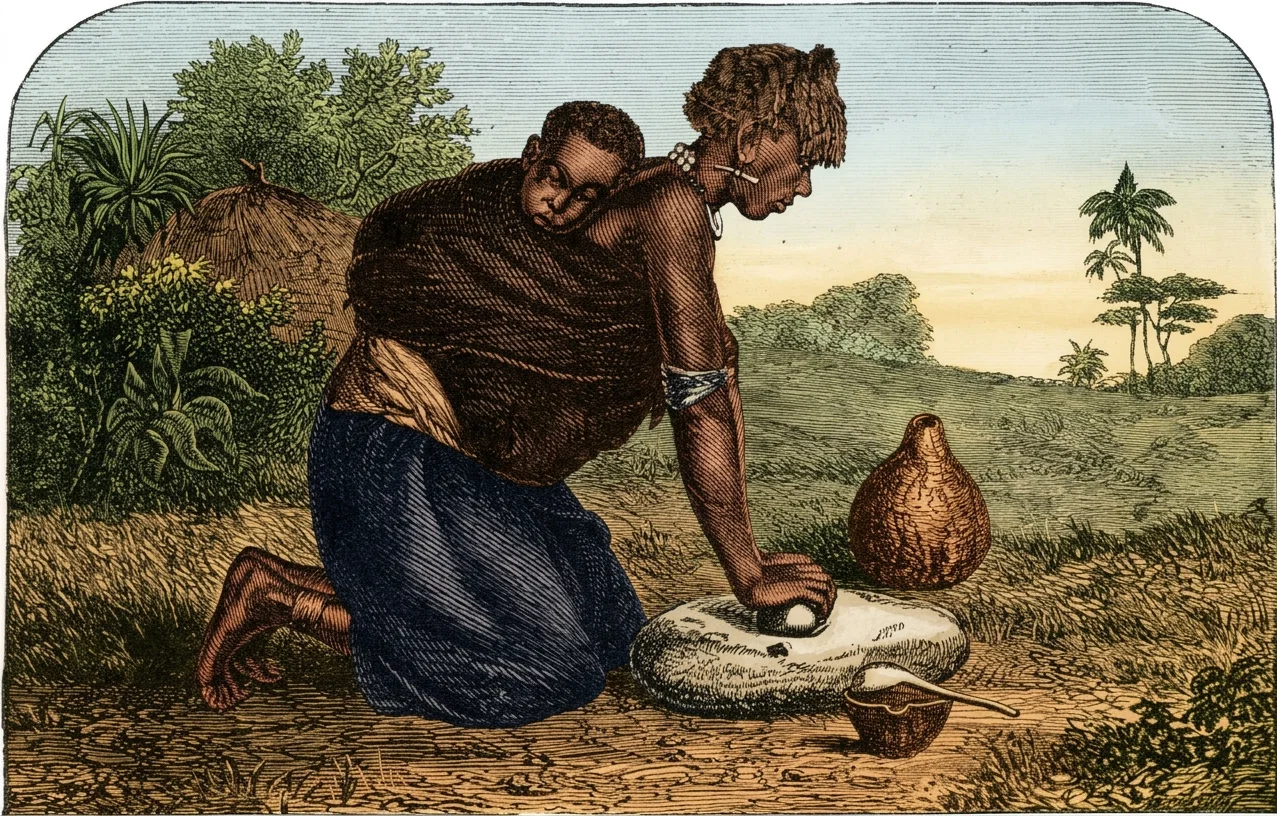
A WOMAN MAKING BREAD IN AFRICA.
The temporal penalties of sin seem to bear most heavily on woman. Everywhere and always heathenism means for her degradation and humiliation, altho it takes different forms in India, China, Turkey, and Africa.
Her lot in Africa is, perhaps, not so hard as in some other heathen lands. The soil is more productive and the population less dense than in China and India. As a consequence the struggle for the necessities of life is less sharp and pangs of hunger are less often felt than in parts of Asia. Then, too, woman is not in Africa confined like a prisoner for life in a zenana or harem, but has the fullest liberty to go about, and can and does come to hear the Gospel as freely as the men. But in other respects her lot is a hard one and ought to appeal powerfully to the sympathies of her sisters in Christian lands.
Point a native of Gaboon or the Ogowe to his right hand and ask what he calls it. He answers, “That is the ‘man hand.’”
“And what is the other?”
“This,” pointing to his left, “is the ‘woman hand.’”
“Why are they so named?”
“Because,” he explains, “this is the stronger and better hand and arm, and is therefore the man hand. The other is inferior in strength and efficiency, and hence is the woman.”
Here we have embodied in an idiom of the language the African estimate of woman’s worth.
At meal-time a plate of the best of everything is placed on the rude table, and the man of the house sits down and eats in solitary grandeur. He may invite any male friend to eat with him, in some cases even his boys; but never his wife.
She may wait till he has eaten, or she may take a plate of food and eat apart; but while her lord and master is dining, she may expect to be called at any moment, in imperious tones, to bring him this and to do that. No matter how hungry or tired she may be, she must drop everything and obey at once, or she is wanting in respect to her husband. The arrogant tone and manner in which his commands are often uttered show a deliberate purpose to emphasize and render yet more galling her menial position.
Take a very common sight in Africa: On a forest path you meet a family returning home from the plantation. In advance stalks the man, a great, stalwart fellow, carrying a light gun that weighs five or six pounds. Next come the women, usually much smaller and feebler, every one of them panting and staggering under the loads they carry. On their backs, supported by grass ropes passing over their foreheads, are bushel baskets full of plantains or cassava roots and heaped until there is nearly a bushel on top, and, perhaps, an additional burden in each hand, till they look like pack mules rather than women. You say to the man, “Why do you make your wives carry such heavy loads?” In surprise he answers, “Why, they are my women.” “I know they are,” you reply; “but why don’t you carry the basket for that poor woman and let her carry your gun?” “Me! Why, I’m a man! It is the work of the women to carry the loads.”
And so women are the burden-bearers, and they age rapidly under it.
But it is in the marriage customs of Africa that woman’s degradation is most marked. Betrothed when a mere child, she grows up bound to a man who is certainly ten or fifteen and perhaps forty years her senior. She may dislike him, even hate him, it makes little difference. She is taken from her home at the age of eight or ten, and goes to live in the family of her future husband, where her mother-in-law teaches her that her great duty in life is to obey her husband, and the great business of life is to serve him. Here she begins at once to cook his food and to wait on him, and as soon as he chooses, she becomes his wife without any further ceremony. If she fails to show her husband due respect, if his abuse and imperious demands cause her to lose her temper (for she still has one, and a tongue too), then he beats her. You remonstrate, “Stranger, why do you beat this woman?” “She’s my wife.” “Yes; but why abuse her?” “She did not obey me.” “But why do you expect more deference from her than you show to her?” “Did I not,” he replies, “pay for her more than two hundred dollars, the wages of years of work? She’s mine.”
There you have the story. Greed prompted her father to sell her, and he tries to satisfy his parental instincts by calling it marriage. Selfishness prompts her husband to oppress her, to take advantage of her weakness, to make her his slave, his drudge.—Gospel in All Lands.
NO TIME FOR TRIFLES.
We teach the children Danish,
Trigonometry and Spanish;
Fill their heads with old-time notions,
And the secrets of the oceans,
And the cuneiform inscriptions
From the land of the Egyptians;
Teach the date of every battle,
And the habits of the cattle,
With the date of every crowning;
Read the poetry of Browning;
Make them show a preference
For each musty branch of science;
Tell the acreage of Sweden;
And the serpent’s wiles in Eden;
And the other things we teach ’em
Make a mountain so immense
That we’ve not a moment left
To teach them common sense.
—London Standard.
INFANT FOODS.
DR. KATE LINDSAY, speaking of “Artificial Infant Foods,” in Good Health, says:—
“It may sometimes be necessary, in an emergency, to use predigested food for a short time, but nature never intended the human body to be nourished by foods artificially digested, and no infant can live on them and be properly nourished for any length of time. All the predigested starchy foods are deficient in the fatty elements, and must be used only for a short time or the nutrition will be disturbed, and rickets or some other form of malnutrition result. If dependence is put entirely on any one of the many prepared foods, the same danger will be met. It would be well for the preservation of the lives and health of children, if all mothers comprehended this important fact. Patent foods are all very easily prepared for the baby, and unless the mother or nurse is wise enough to be watchful, and ask the opinion of the infant organism, by means of the scales, or by the manner in which each organ does its work, as to how the nutrition of the baby is maintained, there is danger that its life and health may be endangered, and it be seriously ill before it is discovered that it has been slowly starving to death because its food was deficient in some important food element.”
A FRAGRANT LIFE.
By Ralph Waldo Trine
WE are told by the mariners who sail on the Indian Seas, that many times they can tell their approach to certain islands long before they can see them, by the sweet fragrance of the sandalwood that is wafted far out upon the deep. Do you not see how it would serve to have such a soul playing through such a body that as you go here and there a subtle, silent force goes out from you that all feel and are influenced by; so that you carry with you an inspiration, and continually shed a benediction wherever you go; so that your friends and all people will say, His coming brings peace and joy into our homes; welcome his coming; so that as you pass along the street, tired, and weary, and even sin-sick men and women will feel a certain divine touch that will awaken new desires and a new life in them; that will make the very horse as you pass him turn his head with a strange, half-human, longing look? Such are the subtle powers of the human soul when it makes itself translucent to the divine. —Ralph Waldo Trine.
The Value of a Lost Hour
“MONEY can be recovered, but an hour lost is gone forever.”
Jenin to Samaria
By H. P. H.
JOTTINGS FROM PALESTINE. No. 8.
Jenin to Samaria.
AFTER an hour’s halt for lunch in the vicinity of Jenin, we continued our journey southwards toward Samaria. Soon after leaving Jenin, we have on our right a fine valley, at the head of which lies Dothan. When Joseph came to Shechem to visit his brethren with their flocks, he learned that they had gone to Dothan; he followed them to this place, and was here sold and taken to Egypt. The Arabs still call the place “Joseph’s Pit.” The valley of Dothan is a fine place for grazing; and being quite extensive, Joseph’s brethren could well have seen him “afar off, even before he came near unto them.” Dothan is in the caravan line from Gilead to Egypt. It was doubtless in this same valley that they “lifted up their eyes and looked, and, behold, a company of Ishmaelites came from Gilead with their camels bearing spicery and balm and myrrh, going to carry it down to Egypt.” One still meets an occasional band with camels bearing burdens of merchandise, so that it is quite easy to fill out the rest of the scene enacted in selling Joseph.
Turning our eyes from the valley to the east of Dothan, we look to the hills round about, and remember that once they were filled with “horses and chariots of fire round about Elisha.” It was here the grand truth, which has ever since echoed in the heart of Christians, was declared and so impressively emphasized: “Fear not; for they that be with us are more than they that be with them.” 2 Kings 6:16. It was here that the Syrian host was smitten with blindness and led into Samaria, which is about three hours distant.
About an hour after passing Dothan, the setting sun reminded us that we must seek quarters for the night. Travelers usually stop overnight at Nablous or Jenin, as there is no place affording accommodations between. But not wishing to stop where we would be treated as tourists, as nearly as possible in European style, we planned our journey to leave the beaten track, and stop in some Arab village, to get a peep at their home life. The hotel-keeper at Nazareth assured me that I could not do this with any degree of comfort; and my Arab companion thought I could not put up with the accommodations which I would find in a village; yet at my special request, he finally consented to leave the usual course.
As we entered the Arab villages among the hills of Samaria, we were reminded of the mud villages which we had made in childhood. The huts and walls inclosing the court of the house were made of mud; in the place of streets were crooked passages so narrow as to be almost impassable to one on horseback. My Arab companion soon found a house where they were willing to receive us for the night. The entrance to the little court in front of the house was so small that we had to dismount and remove the saddle before the horses could enter. But, one may ask, were the horses taken into the house?—Certainly. The Arab seems to think that if the horse is good enough to ride on all day, he is good enough to lodge with at night.
While dismounting, a small company gathered about to see the strangers; for such travelers were rarely seen in their village. On entering the house, we found that it had but one room. At the right was a place for the animals, and at the left the kitchen, the principal furniture of which was a fireplace; above was a floor like a scaffold in a barn, reached by a ladder, for the accommodation of the family and the guests. After bringing in water for the horses, and grape-vines and dried brush for the fire, the women brought to the scaffold a “fire of coals” in a brazier to prepare some supper for us. It was difficult to make the hostess understand that I would take nothing; for the evening meal seems to be the principal one with the Arab. My companion gave his horses nothing to eat all day, and took but little dinner himself; but in the evening, he took a hearty meal, consisting chiefly of eggs fried in olive oil, and bread.
In this Arab home, the women seemed to bear the burden of everything; they were like servants, while the husband and father was the lord. They were all barefoot, the hair was sadly neglected, and in most cases the face, especially the chin, was tattooed. We were kindly treated and permitted to go in peace.
In the light of another fair morning, we continued to wind our way over the hills and through the valleys towards Samaria, the ancient capital of Israel. Sometimes for several miles we would pick our way among the stones, and over bare, unbroken rocks; and again we would wind through an olive grove. The olive trees here are the finest I have seen; the trees are twice as large as those in southern France and Greece. How they must have flourished when this land was in its prime!
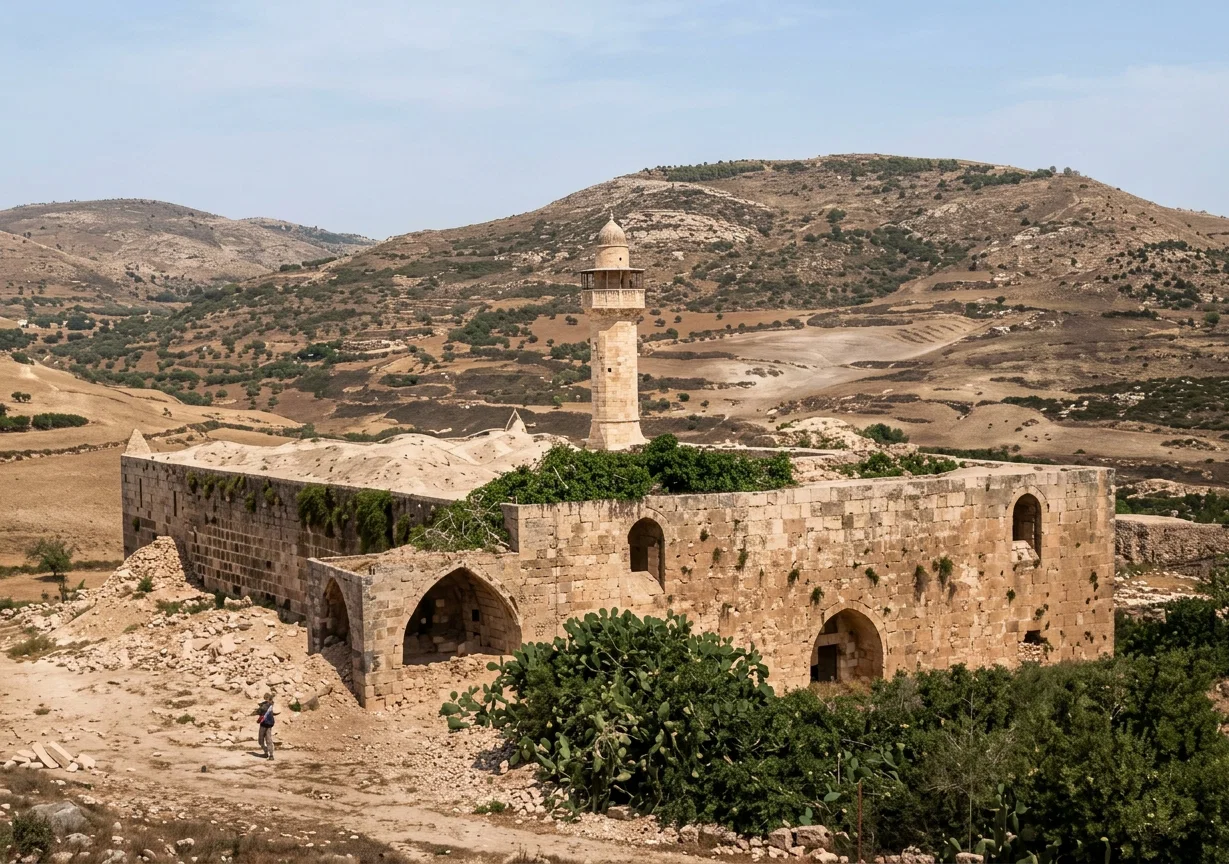
Occasionally we would pass over a ridge, or the summit of a hill, from which we had an extensive view. At each rise we scanned the land before us to catch our first glance of the hill which Omri, king of Israel, bought of Shemer for two talents of silver, and built on it a capital for his kingdom, and called the city Samaria. Fully an hour before reaching it, from a summit to the northwest, we had a clear view of this hill and extensive valleys surrounding it. Omri made an excellent choice. The hill of Samaria is terraced and planted with vines and olive trees nearly to the top. It is five miles in circumference and nearly five hundred feet higher than the surrounding plain. From the summit is a charming11view of the undulating hills and valleys round about; to the north rises the snowy peak of Mount Hermon; to the southeast, six miles distant, rise Mounts Ebal and Gerizim; and to the west, in the vicinity of Cæsarea, is the wide expanse of the blue Mediterranean.
About half way up the eastern slope is an Arab village of some sixty houses, and in one corner of it the ruins of a church of the Crusaders, which is claimed to stand over the tomb of John the Baptist. The top of the hill is now barren, except a few columns dating from the time of Herod the Great, who did much to restore Samaria. He gave it a new name, by which it is still known,—Sebaste, the Greek of Augusta. After having stood as capital of Israel for two hundred years, Samaria was totally destroyed by the Assyrians, and the people carried into exile, and their places filled with heathen from the vicinity of Babylon.
THE HILL ON WHICH SAMARIA STOOD.
The most interesting part of the history of Samaria was in the days of Ahab, during the time of Elijah and Elisha. Twice Ben-hadad of Syria while besieging Samaria with an immense host was put to flight in great confusion, once by the sound of an approaching host which the Lord caused him to hear, and once by a small band of Israel. Evidently the prophet Elisha spent considerable time here.
When Philip preached the Gospel in Samaria, “the people with one accord gave heed.” Many were healed, “and there was great joy in that city.” It was on this occasion that Peter and John came here, and Simon, who “used sorcery, and bewitched the people of Samaria,” tried to purchase the gift of God with money. As we stood on this hill, once the center of natural life, adorned with royal palaces, and then looked upon its present desolations, we were forcibly reminded of how literally the words of the Lord have been fulfilled which were spoken by Micah: “Therefore I will make Samaria as an heap of the field, and as plantings of a vineyard; and I will pour down the stone thereof into the valley, and I will discover the foundations thereof. And all the graven images thereof shall be beaten to pieces.” Micah 1:6, 7. H. P. H.
MISTAKES TO BE AVOIDED IN A REFORM DIET.
THE most common mistake made by those who commence a reformed diet is that of eating too much, and therefore abstemiousness can not be too strongly urged. A learned physician has stated that “we live on one-fifth of what we eat and retain the other four-fifths at our peril.” Foods which require to be bitten and masticated will be more easily digested than sloppy foods. Porridge should be eaten in moderation, and it is unwise for many persons to take fruit immediately after it—as fermentation is often caused thereby. A light breakfast will be found to be more beneficial by most persons than a heavy one, except in cases where it is difficult to get a good mid-day meal. Three meals a day are the utmost that should be partaken of, and many persons find themselves better upon two. The last meal should rarely be later than 7 o’clock.
Beginners are advised to commence by abstaining from flesh and fowl, and to leave off fish by degrees—as their own tastes will prompt them to do in a few months. It is better thus to make a step at a time and to insure success than to attempt too much at once and get into difficulties. Avoid listening to any doubts concerning the feasibility or the hygienic wisdom of living without flesh. It is no mere experiment; it has been practised by thousands in this and other countries, who after long years of experience enjoy splendid health and almost complete immunity from sickness or disease. Avoid “fadism,” and let every one know that you are acting from conscientious principle. They will then respect you and be willing to listen to what you say. Give as little trouble as possible.—Herald of the Golden Age.
SLIGHTING A DUTY.
“You haven’t made things look very neat and orderly here in the back shop,” said a merchant to a young clerk.
“Well, I thought it was good enough for back there, where things can not be seen very plainly, and where customers seldom go.”
“That won’t do,” said the merchant sharply, and then added in a kinder tone: “You must get ideas of that kind out of your head, my boy, if you hope to succeed in life. That kind of ‘good enough’ isn’t much better than ‘bad enough.’”
And the merchant made the boy go and do all the cleaning over again.
The girls who do not sweep in the corners or dust under things, and the boys who dispose of things as quickly as possible, saying that things “will do” if they are not well done, are the boys and girls who will not turn out to be great men and useful women.—Selected.
SOME DAY.
By M. Ashley
Some day all doubt and mystery
Will be made clear,
The threatening clouds which now we see
Will disappear.
Some day what seems punishment,
Or loss, or pain,
Will prove to be God’s blessing, and
Our everlasting gain.
Some day our weary feet will rest
In sweet content,
And we shall see how we were blest
By what was sent.
In looking back with clearer eyes
O’er life’s short span,
We’ll see with wondering, glad surprise,
God’s perfect plan.
—M. Ashley, M.D., in South African Sentinel.
THE EVANGELIZATION OF THE WORLD.
By W. T. Float
“I want—I want the Christians to go all over the world spreading the glad news.”—Reginald Radcliffe’s last message.
I WANT—I want the Christians
O’er all the world to go,
To spread the wond’rous tidings
To all that dwell below.
I want each Gentile people,
And those from Jewish stem,
To know there is a Gospel,
And that it is for them.
Dark Africa for ages
Has been without the light;
Its tribes have worshiped stocks and stones
With every heathen rite;
Its witchcrafts and its wickedness
Have sunk them low in sin;
I want the Christian witnesses
To let the light stream in.
The long “Neglected Continent,”
So populous and vast,
Has groaned beneath Rome’s tyranny
For generations past.
Peru, Brazil, and Ecuador
Are dark as dark can be.
O men and women, saved by grace,
Go forth and set them free!
—W. T. Float.
WHAT THE SIGNS OF THE TIMES DID.
By Birdie Rogers
The following was prepared and read at a local missionary meeting recently by a little girl 12 years of age:—
In the little village of S. lived a mason by the name of Mr. Jackson, together with his family. He had a little girl that he loved dearly, whose name was Millie. Millie’s mother said she was a little sunbeam about the house and she always gave her joy when she was around.
Millie kept the depot racks filled with papers and tracts, such as, SIGNS OF THE TIMES, Gospel of Health, etc.
Every morning Millie and her mother offered prayer to our heavenly Father to bless the husband and father and help him to see the blessed truth of the Gospel of Jesus.
One morning while they were eating their breakfast a telegram came for Mr. Jackson to take the next train for the village of W., to do some work for a man there. When he came to the depot, he found out that he would have to wait some little time for the train; he took one of the papers from the rack; it was the SIGNS OF THE TIMES; but he did not know that his only little girl had put them there.
Would you like to know what Millie and her mother were doing while Mr. Jackson was waiting? They were praying that he might get some of the papers in the depot.
“Mama,” said Millie, “don’t you hope the Lord will answer our prayer?”
“Yes,” said her mother, “I do, and I am quite sure He will, for He said if any man should ask Him in faith for anything, He would give it to him.”
After a pause Millie said, “I am so glad that we have such a Father that will give us every good and proper thing we ask for; aren’t you, mama?”
When Mr. Jackson went into the car, he took the paper with him and read and read. He was so interested that he did not know where he was, and when the conductor came to tell him that this was the village of W., Mr. Jackson was greatly surprised. He still kept that SIGNS OF THE TIMES with him; it seemed to him that he could not throw it away.
After he finished the job, he went home, but still clung to that copy of the SIGNS OF THE TIMES. What a rejoicing there was when he got home, but more when Millie and her mother learned that Mr. Jackson had found the paper! While Mr. Jackson was at work around home or in the garden, Mrs. Jackson and Millie were praying that that paper would convince him of the power of the Gospel.
One evening while they were sitting around the fire, Mr. Jackson looked thoughtfully at the coals, and presently he said, “Minnie” (which is his wife’s name), “what a wonderful paper that SIGNS OF THE TIMES is. I have been reading it. It has convinced me that you and Millie are right. I intend to obey God. I believe you have been praying for me.”
At this Millie looked up from the book she had been reading, and said, “So we have been praying for you, and the Lord has answered our prayers.”
At this Mr. Jackson began to weep. There were two silent prayers sent straight up to heaven to convert him, and sure enough he was. He said: “Let us bow down and pray. Minnie, you pray first. You have prayed more than I have.”
So they kneeled down and prayed, and what a happy hour that was!
How much a good paper may do! We should never forget to pray when we give away papers or tracts. BIRDIE ROGERS.
Sioux Falls, S. D.
Our Work and Workers.
There were three additions to the church at Watertown, Wis., July 30.
Brother J. M. Rees reports three additions to the church at Monte Vista.
Brother Henry Block notes the baptism of three candidates at Idalia, Colo.
The addition of two to our ranks at Niwot, Colo., is reported by Brother J. H. Kraft.
By a tent effort in Denver, Colo., nine persons have been gathered into the fold under the ministration of Brother W. Zeigler.
The church at Christchurch, N. Z., reports an increase of eleven members the first half of this year.
In connection with meetings recently held in Lincoln, N. Z., Brother George Teasdale reports nine converts.
At Grand Junction, Colo., where Brother M. Mackintosh is laboring, about $250 worth of jewelry has been donated to the cause.
Brother B. L. Howe and family, and Brother J. L. Doble and wife, will sail for Honolulu September 7, to engage in missionary work.
Prof. Delos Lake, for several years connected with South Lancaster (Mass.) Academy, is now in Healdsburg, Cal., and expects to sail September 7 for Samoa, where he and his wife go as self-supporting missionaries.
Through a report in the Monitor, we have another encouraging word for the Signs in Wheeling, W. Va.: “There are many interested readers of the Signs. I often hear such remarks as these: ‘The only religious paper worthy the name;’ ‘Just what I have been looking for;’ ‘The best paper published,’ etc.” To this the reporter, Brother B. B. Noftsger, adds: “Brethren all over the State, you ought to be getting ready to support a mission in Wheeling.” And this is true of the principal cities in every State.12
Brother J. V. Willson, of Iowa, has been assigned to work in connection with the Claremont Sanitarium, South Africa. With his family he will sail from New York September 15.
Brother Morris Lukens speaks encouragingly of the canvassing work in Pennsylvania. In ten years our canvassers have sold about a quarter million dollars’ worth of books. In one place a church was raised up as a result of the book work; in another place nine were led to an acceptance of the truth by the same means, and these are only isolated instances of the good influences of this branch of the work.
Writing from Tonga, Friendly Islands, to the Minnesota Worker, Brother E. Hilliard says: “We are anxious to get out to the villages, visit the people, and treat the sick. We can now talk the language enough to give short Bible-readings, and make ourselves understood quite well in commonplace things.” Owing to close times, their school has been somewhat reduced in attendance. Concerning the financial depression he says: “The cause is a failure of the coconut crop for two successive years. This year bids fair for a good crop, unless some devastating hurricane passes this way. These heavy storms twist the stem of the nut, so that it dries up and falls from the tree when about half grown.”
Keep at Your Work.—Has God given you work to do? then keep at it. Others may disapprove and criticise you; keep at your work. Obstacles may be cast in your way; keep at your work. Men may ask you to surrender your work to other hands; keep at your work. Persons may wish to co-operate till they co-operate everything out of your hands and into their own; keep at your work. Men may threaten to hinder if you do not come under their rule; let them hinder; keep at your work. If God has given you a work to do, He will give you strength to do it, and will bless you in the doing of it. Many a good man has allowed his work to be taken from his hands, and wrecked by incompetent men, who never could or would begin the work themselves, but seem on the watch to capture and control what others have begun. Many a man has idly wasted years of life and work by surrendering work which God had given him, into the hands of men whom God had neither called nor qualified to undertake it.—The Armory.
The new quarters of the Helping Hand Mission in Cleveland, Ohio, were dedicated on the 28th ult. Elder J. W. Collie delivered the address of the evening, and was followed by other gentlemen interested in mission work. From the description of the place published in the Visitor, we collate these items: “On the first floor is the chapel, capable of seating about 100 people. The walls are painted white, and beautifully decorated with Scripture mottoes. . . . In the rear of the chapel is the lunch counter, where penny meals are served. These are brought from the kitchen above by a dumb waiter. At the right of the chapel is the superintendent’s office, nicely inclosed with a wire railing. On the second floor we found the workers’ bedrooms, dining-room, room for dispensary, and kitchen. This is fitted up with a large Born Steel Range, extra large sink, and cupboard. In the hall, just outside of the kitchen, are large closets for storing clothes. On the third floor is the dormitory. This is the finest we have ever seen in any mission. It contains about thirty double-deck iron bedsteads, rooming sixty men. Large windows open at either end; these, with the skylight, furnish excellent ventilation. In the rear of this room is the fumigating-room, where certain undesirable comers are destroyed. There is also a double shower bath, capable of accommodating two men at a time, closets, and a large sink for toilet purposes. Everything had that air of neatness and cleanliness that will make it a most desirable place for those who want to become better.”