Your ShelfYour Projects

Review and Herald, Vol. 85, No. 51.

The Valley of Prayer

Review and Herald

Dec 17, 1908

Review and Herald Publishing Association · Takoma Park Station, Washington, D. C. · Dec 17, 1908

The Valley of Prayer

There's a quiet, deep vale by the wayside of life, And the name of this valley is prayer; It is hid from the world with its tumult and strife, And the Angel of Peace dwelleth there.
Winding down through its calm flows the river of God, All agleam with the glory on high; And I feel in my soul, as I kneel on its sod, A sweet rapture that comes from the sky.
The breezes that blow through this valley of prayer Are as soft as the sighing of love, And as pure as the dew on the clover bloom there, Or the rain-drops that fall from above.
The wild storms that come nigh it soon swoon into calm In this deep, hidden valley of prayer; And the leaves of the trees there are rich with the balm That heals all my pain and my care.
Hovering o'er its still depths are the infolded wings Of bright seraphs sent down from the throne, To shelter with love the intercessor who clings Unto Him whose shed blood can atone.
When the tempest is on me, and fierce in its wrath, And my heart is sore pressed with its care, I turn from the world, and gladly enter the path That leads down to the valley of prayer. — Campbell Coyle.

A RARE OPPORTUNITY

Great Controversy, Library, Post-paid, for $1.50
We have on hand over one hundred copies of “Great Controversy” in the library binding, which are perfect in every way, except that the Subject Index and Scripture Index do not appear in the back part of the book, as they do in the latest editions.
Missionary Volunteers will appreciate this opportunity of securing “Great Controversy” at such a low price.
Others who have wished for a copy which they could lend to their friends or neighbors, should avail themselves of this offer.
Remember, the book is identical with the regular subscription edition, aside from the fact that it contains neither Subject nor Scripture Index, but simply the Table of Contents.
Price, Post-paid, $1.50

A MAN OF VALOR

The Most Intensely Interesting Book of the Season
“A MAN OF VALOR” is the story of Jonathan’s life. The narrative includes his friendship with David, and the political history of Israel from Saul’s anointing to the beginning of David’s reign.
The author, Prof. A. W. Spaulding, has vividly portrayed the social life and customs of ancient Israel, together with a close study of the characters of the people.
Professor Spaulding follows closely the Old Testament record, and has not allowed himself to overdraw any of the scenes or to assume any fictitious characters.
The reading of the book will not only entertain, but will impart a large amount of information concerning the rites and ceremonies of ancient Israel, which will make other portions of the Old Testament clearer than they have been before.
Price, Post-paid, $ .75
Review and Herald Publishing Association Battle Creek, Mich.                 WASHINGTON, D. C.                 New York City

The Federal Council of Churches

A BRIEF report was made last week of the opening of the first meeting of the Federal Council of the Churches of Christ in America, held in Philadelphia, December 2-8. In order to give a clear idea of the nature of this organization, a statement concerning its origin is necessary.
In November, 1905, there was held in New York City an inter-church conference on federation, at which general plans were discussed looking toward a union of such of the Protestant churches of America as were agreed upon fundamental doctrines. In that meeting, the following action was taken:—
In case the plan of federation is approved by two thirds of the proposed constituent bodies, the executive committee of the National Federation of Churches and Christian Workers, which has called this federation, is requested to call the federal council to meet at a fitting place in December, 1908.
The plan of federation became operative when approved by two thirds of the constituent churches; and as the approval of the required number was secured early in the present year, the federal council really came into existence then, and the meeting at Philadelphia was its first meeting.
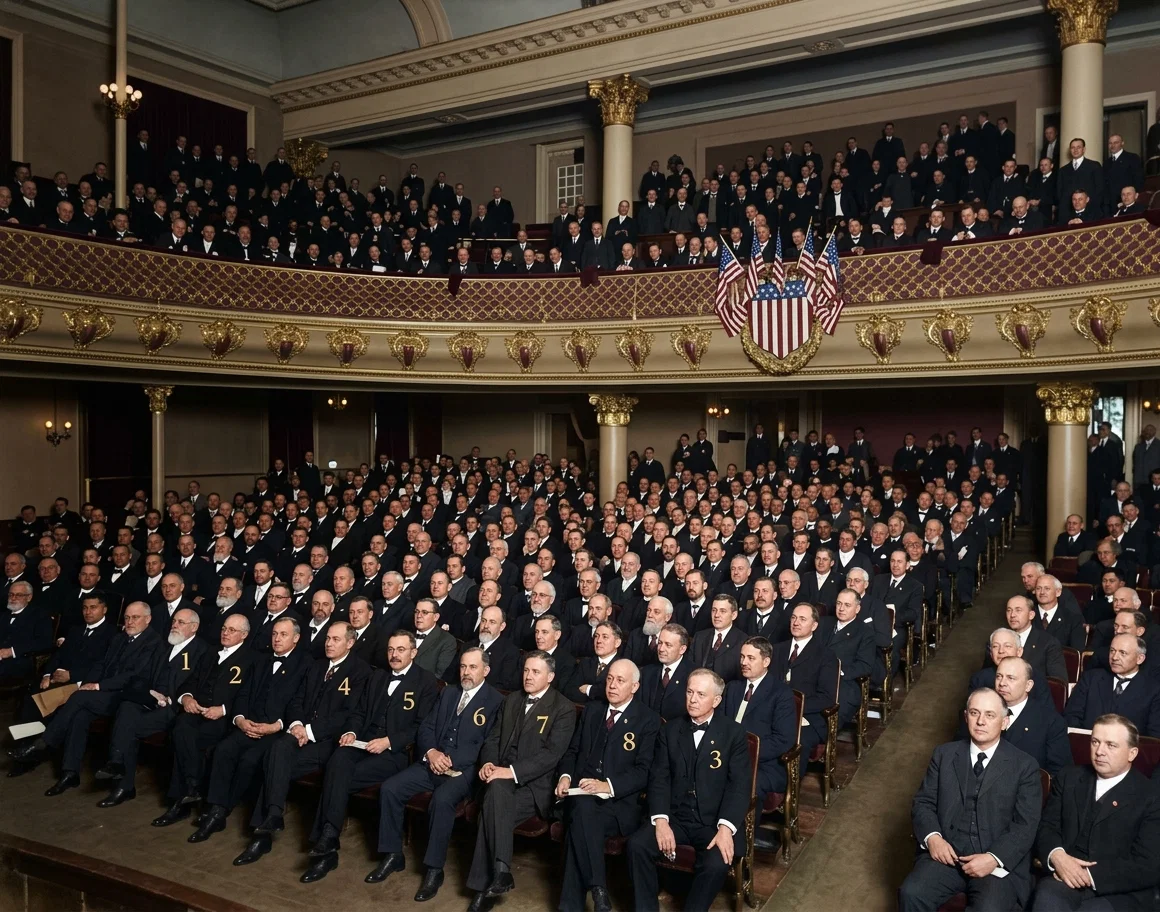
The council consisted of about four hundred fifty delegates, officially representing the following denominations:—
The Baptist Churches of the United States. The Free Baptist General Conference. The Christians (The Christian Connection). The Congregational Churches. The Disciples of Christ. The Evangelical Association. The Evangelical Synod of North America. The Friends. The Evangelical Lutheran Church, General Synod. The Methodist Episcopal Church. The Methodist Episcopal Church, South. The Primitive Methodist Church. The Colored Methodist Episcopal Church in America. The Methodist Protestant Church. The African Methodist Episcopal Church. The African Methodist Episcopal Zion Church. The General Conference of the Mennonite Church of North America. The Moravian Church. The Presbyterian Church in the United States of America. The Cumberland Presbyterian Church. The Welsh Calvinistic Methodist or Presbyterian Church. The Reformed Presbyterian Church. The United Presbyterian Church. The Protestant Episcopal Church. The Reformed Church in America. The Reformed Church of the United States of America. The Reformed Episcopal Church. The Seventh-day Baptist Churches. The United Brethren in Christ. The United Evangelical Church.
At the opening session of the council, the retiring president, Dr. William H. Roberts, made an address in which the general status of the organization was defined, and its aims and purposes were set forth. From this address we quote:—
It [the federal council] is not a body whose members are self-chosen, but one composed of delegates duly appointed by competent authority, and possessed of a representative character. This council stands officially for thirty denominations, eighteen millions of communicants, and a world-wide Christian work.
The church of Christ and the nation are vitally related each to the other, and the welfare of the nation depends upon the fidelity of the church to its trust. The question of questions for a nation is its religion, and that question this council will make effort to answer in a Christian manner.
We believe that the great Christian bodies in our country should stand together, lead in the discussion of, and give an impulse to, all great movements that make for righteousness. We believe that questions like those of marriageand divorce, Sabbath desecration, foreign immigration, modern industry, the moral and religious training of the young, indeed, all great questions in which the voice of the churches should be heard, demand their united and concerted action if the church of Christ is to lead effectively in the thorough Christianization of our country.
Another supremely important matter is the relation of the American churches and the American nation to the world for which Christ died, and which he lives to save, bless, and make perfect in holiness. It is a subject of felicitation that the attitude of our nation is largely a Christian one toward other peoples.
THE DELEGATES TO THE FEDERAL COUNCIL OF CHURCHES
Our world policies of the last few years, with their center at Washington, have been prevailingly Christian in their spirit. American diplomacy has won of late victories impossible to battle-ships. The essential spirit of our nation is that of Jesus Christ, and it is the duty of the American churches to make that spirit more Christian, to awaken yet greater national interest in the welfare of all earth's peoples, to provide men and means in increasing ratios for the work of spiritual salvation, and to hasten the coming of the day when the true King of men shall everywhere be crowned as Lord of all. And this council stands for the hope of organized work for speedy Christian advance toward world conquest.
A statement of the purposes requires a concise statement of historical facts. The meeting of this council, as suggested by its character, is an indication of that appropriate development which is true progress in the affairs of the kingdom of God. Different epochs are characterized by dominant ideas, differing, yet closely related to each other in the system of religious thought. The Protestant Reformation, for instance, emphasized the right of private judgment, and by so doing rendered inestimable benefit to mankind. It taught men to think for themselves, and developed in a notable manner individuality of character.
Rights of conscience and the independence of the individual have now been efficiently acknowledged for four centuries, and have become fundamental principles of the social and religious organizations of the modern world, especially in the United States. Thoughtful persons are realizing the need of combination and co-operation in religious work. The rights secured by the Reformation of the sixteenth century are a foundation, standing upon which Christians are assured of liberty of thought and action.
And the time has come when Christian free men should be prepared to act together for the welfare of their neighbors, their country, and their God. The interests of the individual no longer blind the eyes of believers to the need of mutuality in service.
From these statements, two conclusions may be readily drawn: (1) The problems to which the council proposes to give attention are nearly all such as can be solved only by means of legislation; (2) the council is a great “combination” whose influence is to be exerted as a unit in the accomplishment of its aims. In other words, this federal council of churches is to a large extent a combination for religio-political purposes. This is also clear from the following statement of one of the objects of this organization:—
To secure a larger combined influence for the church of Christ in all matters affecting the moral and social condition of the people, so as to promote the application of the law of Christ in every relation of human life.
In view of this explanation of purpose, we may fittingly call attention to the declarations in the Senate Mail Report communicated to the United States Senate, Jan. 19, 1829, and concurred in by that body:—
Extensive religious combinations, to effect a political object are, in the opinion of the committee, always dangerous. This first effort of the kind calls for the establishment of a principle which, in the opinion of the committee, would lay the foundation for dangerous innovations upon the spirit of the Constitution, and upon the religious rights of the citizens. If admitted, it may be justly apprehended that the future measures of the government will be strongly marked, if not eventually controlled, by the same influence. All religious despotism commences by combination and influence; and when that influence begins to operate upon the political institutions of a country, the civil power soon bends under it; and the catastrophe of other nations furnishes an awful warning of the consequence.
The report made to the council by its secretary, Dr. E. B. Sanford, is of interest as indicating the class of work which is likely to be undertaken by this great “combination.” He referred to three definite victories which had been gained through federation. First, the change in the divorce law of South Dakota. Concerning this change the secretary said:—
It gives me pleasure to announce in this presence that the instrumentality that gave the initiative and labored unceasingly until the victory of the ballot-box was won was the federation of churches of South Dakota. It was a victory won by the united churches of Christ in that commonwealth.
The second definite result reported was the passage of the anti-gambling law in the State of New York. Concerning this work, the secretary thus reported:—
At the request of the executive committee this matter was taken up by the National Federation of Churches in connection with the New York State and city federations. Literature explaining the entire situation was sent to every pastor in the State. The response to this appeal carried petitions to the Assembly at Albany, signed by thousands of voters. Various voluntary organizations had before this sought to arouse public sentiment, but now for the first time the forces of evil realized that the churches in a united way were back of this appeal for the righting of a great wrong.
In his message of December, 1907, Governor Hughes, a charter member of the executive board of the National Federation of Churches, sounded a clarion note and gave a splendid leadership under which the forces of righteousness, civic and religious, rallied to his support, and secured the victory that is now world famous.
The amelioration of the condition of the inhabitants of the basin of the Kongo was the third result reported. After referring to the combined action taken in the interest of this effort, and to interviews with the President of the United States and the Senate Committee on Foreign Relations, the report of the secretary continues:—
Within a week after these interviews a resolution was introduced in the Senate, and adopted by a unanimous non-partisan vote that gave the President power to take such steps as he might deem wise in co-operating with, or in aid of, any of the powers signatory of the treaty of Berlin for the amelioration of the condition of the inhabitants of the basin of the Kongo if inquiry revealed the truth of alleged cruelty. . . . The united action of Protestant Christianity in Europe and America has brought partial relief, and selfish greed, backed by imperial resources, was compelled to recognize a power for righteousness that is the hope of nations and of oppressed humanity.
The report of these successes was commented upon by the secretary in these words:—
This brief summary of office and executive work illustrates the power of federated action in winning victories where moral issues were involved—matters which, to quote the language of the letter missive that brought together the conference of 1905, “concern Christians of every name, and demand their united and concerted action if the church is to lead, effectively, in the conquest of the world for Christ.”
From the closing paragraphs of the secretary’s report we quote the following:—
The American church, in its evangelical fellowship, is represented here today as never before in the history of the nation. It is no exaggeration to say that the attention of the leaders of thought in the Christian world in all the divisions of its ecclesiastical life is turned toward this council. A body of men that represents to any extent a constituency that includes a church-membership of over seventeen millions and a family and individual constituency of more than half of the population of this nation of eighty millions, can but receive world-wide recognition from those who thoughtfully watch the trend of national and international affairs.
It is true that there were individual utterances in the council which indicated that there were some of the delegates who realized the impossibility of converting the world by securing better laws governing marriage and divorce, Sabbath observance, etc., but it was very clear that the official leadership of the council had a very definite conviction that the great victories to be gained were in the field of legislation upon moral subjects, and that it was in this way that the combined influence of such a large body could be used most effectively.
In illustration of the correctness of this estimate of the future work of the council, we quote the following statement made by Rev. E. T. Root, field secretary of the Rhode Island and Massachusetts Federation of Churches. In the discussion of one of the questions before the council, Mr. Root said:—
The churches must know and have on record the position of every voter upon all moral questions, and then it is prepared to act upon such questions.
When church leaders use their organization for such a purpose as this, they become a mere adjunct to a political party, and use their combined influence in a purely political way, for purely political purposes.
Of the various reports submitted to the council and the discussion thereupon, we will speak in a further report.

The Gospel, Not Legislation

SINNERS are not converted by act of Congress. Evil desires are not taken out of the heart by legislation. Religion is a matter between man and God, and depends upon individual choice. It is the mission of the ministers of Christ to preach the gospel of the kingdom of God, not the gospel of this world, and men are regenerated as individuals rather than collectively. The troubles in the world are the result of sin, and the gospel of Christ is the only remedy for sin. If ministers neglect to preach the gospel, and undertake to cure the ills of the world by some other means, such as by changing the environment or securing favorable legislation, they will meet with a double failure; for the gospel will not be preached, and the ills will not be cured. Neither Jesus nor his disciples attempted to reform Roman society, then most corrupt, by combining all those in favor of good morals in an effort to improve the laws of the empire, but they went everywhere preaching the Word of God as the agency for true reform. We can not improve upon the methods of Jesus.

Editorial

THE longing of the soul for light and truth, and the earnest desire for fellowship with our Elder Brother, are not the mere mockings of a fevered imagination. They are the responses of a being made in the image of God, who is being drawn toward heavenly things. Cultivate the longing, and encourage the desire. There is hope for those who are reaching out for something better, and there is satisfaction for those who hunger and thirst after righteousness.

The Calendar of the Week in Bible Times

In his comments on the phrase, “Toward the first day of the week” (Matt. 28:1), Dr. Lightfoot, the old English scholar, said:—
The Jews reckon the days of the week thus: One day (or the first day) of the sabbath. Two of the sabbath [he puts it in Hebrew characters]. Two witnesses come and say, The first of the sabbath this man stole, etc., and on the second day of the sabbath judgment passed on him (i. Bab. Maccoth, fol. 5. 1). . . . Ezra ordained that they should read the law publicly on the second and fifth day of the sabbath, etc. He appointed that judges should sit in the cities on the second and fifth day (Hieros. Meg. fol. 75. 1). Ezra appointed also that they should wash their clothes on the first day of the sabbath. (Bab. Bava Kama, fol. 8. 2).—Lightfoot’s Works, Vol. II, page 271, London, 1684.
It is plainly to be seen how, in common usage, the Sabbath gave its name to the weekly cycle. The Sabbath marked the full week, and was the chief day. So many weeks were so many sabbaths. A week came to be called a sabbath, and the days of the week were one, two, three, etc., into or of the sabbath.
This was the common weekly calendar style in ancient Syria. Horne, in his “Introduction” (Vol. III, page 165), refers to the use of the word sabbata for a week “among the Syrians, Arabians, Christian Persians, and Ethiopians, as in the following ancient Syriac calendar expressed in Hebrew characters (taken from Bishop Marsh’s Translation of Michaelis’s ‘Introduction to the New Testament,’ Vol. I, page 136):—
One of the sabbath, or week—Sunday Two of the sabbath, “ “ Monday Three of the sabbath, “ “ Tuesday Four of the sabbath, or week—Wednesday Five of the sabbath, “ “ Thursday Eve of the Sabbath, “ “ Friday The Sabbath — — — Saturday
With such a calendar in current use, the only way in which one could understandingly speak of the days of the week in New Testament times was to call the seventh day “the Sabbath;” the first day of the week, or Sunday, would be “one of the sabbath;” Monday, “two of the sabbath,” etc. Horne says:—
It is remarkable that all the evangelists follow the Syriac calendar, both in the word sabbata, used for “a week,” and also in retaining the cardinal number, mia sabbaton, “one of the week,” to express the day of the resurrection. Matt. 28:1; Mark 16:2; Luke 24:1; John 20:1.
The Jewish usage of centuries, as quoted by Lightfoot, and the style of the ancient Syriac calendar of the week, are sufficient to demonstrate to any eye that can see, that the translators of the Bible have correctly translated Matt. 28:1 and kindred texts, by the phrase “first day of the week.” W. A. S.

The Rise and Fall of Religious Liberty in America

The Constitution and the Gospel Misinterpreted

The argument of Mr. Justice Brewer, referred to in the preceding article, opened the way for the nation to enter upon a course of religious legislation; and not only that, but the justice sought, in that argument, so to interpret the United States Constitution as to make it uphold, in spite of itself, the Christian nation idea. The Constitution plainly declares the purpose of the federal government to be non-interference in the religious affairs of the people. Nevertheless, in the effort to prove this a Christian nation the justice cites the church-and-state compact of the Puritans (which made the maintenance of the gospel and the discipline of the churches a part of the state's duties); the religious-test oath of Pennsylvania (which made belief in God and in future rewards and punishments a prerequisite to citizenship); public taxation for the support of religion; a declaration of belief in the Trinity and the inspiration of the Scriptures as a necessary qualification to the holding of public office; the Pennsylvania Supreme Court's decision that Christianity is a part of the common law; and the laws respecting the “observance of the sabbath” in the various States—he cites all these church-and-state arrangements to prove this a Christian nation, then brings the national Constitution into the group, and declares:—
There is no dissonance in these declarations. There is a universal language pervading them all, having one meaning. They affirm and reaffirm that this is a religious nation.
Thus is the Constitution, which was designed to guarantee a separation of church and state, made to speak the same language, and stand for the same thing, as did those utterances and documents which had to do solely with governments that tyrannized over the souls of men. In other words, the national Constitution, the guardian of liberties, is made to speak a language completely at variance with itself, and in harmony with institutions against which it was designed by its framers to be an everlasting protest. So by this misinterpretation the Constitution is made to stand not for “a new order of things,” as the great seal reads, but for the same old order of things that obtained in colonial days, and in the days of Elizabeth, and Ferdinand and Isabella. Against such an interpretation we protest, and set the liberties of this generation over against the soul-thraldom of those generations as a proof that the protest is just and warranted.
But this misinterpretation of the spirit and purpose of our Constitution, and this declaration that this is a Christian nation, has been received with enthusiastic plaudits by that element in the country which is seeking to “put God in the Constitution,” put certain Christian laws, rules, and usages in “the fundamental law of the land,” and inaugurate a campaign of religious legislation for the “moral reformation of the nation.” Morality by enactment, religion by civil law, salvation through legislatures, general taxation to support the teachers of religion, Sunday laws to fill the churches with worshipers, legal censorship over the religious faith and practise of men, the kingdom of God through the gateway of politics—these purposes of the National Reform and “civic righteousness” forces have, by that dictum of the Supreme Court and that misinterpretation of the national Constitution, received a stimulus that has increased the effectiveness of their efforts a hundredfold. That some such pronouncement was what they were hoping for will be seen by the following quotations. The first is from the official organ of the American Sabbath Union, the Pearl of Days, of May 7, 1892, less than four months after the famous dictum had been uttered. It declares that this decision—
‘establishes clearly the fact that our government is Christian. The decision is vital to the Sunday question in all its aspects, and places the question among the most important issues now before the American people. And this important decision rests upon the fundamental principle that religion is imbedded in the organic structure of the American government—a religion that recognizes, and is bound to maintain, Sunday as a day for rest and worship.’
It is easy to see from the above quotation how the Christian-nation dictum of the Supreme Court has helped Sunday-law advocates to read into the “organic structure of the American government” something that the founders of this government never designed should be there—a commingling of civil and religious things, and the maintenance of a religious observance by national law.
On May 21 the Christian Statesman, official organ of the National Reform Association, seconded the declaration of the Pearl of Days in these words:—
“Christianity is the law of the land.” “This is a Christian nation.”—U. S. Supreme Court, Feb. 29, 1892. The Christian church, therefore, has rights in this country. Among these is the right to one day in seven protected from the assaults of greed, the god of this world, that it may be devoted to worship of the God of heaven and earth.
It would, of course, be inferred from this expression that since the beginning of this nation, and up to the date of that Christian-nation declaration, the Christian church in this country had been deprived of its rights, and church-members were forbidden to assemble one day in seven for the worship of God. Such an implication is an utter perversion of the noble principles of justice and equality upon which the nation was founded.
That we have not misinterpreted the attitude of the National Reform Association toward the Supreme Court decision of Feb. 29, 1892, nor its attitude toward the fundamental principles of the nation itself, is shown from the following quotation from the Christian Statesman of Nov. 19, 1892. This utterance is from one of the district secretaries of that association, Mr. William Weir, of Washington, Pa., and reads:—
“This is a Christian nation.” That means Christian government, Christian laws, Christian institutions, Christian citizenship. And this is not an outburst of popular passion or prejudice. Christ did not lay his guiding hand there, but upon the calm, dispassionate supreme judicial tribunal of our government. It is the weightiest, the noblest, the most tremendously far-reaching in its consequences of all the utterances of that sovereign tribunal. And that utterance is for Christianity, for Christ. “A Christian nation!” Then this nation is Christ's nation [“My kingdom is not of this world.”—Jesus], for nothing can be Christian that does not belong to him. Then his Word is its sovereign law. Then the nation is Christ's servant. Then it ought to, and must, confess, love, and obey Christ. All that the National Reform Association seeks, all that this department of Christian politics works for, is to be found in the development of that royal truth, “This is a Christian nation.” It is the hand of the second of our three great departments of national government throwing open a door of our national house, one that leads straight to the throne of Christ.
And that association began at once to make of that declaration of the Supreme Court all they could for the furtherance of their aims. They had battled against the national Constitution for years. Here now was a decision of the Supreme Court attempting to make the Constitution stand for what they wanted it to stand for, attempting to make it mean what they wanted it to say. But the spirit of the above quotation, which is the spirit of the National Reform Association and its allies, is entirely at variance with the genius of American government, and with the spirit of the great document which they assail. Civil government is an instrument of force, of compulsion. The religion of Jesus Christ is a matter of choice, of heart service. We can not compel men to love Christ; we can not compel men to yield acceptable heart service to him. To attempt either is to misinterpret utterly the spirit of the gospel, and to misconstrue the purpose of Christ in giving it. Neither has the leading of men “straight to the throne of Christ” ever been given to the nation to do. That is the work of the church; and when the church seeks to put it upon the nation, to bring about by legislation, she cumbers the nation with a task it can not hope to do, and herself shirks the task which her divine Master has laid upon her. Strange to say, that theory of the church's need of a political assistant in promulgating the gospel and of the state's appointment to that position, is winning adherents with marked rapidity. The church is “laying hands” on the state, and dedicating it to that solemn work, and statesmen who fear “political beheadal” are offering their unsanctified services to that end.
The manner in which this was brought about, and the attitude of statesmen in accepting the appointment, will be shown in another article. C. M. S.

A Word for the Watchman

OUR people are being notified by the publishers of the Watchman that, beginning January, 1909, that paper will be issued as a monthly. The reasons for making this change have been clearly stated, and the general policy of editors and publishers has been presented.
All who are interested in the success of the Watchman are praying and hoping that this change will greatly increase both the circulation and the influence of this herald of the truth for this time. It is the determination of those in charge of the Watchman to make it a strong, up-to-date journal. It will take its place among our best monthlies, and should have a largenumber of our people to do home missionary work. Our brethren and sisters in all the churches throughout the South should push this publication. Young people in all the schools of the South should be trained to sell it. Many of our people in the North could go South and engage in self-supporting work in the circulation of the Watchman. The way is clear, the work should be done, and the Lord has raised up the people who can do it. Then let us do it with all the heart. A. G. DANIELLS.

Prohibition Opposed

IN the current number of the North American Review, a Catholic priest writes upon “Prohibition in the Light of Christian Ethics,” taking ground against prohibition, but in favor of what he calls temperance. He argues thus:—
One great danger to-day with prohibitionists is the tendency to make their movement synonymous with Christianity, and to base their principles confusedly upon what they suppose to be the principles of Christ. They fall into the common error of quoting from a fickle memory without verifying their references. Still another mistake is the manner in which they confound the cardinal virtue of temperance with prohibition, whereas the only relation in which the latter can be looked upon as being in any sense a Christian virtue, is when its exercise is along the lines of religious asceticism in the name of Christ. And even then, as we shall show, it is clearly a matter of expediency rather than a Christian principle.
All this is in perfect harmony with the traditions of the Roman Catholic Church, which organizes great temperance societies, and makes a loud profession in favor of temperance, while a very large number of those who both sell and drink intoxicating liquors are members of the Roman Catholic Church. The writer of this article does not anticipate that any especially valuable results will follow from making it difficult to purchase intoxicating liquors. He advocates an entirely different plan:—
The only basis of reform, then, is through the individual; the building up of his moral strength and will-power which will result in self-control. This clearly is the work of the Christian church, and the only solution of the problem. Regulate the saloon by all means; rid it of its debasing conditions, or change the method of supply of intoxicants by abolishing the saloon, if needs be, for governmental control and sale, or some other judicious method: all this may be well and good and wise, but the one essential that must ever be kept in view is to teach men to be masters of their appetites. When this is done, the problem is solved.
Reform the individual certainly, but it is not necessary to have a saloon on every corner in order to do this. Prohibition helps rather than hinders the work of individual reform.
Continue reading: Religion and the Government