It is interesting to note that this complicated problem, with which statesmen have struggled for a century and which is now convulsing all Europe, was foretold in the writings of the prophets centuries ago.
Students of the Bible and of Bible commentaries are familiar with the prophetic outlines which give the rise, history, and downfall of many of the great nations of the world. The overthrow of Egypt, Assyria, and Babylonia was foretold by the prophets long before their downfall. The place, power, and final destruction of the Medo-Persian, Grecian, Roman, and Turkish Empires are definitely and clearly set forth in the prophetic outlines.
The eleventh chapter of Daniel gives a wonderful forecast of the history of the world from the Persian Empire to the close of human history. The prophecy opens with the following statement:—
“Now will I show thee the truth. Behold, there shall stand up yet three kings in Persia; and the fourth shall be far richer than they all; and by his strength through his riches he shall stir up all against the realm of Grecia.” Dan. 11: 2.
Starts with Persia
From this statement it is plain that Persia is the kingdom with which this long line of prophecy starts. Persia was to “stir up all against the realm of Grecia,” but was to meet in Grecia a “mighty king” who would “rule with great dominion, and do according to his will.” Verse 3.
This mighty king of Grecia, as all know, was Alexander. Of him, and the vast dominion over which he extended his conquests, the prophecy declared:—
“When he shall stand up, his kingdom shall be broken, and shall be divided toward the four winds of heaven; and not to his posterity, nor according to his dominion which he ruled; for his kingdom shall be plucked up, even for others beside those.” Verse 4.
Note these specifications: (1) When he shall stand up, his kingdom shall be broken; (2) it shall be divided toward the four winds of heaven; (3) not to his posterity, but for others.
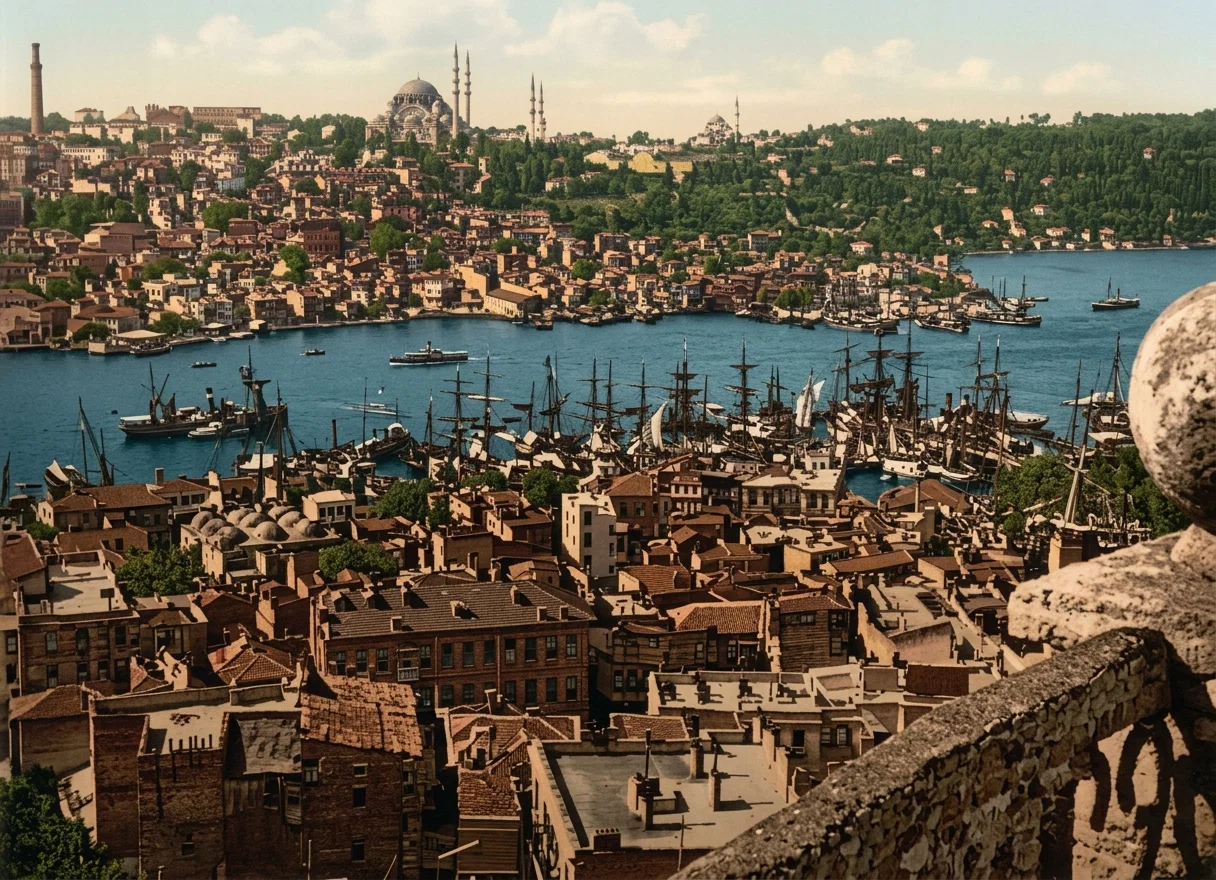
A VIEW OF CONSTANTINOPLE ON THE BOSPORUS
These predictions are all clearly met in the history of Alexander’s conquests, and the division of his empire after his death. Note the following historical facts:—
1. Immediately after his return to Babylon from his triumphant march through Asia as far east as India, Alexander died, while still young, and at the pinnacle of his glory and power. As he left no heir to his throne, his generals made his weak-minded half brother Arrhidaeus king. It was also arranged that if the expected child from Roxana, Alexander’s wife, should be a son, he should succeed to the throne. Perdiccas, one of the generals, was appointed regent; and other leading generals were appointed governors of various provinces and divisions of the empire. Roxana’s child proved to be a son, but in a short time both mother and child were murdered.
2. “With the death of Alexander’s son, the empire of Alexander the Great became only a geographical conception. In fact, it was split into separate parts, and the central power, continually weakened since Alexander’s death, had completely vanished. The generals now regarded the provinces, which had been originally assigned to them by the higher power merely for administration, as their own dominion. It was therefore only natural that after 306 B. C. they styled themselves ‘kings,’ for kings they had been for years.” — “The World’s History,” Vol. IV, p. 134.
3. “The battle of Ipsus (301 B. C.) resulted in a permanent division of the vast empire founded by Alexander the Great, after twenty-two years of sanguinary wars among his generals, during which the whole of Alexander’s family and all his relatives perished. The triumphant Seleucus and Lysimachus divided the dominion of Asia between them; Seleucus received the Euphrates Valley, north of Syria, Cappadocia, and part of Phrygia; while Lysimachus obtained the remainder of Asia Minor, in addition to Thrace, which extended along the eastern shores of the Euxine as far north as the mouth of the Danube. Ptolemy was allowed to hold Egypt along with Palestine, Phœnicia, and Cœle-Syria; while Cassander was allowed to reign in Macedonia and Greece until his death.” — “Library of Universal History,” Vol. III, p. 799.
These brief historical statements record the fulfilment of every specification given in Dan. 11: 4. In two hundred thirty-five years after this prophecy was given, Persia had been overthrown by Grecia; Alexander, the “mighty king,” had been broken by the hand of death, and his kingdom had been divided toward the four winds of heaven, “not to his posterity,” but for others.
The King of the North, and the King of the South
At this point, two of these divisions, the east and the west, drop out of sight, while the other two, the north and the south, attain greater prominence. The situation in the year 281 B. C. exactly meets the statement of the prophecy. There were then but two divisions of the Grecian Empire. One was Egypt, in the south, a strong kingdom; the other was the kingdom of the Seleucidæ, in the north, a greater and stronger kingdom, stretching from Persia in the east to Macedonia in the west. These are the two kingdoms designated in verses 5-15 as “the king of the south” and “the king of the north.” These two kingdoms, founded by Ptolemy and Seleucus, for more than one hundred years very clearly filled in the outline given in the ten verses that follow their introduction into the prophecy.
At the close of Dan. 11: 15 the prophecy drops the two kingdoms of Ptolemy and Seleucus, while it traces the history of events that were to follow to the close of time. It foretells briefly the history of the Roman Empire, the great apostasy of the church during the Dark Ages, the Reformation of the sixteenth century, and the French Revolution which occurred near the close of the eighteenth century. After passing over this long period of about two thousand years, the prophet, in a very direct, positive statement, brings “the king of the south” and “the king of the north” back to the prominent place they occupied in the early part of the prophecy. The prediction is as follows:—
“At the time of the end shall the king of the south push at him; and the king of the north shall come against him.” Verse 40.
French Invasion of Egypt and Turkey
It is believed by many who have given this prophecy careful study, that “the time of the end” began in the year 1798, and that the power against which “the king of the south” and “the king of the north” were to make war was France. At “the time of the end,” 1798, Egypt, the old kingdom of the south, had come under the rule of the Mamelukes, while Syria, Asia Minor, Thrace, and Macedon, the original kingdom of the north, had been for centuries the Turkish Empire.
Thus in 1798, if this exposition be correct, Egypt and Turkey were to be at war with France. It is significant that in that very year, war was begun between these three powers. On May 19, 1798, a French fleet of four hundred ships, carrying forty thousand troops under the command of Napoleon, sailed from the south coast of France for the purpose of invading and conquering Egypt and Turkey. Before the year closed, both of these countries were at war with France. This conflict seems clearly to meet the specifications of the prophecy. And just what had been foretold regarding the outcome occurred. Egypt, the prophecy declared, was to offer resistance to this invasion by France. This she did, but failed. The Mamelukes fought desperately, but they could not stand before the onslaught of the French. They were terribly defeated July 21, at the Battle of the Pyramids, and the French flag was soon floating over the palace at Cairo.
Napoleon Defeated by Turkey
When the Turkish government at Constantinople learned of the French victories over the Mamelukes in Egypt, it declared war on France, September 4, and began preparing to meet Napoleon and his forces on the borders of Egypt. Learning of this, Napoleon, with his accustomed promptness to act, began his march from Cairo to Constantinople. Everything along the route was taken by the French until they arrived at St. Jean d’Acre. Here he met a stubborn resistance by the Turkish forces, who were assisted by the British ships under the command of Sir Sidney Smith. With a grim determination which only a Napoleon could muster, the French laid siege to the town. The struggle was4desperate and long. But Napoleon failed; and for the first time in his career, he sounded the note of retreat, and with his army, fled before the enemy. The victorious Turks pursued him, retaking southern Palestine, wresting from the French the whole of Egypt, and adding Libya and Ethiopia to their African possessions.
How clearly Turkey’s victories over the French, and her conquests in Egypt, Libya, and Ethiopia, meet the predictions of the prophet! He said that “the king of the north” would come against the invader “like a whirlwind, with chariots, and with horsemen, and with many ships; and he shall enter into the countries, and shall overflow and pass over. He shall enter also into the glorious land,” Palestine. “He shall stretch forth his hand also upon the countries: and the land of Egypt shall not escape. But the Libyans and the Ethiopians shall be at his steps.” Dan. 11: 40-43. Turkey’s history in Palestine, Egypt, Libya, and Ethiopia, from 1798 to 1825, meets every specification here given.
The Dismemberment of Turkey Foretold in Prophecy
But after foretelling these splendid victories for this power, the prophet predicts trouble and reverses, and utter ruin. He says: “But tidings out of the east and out of the north shall trouble him: and he shall come to his end, and none shall help him.” Verses 44, 45.
Turkey had no sooner completed her conquests in the south (1825) than serious troubles arose in the north—troubles that have continued to this day. Russia declared war on Turkey in 1827, and extended her invasion and conquests as far as Adrianople in the Balkan Peninsula, and Erzerum in Armenia. Turkey sued for peace, and signed the Treaty of Constantinople, losing heavily. Here began the disintegration and dismemberment of Turkey, which has gone steadily on until she has lost nearly all her territory in Europe, and every foot of her possessions in Africa. These losses have been so great that, as the North American Review says, “There is no longer a Turkish Empire in Europe. A strip of country around Constantinople is still held by the sultan’s troops; but all the other provinces of the Turkish Empire are in the hands of the Balkan Confederation.”
The Death Knell of Turkey
And now the decision has been made that the Turk must leave Europe. The decree has gone forth. When Turkey joined the Teutonic powers in the war now raging in Europe, Mr. Asquith, premier of Great Britain, made the following declaration for the British Cabinet: “It is not the Turkish people, it is the Turkish government, that has drawn the sword, and I do not hesitate to predict that that government will perish by the sword. It is they, and not we, who have rung the death knell of the Ottoman dominions, not only in Europe, but in Asia.”
Following this statement by the British premier, Mr. Sazonoff, the premier of Russia, in announcing certain Russian victories over the Turks, said that “the radiant future of Russia on the Black Sea is beginning to dawn near the walls of Constantinople.” About the same time, Sir Edward Grey, British foreign secretary, stated in the House of Commons that England was “in entire sympathy” with Russia’s plans for the settlement of the “politico-economic problem bound up with her access to the sea.” And he added, “What form their realization will take, will no doubt be settled in the terms of peace.”
The Program of Russia
The plainly expressed policy of Russia was well understood by both the premier and the foreign secretary of Great Britain when they made the significant utterances given above.
Writing of these important political announcements made in the capitals of England and Russia, Mr. Joseph Edgar Chamberlain says: “That the program of Russia and her allies will be carried out, and that Constantinople will become Russian, admits of little doubt. Sir Edward Grey did not name Constantinople in his remarks in the House of Commons expressing England’s sympathy with Russia’s aspirations, but the Duma pronouncement to which he referred did name it, and his declaration has no other meaning. It is arranged that Russia shall take the great city on the Bosporus.”—Evening Mail, London, Feb. 26, 1915.
England’s Policy Reversed
Students of world-wide politics are amazed at the great changes now taking place. In the Review of Reviews, April, 1915, Frank H. Simonds says: “Thus in a single hour the Eastern Question changed its whole appearance. Thus England, at last and unmistakably, however guarded the diplomatic phrase, renounced the policy of Beaconsfield, the policy which had provoked the Crimean War, and sent the British fleet to the Sea of Marmora to destroy the Treaty of San Stefano.”
In the London Evening Mail, Feb. 26, 1915, Joseph Edgar Chamberlain makes the following statement:—
“This news points to a step in history which the world has awaited with a sort of chill of horror for two hundred years; which England and France together fought one great war to prevent; and to discourage which, England has been more than once on the brink of other wars. After laying down millions in treasure and many thousands of lives in the Crimean War in 1853-56, and after the immense and costly coups of Disraeli’s statesmanship in 1878, it is now England herself who batters down the gates of Constantinople, in order that Russia may come in and possess it. Has there ever been so strange a right-about-face in the history of the nations?”
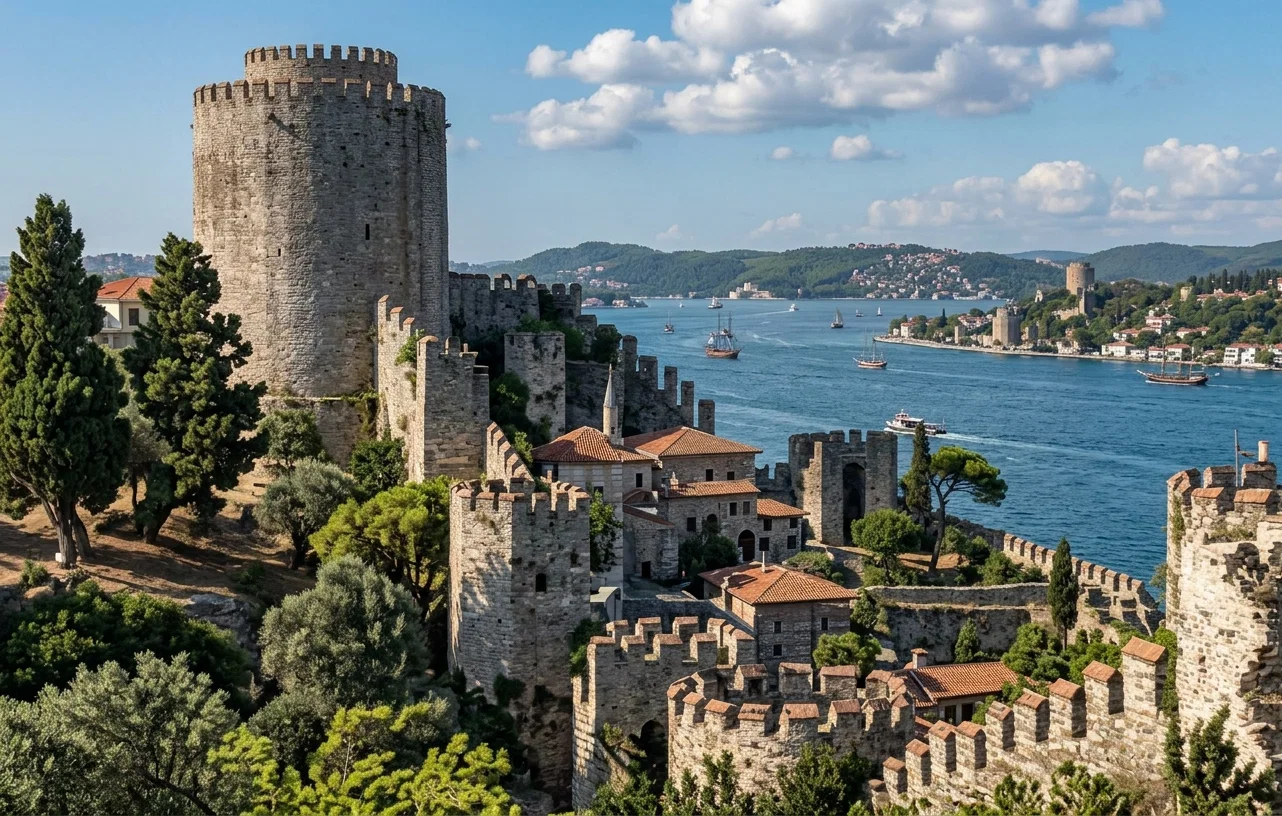
FORTIFICATIONS ON THE BOSPORUS NEAR CONSTANTINOPLE
Now all this is serious, very serious, for Turkey. It is the climax of the trouble she has been passing through since 1827, when Russia, her powerful enemy in the north, declared war upon her, pushed Russian victories almost to the walls of Constantinople, and compelled Turkey to sign a humiliating treaty. This was the beginning of a series of Turkish reverses which has continued to the present time, and brought the empire to the brink of ruin.
The trouble growing out of Turkey’s reverses and disintegration is not confined to the Turkish nation. It has extended to others, until it is now smiting all the nations of the world.
And there is nothing in sight that gives promise of relief. The roads of the European nations cross at Constantinople; and at that cross “the peace of Europe was crucified.” The sword will never be sheathed until Constantinople, the Bosporus, and the Dardanelles pass from Turkey into the hands of some other great power or combination of powers.
Will There be Peace?
But will that end the trouble, and establish lasting peace? How will peace be possible under the conditions that are sure to be created? According to the claims of all the Powers for a hundred years, the strong nation that possesses this strategic position will dictate terms to the rest of Europe, and that surely will not promote the peace of the world.
It requires no stretch of the imagination to see great trouble ahead of the Powers in their attempts to arrange terms of peace after the present war closes.
Discussing the question of remapping Europe after the war closes, Mr. H. G. Wells says: “To the redrawing of that map a thousand complex forces will come. There will be much attempted overreaching in the business and much greed. Few will come to negotiations with simple intentions. In a wrangle all sorts of ugly and stupid things may happen. . . . Europe will blunder into a new set of ugly complications, and prepare a still more colossal Armageddon than this that is now going on.”
Some such calamity was certainly foreseen by the ancient prophets. In closing the great prophetic outline recorded in the eleventh chapter of his book, the prophet Daniel foretells the destiny of the Turkish Empire. He says: “He shall plant the tabernacles of his palace between the seas in the glorious holy mountain; yet he shall come to his end, and none shall help him.” Dan. 11: 45.
Two things are here foretold of the Turk: First, he shall establish his palace in the “glorious holy mountain;” second, he shall then “come to his end.”
The Turk’s Capital to be Jerusalem
The palace, it is fair to assume, stands for the dwelling place of the sovereign—the capital. At present the palace of the sultan is in Constantinople. But that is not “the glorious holy mountain” of the Bible. That mountain is Mt. Zion, where Jerusalem stands.
This is made plain by a previous statement of the prophet Daniel, in one of his recorded prayers, in which he says, “O Lord, according to all thy righteousness, I beseech thee, let thine anger and thy fury be turned away from thy city Jerusalem, thy holy mountain.” Dan. 9: 16. With this agree the words of Zechariah, “Jerusalem shall be called a city of truth; and the mountain of the Lord of hosts the holy mountain.”
The capital of Turkey has never yet been located at Jerusalem, “in the glorious holy mountain.” But it is to be placed there, if we correctly understand this prophecy.
Without question, Jerusalem is the most likely city in Asiatic Turkey for the new capital of the government.
Blotted Out of Existence
Just when Turkey will be compelled to leave Constantinople, no one can tell. Just what city or cities may be made the new temporary capital, no one knows. The prophet said the palace would finally be planted “in the glorious holy mountain,” where Jerusalem is located; and everything in present-day conditions points to an early fulfilment of the prediction. How wonderfully time fills in the prophetic outlines of the Word of God!
But the prophet saw beyond the establishment of the new capital of Turkey at Jerusalem, “in the glorious holy mountain.” He foresaw and foretold the end—the utter ruin of the government of Turkey.
Colossal Complications at the Settlement
Looking at the serious complications already existing, and the worse tangle that is certain to follow this war, and judging of the future by the experiences of the past, how can we look for anything short of colossal trouble when these nations attempt a settlement of accounts? Divergent views, exorbitant demands, and conflicting claims are sure to prove insurmountable obstacles to the maintenance of peace.
This is the outlook presented by the prophet. After foretelling the disintegration of Turkey, the transfer of her capital to Jerusalem, and her final overthrow and ruin, the prophet says:—
“At that time shall Michael stand up, the great Prince which standeth for the children of thy people; and there shall be a time of trouble, such as never was since there was a nation even to that same time; and at that time thy people shall be delivered, every one that shall be found written in the book”—the book of life.
Universal Trouble and Ruin
By the connective “at that time,” these two events, the end of Turkey and the time of trouble, are immediately and inseparably associated. The sign of the end of Turkey’s reign will be the herald of the time of trouble. When the world sees Turkey coming to an end, all may know that the human race is about to receive a baptism of trouble such as it has never known “since there was a nation.” This is surely a sad, dark outlook, but it is exactly what the world faces today.
Deliverance Through the Prince of Peace
But this is not all that the future has in store for sinful, sorrowing, ruined humanity. Thank God, deliverance is promised to all who will accept it on the conditions required by the Deliverer. Here is the promise: “At that time shall Michael stand up, the great Prince which standeth for the children of thy people. . . . And at that time thy people shall be delivered, every one that shall be found written in the book,” Dan. 12: 1.
Michael, the Prince of Peace, is the Lord Jesus Christ. The standing up of the Prince of Peace is the beginning of his reign over his glorious kingdom of peace. The beginning of his reign is in connection with the time of trouble—the time of the world struggle of the nations. Then, in the midst of this trouble, when the Prince of Peace begins his reign, all whose names are at that hour found written in the book of
life will be delivered. They are the redeemed, and will receive the protection of him “who standeth for the children of thy people.”
This is the all-important feature of the prophecy. This is its climax, its glorious consummation. This is the great objective from the first verse to the last. There is the closest possible connection between the historical events foretold in the prophecy, and the things of the kingdom which the Prince of Peace is establishing. The prophecy points out these movements in the world which in one way and another touch the work of God. When thus set forth by the prophets, these events in the world become signs, or heralds, of greater and more important events relating to the kingdom of God.
The Final Clash of Nations
According to the prophecies, the whole world will be thrown into tumult and war over disputed political questions relating to the Near East. It so happens that Turkey is the nation in possession of the territory and the interests of the Near East at the time of this conflict. To reach a settlement of these problems means to dispossess Turkey. That means her downfall. The first step in the accomplishment of this end is to foment strife and war. This has been going on for a hundred years. The next step is to wrest territory from her. This has been done until now all her possessions in Africa, and nearly all in Europe, are gone. The great deciding blow will be to drive her from Constantinople, the capital of her empire. The war now raging in Europe is designed to accomplish this; and when it is brought about, there will be but one more great act in the drama,—the final and utter destruction of the Ottoman Empire. A number of the Great Powers have agreed to and publicly announced this last act. The universal belief is that this will soon be accomplished.
But the clash of nations that will bring Turkey’s end will be the Armageddon, the battle of the great day of God, foretold by John in Rev. 16: 13-17. That will be the time of trouble that the prophet Daniel says will attend Turkey’s overthrow. And at that time Christ, the Prince of Peace, will establish his everlasting kingdom. Then deliverance from all the sin, suffering, and sorrow of this world will come to the people of God.
The events now taking place before our eyes are sure tokens, cheering heralds, that that glorious day is almost here.
O that the world would read the signs of the times! O that sorrowing hearts might know that the terrible events now devastating the world are evidences of a better day close at hand! Let all who know the word which the Lord has spoken, proclaim it with a loud voice to all men, that they may be led to prepare to meet the Prince of Peace, who will soon bring deliverance to all his people.