VII. The Heavenly Sanctuary; the Appointed Time of Its Cleansing; the 2,300 Days
When called before the Roman governor to answer for his faith, the great apostle to the Gentiles “reasoned of righteousness, temperance, and judgment to come.” Never before had the haughty ruler listened to words like these. He had been accustomed to listen to words of flattery, such as upon this occasion had come from the proud Tertullus; but never had he been arraigned at the bar of divine justice; never had he stood face to face with the Judge of all the earth; never had he seen the corruption of his own life as it then appeared in contrast with the purity, the righteousness, of God’s holy law, by which he was eventually to be judged.
The divine certainty with which the prisoner pressed home the truth that his hearer would one day “stand before the judgment-seat of Christ,” that he must “give account of himself to God,” brought down the lofty spirit of the governor, and “Felix trembled” before the awful tribunal of eternal justice. Acts 24:25; Rom. 14:10, 12. It is evident that the apostle made the fact very emphatic that the great assize before which Felix was yet to be arraigned, was not in any wise uncertain, but was by fixed necessity, by divine appointment; and as the reality of that awful hour, when, instead of sitting in judgment upon another, he must himself stand before the judgment-seat of Christ, was impressed upon his heart by the Holy Spirit, he “was terrified, and answered, Go thy way for this time; and when I have a convenient season, I will call thee unto me.” Acts 24:25, A.R.V.
Upon another occasion the same apostle declared, “He hath appointed a day, in the which He will judge the world in righteousness by that Man whom He hath ordained; whereof He hath given assurance unto all men, in that He hath raised Him from the dead.” Acts 17:31. In the time of the apostles, therefore, the day of judgment had been appointed, but was then future.
In the book of Revelation, after portraying the scenes of conflict through which the righteous in the coming ages were to pass, the apostle John says: “I saw another angel fly in the midst of heaven, having the everlasting gospel to preach unto them that dwell on the earth, and to every nation, and kindred, and tongue, and people, saying with a loud voice, Fear God, and give glory to Him; for the hour of His judgment is come; and worship Him that made heaven, and earth, and the sea, and the fountains of waters.” Rev. 14:6, 7.
The Judgment Precedes the Coming of Christ
This is a very important declaration, and throws much light on the subject of the judgment, especially upon the time of its beginning. The angel was seen “having the everlasting gospel to preach unto them that dwell on the earth, and to every nation, and kindred, and tongue, and people.” In answer to the question of the disciples, “Tell us, when shall these things be? and what shall be the sign of Thy coming, and of the end of the world?” among other things Jesus said, “This gospel of the kingdom shall be preached in all the world for a witness unto all nations; and then shall the end come.” Matt. 24:3, 14. One of the prominent signs of the coming of the Lord and of the end of the world is the preaching of the gospel to “every nation, and kindred, and tongue, and people.” But with the preaching of the gospel message in all the world will be heard the solemn declaration, “Fear God, and give glory to Him; for the hour of His judgment is come.” Two angels were seen following the one with the judgment message. Then the prophet says: “I looked, and behold a white cloud, and upon the cloud One sat like unto the Son of Man, having on His head a golden crown, and in His hand a sharp sickle. And another angel came out of the temple, crying with a loud voice to Him that sat on the cloud, Thrust in Thy sickle, and reap; for the time is come for Thee to reap; for the harvest of the earth is ripe. And He that sat on the cloud thrust in His sickle on the earth; and the earth was reaped.” Rev. 14:14–16. “The harvest,” says Jesus, “is the end of the world.” Matt. 13:39. It is plain, therefore, that the message, “The hour of His judgment is come,” is to be proclaimed just prior to the coming of Christ, and while mercy is still extended to men.
The Investigative and the Executive Judgment
To such as have been accustomed to think of the judgment as taking place in connection with the coming of the Lord, the idea of its taking place in heaven prior to His coming may at first appear very strange. There are at least two phases of the judgment work—the investigative and the executive. This is in harmony with the principles of justice followed in earthly governments. Having been charged with a crime, the individual is brought before a tribunal, where the case is tried. All the evidence on either side having been presented, the case is submitted to the judge or jury for verdict. If the individual is found guilty of the crime with which he was charged, sentence is then pronounced against him. This is what we may call, for convenience, the investigative judgment. If justice is meted out to the criminal, there must follow the execution of the sentence, or the executive judgment.
The investigative judgment takes place in the holy of holies of the heavenly sanctuary, and constitutes the last work of our great High Priest. The executive judgment follows the close of Christ’s work as priest, and the beginning of His reign as king.
When the records kept in the sanctuary have been examined, the sins of the righteous “blotted out,” and their names confessed before the “Father, and before His angels” (Dan. 7:9, 10; Rev. 20:12; Acts 3:19; Rev. 3:5), the kingdoms of this world will then “become the kingdoms of our Lord, and of His Christ; and He shall reign forever and ever.” Rev. 11:15. The Lord of Glory will return to earth for His loyal subjects—the “heirs of the kingdom which He hath promised to them that love Him.” Those who have “died in faith, not having received the promises,” will hear His voice, and come forth glorified; and the living righteous will be “changed;” and all will hear “the King say unto them,” “Come, ye blessed of My Father, inherit the kingdom prepared for you from the foundation of the world.” John 14:1–3; James 2:5; Heb. 11:13; John 5:28, 29; 1 Cor. 15:42, 43, 51, 52; Matt. 25:34.
The Time of the Judgment
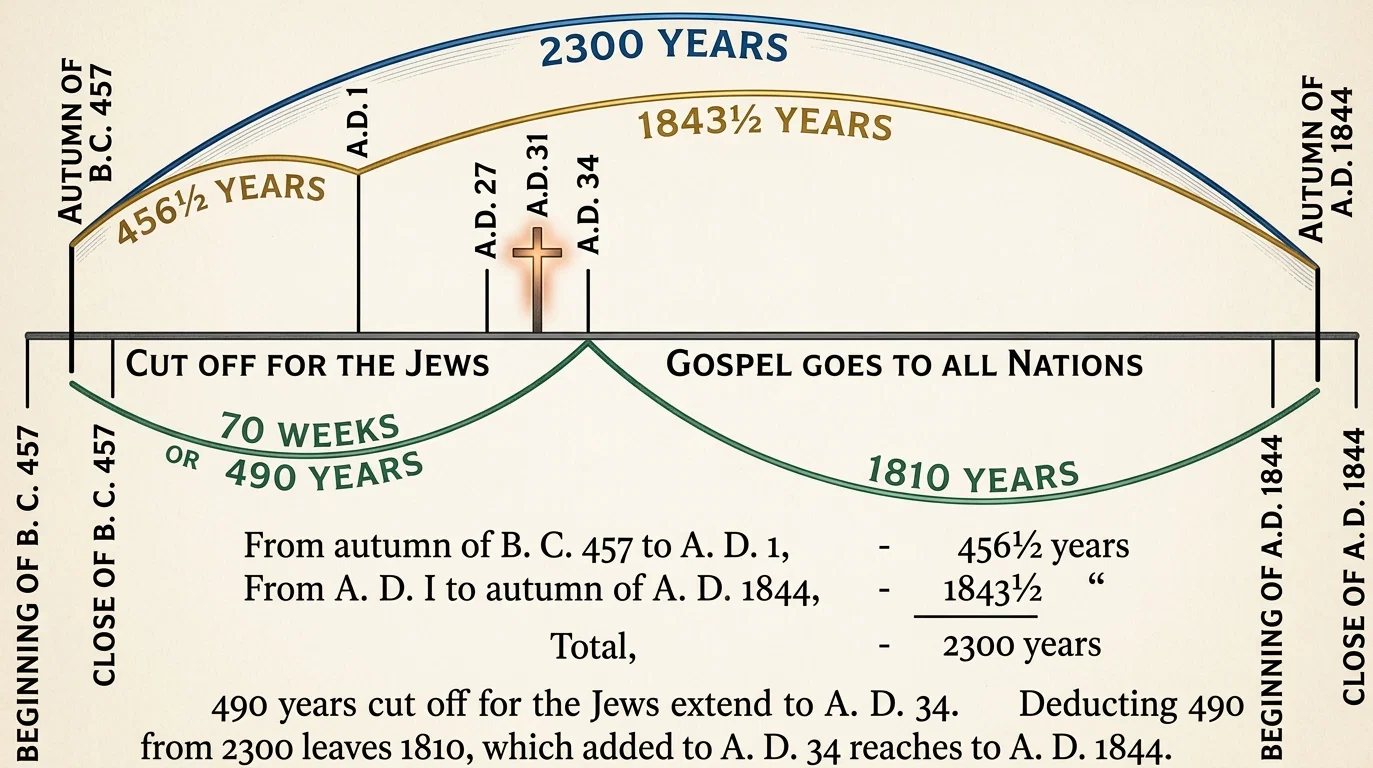
The apostle Paul said, “He hath appointed a day, in the which He will judge the world.” Acts 17:31. While Daniel was in vision, the angel said to him, “Unto two thousand and three hundred days; then shall the sanctuary be cleansed.” Dan. 8:14. This was evidently prophetic time; and as in prophecy one day represents a year (Num. 14:34; Eze. 4:6), this prophecy would cover a period of two thousand and three hundred years. In explaining to the prophet this time prophecy, the angel said: “Seventy weeks are determined upon thy people and upon thy holy city, to finish the transgression, and to make an end of sins, and to make reconciliation for iniquity, and to bring in everlasting righteousness, and to seal up the vision and prophecy, and to anoint the most holy. Know therefore and understand, that from the going forth of the commandment to restore and to build Jerusalem unto the Messiah the Prince shall be seven weeks, and threescore and two weeks: the street shall be built again, and the wall, even in troublous times. And after threescore and two weeks shall Messiah be cut off, but not for Himself.” Dan. 9:24–26. The Hebrew word chathak, here rendered “determined,” signifies to cut off. Seventy weeks—four hundred and ninety days or years—cut off from twenty-three hundred leaves eighteen hundred and ten. The time for the beginning of this period was said by the angel to be the “going forth of the commandment to restore and to build Jerusalem.” A copy of this commandment may be found in the seventh chapter of Ezra. It was issued in 457 B.C. “And they builded, and finished it, according to the commandment of the God of Israel, and according to the commandment of Cyrus, and Darius, and Artaxerxes king of Persia.” Ezra 6:14. Ezra arrived at Jerusalem in the autumn of 457 B.C. From this date 69 weeks, or 483 years, were to reach to the Messiah. This takes us down to the autumn of 27 A.D., when Jesus “was baptized of John in Jordan.” “And straightway coming up out of the water, He saw the heavens opened, and the Spirit like a dove descending upon Him.” Mark 1:9, 10, margin. The word “Messiah” means “Anointed.” John 1:41, margin. At His baptism, “God anointed Jesus of Nazareth with6power.” Acts 10:37, 38. Hence this portion of the prophecy met its perfect fulfilment at the baptism of Jesus, when He became the Anointed of God—the Messiah. “After threescore and two weeks shall Messiah be cut off, but not for Himself.” “And He shall confirm the covenant with many for one week: and in the midst [“half,” Leeser translation] of the week He shall cause the sacrifice and the oblation to cease.” Dan. 9:26, 27. Sixty-nine of the seventy weeks reached to the baptism of Jesus; and in the half or middle of the last week He was to be “cut off, but not for Himself.” This prediction was literally fulfilled in the crucifixion of the Saviour, in the spring of 31 A.D., exactly three and a half years from His baptism. The remaining three and a half years of the last week were devoted to the confirmation of the covenant through the apostles. Heb. 2:3. The entire period terminated in the autumn of 34 A.D. “At that time there was a great persecution against the church which was at Jerusalem; and they were scattered abroad,” and “went everywhere preaching the word.” Acts 8:1, 4.
DIAGRAM OF THE 2300 DAYS. (Symbolic Time.)
Thus far every feature of this wonderful time prophecy meets its exact fulfilment in the baptism and crucifixion of the Saviour, and in the apostles’ turning from the Jews to the Gentiles. When speaking to the Jews, Paul said: “It was necessary that the word of God should first have been spoken to you: but seeing ye put it from you, and judge yourselves unworthy of everlasting life, lo, we turn to the Gentiles.” Acts 13:46. 490 of the 2,300 years were now past, and 1,810 still remained. The 490 years ended in 34 A.D., hence 1,810 years more brings us to 1844. This marks the date of the termination of the 2,300 years, and reveals the time when, as the angel Gabriel declared, “the sanctuary shall be cleansed.” No earthly sanctuary then existed to which the word of the angel could apply, hence we look to the heavenly sanctuary for the fulfilment of the type. This prophecy definitely points out the time for the offering of the great antitypical sacrifice on Calvary, and the beginning of the ministry of our great High Priest in the first apartment of the heavenly sanctuary; also the time when He passed through the veil, and began His ministry in the second apartment, or most holy place, and the beginning of the work of cleansing the sanctuary—the final judgment.
The Holy of Holies Opened, and the Mystery of God Finished
The apostle John in vision beheld seven angels with seven trumpets. These angels sounded one after the other, and denote a series of events that were to take place from the close of the fourth century and onward to the time when the wicked are finally destroyed. Revelation 8, 9, 10, 11. “In the days of the voice of the seventh angel, when he shall begin to sound, the mystery of God should be finished, as He hath declared to His servants the prophets.” Rev. 10:7. The mystery of God is the gospel. Eph. 3:1–9; Col. 1:25–27; Rom. 16:25; 1 Tim. 3:16. The finishing of the mystery of God is to be accomplished early under the sounding of the seventh trumpet. The sixth trumpet ceased to sound with the loss of the independence of the Ottoman or Turkish power in August, 1840. This is susceptible of the clearest proof. The last three of the seven trumpets are called wo trumpets, and correspond to the fifth, sixth, and seventh trumpets. “The second wo is past,” said the angel; “and, behold, the third wo cometh quickly.” Rev. 11:14. A little period intervened between the close of the sixth trumpet in 1840, and the beginning of the seventh in 1844. When the seventh angel sounded, “the temple of God was opened in heaven, and there was seen in His temple the ark of His testament.” Rev. 11:15, 19. This, therefore, marks the beginning of Christ’s ministry in the most holy apartment of the heavenly temple. His work in that apartment is synchronous with the work of His people in the proclamation of the last message of mercy to all the world, “Fear God, and give glory to Him; for the hour of His judgment is come.”
The Standard of the Judgment
With the beginning of Christ’s work in the most holy place, the “ark of His testament” was seen. This article of furniture in the earthly sanctuary received its name from that which it contained—“two tables of testimony, tables of stone, written with the finger of God.” Ex. 31:18; 25:21, 22; Deut. 10:1–4. God’s ten holy precepts, found within the ark of His testament, beneath the mercy-seat in the heavenly temple, of which the law proclaimed upon Mount Sinai, and given to Moses, was but a copy, constitutes the standard of the judgment. Rom. 2:12, 16. By it every case will be decided for eternity. For more than sixty-eight years the judgment has been in progress in heaven. Soon it will close. God’s holy law enshrined beneath the mercy-seat, before which our Advocate pleads, speaks condemnation to the sinner, but righteousness and peace to the obedient.
The Final Scene
Once again we behold the judgment scene, not this time with the Roman governor alone standing tremblingly before the bar of God, but with the whole world arraigned before that awful tribunal; not now in prospect, but in the living present—“the hour of His judgment is come.” When Jesus ascended from Mount Olivet and took His place at the right hand of God as our Advocate and Saviour, and began His intercessory work at the throne of grace as our great High Priest, the world was all unconscious of that stupendous event, that God testified to the same by the outpouring of His Spirit on Pentecost, and His witnesses with great power proclaimed the message to all the world. So to-day the world is unconscious of the awful fact that the judgment is set, and the books are opened; that soon the final, irrevocable decision in every case will be reached, and the decree which will forever close the probation and fix the eternal destiny of all the world will be pronounced—“He that is unjust, let him be unjust still: and he which is filthy, let him be filthy still: and he that is righteous, let him be righteous still: and he that is holy, let him be holy still. And, behold, I come quickly; and My reward is with Me, to give every man according as his work shall be.” Rev. 22:11, 12.
Dear reader, you can not, with the natural eye, behold the judgment now in session in the heavenly court; but with the eye of faith you may behold it, and tho in truth you are guilty of the violation of God’s holy law, and are worthy of death, if you now commit your case wholly to your Advocate, trusting alone in the merits of His blood to cleanse you from all sin, and accept by faith the robe of His righteousness to cover the shame of your nakedness, you will stand before the throne of infinite justice without spot or wrinkle or any such thing, but perfect and complete in Him. If you have not done this, delay no longer. A more convenient season will never come. Haste, while mercy lingers, while its door is still open, to make your peace with God. “Behold, the Judge standeth before the door.” “Blessed are they that do His commandments, that they may have right to the Tree of Life, and may enter in through the gates into the city.” James 5:9; Rev. 22:14.