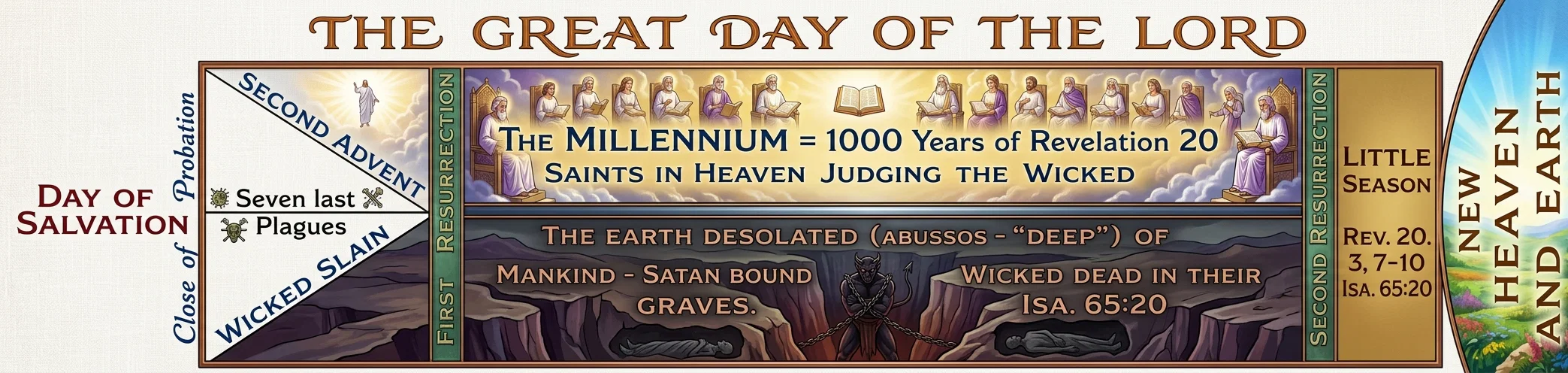
In our previous article, it was shown by clear and conclusive Scripture teaching that “the day of salvation,” the Gospel day, is followed by “the great day of the Lord,” a day of wrath, of retribution, of judgment. In other words, the close of the Gospel day is the close of probation, when the last generation of men make their final choice, and their character is fixed by that choice.
It is the time spoken of in Joel 2:14, when multitudes are in “the valley of decision.” They are brought into this valley of decision by the clear, stirring message of warning which goes to the world in the last generation, a message which proclaims the hour of God’s judgment, the second coming of Christ, and a warning against all false worship. This message develops a people who keep the commandments of God and the faith of Jesus, and it is followed by the seven last plagues, the second coming of Christ, and the harvest. See Rev. 14:6-20.
As the message of Noah brought the antediluvian world into the valley of decision, and thus ripened it for destruction, so the message of Revelation 14 brings the last generation into the valley of decision, and ripens off the harvest of the earth. See Joel 2:11-16. In verses 11 and 12 the heathen are warned of the judgment that is coming. Verse 13 declares that “the harvest is ripe;” verse 14 shows how the message of warning brings the people to a decision, and thus ripens the harvest.
This verse also proves that when the people are tested by the message, and decide for or against it, “the day of the Lord” follows it. Those who accept the Heaven-sent message are sealed as God’s servants and remain His to all eternity. Those who reject it, place themselves beyond the reach of God’s mercy, because they have trodden underfoot the Son of God, and counted the blood of the covenant an unholy thing, and done despite unto the spirit of grace. Heb. 10:29. Hence they remain filthy and unjust still. Rev. 22:11.
Christ Our Advocate.
“If any man sin, we have an Advocate with the Father, Jesus Christ, the righteous.” 1 John 2:1.
By divine appointment a complete round of service was performed each year in the earthly sanctuary in order that the work of each high priest might typify or represent the ministration of our High Priest in the heavenly sanctuary. His work is once for all. His sacrifice on Calvary was once for all. As our Advocate He ministers for us, once for all, in the true holy places, of which the holy places in the earthly sanctuary were patterns or figures. Heb. 9:24-28.
As the service of the high priest in the earthly sanctuary came to an end each year at the close of the Day of Atonement, so the service of our High Priest, or Advocate, closes in the heavenly sanctuary before He comes to reap the harvest of the earth, because the former service was a type of the latter. Heb. 8:1-5.
As the close of the year’s service in the type was marked by the Day of Atonement, a work of judgment, the removal of sin from the camp of Israel, and the cutting off of those who did not confess and forsake their sins (Lev. 23:27-30), so when our great High Priest comes to the close of His priestly service on the great antitypical Day of Atonement, there will be a work of judgment, the sins of God’s people will be finally removed, and those who have not confessed and forsaken their sins will be cut off, or destroyed. The following scriptures clearly show that Christ’s work as priest in ministering grace and pardon to sinners closes before He comes the second time, because when He comes again, it is to execute judgment and reward every man according to his works. Matt. 16:27; 24:30, 31; 25:31-33; 2 Thess. 1:7-9; 2 Tim. 4:1; Jude 14, 15; Rev. 22:11, 12.
The Coronation of Christ.
Jesus now reigns as priest-king on His Father’s throne. Rev. 3:21; Zech. 6:12, 13. While Jesus so reigns, it is called also the throne of grace (Heb. 4:16), because, as our Advocate, He ministers grace and pardon to repentant sinners. But the time will come when that reign will cease, and that throne and kingdom of grace will end (1 Cor. 15:24), and Christ will then be given His own throne and kingdom, inherited from His father David. Luke 1:31-33; Rev. 3:21; Dan. 7:13, 14.
Christ will be crowned King and receive His kingdom in heaven, before He comes again. Luke 19:12, 15. Those who reject the Gospel message and the solemn warning that accompanies it to all the world, just before the Saviour’s coming, are threatened with the unmixed wrath of God. Rev. 14:6-14.
While Jesus pleads the cause of sinners as High Priest, God’s wrath is mingled with mercy, but when He lays off His priestly robes and is crowned King of Kings, and Lord of Lords, wrath without the mixture of mercy is visited upon the ungodly. By rejecting God’s love and mercy, and resisting His Holy Spirit, they place themselves beyond the reach of divine mercy. They close their own probation and seal their own destiny by deliberately choosing the path of disobedience. Hence the divine announcement made shortly before Christ’s coming, “He that is unjust, let him be unjust still,” etc. See Rev. 22:11, 12.
In the brief period intervening between the close of probation, when Christ is crowned King, and His second coming, the seven last plagues in which is filled up the wrath of God are visited upon the wicked who have rejected the counsel of God and great Gospel light. These plagues are brought to view in Rev. 15:1, and graphically described in Revelation 16.
The events in the beginning of the great day of the Lord may be named as follows: (1) The coronation of Christ. (2) The close of probation and its announcement. Rev. 22:11. (3) The pouring out of the seven last plagues, the unmixed wrath of God. Rev. 14:9, 10; 15:1; and Rev. 16:1-21. (4) The second advent. Rev. 22:11, 12. Then we will have a fulfilment of Ps. 2:9; Rev. 2:27; 2 Thess. 1:7-9; 2:8; Rev. 19:11-16.