Ye Must Be Born Again

3%

Pacific Press Publishing Company · Oakland, California · Apr 23, 1896

FromSigns of the Times, Vol. 22, No. 17.

Read the full edition

Ye Must Be Born Again

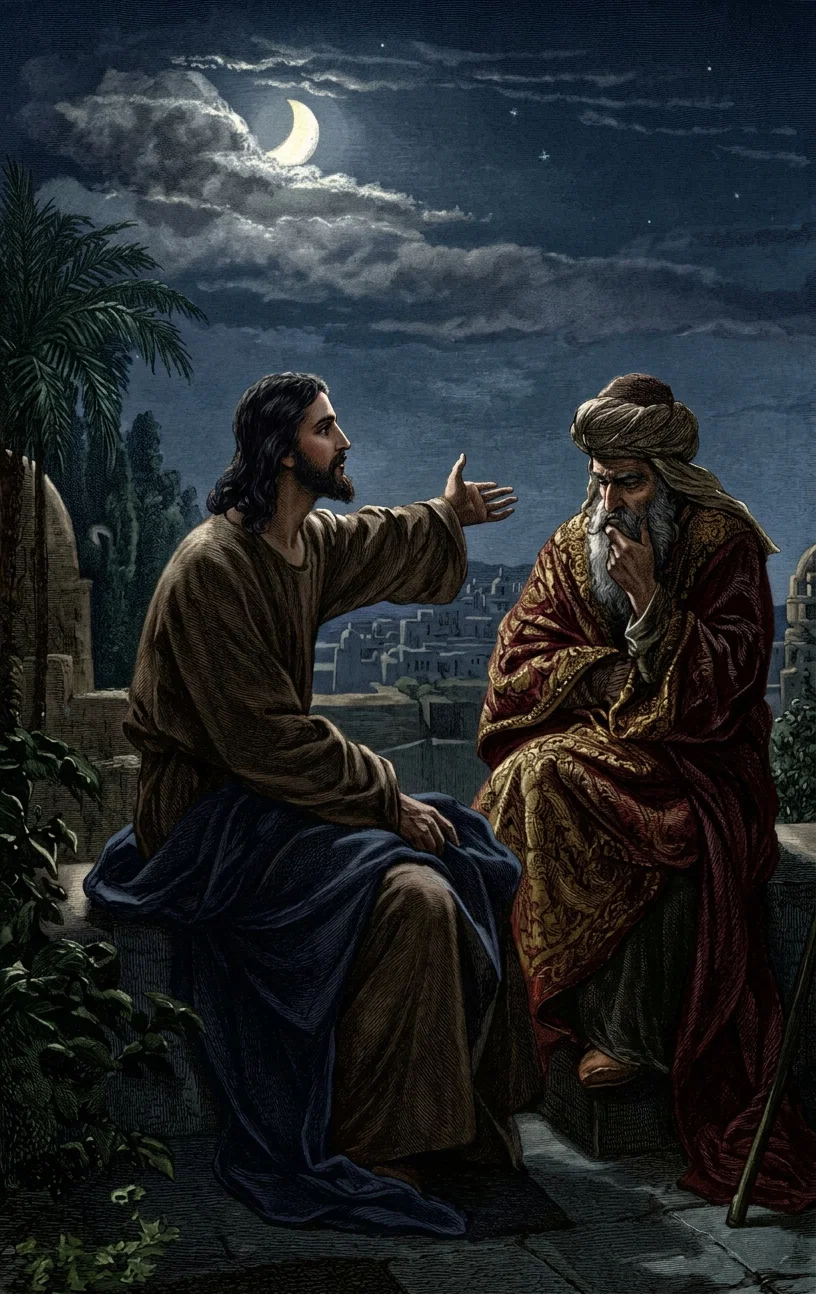
CHRIST AND NICODEMUS.
The above words express a truth taught by Jesus Christ. Shortly after beginning his ministry he had come to Jerusalem, had entered the temple, defiled by unholy traffic, had made a harmless whip of small cords, and, with divine majesty and righteous anger against sin, had driven out the unholy traffickers from the temple courts, rebuking their selfish and unholy zeal, and then with divine compassion had ministered to the bodies and souls of the sick and sinful.

The Surprised Pharisee

When the labors of the day were done, and Jesus was alone, a noted member of the Sanhedrin, a strict Pharisee, Nicodemus by name, whose curiosity and doubtless desire for truth had been aroused, came to Jesus with the courteous and somewhat patronizing address: “Rabbi, we know that thou art a teacher come from God; for no man can do these miracles that thou doest, except God be with him.” The reply of Jesus touched upon a spiritual truth so deep, yet withal so simple, that the Pharisee was surprised and nonplussed. Said Jesus, “Verily, verily, I say unto thee, Except a man be born again, he can not see the kingdom of God.” John 3:3.

How Born

Nicodemus replied as tho he understood in the most literal, material sense: “How can a man be born when he is old? can he enter the second time into his mother’s womb, and be born? Jesus answered, Verily, verily, I say unto thee, Except a man be born of water and of the Spirit, he can not enter into the kingdom of God. That which is born of the flesh is flesh; and that which is born of the Spirit is spirit. Marvel not that I said unto thee, Ye must be born again.” Verses 4–7. Very clearly was it stated by Jesus that the birth referred to was not a fleshly or material birth, but a spiritual birth, a change of the nature from fleshly to spiritual. Marvel not that so it must be.

Man’s Present Condition

“Man that is born of a woman is of few days, and full of trouble. He cometh forth like a flower, and is cut down; he fleeth also as a shadow, and continueth not.” Job 14:1, 2. The reason of this is that man can of himself rise no higher than his own nature, and this nature is sinful, inherited from Adam. See Rom. 5:12. Not alone this, but the entire race has followed on, sinning of themselves. “All have sinned, and come short of the glory of God.” Rom. 3:23. “Sin is the transgression of the law” (1 John 3:4; Rom. 7:7); and “sin, when it is finished, bringeth forth death” (James 1:15). “All unrighteousness is sin” (1 John 5:17); therefore righteousness is the keeping of God’s law, and is man’s bounden duty, else the law could not condemn him as a sinner. Moreover, the law is the reflect of God’s character (Ps. 119:172; Isa. 51:6, 7), and is what he requires of man (Eccl. 12:13; James 2:8–12). It is therefore evident that all mankind are now sinners, doomed to death. From the day of man’s birth his journey is toward the grave. He may spin out his little existence for a hundred years, but the brief moment is soon ended, and man lies down in the arms, not of a friend, but an enemy; for death is not a passport to the kingdom of God, but a bar to all its blessedness of life.

Under a Perverted Law

The law of God is the law of man’s life, not death. The “law was ordained to life.” Rom. 7:10. It was spoken in the words of God, which are spirit and life. John 6:63. If man had forever walked in God’s law, he would forever have been upheld by its life, or God’s life, which is in it; for “righteousness tendeth to life;” “he is in the way of life that keepeth instruction;” “in the way of righteousness is life; and in the pathway thereof there is no death.” Prov. 10:16; 11:19; 12:28. With the law in the heart there is life. But man perverted God’s law; and the perversion of God’s law is sin. The slightest alteration of a perfect circle destroys the circle. The change of a line or angle destroys a perfect square. So the Gospel perverted becomes “another gospel.” (Gal. 1:6, 7.) So also God’s law perverted in man’s life makes it “another law,” a law perverted by sin, leading to death, hence a law of sin and death, to which the sinner is a slave, “sold under sin.” (See Rom. 7:14, 21, 23, 25; 8:2.) The power of God is, however, still in his law, perverted tho it be. In God’s way, in the normal way of the law, the law works life; in the law perverted “thelaw worketh wrath” (Rom. 4:15); and the commandment which was “ordained to life,” the sinner finds to be unto death, because the carnal heart has perverted it (Rom. 7:10, 11, 13; 8:6). By perverting the power of the law, which was designed to work out in man only righteousness and life, its good power is used by sin to work out death. Therefore “the sting of death is sin; and the strength of sin [to cause death] is the law.” 1 Cor. 15:56. But it is God’s law perverted.

The Fruits of This Law

When man yielded to Satan, to the perverted law, he became the servant of sin. See Rom. 6:16–21. He was no longer free. He was of his father the devil, and the lusts of his father did he do, and has done ever since. (John 8:44.) His heart is carnal, bearing the fruits set forth by our Lord in Mark 7:21–23: “For from within, out of the heart of men, proceed evil thoughts, adulteries, fornications, murders, thefts, covetousness, wickedness, deceit, lasciviousness, an evil eye, blasphemy, pride, foolishness; all these evil things come from within, and defile the man.” The apostle Paul states the same thing in Gal. 5:19–21, and plainly declares that it is because of this condition that man “shall not inherit the kingdom of God.” He says: “Now the works of the flesh are manifest, which are these, Adultery, fornication, uncleanness, lasciviousness, idolatry, witchcraft, hatred, variance, emulations, wrath, strife, seditions, heresies, envyings, murders, drunkenness, revelings, and such like; of the which I tell you before, as I have also told you in time past, that they which do such things shall not inherit the kingdom of God.”

Man Helpless

And yet man of himself can do no better. He is a slave to sin, unable by the instruments of sin to break the bonds of sin. He is a child of wrath, a sinner, and therefore doomed to death. He is represented as being bound to a dead body, doomed to die with it. See Rom. 7:24. Having only the life of the perverted law, he can not rise above his perverted nature. A new power must come into his being, a stronger than he must break his bonds, a different law must take possession of his life, and he must possess a different heart, in order that he may bring forth proper fruit, and have a part in the kingdom of God. This is true of every one, outwardly exemplary tho his life may be. He may be “only strong for lack of test;” his heart may be like “a whited sepulcher,” full of corruption; his righteousness may be all of self and not of God.

“Marvel Not”

It was for reasons like the foregoing that our Lord told Nicodemus, “Marvel not that I said unto you, Ye must be born again.” The margin gives us a good thought, “Ye must be born from above.” See also in John 3:3: “Except a man be born from above, he can not see the kingdom of God.” He must be a child of the kingdom in order to inherit it. He must have its spirit in order that he may enjoy it. He must possess its life, and be infused with its power, in order that he may honor its King and keep its laws. Nay, more, the law of that kingdom must be written in his heart and mind, or he will not be loyal to its claims. But it can not be written on the carnal heart, or mind; for that is “enmity against God; for it is not subject to the law of God, neither indeed can be.” Rom. 8:7. The only way that man can be freed, the only way he can enter the fold of Christ and become a child of the kingdom, is to be converted, or changed, to be made a new creature, to have a new heart, a new mind, and new spirit. This is all implied in the “born from above,” “a new creature.”

Through Faith

This change is wrought through faith. “For ye are all the children of God by faith in Christ Jesus.” Gal. 3:26. The power which faith appropriates is of God, and is spoken in his word. “Of his own will begat he us with the word of truth.” James 1:18. “Being born again, not of corruptible seed, but of incorruptible, by the word of God, which liveth and abideth forever.” 1 Peter 1:23. The power in the word is the Spirit of God, or Spirit of Christ, for it is “by one Spirit are we all baptized into one body” or church of Christ, of which Jesus our Lord is the head. See 1 Cor. 12:13; Eph. 1:22, 23. But faith is giving up all of self to God, submitting to him in unconditional surrender, accepting the crucifixion and cross of Christ, dying with him, and letting him work in us according to his own will. And that means receiving Christ, letting him come into the heart by his own mighty power; and to those who thus receive him, to them he gives “power [‘right,’ or ‘privilege,’ margin] to become the sons of God, even to them that believe on his name; which were born, not of blood, nor of the will of the flesh, nor of the will of man, but of God.” John 1:12, 13.

The Power

The power which does all this is the creative power of God in Christ Jesus. “If any man be in Christ, he is a new creature.” “For we are his workmanship, created in Christ Jesus unto good works.” The promise is fulfilled: “A new heart also will I give you, and a new spirit will I put within you. . . . And I will put my Spirit within you, and cause you to walk in my statutes, and ye shall keep my judgments, and do them.” Eze. 36:26, 27. “The Son of God is come, and hath given us a mind.” John 5:20, Young. “I will put my laws into their mind, and write them in their hearts.” Heb. 8:10. “Tho your sins be as scarlet, they shall be as white as snow; tho they be red like crimson, they shall be as wool.” Isa. 1:18. “Now ye are clean through the word which I have spoken unto you.” John 15:3. It is all “of his own will” if we will only let him.

Through Christ

All this wonderful work is accomplished through Jesus Christ, as shown in the texts given above. He “of God is made unto us wisdom, and righteousness, and sanctification, and redemption.” 1 Cor. 1:30. He was made sin that we might in him be made righteousness. The power by which God created the world through him creates us anew in him.

The Law of Life

In him we find the law restored in humanity, as it was ordained, namely, to life; it is “the law of the Spirit of life in Christ Jesus,” which makes free from the perverted law, “the law of sin and death.” All the righteousness which was in Christ was the righteousness of obedience to the law, and when we receive him, the law of God comes into our heart with him. In fact, Christ and the law are inseparable, for he is the law in living character. That law is the law of the eternal God. Its life is the life of the “eternal Spirit,” and is therefore eternal life, given to every believer (see 1 John 5:11, 12); but “if any man have not the Spirit of Christ, he is none of his” (Rom. 8:9). By this life he becomes a new creature in Christ Jesus, the old life of sin is forsaken, the lusts of the flesh are crucified, and the erstwhile child of the world and subject of Satan becomes a child of God, and is “translated into the kingdom of the Son of his love.” Col. 1:13, margin. The new birth gives him entrance into the kingdom of Christ.

Of Water and of the Spirit

Above is shown what born of the Spirit is. The water is that symbol of faith which indicates the faith of the believer in the efficiency of Christ’s offering and the power of God not only to create anew, but to preserve to the end. This is met in believers’ baptism, immersion into the name of the Father, Son, and Holy Spirit. “Know ye not, that so many of us as were baptized into Jesus Christ were baptized into his death? Therefore we are buried with him by baptism into death; that like as Christ was raised up from the dead by the glory of the Father, even so we also should walk in newness of life. For if we have been planted together in the likeness of his death, we shall be also in the likeness of his resurrection.” (Rom. 6:3–5.) It is all in Christ’s death, burial, and resurrection. It is by the power of his resurrection that we walk in newness of life. (See Eph. 1:18–20.) It is by the power of that same “endless life,” if we are faithful to the end, that our corruptible bodies are fashioned like the glorious body of Christ Jesus our Lord, and the kingdom of grace is merged into the kingdom of Christ’s undimmed glory. (Phil. 3:21.) The kingdom begins here in giving ourselves to Jesus Christ as his subjects; it culminates in the everlasting glory of the age to come, in the kingdom and life and immortality that shall have no end. To have a part there, Christ’s words must be fulfilled in us here, “YE MUST BE BORN FROM ABOVE.”

The Essential Difference

The foundation of every false religion is selfishness. The foundation of the true religion is self-denial. The devotee of the former makes a god of his own creation or fancy, innate with all the selfish lusts and tendencies of his nature. The believer in the true religion by yielding up self puts himself in such an attitude that the great God of the universe, the God of love, can come into his life and enlightenand renew his mind. By living faith he continually reaches out and grasps more and more of the Infinite. The former puts himself in the place of God, and becomes a man of sin, a son of perdition; the latter by faith lets God take the place of self and thus becomes a man of righteousness, a son of God, an inheritor of eternal life and immortality. In Christ is revealed the true; all apart from him is doomed to perish.