THE CLOSE OF PROBATION

4%

Pacific Press Publishing Company · Oakland, California · Mar 12, 1896

FromSigns of the Times, Vol. 22, No. 11.

Read the full edition

THE CLOSE OF PROBATION.

THE word “probation” is not found in the Bible. It is defined, “Any proceeding designed to ascertain or test character; examination; trial.”—Standard. We therefore have in the Scriptures words akin to probation: “The trial of your faith,” “the fiery trial which is to try you,” “every man’s work shall be tried.” We have also the word “reprobate,” one rejected after trial. The time of man’s probation, therefore, is the time of his development or trial of character, that which will reveal his choice under test. The close of probation will be when the trial is ended and character is forever decided for good or ill. It is therefore evident that in the day of probation or trial there is hope for man; but when that day is closed, there is no more room for hope. That bright star is forever eclipsed to the reprobate. In fact, he will have so fixed his character that future trial would be useless.
“God is love;” and when man fell, God’s love was not exhausted. He gave man a new trial. The resources of Infinite Love were employed to bring him back to holiness. As sin abounded, God’s wondrous grace did much more abound. He so loved the world as to give “his only-begotten Son,” “the Son of his love,” that he might win man from sin to holiness.
But love could not coerce, compel, or force the will of man. To do this would be to make man a mere machine, an automaton. His service would be a forced service, repugnant to himself and repulsive to God. The only service acceptable to God is willing, loving service. The only service which will or can bring joy to man is willing service, the service of love. All this is met in man’s freedom of choice freely given of God. The message of God to man is ever, “I have set before you life and death, blessing and cursing; therefore choose life, that both thou and thy seed may live.” Deut. 30:19. To this both heaven and earth are witnesses; and Infinite Love will do all that love can do to win man back to righteousness and life. But it must be evident to all that when God has done all that can be done—purchased eternal salvation and offered it full and free—and man rejects it, his inevitable doom is the death which he has chosen by choosing sin.
One other thought in this connection: God’s law “was ordained to life.” Rom. 7:10. If man had believed God, walking in his law faithfully, it would have developed in man a righteous character, upon which God would have eventually set the seal of immortality. But man transgressed the living law of God, and the law works out wrath (Rom. 4:15), which culminates, if unchecked, in the extinction of both sin and sinner (Rom. 6:23; James 1:15). But all have sinned, and in all the law works wrath, or death. But in wrath God remembers mercy. This wrath worked out in man by God’s law, solely because of man’s transgression (Rom. 7:10–14), is represented as a cup of red wine in the Lord’s hand, from which he pours out upon the earth:—
“For in the hand of the Lord there is a cup, and the wine is red; it is full of mixture; and he poureth out of the same; but the dregs thereof, all the wicked of the earth shall wring them out, and drink them.” Ps. 75:8.
The mixture of which it is full is God’s wondrous mercy, in answer to the prayer inspired in behalf of humanity by his own Spirit: “In wrath remember mercy.” Mercy abounds, and is freely poured out upon the children of men. And in his love and mercy he has provided a way, through the life and death of Jesus Christ, whereby the law may again work life in man. In the time of man’s trial, or probation, God seeks to win man back to that submission to his plan, to his holy law, to the life of Jesus Christ.
This period of probation is generally regarded to be about six thousand years, during which time the Gospel, the message of God’s love and power, is proclaimed to sinful man. At the close of this period comes, as must come to every work of trial, the judgment, the examination of cases, the passing of sentence, the execution of sentence. See 1 Chron. 16:23–34; Rev. 14:6, 7. The period of probation, or trial, during which time God offers life to man, and the time of wrath, in which sinful man will find no mercy, are thus spoken of in the word of God:—
“To-day if ye will hear his voice, harden not your hearts.” Heb. 3:7, 8.
“I have heard thee in a time accepted, and in the day of salvation have I succored thee; behold, now is the accepted time; behold, now is the day of salvation.” 2 Cor. 6:2; Isa. 49:8.
“The day of the Lord cometh, cruel both with wrath and fierce anger, to lay the land desolate; and he shall destroy the sinners thereof out of it.” Isa. 13:9.
“Shall not the day of the Lord [on this earth] be darkness, and not light? even very dark, and no brightness in it?” Amos 5:20.
“That day is a day of wrath, a day of trouble and distress, a day of wasteness and desolation, a day of darkness and gloominess, a day of clouds and thick darkness.” See Zeph. 1:14–18.
“Day of judgment and perdition of ungodly men.” 2 Peter 3:7.
Therefore the Lord entreats his people, the purchase of his blood:—
“Gather yourselves together [to the standard erected by the Lord, Isa. 62:10; 59:19], yea, gather together, O nation not desirous; before the decree bring forth, before the day [of probation or salvation] pass as the chaff, before the fierce anger of the Lord come upon you, before the day of the Lord’s anger come upon you. Seek ye the Lord, all ye meek of the earth, which have wrought his judgment; seek righteousness, seek meekness; it may be ye shall be hid in the day of the Lord’s anger.” Zeph. 2:1–3, margin.
He entreats man to accept and receive of his mercy, to take him for what he is—a God full of compassion. He declares that “he delighteth in mercy,” and “taketh pleasure” in those that hope in his mercy. He has wrath only against sin. But when the sinner rejects every manifestation and appeal that a God of infinite love can make, he is left to wrath, the dregs of the red cup, which he has chosen instead of mercy. God desired him to quaff the mercy and righteousness and life; the wicked choose the dregs of the cup—sin, wrath, death.
It will be seen by the above texts that now is the acceptable time, the day of salvation. When that closes by God’s decree, then will begin that day of gloominess, darkness, wrath, in which are no gleams of hope; and from Zeph. 2:1–3, quoted above, a decree marksthat time or point in the world’s history. In individual cases it has always occurred when man for the last time exhausted God’s love, and utterly rejected his pleading. But before Christ comes, truth will be made so clear under the glory of the last message (Rev. 18:1–4), love will plead so strong, the power of God’s Spirit will be so clearly manifest in opposition to Satan, and against the confederacies of earth, that multitudes now in the valley of decision (Joel 3:13, 14) will then decide at once and forever, just as many are deciding to-day, for or against God. Then his decree will go forth:—
“He that is unjust, let him be unjust still; and he which is filthy, let him be filthy still; and he that is righteous, let him be righteous still; and he that is holy, let him be holy still. And, behold, I come quickly; and my reward is with me, to give every man according as his work shall be.” Rev. 22:11, 12.
The Judge has decided. Every soul by acceptance or rejection of God’s mercy has forever fixed his own destiny. The Spirit of grace has forever withdrawn its pleadings from those who despised them. Then it is that the day of wrath, “with no brightness in it,” begins. Then it is that “the Lord shall rise up as in Mount Perazim, he shall be wroth as in the valley of Gibeon, that he may do his work, his strange work; and bring to pass his act, his strange act.” Isa. 28:21. Never before has wrath which the sinner has chosen fallen without the mercy which he had not chosen. God seemingly does not act like himself; but let it be remembered that it is wrath against sin, with which sinful man at that time will have forever identified himself, and must in consequence perish with it. His destruction becomes therefore a manifestation of infinite love; for if man can not be won from sin to righteousness, and rejects the very mercy which has brought him all the happiness he has ever known, it is mercy indeed to terminate that existence which delights only in sin. But ere he does that, God faithfully warns and pleads: “Now therefore be ye not mockers, lest your bands be made strong; for I have heard from the Lord God of hosts a consumption, even determined upon the whole earth.” Isa. 28:22.

The Seven Last Plagues.

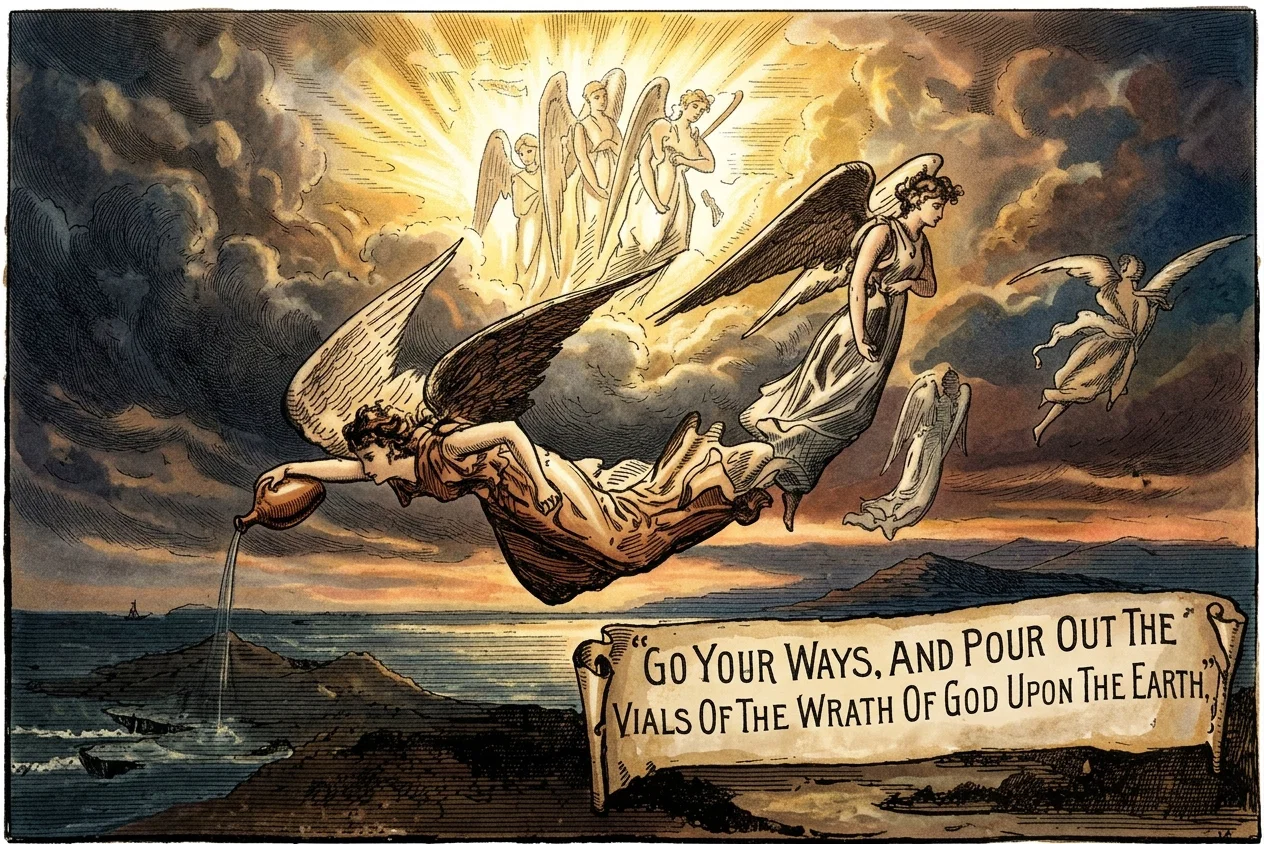
This wrath will be visited upon the world in the seven last plagues, mentioned and described in Rev. 14:9–11; 15:5–8; 16 entire, and other scriptures. That this is evident one consideration will clearly show. That period in which the judgment will be executed, as the scriptures quoted above demonstrate, is the day of wrath unmixed with mercy. This is what the last generation is warned against. See Rev. 14:9–11. But it is expressly said that in these “seven last plagues” “is filled up the wrath of God.” Rev. 15:1. “Seven angels having seven plagues, which are the last, for in them is finished the wrath of God.” R. V. “Seven messengers, having seven plagues, the last; because IN THEM was ended the wrath of God.”—Rotherham. “Seven angels, having seven plagues, the last in order, because with them the wrath of God is consummated.”—Murdock’s Syriac. “Because in these was completed the wrath of God.”—Young. The wrath of the great day of God’s wrath is all contained in the wrath of the seven plagues.
The pouring out of these plagues seems to occupy a comparatively short space of time, perhaps a year (Rev. 18:8; Isa. 34:8); but their effect continues throughout the great day of God’s wrath, culminating in the everlasting destruction of all sin and those who have identified themselves with sin, at the close of the thousand years. See Rev. 20:7–15; Zech. 14:12.) The terrible working of sin would long ago, as a lesson of destruction, have swept out of existence all life upon the earth had not God’s mercy interposed. But when the plagues are poured out, the power to sustain and shield and prevent is withdrawn, and the agencies of destruction are allowed to work their own way, and especially and first upon those who have chosen evil in the face of great light; and when the last bowl of wrath is poured out, and the agencies of destruction are allowed free course, then will be said in heaven, “It is done.”
Now men boast their own might, their own innate goodness and inherent immortality, their power by education and science to evolve higher organizations, and to do this, if not apart from God, at the most with little assistance from him. To man they give the glory. A constantly and wonderfully developing science will lead them to believe, as some already do, that man holds the power of life or death in his own hands, and therefore glory is given to men, while the Gospel of Jesus Christ is denied or belittled. But when God withdraws his mercy from a world which has rejected it, when the angels are bidden to release the fearful workings of sin and death, man will be left to his own choosing; and it will then be demonstrated to a faithful universe that man apart from God has not even the power or desire to repent, that he may give God glory. See Rev. 16:9.
But, reader, Mercy still pleads in tones of infinite love, Come to Christ, the only Saviour. God still sends his thrillingly solemn warning messages to the world, especially set forth in Rev. 14:6–14. Still the Lord of heaven and earth declares and pleads, and will you not hear him? “As I live, saith the Lord God, I have no pleasure in the death of the wicked; but that the wicked turn from his way and live; turn ye, turn ye from your evil ways; for WHY WILL YE DIE?” “BEHOLD, NOW IS THE ACCEPTED TIME; behold, NOW IS THE DAY OF SALVATION.”