“By the word of the Lord were the heavens made; and all the host of them by the breath of his mouth.” “For he spake, and it was done; he commanded, and it stood fast.” Ps. 33:6, 9. So the psalmist sings praise of the power of the Creator.
As the earth came from the hand of the Creator, it was beautiful beyond all comparison. Adorned with majestic trees, graceful shrubs, and delicately tinted flowers, it formed a picture with which the human eye—accustomed to the blight of the triple curse, as it rests so heavily upon all nature—is not familiar. He who filled the earth and the heavens with the wonders of his power, had prepared the earth for the home of man.
“And God said, Let us make man in our image, after our likeness; and let them have dominion over . . . the earth. So God created man in his own image; . . . male and female created he them.” Gen. 1:26, 27. Thus was man, the crowning work of creation, brought into existence, to be the representative of God on earth. He was, therefore, formed in the image and likeness of his Maker.
The creation was now complete. “Thus the heavens and the earth were finished, and all the host of them.” “And God saw everything that he had made, and, behold, it was very good.” Beautiful Eden, the garden of God, bloomed on earth. Sin, sickness, sorrow, pain, and death were not known in all that fair domain. Adam and Eve had access to the tree of life, and communion with God,3and nothing seemed wanting that could contribute to the happiness of the holy pair. “The morning-stars sang together, and all the sons of God shouted for joy.” Job 38:7.
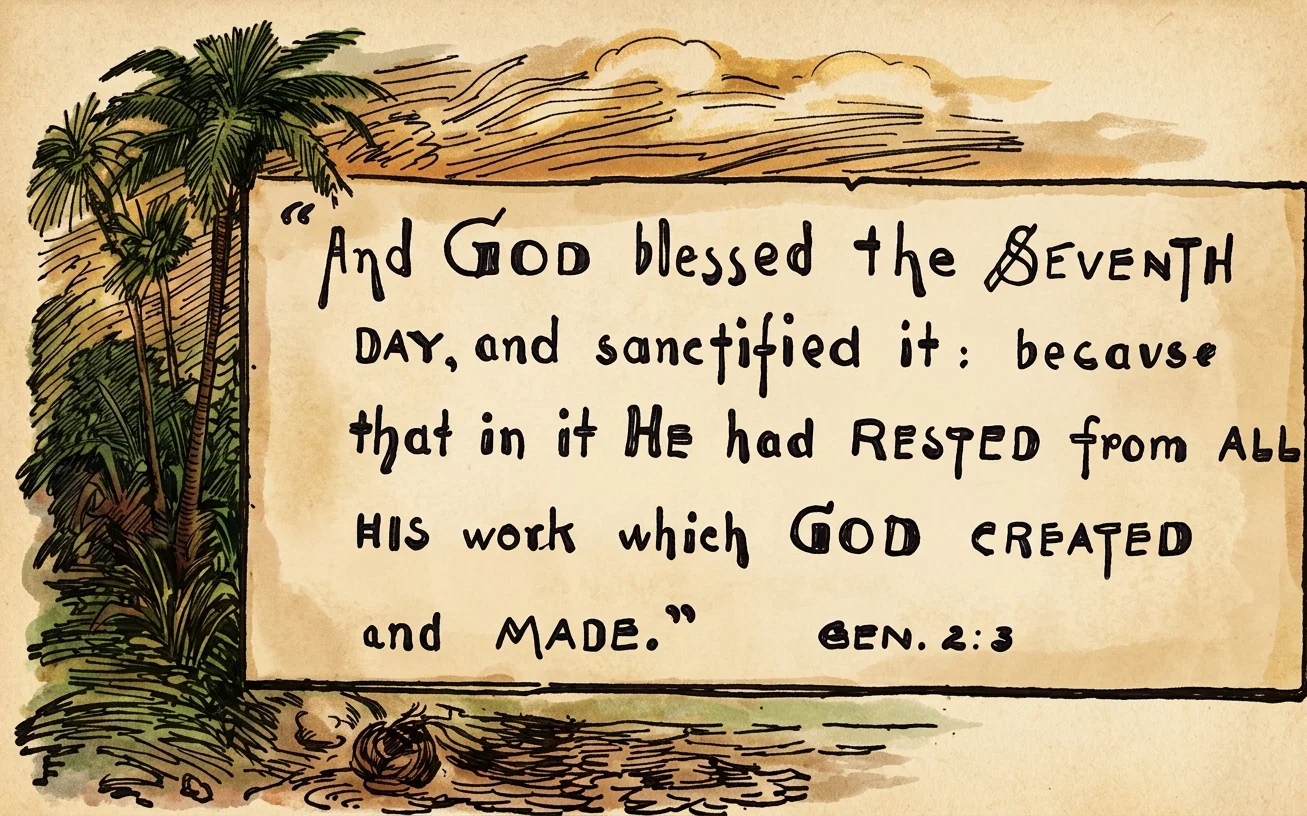
In six days the wonderful works of God had been finished. And God “rested on the seventh day from all his work which he had made. And God blessed the seventh day, and sanctified it; because that in it he had rested from all his work which God created and made.” Such is the sublimely simple, yet all-comprehensive, statement of facts concerning the making of that institution which, alone with marriage, shares the glory of being saved to the fallen race from their lost paradise; and with it equally essential to the wellbeing of man.
The reason for the institution of the Sabbath is to be found in the great facts of creation. It is the one institution standing as a monument to all the world of the wonders of God’s power manifested in the creation. And so long as the fact of creation, or the knowledge of a Creator, has any influence upon human thought, or makes any appeal to human sympathies, so long will the Sabbath remain as a constant reminder of the Creator’s power, a sign of the one true God.
When Instituted.
The time when the Sabbath was instituted is worthy of special notice. The language used in relating what took place on the seventh day, concerning the sanctification of the seventh day as a day of rest, would certainly convey to the mind the idea that it took place at the close of the creative week.
And God “blessed the seventh day, and sanctified it.” To sanctify is “to set apart as holy, or for holy purposes; consecrate; hallow.”—Standard Dictionary. The Hebrew verb quadash, here rendered sanctify, is translated elsewhere “appoint,” “proclaim” for a public appointment, or proclamation. See Joshua 20:7, margin; Joel 1:14; 2:15; 2 Kings 10:20, 21; Zeph. 1:7, margin. These cities of refuge, and fasts, and solemn assemblies, were sanctified, or set apart, by a public appointment, or proclamation of the fact. When, therefore, God sanctified, or set apart, the seventh day to be used by man (Mark 2:27) as a holy rest day, it was necessary that he state that fact to man. We may, therefore, conclude that from the first such a proclamation was made.
Our Saviour, when speaking of the corruptions of the marriage relation which had arisen under the Mosaic code, and which was suffered because of the hardness of their hearts, said, “From the beginning it was not so.” Matt. 19:8. Thus he shows the high obligation of the primitive law, that law of which the Sabbath commandment was an integral part. Whatever institutions were given to man then, were given for all time. Thus there is given to the marriage institution, and the Sabbath, which are so closely related, and each of which is so sacredly guarded in that law which is holy, just, good, and spiritual (Rom. 7:12, 14), a permanency of character and authority which show them to have been given to all mankind, for all time.
Dr. Nicholas Bound, in his “True Doctrine of the Sabbath,” London, 1606, page 7, thus states the antiquity of the Sabbath precept:—
This first commandment of the Sabbath was no more than first given when it was pronounced from heaven by the Lord, than any other one of the moral precepts, nay, that it hath so much antiquity as the seventh day hath being; for so soon as the day was, so soon was it sanctified, that we might know that, as it came in with the first man, so it must not go out but with the last man; and as it was in the beginning of the world, so it must continue to the end of the same, and as the first seventh day was sanctified, so must the last be. And this is that which one saith, that the Sabbath was commanded by God, and the seventh day was sanctified of him even from the beginning of the world; where (the latter words expounding the former) he showeth that, when God did sanctify it, then also he commanded it to be kept; and therefore look how ancient the sanctification of the day is, the same antiquity also as the commandment of keeping it holy; for they two are all one.
How Instituted.
And God “rested on the seventh day from all his work which he had made.” Gen. 2:2. “In six days the Lord made heaven and earth, and on the seventh day he rested, and was refreshed.” Ex. 31:17. He rested not as one weary (Isa. 40:28), but as being well pleased with the fruits of his wisdom and love, in his completed work, and the manifestations of his glory. God being spirit (John 4:24), the rest which he had was, therefore, spiritual rest. And, although man has departed far from God and his ways, yet “the heavens declare the glory of God; and the firmament showeth his handiwork.” Ps. 19:1. Notwithstanding the fact that evidences of the curse are seen on every hand, showing that “the wages of sin is death” (Rom. 6:23), still his eternal power and godhead may be understood by the things that are made (Rom. 1:20). Jesus invites us, saying: “Come unto me, all ye that labor and are heavy laden, and I will give you rest. Take my yoke upon you, and learn of me; . . . and ye shall find rest unto your souls.” Matt. 11:28, 29. With the return of the monument of his power and goodness, we are encouraged to trust in him that speaketh “in righteousness, mighty to save.”
After the Creator had rested upon the seventh day—thus laying the foundation of a divine institution, the memorial of his own great work—the record states that “God blessed the seventh day, and sanctified it; because that in it he had rested from all his work which God created and made.” Gen. 2:3. The same thought is stated in the fourth commandment thus: He “rested the seventh day; wherefore the Lord blessed the Sabbath day, and hallowed it.” The second act, then, in instituting this memorial was to place his blessing upon the day of his rest, thus making it the blessed rest day of the Lord. A third act completed the sacred institution. The blessed rest day of the Lord is now sanctified, or hallowed. In other words, it was made sacred, or holy, set apart for a holy purpose. It was thus evermore to be the blessed, sanctified rest day of the Lord.
By Whom Instituted.
It is quite important that we understand by whom this great work was all accomplished. “All things were made by him [Christ]; and without him was not anything made that was made.” “He was in the world, and the world was made by him, and the world knew him not.” John 1:3, 10. “God, who created all things by Jesus Christ.” Eph. 3:9. So, also, see Col. 1:14–17; 1 Cor. 8:6.
As Christ is the one by whom all things were made, and as the Sabbath was among the things that were made (Mark 2:27), it therefore follows that Christ was associated with the Father in resting, blessing and sanctifying the seventh day; that it was he who was refreshed—took delight in the rest of a completed work.
Finally, the Sabbath is shown to have been committed to Adam, the representative of the human race, and so to all mankind, to be an eternal witness to the “one God, the Father, of whom are all things, and we in him; and one Lord Jesus Christ, by whom are all things, and we by him;” to have been set as a perpetual memorial of that power and wisdom which brought all things into being, and ordered their adaptations and harmony; to be a witness of the most important truths that it is possible for man to know. It, therefore, imposes upon all races and generations of men a dutiful observance.