One of the watchwords of the day in political, religious, and religio-political circles is “reform.” The very welkin rings with the word. Societies, guilds, leagues—organizations of all sorts—are springing into existence to further the cause of “reform” in nation, state, municipality, church, or somewhere else.
Much is said of reform on the Sabbath question in various ways. It is preached from pulpit and platform, by legislators and prelates. The Sabbath question is coming to be THE QUESTION in both political and religious circles in all the civilized countries of the world.
What is the true basis of this reform? As the Sabbath question is in its origin purely Biblical and religious, what does the Lord have to say of this reform in his holy word?
A Striking Parallel.
“History repeats itself.” God warns men and peoples by the examples left on record before. God’s prophets spoke to his people in the generations in which they lived, but they wrote for all time to come. The history of the past was “written for our learning” (Rom. 15:4), and “for our admonition, upon whom the ends of the ages are come” (1 Cor. 10:11, R.V.). Note the following striking parallel between the church in the Levitical age and the church in the Christian era:—
3. Backsliding, persecution, division, partial reforms, following heathen customs, and departing from the Lord. Constantine usurps by consent of a backslidden church the place of Christ.
4. Great worldly prosperity under Constantine and succeeding rulers, and consequent apostasy, union of church and state, and a paganized, sun-worshiping Christianity.
5. The Dark Ages. The apostate church a persecutor; the conscientious persecuted and slain. Dan. 7:25.
6. Partial reformation under Wycliffe, Luther, Zwingle, and others.
7. Degenerating into empty forms, multiplying of creeds, union of church and state, exaltation of tradition of fathers above the word of God.
8. Last apostasy, persecution of Christ again in his followers, and the calling out of a remnant who will by faith in Christ Jesus keep all the commandments of God and bear the stamp of the Creator’s authority, his Sabbath. Isa. 58:13; Rev. 12:17; 14:12.10
The condition of the Jewish Church at the time of the first advent was that of division in respect to many of the fundamentals in religion. The one point on which they finally united was the condemnation of the one Voice and Life which condemned their lives. The great professed Christian church is divided to-day upon almost every phase of religion, and especially are they divided as to the proper theological basis for the Sunday sabbath. Upon the one point only are they uniting—namely, that of demanding a universal Sunday law, and the silencing of all opposition by force. But God is not the author of this division and confusion. Certainly a reform is demanded; a remedy is needed. This all good people in the churches will admit. Where shall such a remedy be sought? Is there balm in Gilead?
The Healing Message.
God has given just such a message as this to heal the divisions, and to correct the confusion which exists. It is because of this that he calls the church Babylon; and the causes of her divisions are the errors, “the wine of fornication,” which she has quaffed from Babylon the Great. See Rev. 14:8; 17:4–8. This message of healing is as follows:—
“And I saw another angel fly in the midst of heaven, having the everlasting Gospel to preach unto them that dwell on the earth, and to every nation, and kindred, and tongue, and people, saying with a loud voice, Fear God, and give glory to him; for the hour of his judgment is come; and worship him that made heaven and earth
and the sea, and the fountains of waters.”
“And there followed another angel, saying, Babylon is fallen, is fallen, that great city, because she made all nations drink of the wine of the wrath of her fornication.”
“And the third angel followed them, saying with a loud voice, If any man worship the beast and his image, and receive his mark in his forehead, or in his hand, the same shall drink of the wine of the wrath of God, which is poured out without mixture into the cup of his indignation; . . . and they have no rest day nor night, who worship the beast and his image, and whosoever receiveth the mark of his name. Here is the patience of the saints; here are they that keep the commandments of God, and the faith of Jesus.” Rev. 14:6–12.
Note (1) that the message is threefold: (a) A message bearing the positive truth of the everlasting Gospel of Christ, which “is the power of God unto salvation to every one that believeth.” Rom. 1:16. It is the blessed message of healing for Babylon. (b) A sad announcement immediately follows, that Babylon would not be healed (see Jer. 51:9); that she had chosen error,—the wine of fornication, the errors of paganism and union with the state,—instead of this Gospel of healing. (c) A most solemn, world-wide message of protest and warning to each individual soul against worshiping or obeying this union of church and state, symbolized by the beast and his image, and against receiving the mark of its power.
(2) The message is emphatically a message of the last days. It announces that God’s judgment “is come,” and ushers in the second coming of Christ to reap the harvest of the earth, ripened by this world-wide, threefold message. Rev. 14:14.
How Much the Message Implies.
The Gospel of Christ is the word of his salvation, which, when received, places Christ within the heart and life, “the hope of glory,” and forms in the receiver a character like his own. The first part of this message has a twofold burden: (a) “Fear God, and give glory to him,” in view of the judgment; and (b) “worship him that made heaven and earth. The fear [reverence] of the Lord is the beginning of wisdom; a good understanding have all they that do his commandments.” Ps. 111:10. The proper fear of God leads to obedience, to the observance of his commandments. This is shown also by the following:—
“And unto man he said, Behold, the fear of the Lord, that is wisdom; and to depart from evil is understanding.”
“Let us hear the conclusion of the whole matter: Fear God, and keep his commandments; for this is the whole duty of man.” Job 28:28; Eccl. 12:13.
Give glory to God; give unto him “the glory due unto his name.” The expression shows that the people to whom the words are addressed are giving glory to man, exalting man, the creature instead of God, the Creator. God’s name indicates his character, his goodness, his glory. See Ex. 33:18, 19; 34:6, 7. To give the glory due to God is to confess him to be right, to turn from transgression, and to yield to him and to him alone, acknowledging him as he is, Creator, King, Redeemer. See Isa. 42:5–8; Joshua 7:19; 1 Sam. 6:6; Jer. 13:16. But this means to “fear God, and keep his commandments,” through the grace of the Lord Jesus Christ.
“Worship him,” the great Creator. But the memorial of God’s creative work is his Sabbath (Ex. 20:8–11), the sign between him and his people that they may know that he is God, that he is the God who sanctifies them. See Eze. 20:20, 12. The highest worship is obedience. When Satan demanded of Christ, “Worship me,” Jesus replied, “Thou shalt worship the Lord thy God,
He who serves does as his Lord commands: “Ye are my friends, if ye do whatsoever I command you.” John 15:14. To worship God, therefore, is to turn from all obedience to every opposing law of every earthly power, and to keep all of God’s commandments.
Those who do not do this choose instead the wine of Babylon’s fornication. The only legitimate union for the church to hold is with Jesus Christ. To have or hold communion with another power is spiritual fornication. Compare 2 Cor. 11:3; Rom. 7:4, 5; Jeremiah, chapters 2, 3. Babylon’s fornication is departure from God and union with kings of the earth, with their idolatry, their errors, their power, and from these come, as from all union of church and state, persecution of the people of God. The widespread efforts of both Catholics and Protestants to secure “effective” Sunday laws, not only in this country, but the world, is the beginning of the fulfillment of the prophecy of Revelation 13.
The Seal of God.
Opposed to the work of the beast and his image in the demand for worship and the enforcement of the mark of the beast, is God’s great message of Sabbath reform, a part of which we have already considered. This work of God in the earth is set forth in the sealing of the servants of God, as found in Rev. 7:1–3 and Isa. 8:16, 17:—
“And after these things I saw four angels standing on the four corners of the earth, holding the four winds of the earth, that the wind should not blow on the earth, nor on the sea, nor on any tree. And I saw another angel ascending from the east, having the seal of the living God; and he cried with a loud
voice to the four angels, to whom it was given to hurt the earth and the sea, saying, Hurt not the earth, neither the sea, nor the trees, till we have sealed the servants of our God in their foreheads.”
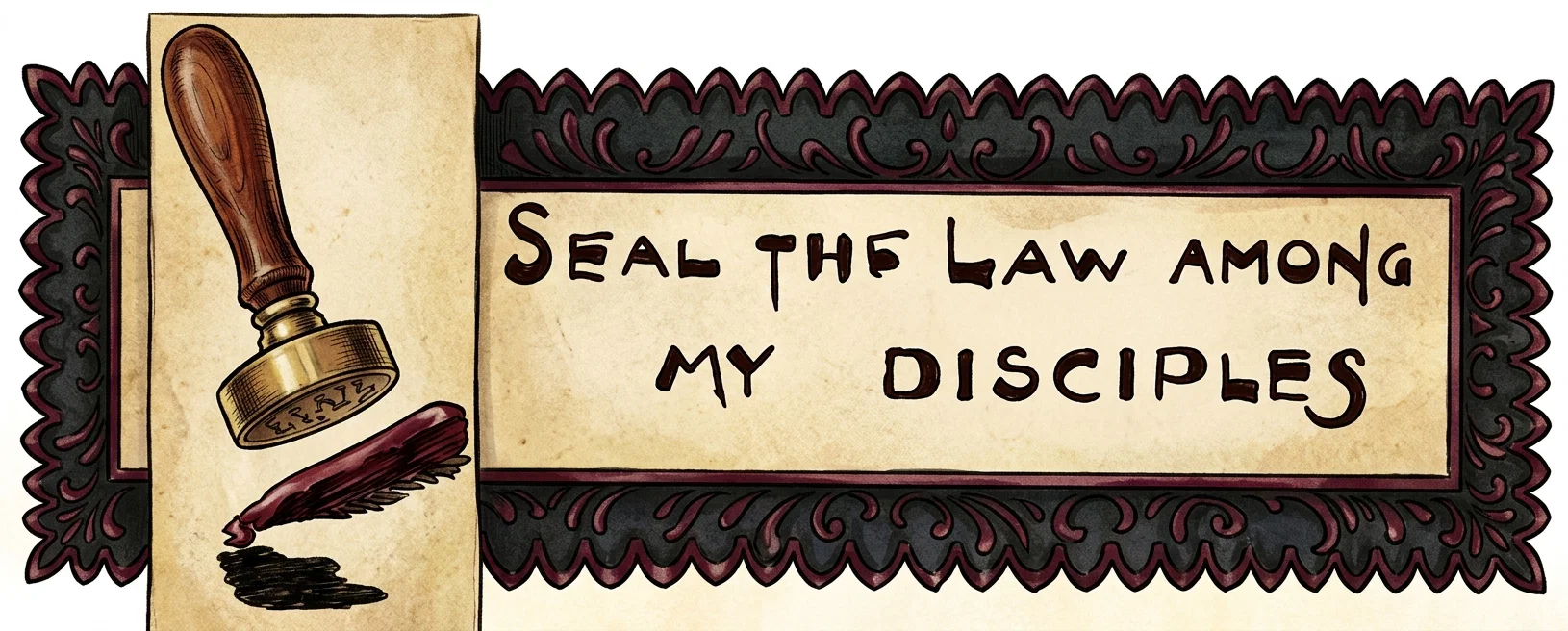
“Bind up the testimony, seal the law among my disciples. And I will wait upon the Lord, that hideth his face from the house of Jacob, and I will look for him.” See also Eze. 9:1–6.
Note the following: (1) Universal strife and war on earth (represented by the four winds) will not come till the servants of God are sealed; then will come the great battle of the day of God. (2) By examination of the context of the two passages it will be seen that both have reference to the Christian dispensation, and the work is among the disciples of Christ, near the time of his second coming, when his people are waiting for him. Compare Isa. 8:16, 17 with Heb. 9:28; 1 Thess. 1:10; Isa. 25:9. (3) They are sealed with the seal of the living God, in contradistinction to false gods. (4) A seal is that which stamps an article as genuine, which gives validity to, which authenticates. God’s seal would stamp them as God’s servants. It was anciently used by kings and those in authority. See 1 Kings 21:8; Esther 8:8. (5) It is always used in connection with law. See texts above referred to. (6) It must of necessity show three things,—the name, the authority, and the realm or territory indicating right of authority of the lawgiver, thus: Victoria, Queen of Great Britain and Ireland. The name is Victoria; the authority, queen; the territory, Great Britain and Ireland. God’s law, the only document he has ever spoken or written to men, is found in Ex. 20:1–17, in ten different precepts. In six of these precepts, the first, sixth, seventh, eighth, ninth, and tenth, not one of the necessary features of the seal is given. In the second, third, and fifth, only the name and authority are given, “Jehovah thy God.” But in the fourth commandment we have every characteristic of the seal,—the name, “Jehovah;” the authority, “thy God;” the extent of authority and right to command, “the Creator of the heavens and the earth”:—
“Remember the Sabbath day, to keep it holy. Six days shalt thou labor, and do all thy work; but the seventh day is the Sabbath of Jehovah thy God; in it thou shalt not do any work; . . . for in six days JEHOVAH MADE HEAVEN AND EARTH, . . . and rested the seventh day; wherefore JEHOVAH blessed the Sabbath day, and hallowed it.”
A law without its seal is void. In no other part of God’s law, written with his own hand, are the characteristics of a seal given; but in the fourth, or Sabbath, commandment are all these characteristics. God there subscribed himself and authenticated his law as the only genuine code of morals; and he will not give his glory to another. Isa. 42:8. The Sabbath is, therefore, the seal of God’s law.
The Sabbath His Memorial.
As God’s creative power is that which distinguishes him from all false gods, so has he given us a perpetual memorial, the observance of which will distinguish his servants from the servants of every opposing power. The psalmist says:—
“He hath made his wonderful works [of power, righteousness, and mercy, see context] to be remembered.” Ps. 111:4. Young translates, “A memorial hath he made.”
Again the psalmist couples God’s name with his memorial, and tells us that they are perpetual in their continuance:—
“Thy name, O Lord, endureth forever; and thy memorial, O Lord, throughout all generations.” Ps. 135:13.
This memorial, as has been clearly shown, is the Sabbath as commanded by God, the memorial of his creative and redeeming power, a sign between him and his people that he is the true and only God, the seal of God’s law.11And this memorial will be especially dear to the last generation of Christians who know his creative power in regenerated hearts. In speaking of the great day of God, when his children who keep the truth shall enter the eternal gates, the prophet thus speaks for the people who are waiting for his coming:—
“Yea, in the way of thy judgments, O Lord, have we waited for thee; to thy name and to thy memorial is the desire of our soul.” Isa. 26:8, R.V.
They have heeded God’s great reform message; they fear and give glory to him, and, hence, find delight in his worship, and in his day, even as they have found deliverance in his name.