THESE words were used by the inspired prophet (Jer. 5:28) concerning the professed people of the Lord in ancient Jerusalem. The careful reader of the context, however, will readily see that their sole application is not to the ancient Jews, but that Jeremiah, while looking at the Jews, saw in prophetic vision far beyond them, and beheld another people in the last days walking in the same path. That the prophecy concerning Jerusalem has equal reference to the church in the last days, may be seen by reading from the beginning of the fourth chapter, and especially verses 19-31 of that chapter.
If anything more were needed to prove that the iniquity which brought destruction upon ancient Jerusalem will be duplicated in the last days, we have only to quote the plain language of the apostle Paul, in 2 Tim. 3:1-5:—
"This know also, that in the last days perilous times shall come. For men shall be lovers of their own selves, covetous, boasters, proud, blasphemers, disobedient to parents, unthankful, unholy, without natural affection, trucebreakers, false accusers, incontinent, fierce, despisers of those that are good, traitors, heady, high-minded, lovers of pleasures more than lovers of God; having a form of godliness, but denying the power thereof."
The last sentence shows that these things will be seen among those who profess to be followers of God. Within the past three weeks, three different things have come under our notice, which vividly illustrate some of the things mentioned by the apostle as characteristic of the last days. First of all, as illustrating the phrase, "lovers of pleasures more than lovers of God," we quote the following which appeared in the column of church news in the Oakland Tribune of September 3:—
"A CHURCH ENTERTAINMENT.
"Yesterday afternoon was devoted by the ladies of the Church of the Advent, East Oakland, to the selling of fancy work, toys, candy, and other useful or ornamental articles at a bazar open in Washington Hall. In the evening a short literary programme was given, after which dancing was indulged in until 11 o'clock. Refreshments were served during the afternoon and evening. About 11 o'clock the company was called together to attend an auction of cakes. W. S. Goodfellow acted as auctioneer, and succeeded in getting a goodly sum of money into the church treasury by the sale of the delectable merchandise."
Lest some should by any possibility get a wrong impression, we will explain that the "Church of the Advent" is the name of an Episcopal house of worship, and has no reference whatever to Adventists. In regard to the above notice, some may say, "It shows, to be sure, that they are lovers of pleasures, but how does it show that they are 'lovers of pleasures more than lovers of God'?" Just this way: Although professedly for the cause of Christ, the pleasures indulged in were such as are utterly incompatible with love to God. It was pleasure which is only of the world. Now John says: "If any man love the world, the love of the Father is not in him." 1 John 2:15. Therefore the indulgence in such amusements at all, at any time or for any purpose, is evidence of absence of love to God. But such things are common nowadays, and we pass to another phase.567In the New York Observer of September 1, we find the following item:—
"Strange things are done in the name of charity. The 'champion' prize-fighter of America, whom Boston delights to honor, recently gave an exhibition of his skill in the fistic art for the benefit of a Roman Catholic benevolent society in Rhode Island. Some charitably disposed persons in Paris, France, have improved upon the Sullivan scheme by instituting 'a grand cock-fight for the benefit of the poor.'"
Certainly nothing more than this is needed to prove the correctness of the appellation, "fierce," to those who in the last days are content with only a form of godliness. To be sure the prize-fight in Rhode Island was under the auspices of the Catholics, but they are now, by the most of the so-called Protestants, recognized as a "branch of the Christian Church."
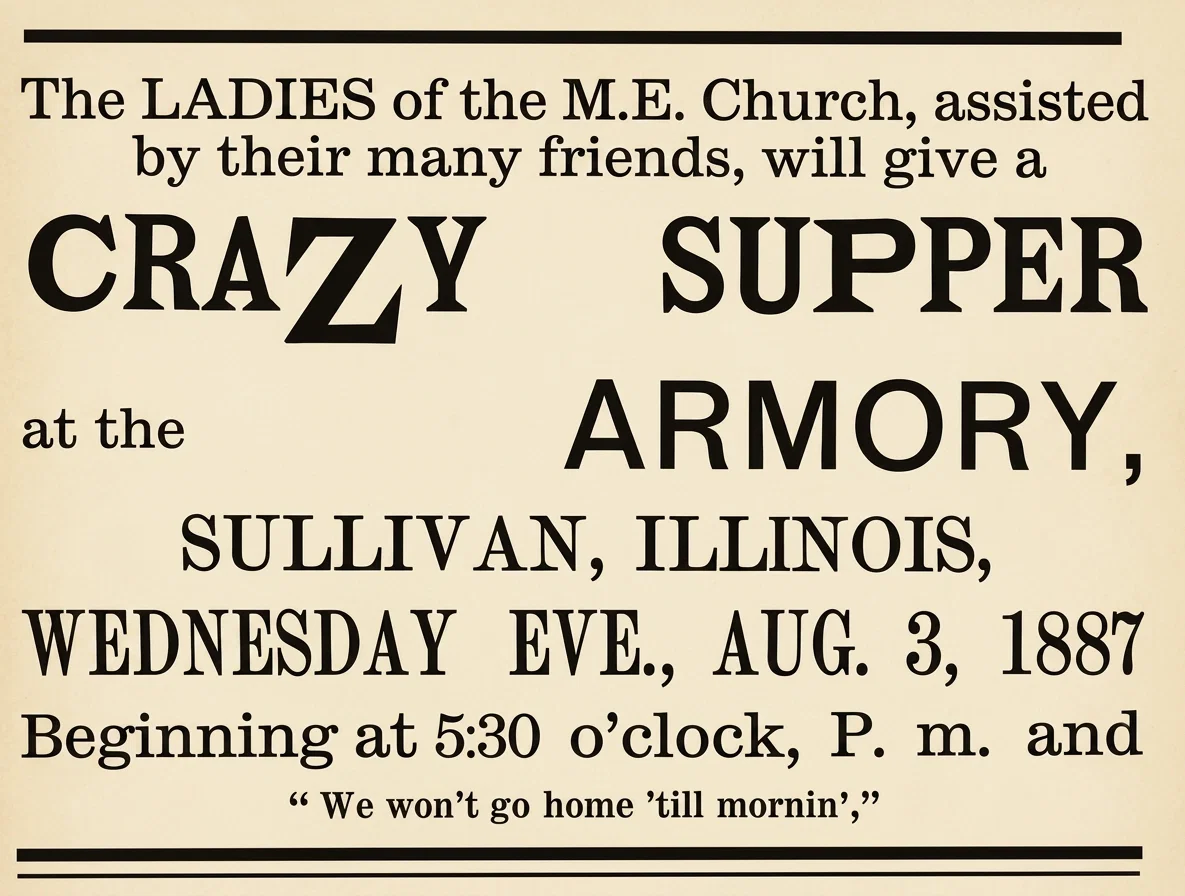
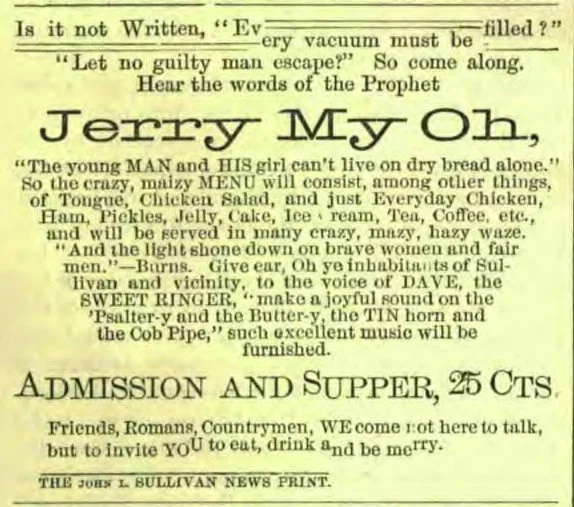
But all these acts of wickedness and worldly pleasures are overpassed by a thing which was done in Illinois about a month ago. It was a "crazy supper" given by the ladies of the Methodist Church. No description could do justice to it, and so we give below as nearly as possible a fac-simile, reduced in size of course, of the hand-bill which announced it:—
The Magic MOON is BREAKING, Like a conqueror from THE east, THE waiting world awakening, To A golden, fairy feast—shakeSPEARE.
One of the original bills, of which the above is an exact copy, is in our possession, having been sent us by our friend Elder A. O. Tait, who was holding meetings in the town of Sullivan when the crazy revel took place. The shape of the hand-bill we cannot reproduce, but it is sufficient to say that it is fantastic, and fully in keeping with the matter which it contains, giving evidence that those who got it up were eminently qualified to conduct a "crazy" supper.
But while the bill shows the church people who got it up to be "lovers of their own selves," and "lovers of pleasures more than lovers of God," it proves to a demonstration that the epithet "blasphemers" is fully merited by these last-day professors. Passing by the extracts from the drunkard's song, "We won't go home 'till morning," which shows that their revel, beginning at 5:30 P. M., was to last all night, we call attention to the abominable caricature of the language of sacred Scriptures. Isaiah's prophecy of the forerunner of the Messiah, in which are found the words, "Every valley shall be exalted," (Isa. 40:3, 4), is distorted into "Every vacuum shall be filled," and made to apply to the filling of the stomachs of unholy gormandizers. The name of that holy man who before his birth was designated as a prophet of God, is caricatured as "Jerry My Oh," and then to him are attributed the words, "The young man and his girl can't live on dry bread alone." And then, worst of all, if we can mark degrees in such blasphemy, is the parody on the name of the psalmist, and of the language of the Psalms, in the sentence: "Give ear, Oh ye inhabitants of Sullivan and vicinity, to the voice of Dave the Sweet Ringer, 'make a joyful sound on the Psalter-y and the Butter-y, the tin horn and the Cob Pipe.'"
We venture the assertion that there is not an infidel club in the United States that would dare put forth such a blasphemous caricature of sacred things. Truly the words of the prophet whom they have ridiculed apply to them: "For among my people are found wicked men; they lay wait, as he that setteth snares; they set a trap, they catch men. As a cage is full of birds, so are their houses full of deceit; therefore they are become great, and waxen rich. They are waxen fat, they shine; yea, they overpass the deeds of the wicked." Jer. 5:26-28.
It is not because we take pleasure in exposing the evil deeds of others, that we give such prominence to these matters, but that we may fulfill the injunction of Isa. 58:1, and if possible to arouse those who are not wholly given over to such abominations, to the fact that the end cannot be far off. There is another point also, that we would make. When we say that the passage of a Sunday law would result in the persecution of those who conscientiously observe the seventh day, we are told that that cannot be, because Christians will not persecute, and worldlings will have no interest in the matter. Leaving "worldlings" aside, what clemency, we ask, can humble commandment-keepers expect from "Christians," who have no sense of the sacredness of the Bible? What better are such professors than "worldlings"? And when the matter comes to the test, no more zealous advocates for a rigid Sunday law can be found than these same ones who walk in "lusts, . . . revelings, banquetings, and abominable idolatries." Having no real godliness in themselves, they will think to make up for it by excessive zeal for a form thereof.
Further, Solomon says, "They that forsake the law praise the wicked" (Prov. 28:4); and they who praise the wicked must, as a necessary consequence, despise the good; therefore it is as clear as the noon-day sun that professors who are guilty of such blasphemies as these which we have noticed, or who suffer them without stern rebuke, will, when the power is placed in their hands, be foremost in persecuting those whose godly lives and teaching condemn their course.
When the Saviour was on earth he drove from the temple those who made it a place of merchandise. Soon he is coming again, and terrible will be the fate of those who do abominable deeds under the garb of religion. The prevalence of these things of which we have spoken should serve simply to cause the servants of God to humble themselves, to seek righteousness, and meekness, that they might be hid in the day of the Lord's anger. "Hear the word of the Lord, ye that tremble at his word: Your brethren that hated you, that cast you out for my name's sake, said, Let the Lord be glorified; but he shall appear to your joy, and they shall be ashamed." Isa. 66:5.
Therefore, "Take heed to yourselves, lest at any time your hearts be overcharged with surfeiting, and drunkenness, and cares of this life, and so that day come upon you unawares." Luke 21:34. W.