THE Reformation of the sixteenth century was not then completed. Luther, Melancthon, Zwingle, and their colaborers in various countries, did not finish the work of reform. The work which they did was based upon Gospel principles; and if these principles had been uncompromisingly adhered to, they would have led the church of Christ from2the errors of the Dark Ages to the full light of Gospel truth. But some of the Reformers turned from these principles, while the successors of others sought to crystallize what truth had been gained, together with inherited error, into creeds, and so destroyed in the church the force of the principles of truth and reform.
The two chief principles of the Reformation were these: The word of God, the Bible, as the sole standard of faith, interpreted not by creed or council, but as understood by the individual mind and conscience; and dependence on the power of divine grace alone for the promotion and propagation of the Gospel. This meant that no earthly pope, council, or creed should bind men's consciences, and that there should be no interference of the civil magistrate with matters religious. But Zwingle departed from the latter, sought to promote and defend the cause of Christ by weapons not spiritual, and fulfilled in himself the words of Christ, "They that take the sword shall perish by the sword." While Martin Luther and his associates escaped the pit into which Zwingle fell, the Reformation begun under Luther was cast into one equally deep and devilish digged by its professed friends. They sought to bind about the living, growing truths of God by cords of earthly creeds. They endeavored to put the new wine into the old bottles. And so creeds were formed, organizations multiplied, Christ and peace departed, and Babel and dissension followed. Then was born into the Protestant Church that thing of sin and crime, union of church and state, with all its attendant evils. Zwingle's was but a shorter road. This condition of things has continued with greater or less fluctuation from that time to the present.
Its Present Phase.
We have now reached the latter days, when "knowledge shall be increased," when the last warning message, recorded in Rev. 14:6-12, shall be given to the world, to prepare a people for the coming of the Lord. This message is based on the true principles of the Reformation, the word of God alone as the standard of faith and morals, and absolute separation of church and state. Of course this sets aside all written creeds of men, and absolutely prohibits the influence of the civil magistrate in religious affairs. The Bible alone brings us to the Gospel of Jesus Christ, and faith in that Gospel leads to obedience to all the commandments of God. It is therefore said of those developed by the message: "Here is the patience of the saints; here are they that keep the commandments of God, and the faith of Jesus." Rev. 14:12.
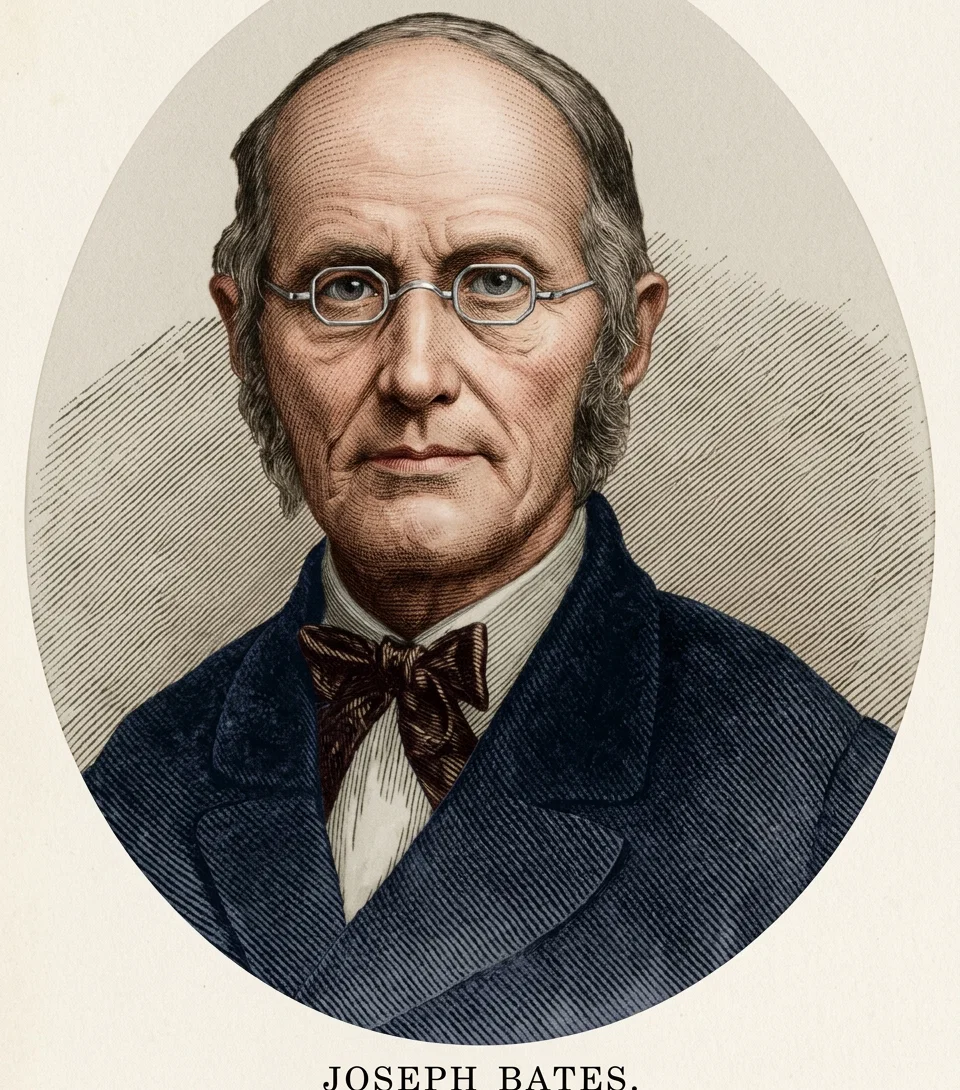
JOSEPH BATES.
What the Message Has Done.
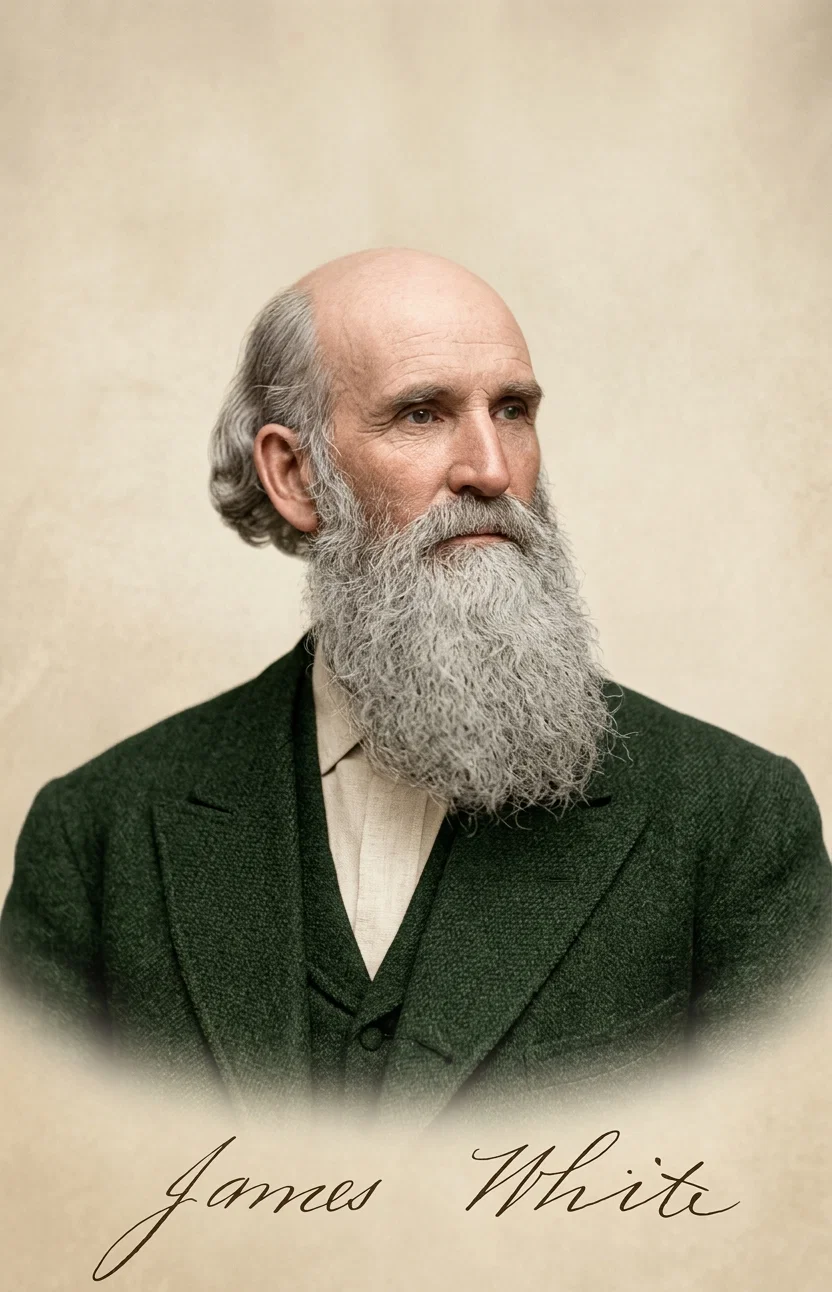
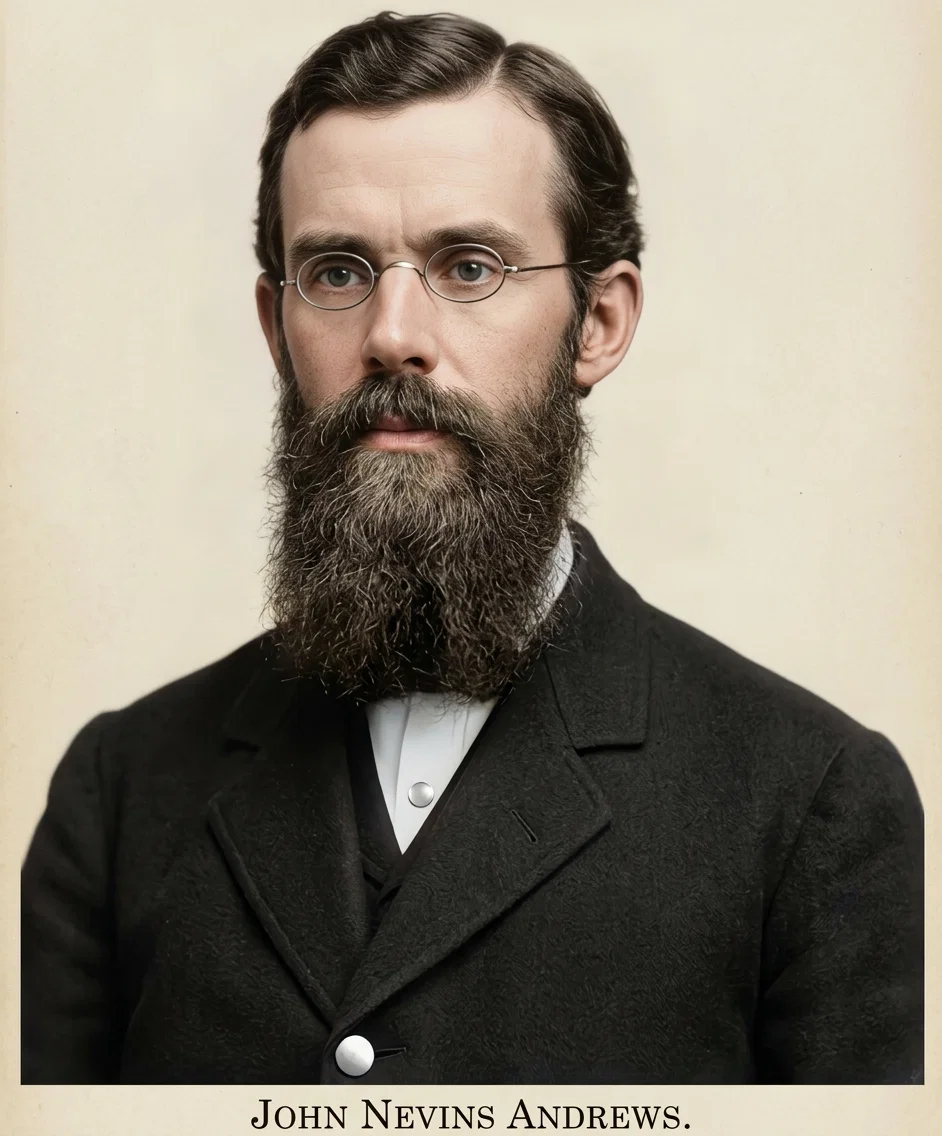
About 1844-45 the great threefold message of Rev. 14:6-14 in its present phase began to be heralded to the world. Earnest men and women saw in that message a call to return to God's word and to the faith of Jesus delivered therein to the saints and manifest in the lives of Christ and his apostles. Among the early pioneers in this work, which developed the denomination known as Seventh-day Adventists, were Joseph Bates, James White, J. N. Andrews, and Mrs. E. G. White. These earnest Christians, together with others who from time to time broke away from human traditions and the bondage of sin, learned in that "everlasting Gospel" of God the following glorious truths:—
4. That he did all this for man, that man by observing it might never forget the true God. Mark 2:27; Eze. 20:20.
5. That the expression of God's character is his holy law, the epitome of which is found in the Decalogue. Ps. 119:172; Isa. 51:6, 7; Ex. 20:1-17.
6. That this law is perfect, holy, just, good, spiritual, and unchangeable, the personification of the righteousness of which is in the character of Jesus Christ. Ps. 19:7; Rom. 7:12, 14; Ps. 111:7, 8; Luke 16:17.
7. That man had transgressed this law and was therefore condemned, without strength, and unable to help himself, "sold under sin." Rom. 3:9, 19, 23; 5:6; 7:7, 14; 1 John 3:4.
8. That to redeem man Jesus Christ gave himself to save man from sin and sinning by implanting within him and clothing upon him the righteousness of God, which was wrought out in Christ's own precious life, to which the law bears witness. Matt. 1:21; Titus 2:14; Rom. 1:16, 17; 3:21, 22; 8:1-4.
9. That Christ might thus redeem his people and be a merciful high priest in ministering his own righteousness, he, who was with the Father before the world was, emptied himself of himself that God might fill him.
JOHN NEVINS ANDREWS.
came to earth, and took upon himself sinful flesh, that he might be a brother to all the race; thus, being both God and man, he could in himself lift sinful man to God without the intervention of priest or saint. Phil. 2:5-93(R. V.); Heb. 1:3, 4; 2:9-16; John 14:7-10.
10. That thus being both divine and human, having by faith overcome the sinful flesh for us, Christ became a merciful, faithful, and mighty high priest, able to succor all who will come unto God by him. Heb. 2:17, 18; 4:14-16; 5:6-9.
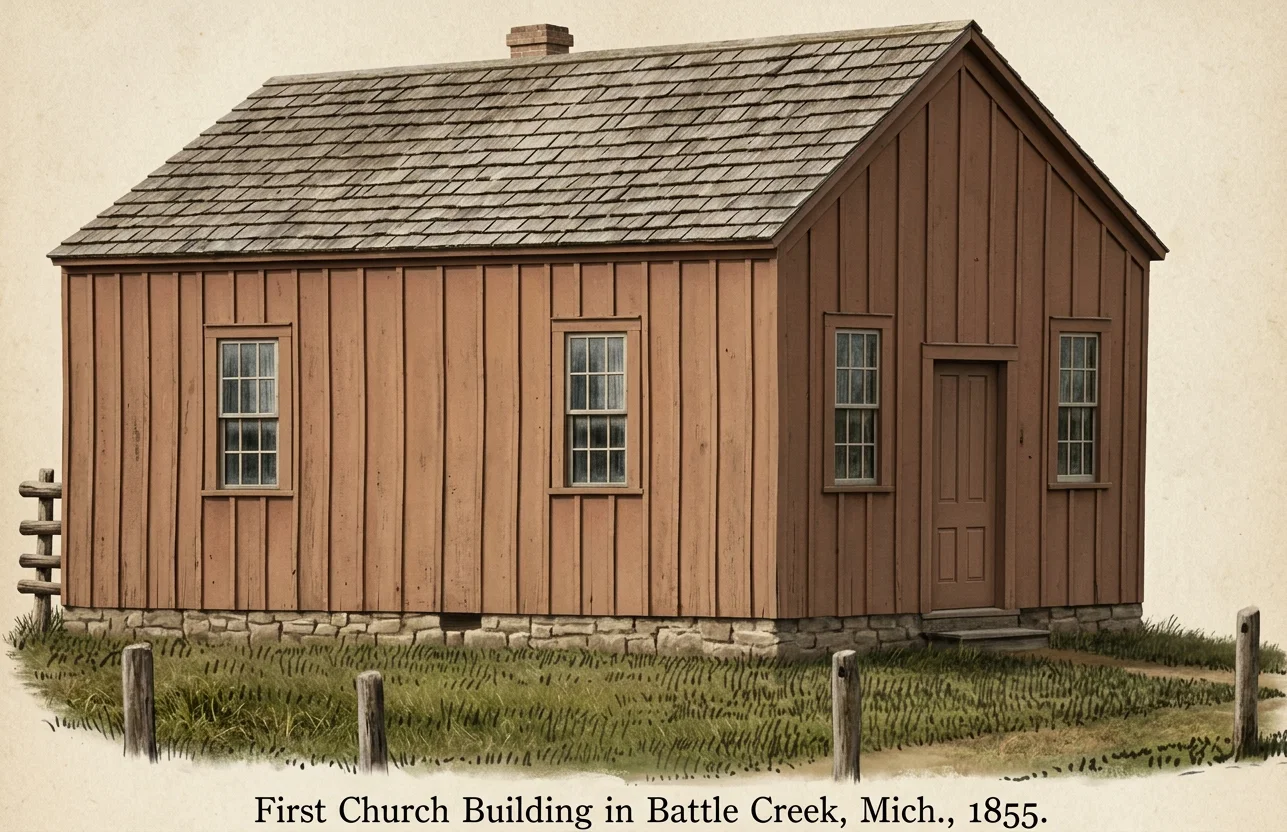
First Church Building in Battle Creek, Mich., 1855.
11. They also learned from the same word of the Gospel that the earthly sanctuary of the Levitical dispensation was in its materials, apartments, and ministrations the figure of the true tabernacle in heaven, where our Lord Jesus Christ ministers his effectual offering for all who come to him. Heb. 8:1-5; 9:1-12, 23, 24.
12. They learned that the cleansing of the earthly sanctuary (Leviticus 16) was a judgment work, and that, therefore, as also the nature of the case shows, our Lord's closing work must be a judgment work. Acts 24:25; 17:31; Rev. 14:7.
13. They found by the same word of prophecy that this judgment work, the finishing of the mystery of God, the closing up of Christ's priestly work, the blotting out of the records of sins in heaven, began in 1844 and continues an indefinite but comparatively short period of time, in which every case will be decided before Christ comes. Dan. 8:14; Rev. 10:6, 7; Luke 20:35; 1 Cor. 15:51, 52; Rev. 22:11, 12.
14. They found that eternal life and immortality were found only in Jesus Christ, who is our life, the former found by faith in Christ now, the latter given at his coming. Gal. 2:20; 1 John 5:10-12; 1 Cor. 15:51-55.
15. They learned that God's purpose to make the earth the everlasting and glorious home of man will not be frustrated by sin, but that Christ by his mighty power will purify the earth and reign therein with his saints forever. Isa. 45:18; Ps. 115:16; 2 Peter 3:1-10, 13; Matt. 25:31, 34; Dan. 7:27.
16. They learned that Jesus Christ is the head and the only head of the church; that by him the members of the church as individuals are redeemed from sin and set at liberty; that the liberty which Christ gives is the only true religious liberty; that this freedom is theirs by right, and that with it governments have no right to meddle. To put it still more forcibly, not only Christians but all men have the right to serve God, or not to serve him, according to the dictates of conscience. As expressed by our Lord, "If any man hear my words, and believe not, I judge
him not; for I came not to judge the world, but to save the world. He that rejecteth me, and receiveth not my words, hath One that judgeth him; the word that I have spoken, the same shall judge him in the last day." John 12:47, 48; 18:36. For these reasons and others Seventh-day Adventists are unalterably opposed to the union of the state and church in any and every form, not only as regards other people, but as regards themselves. On the question of freedom of conscience they have stirred the country as nothing else has stirred it since slavery was settled. Before us lies still greater agitation and greater victories.
All this and much more is taught in the word of the Gospel of God's grace. The message demanded that men should turn away from human creeds, from the world, from giving glory to men, and give glory to God manifest through Jesus Christ, and worship him who made heaven and earth. Rev. 14:6, 7. This brought them again to God's holy law, to Christ the Creator, Redeemer, Sanctifier, Re-creator, to the Sabbath, not only as a memorial of creation but of sanctification (Rev. 14:6, 7; Eze. 20:12), and therefore they turned from the sabbath of tradition to the Sabbath of Jehovah, kept by prophet, apostle, and Christ Jesus.
The Unity of the Spirit.
Their conferences, state and general, are representative bodies. Believing as they do, they have, as before stated, no creed but the Bible. And yet there is the strongest bond of union between them—the unity of the Spirit in the bond of peace. While differences of opinion frequently arise in their conferences over methods of work, and sometimes over doctrines, yet never by resolution or vote do they attempt to settle questions of faith, believing that the Spirit of God, which has created and developed the unity which now exists, will lead to the fuller, completer unity which shall exist in the church when her Lord shall come.
How Supported.
Their evangelistic work is supported by tithes paid by the members, and by various free-will offerings. The tithe is paid voluntarily, by nearly all, and is not made a matter of church discipline. Their method of supporting their work they believe to be Biblical. They have no settled pastors as such, and consequently no minister dependent on any one congregation for support. The church is used largely as the force of which the ministers are leaders, and not as a field in which the ministers are sole laborers. Of the amount of tithes and offerings we will speak later on.
The Seventh-day Adventists have for years been sounding the message of the Gospel to the world. They have pointed out from the word of God—what the good in all denominations admit—that many of the churches of Christendom are Babylon (confusion) in their creeds, and backslidden in their spiritual condition. Instead of these churches heeding this warning from God's word they have clung to their errors, choosing them as preferable to God's truth. They have not only done this, but they are, contrary to the Gospel, appealing to the powers of earth to enforce by civil law the Sunday of apostasy, the page-papal Sunday. Against this growing iniquity Seventh-day Adventists have faithfully protested, not for themselves but for the glory of Christ's name and for the good of all, even those who are engaged in the fearful work of endeavoring to amend the law and Gospel of Jehovah by human tradition and enactment. In this work of protest, praise God, a few noble voices have been heard in various denominations. This protest stands for religious liberty, not for Adventists, but for the world.
This work, it may easily be seen, must necessarily be decidedly unpopular. It would not of itself, humanly speaking, win many hearts, especially in the way it has been prosecuted. It has not sought to lure or dupe victims, but it has ever invited the fullest investigation. Nay, it has constantly and earnestly exhorted all its members and hearers to diligence in this respect, that each one may know that his faith does not stand in the wisdom of men, but in the power of God. It does not and never will seek to colonize those who are converted; but it ever broadens its plans, sending out its missionaries, and inviting men and women not to earthly gain, emoluments, reward, or honors, but to Christ.
Its Progress.
And yet the work has progressed, despite all ridicule, slander, and opposition of word and law. The truth of its message, conceded by many, practiced by few, despised by more, "because the carnal mind is enmity against God, and is not subject to the law of God,"4has permeated all classes. This progress may be shown in various ways. A few indications follow:—
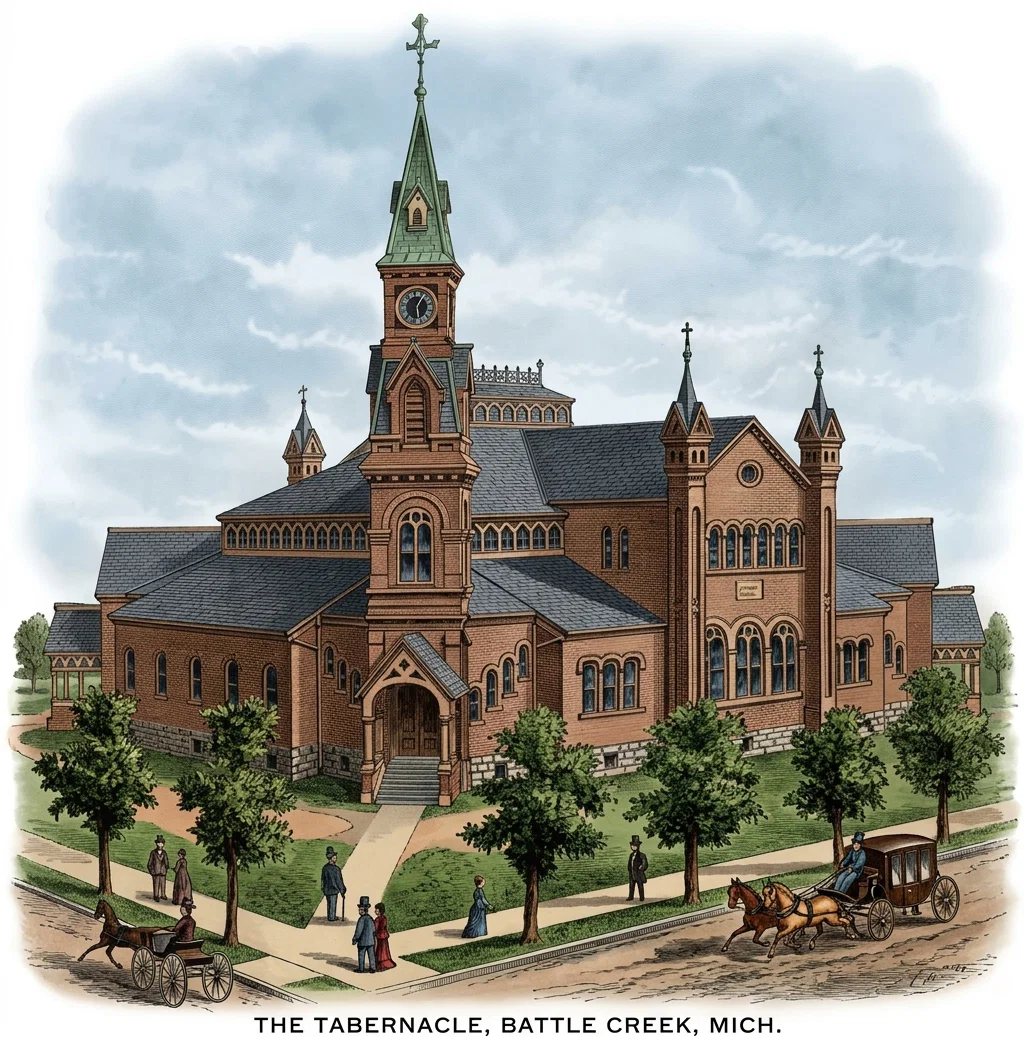
THE TABERNACLE, BATTLE CREEK, MICH.
1. The Increase of Numbers and Offerings.—The first Adventist minister began the proclamation of the Sabbath in 1844. Joseph Bates, a sea captain, began its observance in 1845, and Elder James White and Mrs. E. G. White in the following year. The adherents of the message might at this time be counted by tens, or at the most by scores. They consisted of a few companies and scattered Sabbath keepers. In the year 1855 two church buildings were erected, one at Buck's Bridge, N. Y., the second at Battle Creek, Mich. The latter now forms a wing of a moderate-sized dwelling. A cut of the building will be found on page 3. A general meeting, or conference, was held in Battle Creek, November 16 of the same year, to lay plans for the publishing work, and to consider other means for spreading the message. The company had grown so rapidly in Battle Creek that in 1857 another church building became necessary, and a church was erected 28x44. Now the large Tabernacle, 105 x 130, with a seating capacity of nearly four thousand, is found too small to accommodate the increasing congregations. During the last General Conference (February-March, 1895) overflow meetings were held in both the Review Office chapel and in the college. A cut of the tabernacle is here given.
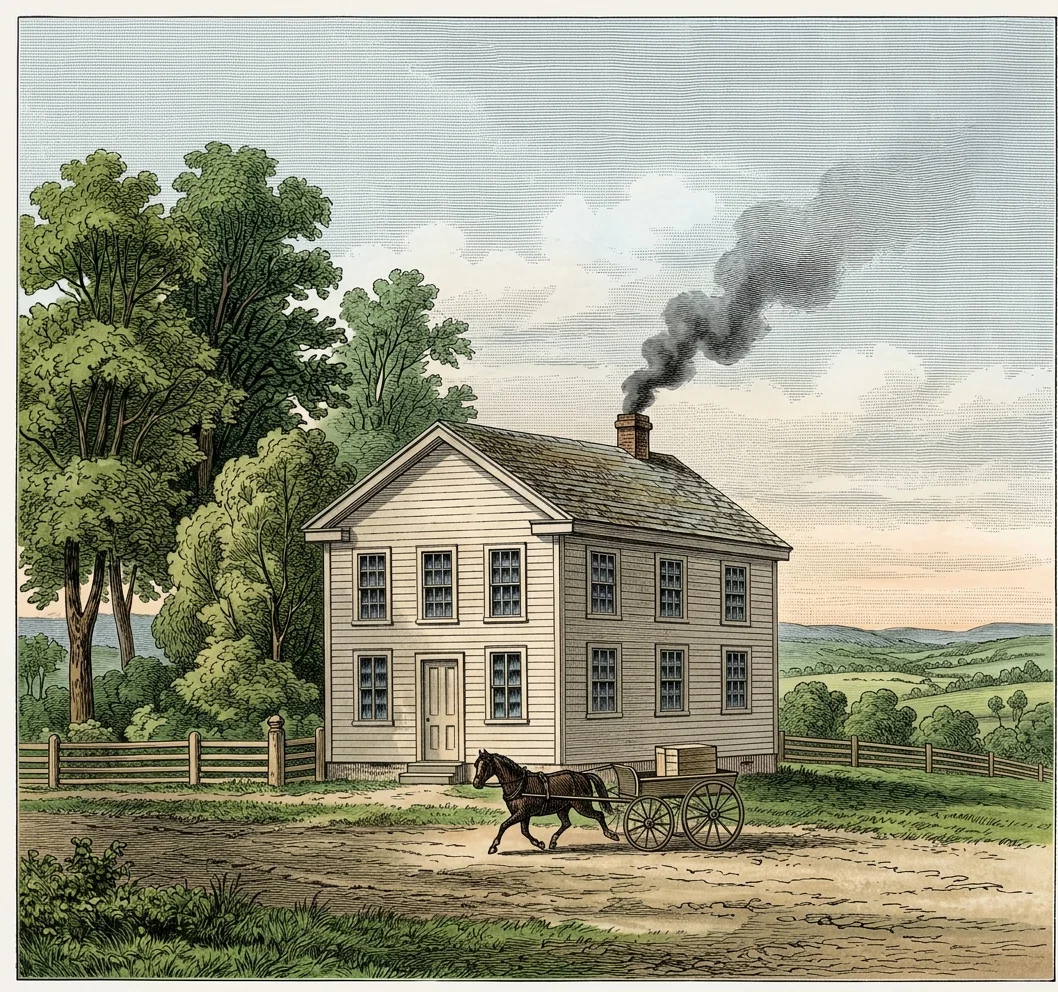
REVIEW AND HERALD OFFICE, 1860.
It was not until 1861 that churches were regularly organized. The first organized conference, that of Michigan, was effected the same year. The following year witnessed the organization of the conferences of New York, Minnesota, and the first General Conference. In 1863 conferences were organized in Ohio and Vermont, and in 1864, Iowa. It was three years after this before the next conference—Maine—was organized. The next year two noted events occurred, the first camp meeting at Wright, Mich., and the beginning of the work on the Pacific Coast.
In 1871 tract and missionary societies were organized to better propagate the Gospel message. The first was that of New England, followed in 1872 by New York, Michigan, and Vermont. The latter year, March 19, Elder Joseph Bates fell asleep, at the ripe age of 80 years. The same year witnessed the organization of a conference on the Pacific Coast, and two years later Elder J. N. Andrews began labor in Switzerland. This pioneer in the message died in the harness Oct. 21, 1883, aged 55 years. He almost knew the Bible by heart from Genesis to Revelation, and was frequently called "a walking concordance." His "History of the Sabbath" will ever stand as a monument of painstaking industry, honesty, and completeness.
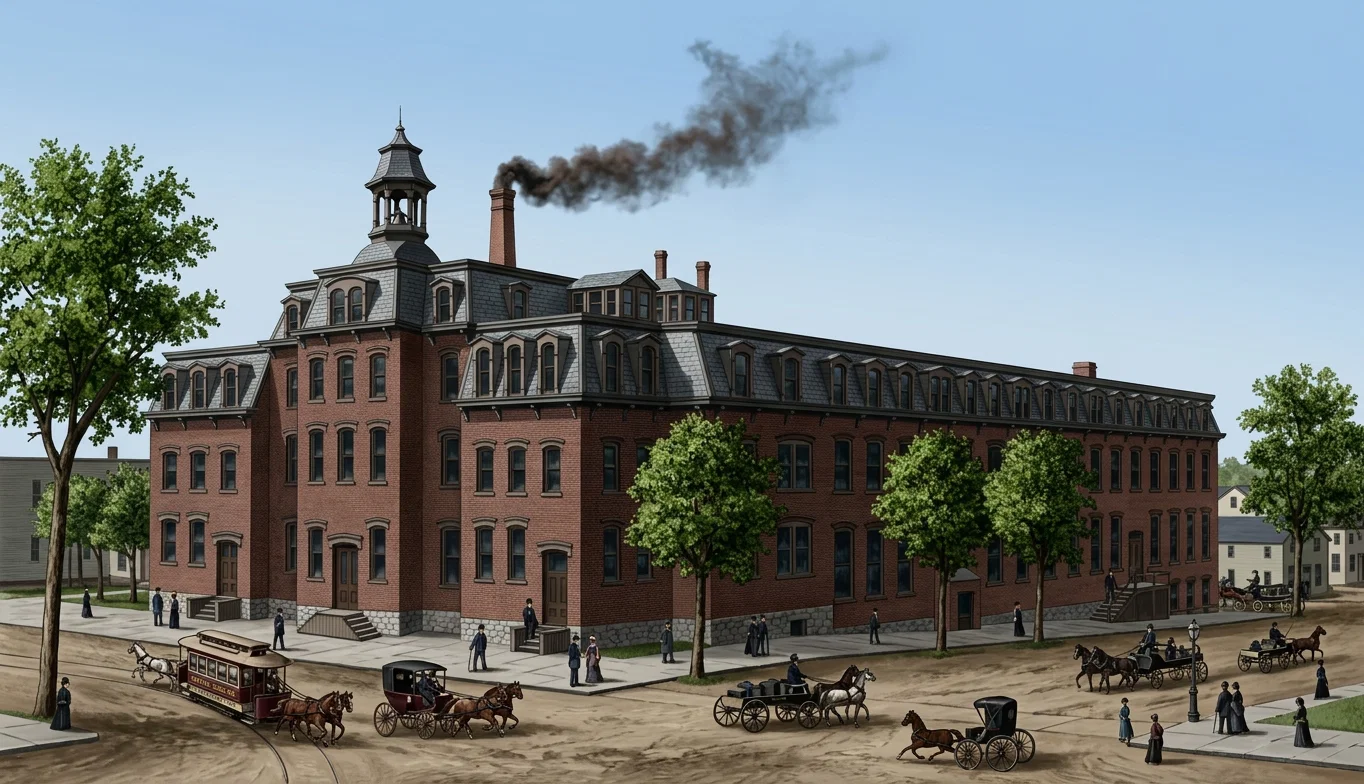
REVIEW AND HERALD OFFICE, BATTLE CREEK, MICH., 1894.
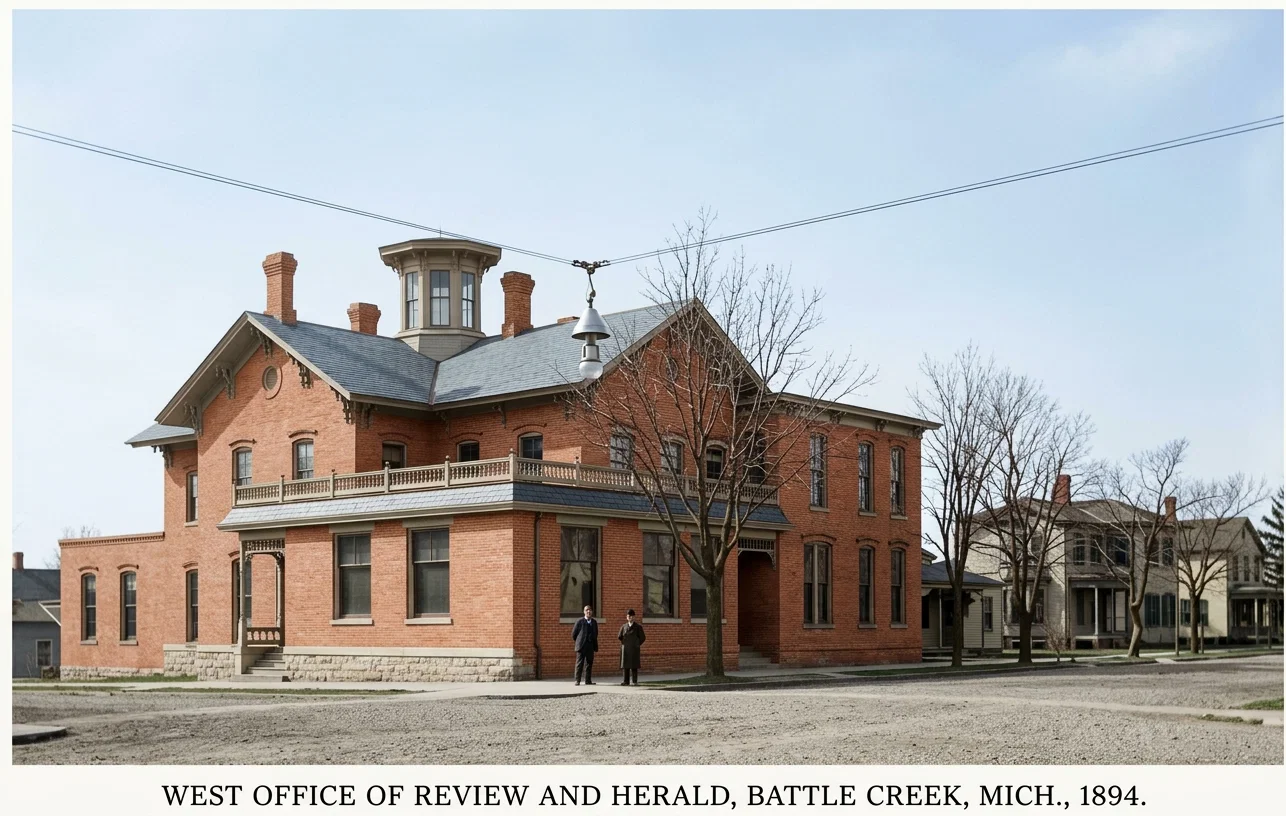
WEST OFFICE OF REVIEW AND HERALD, BATTLE CREEK, MICH., 1894.
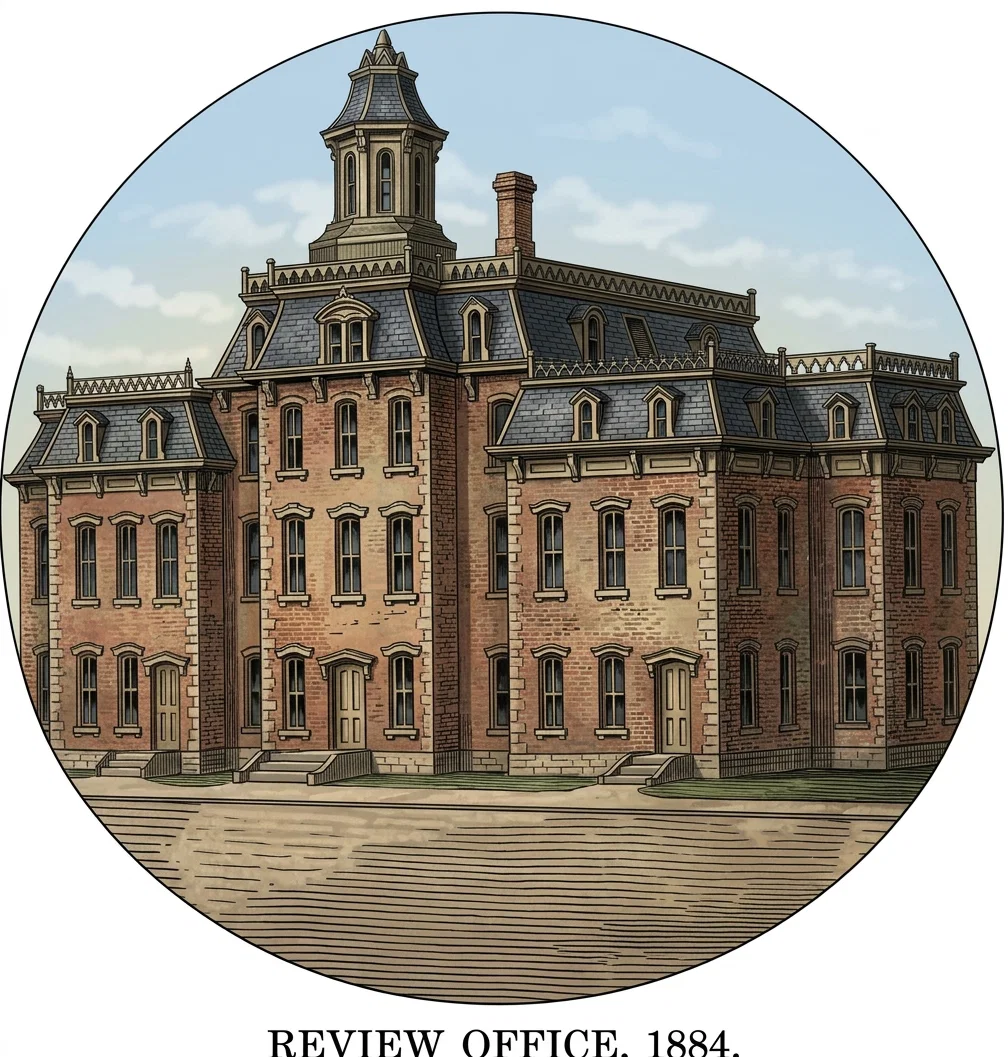
REVIEW OFFICE, 1884.
Another of the pioneers, the one on whom the burdens of the work rested with crushing weight above all others, fell asleep August 6, 1881, at the age of 60. James White, whose ancestors came over in the Mayflower, was a man of rare talent and ability, and God used him in laying the foundation of a great work.
But while God buries his workmen, he carries on his work.
Other organizations came into the sisterhood of conferences from time to time as years passed by, so that in 1881 the aggregate of ordained ministers numbered 148; the number of licentiates, 126; the number of churches, 640; of organized conferences, 26, and mission fields, 6; of members, 16,916; the amount of tithes paid for the ministry, $74,185.55; number of pages of publications distributed, 5,226,336; amount raised on other funds for missionary purposes, $38,836. The same year there were at General Conference 39 delegates, representing 15 conferences and five mission fields. At the General Conference of this year there5were 130 delegates, representing 43 conferences and mission fields. The number of ordained ministers is now 301; licentiates, 214; organized churches, 1,225; members, 42,763; tithes paid, $321,517. The per cent of increase in membership is 158; of tithes, 332—certainly a good indication. Other donations for missionary work, $110,174.09, an increase of 183 per cent. These figures show that the members of the church have increasing faith in the message they are giving to the world. These funds, apart from the tithe, are raised by Sabbath school offerings, first-day offerings (1 Cor. 16:1, 2), offerings for missionary work at the time of the holidays, and irregular offerings, all of which are free-will in the fullest sense.
2. Increase of Publications.—The first paper published by this people was a little sheet—the Present Truth—at Middletown, Conn., in 1849. It did not long continue. The next year—1850—witnessed the beginning of the Advent Review and Herald of the Sabbath, which has continued the leading paper of the denomination. The first number bore date Paris, Me., November, 1850. On the publishing committee are the names of Joseph Bates, J. N. Andrews, and James White. The paper first appeared as an irregular monthly. The next year in April it became a semi-monthly, published in Saratoga County, New York. It was soon after moved to Rochester, N. Y. Its first issue as a weekly was Sept. 8, 1853. Being mindful of the youth, in 1852 the Youth's Instructor was first issued as a monthly. These papers at that time were small, and poorly printed on a hand press. Now the Review is a large 16-page weekly, with over 12,000 subscribers.
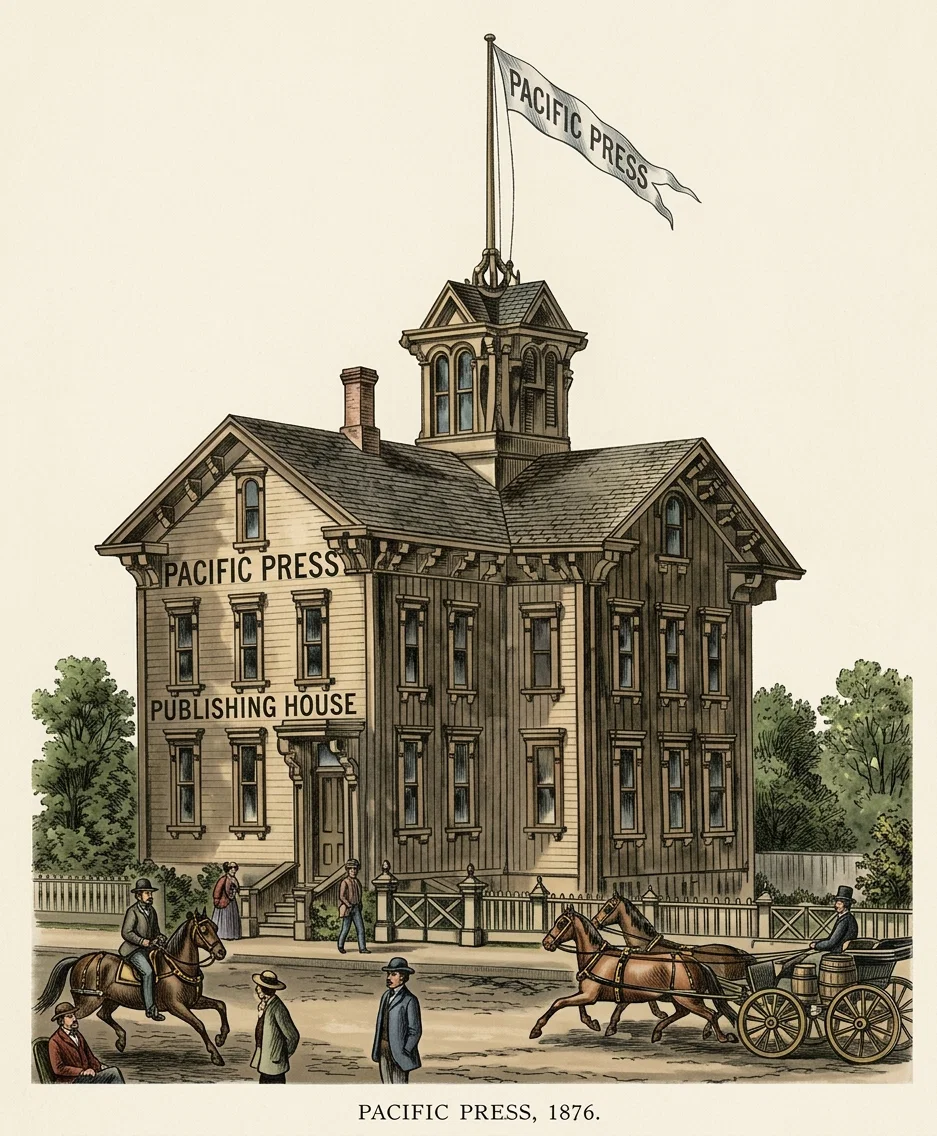
PACIFIC PRESS, 1876.
The next periodical published was the Health Reformer, 1866. With the full Gospel message goes reform in eating, drinking, dressing, and general living. God wants not only healthy souls, but healthy bodies and clear minds, wherein his Spirit may dwell. This was a part of the message which God gave to this people, which they accepted, and which they gladly tell to others. As a result they are users of neither alcohol nor tobacco in their various forms. But few use tea and coffee, and the well-instructed use few condiments. Many are practical vegetarians, and the whole denomination use comparatively but little flesh, and that of the most wholesome kind, eschewing swine's flesh and other foods conceded as unwholesome by both Scripture and science. At the present time there are six journals published in the interests of health reform and temperance; four of these are published in English, one in Danish, and one in Swedish. The aggregate monthly circulation of these cannot be less than 20,000.
In religious publications the denomination now publishes nineteen periodicals, the aggregate monthly circulation of which may be fairly estimated at 400,000. About one hundred and fifty different tracts on all phases of Christian life and work are in circulation. These publications are now circulated in more than twenty-five different languages and dialects; and the year to come it is believed will witness translations into twenty-five more. Besides these are published many bound books, the sale of which last year amounted to more than $300,000.
The growth of the publishing work among this people is well represented by the growth of their publishing houses, some cuts of which are given herewith. The small cut of the Review and Herald building (page 4) represents it near the beginning of its history, about 1860. The larger cuts represent the two parts of the office as it now stands, on West Main Street, Battle Creek, Mich. The office is divided by Washington Street; the larger part is used for the manufacturing department and editorial offices; the smaller, with an extension of about fifty feet on the right, not shown in the cut, is used for sales rooms, packing, shipping, and office and committee rooms of various kinds connected with the work. The first office was a two-story wooden building erected in 1855. The present buildings are substantial brick-faced structures, with an aggregate floor space of 106,000 square feet.
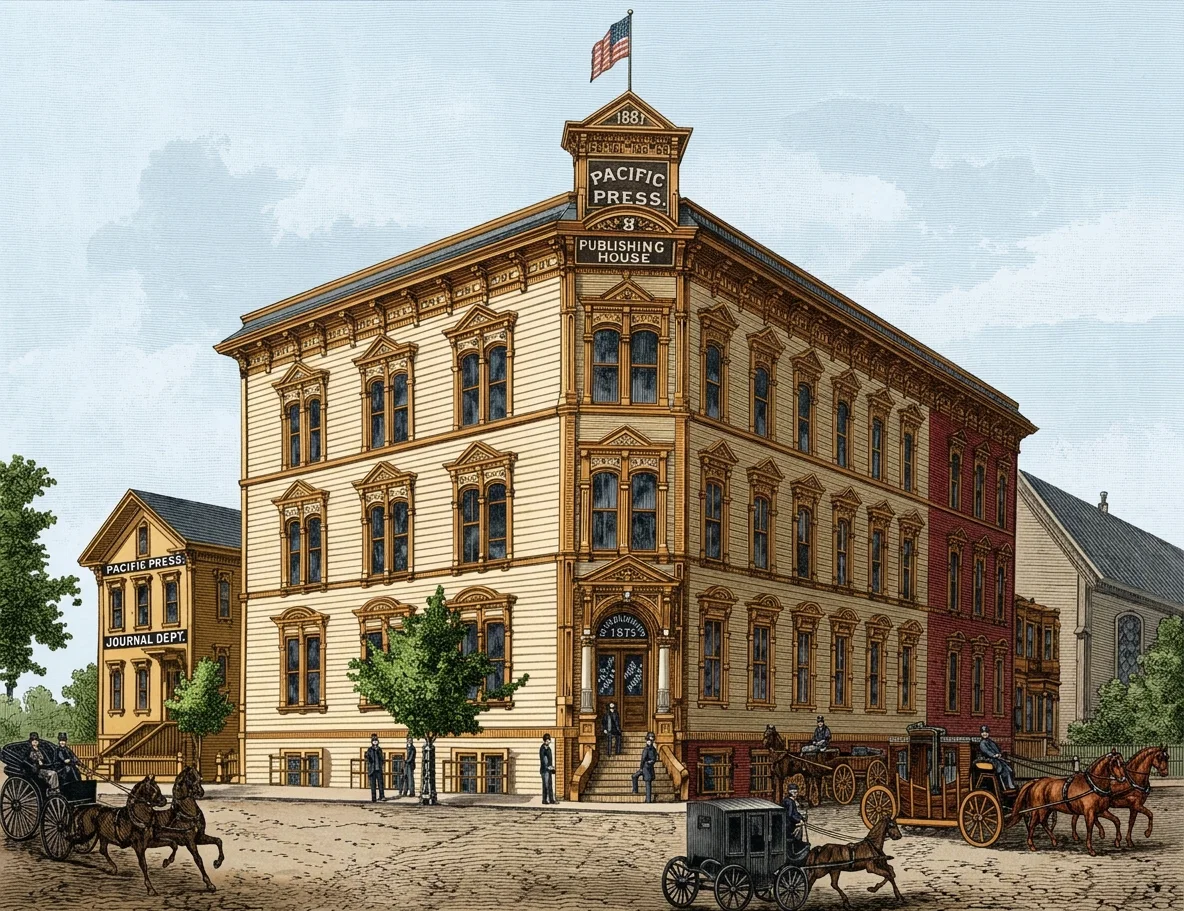
Pacific Press, 1895; Home of the "Signs of the Times."
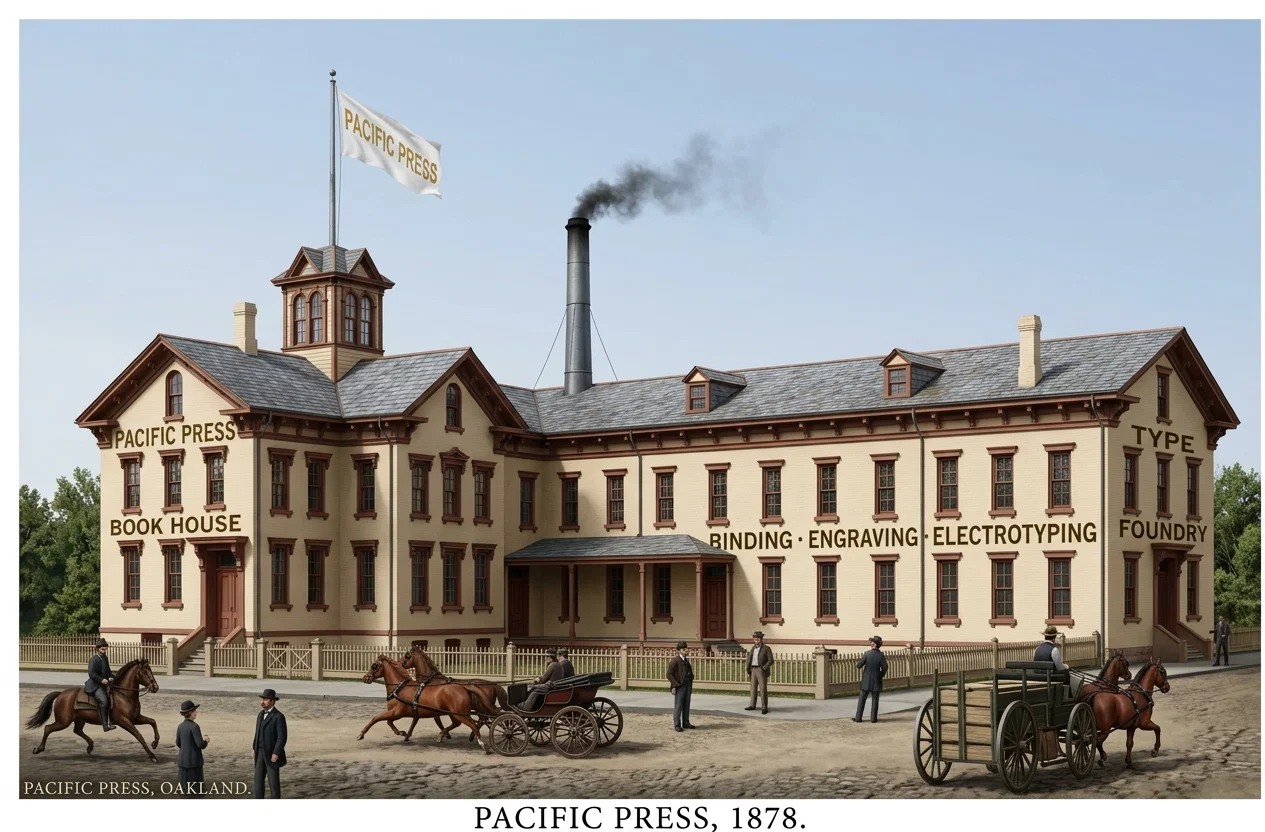
In 1860 the only publishing house of the denomination was the little two-story wooden structure noted above. Now they have the largest and best-equipped publishing house on the Pacific Coast—the Pacific Press—cuts of which are here given in different stages of its history. It has a floor space of about 50,000 square feet. There are also publishing houses in Melbourne, Australia; New York City; London, England; Christiania, Norway; and Basle, Switzerland. Besides these facilities for publishing the truth, there is much work done elsewhere. Yet this means of spreading the Gospel is but the beginning of what this people hope to see.
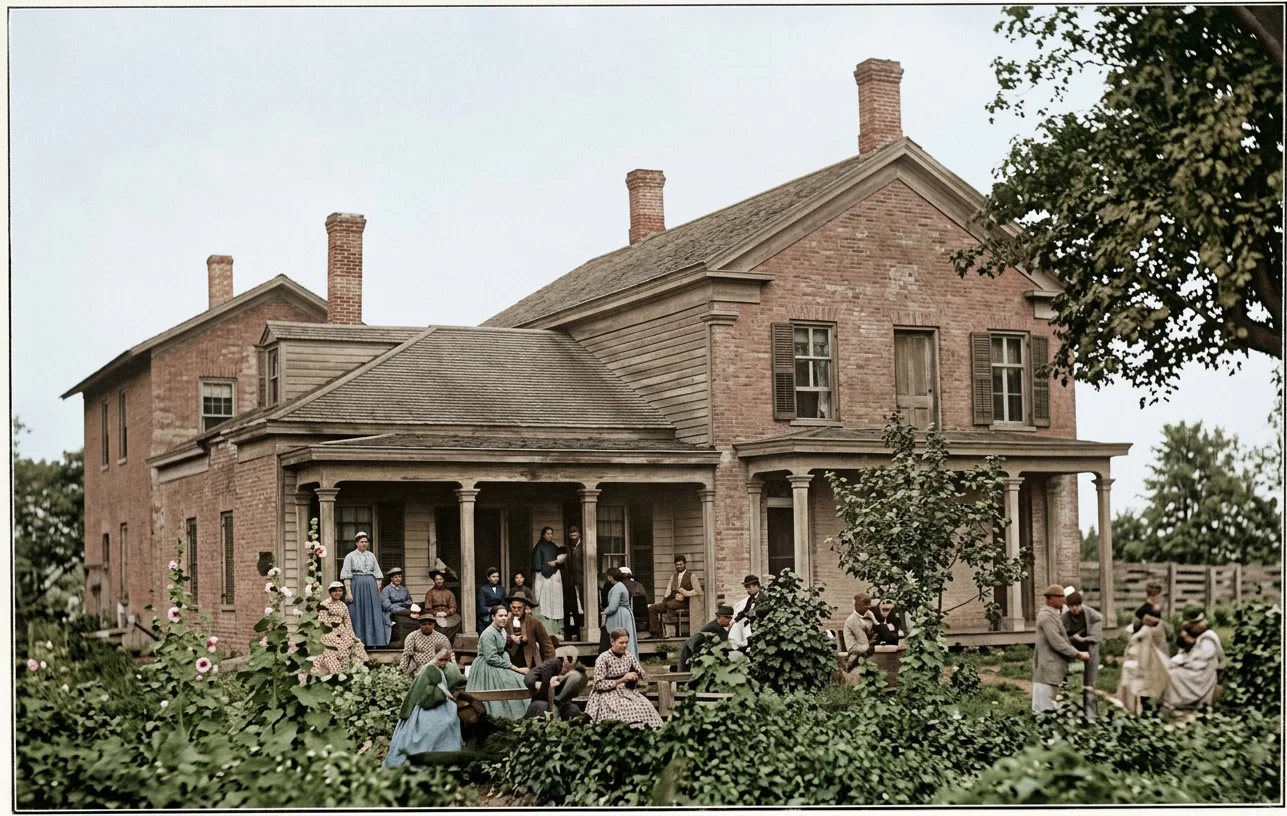
3. The Health Work.—As suggested above, true temperance and healthful living are a vital part of Christianity. It may be questioned whether there was ever a truly converted soul who was using tobacco at the time of his conversion, who was not troubled in conscience over the practice. Many heed the voice of the Spirit and leave the evil habit; many paralyze the conscience and continue its use. Not so with the people under consideration here. They found themselves practicing many injurious things, contrary not only to the word of God, but to true medical science. They set about reforming themselves, by yielding to the Gospel, and began preaching the Gospel reform to others. They found in that same Gospel not only effectual protest against drug medication, but wonderful restoratives in pure air, pure, well-cooked food, pure water, electricity, and ample and proper exercise. They founded an institution where these things could be practiced and taught for the restoration of the sick. The Health6Reform Institute was founded Sept. 5, 1866, and legally incorporated April 6, 1867. A cut of the first building, in West Battle Creek, with its physician, Dr. Lay, all its helpers and patients—twenty-three in all—is given herewith, from an old photograph. The cut is not clear but will serve to illustrate the small beginning of a great work.
PACIFIC PRESS, 1878.
It could not be expected that all good things would be learned at once. The chief remedy used in those days was water in various ways, and by methods somewhat crude. Hydropathy was the one science above all others, and it worked wonders by the blessing of God. But truth grows, especially in a living Christian experience; and so has the gospel of true Christian temperance and right living developed among this people, till now every known remedy of nature and science is in use for the restoration to health of those who are sick, for keeping well those who are not. On the spot and its immediate surroundings are now four large brick edifices, with other smaller buildings.
It is utterly impossible in this brief sketch to give anything like a just idea of the buildings, appliances, and work of the Battle Creek Medical and Surgical Sanitarium. Every known and tried remedy prescribed by conscientious and skilled physicians, applied by trusted and trained nurses, is here used. Our first-page cut presents a front view of the Main Building, 312 feet long, with a rear extension of 100 feet, and is five and six stories in height above the basement. The Hospital building is 100x60 feet, five stories high. The Main Building accommodates 300 persons; the Hospital has 100 beds. Cottages on the grounds accommodate 200 persons. The cut of the new dormitory for students and helpers will speak for itself. It is complete in itself, with all needful furnishings. In addition to these is a large steam laundry building, and a large bakery, from which many tons of health foods are shipped annually to all parts of the world.
The ventilation of the institution is perfect in detail. Each room has an independent ventilating shaft of its own. The Main Building is supplied with 30,000 cubic feet of warm air each minute. In the winter the air is taken at a distance from the building and at sufficient height to insure comparative purity, carried through a large tunnel into large rooms, there warmed and moistened and distributed in ample quantities throughout the building. The Main Building and Hospital are lighted by the Edison system of incandescent light. The surroundings, the parlors, the gymnasiums, dining halls, rooms of all kinds, speak of comfort, health, and home. A thorough examination is made of each patient,—stomach, nerves, lungs, circulation, muscles, and every important organ of the body. All rational remedies are used, such as electricity in all forms, sun baths, Swedish movements, medicated inhalations and atmospheres, pneumatic treatment, etc., etc. Here originated the wonderful electric light, or radiant heat bath, far superior in the mind of the writer to either vapor, Russian, or Turkish baths.
HEALTH REFORM INSTITUTE 1866.
The medical superintendent, the one above all others who has been instrumental in the hands of God in planning this wonderful institution, is J. H. Kellogg, M.D., well known in both this country and England by his writings and otherwise. He is assisted by the following skilled physicians: Drs. Dunlap, Riley, Hoenes, Burleigh, Lindsay, Maxson, and others.
In addition to these buildings is the Haskell Home for orphan children, a cut of which is given elsewhere. Here nearly a hundred orphans may be cared for in families of twelve, by kind, motherly women. Here they are educated in various studies, from kindergarten up, and trained in various lines of work, and in habits of diligence, cleanliness, order, and in the Bible. Each child has his (or her) single bed, hooks for hanging clothing, dressing rooms, towels, napkins, soap, toothbrush, etc. Each has his work to do. We do not begrudge the orphans aught of the many good things here given them, but the heart grows tender and the eye moist as we think of the old house, the bed under the rafters, and the father and mother and brother and sister love, and we would not change the old associations and home love for all else in the world. But may God bless the orphans, and make tender and wise those who care for them. This institution has been constructed largely under the supervision of the S. D. A. Medical and Benevolent Association, which controls and supervises most of this kind of work of the denomination.
At the Sanitarium in Battle Creek is a regular training school for missionary nurses and medical missionaries, for which we have not space to speak at this time. A branch sanitarium is in operation in Chicago, and another at Boulder, Colo. Over $30,000 in charitable work has been given in the last two years by the Sanitarium. It is a noble institution and is doing a noble work. Its profits are used to build up the institution and benefit the poor and sick. We know of no place east of the Sierra Nevadas where one will find a better place to get well than in the Battle Creek Sanitarium, or at its branch in Boulder, Colo.
Another institution of the kind, where the ills of humanity are attended to in the same7general and successful way, although on not so large a scale, is the Rural Health Retreat, near St. Helena, Cal., under the supervision of Drs. W. H. and Hattie S. Maxson. Here also is a training school for medical missionaries. This institution is blessed with delightful climate, beautiful surroundings, and pure, soft mountain water, and is enjoying prosperity. We know of no better place west of the backbone of the continent for a sojourn for the weary or sick, under the faithful direction of genial and skilled physicians. We give a cut of the Main Building as it appeared three years ago (page 8). It has since been greatly improved. There are other buildings, cottages, chapel, etc. Many tents are used in the dry season.