THE HARVEST OF EARTH

4%

Pacific Press Publishing Company · Oakland, Cal., Kansas City, and New York · Nov 29, 1899

FromSigns of the Times, Vol. 25, Nos. 48, 49.

Read the full edition

THE HARVEST OF EARTH

By Milton C. Wilcox.
THERE is a sowing of Righteousness and a sowing of Sin.
There is the Harvest of Righteousness and Life; there is also the Harvest of Sin and Death.
There is a gathering time for heaven; there is also a gathering time for earth.
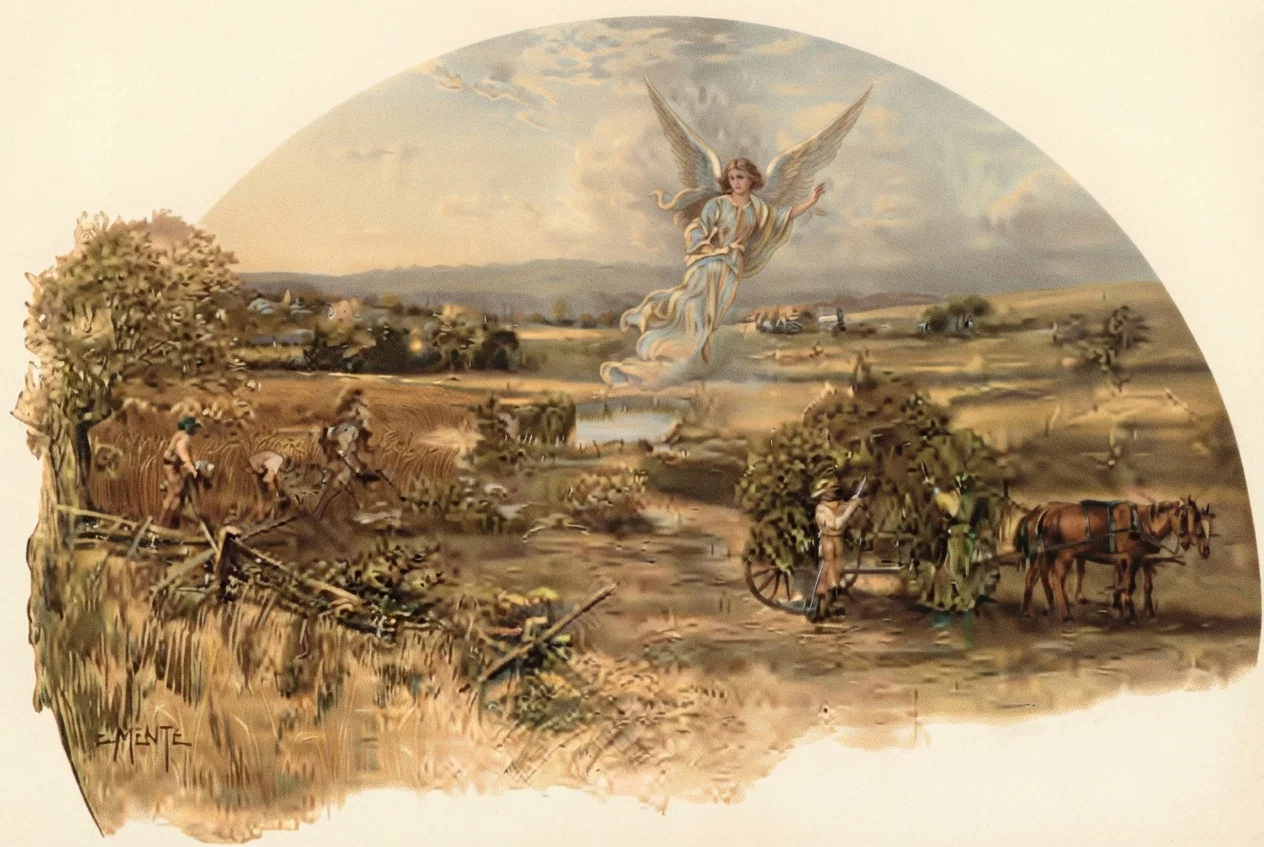
In Matthew 13 the former is represented by the wheat and its garnering; the latter, by the tares and their burning. In Rev. 14:14-16 is represented the reaping of the sheaves of wheat by the Son of man; in verses 17 to 19 is set forth the sad other side, in the following words:—
"And another angel came out of the temple which is in heaven, he also having a sharp sickle. And another angel came out from the altar, which had power over fire; and cried with a loud cry to him that had a sharp sickle, saying, Thrust in thy sharp sickle, and gather the clusters of the vine of the earth; for her grapes are fully ripe. And the angel thrust in his sickle into the earth, and gathered the vine of the earth, and cast it into the great wine-press of the wrath of God."
Righteousness and life are from above; for with the Lord "is the fountain of life" (Ps. 36:9), and He also is "the Lord our Righteousness" (Jer. 23:6). "Their righteousness is of Me, saith the Lord." Isa. 54:17.
He who is in reality the child of God is "born from above" (John 3:3, margin), "not of blood, nor of the will of the flesh, nor of the will of man, but of God," "of water and of the Spirit." John 1:13; 3:5.
The heaven-born are the fruit of the seed-sowing, the "incorruptible" seed of "the Word of God," sown by the Son of man. 1 Peter 1:23; Matt. 13:37.
The opposite class are the earth-born, sown unto selfishness and death, "the children of the wicked one," "the children of disobedience," "the children of wrath." Matt. 13:38; Eph. 2:2, 3. Every soul has the privilege of saying whose progeny he will be; for "whatsoever a man soweth, that shall he also reap. For he that soweth to his flesh shall of the flesh reap corruption; but he that soweth to the Spirit shall of the Spirit reap life everlasting." Gal. 6:7, 8. He who yields himself to receive the seed of the Word, sows to the Spirit, to righteousness, to life. He who will not receive the good seed, has a soil prepared for the seed of sin, with its Harvest of Death.
We may better understand the seed-sowing and harvest by a careful reading of the chapter in which this harvest scene is set forth, namely, the fourteenth of Revelation, beginning at verse 6. While this prophecy has its special application to the last generation, it is in itself an epitome of all the ages. Note, then, among other important things, the following:—
1. The everlasting Gospel—the message of good tidings, God's means of saving men in all ages, "the power of God unto salvation to every one that believeth"—is proclaimed to every people and tongue and tribe and nation in connection with the impending judgment. He who receives this message the judgment will acquit. He who rejects it meets the consequence,—death.
2. The time of the message is the close of the Gospel work. Paul preached of judgment to come (Acts 24:25), but this message is burdened with "the hour of His judgment is come," it is now impending over a shelterless world, save for Him in whom alone the faithful find refuge. The time of the message is also shown in what follows its third part, the coming of the Son of man to reap. Verse 14.
3. The first part of this message is positive truth, calling the church of God away from the fear and glory and worship of men to the fear and glory and worship of God, to His creative power, and, logically, to the memorial of His power, exercised in creation and redemption,—the Sabbath. This message, which began in 1840, was designed to heal the scattered and torn condition of the church, represented by "Babylon." The second part sadly announces the fall of Babylon,—the spiritual decline of religious bodies, because of the rejection of the healing message of the Gospel. The third part, represented by the third angel, solemnly warns against the overflowing last-day substitutes for the Gospel, and the union of Church and State and its worship. The consequence of rejecting this message is the reception of the unmixed wrath of God.
4. This great, threefold, world-wide message develops a class of whom it is said, "Here is the patience of the saints; here are they that keep the commandments of God, and the faith of Jesus." Verse 12. In other words, through faith it develops a class in whom the character of Christ is reflected. They have His name and the Father's name written upon them. They are saints, holy in His holiness. They keep the commandments of God, not seven of them, nor nine of them, nor one of them. It could not be said that a man kept the laws of a State who was continually transgressing one. To keep the laws of the State, he must keep all. So likewise when it is said of a class that they "keep the commandments of God," it means that they keep all His commandments, the whole Decalogue. They are seventh-day observers; for one command of God declares: "Remember the Sabbath day, to keep it holy. . . . The seventh day is the Sabbath of the Lord thy God." Neither are theynominal Jews; for they keep "the faith of Jesus" also. His is the faith "which worketh by love," the love that counts it the highest joy to obey; "for this is the love of God, that we keep His commandments; and His commandments are not grievous." Gal. 5:6; 1 John 5:3.
The rejection or perversion of the everlasting Gospel leaves man in sin and death.
During all the ages God has interposed His mercy to save man. Altho man had sinned, altho his sin was working out wrath or death (for "sin, when it is finished, bringeth forth death," James 1:15), God has ever interposed His mercy to stay the wrath. "For in the hand of the Lord there is a cup, and the wine is red; it is full of mixture; and He poureth out of the same; but the dregs thereof, all the wicked of the earth shall wring them out, and drink them." Ps. 75:8.
Since Adam fell, God has been pouring out of His mixture of mercy and wrath. The wrath has been manifest in the curse upon the ground, in the shortening of man's natural life, in allowing sin at times to develop its inherent evil, that man might sin and forsake it; but an abundance of infinite mercy has been mixed with the wrath, abundance for the pardon and salvation of every sinful soul, abundance to restrain all wrath which will not eventually redound to God's praise and the good of all who trust Him—mercy infinite in its giving, costing not only the eternal sacrifice of the Son of God, but the giving of countless human lives that sinful man might be won to righteousness and life. Where sin abounds, grace doth superabound. His mercy and grace have been, and are being, poured out without stint to restore a wicked world. All temporal good, all necessities of temporal life, all mental resources, all moral and spiritual enlightenment—perverted and turned even against God, as they are—are all manifestations of infinite mercy to a sinful world, in order that the goodness of God may lead to repentance.
Mercy not only restrains the outworking of sin, but it vails God's glory, lest sinful man seeing it gaze and perish. Jesus Christ was but the glory of God—eternal righteousness—vailed in humanity, that man might see the excellence and beneficence of the glory, and so believe without fear and serve without compulsion. Even the glory of heavenly orbs is dimmed that sinful man may not perish; for we are taught that "the light of the moon shall be as the light of the sun, and the light of the sun shall be sevenfold, as the light of seven days, in the day that the Lord bindeth up the breach of His people, and healeth the stroke of their wound." Isa. 30:26. But in the Lord's glorious metropolitan city, in the glory of His immediate presence, "the moon shall be confounded, and the sun ashamed, when the Lord of hosts shall reign in Mount Zion, and in Jerusalem, and before His ancients gloriously." Isa. 24:23; Rev. 21:23; 22:5. And yet God's people, in whom the incorruptible seed of His Word has borne the fruit of His righteousness, "shall see His face," and rejoice forevermore in His presence.
Christ is now withholding the forthshining of His presence. He has not yet come to reign in this earth purchased by His life. He swears by Himself: "As I live, saith the Lord God, I have no pleasure in the death of the wicked; but that the wicked turn from his way and live; turn ye, turn ye from your evil ways; for why will ye die?" "He delighteth in mercy." "The Lord taketh pleasure in them . . . that hope in His mercy." And therefore He pours it out upon a revolting world.
But there will come a time when every overture of divine and infinite mercy will be rejected; and the day draws on apace. All that will be left of the offered cup in Jehovah's hand will be the dregs of wrath. Then the Lord will do that which through all the ages He has had a right to do, come into His own and let His transcendent glory fill the earth as the waves fill the sea.
That will be all. The great Harvest of Earth, the eternal fate of the wicked, will be but leaving them to their own choosing. Christ will leave His priestly intercession, then utterly rejected, and take His restraining hand from off the agencies of destruction, and plague and pestilence and storm and earthquake will devastate the earth. He will come again in His own glory, in the glory of the Father, and of all the holy angels, and shall speak eternal peace to those who know Him within. Then, also, "that Wicked [posing hitherto as righteousness] shall be revealed, whom the Lord shall consume with the spirit of His mouth, and shall destroy with the forthshining of His personal presence." Matt. 16:27; 25:31; 2 Thess. 2:8. "Who shall be punished with everlasting destruction from the presence of the Lord, and from the glory of His power." 2 Thess. 1:9. But His glory and power will then fill the universe. And then neither the wicked nor his place, tho sought diligently, shall be found again. Ps. 37:10.
"Our God is a devouring fire," but only to devour sin. The offering which Israel of old brought, if they were whole-hearted and sincere in repentance and confession, represented their sin. Sin was confessed and laid upon their victim. Then "the glory of the Lord appeared unto all the people. And there came a fire out from before the Lord, and consumed upon the altar the burnt-offering and the fat; which when all the people saw, they shouted, and fell on their faces" and worshiped. Lev. 9:23, 24. The sin was devoured; the people, separate from sin, lived. In the next chapter another history is recorded. Contrary to God's command, drunken to indifference, Nadab and Abihu offered "strange fire" before the Lord. They said by their acts that God and His commands were of little account, and could be set aside as a matter of convenience. They identified themselves with the sin; and "there went out fire from the Lord, and devoured them." See Lev. 10:1-11. So will it be with the wicked when they stand at last before "the great white throne," in the end of the great day of God's wrath. Rev. 20:9. The everlasting glory—to them the everlasting fire of wrath—devours all sin and all identified with sin; the universe is clean; God has made a full end of sin, and "affliction shall not rise up the second time." Nahum 1:9. "There shall be no more curse." Rev. 22:3. The wicked have reaped their own harvest, have eaten "of the fruit of their own way;" and God's universe is free from sin and death and wo and weeping. Rev. 21:3-5.
Voluntarily, in infinite mercy, Christ, the Son of God, became "sin for us," "that we might be made the righteousness of God in Him." 2 Cor. 5:21. He would place in us His own power and glory by sowing in our hearts the incorruptible seed of His Word. That Word received by faith is Spirit and life. If our sins are yielded to Him, His Spirit in His Word will burn out all the dross and sin, and sin will die, and we shall live. And then at His coming the glory of God within us will respond to the transcendent glory of His presence, and, as we are changed from mortality to immortality, with rapturous hearts we will sing: "Lo, this is our God; we have waited for Him, and He will save us; this is the Lord; we have waited for Him, we will be glad and rejoice in His salvation." "In Thy presence is fulness of joy; at Thy right hand are pleasures forevermore."
And I saw another angel fly in the midst of heaven, having the everlasting Gospel to preach unto them that dwell on the earth—