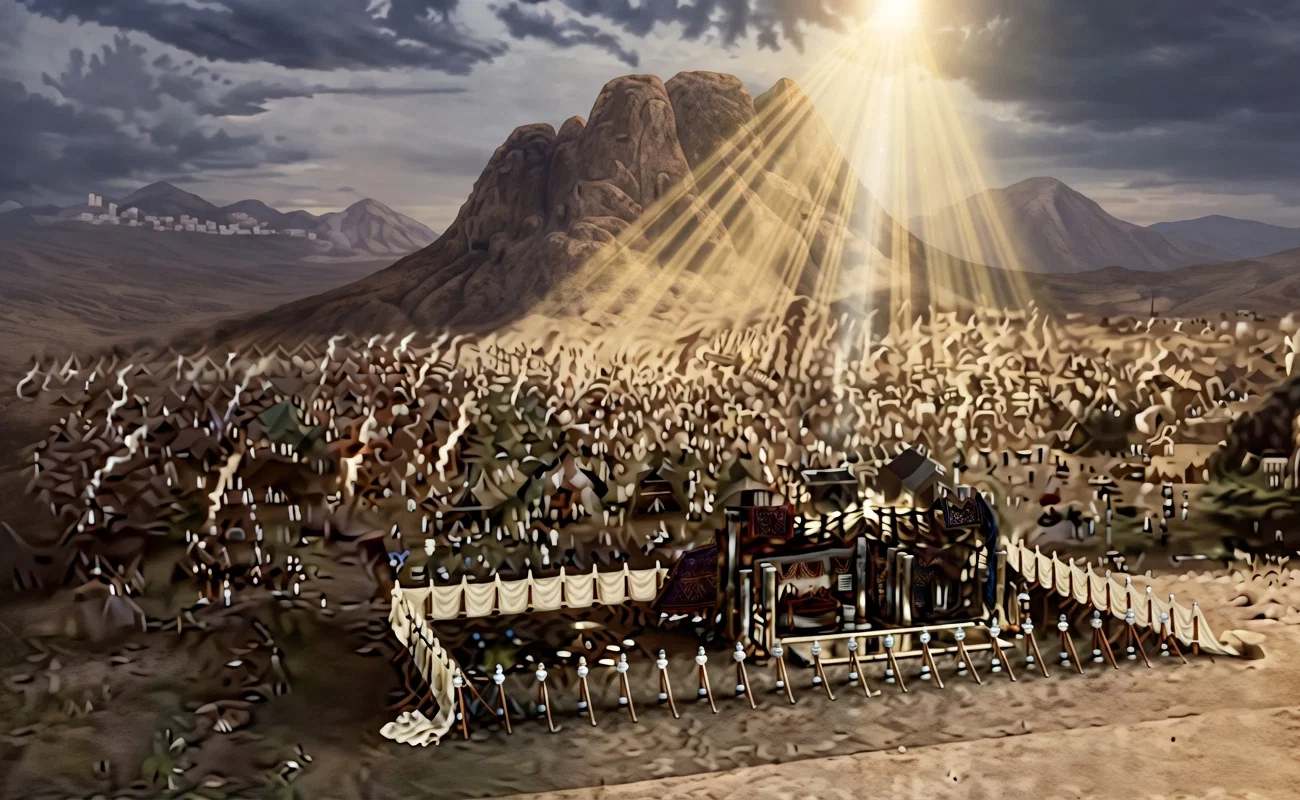
BY divine appointment the worship of the true God has centered in the sanctuary ever since the days of Moses. He commanded Moses to make Him a sanctuary that He might dwell among them. Ex. 25:8. The sanctuary was to be His dwelling-place. His presence was manifested in it. Hence His "way" is declared to be "in the sanctuary." Ps. 77:13. By studying God's "way" in the sanctuary, David received divine enlightenment concerning His dealings with men, and was saved from the despair of unbelief. Ps. 73:1-17. In God's sanctuary he saw His power and glory. Ps. 63:2.
A subject which reveals God's "way," His "power," and His "glory," must be worthy of careful and prayerful study. In the book of Exodus, chapters 25, 26, 27, and 30, we find the instructions that the Lord gave Moses for building the sanctuary. Chapters 36 to 39 record the making, and chapter 40 the erection of it. In Leviticus, chapters 1 to 7, 16 and 23, the main features of the service of the sanctuary are described. We may be sure that these scriptures, altho they may seem to us unimportant and unprofitable, were not written in vain, or without a purpose. They are a part of the "Scripture" that Paul declares is "profitable for doctrine, for reproof, for correction, for instruction in righteousness; that the man of God may be perfect." 2 Tim. 3:16. He also declares that "whatsoever things were written aforetime were written for our learning, that we thru patience and comfort of the Scriptures might have hope." Rom. 15:4. This certainly includes the sanctuary and its service.
The New Testament also speaks particularly concerning this important theme, and declares that Christ is our High Priest, and is a Minister of the sanctuary in heaven (Heb. 8:1, 2); that the earthly sanctuary was a pattern and its service a shadow, or type, of the heavenly (Heb. 8:5; 9:8, 9, 23, 24). In the eighth and ninth chapters of Hebrews we have a brief summary of the whole subject, showing that the earthly sanctuary and its service were an impressive object-lesson to teach us concerning the temple of God in heaven, and Christ's priestly service therein. Therefore a study of the former will enable us to understand the latter, and give us clearer views of our Saviour and of His work in our behalf.
The Sanctuary Built by Moses.
This structure was built of materials furnished by the people, and it was very beautiful and rich in appearance, because it was a pattern of the heavenly sanctuary, or true tabernacle which the Lord pitched and not man. Heb. 8:1-5; 9:11, 23, 24. We are not to understand from this that the sanctuary built by Moses and its service were a perfect representation—the very image—of the heavenly sanctuary and its service, because earthly things can not fully represent heavenly things. Heb. 10:1. The leading features, all in fact that is vital and necessary to teach us God's "way" in the sanctuary, is found in the type as presented in the Scriptures.
The earthly sanctuary had two apartments. The first was called the holy place, and the tent of the congregation, having the table of showbread, the golden candlestick, and the altar of incense. The second apartment was called the holy of holies, the holiest, also the holiest of all, and the most holy place. It was half as large as the first apartment, and contained the ark of God's covenant. This ark was also called the ark of God, because it contained His law, the Ten Commandments, written upon tables of stone. The cover of the ark was made of fine gold, so beaten as to form not only the cover, but two cherubim, one on each end. This cover was called the "mercy-seat," because mercy and pardon were granted to the repentant sinner when the blood of the offering was sprinkled before and upon it, thus honoring and satisfying the claims of the divine law, beneath the mercy-seat, that had been transgressed.
A curtain called the "veil" was hung before the first apartment of the sanctuary, and another curtain sometimes called the "veil," and the "second veil," separated the two apartments. The sides of the sanctuary were made of wood overlaid with gold, and covered over the top with four curtains. The first one was made of fine twined linen, blue, purple, and scarlet, beautifully embroidered with cherubim, representing the angels that minister in the heavenly sanctuary. The second was made of goat's hair, the third of ram's skins, and the fourth, or top curtain, was made of badger's skins.
The Service of the Sanctuary.
There was a ministration in both apartments of the sanctuary, a complete round of service being accomplished each year, closing with the tenth day of the seventh month, called the day of atonement. The service in the first apartment was carried on daily through the year. Offerings were brought to the door of the tabernacle. The sinner would confess his sin, placing his hand upon the head of the offering, and thus transfer his sin to the offering. He would then kill the offering, thus acknowledging that his sins—
Tabernacle and Court Open.
his transgressions of the divine law—made him worthy of death, because "sin is the transgression of the law" (1 John 3:4), and "the wages of sin is death" (Rom. 6:23). The sin was then transferred to the sanctuary by the priest, either by his eating the flesh of the offering in the holy place, or by his bringing some of the blood of the offering there. Lev. 6:25-30.
Thus the sins of God's people were transferred to the sanctuary by the daily ministration throughout the year. This made it necessary to have a removal of the sin from the sanctuary. This was called the cleansing of the sanctuary, and was a service performed each year on the tenth day of the seventh month. This was known as the day of atonement. This service is fully described in Leviticus 16 and 23. The high priest took two goats and cast lots upon them, one lot for the Lord and one lot for the scapegoat. The one upon which the Lord's lot fell was killed as a sin-offering for the people, and the high priest took of the blood and sprinkled it before and upon the mercy-seat, and upon the horns of the altar. This was the divinely appointed service for making the atonement and cleansing the sanctuary. Lev. 16:15, 16, 19, 20. Then the sins were borne by the priest from the sanctuary, and, by a simple service, were laid upon the head of the goat upon which the lot fell to be the scapegoat. The goat was then sent away into the wilderness by the hand of a fit man. Verses 20-22. Thus the sins of the people that were lodged in the sanctuary by the daily service thru the year, were borne away by the scapegoat into the wilderness at the close of the yearly service on the great day of atonement, the tenth day of the seventh month. See Lev. 16:29-34; 23:26-29. In this way there was a final riddance of sin from the people and the sanctuary every year. It perished with the scapegoat in the wilderness.
Truly, God's "way" of life and salvation is revealed in the sanctuary, and also His "power" and "glory." There we also are enabled to understand the end of those who obey not the Gospel of God. 1 Peter 4:17; Ps. 73:17.