A Partial Review of Some of Our Six Months' Series
THE one great truth which has differentiated Bible religion from all the other religions of the world is that there is one God, self-existent, omnipotent, omniscient, filled with everlasting love for His creatures. He is without beginning and without end; as expressed by Moses, the man of God, in his prayer, “Even from everlasting to everlasting, Thou art God.”
There is one universe. Marred as it is now by sin, there are still evidences to show that all created nature is one, bound together in some way by indissoluble law and life. Over this universe reigns supremely the one God, Jehovah, Creator of the heavens and the earth. The all-wise God has seen fit to create suns and systems and worlds in all parts of His visible domain. From what we see in our own world, He has seen fit to people these with intelligent creatures, having conscience, moral sense, personal responsibility, and power of choice. All this is necessary in the formation of character and the greater happiness of all the various intelligent creatures to which God has given being. That there are such creatures apart from this world is clearly evident, not only from the revelation which God has left us, but in the experiences of humanity. There are certain beneficent and malign spirits which visit mankind, which at times in man’s existence have become visible, the generally invisible, which have helped and hindered in the development of the race.
A Law of Character.
It follows logically in the consideration of this question that the great Ruler of the universe has a law, that that law is the reflection of His own character, that as He is perfect, so also His law must be perfect, and that that law must be the rule by which character is to be developed among His responsible creatures. Before man sinned that law was written in his very nature. In its positive form it is expressed in love to God and equal love to our fellows. Obedience to it is ever the fruit of faith, faith in the great, all-wise, loving God who creates. It is God’s plan that His creatures should become like Himself in character; to do that they must ever look to Him. As He is the fulness of all perfection in infinity, and as the finite can never reach the infinite, it is also evident that by God’s plan there would be constant growth in the development of His creatures, leading on to infinite happiness through all future ages. But this rested in the power of choice; man could do or refuse to do; character could not be formed on any other basis. And an infinitely wise God must take the awful responsibility of His creatures refusing to do right. Having set before them what the choice means, they themselves become wholly responsible for the consequences of the choice.
The Choice of Evil.
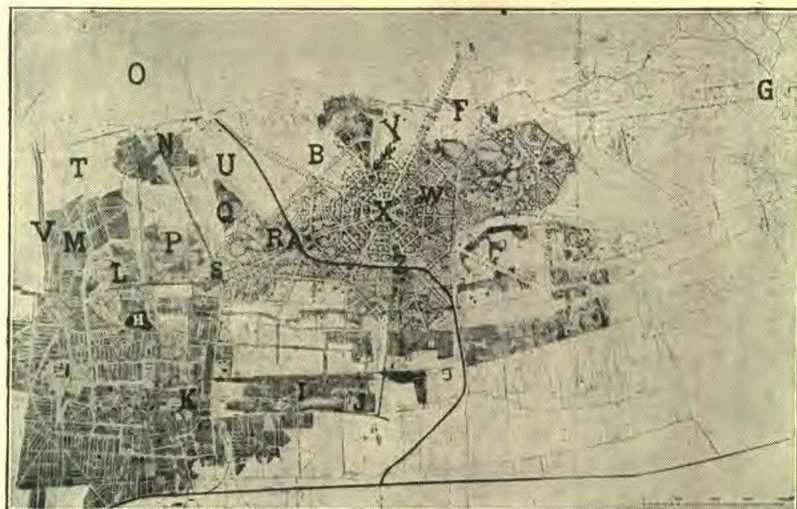
Diagram showing the location of the proposed capital of the world. For a fuller presentation of what is proposed by this diagram, also the cut on the opposite page, see the article on pages 3, 4, also the article from Mr. Vuilleumier on page 10.
One class of beings chose their own way rather than God’s way. They elected to look to themselves instead of to God, and to center their own minds and thoughts upon the finite creature rather than the infinite Creator. This defection took place among the angels of God, and Lucifer, the highest of all created beings, became Satan, the adversary. Having himself rebelled, it became his studied purpose to induce all others in God’s universe to rebel. This he accomplished with one-third of all the angels of God. Rev. 12:2. When the earth was brought into being and peopled with the beginnings of the race of man, the adversary came here also, and induced our first parents, Adam and Eve (who were given the privilege of eternal life in the obedience of faith, or the choice of unbelief, disobedience, and death), to turn from the right way and accept his suggestion, “Ye shall not surely die,” “ye shall be as God.” Gen. 3:4, 5. Even so the adversary brought death into the world, with all its wo and misery and sin.
In God’s plan, “in the way of righteousness is life; and in the pathway thereof there is no death.” Prov. 12:28. Perverting the right way changes it into a wrong way. Any change in a right line makes it a crooked line. The perversion of truth is error, the perversion of life, death. In God’s plan, life flows constantly from His great fount thru the channel of righteousness. Perverting that channel of righteousness perverts the life which flows thru it and brings death. Sin’s coming into the perverted universe of God marred its harmony and perverted the laws of its existence.
It is utterly impossible for men to judge now of the perfect earth and universe which came from God’s hands and were pronounced very good. Beautiful as nature is, in some of its aspects, it is marred by disease and death. No tree is so fair but what it has its dead branches and dead limbs; no fruit is so beautiful but what worms may be gnawing at its core, and sooner or later it shows decay. No human being so divinely fair and strong and well, but weakness, feebleness, decay, and death sooner or later will still the heart and lay the form prostrate in death. Instinctively humanity knows that things are not as they ought to be, knows that this plan which we now see in operation and of which history gives us account for six millenniums must be contrary to a perfect God of love and power and life. The very planets in their courses reveal that there is something wrong. Some invention has affected the perfect equilibrium. The broken fragments of the planets or suns which visit this earth in the form of meteorites teach the same lesson. The comets which dash flaming thru the heavens and bury themselves in the sun are evidences that the perfect plan of the all-wise God has been interfered with by Satanic agencies, and therefore men may study, conjecture, and conclude as they will, never will they be able to solve the great problem of existence by conclusions drawn from perverted nature.
Why Evil Is Permitted to Continue.
Yet infinite Wisdom is not willing to let conditions remain as they are and have been; infinite Order can not permit the universe of God to be marred forever; infinite Love can not rest when sentient creatures are suffering. Yet in God’s wisdom the evil conditions must be permitted to go on, that His creatures may learn by experience that which they have not been willing to learn by faith, that God’s way is best. Since the time when the first adversary charged, in the very action which he took, God’s plan with unwisdom and injustice, God has been on trial before His universe. In the principles of His kingdom right makes might. In righteousness is life; in rejection of His plan lie confusion and death; and so God in His great wisdom has allowed the long travail of sin to persist that rebellious creatures may devise and try every plan of their devising, and the multiplicity of the plans of their devising, and all the combined plans of their devising, and see them all work out confusion and every evil work.<page-break/
God’s Remedy.
All this God foresaw; all this lesson must come to His universe and be worked out once and forever, yet, in the working of that out that there might be no loss to a single one who would choose life, God has provided the great remedy for sin, so ordering it that where sin abounds, His grace—unmerited favor—does much more abound; so that even in those parts of His universe where sin has reigned and ruled to destroy to the greatest extent, there also might grace reign unto eternal life. Therefore, to meet the destruction which came from the decision of that most perfect of all created beings, “I will ascend into heaven, I will exalt my throne above the stars of God,” “I will be like the Most High” (Isa. 14:12-14), another Being, the Son of the eternal God, said, I will empty Myself of all My glory and all My prerogatives, will place Myself among God’s creatures, and demonstrate to the entire universe that God is good, and only good, and that all His plans shall work out for the best good of His creatures.
The Great Sacrifice.
The spirit that wins in the long conflict between right and wrong is that manifested in Christ Jesus, thus expressed in Phil. 2:5-9: “Have this mind in you, which was also in Christ Jesus; who, existing in the form of God, counted not the being on an equality with God a thing to be grasped, but emptied Himself, taking the form of a servant, being made in the likeness of men; and being found in fashion as a man, He humbled Himself, becoming obedient unto death, yea, the death of the cross. Wherefore also God highly exalted Him, and gave unto Him the name which is above every name.”
Lucifer exalted himself and aspired to rule on the throne of the universe, or, to put it in other words, to dethrone the Most High. “I will be like the Most High,” was the language of his heart. There can be but one Most High, and if Lucifer became that, it meant the utter dethroning of the God of heaven, Love. But the disposition that was in the Son of God said, I will empty Myself, become whatever is necessary to demonstrate God’s goodness and the power of righteousness, and leave the outcome with Him.
All was in that decision, when He emptied Himself; therefore is He called the “Lamb slain from the foundation of the world.” It was all in the purpose in the beginning; it was demonstrated to the universe as He came down step by step until He reached the very lowest humiliation possible—death on the cross of Calvary. First He became the angel Michael, one who is like God, the chiefest of all the angels—because the chiefest servant—of God, and so demonstrated that under the strongest of temptations and opposition from evil spirits, and meeting all the falsehoods and taunts of the adversary, angels could live righteously and holily before God.
Another step in His humiliation was to become man, and so “when the fulness of the time came, God sent forth His Son, born of a woman, born under the law, that He might redeem them that were under the law, that we might receive the adoption of sons.” Gal. 4:4, 5. Thus in His descent He came through all stages of intelligent creatures, from the highest in the universe to sinful man in his lowest estate, becoming sin for the sinner that the sinner might be the righteousness of God in Him.
Types and Shadows.
That Gospel of the Son of God was preached in the beginning, as indicated by the words to the serpent, that the Seed of the woman should bruise the serpent’s head—a prophecy and also a promise. Gen. 3:15. Eve thought that Deliverer had come when Cain was born, as indicated by her joyful exclamation, “I have gotten a man from the Lord,” or the God-man. How sorely was she disappointed! Noah’s parents evidently thought that to them had come the Deliverer, and so they named their son Noah, rest; “the same shall comfort us concerning the work of our hands.” And so indeed he was a type of One who would give complete rest and send the Comforter who would wipe away all tears from the eyes of the afflicted. Abel offered unto God a more excellent sacrifice than did Cain; he did it by faith, showing that he believed God. Heb. 11:4; 1 John 3:12. “Without shedding of blood is no remission.” Heb. 9:22. And Abel’s offering of the guileless lamb showed his faith in the Saviour to come.
These offerings of clean beasts, representative of the divine Sacrifice, continued in symbolic form down to the time when the children of Israel were called out of Egypt. Then God called a nation; a national center of worship was established; one tribe of the nation was taken instead of the first-born of the family as the priests of the nation; and a great and elaborate system of types and shadows, sacrifices and offerings, was ordained, as set forth in Exodus, Leviticus, and Numbers. But all these pointed forward to Christ. Every priest that ministered in that earthly sanctuary was a type of Christ who was to come and minister in the heavenly sanctuary. Every lamb and goat and kid and bullock that was offered represented the perfect offering of the Lord Jesus Christ; and he who truly offered by faith saw in that offering, not something which could take away his sin, but simply a shadow that pointed forward to the substance to come that could truly take it away. Therefore when Jesus Christ came, it was John the Baptist, who was educated under the Levitical law, who proclaimed on first seeing Him, “Behold the Lamb of God, which taketh away the sin of the world!” John 1:29.
The Round of Service.
Each high priest anciently served at least a full year, and each year of that ritualistic round of ceremonies typified the entire service of the priesthood of the Lord Jesus Christ. This is fully set forth in the book of Hebrews. For 359 days of that year he ministered in the first apartment of that earthly sanctuary, called the holy place. Into this apartment the blood of the slain beasts was brought and sprinkled before the veil, behind which was the ark of the covenant containing the law of God, the transgression of which is sin. Thus by figure the
sins of Israel were borne in by the sprinkled blood, and there acknowledged before God.6
The last day of the year was the great Day of Atonement, the judgment-day of the year, the day when all the various cases of the days before were brought in final review before God; for all the sins brought into remembrance before God into the holy place of that earthly sanctuary were on the Day of Atonement, in the person of the high priest, brought into the most holy place, and there confessed before the ark of God. There the blood of the atonement-goat was sprinkled. The priest in his own person brought out those sins and placed them upon another goat which was chosen for Satan and sent away by a fit man into a land of oblivion and destroyed. All those who afflicted their souls, confessed their sins, and put them away, stood clear before God. Those who did not do this were cut off from the congregation of God’s people. See Leviticus 16 and also 23.
The Antitype.
When our Lord Jesus Christ died upon the cross, the great effectual offering was made for sin, “once for all.” “He was wounded for our transgressions, He was bruised for our iniquities; the chastisement of our peace was upon Him; and with His stripes we are healed.” How graphically it is set forth in that wonderful fifty-third chapter of Isaiah. He “died for our sins,” the apostle declares in 1 Cor. 15:3, “according to the Scriptures,” and lays that down as the great basic fact of our hope and faith. He became “sin for us who knew no sin; that we might be made the righteousness of God in Him.” 2 Cor. 5:21. He died that we might have life, but having no sin of His own, having lived in perfect harmony with the law of God, and so demonstrating the purity and power and holiness of that law, He died because He stood in our stead; but it was not possible that death should hold Him (Acts 2:24); and therefore He demonstrated Himself to be the Son of God by rising from the dead. Rom. 1:4. By simple faith in God, in the lowliest of humanity, He conquered all the powers of sin, and demonstrated what God had before said in His word, “God is love; see how much God loves you.”
Our Effectual Priest.
When He ascended on high, He became priest at the right hand of the throne of the Father, and there He has reigned on the throne of the Father, in the kingdom of grace, gathering out from all the nations of earth those who would build into His great spiritual temple and glorify His name forever. Zech. 6:12, 13; Eph. 2:19-22; 1 Peter 2:5-9.
In the end of the Gospel work comes the judgment, even as judgment closes, of necessity, every probationary work. God must show, and the universe must see and know, who have endured the test; and, therefore, there will come in the very closing years of Christ’s work the judgment which will determine who of the dead are worthy to be brought forth in the first resurrection, who of the living are worthy to be changed from
mortality to immortality, when He shall come; and those who are not worthy will remain in their tombs until the second resurrection.7
This has been the faith of the children of God throughout all the ages in its essentials. They have not seen it as fully developed as those of the later days, have not seen the fulness of the light as those who have lived since Christ came; but they all looked forward to that wonderful event as the culmination of their hopes; so did Abel, Noah, Abraham, Moses, Joshua, Samuel, Elijah, Isaiah, and all the prophets; and therefore the faith of Christianity in all ages is that which is “built upon the foundation of the apostles and prophets”—the same foundation on which they built—“Jesus Christ Himself being the chief Corner-stone.”
The Eternal Purpose.
It was God’s great purpose in the beginning to have children “holy and without blame before Him.” Eph. 1:4. It was His purpose that they should develop character without sin. His law could not be changed; in the very nature of the case it is absolutely unchangeable. It is not even conceivable to a right mind that God should have a moral law different from His own character; it is not even conceivable that His character should be subject to change. But knowing that men would think to pervert His law, He tells us, “I am Jehovah; I change not;” “with whom is no variableness, neither shadow of turning.” And the same unchangeable attributes which He predicts of Himself He has also predicted of His unchangeable law. Jesus therefore came not to change the law. On the other hand, He declares that it is easier for heaven and earth to pass than for one tittle of the law to fail. Matt. 5:17-20; Luke 16:17. And therefore faith in all ages, from righteous Abel to the last soul that shall be gathered in, has for its purpose the writing of God’s unchangeable law in the hearts of His children.
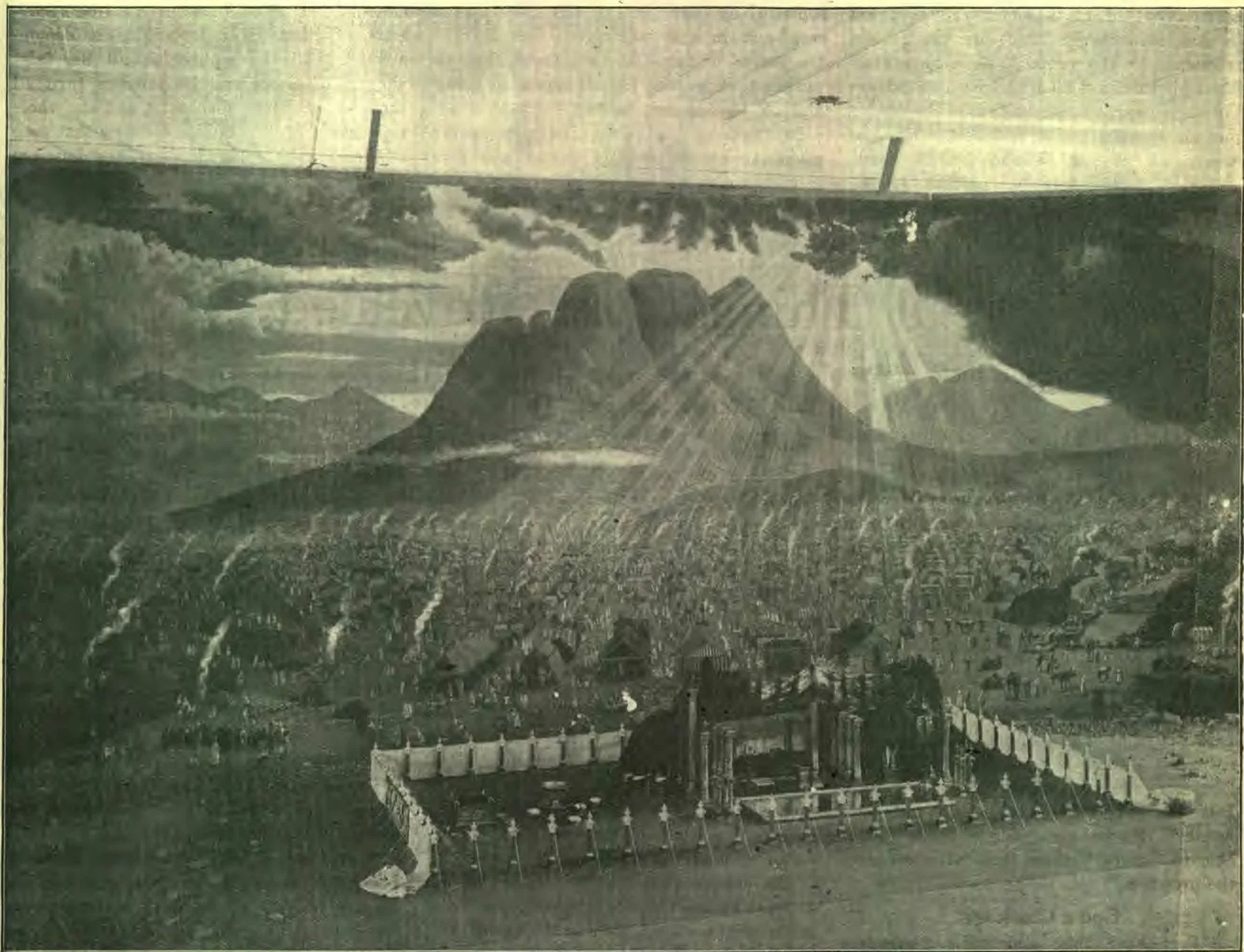
THE SANCTUARY AND COURT WHICH WERE THE SHADOWS OF THE HEAVENLY.
So it will be with every saved soul. True it is, there will be many who will not see all the light there is in God’s law, but the spirit of obedience will be written in the heart; and light as revealed by the word, the law of the Decalogue, which was kept by Christ Jesus—that light will be received. Therefore when Christ came, it was not to change the law and so justify man; it was not to justify man in the transgression of that law; but “thou shalt call His name Jesus; for He shall save His people from their sins.” Matt. 1:21. And again, “Who gave Himself for us, that He might redeem us from all iniquity, and purify unto Himself a people for His own possession, zealous of good works.” Titus 2:14. And He is the same “yesterday, and to-day, and forever.” Heb. 13:8. He never can be otherwise than the unchangeable One because He and the Father are one. Faith, instead of making void the law, establishes the law in the hearts of God’s children. Rom. 3:31.
It is the carnal heart that is enmity against God; for “it is not subject to the law of God, neither indeed can be.” Rom. 8:7. But when Christ comes into that heart which is yielded to God, the carnality and enmity, the hatred of God, is done away, and the heart is made new, upon which Christ writes His holy law. It is not the commandment or the law that becomes new, only as it becomes new in the new creature who sees it in a new light. 1 John 2:7, 8. Therefore while the law condemns the sin, it witnesses to the justification of the righteous one who is in harmony with the law of God. Rom. 3:20-22.8
Sin therefore is death, “the soul that sinneth, it shall die;” “sin, when it is finished, bringeth forth death.” Righteousness is life, “in the way of righteousness is life; and in the pathway thereof there is no death.” He therefore who chooses sin chooses death, and he who loves sin loves death. Christ gives righteousness that He may give life, and He gives life that we may live righteously.
He who in the grace of Christ perfects character, a character that is unchangeable, that is invincible against the assaults of the enemy, possesses character that is worthy to exist to all eternity; it is immortal character. When Christ comes He clothes that immortal character with His own immortality. The immortal character is worthy of an immortal body. Those who refuse to live, in refusing the righteousness, receive that which they choose in the sin, eternal death. In this God is not arbitrary. He gives man his full and free choice.
Then comes the end of the probation of mankind, when Christ shall give up the kingdom which He has occupied as priest to God, even the Father; when the Father, according to His promise, shall have abolished all rule and all authority and power; for Christ reigns as priest till the Father has put all enemies under His feet. The last enemy which shall be abolished is death. 1 Cor. 15:24-26. After our Lord shall come, there will be the thousand years of the judgment when the earth shall lie waste enjoying the Sabbaths which sin has refused it for six thousand years of man’s sojourn upon it. At the end of that time, the whole creation, which has been marred, made subject to vanity by the revolt of angels and men and has by reason of that suffered with this little world—that creation itself shall be delivered from the bondage of corruption into the liberty of the glory of the children of God. Isaiah 24; Revelation 20; Rom. 8:19-22.
No longer shall the curse mar the earth or any of God’s creatures; no ever-burning hell shall send forth horrid blasphemies against the government of God; no doubting souls in any dark place of His domain shall seek rest in self-destruction; but throughout the entire universe of God there shall be praises to Him who has all power to create and all love to redeem.
In the very beginning, He gave man a memorial by which His power and love in giving man his blessed home should ever be kept in mind. That sign of His creative power was the Sabbath. Men have belied God, have set Him aside for theories, have enthroned evolution in the place of creation, but the mighty, creative power of God has persisted. It was manifested in glorious miracles in the life of Jesus Christ, and has been manifested in the millions of miracles in changing sin-loving souls into loyal children of righteousness; and as a sign of that sanctification and redemption, God’s Sabbath still abides. Eze. 20:12, 20. And when that glorious new heaven and new earth shall come from the hand of God, still from one Sabbath to another shall all flesh come to worship before Him in the glorious new creation. Then the great controversy will have ended. The great principle of God’s government, that right is might, is demonstrated. All the sophistries, all the false charges of Satan and his minions through all the ages, have been disproved, and the whole universe of God will unite and sing that song of Moses and the Lamb, “Just and true are Thy ways, Thou King of saints.” “God is love.”