Notes and Comment

6%

Pacific Press Publishing Association · Mountain View, California · Nov 22, 1910

FromSigns of the Times, Vol. 37, No. 46.

Read the full edition

Notes and Comment

1. "The Tribulation."—Our word "tribulation" comes from tribulum, a thrashing instrument used to beat out the corn. The Greek word thlipsis means pressure, squeezing, affliction, oppression. Once John and James wished a high place in Christ's work, Jesus told them that they knew not the meaning of their request, and He then asked them if they were able to drink of the cup of which He would drink, and be baptized with His baptism. Confidently they said, "We are able." They did indeed drink of it. James was slain by the sword of Herod. John, tradition tells us, was cast into a caldron of boiling oil, out of which God saved him. Afterward he was banished to Patmos. It was part of life's discipline to fit him for better service. The kingdom of God is not entered by mere profession. It is "through many tribulations we must enter into the kingdom of God." Acts 14:22. The wheat must be separated from the chaff. The oil, the wine, must be pressed out. Tribulation worketh patience—endurance. Yet, tho enduring tribulation, he was yet in Christ, in the kingdom; for he had been delivered "out of the power of darkness, and translated . . . into the kingdom of the Son of His love." Col. 1:13. All these are in Jesus, and in Him are we brothers and partakers with all the good of all ages.
2. "The Word of God."—John was a preacher of that Word in word and life, and its mighty truth stirred up the hatred of hearts of evil. The words of Christ were, "If they persecuted Me, they will also persecute you." John 15:20. "The Testimony of Jesus."—Once John wanted the testimony, the witness, of Jesus to assure him a place of honor. Now he is banished to a desolate island because of it. It is generally held that John exercised a watch-care over the churches of Asia Minor, of which Ephesus was the largest. From this field, to silence his witness to Christ, the testimony of Jesus in him, he was banished to lonely Patmos. But both Word of God and testimony of Jesus were with him; and his desolate prison, designed to silence his message, became an audience-chamber of God, a sevenfold avenue for the light of life to reach the world.
3. "The Lord's Day."—We do not need to speculate as to what day of the week this was, if we will but take the Word of God, for loyalty to which John was banished. Surely Protestants—Christians—want no other testimony; and the Word is very clear, as these witnesses will assure us: (1) The Spirit of Christ, speaking through Isaiah the prophet (1 Peter 1:10, 11), designates the Sabbath as "My holy day." Isa. 58:13. Therefore the Sabbath is our Lord's holy day. (2) Jesus confirms this by declaring, "The Son of Man is Lord of the Sabbath." Matt. 12:8. (3) The eternal law of God declares that "the seventh day is the Sabbath of the Lord thy God." Ex. 20:10. Therefore there can be but one conclusion from the Word of God; namely, that the Lord's day is identical
with the eternal Sabbath of Jehovah. That seventh-day Sabbath immediately precedes the first day of the week. Mark 16:1, 2. The Bible knows no other Sabbath, no other weekly worship day. It is the day designated of God to honor both the Maker and Redeemer of the world; for creative power is manifest in both. The memorial of a finished creation became the window through which the prophet in vision could look forward through the mists and fog-banks of sin, over the persecutions and sorrows of centuries, to God's glorious recreation, and the evanishment of sin and death forevermore.
4. "Voice."—"Voice" is used for the speaker. It expresses his individuality. So John the Baptist was "the voice of one crying in the wilderness." John 1:23. The Good Shepherd is known by His voice. John 10:3. The trumpet voice carries us back to that time when it spoke from heaven the holy Decalogue. See Ex. 19:19; 20:1-17; Deut. 5:22. "Seven Churches."—Representing conditions in the entire church of God throughout the Christian dispensation. Local conditions in the churches named, and the order in which the churches were named, were typical of the whole church from that time to the end. "The then actual condition of these churches appears to have been providentially permitted to be illustrative of the moral and spiritual condition of all subsequent times."—Baley.
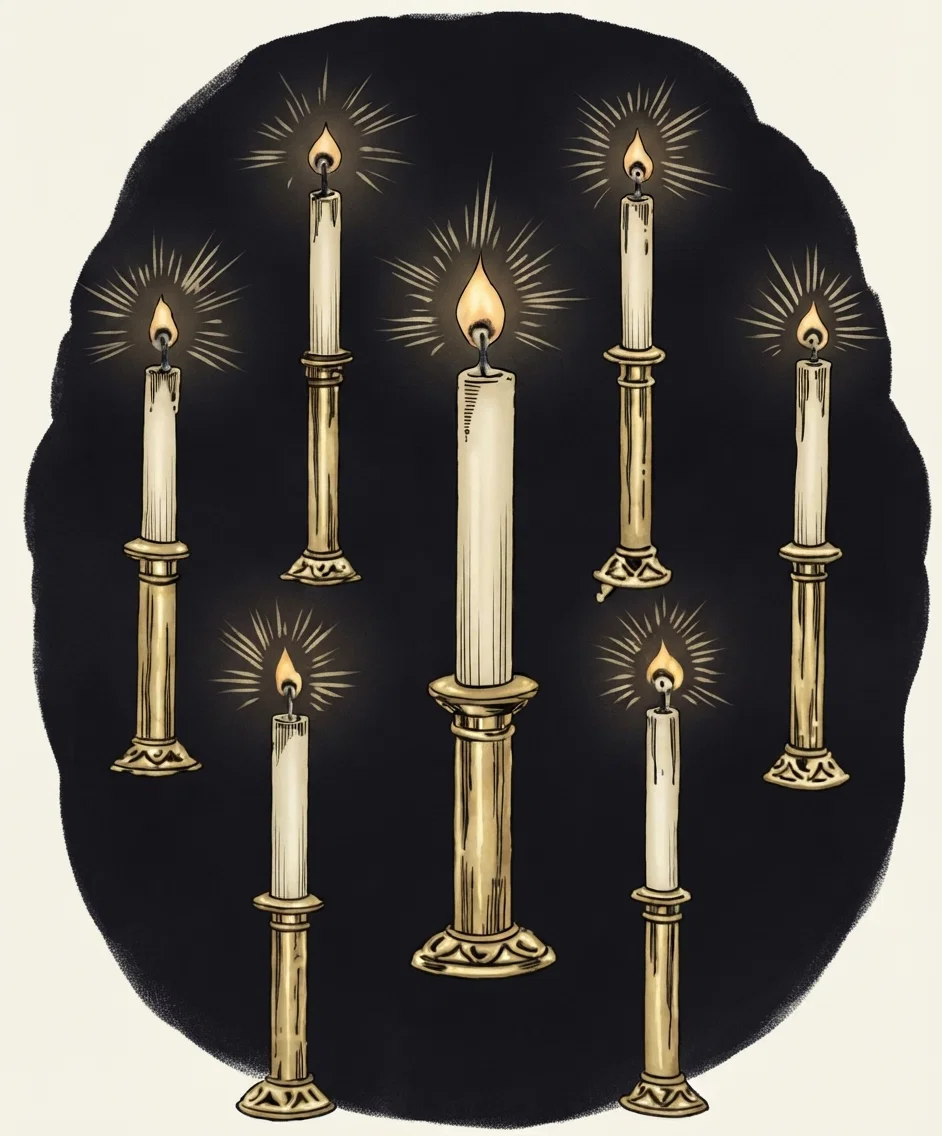
5. "Seven Golden Candlesticks."—Explained by our Lord as meaning the seven churches. Verse 20. Not themselves light, but receptacles, mediums, by which the light of God should shine to the world. Christ is the "Light of the world;" and when He dwells in humanity, those in whom He dwells become the light of the world. John 8:12; Matt. 5:14. He is the Word, the lamp, the light (Ps. 119:105; Prov. 6:23) personified (John 1:14). So His disciples should ever be "lights in the world," "holding forth the Word of light." Phil. 2:15, 16. Like John the Baptist they should be "burning and shining" lights. Only by the living Word in the lives of the members can a church meet God's purpose, and only by so abiding can her candlestick remain. Jesus Christ will furnish the oil and the light if the church is willing to be God's candlestick.
6. Son of Man.—O, the wonderful condescension of God. He who was from eternity, the Creator with the Father of the almost infinite universe, consented for the demonstration of God's love to become a brother to sinful men, was made "in all things" like them, took upon Him their sins, became sin for their sakes, that they might become the righteousness of God in Him, and be saved to all eternity to the praise and glory of God. This was the love of God in Jesus Christ. And now glorified He is still man tho God; and so He reveals Himself that we may faintly perceive what He will do for all who will identify themselves with Him. Once before, John saw Him glorified on the Mount of Transfiguration. Mark 9:2, 3.
7 "A Garment."—The long robe and the girdle around the breast indicate royal dignity, the royal priesthood of Christ. For Christ's robe and girdle see Dan. 10:5; Isa. 11:5; Eph. 6:14; the robe of righteousness, the golden girdle of truth.
8. "White as white wool," symbolizing not age or decay, but perfect purity. Dan. 7:9; Mark 9:3. "Eyes as flame of fire," piercing, penetrating, searching out iniquity, destroying sin. Rev. 19:12; Ex. 24:17; Jer. 17:10. "Feet as burnished brass," passing through the furnace of affliction, and emerging with greater, more manifest power and glory. "Voice" as many waters, denoting distinctiveness, fulness, power. Daniel has it "as a multitude" (10:6), and both are combined in Ezekiel (1:24). "Right hand," the hand of authority, of power and skill. "Stars," a circlet of symbolizing angels. Verse 20. "A sharp two-edged sword," the Word of God, the word of power. See Eph. 6:17; 2 Thess. 2:8; Heb. 4:12; Rev. 19:15. "As the sun shineth in his strength."—When the veil of sin is removed, the sun shall shine forth in its strength, seven times stronger than now. Isa. 30:26. The glory of Christ's face is not like the sun at midday, but like a sevenfold sun at midday. No wonder that John fell as one dead. No mortal could endure such surpassing glory.
9. "The Living One."—Jesus Christ, the Son of God, died. Men's creeds and hymns say and sing it, but men deny it. The glorified Christ does not leave us in doubt. "I was dead," He declares. "He poured out His soul unto death." "Christ died for our sins;" "He was buried." 1 Cor. 15:3, 4. We may not explain it away. It is repeatedly told that the Christ of God died. How He could do it, we know not; but we accept His word, "I was dead." All the wicked will sometime die and stay dead. Of the great arch-rebel it is said, after a certain time, "Thou shalt never-more have any being." Eze. 28:19. Christ came to bring to naught the devil and his works. Heb. 2:14. He will not fail to accomplish His object. In love He died in our behalf, to take away our sins. Our sins slew Him. But in the perfect righteousness of His perfect character is fulness of life, and the grave could not hold Him. Acts 2:24. He demonstrated that He was the Son of God in love in His dying. He demonstrated that He was the Son of God in righteousness and power in rising from the dead. Rom. 1:4. He is the Living One. He tunneled the grave with the power of life. He wrote on its dark portals to every believer, "Rest calm in hope, all ye who enter here." He is not in the rock-hewn tomb of Joseph; He lives forevermore, to lead every trusting soul from all the bondage of sin and error, from mortal assumption and erring tradition, on and on in soul-saving progress to the land that knows no death.
10. "Death and Hades."—Sin is the tyrant, enslaver. Death is the king. Hades is his realm. Hades is the abode of the dead, the great silent land where all sleep irrespective of character. Jesus, by conquering sin, conquered death and Hades. No longer will the dark hidden land hold God's children. And when the wicked are destroyed in Gehenna, the hell of punishment, then all of sin and its prison-houses and keepers will be forever destroyed. Christ's resurrection was the pledge of universal and eternal triumph and righteousness and life.
11. "Write the things."—The Revelation deals with the entirety of Christ's work in connection with the conflict of the ages and triumph over sin. It therefore includes all that John saw of what was then as well as what should come to pass thereafter. It always makes, too, living connection with the past.
12. "Seven Stars."—For the candlesticks, see note 5. The stars represent angels. The word is used in the Revelation as meaning a heavenly messenger.God gives angels, heavenly beings, supervision over individuals, companies, churches, nations. And so over these conditions God has heavenly spirits to take charge. He works through them in sending instruction to His earthly servants. Each one of these heavenly angels, then, stands as representing the church or that condition of the Christian church to which the letter is addressed. It is the church, however, that is ever intended. "He that hath an ear, let him hear what the Spirit saith unto the churches."