Studies in Daniel

2%

Pacific Press Publishing Association · Mountain View, California · Apr 2, 1912

FromSigns of the Times, Vol. 39, No. 14.

Read the full edition

Studies in Daniel

A Vision of Empires—VII

(Daniel 8 Concluded)

What Is the Sanctuary, and Its Cleansing?

In our last study we considered the matter of the "two thousand three hundred evening-mornings." We learned the connection between Daniel 8 and Daniel 9, and found the key to the explanation of the two thousand three hundred days in the explanation given to Daniel, as recorded in chapter 9: 24-27. We learned that 490 years of that 2,300 were cut off upon the Jewish people; that this 490 years was divided into 49 years, 434 years, 3½ years, and 3½ years; that all these terminated just where the prophecy said they would, and so sealed up the vision and the prophecy. 490 years from the 2,300 years leaves 1,810 years, which, added to the year A.D. 34, when the 490 years terminated, brought us to A.D. 1844. At that time, declares the angel, shall the sanctuary be cleansed.

What Is the Sanctuary?

In our study of it in this issue, we can only briefly state some of the great essentials, and refer the reader to other works which discuss the subject much more fully. We will, however, give Scripture references for the statements which we make. We can consider the subject only in its great general teaching, and not in detail. Let us therefore consider this in the following paragraphs.
1. The Bible is the book of salvation. It comes to mankind for that very purpose. It reveals the great plan of salvation so that all men may apprehend God’s purposes and power in salvation, if they can not comprehend them. They may know the great truth of salvation, based on the mighty facts of redemption in Christ Jesus. In that Book they learn that man is a sinner, that the Son of God is a Saviour; that man, who was primarily created pure and innocent, fell, and sin became incarnate, ruling the flesh. God in His goodness covenanted to bring into the flesh righteousness incarnate, and so overcome sin in its very stronghold, and thus save man; and that plan and purpose of God was from the foundation of the world, as implied in Rev. 13: 8; 17: 8; and other passages. We may not, as before remarked, comprehend the mystery of godliness, of God manifest in the flesh (1 Tim. 3: 16), but we may grasp its power by faith. In the very beginning of the Book it is implied in the word of God to the serpent, and must have been given to the man in promise, that the seed of the woman should bruise the serpent’s head; that in some way God was to be manifest in the flesh, and should overcome that power which overcame man in the beginning. See Gen. 3: 15. From that time forward it was to that deliverance that the instructed looked. When the first son was born to the primal mother Eve, she exclaimed, "I have gotten a man from the Lord," or "I have gotten the God-man." Gen. 4: 1. She thought the Saviour was then born; but how infinitely bitter must have been her disappointment when he who she thought would bring life brought death!
2. That faith in the power of God to save, and in the Redeemer to come, was set forth by symbols of clean beasts, offered as sacrifice, prefiguring, from the time that sin entered, the death of our Lord Jesus Christ, of whom Peter said, "Forasmuch as ye know that ye were not redeemed with corruptible things, as silver and gold, from your vain conversation received by tradition from your fathers; but with the precious blood of Christ, as of a lamb without blemish and without spot: who verily was foreordained before the foundation of the world, but was manifest in these last times for you." 1 Peter 1: 18-20. In that beginning Christ, under God our Creator, gave Himself for the race. In that mighty purpose there was salvation, and the carrying out of that purpose of Christ involved the death of the Son of God. And the children of God showed their faith in that offering by offering up an innocent beast as a type of the Lamb of God that should take away the sin of the world. John 1: 29. So Abel, the faithful, offered up the firstlings of his flock (Gen. 4: 4); Noah offered of every clean beast (Gen. 8: 20); Abraham offered up of the ram, a sacrifice for his son (Gen. 22: 13). All these, and many more, looked forward to the saving "Seed," "God manifest in the flesh." That Seed came through Noah; and of Noah’s sons, Shem; and of Shem’s descendants, Abraham; of Abraham’s sons, Isaac; of Isaac’s sons, Jacob; of Jacob’s sons, Judah; but Jacob’s sons went down into Egypt into captivity.
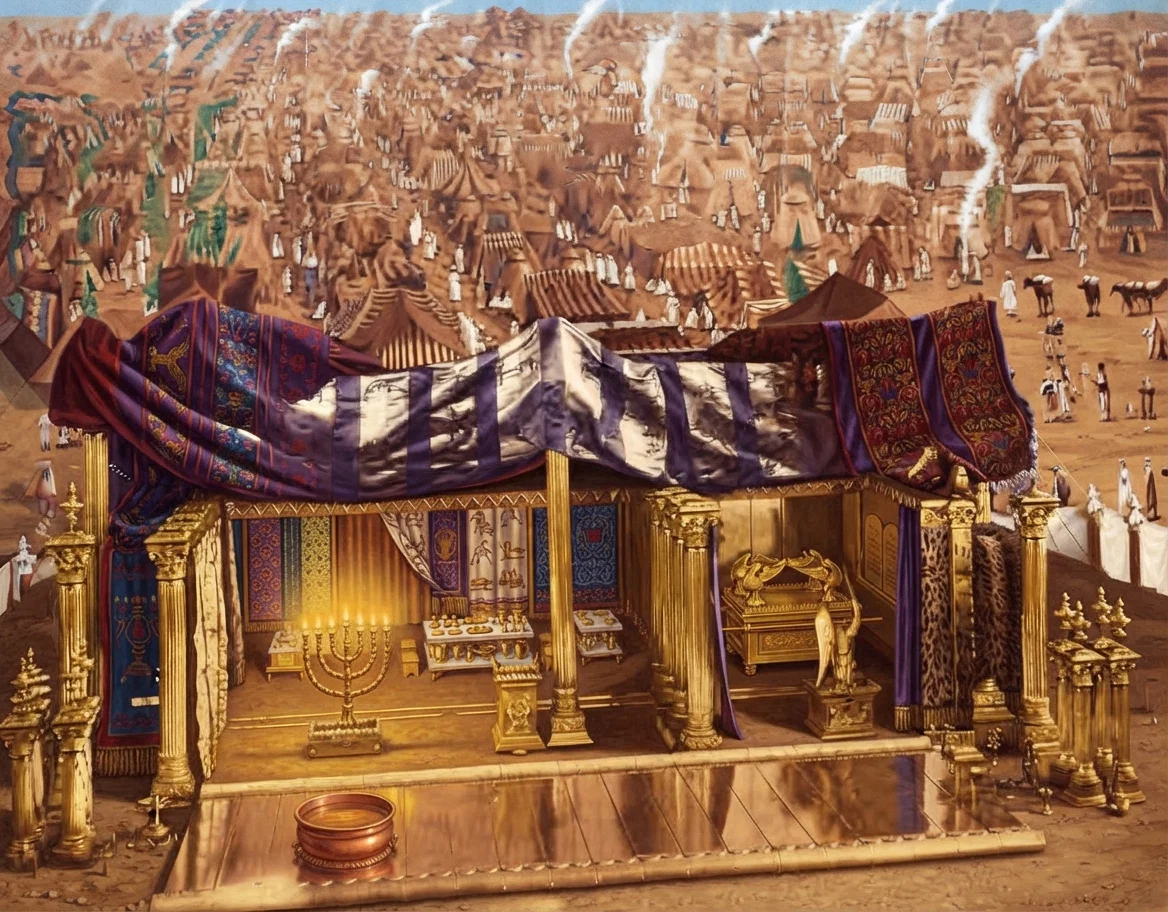
The tabernacle in the midst of the camp of Israel, with the north side thrown open to disclose its interior plan and the position and arrangement of the furniture. See article on pages 6 and 7.

A Centralized Worship

3. And yet, in order that the holy Seed might be preserved, God called that nation out of Egypt, out of idolatry, away from idolatrous priests and idolatrous symbols setting forth perversions of truth contrary to that which made men and developed character. Calling out a nation thus, placing them in a land by themselves, of necessity meant a centralized worship. Previous to this, the father of the family had acted as priest. The oldest son in the family took the place of the father, in case of his death. Wherever there was a family that served God, the father was the priest of that family, and the offering was accepted and the salvation of God came in response to faith. But when a nation was called for a holy purpose, there must be a centralized worship, a common place of meeting, that which would hold together with the one great thought the various families and tribes of the nation; and to a nation that had been reared in idolatrous surroundings, and in their new location were also surrounded by idolatry of every form and kind, AN OBJECT-LESSON WAS NEEDED.
This did not necessarily mean, however, that all the true people of God were found in that nation. There were doubtless others scattered through the nations. God had His witnesses everywhere. We can instance one which every Bible reader will recall — that of Jethro, the priest of Midian, a worshiper of the true God, in whose home Moses found a place as he fled from Egypt.
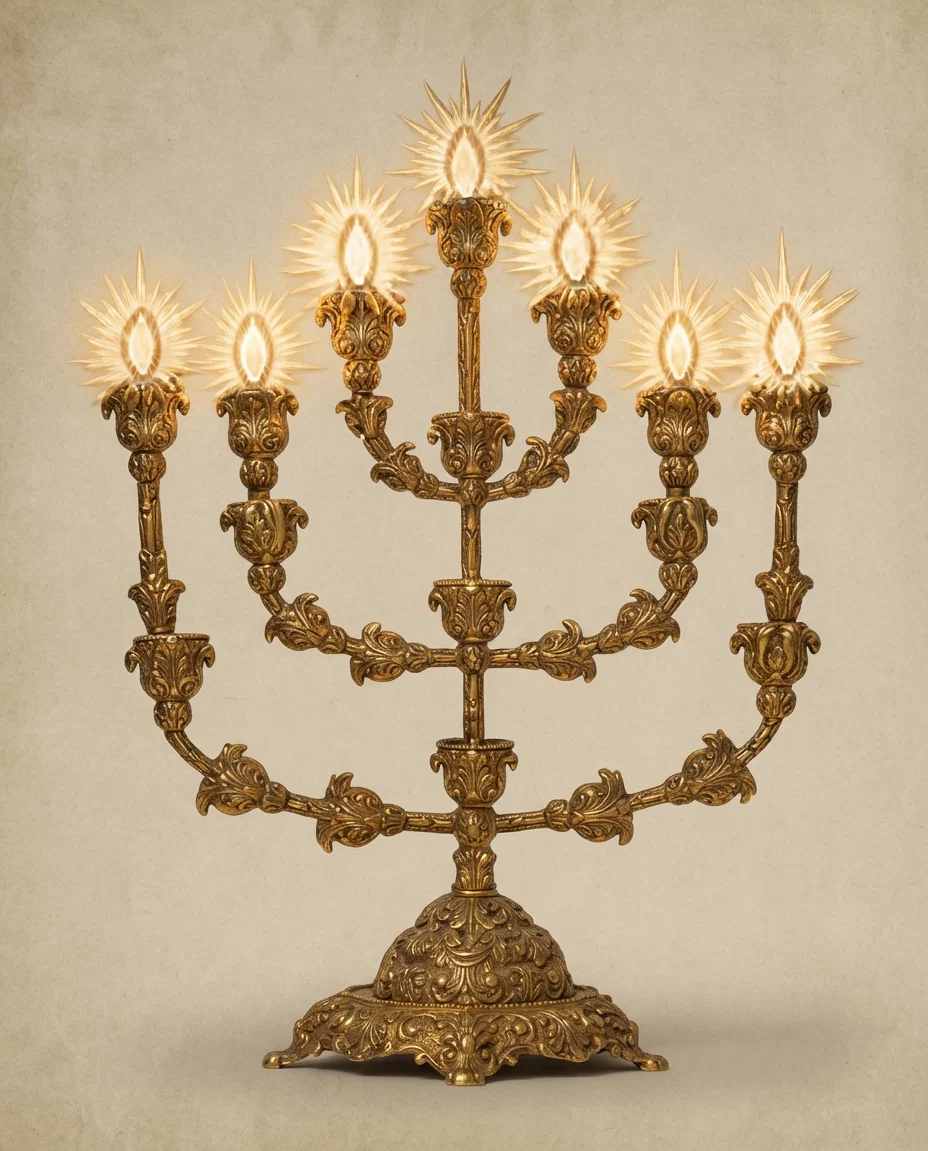
The golden candlestick

Priests to the Nations

4. This nation which God called were not only to preserve the holy Seed, but they were to preserve the holy truths of God. They were called to hold up the light before the world; and the little country in which they were placed, Palestine, was the very highway of the great nations of earth. It was designed of God that they should give light to these nations. "Behold," said Moses, their leader, "I have taught you statutes and judgments, even as the Lord my God commanded me, that ye should do so in the land whither ye go to possess it. Keep therefore and do them; for this is your wisdom and your understanding in the sight of the nations, which shall hear all these statutes, and say, Surely this great nation is a wise and understanding people. For what nation is there so great, who hath God so nigh unto them, as the Lord our God is in all things that we call upon Him for? And what nation is there so great, that hath statutes and judgments so righteous as all this law, which I set before you this day?" Deut. 4: 5-8. Thus in holding forth before the nations the light of God’s covenant truth they would be PRIESTS TO THE NATIONS. And so we read in another passage, "Now therefore, if ye will obey My voice indeed, and keep My covenant, then ye shall be a peculiar treasure unto Me above all people: for all the earth is Mine: and ye shall be unto Me a KINGDOM OF PRIESTS, and an holy nation." Ex. 19: 5, 6.
Note that they were not simply to be a nation, or kingdom, that should have among them holy priests, but the whole nation itself should be a kingdom of priests, the whole nation itself a holy nation. They were to be PRIESTS TO THE WORLD. They were to carry out in their life, for the sake of others, what is said of the office of the priest: "For the priest’s lips should keep knowledge, and they should seek the law at his mouth: for he is the messenger of the Lord of Hosts." Mal. 2: 7. All this is abundantly taught in the Old Testament. Thus God has set forth not an exclusive nation, not a nation that should be wrapped up selfishly in their own interests, but a nation and people that should be consecrated to God, loyal in all respects to Him, but reaching out pitiful, strong, saving, helpful hands to every soul who desired to know God among surrounding peoples.

The Need of Teaching Symbols

5. But the nation failed to meet the great purpose of God. We learn in the 20th chapter the sad thought that when God was speaking to them His holy law, the admiration of all ages, they pleaded that God should not speak with them any more. They were not willing to open their hearts to receive it. And therefore they must be taught as children are taught. They themselves needed priests; therefore a tribe was set apart to the priesthood,—that of Levi. They themselves needed object-lessons and symbols; and so a sanctuary was built. The holy shekinah of God’s presence was there, in order to teach the nation which seemed so slow to grasp His great truth. They could not grasp, as did Moses, that God was among them constantly, that the great God who made heaven and earth was always near them, and ready to help them; that the word which He spoke was not in heaven, afar off, that some one should climb up to bring it down; that it was not in the deep, that some one should go down into the deep to bring it up; but it was nigh them, in their mouth and in their heart. Deut. 30: 11-14. So God wanted to dwell with His people, and each individual soul, but they would not. Therefore he said, "Let them make Me a sanctuary; that I may dwell among them." Ex. 25: 8.
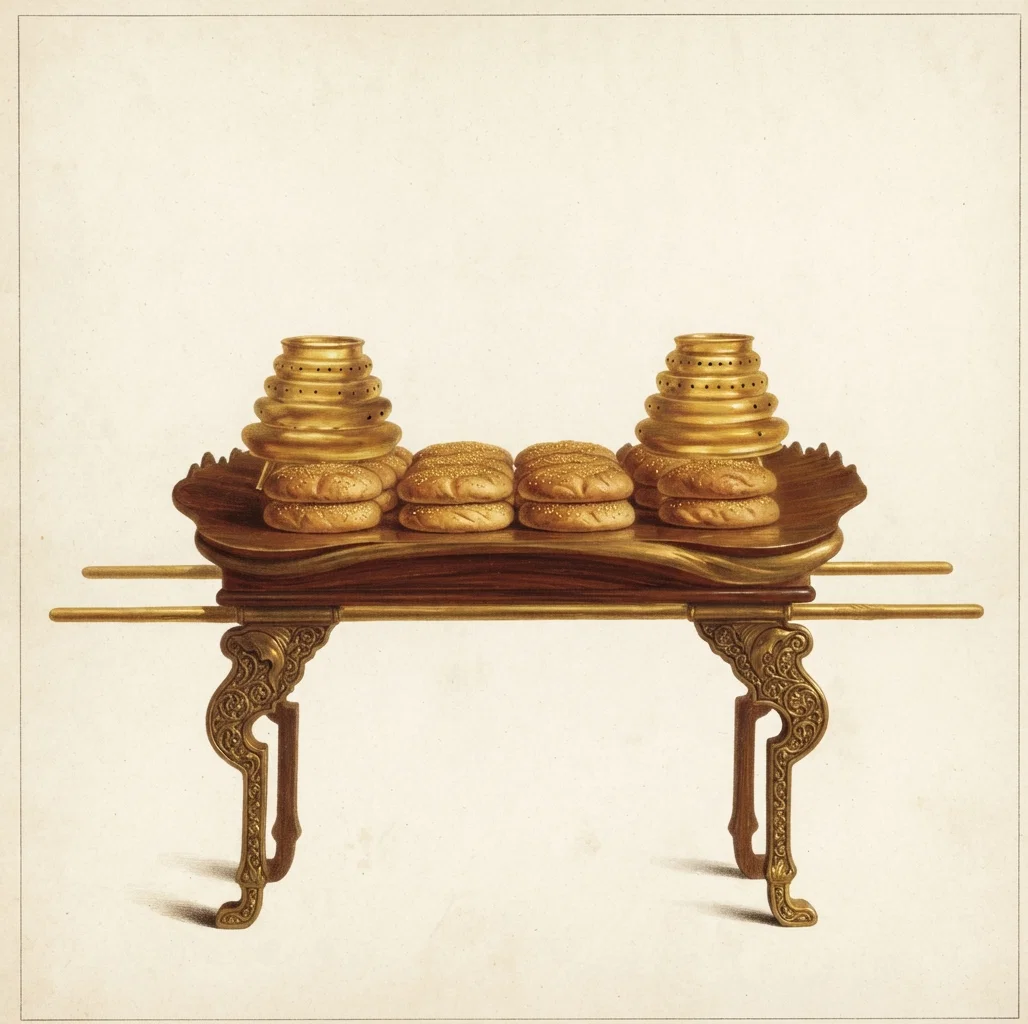
The table of showbread
In this God would manifest His presence and His glory, and there would be connected with it that which would continually teach the children of Israel of God. He sent His angels to minister to them; nay, more than this, the very Angel of the covenant — the Archangel, Michael, He who afterward became Jesus of Nazareth, the Angel in whom was God's name — became companion with them. "Behold, I send an Angel before thee, to keep thee in the way, and to bring thee into the place which I have prepared. Beware of Him, and obey His voice, provoke Him not; for He will not pardon your transgressions: for My name is in Him. But if thou shalt indeed obey His voice, and do all that I speak; then I will be an enemy unto thine enemies, and an adversary unto thine adversaries. For Mine Angel shall go before thee." Hundreds of years afterward the prophet puts the same blessed truth in these words: "I will mention the loving-kindnesses of the Lord, and the praises of the Lord, according to all that the Lord hath bestowed on us, and the great goodness toward the house of Israel, which He hath bestowed on them according to His mercies, and according to the multitude of His loving-kindnesses. For He said, Surely they are My people, children that will not lie: so He was their Saviour. In all their affliction He was afflicted, and the Angel of His presence saved them: in His love and in His pity He redeemed them; and He bare them, and carried them all the days of old." Isa. 63: 7-9.

Description of the Sanctuary

6. In the book of Exodus, from the 25th chapter on, we have the description of the sanctuary that was to be built, and how that work was carried out. We give a brief description. The sanctuary was an oblong building, thirty cubits long by ten wide and ten high. Its walls, made of boards of acacia wood, were covered with gold; and over these golden walls were thrown, first a marvelously woven curtain of fine-twined linen, on which were embroidered the figures of cherubim; and over this, three other covers, to protect it from the weather, and to preserve the whole building. These cherubim, or companies of angels, woven into the holy covering, were not symbols of walls to enclose God, nor were they the symbols of anything which did enclose God. This thought is especially guarded in the prayer of Solomon, at the dedication of the temple: "But will God indeed dwell on the earth? behold, the heaven and heaven of heavens can not contain Thee; how much less this house that I have builded?" What these angels did represent was the wonderful power and goodness and infinity of God in providing ministering spirits to serve His people, to show to them that He had invisible forces at His command which would be sent for their succor and help always. And this thought is emphasized again and again all through the history of Israel. "Are they not all ministering spirits, sent forth to minister for them who shall be heirs of salvation?" Heb. 1: 14.
This sanctuary was divided into two parts, called the "holy" and the "most holy" place. The holy place included the first part of the sanctuary, with a door opening toward the east, twenty cubits long by ten wide by ten high. The most holy place, separated by a veil, was a cube of ten cubits.

The Earthly Center of Worship

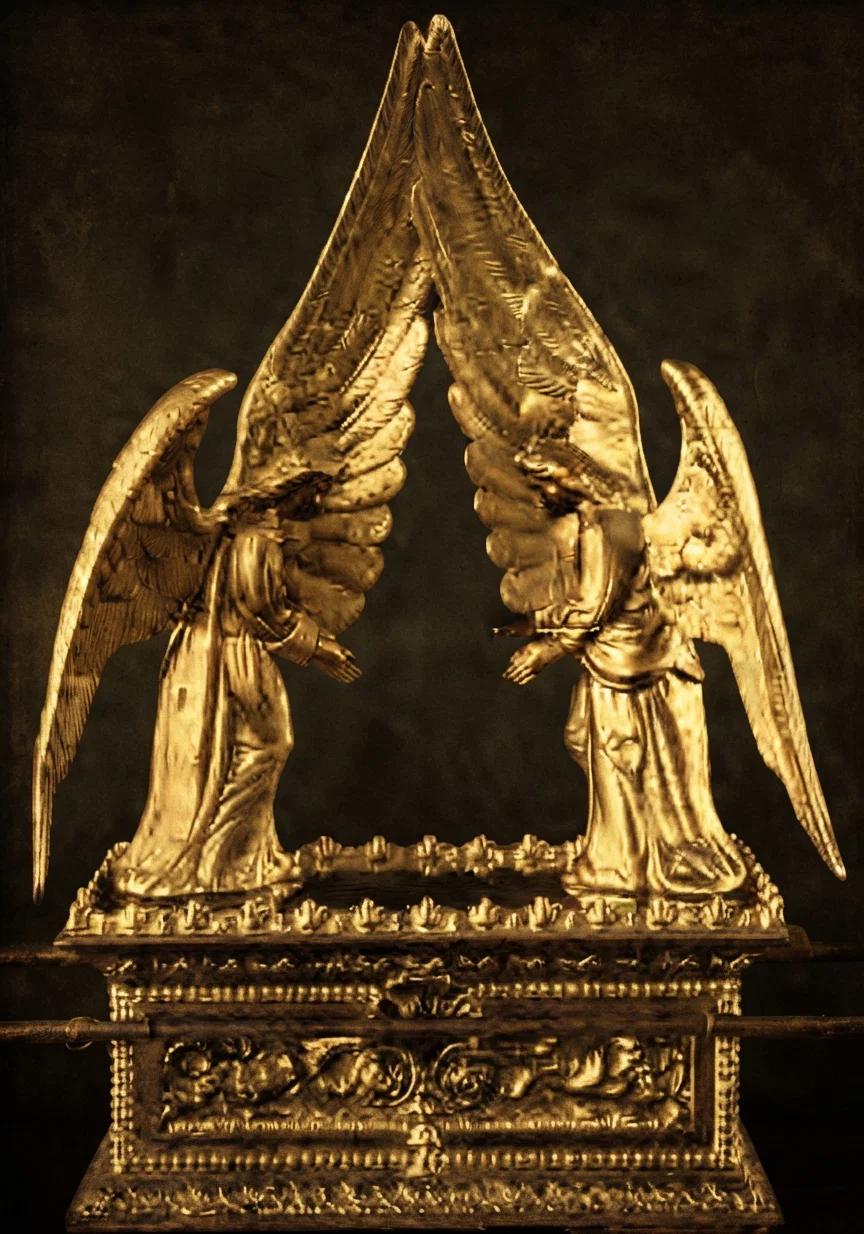
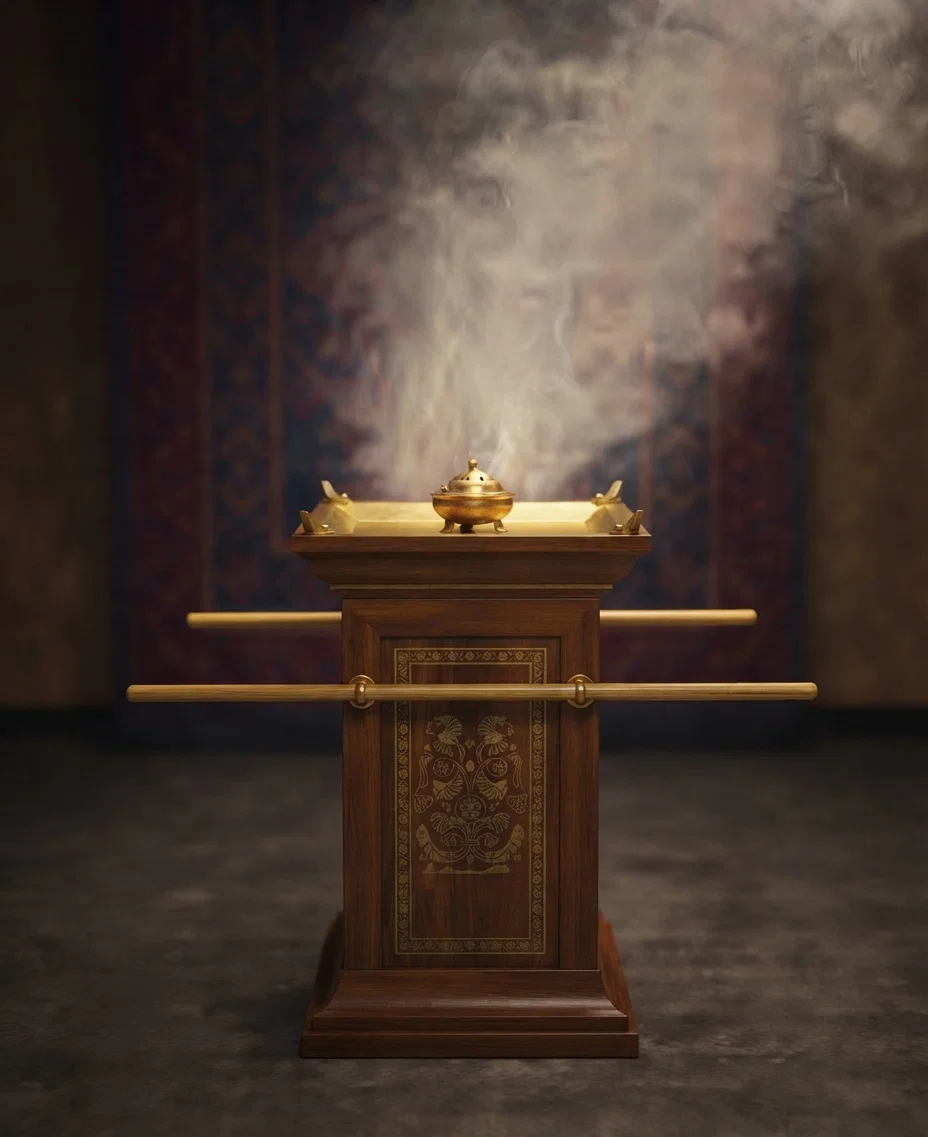
7. There were various articles of furniture and utensils about this sanctuary. First, before we reach the sanctuary, was the altar of burnt offering, where all the victims of sacrifice pointing forward to Christ were slain. On entering the holy place through the veil, on the right was the table of showbread, or literally "presence-bread"—the bread of God's presence, representing the Holy Word upon which His people should feed, and feeding by faith, would find His presence and power. On the left was the golden candlestick, seven-branched, which, we are told in Rev. 4: 5, is typical of the light given through the seven Spirits of God, or the Spirit of God in all its fulness. We could imagine the beauty and glory that there would be in that sanctuary, with the light reflected from the golden walls, and re-reflected until it was a place of dazzling glory. And it well represented the illuminating power of the Holy Spirit. Just before the veil, entering the most holy place, was the altar of incense, that incense representing the grace of God which is added to the prayers of His people, making them effectual before His throne. Entering the most holy place, there is but one article of furniture, and that is the ark of the covenant, or the ark of the testimony, called also the ark of the testament, the very basis of all the covenants which God has made with His children,—the ark of the testimony, or witness, to the character of God and the holy law which it contained, as also expressed in the word "testament," or will, of God. Within that holy ark were placed the tables of stone on which were inscribed God's law to sinful man,—the Decalogue, that which points out sin, that which condemns the sinner and places him under bondage, or rather, shows him to be what he is under bondage, but which to the child of God is a witness of his acceptance in the Lord Jesus Christ. Above, forming the covering of this ark, was the mercy-seat, upon which was placed the sprinkled blood representing the life given by our Lord Jesus Christ for the redemption of His children from sin. Here "mercy and truth" "met together," and "righteousness and peace" "kissed each other." This was the center of worship, over which rested the divine glory.
The ark of the covenant

The Ministries—A Judgment-Day

8. There were three, what might be called general ministries, connected with this earthly sanctuary: first, the ministry of individuals who came burdened with their sins, bringing their offerings, showing their faith in that Redeemer who was to come (see the first chapters of Leviticus); secondly, the daily ministration in the sanctuary for the nation, bringing together, combining, correlating, so to speak, all the various offerings brought from day to day, in the one offering for the nation. This daily ministration is described in Numbers 28, in which one lamb, together with meal and oil, was offered in the morning, and the same at evening. On the Sabbath day these offerings were doubled. And so the services went through the year, day by day; remembrance of sin was constantly made in the sanctuary; the beasts were constantly offered, indicating the faith of those who brought them. Third, at the close of the year came what is called the "cleansing of the sanctuary." This is described in the 16th chapter of Leviticus. We will not take time to enter into the details of it. Space forbids it here, nor does the article contemplate an exposition of the various parts of the sanctuary. Suffice to say that on this day two goats were brought, one for Jehovah and one for Azazel. The priests themselves, having been prepared for the solemn ordinance, offered the Lord's goat, bore the blood within the veil, sprinkled it upon the mercy-seat, came out again, and confessed the sins over the head of the goat for Azazel, and the goat was sent away by a special person into a "land of forgetfulness." The sanctuary was cleansed; the people were cleansed from all their sins. In a way, it was a judgment-day; because we read of this day in Leviticus 23: "Also on the tenth day of this seventh month there shall be a day of atonement: it shall be an holy convocation unto you; and ye shall afflict your souls, and offer an offering made by fire unto the Lord. And ye shall do no work in that same day: for it is a day of atonement, to make an atonement for you before the Lord your God. For whatsoever soul it be that shall not be afflicted in that same day, he shall be cut off from among his people." Verses 27-29. In other words, every soul that was not represented before God by faith in the services then rendered, was cut off. That is to say, he chose his own sins instead of the at-one-ment of God. Under the instructions which God so explicitly gave, he approved of the sentence that must necessarily be passed upon him. This yearly service was one entire round; that is, all the offerings in connection with the worship of God were expressed in one year's service, all the daily offerings looking forward to an antitype of the future, the yearly day of atonement looking forward to the great antitypical day of atonement.
The altar of incense

The Great Antitype

9. In the language of the New Testament, "It is not possible that the blood of bulls and of goats should take away sins." In those sacrifices of the past there was simply a remembrance made of sins every year. It was simply the expression of faith on the part of those who offered the sacrifices, in the One who could and did take away the sins. See Heb. 10: 3, 4. When the cross of Christ was reached, the type met the antitype, the shadow met the substance. Every lamb—every sacrifice, in fact—offered through past ages, all centered in the one sacrifice of Christ Jesus once for all, and that great sacrifice met its climax on the cross of Calvary. He literally gave Himself in the very beginning in will, in purpose. That purpose was carried out step by step, reaching its fulness of giving when He died upon the cross. And yet perhaps this does not express all that it ought, for that fulness of giving means to all eternity; for the Son of the living God will always bear the image of the creature, the human. Consequently the sacrifice was an eternal sacrifice, just as its fruits are eternal fruits.
The following scripture quite clearly shows to what all the past referred:
Now of the things which we have spoken this is the sum: We have such an high priest, who is set on the right hand of the throne of the Majesty in the heavens; a minister of the sanctuary, and of the true tabernacle, which the Lord pitched, and not man. For every high priest is ordained to offer gifts and sacrifices: wherefore it is of necessity that this Man have somewhat also to offer. For if He were on earth, He should not be a priest, seeing that there are priests that offer gifts according to the law: who serve unto the example and shadow of heavenly things, as Moses was admonished of God when he was about to make the tabernacle: for, See, saith He, that thou make all things according to the pattern showed to thee in the mount. Heb. 8: 1-5.
The same thing is spoken of in the 9th chapter; for after describing the earthly sanctuary, the ministry is thus referred to:
Now these things having been thus prepared, the priests go in continually [daily] into the first tabernacle, accomplishing the services; but into the second the high priest alone, once in the year, not without blood, which he offereth for himself, and for the errors of the people: the Holy Spirit this signifying, that the way into the holy place hath not yet been made manifest, while the first tabernacle is yet standing, which is a figure for the time present; according to which are offered both gifts and sacrifices that can not, as touching the conscience, make the worshiper perfect. . . . But Christ having come a high priest of the good things to come, through the greater and more perfect tabernacle, not made with hands, that is to say, not of this creation, nor yet through the blood of goats and calves, but through His own blood, entered in once for all into the holy place [literally, holy places], having obtained eternal redemption [for us]. . . . For Christ entered not into a holy place [literally, holy places] made with hands, like in pattern to the true; but into heaven itself, now to appear before the face of God for us: nor yet that He should offer Himself often, as the high priest entereth into the holy place [literally, holy places] year by year with blood not his own; else must He often have suffered since the foundation of the world: but now once at the end of the ages hath He been manifested to put away sin by the sacrifice of Himself. Chapter 9: 8-12, 24-28.
These passages clearly show that our Lord was meeting, in the sacrifice of Himself, and in His own ministry as priest, the antitype of the Levitical priesthood. So, too, must He meet its antitype in the very closing work, or the cleansing of the heavenly sanctuary from all remembrance of sin. Therefore we read in verse 23: "It was necessary therefore that the copies of the things in the heavens [that is, the earthly sanctuary] should be cleansed with these; but the heavenly things themselves with better sacrifices than these."
It will be readily seen that the antitype could not in every particular be shadowed forth in the type. We may not demand that the ancient object-lesson given to Israel — the parable for the time then being — must "go on all fours," to use a common and trite expression. Its object was to shadow forth the great eternal facts of redemption. So we are told that the "law having a shadow of the good things to come, not the very image of the things." Heb. 10: 1. More than this: the object-lesson of the Levitical dispensation pertained to the Levitical priesthood alone, pertained alone to the putting away of sin, to justifying men before God. But the priesthood of our Lord embodied more than the antitype of the Levitical priesthood; it included the everlasting Melchizedek priesthood. The Levitical priesthood was a priesthood for time; the Melchizedek, for eternity. Sin is not an eternal thing, thank God. Its blasting influence will not be forever felt; it is but an incident, one to which those of eternal birth in God's kingdom shall look back as a painful incident for a little while, and yet an incident which brought out the great love and condescension of our God. To that incident, in part of its time, the Levitical priesthood pertained; but in the object-lessons of that priesthood there is set forth the sacrifice and the ministry of our Lord Jesus Christ in behalf of the sinful.

The Judgment Work

10. Therefore as there was a cleansing of the sanctuary in that type, in each year of the priest's work, so there will be a cleansing of the heavenly sanctuary, a putting away of sin forever. And as that ancient typical work was a judgment work, so in the antitype it will be a judgment work also. As in the type it was the finishing up of the Gospel service for the year to that people, so in the antitype it will be the finishing up of the Gospel of Christ for the world in the great antitypical day of atonement, "once for all." In other words, it is the finishing of the mystery, for thus the Gospel is called. Eph. 6: 19. This mystery, as before set forth, is the mystery of godliness, or God manifest in the flesh over sin. The time when this cleansing is to take place — a cleansing not from physical defilement, but a cleansing from sins recorded there, a cleansing of all souls who have yielded themselves to the Gospel of Jesus Christ, a putting away of all the reproach which Satan has sought to put upon those who have made themselves one with God through Jesus Christ — is also set forth in prophecy: "And the angel that I saw standing upon the sea and upon the earth lifted up his right hand to heaven, and sware by Him that liveth forever and ever, who created the heaven and the things that are therein, and the earth and the things that are therein, and the sea and the things that are therein, that there shall be delay no longer: but in the days of the voice of the seventh angel, when he is about to sound, THEN IS FINISHED THE MYSTERY OF GOD, ACCORDING TO THE GOOD THINGS WHICH HE DECLARED TO HIS SERVANTS THE PROPHETS." That finishing relates to time, and that time is based on prophecies which God has given concerning it, and the only prophecy in all the Word of God that points out definitely when the finishing of the mystery of God shall begin is Dan. 8: 14. For all the Gospel and redemption of Christ is set forth in the sanctuary. The text, therefore, could not pertain to the earthly sanctuary, for that expired within the seventy weeks of years devoted to the Jewish people. It therefore must pertain to that sanctuary that was in vogue during the 1,810 years to follow, and that sanctuary was the sanctuary where Christ ministers as High Priest in heaven. And therefore it is to the finishing of Christ's work in that heavenly sanctuary that the angel refers when he declares, "Unto two thousand and three hundred days; then shall the sanctuary be cleansed," or justified. Then it will be that Satan will have done all that he can to hinder the Gospel of God, by every means, wicked and foul, to destroy the influence of Christ and lead away souls. But then it will also be that eternal right will triumph over eternal wrong; and the Gospel of Christ, by virtue of its own inherent righteousness and glory and beauty, will have gathered out God's elect number from all the sinful ages of the earth, and will have inscribed their new names, spelled out through tribulation and discipline, in the everlasting books of life.
Every work of probation closes with the judgment. This is true in all earthly careers of probation. All our school terms, to mention a common thing, close with examination and judgment. So it is with the probationary day of this great world. The cases of all responsible souls will close with examination and judgment. Those who enter into the great realm of God, will be those who are "accounted worthy" to reign. Luke 20: 35. They will not be raised from the dead, arraigned before the judgment-bar of God, and then changed if acquitted of sin; their cases have already been tested, and they will come up immortal. 1 Cor. 15: 51-54.
It is to this great examination of cases that the prophet Daniel pointed in his seventh chapter, the ninth and tenth verses, when he saw the books open before God. Christ is doing His last mediatorial work; and as He is pleading for the souls of men, that great examination goes on. In His work in heaven He is doing all in His power to induce men to come to the great mercy-seat, yield themselves to perfect harmony with God's holy law, which they have transgressed, and receive the approval of God and the stamp of eternal character. In earth a message to prepare men for that, is going forward, and has been since the time of the cleansing of the sanctuary began. This, we learned in our last study, was in 1844. Just as truly as we know the first parts of the period were met at the first advent of our Lord Jesus Christ, just so truly we may know that —

The End of the Period Was Met in 1844

Since that time no man must set the day. There prophetic time ended, and all we may know now is that we are in the time of the voice of the seventh angel, and the great sounding lies just before. When, we may not know. It is for us to heed His voice and turn to Him who is able to save to the uttermost. This does not mean that those who may not understand all of the various steps in connection with the sanctuary service, may not be saved by faith in the Lord Jesus Christ. There are many honest souls who do not know all of this, who are trusting in the Saviour. There are many who do not know that He has passed from His daily ministry into the closing part of that ministry, the judgment work. They are trusting in Him, they are living under His cleansing, keeping power. Sooner or later, however, in connection with the last great threefold message that God is giving to this world, they will know, and will seek more earnestly to bring themselves into perfect harmony with the precepts of the Decalogue, over which is the mercy-seat inviting them to come.
One other thought in connection with this great subject: In the death, mediation, and atonement of our Lord Jesus Christ, there is wrapped up all the mighty truth of God, all that will bind in eternal loyalty to Him every soul who receives it, that which will restore to Him again "the continual" which was taken away from Him by the little-horn power of apostasy. "How long shall be the vision concerning the continual and the transgression that maketh desolate, to give both the sanctuary and the host to be trodden under foot?" was the question of a holy one. How long would it be that devastating power of error, that corrupting, perverting power of apostasy, should continue to hold sway in the church of God and over the world? And the mighty angel answered, not to the holy one who asked the question, but to Daniel, who stood there for the church: "Unto two thousand and three hundred days; then shall the sanctuary be cleansed." Then will the truth of God appear in all its simplicity, its power, its beauty, to His children. Then will that great threefold message of Revelation 14, of the everlasting Gospel, and the protests against all those powers of apostasy which could corrupt that Gospel, be given to the world. The children of the King will be prepared, and Christ will come to gather them home.
Then, according to our last specification of the little horn, that great apostate power which has stood up against the Prince of Princes will be broken without hand, at the second coming of our Lord Jesus Christ. It is not by the power of man that the power of the Papacy will be swept away. It is not by carnal weapons that it is to be opposed by Christians. It is not by adopting any of the methods of the Dark Ages, or any of the militant methods of those who are opposing the Papacy at the present time, that its influence will be overthrown. By the Word of God it may be overthrown in hearts now; and its final overthrow will occur when it meets God in the judgment, and God Himself shall take in hand all the great apostasies of earth. Then all that is of sin, or identified with sin, will perish in His presence; and all that is of righteousness, and all those who are identified with righteousness, will endure forever.