“Solomon slept with his fathers, and was buried in the city of David his father: and Rehoboam his son reigned in his stead.”
Soon after his accession to the throne, Rehoboam went to Shechem, where he expected to receive formal recognition from all the tribes. “To Shechem were all Israel come to make him king.”
Among those present was Jeroboam the son of Nebat—the same Jeroboam who during Solomon’s reign had been known as “a mighty man of valor,” and to whom the prophet Ahijah the Shilonite had delivered the startling message, “Behold, I will rend the kingdom out of the hand of Solomon, and will give ten tribes to thee.”
The Lord through His messenger had spoken plainly to Jeroboam regarding the necessity of dividing the kingdom. This division must take place, He had declared, “because that they have forsaken Me,88and have worshiped Ashtoreth the goddess of the Zidonians, Chemosh the god of the Moabites, and Milcom the god of the children of Ammon, and have not walked in My ways, to do that which is right in Mine eyes, and to keep My statutes and My judgments, as did David.”
Jeroboam had been further instructed that the kingdom was not to be divided before the close of Solomon’s reign. “I will not take the whole kingdom out of his hand,” the Lord had declared; “but I will make him prince all the days of his life for David My servant’s sake, whom I chose, because he kept My commandments and My statutes: but I will take the kingdom out of his son’s hand, and will give it unto thee, even ten tribes.”
Although Solomon had longed to prepare the mind of Rehoboam, his chosen successor, to meet with wisdom the crisis foretold by the prophet of God, he had never been able to exert a strong moulding influence for good over the mind of his son, whose early training had been so grossly neglected. Rehoboam had received from his mother, an Ammonitess, the stamp of a vacillating character. At times he endeavored to serve God, and was granted a measure of prosperity; but he was not steadfast, and at last he yielded to the influences for evil that had surrounded him from infancy. In the mistakes of Rehoboam’s life and in his final apostasy is revealed the fearful result of Solomon’s union with idolatrous women.
The tribes had long suffered grievous wrongs under the oppressive measures of their former ruler. The extravagance of Solomon’s reign during his89apostasy had led him to tax the people heavily, and to require of them much menial service. Before going forward with the coronation of a new ruler, the leading men from among the tribes determined to ascertain whether or not it was the purpose of Solomon’s son to lessen these burdens. “So Jeroboam and all Israel came and spake to Rehoboam, saying, Thy father made our yoke grievous: now therefore ease thou somewhat the grievous servitude of thy father, and his heavy yoke that he put upon us, and we will serve thee.”
Desirous of taking counsel with his advisers before outlining his policy, Rehoboam answered, “Come again unto me after three days. And the people departed.
“And King Rehoboam took counsel with the old men that had stood before Solomon his father while he yet lived, saying, What counsel give ye me to return answer to this people? And they spake unto him, saying, If thou be kind to this people, and please them, and speak good words to them, they will be thy servants forever.”
Dissatisfied, Rehoboam turned to the younger men with whom he had associated during his youth and early manhood, and inquired of them, “What counsel give ye that we may answer this people, who have spoken to me, saying, Make the yoke which thy father did put upon us lighter?” The young men suggested that he deal sternly with the subjects of his kingdom, and make plain to them that from the very beginning he would brook no interference with his personal wishes.
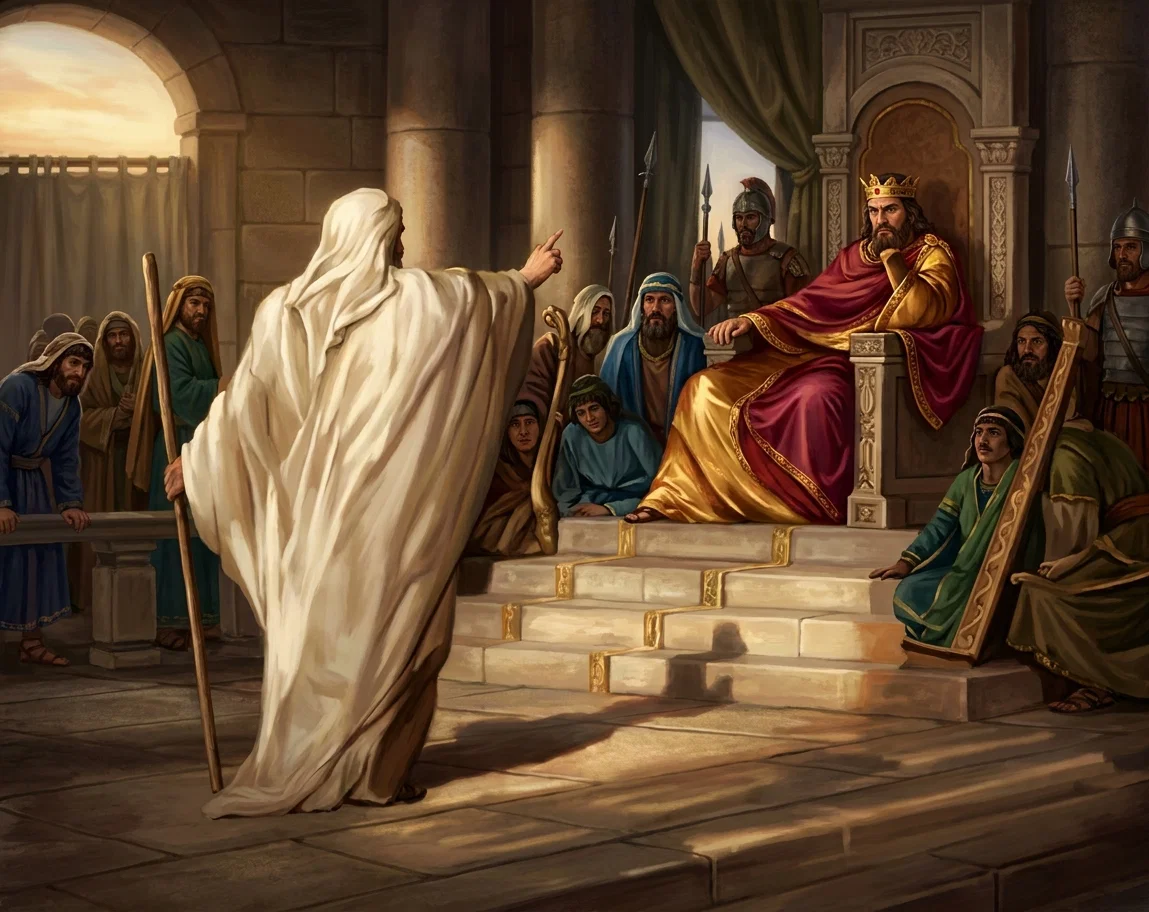
Flattered by the prospect of exercising supreme authority, Rehoboam determined to disregard the counsel of the older men of his realm, and to make the younger men his advisers. Thus it came to pass that on the day appointed, when “Jeroboam and all the people came to Rehoboam” for a statement concerning the policy he intended to pursue, Rehoboam “answered the people roughly, . . . saying, My father made your yoke heavy, and I will add to your yoke: my father also chastised you with whips, but I will chastise you with scorpions.”
Had Rehoboam and his inexperienced counselors understood the divine will concerning Israel, they would have listened to the request of the people for decided reforms in the administration of the government. But in the hour of opportunity that came to them during the meeting in Shechem, they failed to reason from cause to effect, and thus forever weakened their influence over a large number of the people. Their expressed determination to perpetuate and add to the oppression introduced during Solomon’s reign, was in direct conflict with God’s plan for Israel, and gave the people ample occasion to doubt the sincerity of their motives. In this unwise and unfeeling attempt to exercise power, the king and his chosen counselors revealed the pride of position and authority.
The Lord did not allow Rehoboam to carry out the policy he had outlined. Among the tribes were many thousands who had become thoroughly aroused over the oppressive measures of Solomon’s reign, and these now felt that they could not do otherwise than rebel against the house of David. “When all Israel saw91that the king hearkened not unto them, the people answered the king, saying, What portion have we in David? neither have we inheritance in the son of Jesse: to your tents, O Israel: now see to thine own house, David. So Israel departed unto their tents.”
The breach created by the rash speech of Rehoboam proved irreparable. Thenceforth the twelve tribes of Israel were divided, the tribes of Judah and Benjamin composing the lower or southern kingdom of Judah, under the rulership of Rehoboam; while the ten northern tribes formed and maintained a separate government, known as the kingdom of Israel, with Jeroboam as their ruler. Thus was fulfilled the prediction of the prophet concerning the rending of the kingdom. “The cause was from the Lord.”
When Rehoboam saw the ten tribes withdrawing their allegiance from him, he was aroused to action. Through one of the influential men of his kingdom, “Adoram, who was over the tribute,” he made an effort to conciliate them. But the ambassador of peace received treatment which bore witness to the feeling against Rehoboam. “All Israel stoned him with stones, that he died.” Startled by this evidence of the strength of revolt, “King Rehoboam made speed to get him up to his chariot, to flee to Jerusalem.”
At Jerusalem “he assembled all the house of Judah, with the tribe of Benjamin, an hundred and fourscore thousand chosen men, which were warriors, to fight against the house of Israel, to bring the kingdom again to Rehoboam the son of Solomon. But the word of God came unto Shemaiah the man of God,92saying, Speak unto Rehoboam, the son of Solomon, king of Judah, and unto all the house of Judah and Benjamin, and to the remnant of the people, saying, Thus saith the Lord, Ye shall not go up, nor fight against your brethren the children of Israel: return every man to his house; for this thing is from Me. They hearkened therefore to the word of the Lord, and returned to depart, according to the word of the Lord.”
REHOBOAM FORBIDDEN TO WAR AGAINST ISRAEL
“Ye shall not go up, nor fight against your brethren.”
For three years Rehoboam tried to profit by his sad experience at the beginning of his reign; and in this effort he was prospered. He “built cities for93defense in Judah,” and “fortified the strongholds, and put captains in them, and store of victual, and of oil and wine.” He was careful to make these fortified cities “exceeding strong.” But the secret of Judah’s prosperity during the first years of Rehoboam’s reign lay not in these measures. It was their recognition of God as the Supreme Ruler, that placed the tribes of Judah and Benjamin on vantage-ground. To their number were added many God-fearing men from the northern tribes. “Out of all the tribes of Israel,” the record reads, “such as set their hearts to seek the Lord God of Israel came to Jerusalem, to sacrifice unto the Lord God of their fathers. So they strengthened the kingdom of Judah, and made Rehoboam the son of Solomon strong, three years: for three years they walked in the way of David and Solomon.”
In continuing this course lay Rehoboam’s opportunity to redeem in large measure the mistakes of the past and to restore confidence in his ability to rule with discretion. But the pen of inspiration has traced the sad record of Solomon’s successor as one who failed to exert a strong influence for loyalty to Jehovah. Naturally headstrong, confident, self-willed, and inclined to idolatry, nevertheless, had he placed his trust wholly in God, he would have developed strength of character, steadfast faith, and submission to the divine requirements. But as time passed, the king put his trust in the power of position and in the strongholds he had fortified. Little by little he gave way to inherited weaknesses, until he threw his influence wholly on the side of idolatry. “It came to pass,94when Rehoboam had established the kingdom, and had strengthened himself, he forsook the law of the Lord, and all Israel with him.”
How sad, how filled with significance, the words, “And all Israel with him”! The people whom God had chosen to stand as a light to the surrounding nations, were turning from their Source of strength, and seeking to become like the nations about them. As with Solomon, so with Rehoboam,—the influence of wrong example led many astray. And as with them, so to a greater or less degree is it to-day with every one who gives himself up to work evil,—the influence of wrong-doing is not confined to the doer. No man liveth unto himself. None perish alone in their iniquity. Every life is a light that brightens and cheers the pathway of others, or a dark and desolating influence that tends toward despair and ruin. We lead others either upward to happiness and immortal life, or downward to sorrow and eternal death. And if by our deeds we strengthen or force into activity the evil powers of those around us, we share their sin.
God did not allow the apostasy of Judah’s ruler to remain unpunished. “In the fifth year of King Rehoboam Shishak king of Egypt came up against Jerusalem, because they had transgressed against the Lord, with twelve hundred chariots, and threescore thousand horsemen: and the people were without number that came with him out of Egypt. . . . And he took the fenced cities which pertained to Judah, and came to Jerusalem.
“Then came Shemaiah the prophet to Rehoboam, and to the princes of Judah, that were gathered together to Jerusalem because of Shishak, and said unto95them, Thus saith the Lord, Ye have forsaken Me, and therefore have I also left you in the hand of Shishak.”
The people had not yet gone to such lengths in apostasy that they despised the judgments of God. In the losses sustained by the invasion of Shishak, they recognized the hand of God, and for a time humbled themselves. “The Lord is righteous,” they acknowledged.
“And when the Lord saw that they humbled themselves, the word of the Lord came to Shemaiah, saying, They have humbled themselves; therefore I will not destroy them, but I will grant them some deliverance; and My wrath shall not be poured out upon Jerusalem by the hand of Shishak. Nevertheless they shall be his servants; that they may know My service, and the service of the kingdoms of the countries.
“So Shishak king of Egypt came up against Jerusalem, and took away the treasures of the house of the Lord, and the treasures of the king’s house; he took all: he carried away also the shields of gold which Solomon had made. Instead of which King Rehoboam made shields of brass, and committed them to the hands of the chief of the guard, that kept the entrance of the king’s house. . . . And when he humbled himself, the wrath of the Lord turned from him, that He would not destroy him altogether: and also in Judah things went well.”
But as the hand of affliction was removed, and the nation prospered once more, many forgot their fears, and turned again to idolatry. Among these was King Rehoboam himself. Though humbled by the calamity96that had befallen him, he failed to make this experience a decisive turning-point in his life. Forgetting the lesson that God had endeavored to teach him, he relapsed into the sins that had brought judgments on the nation. After a few inglorious years, during which the king “did evil, because he prepared not his heart to seek the Lord,” “Rehoboam slept with his fathers, and was buried in the city of David: and Abijah his son reigned in his stead.”
With the rending of the kingdom early in Rehoboam’s reign, the glory of Israel began to depart, never again to be regained in its fullness. At times during the centuries that followed, the throne of David was occupied by men of moral worth and far-seeing judgment, and under the rulership of these sovereigns the blessings resting upon the men of Judah were extended to the surrounding nations. At times the name of Jehovah was exalted above every false god, and His law was held in reverence. From time to time mighty prophets arose, to strengthen the hands of the rulers, and to encourage the people to continued faithfulness. But the seeds of evil already springing up when Rehoboam ascended the throne, were never to be wholly uprooted; and at times the once-favored people of God were to fall so low as to become a byword among the heathen.
Yet notwithstanding the perversity of those who leaned toward idolatrous practices, God in mercy would do everything in His power to save the divided kingdom from utter ruin. And as the years rolled on, and His purpose concerning Israel seemed to be utterly thwarted by the devices of men inspired by satanic agencies, He still manifested His beneficent97designs through the captivity and restoration of the chosen nation.
The rending of the kingdom was but the beginning of a wonderful history, wherein are revealed the long-sufferance and tender mercy of God. From the crucible of affliction through which they were to pass because of hereditary and cultivated tendencies to evil, those whom God was seeking to purify unto Himself a peculiar people, zealous of good works, were finally to acknowledge:
“There is none like unto Thee, O Lord; Thou art great, and Thy name is great in might. Who would not fear Thee, O King of nations? . . . Among all the wise men of the nations, and in all their kingdoms, there is none like unto Thee.” “The Lord is the true God, He is the living God, and an everlasting King.”
And the worshipers of idols were at last to learn the lesson that false gods are powerless to uplift and save. “The gods that have not made the heavens and the earth, even they shall perish from the earth, and from under these heavens.” Only in allegiance to the living God, the Creator of all and the Ruler over all, can man find rest and peace.
With one accord the chastened and penitent of Israel and Judah were at last to renew their covenant relationship with Jehovah of hosts, the God of their fathers; and of Him they were to declare:
“He hath made the earth by His power,
He hath established the world by His wisdom,
And hath stretched out the heavens by His discretion.
“When He uttereth His voice, there is a multitude of waters in the heavens,98
And He causeth the vapors to ascend from the ends of the earth;
He maketh lightnings with rain, and bringeth forth the wind out of His treasures.
“Every man is brutish in his knowledge:
Every founder is confounded by the graven image:
For his molten image is falsehood, and there is no breath in them.
“They are vanity, and the work of errors:
In the time of their visitation they shall perish.
The portion of Jacob is not like them:
“For He is the former of all things; And Israel is the rod of His inheritance: The Lord of hosts is His name.”
THE GOLDEN CALF AT DAN
JEROBOAM—7
PLACED on the throne by the ten tribes of Israel who had rebelled against the house of David, Jeroboam, the former servant of Solomon, was in a position to bring about wise reforms in both civil and religious affairs. Under the rulership of Solomon he had shown aptitude and sound judgment; and the knowledge he had gained during years of faithful service fitted him to rule with discretion. But Jeroboam failed to make God his trust.
Jeroboam’s greatest fear was that at some future time the hearts of his subjects might be won over by the ruler occupying the throne of David. He reasoned that if the ten tribes should be permitted to visit often the ancient seat of the Jewish monarchy, where the services of the temple were still conducted as in the years of Solomon’s reign, many might feel inclined to renew their allegiance to the government centering at Jerusalem. Taking counsel with his advisers, Jeroboam determined by one bold stroke to100lessen, so far as possible, the probability of a revolt from his rule. He would bring this about by creating within the borders of his newly formed kingdom two centers of worship, one at Bethel and the other at Dan. In these places the ten tribes should be invited to assemble, instead of at Jerusalem, to worship God.
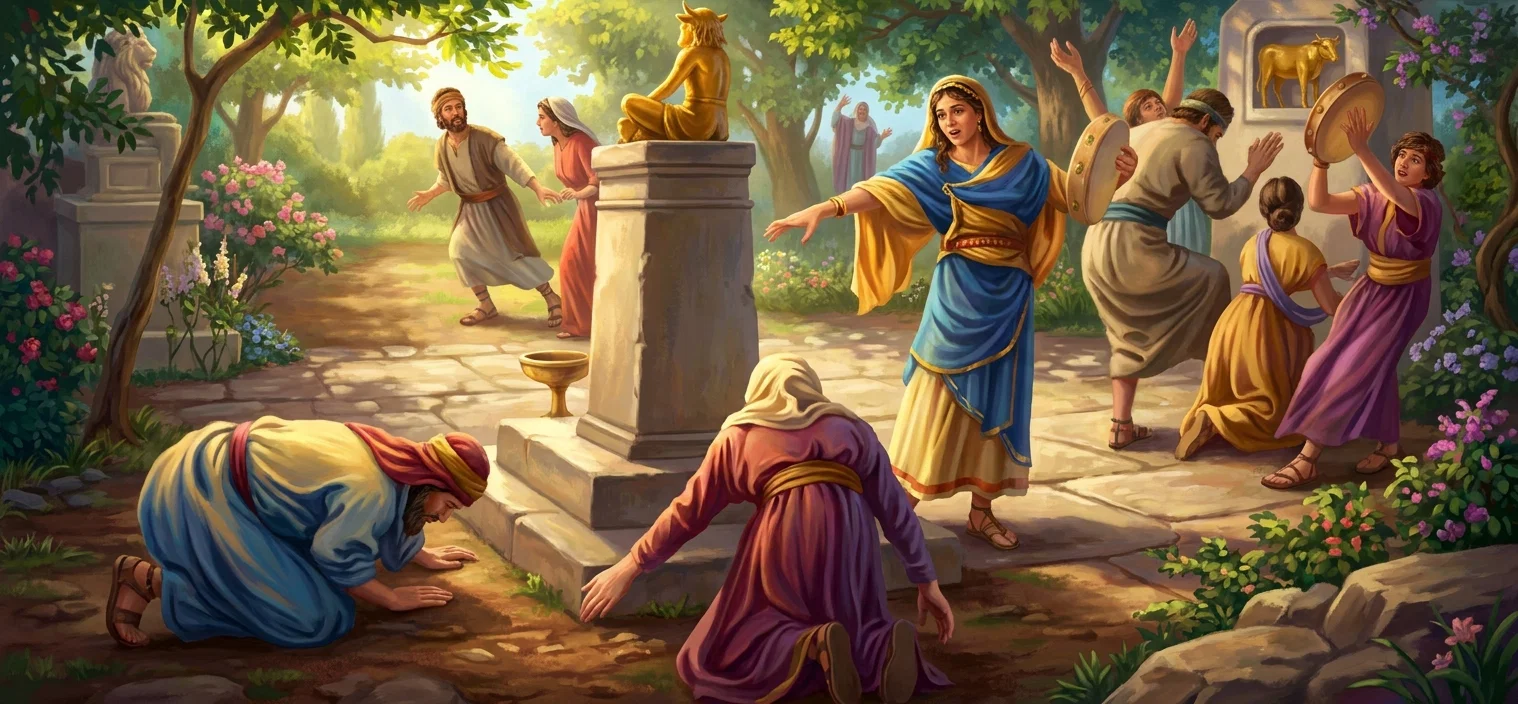
In arranging this transfer, Jeroboam thought to appeal to the imagination of the Israelites by setting before them some visible representation to symbolize the presence of the invisible God. Accordingly, he caused to be made two calves of gold, and these were placed within shrines at the appointed centers of worship. In this effort to represent the Deity, Jeroboam violated the plain command of Jehovah: “Thou shalt not make unto thee any graven image. . . . Thou shalt not bow down thyself to them, nor serve them.”
So strong was Jeroboam’s desire to keep the ten tribes away from Jerusalem, that he lost sight of the fundamental weakness of his plan. He failed to take into consideration the great peril to which he was exposing the Israelites by setting before them the idolatrous symbol of the Deity with which their ancestors had been so familiar during the centuries of Egyptian bondage. Jeroboam’s recent residence in Egypt should have taught him the folly of placing before the people such heathen representations. But his set purpose of inducing the northern tribes to discontinue their annual visits to the holy city, led him to adopt the most imprudent of measures. “It is too much for you to go up to Jerusalem,” he urged; “behold thy gods, O Israel, which brought thee up out of the land of Egypt.” Thus they were invited to bow101down before the golden images, and adopt strange forms of worship.
The king tried to persuade the Levites, some of whom were living within his realm, to serve as priests in the newly erected shrines at Bethel and Dan; but in this effort he met with failure. He was therefore compelled to elevate to the priesthood men from “the lowest of the people.” Alarmed over the prospect, many of the faithful, including a great number of the Levites, fled to Jerusalem, where they might worship in harmony with the divine requirements.
“Jeroboam ordained a feast in the eighth month, on the fifteenth day of the month, like unto the feast that is in Judah, and he offered upon the altar. So did he in Bethel, sacrificing unto the calves that he had made: and he placed in Bethel the priests of the high places which he had made.”
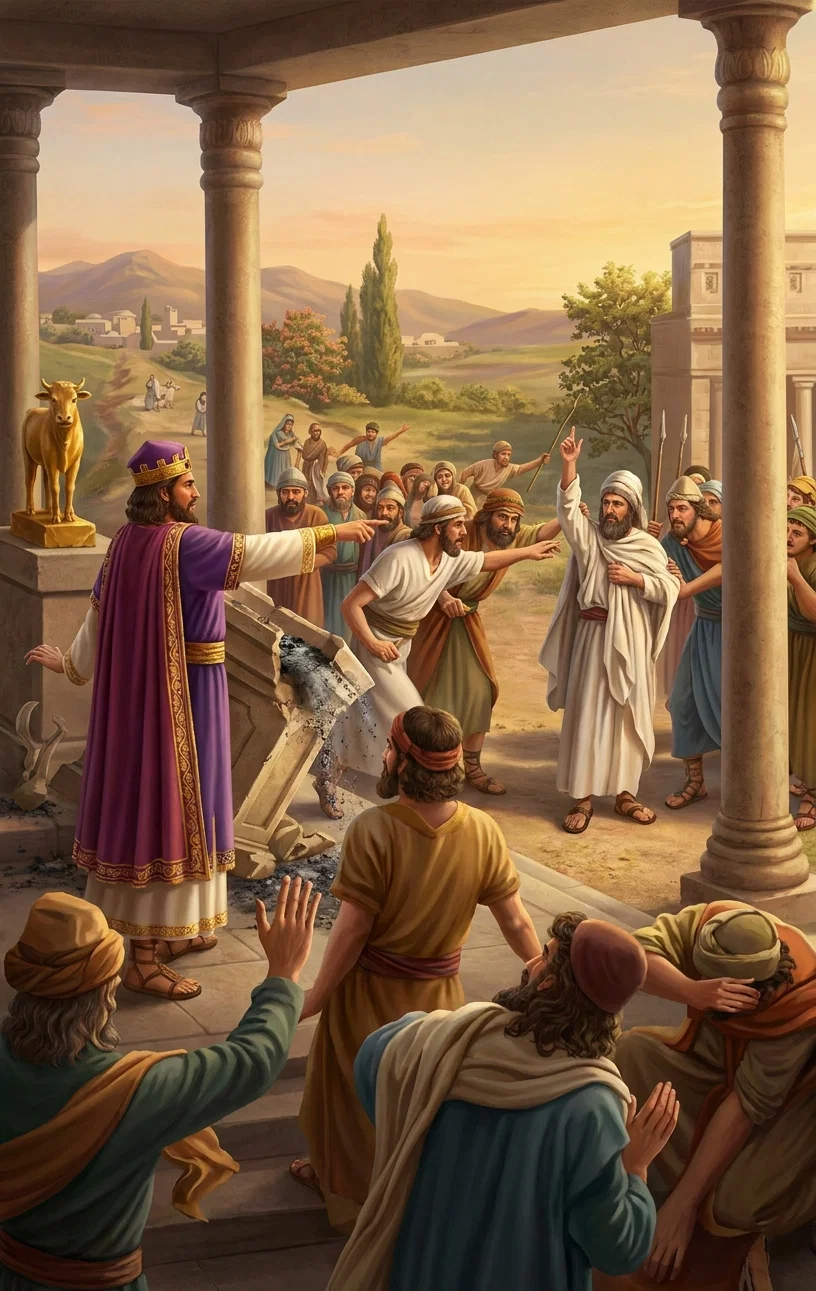
The king’s bold defiance of God in thus setting aside divinely appointed institutions, was not allowed to pass unrebuked. Even while he was officiating and burning incense during the dedication of the strange altar he had set up at Bethel, there appeared before him a man of God from the kingdom of Judah, sent to denounce him for presuming to introduce new forms of worship. The prophet “cried against the altar, . . . and said, O altar, altar, thus saith the Lord; Behold, a child shall be born unto the house of David, Josiah by name; and upon thee shall he offer the priests of the high places that burn incense upon thee, and men’s bones shall be burnt upon thee.”
“And he gave a sign the same day, saying, This is the sign which the Lord hath spoken; Behold, the102altar shall be rent, and the ashes that are upon it shall be poured out.” Immediately the altar “was rent, and the ashes poured out from the altar, according to the sign which the man of God had given by the word of the Lord.”
On seeing this, Jeroboam was filled with a spirit of defiance against God, and attempted to restrain the one who had delivered the message. In wrath “he put forth his hand from the altar,” and cried out, “Lay hold on him.” His impetuous act met with swift rebuke. The hand outstretched against the messenger of Jehovah suddenly became powerless and withered, and could not be withdrawn.
Terror-stricken, the king appealed to the prophet to intercede with God in his behalf. “Entreat now the face of the Lord thy God,” he pleaded, “and pray for me, that my hand may be restored me again. And the man of God besought the Lord, and the king’s hand was restored him again, and became as it was before.”
Vain had been Jeroboam’s effort to invest with solemnity the dedication of a strange altar, respect for which would have led to disrespect for the worship of Jehovah in the temple at Jerusalem. By the message of the prophet, the king of Israel should have been led to repent, and to renounce his wicked purposes, which were turning the people away from the true worship of God. But he hardened his heart, and determined to follow a way of his own choosing.
At the time of the feast at Bethel, the hearts of the Israelites were not fully hardened. Many were susceptible to the influence of the Holy Spirit. The103Lord designed that those who were taking rapid steps in apostasy, should be checked in their course before it should be too late. He sent His messenger to interrupt the idolatrous proceedings, and to reveal to king and people what the outworking of this apostasy would be. The rending of the altar was a sign of God’s displeasure at the abomination that was being wrought in Israel.
JEROBOAM’S DEFIANCE OF GOD AT BETHEL
“The altar also was rent, and the ashes poured out.” 1 Kings 13:5.
The Lord seeks to save, not to destroy. He delights in the rescue of sinners. “As I live, saith the Lord God, I have no pleasure in the death of the wicked.” By warnings and entreaties He calls the wayward to cease from their evil-doing, and to turn to Him and live. He gives His chosen messengers a holy boldness, that those who hear may fear and be brought to repentance. How firmly the man of God rebuked the king! And this firmness was essential; in no other way could the existing evils have been rebuked. The Lord gave His servant boldness, that an abiding impression might be made on those who heard. The messengers of the Lord are never to fear the face of man, but are to stand unflinchingly for the right. So long as they put their trust in God, they need not fear; for He who gives them their commission gives them also the assurance of His protecting care.
Having delivered his message, the prophet was about to return, when Jeroboam said to him, “Come home with me, and refresh thyself, and I will give thee a reward.” “If thou wilt give me half thine house,” the prophet replied, “I will not go in with thee, neither will I eat bread nor drink water in this place: for so was it charged me by the word of the106Lord, saying, Eat no bread, nor drink water, nor turn again by the same way that thou camest.”
Well would it have been for the prophet had he adhered to his purpose to return to Judea without delay. While traveling homeward by another route, he was overtaken by an aged man who claimed to be a prophet, and who made false representations to the man of God, declaring: “I am a prophet also as thou art; and an angel spake unto me by the word of the Lord, saying, Bring him back with thee into thine house, that he may eat bread and drink water.” Again and again the lie was repeated, and the invitation urged, until the man of God was persuaded to return.
Because the true prophet allowed himself to take a course contrary to the line of duty, God permitted him to suffer the penalty of transgression. While he and the one who had invited him to return to Bethel were sitting together at the table, the inspiration of the Almighty came upon the false prophet, “and he cried unto the man of God that came from Judah, saying: Thus saith the Lord, Forasmuch as thou hast disobeyed the mouth of the Lord, and hast not kept the commandment which the Lord thy God commanded thee, . . . thy carcass shall not come unto the sepulcher of thy fathers.”
This prophecy of doom was soon literally fulfilled. “It came to pass, after he had eaten bread, and after he had drunk, that he saddled for him the ass. . . . And when he was gone, a lion met him by the way, and slew him: and his carcass was cast in the way, and the ass stood by it, the lion also stood by the107carcass. And, behold, men passed by, and saw the carcass cast in the way, . . . and they came and told it in the city where the old prophet dwelt. And when the prophet that brought him back from the way heard thereof, he said, It is the man of God, who was disobedient unto the word of the Lord.”
The penalty that overtook the unfaithful messenger was a still further evidence of the truth of the prophecy uttered over the altar. If, after disobeying the word of the Lord, the prophet had been permitted to go on in safety, the king would have used this fact in an attempt to vindicate his own disobedience. In the rent altar, in the palsied arm, and in the terrible fate of the one who dared disobey an express command of Jehovah, Jeroboam should have discerned the swift displeasure of an offended God, and these judgments should have warned him not to persist in wrong-doing. But, far from repenting, Jeroboam “made again of the lowest of the people priests of the high places: whosoever would, he consecrated him, and he became one of the priests of the high places.” Thus he not only sinned greatly himself, but “made Israel to sin;” and “this thing became sin unto the house of Jeroboam, even to cut it off, and to destroy it from off the face of the earth.”
Toward the close of a troubled reign of twenty-two years, Jeroboam met with a disastrous defeat in a war with Abijah, the successor of Rehoboam. “Neither did Jeroboam recover strength again in the days of Abijah: and the Lord struck him, and he died.”
The apostasy introduced during Jeroboam’s reign, became more and more marked, until finally it resulted in the utter ruin of the kingdom of Israel.108Even before the death of Jeroboam, Ahijah, the aged prophet at Shiloh who many years before had predicted the elevation of Jeroboam to the throne, declared: “The Lord shall smite Israel, as a reed is shaken in the water, and He shall root up Israel out of this good land, which He gave to their fathers, and shall scatter them beyond the river, because they have made their groves, provoking the Lord to anger. And He shall give Israel up because of the sins of Jeroboam, who did sin, and who made Israel to sin.”
Yet the Lord did not give Israel up without first doing all that could be done to lead them back to their allegiance to Him. Through long, dark years when ruler after ruler stood up in bold defiance of Heaven and led Israel deeper and still deeper into idolatry, God sent message after message to His backslidden people. Through His prophets He gave them every opportunity to stay the tide of apostasy, and to return to Him. During the years that were to follow the rending of the kingdom, Elijah and Elisha were to live and labor, and the tender appeals of Hosea and Amos and Obadiah were to be heard in the land. Never was the kingdom of Israel to be left without noble witnesses to the mighty power of God to save from sin. Even in the darkest hours, some would remain true to their divine Ruler, and in the midst of idolatry would live blameless in the sight of a holy God. These faithful ones were numbered among the goodly remnant through whom the eternal purpose of Jehovah was finally to be fulfilled.