From the time of Jeroboam’s death to Elijah’s appearance before Ahab, the people of Israel suffered a steady spiritual decline. Ruled by men who did not fear Jehovah and who encouraged strange forms of worship, the larger number of the people rapidly lost sight of their duty to serve the living God, and adopted many of the practices of idolatry.
Nadab, the son of Jeroboam, occupied the throne of Israel for only a few months. His career of evil was suddenly stopped by a conspiracy headed by Baasha, one of his generals, to gain control of the government. Nadab was slain, with all his kindred in the line of succession, “according unto the saying of the Lord, which He spake by His servant Ahijah the Shilonite: because of the sins of Jeroboam which he sinned, and which he made Israel sin.”
Thus perished the house of Jeroboam. The idolatrous worship introduced by him had brought upon the guilty offenders the retributive judgments of110Heaven; and yet the rulers who followed,—Baasha, Elah, Zimri, and Omri,—during a period of nearly forty years, continued in the same fatal course of evil-doing.
During the greater part of this time of apostasy in Israel, Asa was ruling in the kingdom of Judah. For many years “Asa did that which was good and right in the eyes of the Lord his God: for he took away the altars of the strange gods, and the high places, and brake down the images, and cut down the groves: and commanded Judah to seek the Lord God of their fathers, and to do the law and the commandment. Also he took away out of all the cities of Judah the high places and the sun images: and the kingdom was quiet before him.”
The faith of Asa was put to a severe test when “Zerah the Ethiopian with an host of a thousand thousand, and three hundred chariots,” invaded his kingdom. In this crisis Asa did not put his trust in the “fenced cities in Judah” that he had built, with “walls, and towers, gates, and bars,” nor in the “mighty men of valor” in his carefully trained army. The king’s trust was in Jehovah of hosts, in whose name marvelous deliverances had been wrought in behalf of Israel of old. Setting his forces in battle array, he sought the help of God.
The opposing armies now stood face to face. It was a time of test and trial to those who served the Lord. Had every sin been confessed? Had the men of Judah full confidence in God’s power to deliver? Such thoughts as these were in the minds of the leaders. From every human viewpoint, the vast host111from Egypt would sweep everything before it. But in time of peace Asa had not been giving himself to amusement and pleasure; he had been preparing for any emergency. He had an army trained for conflict; he had endeavored to lead his people to make their peace with God. And now, although his forces were fewer in number than the enemy, his faith in the One whom he had made his trust, did not weaken.
Having sought the Lord in the days of prosperity, the king could now rely upon Him in the day of adversity. His petitions showed that he was not a stranger to God’s wonderful power. “It is nothing with Thee to help,” he pleaded, “whether with many, or with them that have no power: help us, O Lord our God; for we rest on Thee, and in Thy name we go against this multitude. O Lord, Thou art our God; let not man prevail against Thee.”
The prayer of Asa is one that every Christian believer may fittingly offer. We fight in a warfare, not against flesh and blood, but against principalities and powers, and against spiritual wickedness in high places. In life’s conflict, we must meet evil agencies that have arrayed themselves against the right. Our hope is not in man, but in the living God. With full assurance of faith, we may expect that He will unite His omnipotence with the efforts of human instrumentalities, for the glory of His name. Clad with the armor of His righteousness, we may gain the victory over every foe.
King Asa’s faith was signally rewarded. “The Lord smote the Ethiopians before Asa, and before Judah; and the Ethiopians fled. And Asa and the112people that were with him pursued them unto Gerar: and the Ethiopians were overthrown, that they could not recover themselves; for they were destroyed before the Lord, and before His host.”
As the victorious armies of Judah and Benjamin were returning to Jerusalem, “the Spirit of God came upon Azariah the son of Oded: and he went out to meet Asa, and said unto him, Hear ye me, Asa, and all Judah and Benjamin; The Lord is with you, while ye be with Him; and if ye seek Him, He will be found of you; but if ye forsake Him, He will forsake you.” “Be ye strong therefore, and let not your hands be weak: for your work shall be rewarded.”
Greatly encouraged by these words, Asa soon led out in a second reformation in Judah. He “put away the abominable idols out of all the land of Judah and Benjamin, and out of the cities which he had taken from Mount Ephraim, and renewed the altar of the Lord, that was before the porch of the Lord.”
“And he gathered all Judah and Benjamin, and the strangers with them out of Ephraim and Manasseh, and out of Simeon: for they fell to him out of Israel in abundance, when they saw that the Lord his God was with him. So they gathered themselves together at Jerusalem in the third month, in the fifteenth year of the reign of Asa. And they offered unto the Lord the same time, of the spoil which they had brought, seven hundred oxen and seven thousand sheep. And they entered into a covenant to seek the Lord God of their fathers with all their heart and with all their soul.” “And He was found of them: and the Lord gave them rest round about.”
Asa’s long record of faithful service was marred by some mistakes, made at times when he failed to put his trust fully in God. When, on one occasion, the king of Israel entered the kingdom of Judah and seized Ramah, a fortified city only five miles from Jerusalem, Asa sought deliverance by forming an alliance with Benhadad, king of Syria. This failure to trust God alone in time of need was sternly rebuked by Hanani the prophet, who appeared before Asa with the message: “Because thou hast relied on the king of Syria, and not relied on the Lord thy God, therefore is the host of the king of Syria escaped out of thine hand. Were not the Ethiopians and the Lubims a huge host, with very many chariots and horsemen? yet, because thou didst rely on the Lord, He delivered them into thine hand. For the eyes of the Lord run to and fro throughout the whole earth, to show Himself strong in the behalf of them whose heart is perfect toward Him. Herein thou hast done foolishly: therefore from henceforth thou shalt have wars.”
Instead of humbling himself before God because of his mistake, “Asa was wroth with the seer, and put him in a prison-house; for he was in a rage with him because of this thing. And Asa oppressed some of the people the same time.”
“In the thirty and ninth year of his reign,” Asa was “diseased in his feet, until his disease was exceeding great: yet in his disease he sought not to the Lord, but to the physicians.” The king died in the forty-first year of his reign, and was succeeded by Jehoshaphat, his son.
Two years before the death of Asa, Ahab began to rule in the kingdom of Israel. From the beginning, his reign was marked by a strange and terrible apostasy. His father, Omri, the founder of Samaria, had “wrought evil in the eyes of the Lord, and did worse than all that were before him;” but the sins of Ahab were even greater. He “did more to provoke the Lord God of Israel to anger than all the kings of Israel that were before him,” acting “as if it had been a light thing for him to walk in the sins of Jeroboam the son of Nebat.” Not content with encouraging the forms of religious service followed at Bethel and Dan, he boldly led the people into the grossest heathenism, by setting aside the worship of Jehovah for Baal-worship.
Taking to wife Jezebel, “the daughter of Ethbaal king of the Zidonians” and high priest of Baal, Ahab “served Baal, and worshiped him. And he reared up an altar for Baal in the house of Baal, which he had built in Samaria.”
Not only did Ahab introduce Baal-worship at the capital city, but under the leadership of Jezebel he erected heathen altars in many “high places,” where in the shelter of surrounding groves the priests and others connected with this seductive form of idolatry exerted their baleful influence, until well-nigh all Israel were following after Baal. “There was none like unto Ahab,” who “did sell himself to work wickedness in the sight of the Lord, whom Jezebel his wife stirred up. And he did very abominably in following idols, according to all things as did the Amorites,115whom the Lord cast out before the children of Israel.”
Ahab was weak in moral power. His union by marriage with an idolatrous woman of decided character and positive temperament, resulted disastrously both to himself and to the nation. Unprincipled, and with no high standard of right-doing, his character was easily moulded by the determined spirit of Jezebel. His selfish nature was incapable of appreciating the mercies of God to Israel, and his own obligations as the guardian and leader of the chosen people.
Under the blighting influence of Ahab’s rule, Israel wandered far from the living God, and corrupted their ways before Him. For many years, they had been losing their sense of reverence and godly fear; and now it seemed as if there were none who dared expose their lives by openly standing forth in opposition to the prevailing blasphemy. The dark shadow of apostasy covered the whole land. Images of Baalim and Ashtoreth were everywhere to be seen. Idolatrous temples and consecrated groves, wherein were worshiped the works of men’s hands, were multiplied. The air was polluted with the smoke of the sacrifices offered to false gods. Hill and vale resounded with the drunken cries of a heathen priesthood who sacrificed to the sun, moon, and stars.
Through the influence of Jezebel and her impious priests, the people were taught that the idol gods that had been set up were deities, ruling by their mystic power the elements of earth, fire, and water. All the bounties of heaven — the running brooks, the streams of living water, the gentle dew, the showers of rain which refreshed the earth and caused the fields to116bring forth abundantly — were ascribed to the favor of Baal and Ashtoreth, instead of to the Giver of every good and perfect gift. The people forgot that the hills and valleys, the streams and fountains, were in the hand of the living God; that He controlled the sun, the clouds of heaven, and all the powers of nature.
Through faithful messengers, the Lord sent repeated warnings to the apostate king and the people; but in vain were these words of reproof. In vain did the inspired messengers assert Jehovah’s right to be the only God in Israel; in vain did they exalt the laws that He had entrusted to them. Captivated by the gorgeous display and the fascinating rites of idol-worship, the people followed the example of the king and his court, and gave themselves up to the intoxicating, degrading pleasures of a sensual worship. In their blind folly, they chose to reject God and His worship. The light so graciously given them had become darkness. The fine gold had become dim.
Alas, how had the glory of Israel departed! Never before had the chosen people of God fallen so low in apostasy. Of “the prophets of Baal” there were “four hundred and fifty,” besides four hundred “prophets of the groves.” Nothing short of the miracle-working power of God could preserve the nation from utter destruction. Israel had voluntarily separated herself from Jehovah; yet the Lord in compassion still yearned after those who had been led into sin, and He was about to send to them one of the mightiest of His prophets, through whom many were to be led back to allegiance to the God of their fathers.
PROPHETS OF THE NORTHERN KINGDOM
“Who is wise, and he shall understand these things?
Prudent, and he shall know them?
For the ways of the Lord are right,
And the just shall walk in them:
But the transgressors shall fall therein.”
Hosea 14:9.
“THERE SHALL NOT BE DEW NOR RAIN”
ELIJAH THE TISHBITE—9
Among the mountains of Gilead, east of the Jordan, there dwelt in the days of Ahab a man of faith and prayer whose fearless ministry was destined to check the rapid spread of apostasy in Israel. Far removed from any city of renown, and occupying no high station in life, Elijah the Tishbite nevertheless entered upon his mission confident in God’s purpose to prepare the way before him and to give him abundant success. The word of faith and power was upon his lips, and his whole life was devoted to the work of reform. His was the voice of one crying in the wilderness to rebuke sin and press back the tide of evil. And while he came to the people as a reprover of sin, his message offered the balm of Gilead to the sin-sick souls of all who desired to be healed.
As Elijah saw Israel going deeper and deeper into idolatry, his soul was distressed and his indignation aroused. God had done great things for His people.120He had delivered them from bondage and given them “the lands of the heathen, . . . that they might observe His statutes, and keep His laws.” But the beneficent designs of Jehovah were now well-nigh forgotten. Unbelief was fast separating the chosen nation from the Source of their strength. Viewing this apostasy from his mountain retreat, Elijah was overwhelmed with sorrow. In anguish of soul he besought God to arrest the once favored people in their wicked course, to visit them with judgments, if need be, that they might be led to see in its true light their departure from Heaven. He longed to see them brought to repentance before they should go to such lengths in evil-doing as to provoke the Lord to destroy them utterly.
Elijah’s prayer was answered. Oft-repeated appeals, remonstrances, and warnings had failed to bring Israel to repentance. The time had come when God must speak to them by means of judgments. Inasmuch as the worshipers of Baal claimed that the treasures of heaven, the dew and the rain, came not from Jehovah, but from the ruling forces of nature, and that it was through the creative energy of the sun that the earth was enriched and made to bring forth abundantly, the curse of God was to rest heavily upon the polluted land. The apostate tribes of Israel were to be shown the folly of trusting to the power of Baal for temporal blessings. Until they should turn to God with repentance, and acknowledge Him as the source of all blessing, there should fall upon the land neither dew nor rain.
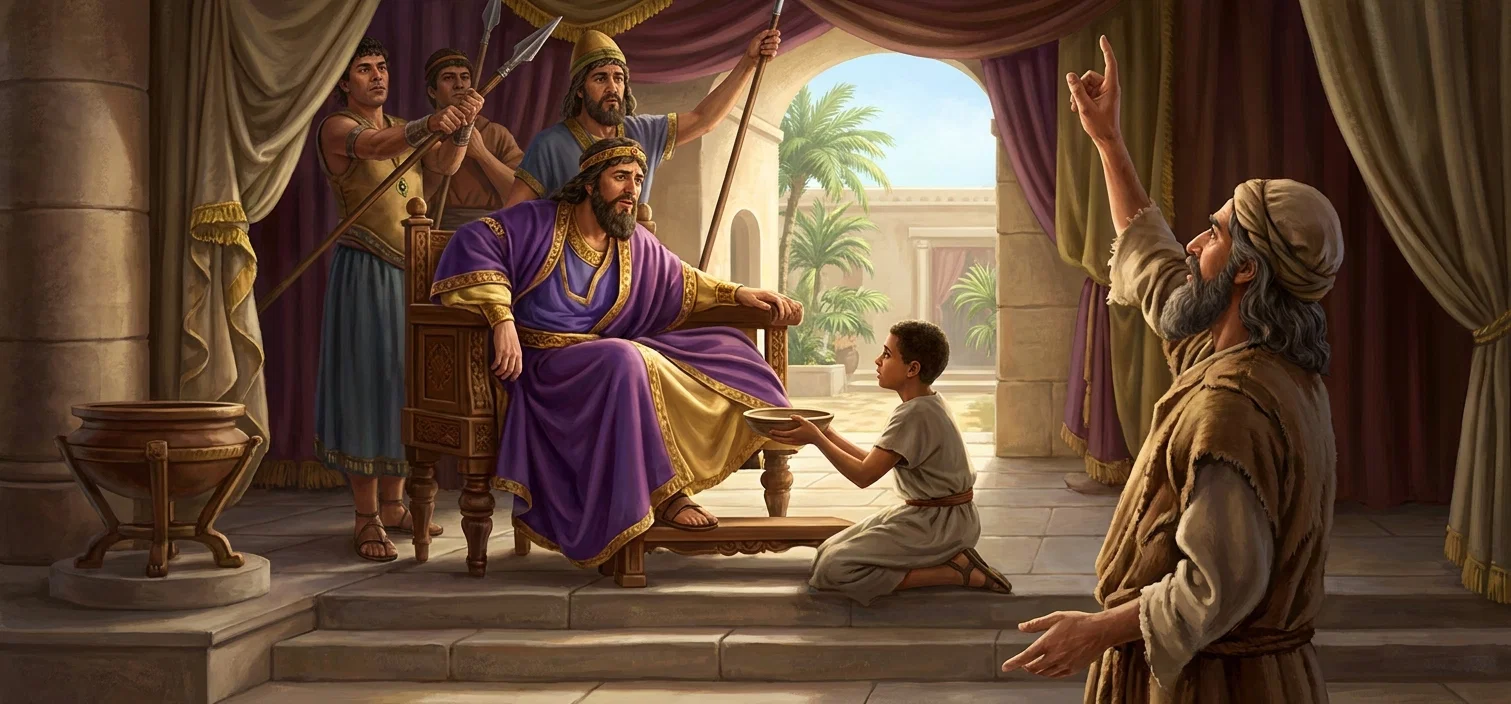
To Elijah was entrusted the mission of delivering to Ahab Heaven’s message of judgment. He did not121seek to be the Lord’s messenger; the word of the Lord came to him. And jealous for the honor of God’s cause, he did not hesitate to obey the divine summons, though to obey seemed to invite swift destruction at the hand of the wicked king. The prophet set out at once, and traveled night and day until he reached Samaria. At the palace he solicited no admission, nor waited to be formally announced. Clad in the coarse garments usually worn by the prophets of that time, he passed the guards, apparently unnoticed, and stood for a moment before the astonished king.
Elijah made no apology for his abrupt appearance. A Greater than the ruler of Israel had commissioned him to speak; and, lifting his hand toward heaven, he solemnly affirmed by the living God that the judgments of the Most High were about to fall upon Israel. “As the Lord God of Israel liveth, before whom I stand,” he declared, “there shall not be dew nor rain these years, but according to my word.”
It was only by the exercise of strong faith in the unfailing power of God’s word that Elijah delivered his message. Had he not possessed implicit confidence in the One whom he served, he would never have appeared before Ahab. On his way to Samaria, Elijah had passed by ever-flowing streams, hills covered with verdure, and stately forests that seemed beyond the reach of drought. Everything on which the eye rested was clothed with beauty. The prophet might have wondered how the streams that had never ceased their flow could become dry, or how those hills and valleys could be burned with drought. But he gave no place to unbelief. He fully believed122that God would humble apostate Israel, and that through judgments they would be brought to repentance. The fiat of Heaven had gone forth; God’s word could not fail; and at the peril of his life Elijah fearlessly fulfilled his commission. Like a thunderbolt from a clear sky, the message of impending judgment fell upon the ears of the wicked king; but before Ahab could recover from his astonishment, or frame a reply, Elijah disappeared as abruptly as he had come, without waiting to witness the effect of his message. And the Lord went before him, making plain the way. “Turn thee eastward,” the prophet123was bidden, “and hide thyself by the brook Cherith, that is before Jordan. And it shall be, that thou shalt drink of the brook; and I have commanded the ravens to feed thee.”
“THE HILLS WERE COVERED WITH VERDURE”
“How could the streams that had never ceased their flow, become dry?”
The king made diligent inquiry, but the prophet was not to be found. Queen Jezebel, angered over the message that had locked up the treasures of heaven, lost no time in conferring with the priests of Baal, who united with her in cursing the prophet and in defying the wrath of Jehovah. But notwithstanding their desire to find him who had uttered the word of woe, they were destined to meet with disappointment. Nor could they conceal from others a knowledge of the judgment pronounced in consequence of the prevailing apostasy. Tidings of Elijah’s denunciation of the sins of Israel, and of his prophecy of swift-coming punishment, quickly spread throughout the land. The fears of some were aroused, but in general the heavenly message was received with scorn and ridicule.
The prophet’s words went into immediate effect. Those who were at first inclined to scoff at the thought of calamity, soon had occasion for serious reflection; for after a few months the earth, unrefreshed by dew or rain, became dry, and vegetation withered. As time passed, streams that had never been known to fail, began to decrease, and brooks began to dry up. Yet the people were urged by their leaders to have confidence in the power of Baal, and to set aside as idle words the prophecy of Elijah. The priests still insisted that it was through the power of Baal that the showers of rain fell. Fear not the God of Elijah, nor tremble at his word, they124urged; it is Baal that brings forth the harvest in its season, and provides for man and beast.
God’s message to Ahab gave Jezebel and her priests, and all the followers of Baal and Ashtoreth, opportunity to test the power of their gods, and, if possible, to prove the word of Elijah false. Against the assurances of hundreds of idolatrous priests, the prophecy of Elijah stood alone. If, notwithstanding the prophet’s declaration, Baal could still give dew and rain, causing the streams to continue to flow and vegetation to flourish, then let the king of Israel worship him, and the people say that he is God.
Determined to keep the people in deception, the priests of Baal continue to offer sacrifices to their gods, and to call upon them night and day to refresh the earth. With costly offerings the priests attempt to appease the anger of their gods; with a zeal and a perseverance worthy of a better cause they linger round their pagan altars, and pray earnestly for rain. Night after night, throughout the doomed land, their cries and entreaties arise. But no clouds appear in the heavens by day to hide the burning rays of the sun. No dew or rain refreshes the thirsty earth. The word of Jehovah stands unchanged by anything the priests of Baal can do.
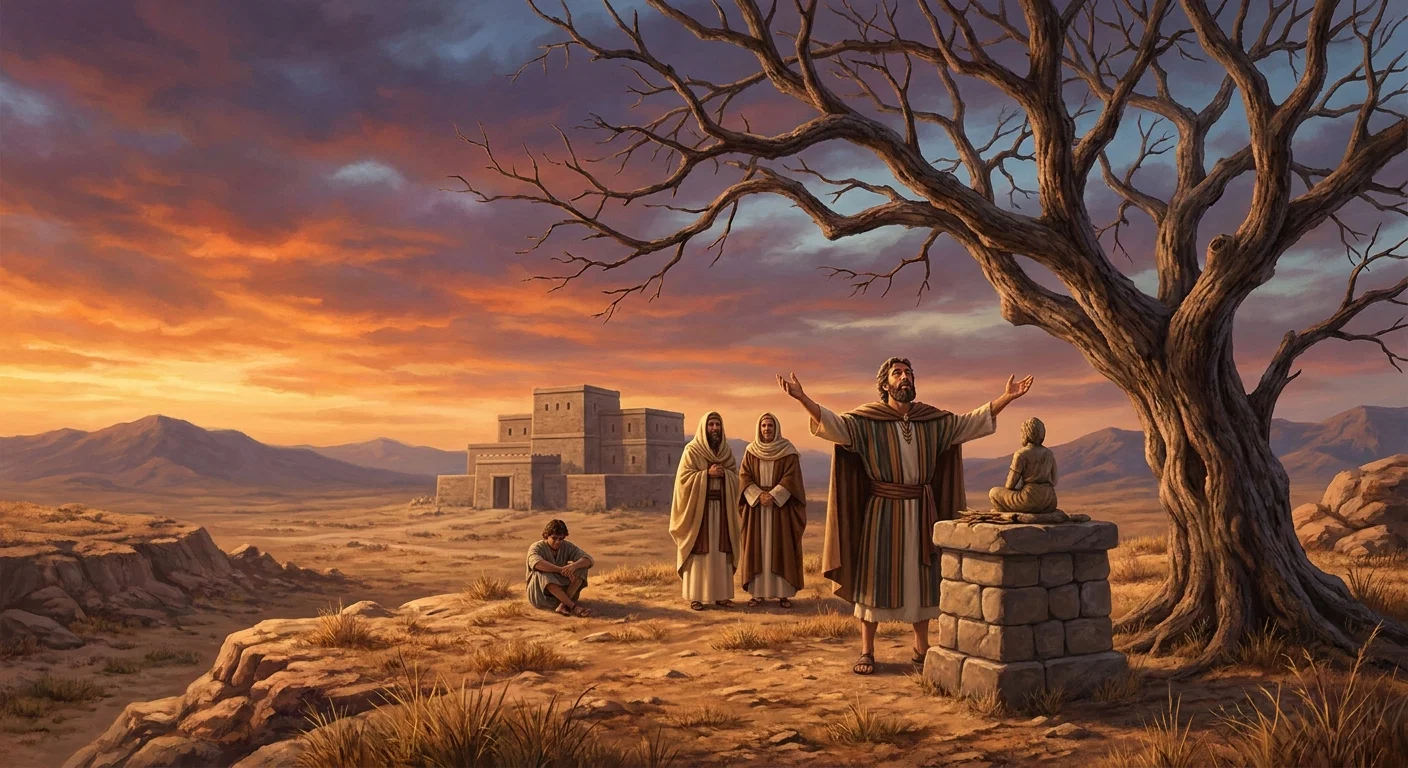
A year passes, and yet there is no rain. The earth is parched as if with fire. The scorching heat of the sun destroys what little vegetation has survived. Streams dry up, and lowing herds and bleating flocks wander hither and thither in distress. Once-flourishing fields have become like burning desert sands,—a desolate waste. The groves dedicated to idol-worship are leafless; the forest trees, gaunt skeletons125of nature, afford no shade. The air is dry and suffocating; dust storms blind the eyes and nearly stop the breath. Once prosperous cities and villages have become places of mourning. Hunger and thirst are telling upon man and beast with fearful mortality. Famine, with all its horrors, comes closer and still closer.
“THE FAMINE-STRICKEN LAND”
“Night after night, throughout the doomed land, their cries and entreaties arise.”
Yet notwithstanding these evidences of God’s power, Israel repented not, nor learned the lesson that God would have them learn. They did not see that He who created nature controls her laws, and can make of them instruments of blessing or of destruction. Proud-hearted, enamored of their false126worship, they were unwilling to humble themselves under the mighty hand of God, and they began to cast about for some other cause to which to attribute their sufferings.
Jezebel utterly refused to recognize the drought as a judgment from Jehovah. Unyielding in her determination to defy the God of heaven, she, with nearly the whole of Israel, united in denouncing Elijah as the cause of all their misery. Had he not borne testimony against their forms of worship? If only he could be put out of the way, she argued, the anger of their gods would be appeased, and their troubles would end.
Urged on by the queen, Ahab instituted a most diligent search for the hiding-place of the prophet. To the surrounding nations, far and near, he sent messengers to seek for the man whom he hated, yet feared; and in his anxiety to make the search as thorough as possible, he required of these kingdoms and nations an oath that they knew nothing of the whereabouts of the prophet. But the search was in vain. The prophet was safe from the malice of the king whose sins had brought upon the land the denunciation of an offended God.
Failing in her efforts against Elijah, Jezebel determined to avenge herself by slaying all the prophets of Jehovah in Israel. Not one should be left alive. The infuriated woman carried out her purpose in the massacre of many of God’s servants. Not all, however, perished. Obadiah, the governor of Ahab’s house, yet faithful to God, “took an hundred prophets,” and at the risk of his own life, “hid them by fifty in a cave, and fed them with bread and water.”
The second year of famine passed, and still the pitiless heavens gave no sign of rain. Drought and famine continued their devastation throughout the kingdom. Fathers and mothers, powerless to relieve the sufferings of their children, were forced to see them die. Yet still apostate Israel refused to humble their hearts before God, and continued to murmur against the man by whose word these terrible judgments had been brought upon them. They seemed unable to discern in their suffering and distress a call to repentance,—a divine interposition to save them from taking the fatal step beyond the boundary of Heaven’s forgiveness.
The apostasy of Israel was an evil more dreadful than all the multiplied horrors of famine. God was seeking to free the people from their delusion, and lead them to understand their accountability to the One to whom they owed their life and all things. He was trying to help them to recover their lost faith, and He must needs bring upon them great affliction.
“Have I any pleasure at all that the wicked should die? saith the Lord God: and not that he should return from his ways, and live?” “Cast away from you all your transgressions, whereby ye have transgressed; and make you a new heart and a new spirit: for why will ye die, O house of Israel? For I have no pleasure in the death of him that dieth, saith the Lord God: wherefore turn yourselves, and live ye.” “Turn ye, turn ye from your evil ways; for why will ye die, O house of Israel?”
God had sent messengers to Israel, with appeals to return to their allegiance. Had they heeded these appeals, had they turned from Baal to the living God,128Elijah’s message of judgment would never have been given. But the warnings that might have been a savor of life unto life, had proved to them a savor of death unto death. Their pride had been wounded; their anger had been aroused against the messengers; and now they regarded with intense hatred the prophet Elijah. If only he should fall into their hands, gladly they would deliver him to Jezebel,—as if by silencing his voice they could stay the fulfillment of his words! In the face of calamity, they continued to stand firm in their idolatry. Thus they were adding to the guilt that had brought the judgments of Heaven upon the land.
For stricken Israel there was but one remedy,— a turning away from the sins that had brought upon them the chastening hand of the Almighty, and a turning to the Lord with full purpose of heart. To them had been given the assurance, “If I shut up heaven that there be no rain, or if I command the locusts to devour the land, or if I send pestilence among My people; if My people, which are called by My name, shall humble themselves, and pray, and seek My face, and turn from their wicked ways; then will I hear from heaven, and will forgive their sin, and will heal their land.” It was to bring to pass this blessed result, that God continued to withhold from them the dew and the rain until a decided reformation should take place.
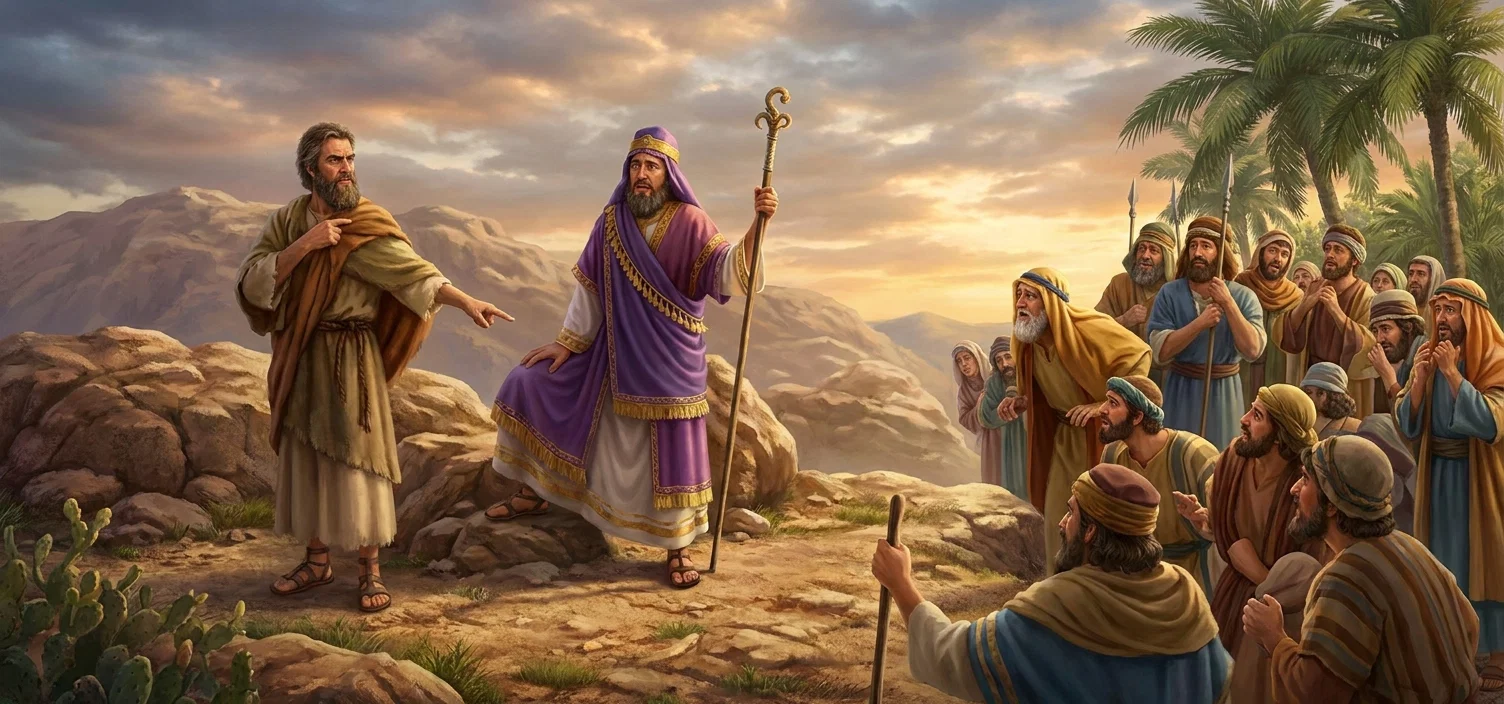
“I HAVE NOT TROUBLED ISRAEL, BUT THOU, AND THY FATHER’S HOUSE”