“Ye are My witnesses, saith the Lord, and My servant whom I have chosen.” Isa. 43: 10.
“PROVE THY SERVANTS, I BESEECH THEE”
IN THE COURT OF BABYLON—39
AMONG the children of Israel who were carried captive to Babylon at the beginning of the seventy years’ captivity were Christian patriots, men who were as true as steel to principle, who would not be corrupted by selfishness, but who would honor God at the loss of all things. In the land of their captivity these men were to carry out God’s purpose by giving to heathen nations the blessings that come through a knowledge of Jehovah. They were to be His representatives. Never were they to compromise with idolaters; their faith and their name as worshipers of the living God they were to bear as a high honor. And this they did. In prosperity and adversity they honored God; and God honored them.
The fact that these men, worshipers of Jehovah, were captives in Babylon, and that the vessels of God’s house had been placed in the temple of the Babylonish gods, was boastfully cited by the victors480as evidence that their religion and customs were superior to the religion and customs of the Hebrews. Yet through the very humiliations that Israel’s departure from Him had invited, God gave Babylon evidence of His supremacy, of the holiness of His requirements, and of the sure results of obedience. And this testimony He gave, as alone it could be given, through those who were loyal to Him.
Among those who maintained their allegiance to God were Daniel and his three companions,—illustrious examples of what men may become who unite with the God of wisdom and power. From the comparative simplicity of their Jewish home, these youth of royal line were taken to the most magnificent of cities, and into the court of the world’s greatest monarch. Nebuchadnezzar “spake unto Ashpenaz the master of his eunuchs, that he should bring certain of the children of Israel, and of the king’s seed, and of the princes; children in whom was no blemish, but well favored, and skillful in all wisdom, and cunning in knowledge, and understanding science, and such as had ability in them to stand in the king’s palace. . . .
“Now among these were of the children of Judah, Daniel, Hananiah, Mishael, and Azariah.” Seeing in these youth the promise of remarkable ability, Nebuchadnezzar determined that they should be trained to fill important positions in his kingdom. That they might be fully qualified for their life-work, he arranged for them to learn the language of the Chaldeans, and for three years to be granted the unusual educational advantages afforded princes of the realm.
The names of Daniel and his companions were changed to names representing Chaldean deities.481Great significance was attached to the names given by Hebrew parents to their children. Often these stood for traits of character that the parent desired to see developed in the child. The prince in whose charge the captive youth were placed, “gave unto Daniel the name of Belteshazzar; and to Hananiah, of Shadrach; and to Mishael, of Meshach; and to Azariah, of Abednego.”
The king did not compel the Hebrew youth to renounce their faith in favor of idolatry, but he hoped to bring this about gradually. By giving them names significant of idolatry, by bringing them daily into close association with idolatrous customs, and under the influence of the seductive rites of heathen worship, he hoped to induce them to renounce the religion of their nation, and to unite with the worship of the Babylonians.
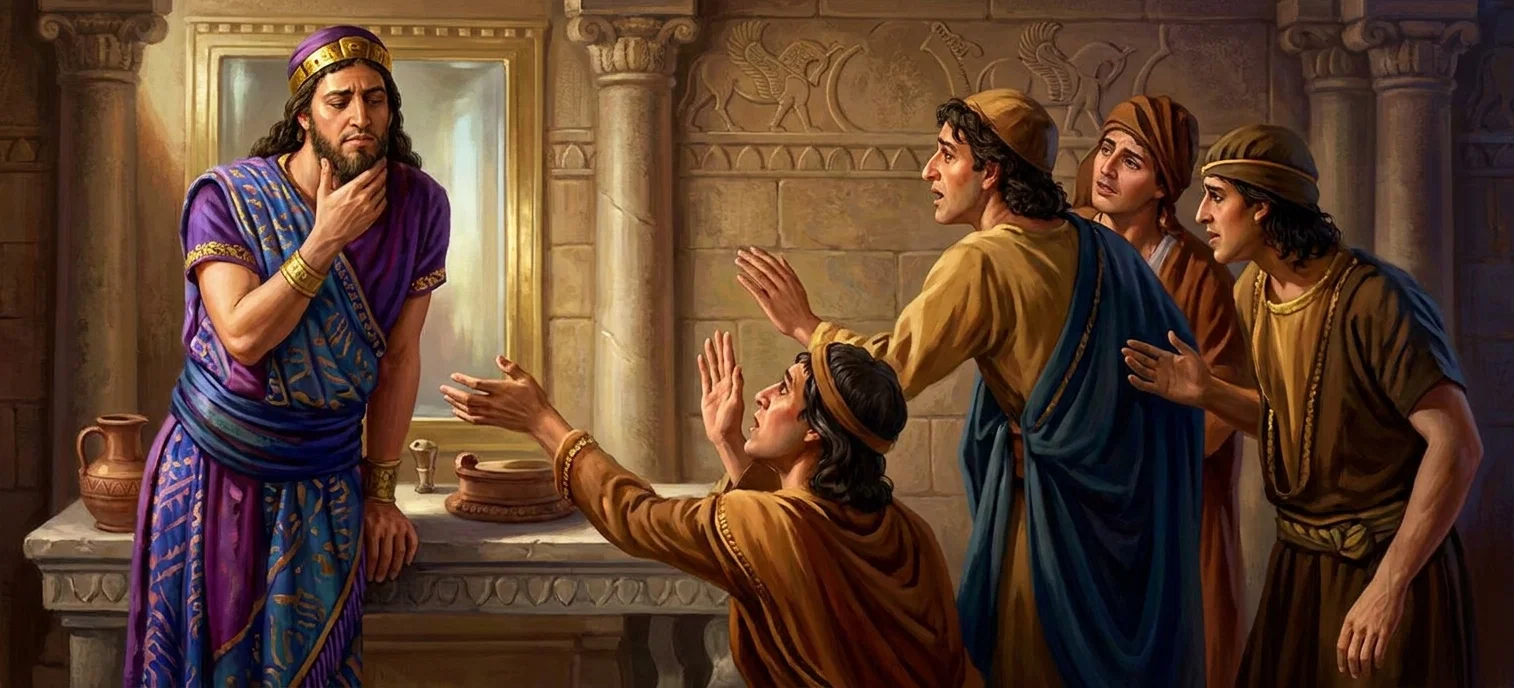
At the very outset of their career there came to them a decisive test of character. It was provided that they should eat of the food and drink of the wine that came from the king’s table. In this the king thought to give them an expression of his favor and of his solicitude for their welfare. But a portion having been offered to idols, the food from the king’s table was consecrated to idolatry; and one partaking of it would be regarded as offering homage to the gods of Babylon. In such homage, loyalty to Jehovah forbade Daniel and his companions to join. Even a mere pretense of eating the food or drinking the wine would be a denial of their faith. To do this would be to array themselves with heathenism, and to dishonor the principles of the law of God.
Nor dared they risk the enervating effect of luxury and dissipation on physical, mental, and spiritual development. They were acquainted with the history of Nadab and Abihu, the record of whose intemperance and its results had been preserved in the parchments of the Pentateuch; and they knew that their own physical and mental power would be injuriously affected by the use of wine.
Daniel and his associates had been trained by their parents to habits of strict temperance. They had been taught that God would hold them accountable for their capabilities, and that they must never dwarf or enfeeble their powers. This education was to Daniel and his companions the means of their preservation amidst the demoralizing influences of the court of Babylon. Strong were the temptations surrounding them in that corrupt and luxurious court, but they remained uncontaminated. No power, no influence, could sway them from the principles they had learned in early life by a study of the word and works of God.
Had Daniel so desired, he might have found in his surroundings a plausible excuse for departing from strictly temperate habits. He might have argued that, dependent as he was on the king’s favor and subject to his power, there was no other course for him to pursue than to eat of the king’s food and drink of his wine; for should he adhere to the divine teaching, he would offend the king, and probably lose his position and his life. Should he disregard the commandment of the Lord, he would retain the favor of the king, and secure for himself intellectual advantages and flattering worldly prospects.
But Daniel did not hesitate. The approval of God was dearer to him than the favor of the most powerful earthly potentate—dearer than life itself. He determined to stand firm in his integrity, let the result be what it might. He “purposed in his heart that he would not defile himself with the portion of the king’s meat, nor with the wine which he drank.” And in this resolve he was supported by his three companions.
In reaching this decision, the Hebrew youth did not act presumptuously, but in firm reliance upon God. They did not choose to be singular, but they would be so rather than dishonor God. Should they compromise with wrong in this instance by yielding to the pressure of circumstances, their departure from principle would weaken their sense of right and their abhorrence of wrong. The first wrong step would lead to others, until, their connection with Heaven severed, they would be swept away by temptation.
“God had brought Daniel into favor and tender love with the prince of the eunuchs,” and the request that he might not defile himself was received with respect. Yet the prince hesitated to grant it. “I fear my lord the king, who hath appointed your meat and your drink,” he explained to Daniel; “for why should he see your faces worse liking than the children which are of your sort? then shall ye make me endanger my head to the king.”
Daniel then appealed to Melzar, the officer in special charge of the Hebrew youth, requesting that they might be excused from eating the king’s meat and drinking his wine. He asked that the matter be tested by a ten days’ trial, the Hebrew youth during484this time being supplied with simple food, while their companions ate of the king’s dainties.
Melzar, though fearful that by complying with this request he would incur the displeasure of the king, nevertheless consented; and Daniel knew that his case was won. At the end of the ten days’ trial, the result was found to be the opposite of the prince’s fears. “Their countenances appeared fairer and fatter in flesh than all the children which did eat the portion of the king’s meat.” In personal appearance the Hebrew youth showed a marked superiority over their companions. As a result, Daniel and his associates were permitted to continue their simple diet during their entire course of training.
For three years the Hebrew youth studied to acquire “the learning and the tongue of the Chaldeans.” During this time they held fast their allegiance to God, and depended constantly upon His power. With their habits of self-denial they united earnestness of purpose, diligence, and steadfastness. It was not pride or ambition that had brought them into the king’s court,—into companionship with those who neither knew nor feared God; they were captives in a strange land, placed there by Infinite Wisdom. Separated from home influences and sacred associations, they sought to acquit themselves creditably, for the honor of their downtrodden people, and for the glory of Him whose servants they were.
The Lord regarded with approval the firmness and self-denial of the Hebrew youth, and their purity of motive; and His blessing attended them. He “gave them knowledge and skill in all learning and wisdom: and Daniel had understanding in all visions and485dreams.” The promise was fulfilled, “Them that honor Me I will honor.” As Daniel clung to God with unwavering trust, the spirit of prophetic power came upon him. While receiving instruction from man in the duties of court life, he was being taught by God to read the mysteries of the future, and to record for coming generations, through figures and symbols, events covering the history of this world till the close of time.
When the time came for the youth in training to be tested, the Hebrews were examined, with other candidates, for the service of the kingdom. But “among them all was found none like Daniel, Hananiah, Mishael, and Azariah.” Their keen comprehension, their wide knowledge, their choice and exact language, testified to the unimpaired strength and vigor of their mental powers. “In all matters of wisdom and understanding, that the king inquired of them, he found them ten times better than all the magicians and astrologers that were in all his realm;” “therefore stood they before the king.”
At the court of Babylon were gathered representatives from all lands, men of the highest talent, men the most richly endowed with natural gifts, and possessed of the broadest culture that the world could bestow; yet among them all, the Hebrew youth were without a peer. In physical strength and beauty, in mental vigor and literary attainment, they stood unrivaled. The erect form, the firm, elastic step, the fair countenance, the undimmed senses, the untainted breath,—all were so many certificates of good habits, insignia of the nobility with which nature honors those who are obedient to her laws.
In acquiring the wisdom of the Babylonians, Daniel and his companions were far more successful than their fellow students; but their learning did not come by chance. They obtained their knowledge by the faithful use of their powers, under the guidance of the Holy Spirit. They placed themselves in connection with the Source of all wisdom, making the knowledge of God the foundation of their education. In faith they prayed for wisdom, and they lived their prayers. They placed themselves where God could bless them. They avoided that which would weaken their powers, and improved every opportunity to become intelligent in all lines of learning. They followed the rules of life that could not fail to give them strength of intellect. They sought to acquire knowledge for one purpose,—that they might honor God. They realized that in order to stand as representatives of true religion amid the false religions of heathenism, they must have clearness of intellect, and must perfect a Christian character. And God Himself was their teacher. Constantly praying, conscientiously studying, keeping in touch with the Unseen, they walked with God as did Enoch.
True success in any line of work is not the result of chance or accident or destiny. It is the outworking of God’s providences, the reward of faith and discretion, of virtue and perseverance. Fine mental qualities and a high moral tone are not the result of accident. God gives opportunities; success depends upon the use made of them.
While God was working in Daniel and his companions “to will and to do of His good pleasure,” they were working out their own salvation. Herein487is revealed the outworking of the divine principle of coöperation, without which no true success can be attained. Human effort avails nothing without divine power; and without human endeavor, divine effort is with many of no avail. To make God’s grace our own, we must act our part. His grace is given to work in us to will and to do, but never as a substitute for our effort.
As the Lord coöperated with Daniel and his fellows, so He will coöperate with all who strive to do His will. And by the impartation of His Spirit He will strengthen every true purpose, every noble resolution. Those who walk in the path of obedience will encounter many hindrances. Strong, subtle influences may bind them to the world; but the Lord is able to render futile every agency that works for the defeat of His chosen ones; in His strength they may overcome every temptation, conquer every difficulty.
God brought Daniel and his associates into connection with the great men of Babylon, that in the midst of a nation of idolaters they might represent His character. How did they become fitted for a position of so great trust and honor? It was faithfulness in little things that gave complexion to their whole life. They honored God in the smallest duties, as well as in the larger responsibilities.
As God called Daniel to witness for Him in Babylon, so He calls us to be His witnesses in the world to-day. In the smallest as well as the largest affairs of life, He desires us to reveal to men the principles of His kingdom. Many are waiting for some great work to be brought to them, while daily they lose opportunities for revealing faithfulness to God. Daily488they fail of discharging with whole-heartedness the little duties of life. While they wait for some large work in which they may exercise supposedly great talents, and thus satisfy their ambitious longings, their days pass away.
In the life of the true Christian there are no non-essentials; in the sight of Omnipotence every duty is important. The Lord measures with exactness every possibility for service. The unused capabilities are just as much brought into account as those that are used. We shall be judged by what we ought to have done, but did not accomplish because we did not use our powers to glorify God.
A noble character is not the result of accident; it is not due to special favors or endowments of Providence. It is the result of self-discipline, of subjection of the lower to the higher nature, of the surrender of self to the service of God and man.
Through the fidelity to the principles of temperance shown by the Hebrew youth, God is speaking to the youth of to-day. There is need of men who, like Daniel, will do and dare for the cause of right. Pure hearts, strong hands, fearless courage, are needed; for the warfare between vice and virtue calls for ceaseless vigilance. To every soul Satan comes with temptation in many alluring forms on the point of indulgence of appetite.
The body is a most important medium through which the mind and the soul are developed for the upbuilding of character. Hence it is that the adversary of souls directs his temptations to the enfeebling and degrading of the physical powers. His success here often means the surrender of the whole being to489evil. The tendencies of the physical nature, unless under the dominion of a higher power, will surely work ruin and death. The body is to be brought into subjection to the higher powers of the being. The passions are to be controlled by the will, which is itself to be under the control of God. The kingly power of reason, sanctified by divine grace, is to bear sway in the life. Intellectual power, physical stamina, and the length of life depend upon immutable laws. Through obedience to these laws, man may stand conqueror of himself, conqueror of his own inclinations, conqueror of principalities and powers, of “the rulers of the darkness of this world,” and of “spiritual wickedness in high places.”
In that ancient ritual which is the gospel in symbol, no blemished offering could be brought to God’s altar. The sacrifice that was to represent Christ must be spotless. The word of God points to this as an illustration of what His children are to be,—“a living sacrifice,” “holy and without blemish.”
The Hebrew worthies were men of like passions with ourselves; yet, notwithstanding the seductive influences of the court of Babylon, they stood firm, because they depended upon a strength that is infinite. In them a heathen nation beheld an illustration of the goodness and beneficence of God, and of the love of Christ. And in their experience we have an instance of the triumph of principle over temptation, of purity over depravity, of devotion and loyalty over atheism and idolatry.
The spirit that possessed Daniel, the youth of to-day may have; they may draw from the same490source of strength, possess the same power of self-control, and reveal the same grace in their lives, even under circumstances as unfavorable. Though surrounded by temptations to self-indulgence, especially in our large cities, where every form of sensual gratification is made easy and inviting, yet by divine grace their purpose to honor God may remain firm. Through strong resolution and vigilant watchfulness they may withstand every temptation that assails the soul. But only by him who determines to do right because it is right will the victory be gained.
What a life-work was that of these noble Hebrews! As they bade farewell to their childhood home, little did they dream what a high destiny was to be theirs. Faithful and steadfast, they yielded to the divine guiding, so that through them God could fulfill His purpose.
The same mighty truths that were revealed through these men, God desires to reveal through the youth and children to-day. The life of Daniel and his fellows is a demonstration of what He will do for those who yield themselves to Him, and with the whole heart seek to accomplish His purpose.
“I HAVE DREAMED A DREAM”
NEBUCHADNEZZAR’S DREAM—40
Soon after Daniel and his companions entered the service of the king of Babylon, events occurred that revealed to an idolatrous nation the power and faithfulness of the God of Israel. Nebuchadnezzar had a remarkable dream, by which “his spirit was troubled, and his sleep brake from him.” But although the king’s mind was deeply impressed, he found it impossible, when he awoke, to recall the particulars.
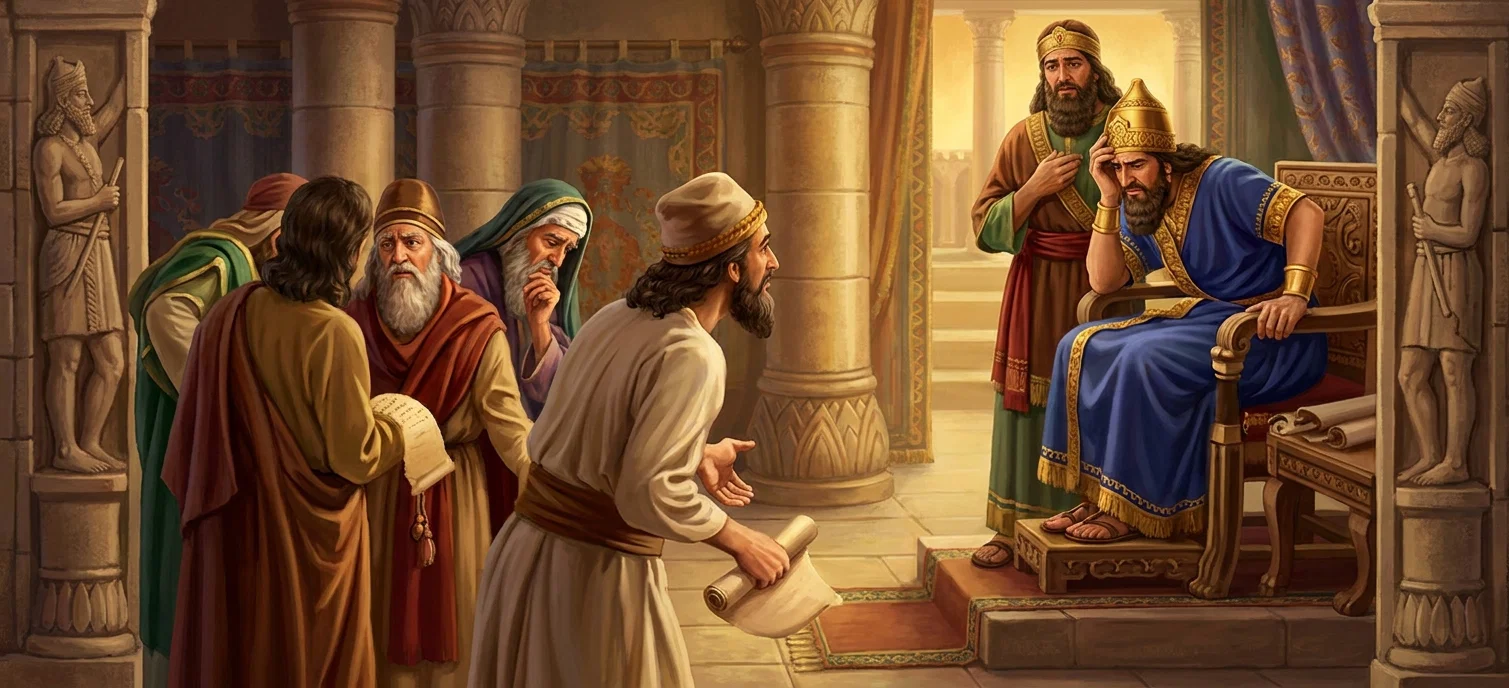
In his perplexity, Nebuchadnezzar assembled his wise men,—“the magicians, and the astrologers, and the sorcerers,”—and besought their help. “I have dreamed a dream,” he said, “and my spirit was troubled to know the dream.” With this statement of his perplexity, he requested them to reveal to him that which would bring relief to his mind.
To this the wise men responded, “O king, live forever: tell thy servants the dream, and we will show the interpretation.”
Dissatisfied with their evasive answer, and suspicious because, despite their pretentious claims to reveal the secrets of men, they nevertheless seemed unwilling to grant him help, the king commanded his wise men, with promises of wealth and honor on the one hand, and threats of death on the other, to tell him not only the interpretation of the dream, but the dream itself. “The thing is gone from me,” he said; “if ye will not make known unto me the dream, with the interpretation thereof, ye shall be cut in pieces, and your houses shall be made a dunghill. But if ye show the dream, and the interpretation thereof, ye shall receive of me gifts and rewards and great honor.”
Still the wise men returned the answer, “Let the king tell his servants the dream, and we will show the interpretation of it.”
Nebuchadnezzar, now thoroughly aroused and angered by the apparent perfidy of those in whom he had trusted, declared: “I know of certainty that ye would gain the time, because ye see the thing is gone from me. But if ye will not make known unto me the dream, there is but one decree for you: for ye have prepared lying and corrupt words to speak before me, till the time be changed: therefore tell me the dream, and I shall know that ye can show me the interpretation thereof.”
Filled with fear for the consequences of their failure, the magicians endeavored to show the king that his request was unreasonable, and his test beyond that which had ever been required of any man. “There is not a man upon the earth,” they remonstrated, “that can show the king’s matter: therefore there is no king, lord, nor ruler, that asked such things493at any magician, or astrologer, or Chaldean. And it is a rare thing that the king requireth, and there is none other that can show it before the king, except the gods, whose dwelling is not with flesh.”
Then “the king was angry and very furious, and commanded to destroy all the wise men of Babylon.”
Among those sought for by the officers who were preparing to fulfill the provisions of the royal decree, were Daniel and his friends. When told that according to the decree they also must die, “with counsel and wisdom” Daniel inquired of Arioch, the captain of the king’s guard, “Why is the decree so hasty from the king?” Arioch told him the story of the king’s perplexity over his remarkable dream, and of his failure to secure help from those in whom he had hitherto placed fullest confidence. Upon hearing this, Daniel, taking his life in his hands, ventured into the king’s presence, and begged that time be granted, that he might petition his God to reveal to him the dream and its interpretation.
To this request the monarch acceded. “Then Daniel went to his house, and made the thing known to Hananiah, Mishael, and Azariah, his companions.” Together they sought for wisdom from the Source of light and knowledge. Their faith was strong in the consciousness that God had placed them where they were, that they were doing His work and meeting the demands of duty. In times of perplexity and danger they had always turned to Him for guidance and protection, and He had proved an ever-present help. Now with contrition of heart they submitted themselves anew to the Judge of the earth, pleading that He would grant them deliverance in this their time of494special need. And they did not plead in vain. The God whom they had honored, now honored them. The Spirit of the Lord rested upon them, and to Daniel, “in a night vision,” was revealed the king’s dream and its meaning.
Daniel’s first act was to thank God for the revelation given him. “Blessed be the name of God forever and ever,” he exclaimed; “for wisdom and might are His: and He changeth the times and the seasons: He removeth kings, and setteth up kings: He giveth wisdom unto the wise, and knowledge to them that know understanding: He revealeth the deep and secret things: He knoweth what is in the darkness, and the light dwelleth with Him. I thank Thee, and praise Thee, O Thou God of my fathers, who hast given me wisdom and might, and hast made known unto me now what we desired of Thee: for Thou hast now made known unto us the king’s matter.”
Going immediately to Arioch, whom the king had commanded to destroy the wise men, Daniel said: “Destroy not the wise men of Babylon: bring me in before the king, and I will show unto the king the interpretation.” Quickly the officer ushered Daniel in before the king, with the words, “I have found a man of the captives of Judah, that will make known unto the king the interpretation.”
Behold the Jewish captive, calm and self-possessed, in the presence of the monarch of the world’s most powerful empire. In his first words he disclaimed honor for himself, and exalted God as the source of all wisdom. To the anxious inquiry of the king, “Art thou able to make known unto me the dream which I have seen, and the interpretation thereof?” he replied:495“The secret which the king hath demanded cannot the wise men, the astrologers, the magicians, the soothsayers, show unto the king; but there is a God in heaven that revealeth secrets, and maketh known to the king Nebuchadnezzar what shall be in the latter days.