STANDING before Ahab, Elijah demanded that all Israel be assembled to meet him and the prophets of Baal and Ashtoreth on Mount Carmel. “Send,” he commanded, “and gather to me all Israel unto Mount Carmel, and the prophets of Baal four hundred and fifty, and the prophets of the groves four hundred, which eat at Jezebel’s table.”
The command was issued by one who seemed to stand in the very presence of Jehovah; and Ahab obeyed at once, as if the prophet were monarch, and the king a subject. Swift messengers were sent throughout the kingdom with the summons to meet Elijah and the prophets of Baal and Ashtoreth. In every town and village, the people prepared to assemble at the appointed time. As they journeyed toward the place, the hearts of many were filled with strange forebodings. Something unusual was about to happen; else why this summons to gather at144Carmel? What new calamity was about to fall upon the people and the land?
Before the drought, Mount Carmel had been a place of beauty, its streams fed from never-failing springs, and its fertile slopes covered with fair flowers and flourishing groves. But now its beauty languished under a withering curse. The altars erected to the worship of Baal and Ashtoreth stood now in leafless groves. On the summit of one of the highest ridges, in sharp contrast with these was the broken-down altar of Jehovah.
Carmel overlooked a wide expanse of country; its heights were visible from many parts of the kingdom of Israel. At the foot of the mount there were vantage points from which could be seen much of what took place above. God had been signally dishonored by the idolatrous worship carried on under cover of its wooded slopes; and Elijah chose this elevation as the most conspicuous place for the display of God’s power and for the vindication of the honor of His name.
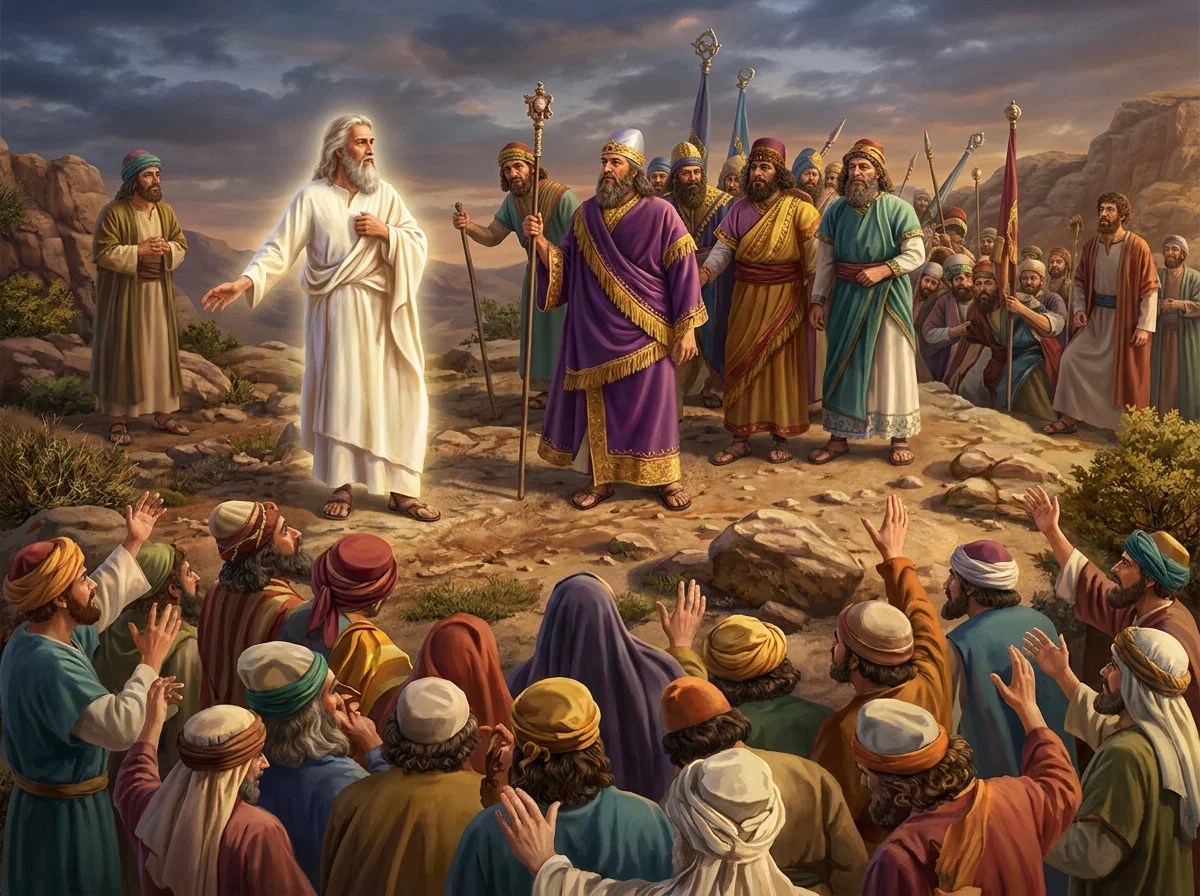
Early on the morning of the day appointed, the hosts of apostate Israel, in eager expectancy, gather near the top of the mountain. Jezebel’s prophets march up in imposing array. In regal pomp the king appears and takes his position at the head of the priests; and the idolaters shout his welcome. But there is apprehension in the hearts of the priests as they remember that at the word of the prophet the land of Israel for three years and a half has been destitute of dew and rain. Some fearful crisis is at hand, they feel sure. The gods in whom they have trusted have been unable to prove Elijah a false prophet.145To their frantic cries, their prayers, their tears, their humiliation, their revolting ceremonies, their costly and ceaseless sacrifices, the objects of their worship have been strangely indifferent.
ELIJAH MEETING AHAB AND THE IDOLATROUS PRIESTS
“He whom the whole kingdom has charged with its weight of woe, is now before them.”
Facing King Ahab and the false prophets, and surrounded by the assembled hosts of Israel, Elijah stands, the only one who has appeared to vindicate the honor of Jehovah. He whom the whole kingdom has charged with its weight of woe, is now before them, apparently defenseless in the presence of the monarch of Israel, the prophets of Baal, the men of war, and the surrounding thousands. But Elijah is not alone. Above and around him are the protecting hosts of heaven,—angels that excel in strength.
Unashamed, unterrified, the prophet stands before the multitude, fully aware of his commission to execute the divine command. His countenance is lighted with an awful solemnity. In anxious expectancy the people wait for him to speak. Looking first upon the broken-down altar of Jehovah, and then upon the multitude, Elijah cries out in clear, trumpet-like tones: “How long halt ye between two opinions? if the Lord be God, follow Him: but if Baal, then follow him.”
The people answer him not a word. Not one in that vast assembly dare reveal loyalty to Jehovah. Like a dark cloud, deception and blindness had overspread Israel. Not all at once had this fatal apostasy closed about them, but gradually, as from time to time they had failed to heed the words of warning and reproof that the Lord sent them. Each departure from right-doing, each refusal to repent, had deepened their guilt, and driven them farther from heaven.148And now, in this crisis, they persisted in refusing to take their stand for God.
The Lord abhors indifference and disloyalty in a time of crisis in His work. The whole universe is watching with inexpressible interest the closing scenes of the great controversy between good and evil. The people of God are nearing the borders of the eternal world; what can be of more importance to them than that they be loyal to the God of heaven? All through the ages, God has had moral heroes; and He has them now,—those who, like Joseph and Elijah and Daniel, are not ashamed to acknowledge themselves His peculiar people. His special blessing accompanies the labors of men of action; men who will not be swerved from the straight line of duty, but who with divine energy will inquire, “Who is on the Lord’s side?” men who will not stop merely with the inquiry, but who will demand that those who choose to identify themselves with the people of God shall step forward and reveal unmistakably their allegiance to the King of kings and Lord of lords. Such men make their wills and plans subordinate to the law of God. For love of Him, they count not their lives dear unto themselves. Their work is to catch the light from the Word, and let it shine forth to the world in clear, steady rays. Fidelity to God is their motto.
While Israel on Carmel doubt and hesitate, the voice of Elijah again breaks the silence: “I, even I only, remain a prophet of the Lord; but Baal’s prophets are four hundred and fifty men. Let them therefore give us two bullocks; and let them choose one bullock for themselves, and cut it in pieces, and lay it on wood, and put no fire under: and I will dress149the other bullock, and lay it on wood, and put no fire under: and call ye on the name of your gods, and I will call on the name of the Lord: and the God that answereth by fire, let him be God.”
The proposal of Elijah is so reasonable that the people cannot well evade it, so they find courage to answer, “It is well spoken.” The prophets of Baal dare not lift their voices in dissent; and addressing them, Elijah directs, “Choose you one bullock for yourselves, and dress it first; for ye are many; and call on the name of your gods, but put no fire under.”
Outwardly bold and defiant, but with terror in their guilty hearts, the false priests prepare their altar, laying on the wood and the victim; and then they begin their incantations. Their shrill cries echo and reëcho through the forests and the surrounding heights, as they call on the name of their god, saying, “O Baal, hear us.” The priests gather about their altar, and with leaping and writhing and screaming, with tearing of hair and cutting of flesh, they beseech their god to help them.
The morning passes, noon comes, and yet there is no evidence that Baal hears the cries of his deluded followers. There is no voice, no reply to their frantic prayers. The sacrifice remains unconsumed.
As they continue their frenzied devotions, the crafty priests are continually trying to devise some means by which they may kindle a fire upon the altar, and lead the people to believe that the fire has come direct from Baal. But Elijah watches every movement; and the priests, hoping against hope for some opportunity to deceive, continue to carry on their senseless ceremonies.
“It came to pass at noon, that Elijah mocked them, and said, Cry aloud: for he is a god; either he is talking, or he is pursuing, or he is in a journey, or peradventure he sleepeth, and must be awaked. And they cried aloud, and cut themselves after their manner with knives and lancets, till the blood gushed out upon them. And it came to pass, when midday was past, and they prophesied until the time of the offering of the evening sacrifice, that there was neither voice, nor any to answer, nor any that regarded.”
Gladly would Satan have come to the help of those whom he had deceived, and who were devoted to his service. Gladly would he have sent the lightning to kindle their sacrifice. But Jehovah has set Satan’s bounds,—restrained his power,—and not all the enemy’s devices can convey one spark to Baal’s altar.
At last, their voices hoarse with shouting, their garments stained with blood from self-inflicted wounds, the priests become desperate. With unabated frenzy they now mingle with their pleading terrible cursings of their sun god, and Elijah continues to watch intently; for he knows that if by any device the priests should succeed in kindling their altar fire, he would instantly be torn in pieces.
Evening draws on. The prophets of Baal are weary, faint, confused. One suggests one thing, and another something else, until finally they cease their efforts. Their shrieks and curses no longer resound over Carmel. In despair they retire from the contest.
All day long the people have witnessed the demonstrations of the baffled priests. They have beheld their wild leaping round the altar, as if they would grasp the burning rays of the sun to serve their purpose.151They have looked with horror on the frightful, self-inflicted mutilations of the priests, and have had opportunity to reflect on the follies of idol-worship. Many in the throng are weary of the exhibitions of demonism, and they now await with deepest interest the movements of Elijah.
It is the hour of the evening sacrifice, and Elijah bids the people, “Come near unto me.” As they tremblingly draw near, he turns to the broken-down altar where once men worshiped the God of heaven, and repairs it. To him this heap of ruins is more precious than all the magnificent altars of heathendom.
In the reconstruction of this ancient altar, Elijah revealed his respect for the covenant that the Lord made with Israel when they crossed the Jordan into the promised land. Choosing “twelve stones, according to the number of the tribes of the sons of Jacob, . . . he built an altar in the name of the Lord.”
The disappointed priests of Baal, exhausted by their vain efforts, wait to see what Elijah will do. They hate the prophet for proposing a test that has exposed the weakness and inefficiency of their gods; yet they fear his power. The people, fearful also, and almost breathless with expectancy, watch while Elijah continues his preparations. The calm demeanor of the prophet stands out in sharp contrast with the fanatical, senseless frenzy of the followers of Baal.
The altar completed, the prophet makes a trench about it, and having put the wood in order and prepared the bullock, he lays the victim on the altar, and commands the people to flood the sacrifice and the152altar with water. “Fill four barrels,” he directed, “and pour it on the burnt sacrifice, and on the wood. And he said, Do it the second time. And they did it the second time. And he said, Do it the third time. And they did it the third time. And the water ran round about the altar; and he filled the trench also with water.”
Reminding the people of the long-continued apostasy that has awakened the wrath of Jehovah, Elijah calls upon them to humble their hearts, and turn to the God of their fathers, that the curse upon the land of Israel may be removed. Then bowing reverently before the unseen God, he raises his hands toward heaven, and offers a simple prayer. Baal’s priests have screamed and foamed and leaped, from early morning until late in the afternoon; but as Elijah prays, no senseless shrieks resound over Carmel’s height. He prays as if he knows Jehovah is there, a witness to the scene, a listener to his appeal. The prophets of Baal have prayed wildly, incoherently. Elijah prays simply and fervently, asking God to show His superiority over Baal, that Israel may be led to turn to Him.
“Lord God of Abraham, Isaac, and of Israel,” the prophet pleads, “let it be known this day that Thou art God in Israel, and that I am Thy servant, and that I have done all these things at Thy word. Hear me, O Lord, hear me, that this people may know that Thou art the Lord God, and that Thou hast turned their heart back again.”
A silence, oppressive in its solemnity, rests upon all. The priests of Baal tremble with terror. Conscious of their guilt, they look for swift retribution.
No sooner is the prayer of Elijah ended, than flames of fire, like brilliant flashes of lightning, descend from heaven upon the upreared altar, consuming the sacrifice, licking up the water in the trench, and consuming even the stones of the altar. The brilliancy of the blaze illumines the mountain and dazzles the eyes of the multitude. In the valleys below, where many are watching in anxious suspense the movements of those above, the descent of fire is clearly seen, and all are amazed at the sight. It resembles the pillar of fire which at the Red Sea separated the children of Israel from the Egyptian host.
The people on the mount prostrate themselves in awe before the unseen God. They dare not continue to look upon the Heaven-sent fire. They fear that they themselves will be consumed; and, convicted of their duty to acknowledge the God of Elijah as the God of their fathers, to whom they owe allegiance, they cry out together as with one voice, “The Lord, He is the God; the Lord, He is the God.” With startling distinctness the cry resounds over the mountain and echoes in the plain below. At last Israel is aroused, undeceived, penitent. At last the people see how greatly they have dishonored God. The character of Baal-worship, in contrast with the reasonable service required by the true God, stands fully revealed. The people recognize God’s justice and mercy in withholding the dew and the rain until they have been brought to confess His name. They are ready now to admit that the God of Elijah is above every idol.
The priests of Baal witness with consternation the wonderful revelation of Jehovah’s power. Yet even154in their discomfiture and in the presence of divine glory, they refuse to repent of their evil-doing. They would still remain the prophets of Baal. Thus they showed themselves ripe for destruction. That repentant Israel may be protected from the allurements of those who have taught them to worship Baal, Elijah is directed by the Lord to destroy these false teachers. The anger of the people has already been aroused against the leaders in transgression; and when Elijah gives the command, “Take the prophets of Baal; let not one of them escape,” they are ready to obey. They seize the priests, and take them to the brook Kishon, and there, before the close of the day that marked the beginning of decided reform, the ministers of Baal are slain. Not one is permitted to live.
Brook Kishon
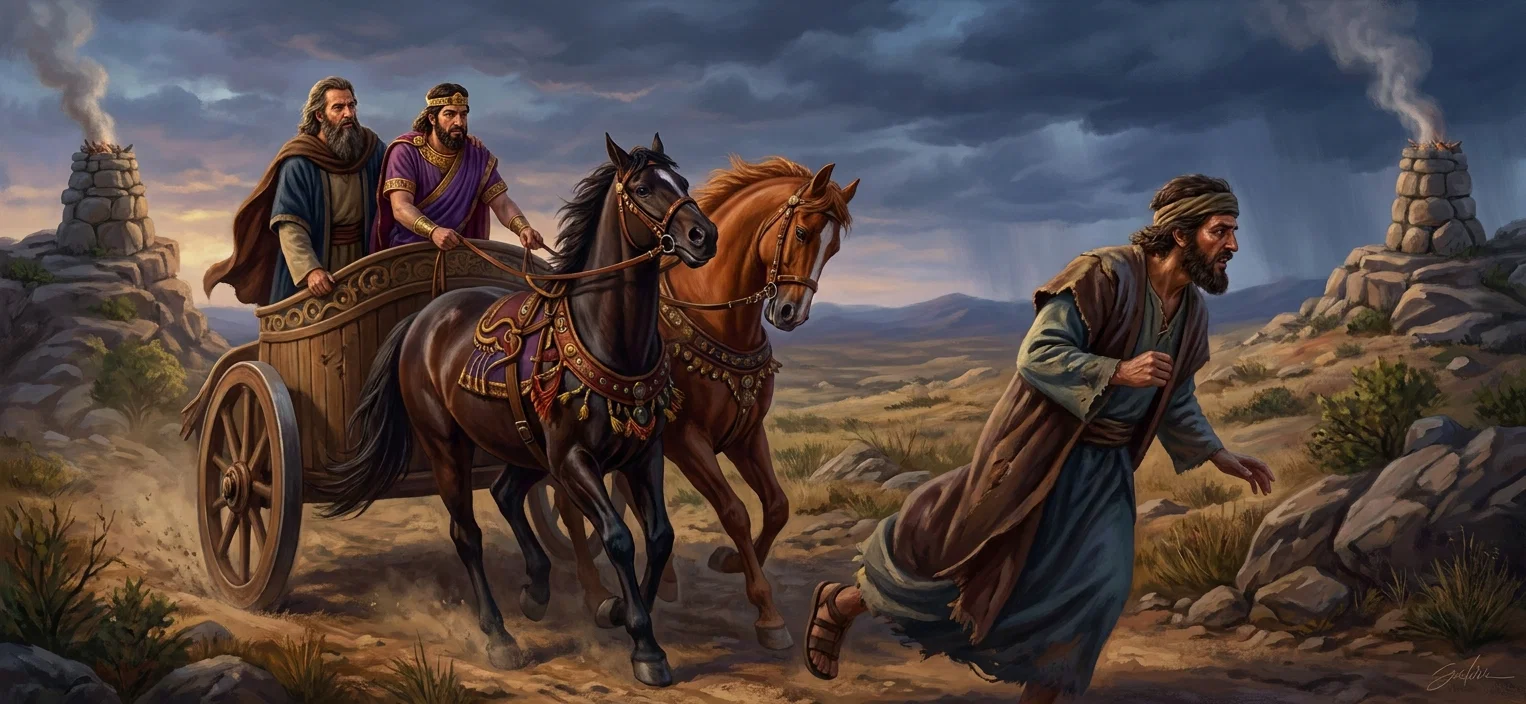
ELIJAH GUIDING THE KING
FROM JEZREEL TO HOREB—12
With the slaying of the prophets of Baal, the way was opened for carrying forward a mighty spiritual reformation among the ten tribes of the northern kingdom. Elijah had set before the people their apostasy; he had called upon them to humble their hearts and turn to the Lord. The judgments of Heaven had been executed; the people had confessed their sins, and had acknowledged the God of their fathers as the living God; and now the curse of Heaven was to be withdrawn, and the temporal blessings of life renewed. The land was to be refreshed with rain. “Get thee up, eat and drink,” Elijah said to Ahab; “for there is a sound of abundance of rain.” Then the prophet went to the top of the mount to pray.
It was not because of any outward evidence that the showers were about to fall, that Elijah could so confidently bid Ahab prepare for rain. The prophet saw no clouds in the heavens; he heard no thunder.156He simply spoke the word that the Spirit of the Lord had moved him to speak in response to his own strong faith. Throughout the day, he had unflinchingly performed the will of God, and had revealed his implicit confidence in the prophecies of God’s word; and now, having done all that was in his power to do, he knew that Heaven would freely bestow the blessings foretold. The same God who had sent the drought had promised an abundance of rain as the reward of right-doing; and now Elijah waited for the promised outpouring. In an attitude of humility, “his face between his knees,” he interceded with God in behalf of penitent Israel.
Again and again Elijah sent his servant to a point overlooking the Mediterranean, to learn whether there were any visible token that God had heard his prayer. Each time the servant returned with the word, “There is nothing.” The prophet did not become impatient or lose faith, but continued his earnest pleading. Six times the servant returned with the word that there was no sign of rain in the brassy heavens. Undaunted, Elijah sent him forth once more; and this time the servant returned with the word, “Behold, there ariseth a little cloud out of the sea, like a man’s hand.”
This was enough. Elijah did not wait for the heavens to gather blackness. In that small cloud, he beheld by faith an abundance of rain; and he acted in harmony with his faith, sending his servant quickly to Ahab with the message, “Prepare thy chariot, and get thee down, that the rain stop thee not.”
It was because Elijah was a man of large faith that God could use him in this grave crisis in the157history of Israel. As he prayed, his faith reached out and grasped the promises of Heaven; and he persevered in prayer until his petitions were answered. He did not wait for the full evidence that God had heard him, but was willing to venture all on the slightest token of divine favor. And yet what he was enabled to do under God, all may do in their sphere of activity in God’s service; for of the prophet from the mountains of Gilead it is written: “Elias was a man subject to like passions as we are, and he prayed earnestly that it might not rain: and it rained not on the earth by the space of three years and six months.”
Faith such as this is needed in the world to-day,—faith that will lay hold on the promises of God’s word, and refuse to let go until Heaven hears. Faith such as this connects us closely with Heaven, and brings us strength for coping with the powers of darkness. Through faith God’s children have “subdued kingdoms, wrought righteousness, obtained promises, stopped the mouths of lions, quenched the violence of fire, escaped the edge of the sword, out of weakness were made strong, waxed valiant in fight, turned to flight the armies of the aliens.” And through faith we to-day are to reach the heights of God’s purpose for us. “If thou canst believe, all things are possible to him that believeth.”
Faith is an essential element of prevailing prayer. “He that cometh to God must believe that He is, and that He is a rewarder of them that diligently seek Him.” “If we ask anything according to His will, He heareth us: and if we know that He hear us,158whatsoever we ask, we know that we have the petitions that we desired of Him.” With the persevering faith of Jacob, with the unyielding persistence of Elijah, we may present our petitions to the Father, claiming all that He has promised. The honor of His throne is staked for the fulfillment of His word.
The shades of night were gathering about Mount Carmel as Ahab prepared for the descent. “It came to pass in the meanwhile, that the heaven was black with clouds and wind, and there was a great rain. And Ahab rode, and went to Jezreel.” As he journeyed toward the royal city through the darkness and the blinding rain, Ahab was unable to see his way before him. Elijah, who, as the prophet of God, had that day humiliated Ahab before his subjects and slain his idolatrous priests, still acknowledged him as Israel’s king; and now, as an act of homage, and strengthened by the power of God, he ran before the royal chariot, guiding the king to the entrance of the city.
In this gracious act of God’s messenger shown to a wicked king is a lesson for all who claim to be servants of God, but who are exalted in their own estimation. There are those who feel above performing duties that to them appear menial. They hesitate to perform even needful service, fearing that they will be found doing the work of a servant. These have much to learn from the example of Elijah. By his word the treasures of heaven had been for three years withheld from the earth; he had been signally honored of God as, in answer to his prayer on Carmel, fire had flashed from heaven and consumed the sacrifice; his hand had executed the judgment of God159in slaying the idolatrous prophets; his petition for rain had been granted. And yet, after the signal triumphs with which God had been pleased to honor his public ministry, he was willing to perform the service of a menial.
At the gate of Jezreel, Elijah and Ahab separated. The prophet, choosing to remain outside the walls, wrapped himself in his mantle, and lay down upon the bare earth to sleep. The king, passing within, soon reached the shelter of his palace, and there related to his wife the wonderful events of the day, and the marvelous revelation of divine power that had proved to Israel that Jehovah is the true God and Elijah His chosen messenger. As Ahab told the queen of the slaying of the idolatrous prophets, Jezebel, hardened and impenitent, became infuriated. She refused to recognize in the events on Carmel the overruling providence of God, and, still defiant, she boldly declared that Elijah should die.
That night a messenger aroused the weary prophet, and delivered to him the word of Jezebel: “So let the gods do to me, and more also, if I make not thy life as the life of one of them by to-morrow about this time.”
It would seem that after showing courage so undaunted, after triumphing so completely over king and priests and people, Elijah could never afterward have given way to despondency, nor been awed into timidity. But he who had been blessed with so many evidences of God’s loving care, was not above the frailties of mankind, and in this dark hour his faith and courage forsook him. Bewildered, he started from his slumber. The rain was pouring from the160heavens, and darkness was on every side. Forgetting that three years before, God had directed his course to a place of refuge from the hatred of Jezebel and the search of Ahab, the prophet now fled for his life. Reaching Beersheba, he “left his servant there. But he himself went a day’s journey into the wilderness.”
Elijah should not have fled from his post of duty. He should have met the threat of Jezebel with an appeal for protection to the One who had commissioned him to vindicate the honor of Jehovah. He should have told the messenger that the God in whom he trusted would protect him against the hatred of the queen. Only a few hours had passed since he had witnessed a wonderful manifestation of divine power, and this should have given him assurance that he would not now be forsaken. Had he remained where he was, had he made God his refuge and strength, standing steadfast for the truth, he would have been shielded from harm. The Lord would have given him another signal victory by sending His judgments on Jezebel; and the impression made on the king and the people would have wrought a great reformation.
Elijah had expected much from the miracle wrought on Carmel. He had hoped that after this display of God’s power, Jezebel would no longer have influence over the mind of Ahab, and that there would be a speedy reform throughout Israel. All day on Carmel’s height he had toiled without food. Yet when he guided the chariot of Ahab to the gate of Jezreel, his courage was strong, despite the physical strain under which he had labored.
But a reaction such as frequently follows high faith and glorious success was pressing upon Elijah. He feared that the reformation begun on Carmel might not be lasting; and depression seized him. He had been exalted to Pisgah’s top; now he was in the valley. While under the inspiration of the Almighty, he had stood the severest trial of faith; but in this time of discouragement, with Jezebel’s threat sounding in his ears,162and Satan still apparently prevailing through the plotting of this wicked woman, he lost his hold on God. He had been exalted above measure, and the reaction was tremendous. Forgetting God, Elijah fled on and on, until he found himself in a dreary waste, alone. Utterly wearied, he sat down to rest under a juniper tree. And sitting there, he requested for himself that he might die. “It is enough; now, O Lord,” he said, “take away my life; for I am not better than my fathers.” A fugitive, far from the dwelling-places of men, his spirits crushed by bitter disappointment, he desired never again to look upon the face of man. At last, utterly exhausted, he fell asleep.
ELIJAH FLEEING
“Forgetting God, Elijah fled on and on.”
Into the experience of all there come times of keen disappointment and utter discouragement,—days when sorrow is the portion, and it is hard to believe that God is still the kind benefactor of His earthborn children; days when troubles harass the soul, till death seems preferable to life. It is then that many lose their hold on God, and are brought into the slavery of doubt, the bondage of unbelief. Could we at such times discern with spiritual insight the meaning of God’s providences, we should see angels seeking to save us from ourselves, striving to plant our feet upon a foundation more firm than the everlasting hills; and new faith, new life, would spring into being.
The faithful Job, in the day of his affliction and darkness, declared:
“Let the day perish wherein I was born.”
“O that my grief were thoroughly weighed,
And my calamity laid in the balances together!”163
“O that I might have my request;
And that God would grant me the thing that I long for:
Even that it would please God to destroy me;
That He would let loose His hand, and cut me off!
Then should I yet have comfort.”
“I will not refrain my mouth;
I will speak in the anguish of my spirit;
I will complain in the bitterness of my soul.”
“My soul chooseth . . . death rather than my life. I loathe it; I would not live alway: Let me alone; For my days are vanity.”
But though weary of life, Job was not allowed to die. To him were pointed out the possibilities of the future, and there was given him the message of hope:
“Thou shalt be steadfast, and shalt not fear:
Because thou shalt forget thy misery,
And remember it as waters that pass away:
And thine age shall be clearer than the noonday;
Thou shalt shine forth, thou shalt be as the morning.
And thou shalt be secure,
Because there is hope. . . .
Thou shalt lie down,
And none shall make thee afraid;
Yea, many shall make suit unto thee.
But the eyes of the wicked shall fail,
And they shall not escape,
And their hope shall be as the giving up of the ghost.”
From the depths of discouragement and despondency Job rose to the heights of implicit trust in the mercy and the saving power of God. Triumphantly he declared:
“Though He slay me, yet will I trust in Him: . . .
He also shall be my salvation.”
“I know that my Redeemer liveth,
And that He shall stand at the latter day upon the earth:
And though after my skin worms destroy this body,
Yet in my flesh shall I see God:
Whom I shall see for myself,
And mine eyes shall behold, and not another.”
“The Lord answered Job out of the whirlwind,” and revealed to His servant the might of His power. When Job caught a glimpse of his Creator, he abhorred himself, and repented in dust and ashes. Then the Lord was able to bless him abundantly, and to make his last years the best of his life.
Hope and courage are essential to perfect service for God. These are the fruit of faith. Despondency is sinful and unreasonable. God is able and willing “more abundantly” to bestow upon His servants the strength they need for test and trial. The plans of the enemies of His work may seem to be well laid and firmly established; but God can overthrow the strongest of these. And this He does in His own time and way, when He sees that the faith of His servants has been sufficiently tested.
For the disheartened there is a sure remedy,—faith, prayer, work. Faith and activity will impart assurance and satisfaction that will increase day by day. Are you tempted to give way to feelings of anxious foreboding or utter despondency? In the darkest days, when appearances seem most forbidding, fear not. Have faith in God. He knows your need. He has all power. His infinite love and compassion never weary. Fear not that He will fail of165fulfilling His promise. He is eternal truth. Never will He change the covenant He has made with those who love Him. And He will bestow upon His faithful servants the measure of efficiency that their need demands. The apostle Paul has testified: “He said unto me, My grace is sufficient for thee: for My strength is made perfect in weakness. . . . Therefore I take pleasure in infirmities, in reproaches, in necessities, in persecutions, in distresses for Christ’s sake: for when I am weak, then am I strong.”
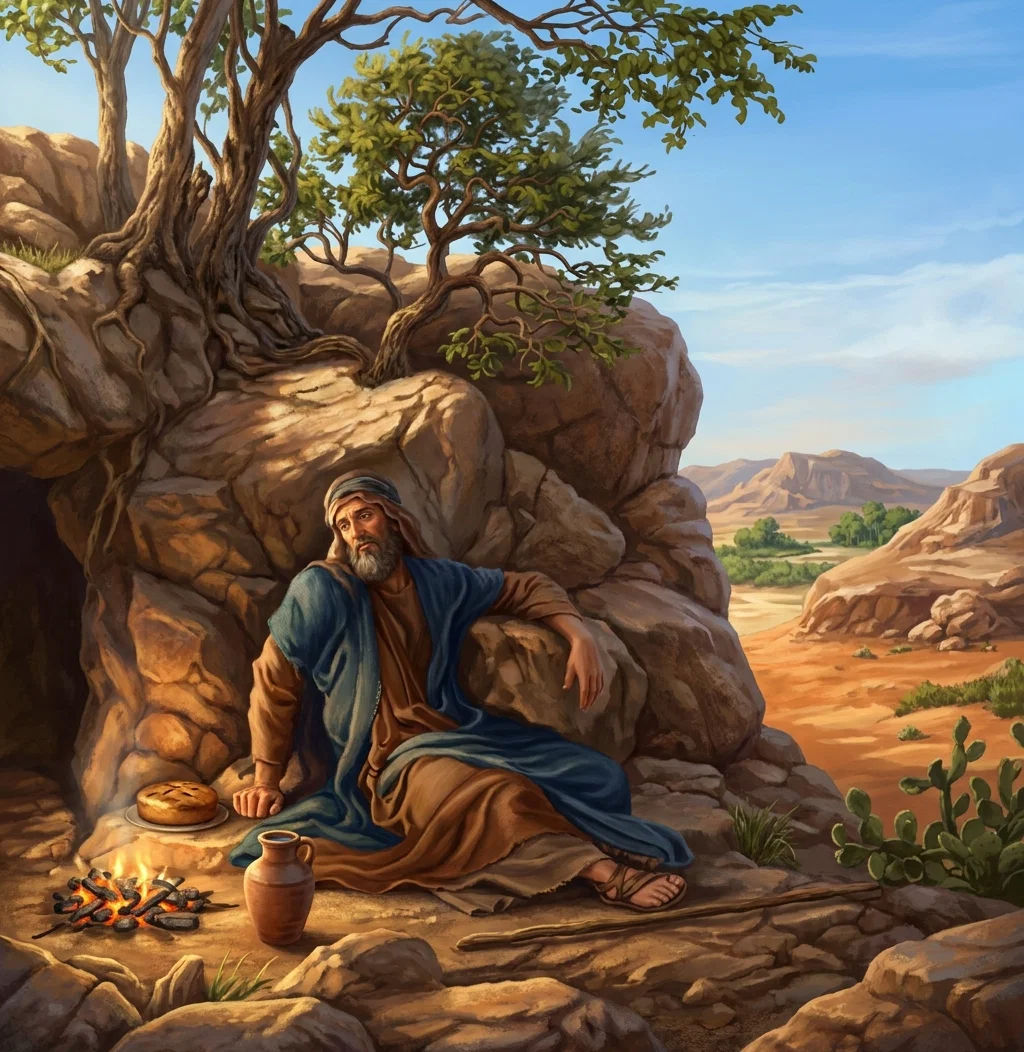
GOD'S PITYING CARE FOR HIS FAITHFUL SERVANTS
“He looked, and, behold, there was a cake baken on the coals, and a cruse of water at his head.”
Did God forsake Elijah in his hour of trial? Oh, no! He loved His servant no less when Elijah felt himself forsaken of God and man, than when, in answer to his prayer, fire flashed from heaven and illuminated the mountain top. And now, as Elijah slept, a soft touch and a pleasant voice awoke him. He started up in terror, as if to flee, fearing that the enemy had discovered him. But the pitying face bending over him was not the face of an enemy, but of a friend. God had sent an angel from heaven with food for His servant. “Arise and eat,” the angel said. “And he looked, and, behold, there was a cake baken on the coals, and a cruse of water at his head.”
After Elijah had partaken of the refreshment prepared for him, he slept again. A second time the angel came. Touching the exhausted man, he said with pitying tenderness, “Arise and eat; because the journey is too great for thee.” “And he arose, and did eat and drink;” and in the strength of that food he was able to journey “forty days and forty nights unto Horeb the mount of God,” where he found refuge in a cave.