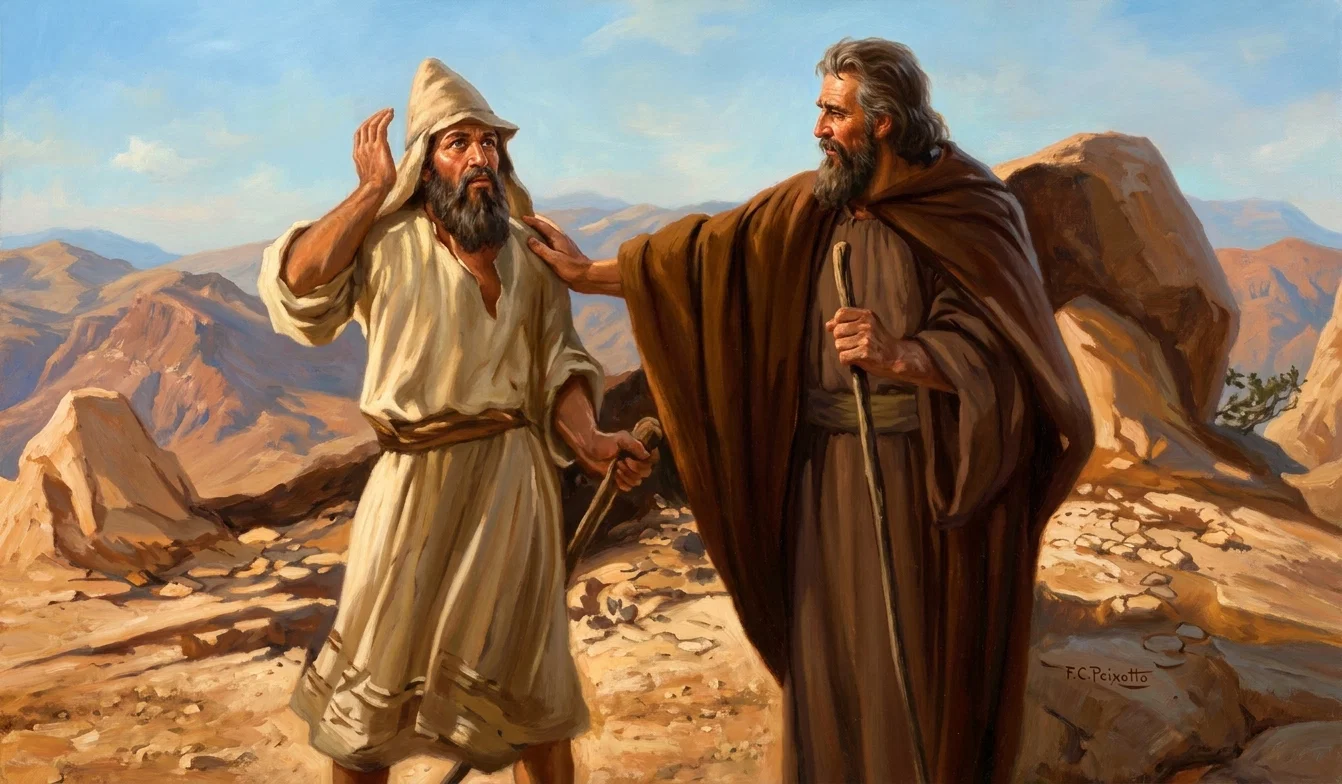
God had bidden Elijah anoint another to be prophet in his stead. “Elisha the son of Shaphat . . . shalt thou anoint to be prophet in thy room,” He had said; and in obedience to the command, Elijah went to find Elisha. As he journeyed northward, how changed was the scene from what it had been only a short while before! Then the ground was parched, the farming districts unworked; for neither dew nor rain had fallen for three and a half years. Now on every hand vegetation was springing up, as if to redeem the time of drought and famine.
Elisha’s father was a wealthy farmer, a man whose household were among the number that in a time of almost universal apostasy had not bowed the knee to Baal. Theirs was a home where God was honored, and where allegiance to the faith of ancient Israel was the rule of daily life. In such surroundings the early years of Elisha were passed. In the quietude of country life, under the teaching of God218and nature and the discipline of useful work, he received the training in habits of simplicity and of obedience to his parents and to God that helped to fit him for the high position he was afterward to occupy.
The prophetic call came to Elisha while, with his father’s servants, he was plowing in the field. He had taken up the work that lay nearest. He possessed both the capabilities of a leader among men, and the meekness of one who is ready to serve. Of a quiet and gentle spirit, he was nevertheless energetic and steadfast. Integrity, fidelity, and the love and fear of God were his; and in the humble round of daily toil, he gained strength of purpose and nobleness of character, constantly increasing in grace and knowledge. While coöperating with his father in the home-life duties, he was learning to coöperate with God.
By faithfulness in little things, Elisha was preparing for weightier trusts. Day by day, through practical experience, he gained a fitness for a broader, higher work. He learned to serve; and in learning this, he learned also how to instruct and lead. The lesson is for all. None can know what may be God’s purpose in His discipline; but all may be certain that faithfulness in little things is the evidence of fitness for greater responsibilities. Every act of life is a revelation of character; and he only who in small duties proves himself “a workman that needeth not to be ashamed,” can be honored by God with higher service.
He who feels that it is of no consequence how he performs the smaller tasks, proves himself unfit for a more honored position. He may think himself fully competent to take up the larger duties; but God looks219deeper than the surface. After test and trial, there is written against him the sentence, “Thou art weighed in the balances, and art found wanting.” His unfaithfulness reacts upon himself. He fails of gaining the grace, the power, the force of character, which is received through unreserved surrender.
Because they are not connected with some directly religious work, many feel that their lives are useless, that they are doing nothing for the advancement of God’s kingdom. If they could do some great thing, how gladly they would undertake it! But because they can serve only in little things, they think themselves justified in doing nothing. In this they err. A man may be in the active service of God while engaged in the ordinary, everyday duties,— while felling trees, clearing the ground, or following the plow. The mother who trains her children for Christ is as truly working for God as is the minister in the pulpit.
Many long for special talent with which to do a wonderful work, while the duties lying close at hand, the performance of which would make the life fragrant, are lost sight of. Let such ones take up the duties lying directly in their pathway. Success depends not so much on talent as on energy and willingness. It is not the possession of splendid talents that enables us to render acceptable service; but the conscientious performance of daily duties, the contented spirit, the unaffected, sincere interest in the welfare of others. In the humblest lot true excellence may be found. The commonest tasks, wrought with loving faithfulness, are beautiful in God’s sight.
As Elijah, divinely directed in seeking a successor, passed the field in which Elisha was plowing, he cast220upon the young man’s shoulders the mantle of consecration. During the famine, the family of Shaphat had become familiar with the work and mission of Elijah; and now the Spirit of God impressed Elisha’s heart as to the meaning of the prophet’s act. To him it was the signal that God had called him to be the successor of Elijah.
“And he left the oxen, and ran after Elijah, and said, Let me, I pray thee, kiss my father and my mother, and then I will follow thee.” “Go back again,” was Elijah’s answer; “for what have I done to thee?” This was not a repulse, but a test of faith. Elisha must count the cost,—decide for himself to accept or reject the call. If his desires clung to his home and its advantages, he was at liberty to remain there. But Elisha understood the meaning of the call. He knew it was from God, and he did not hesitate to obey. Not for any worldly advantage would he forego the opportunity of becoming God’s messenger, or sacrifice the privilege of association with His servant. He “took a yoke of oxen, and slew them, and boiled their flesh with the instruments of the oxen, and gave unto the people, and they did eat. Then he arose, and went after Elijah, and ministered unto him.” Without hesitation he left a home where he was beloved, to attend the prophet in his uncertain life.
Had Elisha asked Elijah what was expected of him,—what would be his work,—he would have been answered: God knows; He will make it known to you. If you wait upon the Lord, He will answer your every question. You may come with me if you have evidence that God has called you. Know for yourself221that God stands back of me, and that it is His voice you hear. If you can count everything but dross that you may win the favor of God, come.
Similar to the call that came to Elisha was the answer given by Christ to the young ruler who asked Him the question, “What good thing shall I do, that I may have eternal life?” “If thou wilt be perfect,” Christ replied, “go and sell that thou hast, and give to the poor, and thou shalt have treasure in heaven: and come and follow Me.”
Elisha accepted the call to service, casting no backward glance at the pleasures and comforts he was leaving. The young ruler, when he heard the Saviour’s words, “went away sorrowful: for he had great possessions.” He was not willing to make the sacrifice. His love for his possessions was greater than his love for God. By his refusal to renounce all for Christ, he proved himself unworthy of a place in the Master’s service.
The call to place all on the altar of service comes to each one. We are not all asked to serve as Elisha served, nor are we all bidden to sell everything we have; but God asks us to give His service the first place in our lives, to allow no day to pass without doing something to advance His work in the earth. He does not expect from all the same kind of service. One may be called to ministry in a foreign land; another may be asked to give of his means for the support of gospel work. God accepts the offering of each. It is the consecration of the life and all its interests, that is necessary. Those who make this consecration, will hear and obey the call of Heaven.
To every one who becomes a partaker of His grace, the Lord appoints a work for others. Individually we are to stand in our lot, saying, “Here am I; send me.” Whether a man be a minister of the Word or a physician, whether he be merchant or farmer, professional man or mechanic, the responsibility rests upon him. It is his work to reveal to others the gospel of their salvation. Every enterprise in which he engages should be a means to this end.
It was no great work that was at first required of Elisha; commonplace duties still constituted his discipline. He is spoken of as pouring water on the hands of Elijah, his master. He was willing to do anything that the Lord directed, and at every step he learned lessons of humility and service. As the prophet’s personal attendant, he continued to prove faithful in little things, while with daily strengthening purpose he devoted himself to the mission appointed him by God.
Elisha’s life after uniting with Elijah was not without temptations. Trials he had in abundance; but in every emergency he relied on God. He was tempted to think of the home that he had left, but to this temptation he gave no heed. Having put his hand to the plow, he was resolved not to turn back, and through test and trial he proved true to his trust.
Ministry comprehends far more than preaching the Word. It means training young men as Elijah trained Elisha, taking them from their ordinary duties, and giving them responsibilities to bear in God’s work,—small responsibilities at first, and larger ones as they gain strength and experience. There are in the ministry men of faith and prayer,223men who can say, “That which was from the beginning, which we have heard, which we have seen with our eyes, which we have looked upon, and our hands have handled, of the Word of life; . . . that which we have seen and heard declare we unto you.” Young, inexperienced workers should be trained by actual labor in connection with these experienced servants of God. Thus they will learn how to bear burdens.
Those who undertake this training of young workers are doing noble service. The Lord Himself co-operates with their efforts. And the young men to whom the word of consecration has been spoken, whose privilege it is to be brought into close association with earnest, godly workers, should make the most of their opportunity. God has honored them by choosing them for His service, and by placing them where they can gain greater fitness for it; and they should be humble, faithful, obedient, and willing to sacrifice. If they submit to God’s discipline, carrying out His directions, and choosing His servants as their counselors, they will develop into righteous, high-principled, steadfast men, whom God can entrust with responsibilities.
As the gospel is proclaimed in its purity, men will be called from the plow and from the common commercial business vocations that largely occupy the mind, and will be educated in connection with men of experience. As they learn to labor effectively, they will proclaim the truth with power. Through most wonderful workings of divine providence, mountains of difficulty will be removed and cast into the sea. The message that means so much to the dwellers upon the earth will be heard and understood. Men will224know what is truth. Onward and still onward the work will advance, until the whole earth shall have been warned; and then shall the end come.
For several years after the call of Elisha, Elijah and Elisha labored together, the younger man daily gaining greater preparedness for his work. Elijah had been God’s instrument for the overthrow of gigantic evils. The idolatry which, supported by Ahab and the heathen Jezebel, had seduced the nation, had been given a decided check. Baal’s prophets had been slain. The whole people of Israel had been deeply stirred, and many were returning to the worship of God. As Elijah’s successor, Elisha, by careful, patient instruction, must endeavor to guide Israel in safe paths. His association with Elijah, the greatest prophet since the days of Moses, prepared him for the work that he was soon to take up alone.
During these years of united ministry, Elijah from time to time was called upon to meet flagrant evils with stern rebuke. When wicked Ahab seized Naboth’s vineyard, it was the voice of Elijah that prophesied his doom and the doom of all his house. And when Ahaziah, after the death of his father Ahab, turned from the living God to Baal-zebub, the god of Ekron, it was Elijah’s voice that was heard once more in earnest protest.
The schools of the prophets, established by Samuel, had fallen into decay during the years of Israel’s apostasy. Elijah reestablished these schools, making provision for young men to gain an education that would lead them to magnify the law and make it honorable. Three of these schools, one at Gilgal, one at Bethel, and one at Jericho, are mentioned in the225record. Just before Elijah was taken to heaven, he and Elisha visited these centers of training. The lessons that the prophet of God had given them on former visits, he now repeated. Especially did he instruct them concerning their high privilege of loyally maintaining their allegiance to the God of heaven. He also impressed upon their minds the importance of letting simplicity mark every feature of their education. Only in this way could they receive the mould of heaven, and go forth to work in the ways of the Lord.
The heart of Elijah was cheered as he saw what was being accomplished by means of these schools. The work of reformation was not complete, but he could see throughout the kingdom a verification of the word of the Lord, “Yet I have left Me seven thousand in Israel, all the knees which have not bowed unto Baal.”
As Elisha accompanied the prophet on his round of service from school to school, his faith and resolution were once more tested. At Gilgal, and again at Bethel and Jericho, he was invited by the prophet to turn back. “Tarry here, I pray thee,” Elijah said; “for the Lord hath sent me to Bethel.” But in his early labor of guiding the plow, Elisha had learned not to fail or to become discouraged; and now that he had set his hand to the plow in another line of duty, he would not be diverted from his purpose. He would not be parted from his master, so long as opportunity remained for gaining a further fitting up for service. Unknown to Elijah, the revelation that he was to be translated had been made known to his disciples in the schools of the prophets, and in particular to226Elisha. And now the tried servant of the man of God kept close beside him. As often as the invitation to turn back was given, his answer was, “As the Lord liveth, and as thy soul liveth, I will not leave thee.”
“And they two went on. . . . And they two stood by Jordan. And Elijah took his mantle, and wrapped it together, and smote the waters, and they were divided hither and thither, so that they two went over on dry ground. And it came to pass, when they were gone over, that Elijah said unto Elisha, Ask what I shall do for thee, before I be taken away from thee.”
ELISHA INVITED TO TURN BACK
“As the Lord liveth, I will not leave thee.”
Elisha asked not for worldly honor, or for a high place among the great men of earth. That which he craved was a large measure of the Spirit that God had bestowed so freely upon the one about to be227honored with translation. He knew that nothing but the Spirit which had rested upon Elijah, could fit him to fill the place in Israel to which God had called him; and so he asked, “I pray thee, let a double portion of thy Spirit be upon me.”
In response to this request, Elijah said: “Thou hast asked a hard thing: nevertheless, if thou see me when I am taken from thee, it shall be so unto thee; but if not, it shall not be so. And it came to pass, as they still went on, and talked, that, behold, there appeared a chariot of fire, and horses of fire, and parted them both asunder; and Elijah went up by a whirlwind into heaven.”
Elijah was a type of the saints who will be living on the earth at the time of the second advent of Christ, and who will be “changed, in a moment, in the twinkling of an eye, at the last trump,” without tasting of death. It was as a representative of those who shall be thus translated, that Elijah, near the close of Christ’s earthly ministry, was permitted to stand with Moses by the side of the Saviour on the mount of transfiguration. In these glorified ones, the disciples saw in miniature a representation of the kingdom of the redeemed. They beheld Jesus clothed with the light of heaven; they heard the “voice out of the cloud,” acknowledging Him as the Son of God; they saw Moses, representing those who will be raised from the dead at the time of the second advent; and there also stood Elijah, representing those who at the close of earth’s history will be changed from mortal to immortal, and be translated to heaven without seeing death.
In the desert, in loneliness and discouragement, Elijah had said that he had had enough of life, and had prayed that he might die. But the Lord in His mercy had not taken him at his word. There was yet a great work for Elijah to do; and when his work was done, he was not to perish in discouragement and solitude. Not for him the descent into the tomb, but the ascent with God’s angels to the presence of His glory.
“And Elisha saw it, and he cried, My father, my father, the chariot of Israel, and the horsemen thereof. And he saw him no more: and he took hold of his own clothes, and rent them in two pieces. He took up also the mantle of Elijah that fell from him, and went back, and stood by the bank of Jordan; and he took the mantle of Elijah that fell from him, and smote the waters, and said, Where is the Lord God of Elijah? and when he also had smitten the waters, they parted hither and thither: and Elisha went over. And when the sons of the prophets which were to view at Jericho saw him, they said, The Spirit of Elijah doth rest on Elisha. And they came to meet him, and bowed themselves to the ground before him.”
When the Lord in His providence sees fit to remove from His work those to whom He has given wisdom, He helps and strengthens their successors, if they will look to Him for aid and will walk in His ways. They may be even wiser than their predecessors; for they may profit by their experience and learn wisdom from their mistakes.
Henceforth Elisha stood in Elijah’s place. He who had been faithful in that which was least was to prove himself faithful also in much.
THE JORDAN VALLEY
THE HEALING OF THE WATERS—18
In patriarchal times, the Jordan valley was “well watered everywhere, . . . even as the garden of the Lord.” It was in this fair valley that Lot chose to make his home, when he “pitched his tent toward Sodom.” At the time that the cities of the plain were destroyed, the region round about became a desolate waste, and it has since formed a part of the wilderness of Judea.
A portion of the beautiful valley remained, with its life-giving springs and streams, to gladden the heart of man. In this valley, rich with fields of grain and forests of date palms and other fruit-bearing trees, the hosts of Israel had encamped after crossing the Jordan, and had first partaken of the fruits of the promised land. Before them had stood the walls of Jericho, a heathen stronghold, the center of the worship of Ashtoreth, vilest and most degrading of all Canaanitish forms of idolatry. Soon its walls were thrown down and its inhabitants slain; and at230the time of its fall, the solemn declaration was made, in the presence of all Israel: “Cursed be the man before the Lord, that riseth up and buildeth this city Jericho: he shall lay the foundation thereof in his first-born, and in his youngest son shall be set up the gates of it.”
Five centuries passed. The spot lay desolate, accursed of God. Even the springs that had made residence in this portion of the valley so desirable, suffered the blighting effects of the curse. But in the days of Ahab’s apostasy, when through Jezebel’s influence the worship of Ashtoreth was revived, Jericho, the ancient seat of this worship, was rebuilt, though at a fearful cost to the builder. Hiel the Bethelite “laid the foundation thereof in Abiram his first-born, and set up the gates thereof in his youngest son Segub, according to the word of the Lord.”
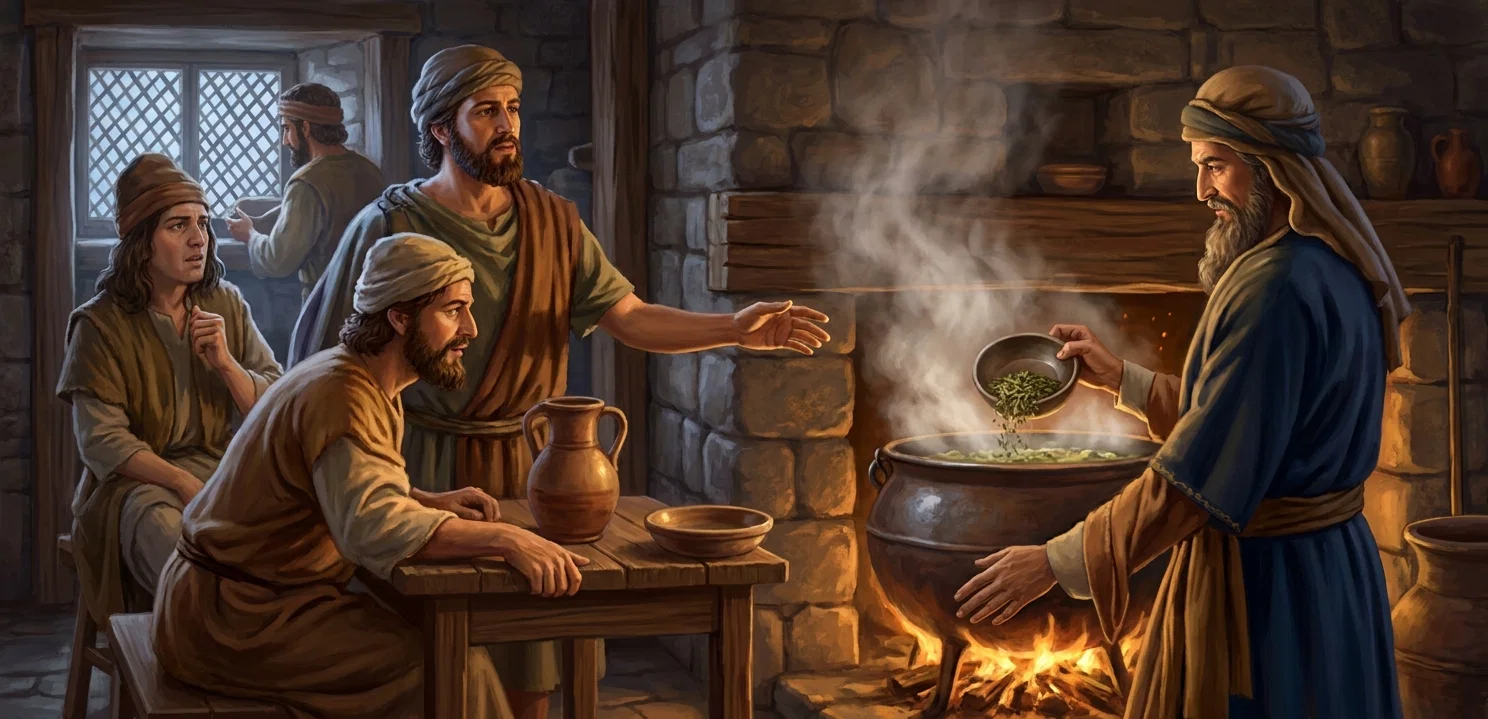
Not far from Jericho, in the midst of fruitful groves, was one of the schools of the prophets; and thither, after the ascension of Elijah, Elisha went. During his sojourn among them, the men of the city came to the prophet, and said, “Behold, I pray thee, the situation of this city is pleasant, as my lord seeth: but the water is naught, and the ground barren.” The spring that in former years had been pure and life-giving, and had contributed largely to the water supply of the city and the surrounding district, was now unfit for use.
In response to the plea of the men of Jericho, Elisha said, “Bring me a new cruse, and put salt therein.” Having received this, “he went forth unto the spring of the waters, and cast the salt in there,231and said, Thus saith the Lord, I have healed these waters; there shall not be from thence any more death or barren land.”
The healing of the waters of Jericho was accomplished, not by any wisdom of man, but by the miraculous interposition of God. Those who had rebuilt the city were undeserving of the favor of Heaven; yet He who “maketh His sun to rise on the evil and on the good, and sendeth rain on the just and on the unjust,” saw fit in this instance to reveal, through this token of compassion, His willingness to heal Israel of their spiritual maladies.
The restoration was permanent; “the waters were healed unto this day, according to the saying of Elisha which he spake.” From age to age the waters have flowed on, making that portion of the valley an oasis of beauty.
Many are the spiritual lessons to be gathered from the story of the healing of the waters. The new cruse, the salt, the spring,—all are highly symbolic.
In casting salt into the bitter spring, Elisha taught the same spiritual lesson imparted centuries later by the Saviour to His disciples when He declared, “Ye are the salt of the earth.” The salt mingling with the polluted spring purified its waters, and brought life and blessing where before had been blighting and death. When God compares His children to salt, He would teach them that His purpose in making them the subjects of His grace is that they may become agents in saving others. The object of God in choosing a people before all the world was not only that He might adopt them as His sons and232daughters, but that through them the world might receive the grace that bringeth salvation. When the Lord chose Abraham, it was not simply to be the special friend of God, but to be a medium of the peculiar privileges the Lord desired to bestow upon the nations.
The world needs evidences of sincere Christianity. The poison of sin is at work at the heart of society. Cities and towns are steeped in sin and moral corruption. The world is full of sickness, suffering, and iniquity. Nigh and afar off are souls in poverty and distress, weighed down with a sense of guilt, and perishing for want of a saving influence. The gospel of truth is kept ever before them, yet they perish, because the example of those who should be a savor of life to them, is a savor of death. Their souls drink in bitterness, because the springs are poisoned, when they should be like a well of water springing up unto everlasting life.
Salt must be mingled with the substance to which it is added; it must penetrate, infuse it, that it may be preserved. So it is through personal contact and association that men are reached by the saving power of the gospel. They are not saved as masses, but as individuals. Personal influence is a power. It is to work with the influence of Christ, to lift where Christ lifts, to impart correct principles, and to stay the progress of the world’s corruption. It is to diffuse that grace which Christ alone can impart. It is to uplift, to sweeten the lives and characters of others by the power of a pure example united with earnest faith and love.
Of the hitherto polluted spring at Jericho, the Lord declared, “I have healed these waters; there shall not be from thence any more death or barren land.” The polluted stream represents the soul that is separate from God. Sin not only shuts away from God, but destroys in the human soul both the desire and the capacity for knowing Him. Through sin, the whole human organism is deranged, the mind is perverted, the imagination corrupted; the faculties of the soul are degraded. There is an absence of pure religion, of heart holiness. The converting power of God has not wrought in transforming the character. The soul is weak, and for want of moral force to overcome, is polluted and debased.
To the heart that has become purified, all is changed. Transformation of character is the testimony to the world of an indwelling Christ. The Spirit of God produces a new life in the soul, bringing the thoughts and desires into obedience to the will of Christ; and the inward man is renewed in the image of God. Weak and erring men and women show to the world that the redeeming power of grace can cause the faulty character to develop into symmetry and abundant fruitfulness.
The heart that receives the word of God is not as a pool that evaporates, not like a broken cistern that loses its treasure. It is like the mountain stream, fed by unfailing springs, whose cool, sparkling waters leap from rock to rock, refreshing the weary, the thirsty, the heavy-laden. It is like a river constantly flowing, and as it advances, becoming deeper and wider, until its life-giving waters are spread over all the earth. The stream that goes singing on its way,234leaves behind its gift of verdure and fruitfulness. The grass on its banks is a fresher green, the trees have a richer verdure, the flowers are more abundant. When the earth lies bare and brown under the summer’s scorching heat, a line of verdure marks the river’s course.
So it is with the true child of God. The religion of Christ reveals itself as a vitalizing, pervading principle, a living, working, spiritual energy. When the heart is opened to the heavenly influence of truth and love, these principles will flow forth again like streams in the desert, causing fruitfulness to appear where now are barrenness and dearth.
As those who have been cleansed and sanctified through a knowledge of Bible truth engage heartily in the work of soul-saving, they will become indeed a savor of life unto life. And as daily they drink of the inexhaustible fountain of grace and knowledge, they will find that their own hearts are filled to overflowing with the Spirit of their Master, and that through their unselfish ministry many are benefited physically, mentally, and spiritually. The weary are refreshed, the sick restored to health, and the sin-burdened relieved. In far-off countries thanksgiving is heard from the lips of those whose hearts are turned from the service of sin unto righteousness.
“Give, and it shall be given unto you;” for the word of God is “a fountain of gardens, a well of living waters, and streams from Lebanon.”