The work of Elisha as a prophet was in some respects very different from that of Elijah. To Elijah had been committed messages of condemnation and judgment; his was the voice of fearless reproof, calling king and people to turn from their evil ways. Elisha’s was a more peaceful mission; his it was to build up and strengthen the work that Elijah had begun; to teach the people the way of the Lord. Inspiration pictures him as coming into personal touch with the people; surrounded by the sons of the prophets; bringing by his miracles and his ministry healing and rejoicing.
Elisha was a man of mild and kindly spirit; but that he could also be stern is shown by his course when, on the way to Bethel, he was mocked by ungodly youth who had come out of the city. These youth had heard of Elijah’s ascension, and they made this solemn event the subject of their jeers, saying to236Elisha, “Go up, thou bald head; go up, thou bald head.” At the sound of their mocking words the prophet turned back, and under the inspiration of the Almighty he pronounced a curse upon them. The awful judgment that followed was of God. “There came forth two she bears out of the wood, and tare forty and two” of them.
Had Elisha allowed the mockery to pass unnoticed, he would have continued to be ridiculed and reviled by the rabble, and his mission to instruct and save in a time of grave national peril might have been defeated. This one instance of terrible severity was sufficient to command respect throughout his life. For fifty years he went in and out of the gate of Bethel, and to and fro in the land, from city to city, passing through crowds of idle, rude, dissolute youth; but none mocked him or made light of his qualifications as the prophet of the Most High.
Even kindness should have its limits. Authority must be maintained by a firm severity, or it will be received by many with mockery and contempt. The so-called tenderness, the coaxing and indulgence, used toward youth, by parents and guardians, is one of the worst evils which can come upon them. In every family, firmness, decision, positive requirements, are essential.
Reverence, in which the youth who mocked Elisha were so lacking, is a grace that should be carefully cherished. Every child should be taught to show true reverence for God. Never should His name be spoken lightly or thoughtlessly. Angels, as they speak it, veil their faces. With what reverence should we, who are fallen and sinful, take it upon our lips!
Reverence should be shown for God’s representatives,—for ministers, teachers, and parents, who are called to speak and act in His stead. In the respect shown them, God is honored.
Courtesy, also, is one of the graces of the Spirit, and should be cultivated by all. It has power to soften natures which without it would grow hard and rough. Those who profess to be followers of Christ, and are at the same time rough, unkind, and uncourteous, have not learned of Jesus. Their sincerity may not be doubted, their uprightness may not be questioned; but sincerity and uprightness will not atone for a lack of kindness and courtesy.
The kindly spirit that enabled Elisha to exert a powerful influence over the lives of many in Israel, is revealed in the story of his friendly relations with a family dwelling at Shunem. In his journeyings to and fro throughout the kingdom, “it fell on a day, that Elisha passed to Shunem, where was a great woman; and she constrained him to eat bread. And so it was, that as oft as he passed by, he turned in thither to eat bread.” The mistress of the house perceived that Elisha was “an holy man of God,” and she said to her husband: “Let us make a little chamber, I pray thee, on the wall; and let us set for him there a bed, and a table, and a stool, and a candlestick: and it shall be, when he cometh to us, that he shall turn in thither.” To this retreat Elisha often came, thankful for its quiet peace. Nor was God unmindful of the woman’s kindness. Her home had been childless; and now the Lord rewarded her hospitality by the gift of a son.
Years passed. The child was old enough to be out in the field with the reapers. One day he was stricken down by the heat, “and he said unto his father, My head, my head.” The father bade a lad carry the child to his mother; “and when he had taken him, and brought him to his mother, he sat on her knees till noon, and then died. And she went up, and laid him on the bed of the man of God, and shut the door upon him, and went out.”
In her distress, the Shunammite determined to go to Elisha for help. The prophet was then at Mount Carmel; and the woman, accompanied by her servant, set forth immediately. “And it came to pass, when the man of God saw her afar off, that he said to Gehazi his servant, Behold, yonder is that Shunammite: run now, I pray thee, to meet her, and say unto her, Is it well with thee? is it well with thy husband? is it well with the child?” The servant did as he was bidden, but not till she had reached Elisha did the stricken mother reveal the cause of her sorrow. Upon hearing of her loss, Elisha bade Gehazi: “Gird up thy loins, and take my staff in thine hand, and go thy way: if thou meet any man, salute him not; and if any salute thee, answer him not again: and lay my staff upon the face of the child.”
But the mother would not be satisfied till Elisha himself came with her. “As the Lord liveth, and as thy soul liveth, I will not leave thee,” she declared. “And he arose, and followed her. And Gehazi passed on before them, and laid the staff upon the face of the child; but there was neither voice, nor hearing. Wherefore he went again to meet him, and told him, saying, The child is not awaked.”
When they reached the house, Elisha went into the room where the dead child lay, “and shut the door upon them twain, and prayed unto the Lord. And he went up, and lay upon the child, and put his mouth upon his mouth, and his eyes upon his eyes, and his hands upon his hands: and he stretched himself upon the child; and the flesh of the child waxed warm. Then he returned, and walked in the house to and fro; and went up, and stretched himself upon him: and the child sneezed seven times, and the child opened his eyes.”
Calling Gehazi, Elisha bade him send the mother to him. “And when she was come in unto him, he said, Take up thy son. Then she went in, and fell at his feet, and bowed herself to the ground, and took up her son, and went out.”
So was the faith of this woman rewarded. Christ, the great Life-giver, restored her son to her. In like manner will His faithful ones be rewarded, when, at His coming, death loses its sting, and the grave is robbed of the victory it has claimed. Then will He restore to His servants the children that have been taken from them by death. “Thus saith the Lord; A voice was heard in Ramah, lamentation, and bitter weeping; Rachel weeping for her children refused to be comforted for her children, because they were not. Thus saith the Lord; Refrain thy voice from weeping, and thine eyes from tears: for thy work shall be rewarded, . . . and they shall come again from the land of the enemy. And there is hope in thine end, saith the Lord, that thy children shall come again to their own border.”
Jesus comforts our sorrow for the dead with a message of infinite hope: “I will ransom them from the power of the grave; I will redeem them from death: O death, I will be thy plagues; O grave, I will be thy destruction.” “I am He that liveth, and was dead; and, behold, I am alive forevermore, . . . and have the keys of hell and of death.” “The Lord Himself shall descend from heaven with a shout, with the voice of the Archangel, and with the trump of God: and the dead in Christ shall rise first: then we which are alive and remain shall be caught up together with them in the clouds, to meet the Lord in the air: and so shall we ever be with the Lord.”
Like the Saviour of mankind, of whom he was a type, Elisha in his ministry among men combined the work of healing with that of teaching. Faithfully, untiringly, throughout his long and effective labors, Elisha endeavored to foster and advance the important educational work carried on by the schools of the prophets. In the providence of God, his words of instruction to the earnest groups of young men assembled were confirmed by the deep movings of the Holy Spirit, and at times by other unmistakable evidences of his authority as a servant of Jehovah.
It was on the occasion of one of his visits to the school established at Gilgal, that he healed the poisoned pottage. “There was a dearth in the land; and the sons of the prophets were sitting before him: and he said unto his servant, Set on the great pot, and seethe pottage for the sons of the prophets. And one went out into the field to gather herbs, and found a wild vine, and gathered thereof wild gourds241his lap full, and came and shred them into the pot of pottage: for they knew them not. So they poured out for the men to eat. And it came to pass, as they were eating of the pottage, that they cried out, and said, O thou man of God, there is death in the pot. And they could not eat thereof. But he said, Then bring meal. And he cast it into the pot; and he said, Pour out for the people, that they may eat. And there was no harm in the pot.”
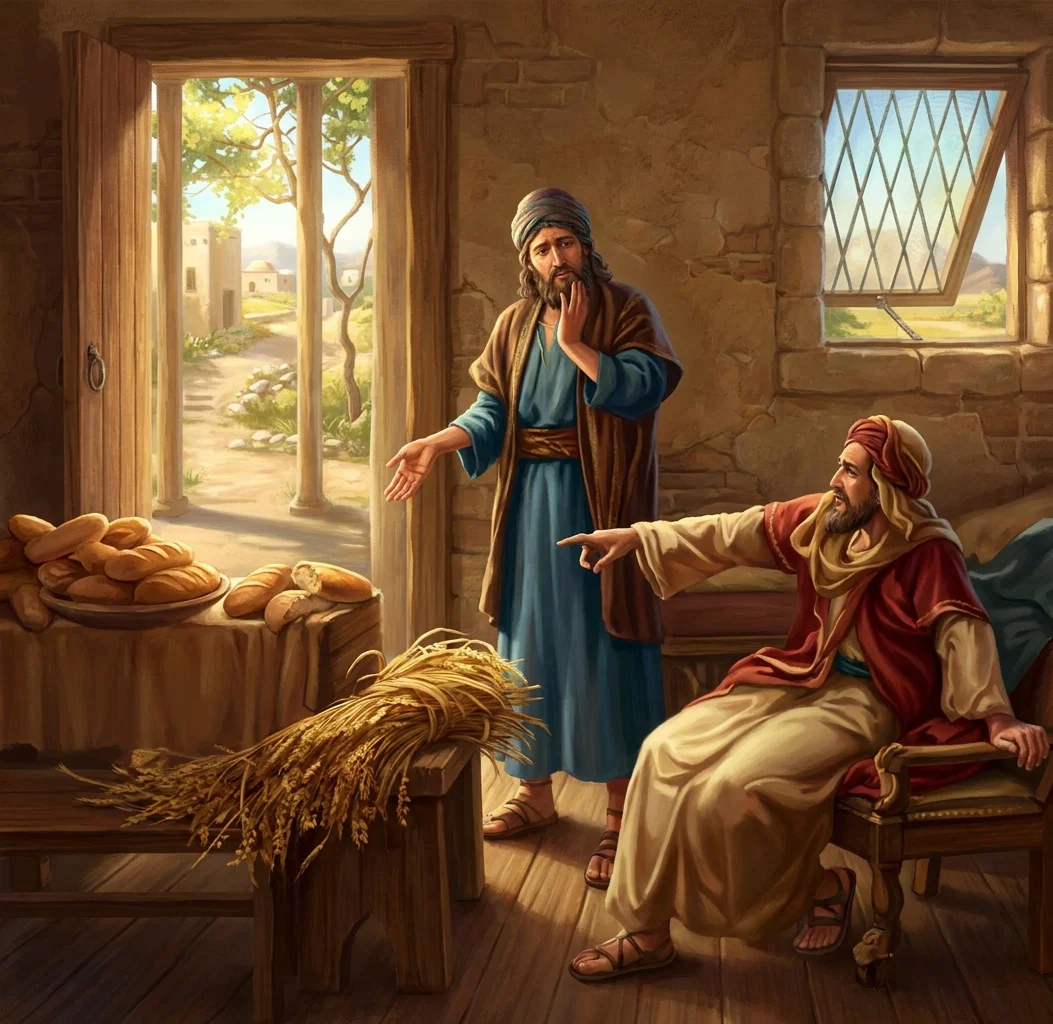
At Gilgal, also, while the dearth was still in the land, Elisha fed one hundred men with the present brought to him by “a man from Baal-shalisha,” “bread of the first-fruits, twenty loaves of barley, and full ears of corn in the husk thereof.” There were those with him who were sorely in need of food. When the offering came, he said to his servant, “Give unto the people, that they may eat.” And his servitor said, “What, should I set this before an hundred men?” He said again, “Give the people, that they may eat: for thus saith the Lord, They shall eat, and shall leave thereof.” So he set it before them, and they did eat, and left thereof, according to the word of the Lord.”
What condescension it was on the part of Christ, through His messenger, to work this miracle to satisfy hunger! Again and again since that time, though not always in so marked and perceptible a manner, has the Lord Jesus worked to supply human need. If we had clearer spiritual discernment, we would recognize more readily than we do God’s compassionate dealing with the children of men.
It is the grace of God on the small portion that makes it all-sufficient. God’s hand can multiply it a242hundredfold. From His resources He can spread a table in the wilderness. By the touch of His hand He can increase the scanty provision, and make it sufficient for all. It was His power that increased the loaves and corn in the hands of the sons of the prophets.
“GIVE UNTO THE PEOPLE, THAT THEY MAY EAT”
“What, should I set this before an hundred men?”
In the days of Christ’s earthly ministry, when He performed a similar miracle in feeding the multitudes, the same unbelief was manifested as was shown by those associated with the prophet of old. “What!”243said Elisha’s servant; “should I set this before an hundred men?” And when Jesus bade His disciples give the multitude to eat, they answered, “We have no more but five loaves and two fishes; except we should go and buy meat for all this people.” What is that among so many?
The lesson is for God’s children in every age. When the Lord gives a work to be done, let not men stop to inquire into the reasonableness of the command or the probable result of their efforts to obey. The supply in their hands may seem to fall short of the need to be filled; but in the hands of the Lord it will prove more than sufficient. The servitor “set it before them, and they did eat, and left thereof, according to the word of the Lord.”
A fuller sense of God’s relationship to those whom He has purchased with the gift of His Son, a greater faith in the onward progress of His cause in the earth,—this is the great need of the church to-day. Let none waste time in deploring the scantiness of their visible resources. The outward appearance may be unpromising; but energy and trust in God will develop resources. The gift brought to Him with thanksgiving and with prayer for His blessing, He will multiply as He multiplied the food given to the sons of the prophets and to the weary multitude.
NAAMAN AT THE HOUSE OF ELISHA
NAAMAN—20
“Now Naaman, captain of the host of the king of Syria, was a great man with his master, and honorable, because by him the Lord had given deliverance unto Syria: he was also a mighty man in valor, but he was a leper.”
Benhadad, king of Syria, had defeated the armies of Israel in the battle which resulted in the death of Ahab. Since that time, the Syrians had maintained against Israel a constant border warfare; and in one of their raids, they had carried away a little maid, who, in the land of her captivity, “waited on Naaman’s wife.” A slave, far from her home, this little maid was nevertheless one of God’s witnesses, unconsciously fulfilling the purpose for which God had chosen Israel as His people. As she ministered in that heathen home, her sympathies were aroused in behalf of her master; and, remembering the wonderful miracles of healing wrought through Elisha, she said245to her mistress, “Would God my lord were with the prophet that is in Samaria! for he would recover him of his leprosy.” She knew that the power of Heaven was with Elisha, and she believed that by this power Naaman could be healed.
The conduct of the captive maid, the way that she bore herself in that heathen home, is a strong witness to the power of early home training. There is no higher trust than that committed to fathers and mothers in the care and training of their children. Parents have to do with the very foundations of habit and character. By their example and teaching, the future of their children is largely decided.
Happy are the parents whose lives are a true reflection of the divine, so that the promises and commands of God awaken in the child gratitude and reverence; the parents whose tenderness and justice and long-suffering interpret to the child the love and justice and long-suffering of God; and who by teaching the child to love and trust and obey them, are teaching him to love and trust and obey his Father in heaven. Parents who impart to the child such a gift have endowed him with a treasure more precious than the wealth of all the ages,—a treasure as enduring as eternity.
We know not in what line our children may be called to serve. They may spend their lives within the circle of the home; they may engage in life’s common vocations, or go as teachers of the gospel to heathen lands; but all are alike called to be missionaries for God, ministers of mercy to the world. They are to obtain an education that will help them to stand by the side of Christ in unselfish service.
The parents of that Hebrew maid, as they taught her of God, did not know the destiny that would be hers. But they were faithful to their trust; and in the home of the captain of the Syrian host, their child bore witness to the God whom she had learned to honor.
Naaman heard of the words that the maid had spoken to her mistress; and obtaining permission from the king, he went forth to seek healing, taking with him “ten talents of silver, and six thousand pieces of gold, and ten changes of raiment.” He also carried a letter from the king of Syria to the king of Israel, in which was written the message, “Behold, I have . . . sent Naaman my servant to thee, that thou mayest recover him of his leprosy.” When the king of Israel read the letter, “he rent his clothes, and said, Am I God, to kill and to make alive, that this man doth send unto me to recover a man of his leprosy? wherefore consider, I pray you, and see how he seeketh a quarrel against me.”
Tidings of the matter reached Elisha, and he sent word to the king, saying: “Wherefore hast thou rent thy clothes? let him come now to me, and he shall know that there is a prophet in Israel.”
“So Naaman came with his horses and with his chariot, and stood at the door of the house of Elisha.” Through a messenger the prophet bade him, “Go and wash in Jordan seven times, and thy flesh shall come again to thee, and thou shalt be clean.”
Naaman had expected to see some wonderful manifestation of power from heaven. “I thought,” he said, “He will surely come out to me, and stand, and call on the name of the Lord his God, and strike his247hand over the place, and recover the leper.” When told to wash in the Jordan, his pride was touched, and in mortification and disappointment he exclaimed: “Are not Abana and Pharpar, rivers of Damascus, better than all the waters of Israel? may I not wash in them, and be clean?” “So he turned and went away in a rage.”
NAAMAN HEALED OF THE LEPROSY
“His flesh came again like unto the flesh of a little child, and he was clean.”
The proud spirit of Naaman rebelled against following the course outlined by Elisha. The rivers mentioned by the Syrian captain were beautified by surrounding groves, and many flocked to the banks of these pleasant streams to worship their idol gods. It would have cost Naaman no great humiliation of soul to descend into one of those streams. But it was only through following the specific directions of the prophet, that he could find healing. Willing obedience alone would bring the desired result.
Naaman’s servants entreated him to carry out Elisha’s directions. “If the prophet had bid thee do some great thing,” they urged, “wouldest thou not have done it? how much rather then, when he saith to thee, Wash, and be clean?” The faith of Naaman was being tested, while pride struggled for the mastery. But faith conquered, and the haughty Syrian yielded his pride of heart, and bowed in submission to the revealed will of Jehovah. Seven times he dipped himself in Jordan, “according to the saying of the man of God.” And his faith was honored; “his flesh came again like unto the flesh of a little child, and he was clean.”
Gratefully “he returned to the man of God, he and all his company,” with the acknowledgment, “Behold, now I know that there is no God in all the earth,250but in Israel.”
In accordance with the custom of the times, Naaman now asked Elisha to accept a costly present. But the prophet refused. It was not for him to take payment for a blessing that God had in mercy bestowed. “As the Lord liveth,” he said, “I will receive none.” The Syrian “urged him to take it; but he refused.
“And Naaman said, Shall there not then, I pray thee, be given to thy servant two mules’ burden of earth? for thy servant will henceforth offer neither burnt offering nor sacrifice unto other gods, but unto the Lord. In this thing the Lord pardon thy servant, that when my master goeth into the house of Rimmon to worship there, and he leaneth on my hand, and I bow myself in the house of Rimmon: when I bow down myself in the house of Rimmon, the Lord pardon thy servant in this thing.”
“And he said unto him, Go in peace. So he departed from him a little way.”
Gehazi, Elisha’s servant, had had opportunity, during the years, to develop the spirit of self-denial characterizing his master’s life-work. It had been his privilege to become a noble standard-bearer in the army of the Lord. The best gifts of Heaven had long been within his reach; yet, turning from these, he had coveted instead the base alloy of worldly wealth. And now the hidden longings of his avaricious spirit led him to yield to an overmastering temptation. “Behold,” he reasoned within himself, “my master hath spared Naaman this Syrian, in not receiving at his hands that which he brought: but . . . I will run251after him, and take somewhat of him.” And thus it came about that in secrecy “Gehazi followed after Naaman.”
“When Naaman saw him running after him, he lighted down from the chariot to meet him, and said, Is all well? And he said, All is well.” Then Gehazi uttered a deliberate lie. “My master,” he said, “hath sent me, saying, Behold, even now there be come to me from Mount Ephraim two young men of the sons of the prophets: give them, I pray thee, a talent of silver, and two changes of garments.” To the request Naaman gladly acceded, pressing upon Gehazi two talents of silver instead of one, “with two changes of garments,” and commissioning servants to bear the treasure back.
As Gehazi neared Elisha’s home, he dismissed the servants, and placed the silver and the garments in hiding. This accomplished, “he went in, and stood before his master;” and, to shield himself from censure, he uttered a second lie. In response to the inquiry of the prophet, “Whence comest thou?” Gehazi answered, “Thy servant went no whither.”
Then came the stern denunciation, showing that Elisha knew all. “Went not mine heart with thee,” he asked, “when the man turned again from his chariot to meet thee? Is it a time to receive money, and to receive garments, and oliveyards, and vineyards, and sheep, and oxen, and menservants, and maidservants? The leprosy therefore of Naaman shall cleave unto thee, and unto thy seed forever.” Swift was the retribution that overtook the guilty man. He went out from Elisha’s presence “a leper as white as snow.”
Solemn are the lessons taught by this experience of one to whom had been given high and holy privileges. The course of Gehazi was such as to place a stumblingblock in the pathway of Naaman, upon whose mind had broken a wonderful light, and who was favorably disposed toward the service of the living God. For the deception practiced by Gehazi there could be pleaded no excuse. To the day of his death he remained a leper, cursed of God, and shunned by his fellow men.
“A false witness shall not be unpunished, and he that speaketh lies shall not escape.” Men may think to hide their evil deeds from human eyes; but they cannot deceive God. “All things are naked and opened unto the eyes of Him with whom we have to do.” Gehazi thought to deceive Elisha, but God revealed to His prophet the words that Gehazi had spoken to Naaman, and every detail of the scene between the two men.
Truth is of God; deception in all its myriad forms is of Satan; and whoever in any way departs from the straight line of truth, is betraying himself into the power of the wicked one. Those who have learned of Christ will “have no fellowship with the unfruitful works of darkness.” In speech, as in life, they will be simple, straightforward, and true; for they are preparing for the fellowship of those holy ones in whose mouth is found no guile.
Centuries after Naaman returned to his Syrian home, healed in body and converted in spirit, his wonderful faith was referred to and commended by the Saviour as an object lesson for all who claim to253serve God. “Many lepers were in Israel in the time of Eliseus the prophet,” the Saviour declared; “and none of them was cleansed, saving Naaman the Syrian.” God passed over the many lepers in Israel, because their unbelief closed the door of good to them. A heathen nobleman who had been true to his convictions of right, and who felt his need of help, was in the sight of God more worthy of His blessing than were the afflicted in Israel, who had slighted and despised their God-given privileges. God works for those who appreciate His favors and respond to the light given them from heaven.
To-day in every land there are those who are honest in heart, and upon these the light of heaven is shining. If they continue faithful in following that which they understand to be duty, they will be given increased light, until, like Naaman of old, they will be constrained to acknowledge that “there is no God in all the earth,” save the living God, the Creator.
To every sincere soul “that walketh in darkness, and hath no light,” is given the invitation, “Let him trust in the name of the Lord, and stay upon his God.” “For since the beginning of the world men have not heard, nor perceived by the ear, neither hath the eye seen, O God, beside Thee, what He hath prepared for him that waiteth for Him. Thou meetest him that rejoiceth and worketh righteousness, those that remember Thee in Thy ways.”