The long reign of Uzziah in the land of Judah and Benjamin was characterized by a prosperity greater than that of any other ruler since the death of Solomon, nearly two centuries before. For many years the king ruled with discretion. Under the blessing of Heaven, his armies regained some of the territory that had been lost in former years. Cities were rebuilt and fortified, and the position of the nation among the surrounding peoples was greatly strengthened. Commerce revived, and the riches of the nations flowed into Jerusalem. Uzziah’s name “spread far abroad; for he was marvelously helped, till he was strong.”
This outward prosperity, however, was not accompanied by a corresponding revival of spiritual power. The temple services were continued as in former years, and multitudes assembled to worship the living God; but pride and formality gradually304took the place of humility and sincerity. Of Uzziah himself it is written: “When he was strong, his heart was lifted up to his destruction: for he transgressed against the Lord his God.”
The sin that resulted so disastrously to Uzziah was one of presumption. In violation of a plain command of Jehovah, that none but the descendants of Aaron should officiate as priests, the king entered the sanctuary “to burn incense upon the altar.” Azariah the high priest and his associates remonstrated, and pleaded with him to turn from his purpose. “Thou hast trespassed,” they urged; “neither shall it be for thine honor.”
Uzziah was filled with wrath, that he, the king, should be thus rebuked. But he was not permitted to profane the sanctuary against the united protest of those in authority. While standing there, in wrathful rebellion, he was suddenly smitten with a divine judgment. Leprosy appeared on his forehead. In dismay he fled, never again to enter the temple courts. Unto the day of his death, some years later, Uzziah remained a leper—a living example of the folly of departing from a plain “Thus saith the Lord.” Neither his exalted position nor his long life of service could be pleaded as an excuse for the presumptuous sin by which he marred the closing years of his reign, and brought upon himself the judgment of Heaven.
God is no respecter of persons. “The soul that doeth aught presumptuously, whether he be born in the land, or a stranger, the same reproacheth the Lord; and that soul shall be cut off from among his people.”
The judgment that befell Uzziah seemed to have a restraining influence on his son. Jotham bore heavy responsibilities during the later years of his father’s reign, and succeeded to the throne after Uzziah’s death. Of Jotham it is written: “He did that which was right in the sight of the Lord: he did according to all that his father Uzziah had done. Howbeit the high places were not removed: the people sacrificed and burned incense still in the high places.”
The reign of Uzziah was drawing to a close, and Jotham was already bearing many of the burdens of state, when Isaiah, of the royal line, was called, while yet a young man, to the prophetic mission. The times in which Isaiah was to labor were fraught with peculiar peril to the people of God. The prophet was to witness the invasion of Judah by the combined armies of northern Israel and of Syria; he was to behold the Assyrian hosts encamped before the chief cities of the kingdom. During his lifetime, Samaria was to fall, and the ten tribes of Israel were to be scattered among the nations. Judah was again and again to be invaded by the Assyrian armies, and Jerusalem was to suffer a siege that would have resulted in her downfall had not God miraculously interposed. Already grave perils were threatening the peace of the southern kingdom. The divine protection was being removed, and the Assyrian forces were about to overspread the land of Judah.
But the dangers from without, overwhelming though they seemed, were not so serious as the dangers from within. It was the perversity of his people that brought to the Lord’s servant the greatest perplexity and the deepest depression. By their apostasy306and rebellion, those who should have been standing as light-bearers among the nations were inviting the judgments of God. Many of the evils which were hastening the swift destruction of the northern kingdom, and which had recently been denounced in unmistakable terms by Hosea and Amos, were fast corrupting the kingdom of Judah.
The outlook was particularly discouraging as regards the social conditions of the people. In their desire for gain, men were adding house to house, and field to field. Justice was perverted; and no pity was shown the poor. Of these evils God declared: “The spoil of the poor is in your houses.” “Ye beat My people to pieces, and grind the faces of the poor.” Even the magistrates, whose duty it was to protect the helpless, turned a deaf ear to the cries of the poor and needy, the widows and the fatherless.
With oppression and wealth came pride and love of display, gross drunkenness, and a spirit of revelry. And in Isaiah’s day idolatry itself no longer provoked surprise. Iniquitous practices had become so prevalent among all classes, that the few who remained true to God were often tempted to lose heart, and to give way to discouragement and despair. It seemed as if God’s purpose for Israel were about to fail, and that the rebellious nation was to suffer a fate similar to that of Sodom and Gomorrah.
In the face of such conditions, it is not surprising that when, during the last year of Uzziah’s reign, Isaiah was called to bear to Judah God’s messages of warning and reproof, he shrank from the responsibility.307He well knew that he would encounter obstinate resistance. As he realized his own inability to meet the situation, and thought of the stubbornness and unbelief of the people for whom he was to labor, his task seemed hopeless. Should he in despair relinquish his mission, and leave Judah undisturbed to their idolatry? Were the gods of Nineveh to rule the earth, in defiance of the God of heaven?
Such thoughts as these were crowding through Isaiah’s mind as he stood under the portico of the temple. Suddenly the gate and the inner veil of the temple seemed to be uplifted or withdrawn, and he was permitted to gaze within, upon the holy of holies, where even the prophet’s feet might not enter. There rose up before him a vision of Jehovah sitting upon a throne high and lifted up, while the train of His glory filled the temple. On each side of the throne hovered the seraphim, their faces veiled in adoration, as they ministered before their Maker, and united in the solemn invocation, “Holy, holy, holy, is the Lord of hosts: the whole earth is full of His glory,” until post and pillar and cedar gate seemed shaken with the sound, and the house was filled with their tribute of praise.
As Isaiah beheld this revelation of the glory and majesty of his Lord, he was overwhelmed with a sense of the purity and holiness of God. How sharp the contrast between the matchless perfection of his Creator, and the sinful course of those who, with himself, had long been numbered among the chosen people of Israel and Judah! “Woe is me!” he cried; “for I am undone; because I am a man of unclean lips, and I dwell in the midst of a people of unclean lips: for308mine eyes have seen the King, the Lord of hosts.” Standing, as it were, in the full light of the divine presence within the inner sanctuary, he realized that if left to his own imperfection and inefficiency, he would be utterly unable to accomplish the mission to which he had been called. But a seraph was sent to relieve him of his distress, and to fit him for his great mission. A living coal from the altar was laid upon his lips, with the words, “Lo, this hath touched thy lips; and thine iniquity is taken away, and thy sin purged.” Then the voice of God was heard saying, “Whom shall I send, and who will go for us?” and Isaiah responded, “Here am I; send me.”
The heavenly visitant bade the waiting messenger, “Go, and tell this people,
“Hear ye indeed, but understand not; And see ye indeed, but perceive not. Make the heart of this people fat, And make their ears heavy, and shut their eyes; Lest they see with their eyes, and hear with their ears, And understand with their heart, And convert, and be healed.”
The prophet’s duty was plain; he was to lift his voice in protest against the prevailing evils. But he dreaded to undertake the work without some assurance of hope. “Lord, how long?” he inquired. Are none of Thy chosen people ever to understand, and repent, and be healed?
His burden of soul in behalf of erring Judah was not to be borne in vain. His mission was not to be309wholly fruitless. Yet the evils that had been multiplying for many generations could not be removed in his day. Throughout his lifetime he must be a patient, courageous teacher,—a prophet of hope as well as of doom. The divine purpose finally accomplished, the full fruitage of his efforts, and of the labors of all God’s faithful messengers, would appear. A remnant should be saved. That this might be brought about, the messages of warning and entreaty were to be delivered to the rebellious nation, the Lord declared,
“Until the cities be wasted without inhabitant,
And the houses without man,
And the land be utterly desolate,
And the Lord have removed men far away,
And there be a great forsaking in the midst
of the land.”
The heavy judgments that were to befall the impenitent,—war, exile, oppression, the loss of power and prestige among the nations,—all these were to come, in order that those who would recognize in them the hand of an offended God, might be led to repent. The ten tribes of the northern kingdom were soon to be scattered among the nations, and their cities left desolate; the destroying armies of hostile nations were to sweep over their land again and again; even Jerusalem was finally to fall, and Judah was to be carried away captive; yet the promised land was not to remain wholly forsaken forever. The assurance of the heavenly visitant to Isaiah was:
“In it shall be a tenth,
And it shall return, and shall be eaten:
Isa. 6: 11, 12.310
As a teil tree, and as an oak,
Whose substance is in them, when they cast their leaves:
So the holy seed shall be the substance thereof.”
This assurance of the final fulfillment of God’s purpose brought courage to the heart of Isaiah. What though earthly powers array themselves against Judah? What though the Lord’s messenger meet with opposition and resistance? Isaiah had seen the King, the Lord of hosts; he had heard the song of the seraphim, “The whole earth is full of His glory;” he had the promise that the messages of Jehovah to backsliding Judah would be accompanied by the convicting power of the Holy Spirit; and the prophet was nerved for the work before him. Throughout his long and arduous mission he carried with him the memory of this vision. For sixty years or more he stood before the children of Judah as a prophet of hope, waxing bolder and still bolder in his predictions of the future triumph of the church.
“Who Hath Created These Things?”
“BEHOLD YOUR GOD!”—26
IN Isaiah’s day the spiritual understanding of mankind was dark through misapprehension of God. Long had Satan sought to lead men to look upon their Creator as the author of sin, and suffering, and death. Those whom he had thus deceived, imagined that God was hard and exacting. They regarded Him as watching to denounce and condemn, unwilling to receive the sinner so long as there was a legal excuse for not helping him. The law of love by which heaven is ruled, had been misrepresented by the arch-deceiver as a restriction upon men’s happiness, a burdensome yoke from which they should be glad to escape. He declared that its precepts could not be obeyed, and that the penalties of transgression were bestowed arbitrarily.
In losing sight of the true character of Jehovah, the Israelites were without excuse. Often had God revealed Himself to them as one “full of compassion, and gracious, long-suffering, and plenteous in mercy312and truth.” “When Israel was a child,” He testified, “then I loved him, and called My son out of Egypt.”
Tenderly had the Lord dealt with Israel in their deliverance from Egyptian bondage and in their journey to the promised land. “In all their affliction He was afflicted, and the angel of His presence saved them; in His love and in His pity He redeemed them; and He bare them, and carried them all the days of old.”
“My presence shall go with thee,” was the promise given during the journey through the wilderness. This assurance was accompanied by a marvelous revelation of Jehovah’s character, which enabled Moses to proclaim to all Israel the goodness of God, and to instruct them fully concerning the attributes of their invisible King. “The Lord passed by before him, and proclaimed, The Lord, The Lord God, merciful and gracious, long-suffering, and abundant in goodness and truth, keeping mercy for thousands, forgiving iniquity and transgression and sin, and that will by no means clear the guilty.”
It was upon his knowledge of the long-sufferance of Jehovah and of His infinite love and mercy, that Moses based his wonderful plea for the life of Israel when, on the borders of the promised land, they refused to advance in obedience to the command of God. At the height of their rebellion, the Lord had declared, “I will smite them with the pestilence, and disinherit them;” and He had proposed to make of the descendants of Moses “a greater nation and mightier than313they.” But the prophet pleaded the marvelous providences and promises of God in behalf of the chosen nation. And then, as the strongest of all pleas, he urged the love of God for fallen man.
Graciously the Lord responded, “I have pardoned according to thy word.” And then He imparted to Moses, in the form of a prophecy, a knowledge of His purpose concerning the final triumph of Israel. “As truly as I live,” He declared, “all the earth shall be filled with the glory of the Lord.” God’s glory, His character, His merciful kindness and tender love,—that which Moses had pleaded in behalf of Israel,—was to be revealed to all mankind. And this promise of Jehovah was made doubly sure; it was confirmed by an oath. As surely as God lives and reigns, His glory should be declared “among the heathen, His wonders among all people.”
It was concerning the future fulfillment of this prophecy that Isaiah had heard the shining seraphim singing before the throne, “The whole earth is full of His glory.” The prophet, confident of the certainty of these words, himself afterward boldly declared of those who were bowing down to images of wood and stone, “They shall see the glory of the Lord, and the excellency of our God.”
To-day this prophecy is meeting rapid fulfillment. The missionary activities of the church of God on earth are bearing rich fruitage, and soon the gospel message will have been proclaimed to all nations. “To the praise of the glory of His grace,” men and women from every kindred, tongue, and people are314being made “accepted in the Beloved,” “that in the ages to come He might show the exceeding riches of His grace in His kindness toward us through Christ Jesus.” “Blessed be the Lord God, the God of Israel, who only doeth wondrous things. And blessed be His glorious name forever: and let the whole earth be filled with His glory.”
In the vision that came to Isaiah in the temple court, he was given a clear view of the character of the God of Israel. “The high and lofty One that inhabiteth eternity, whose name is Holy,” had appeared before him in great majesty; yet the prophet was made to understand the compassionate nature of his Lord. He who dwells “in the high and holy place” dwells “with him also that is of a contrite and humble spirit, to revive the spirit of the humble, and to revive the heart of the contrite ones.” The angel commissioned to touch Isaiah’s lips had brought to him the message, “Thine iniquity is taken away, and thy sin purged.”
In beholding his God, the prophet, like Saul of Tarsus at the gate of Damascus, had not only been given a view of his own unworthiness; there had come to his humbled heart the assurance of forgiveness, full and free; and he had arisen a changed man. He had seen his Lord. He had caught a glimpse of the loveliness of the divine character. He could testify of the transformation wrought through beholding Infinite Love. Henceforth he was inspired with longing desire to see erring Israel set free from the burden and penalty of sin. “Why should ye be stricken any more?” the prophet inquired. “Come315now, and let us reason together, saith the Lord: though your sins be as scarlet, they shall be as white as snow; though they be red like crimson, they shall be as wool.” “Wash you, make you clean; put away the evil of your doings from before Mine eyes; cease to do evil; learn to do well.”
The God whom they had been claiming to serve, but whose character they had misunderstood, was set before them as the great Healer of spiritual disease. What though the whole head was sick and the whole heart faint? what though from the sole of the foot even unto the crown of the head there was no soundness, but wounds, and bruises, and putrefying sores? He who had been walking frowardly in the way of his heart might find healing by turning to the Lord. “I have seen his ways,” the Lord declared, “and will heal him: I will lead him also, and restore comforts unto him. . . . Peace, peace to him that is far off, and to him that is near, saith the Lord; and I will heal him.”
The prophet exalted God as Creator of all. His message to the cities of Judah was, “Behold your God!” “Thus saith God the Lord, He that created the heavens, and stretched them out; He that spread forth the earth, and that which cometh out of it;” “I am the Lord that maketh all things;” “I form the light, and create darkness;” “I have made the earth, and created man upon it: I, even My hands, have stretched out the heavens, and all their host have I commanded.” “To whom then will ye liken Me, or shall I be equal? saith the Holy One. Lift up316your eyes on high, and behold who hath created these things, that bringeth out their host by number: He calleth them all by names by the greatness of His might, for that He is strong in power; not one falleth.”
To those who feared they would not be received if they should return to God, the prophet declared: “Why sayest thou, O Jacob, and speakest, O Israel, My way is hid from the Lord, and my judgment is passed over from my God? Hast thou not known? hast thou not heard, that the everlasting God, the Lord, the Creator of the ends of the earth, fainteth not, neither is weary? there is no searching of His understanding. He giveth power to the faint; and to them that have no might He increaseth strength. Even the youths shall faint and be weary, and the young men shall utterly fall: but they that wait upon the Lord shall renew their strength; they shall mount up with wings as eagles; they shall run, and not be weary; and they shall walk, and not faint.”
The heart of Infinite Love yearns after those who feel powerless to free themselves from the snares of Satan; and He graciously offers to strengthen them to live for Him. “Fear thou not,” He bids them; “for I am with thee: be not dismayed; for I am thy God: I will strengthen thee; yea, I will help thee; yea, I will uphold thee with the right hand of My righteousness.” “I the Lord thy God will hold thy right hand, saying unto thee, Fear not; I will help thee. Fear not, thou worm Jacob, and ye men of Israel; I will help thee, saith the Lord, and thy Redeemer, the Holy One of Israel.”
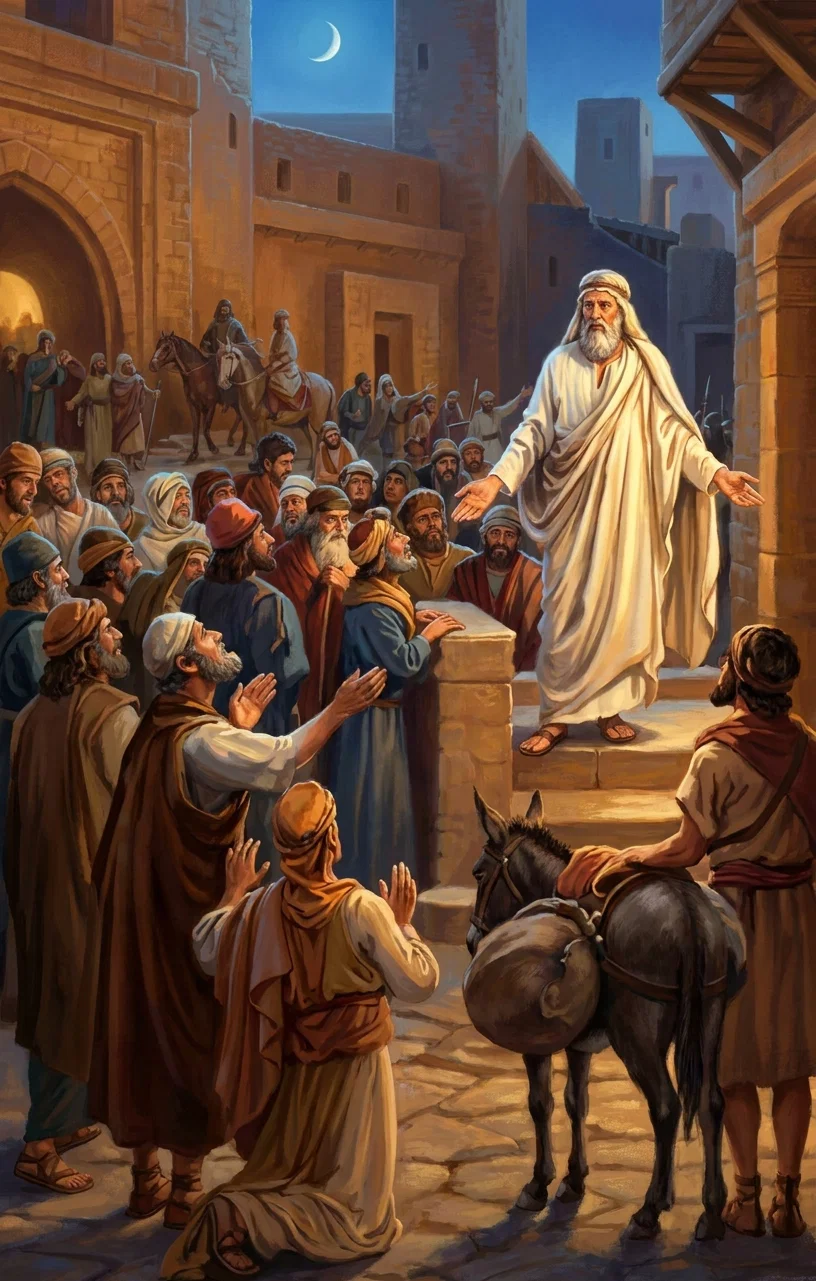
ISAIAH PREACHING IN THE CITIES OF JUDAH
“Return unto the Lord, and He will abundantly pardon.” “Fear not, thou worm Jacob, and ye men of Israel; I will help thee, saith the Lord,”
The inhabitants of Judah were all undeserving, yet God would not give them up. By them His name was to be exalted among the heathen. Many who were wholly unacquainted with His attributes, were yet to behold the glory of the divine character. It was for the purpose of making plain His merciful designs, that He kept sending His servants the prophets with the message, “Turn ye again now every one from his evil way.” “For My name’s sake,” He declared through Isaiah, “will I defer Mine anger, and for My praise will I refrain for thee, that I cut thee not off.” “For Mine own sake, even for Mine own sake, will I do it: for how should My name be polluted? and I will not give My glory unto another.”
The call to repentance was sounded with unmistakable clearness, and all were invited to return. “Seek ye the Lord while He may be found,” the prophet pleaded; “call ye upon Him while He is near: let the wicked forsake his way, and the unrighteous man his thoughts: and let him return unto the Lord, and He will have mercy upon him; and to our God, for He will abundantly pardon.”
Have you, reader, chosen your own way? Have you wandered far from God? Have you sought to feast upon the fruits of transgression, only to find them turn to ashes upon your lips? And now, your life-plans thwarted, and your hopes dead, do you sit alone and desolate? That voice which has long been speaking to your heart, but to which you would not listen, comes to you distinct and clear, “Arise ye, and depart; for this is not your rest: because it is polluted, it shall destroy you, even with a sore destruction.” 320Return to your Father’s house. He invites you, saying, “Return unto Me; for I have redeemed thee.” “Come unto Me: hear, and your soul shall live; and I will make an everlasting covenant with you, even the sure mercies of David.”
Do not listen to the enemy’s suggestion to stay away from Christ until you have made yourself better; until you are good enough to come to God. If you wait until then, you will never come. When Satan points to your filthy garments, repeat the promise of the Saviour, “Him that cometh to Me I will in no wise cast out.” Tell the enemy that the blood of Jesus Christ cleanses from all sin. Make the prayer of David your own: “Purge me with hyssop, and I shall be clean: wash me, and I shall be whiter than snow.”
The exhortations of the prophet to Judah to behold the living God, and to accept His gracious offers, were not in vain. There were some who gave earnest heed, and who turned from their idols to the worship of Jehovah. They learned to see in their Maker love, and mercy, and tender compassion. And in the dark days that were to come in the history of Judah, when only a remnant were to be left in the land, the prophet’s words were to continue bearing fruit in decided reformation. “At that day,” declared Isaiah, “shall a man look to his Maker, and his eyes shall have respect to the Holy One of Israel. And he shall not look to the altars, the work of his hands, neither shall respect that which his fingers have made, either the groves, or the images.”
Many were to behold the One altogether lovely, the chiefest among ten thousand. “Thine eyes shall see the King in His beauty,” was the gracious promise made them. Their sins were to be forgiven, and they were to make their boast in God alone. In that glad day of redemption from idolatry they would exclaim: “The glorious Lord will be unto us a place of broad rivers and streams. . . . The Lord is our judge, the Lord is our lawgiver, the Lord is our king; He will save us.”
The messages borne by Isaiah to those who chose to turn from their evil ways, were full of comfort and encouragement. Hear the word of the Lord through His prophet:
“Remember these, O Jacob and Israel; For thou art My servant: I have formed thee; thou art My servant: O Israel, thou shalt not be forgotten of Me. I have blotted out, as a thick cloud, thy transgressions, And, as a cloud, thy sins: Return unto Me; for I have redeemed thee.”
“In that day thou shalt say,
O Lord, I will praise Thee:
Though Thou wast angry with me,
Thine anger is turned away, and Thou comfortedst me.
‘Behold, God is my salvation;
I will trust, and not be afraid:
For the Lord Jehovah is my strength and my song;
He also is become my salvation. . . .
‘Sing unto the Lord; for He hath done excellent things: This is known in all the earth. Cry out and shout, thou inhabitant of Zion: For great is the Holy One of Israel in the midst of thee.”