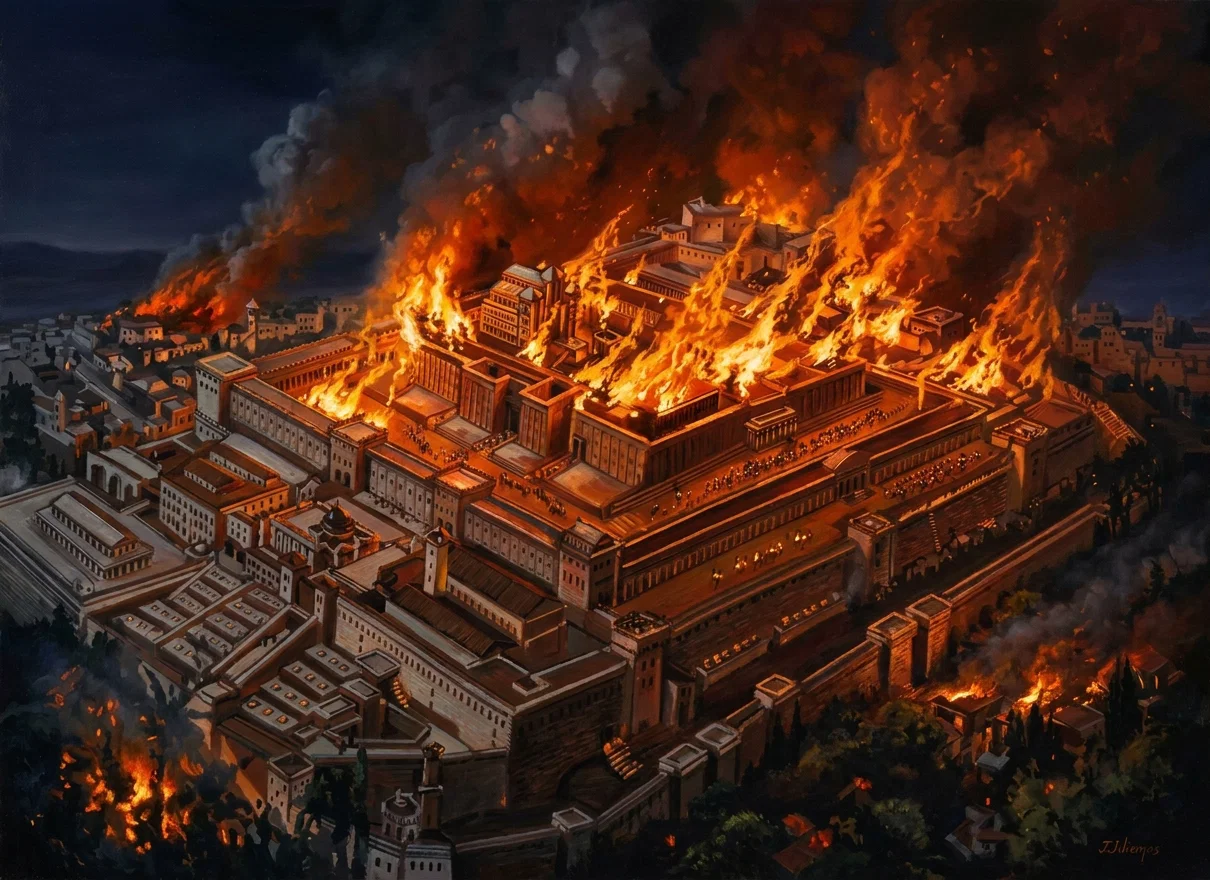
In the ninth year of Zedekiah’s reign, “Nebuchadnezzar king of Babylon came, he, and all his host, against Jerusalem,” to besiege the city. The outlook for Judah was hopeless. “Behold, I am against thee,” the Lord Himself declared through Ezekiel. “I the Lord have drawn forth My sword out of his sheath: it shall not return any more. . . . Every heart shall melt, and all hands shall be feeble, and every spirit shall faint, and all knees shall be weak as water.” “I will pour out Mine indignation upon thee, I will blow against thee in the fire of My wrath, and deliver thee into the hand of brutish men, and skillful to destroy.”
The Egyptians endeavored to come to the rescue of the beleaguered city; and the Chaldeans, in order to keep them back, abandoned for a time their siege of the Judean capital. Hope sprang up in the heart of Zedekiah, and he sent a messenger to Jeremiah, asking him453to pray to God in behalf of the Hebrew nation.
The prophet’s fearful answer was that the Chaldeans would return and destroy the city. The fiat had gone forth; no longer could the impenitent nation avert the divine judgments. “Deceive not yourselves,” the Lord warned His people. “The Chaldeans . . . shall not depart. For though ye had smitten the whole army of the Chaldeans that fight against you, and there remained but wounded men among them, yet should they rise up every man in his tent, and burn this city with fire.” The remnant of Judah were to go into captivity, to learn through adversity the lessons they had refused to learn under circumstances more favorable. From this decree of the holy Watcher there could be no appeal.
Among the righteous still in Jerusalem, to whom had been made plain the divine purpose, were some who determined to place beyond the reach of ruthless hands the sacred ark containing the tables of stone on which had been traced the precepts of the Decalogue. This they did. With mourning and sadness they secreted the ark in a cave, where it was to be hidden from the people of Israel and Judah because of their sins, and was to be no more restored to them. That sacred ark is yet hidden. It has never been disturbed since it was secreted.
For many years Jeremiah had stood before the people as a faithful witness for God; and now, as the fated city was about to pass into the hands of the heathen, he considered his work done, and attempted to leave, but was prevented by a son of one of the false prophets, who reported that Jeremiah was about454to join the Babylonians, to whom he had repeatedly urged the men of Judah to submit. The prophet denied the lying charge, but nevertheless “the princes were wroth with Jeremiah, and smote him, and put him in prison.”
The hopes that had sprung up in the hearts of princes and people when the armies of Nebuchadnezzar turned south to meet the Egyptians, were soon dashed to the ground. The word of the Lord had been, “Behold, I am against thee, Pharaoh king of Egypt.” The might of Egypt was but a broken reed. “All the inhabitants of Egypt,” Inspiration had declared, “shall know that I am the Lord, because they have been a staff of reed to the house of Israel.” “I will strengthen the arms of the king of Babylon, and the arms of Pharaoh shall fall down; and they shall know that I am the Lord, when I shall put My sword into the hand of the king of Babylon, and he shall stretch it out upon the land of Egypt.”
While the princes of Judah were still vainly looking toward Egypt for help, King Zedekiah with anxious foreboding was thinking of the prophet of God that had been thrust into prison. After many days the king sent for him, and asked him secretly, “Is there any word from the Lord?” Jeremiah answered, “There is: for, said He, thou shalt be delivered into the hand of the king of Babylon.
“Moreover Jeremiah said unto King Zedekiah, What have I offended against thee, or against thy servants, or against this people, that ye have put me in prison? Where are now your prophets which prophesied unto you, saying, The king of Babylon455shall not come against you, nor against this land? Therefore hear now, I pray thee, O my lord the king: let my supplication, I pray thee, be accepted before thee; that thou cause me not to return to the house of Jonathan the scribe, lest I die there.”
At this Zedekiah commanded that they “commit Jeremiah into the court of the prison, and that they should give him daily a piece of bread out of the bakers’ street, until all the bread in the city were spent. Thus Jeremiah remained in the court of the prison.”
The king dared not openly manifest any faith in Jeremiah. Though his fear drove him to seek information of him privately, yet he was too weak to brave the disapprobation of his princes and of the people by submitting to the will of God as declared by the prophet.
From the court of the prison Jeremiah continued to advise submission to the Babylonian rule. To offer resistance would be to invite sure death. The message of the Lord to Judah was: “He that remaineth in this city shall die by the sword, by the famine, and by the pestilence: but he that goeth forth to the Chaldeans shall live; for he shall have his life for a prey, and shall live.” Plain and positive were the words spoken. In the name of the Lord the prophet boldly declared, “This city shall surely be given into the hand of the king of Babylon’s army, which shall take it.”
At last the princes, enraged over the repeated counsels of Jeremiah, which were contrary to their set policy of resistance, made a vigorous protest before456the king, urging that the prophet was an enemy to the nation, and that his words had weakened the hands of the people, and brought misfortune upon them; therefore he should be put to death.
The cowardly king knew that the charges were false; but in order to propitiate those who occupied high and influential positions in the nation, he feigned to believe their falsehoods, and gave Jeremiah into their hands to do with him as they pleased. The prophet was cast “into the dungeon of Malchiah the son of Hammelech, that was in the court of the prison: and they let down Jeremiah with cords. And in the dungeon there was no water, but mire: so Jeremiah sunk in the mire.” But God raised up friends for him, who besought the king in his behalf, and had him again removed to the court of the prison.
Once more the king sent privately for Jeremiah, and bade him faithfully relate the purpose of God toward Jerusalem. In response, Jeremiah inquired, “If I declare it unto thee, wilt thou not surely put me to death? and if I give thee counsel, wilt thou not hearken unto me?” The king entered into a secret compact with the prophet. “As the Lord liveth, that made us this soul,” Zedekiah promised, “I will not put thee to death, neither will I give thee into the hand of these men that seek thy life.”
There was still opportunity for the king to reveal a willingness to heed the warnings of Jehovah, and thus to temper with mercy the judgments even now falling on city and nation. “If thou wilt assuredly go forth unto the king of Babylon’s princes,” was the message given the king, “then thy soul shall live, and457this city shall not be burned with fire; and thou shalt live, and thine house: but if thou wilt not go forth to the king of Babylon’s princes, then shall this city be given into the hand of the Chaldeans, and they shall burn it with fire, and thou shalt not escape out of their hand.”
“I am afraid of the Jews that are fallen to the Chaldeans,” the king replied, “lest they deliver me into their hand, and they mock me.” But the prophet promised, “They shall not deliver thee.” And he added the earnest entreaty, “Obey, I beseech thee, the voice of the Lord, which I speak unto thee: so it shall be well unto thee, and thy soul shall live.”
Thus even to the last hour, God made plain His willingness to show mercy to those who should choose to submit to His just requirements. Had the king chosen to obey, the lives of the people might have been spared, and the city saved from conflagration; but he thought he had gone too far to retrace his steps. He was afraid of the Jews, afraid of ridicule, afraid for his life. After years of rebellion against God, Zedekiah thought it too humiliating to say to his people, “I accept the word of the Lord, as spoken through the prophet Jeremiah; I dare not venture to war against the enemy in the face of all these warnings.”
With tears Jeremiah entreated Zedekiah to save himself and his people. With anguish of spirit he assured him that unless he should heed the counsel of God, he could not escape with his life, and all his possessions would fall to the Babylonians. But the king had started on the wrong course, and he would not retrace his steps. He decided to follow the counsel458of the false prophets, and of the men whom he really despised, and who ridiculed his weakness in yielding so readily to their wishes. He sacrificed the noble freedom of his manhood, and became a cringing slave to public opinion. With no fixed purpose to do evil, he was also without resolution to stand boldly for the right. Convicted though he was of the value of the counsel given by Jeremiah, he had not the moral stamina to obey; and as a consequence he advanced steadily in the wrong direction.
The king was even too weak to be willing that his courtiers and people should know that he had held a conference with Jeremiah, so fully had the fear of man taken possession of his soul. If Zedekiah had stood up bravely and declared that he believed the words of the prophet, already half fulfilled, what desolation might have been averted! He should have said: “I will obey the Lord, and save the city from utter ruin. I dare not disregard the commands of God because of the fear or favor of man. I love the truth, I hate sin, and I will follow the counsel of the Mighty One of Israel.” Then the people would have respected his courageous spirit, and those who were wavering between faith and unbelief would have taken a firm stand for the right. The very fearlessness and justice of this course would have inspired his subjects with admiration and loyalty. He would have had ample support; and Judah would have been spared the untold woe of carnage and famine and fire.
The weakness of Zedekiah was a sin for which he paid a fearful penalty. The enemy swept down like a resistless avalanche, and devastated the city. The Hebrew armies were beaten back in confusion. The459nation was conquered. Zedekiah was taken prisoner, and his sons were slain before his eyes. The king was led away from Jerusalem a captive, his eyes were put out, and after arriving in Babylon he perished miserably. The beautiful temple that for more than four centuries had crowned the summit of Mount Zion, was not spared by the Chaldeans. “They burnt the house of God, and brake down the wall of Jerusalem, and burnt all the palaces thereof with fire, and destroyed all the goodly vessels thereof.”
THE BURNING OF THE TEMPLE
“They burnt the house of God with fire.”
At the time of the final overthrow of Jerusalem by Nebuchadnezzar, many had escaped the horrors of the long siege, only to perish by the sword. Of those who still remained, some, notably the chief of the priests460and officers and the princes of the realm, were taken to Babylon and there executed as traitors. Others were carried captive, to live in servitude to Nebuchadnezzar and to his sons “until the reign of the kingdom of Persia: to fulfill the word of the Lord by the mouth of Jeremiah.”
Of Jeremiah himself it is recorded: “Nebuchadnezzar king of Babylon gave charge concerning Jeremiah to Nebuzar-adan the captain of the guard, saying, Take him, and look well to him, and do him no harm; but do unto him even as he shall say unto thee.”
Released from prison by the Babylonian officers, the prophet chose to cast in his lot with the feeble remnant, “certain poor of the land” left by the Chaldeans to be “vinedressers and husbandmen.” Over these the Babylonians set Gedaliah as governor. Only a few months passed before the newly appointed governor was treacherously slain. The poor people, after passing through many trials, were finally persuaded by their leaders to take refuge in the land of Egypt. Against this move, Jeremiah lifted his voice in protest. “Go ye not into Egypt,” he pleaded. But the inspired counsel was not heeded, and “all the remnant of Judah, . . . even men, and women, and children,” took flight into Egypt. “They obeyed not the voice of the Lord: thus came they even to Tahpanhes.”
The prophecies of doom pronounced by Jeremiah upon the remnant that had rebelled against Nebuchadnezzar by fleeing to Egypt, were mingled with promises of pardon to those who should repent of their folly and stand ready to return. While the Lord461would not spare those who turned from His counsel to the seductive influences of Egyptian idolatry, yet He would show mercy to those who should prove loyal and true. “A small number that escape the sword shall return out of the land of Egypt into the land of Judah,” He declared; “and all the remnant of Judah, that are gone into the land of Egypt to sojourn there, shall know whose words shall stand, Mine, or theirs.”
The sorrow of the prophet over the utter perversity of those who should have been the spiritual light of the world, his sorrow over the fate of Zion and of the people carried captive to Babylon, is revealed in the lamentations he has left on record as a memorial of the folly of turning from the counsels of Jehovah to human wisdom. Amid the ruin wrought, Jeremiah could still declare, “It is of the Lord’s mercies that we are not consumed;” and his constant prayer was, “Let us search and try our ways, and turn again to the Lord.” While Judah was still a kingdom among the nations, he had inquired of his God, “Hast Thou utterly rejected Judah? hath Thy soul loathed Zion?” and he had made bold to plead, “Do not abhor us, for Thy name’s sake.” The prophet’s absolute faith in God’s eternal purpose to bring order out of confusion, and to demonstrate to the nations of earth and to the entire universe His attributes of justice and love, now led him to plead confidently in behalf of those who might turn from evil to righteousness.
But now Zion was utterly destroyed; the people of God were in their captivity. Overwhelmed with grief, the prophet exclaimed: “How doth the city sit solitary,462that was full of people! how is she become as a widow! she that was great among the nations, and princess among the provinces, how is she become tributary! She weepeth sore in the night, and her tears are on her cheeks: among all her lovers she hath none to comfort her: all her friends have dealt treacherously with her, they are become her enemies.
“Judah is gone into captivity because of affliction, and because of great servitude: she dwelleth among the heathen, she findeth no rest: all her persecutors overtook her between the straits. The ways of Zion do mourn, because none come to the solemn feasts: all her gates are desolate: her priests sigh, her virgins are afflicted, and she is in bitterness. Her adversaries are the chief, her enemies prosper; for the Lord hath afflicted her for the multitude of her transgressions: her children are gone into captivity before the enemy.”
“How hath the Lord covered the daughter of Zion with a cloud in His anger, and cast down from heaven unto the earth the beauty of Israel, and remembered not His footstool in the day of His anger!” The Lord hath swallowed up all the habitations of Jacob, and hath not pitied: He hath thrown down in His wrath the strongholds of the daughter of Judah; He hath brought them down to the ground: He hath polluted the kingdom and the princes thereof. He hath cut off in His fierce anger all the horn of Israel: He hath drawn back His right hand from before the enemy, and He burned against Jacob like a flaming fire, which devoureth round about. He hath bent His bow like an enemy: He stood with His right hand as an adversary, and slew all that were pleasant to the eye463in the tabernacle of the daughter of Zion: He poured out His fury like fire.”
“What thing shall I take to witness for thee? what thing shall I liken to thee, O daughter of Jerusalem? what shall I equal to thee, that I may comfort thee, O virgin daughter of Zion? for thy breach is great like the sea: who can heal thee?”
“Remember, O Lord, what is come upon us: consider, and behold our reproach. Our inheritance is turned to strangers, our houses to aliens. We are orphans and fatherless, our mothers are as widows. . . . Our fathers have sinned, and are not; and we have borne their iniquities. Servants have ruled over us: there is none that doth deliver us out of their hand. . . . For this our heart is faint; for these things our eyes are dim.”
“Thou, O Lord, remainest forever; Thy throne from generation to generation. Wherefore dost Thou forget us forever, and forsake us so long time? Turn Thou us unto Thee, O Lord, and we shall be turned; renew our days as of old.”
“This Place Shall Be an Habitation of Shepherds”
LIGHT THROUGH DARKNESS—38
The dark years of destruction and death marking the end of the kingdom of Judah, would have brought despair to the stoutest heart, had it not been for the encouragements in the prophetic utterances of God’s messengers. Through Jeremiah in Jerusalem, through Daniel in the court of Babylon, through Ezekiel on the banks of the Chebar, the Lord in mercy made clear His eternal purpose, and gave assurance of His willingness to fulfill to His chosen people the promises recorded in the writings of Moses. That which He had said He would do for those who should prove true to Him, He would surely bring to pass. “The word of God . . . liveth and abideth forever.”
In the days of the wilderness wandering, the Lord had made abundant provision for His children to keep in remembrance the words of His law. After the settlement in Canaan, the divine precepts were to be repeated daily in every home; they were to be written plainly upon the doorposts and gates, and spread465upon memorial tablets. They were to be set to music, and chanted by young and old. Priests were to teach these holy precepts in public assemblies, and the rulers of the land were to make them their daily study. “Meditate therein day and night,” the Lord commanded Joshua concerning the book of the law, “that thou mayest observe to do according to all that is written therein: for then thou shalt make thy way prosperous, and then thou shalt have good success.”
The writings of Moses were taught by Joshua to all Israel. “There was not a word of all that Moses commanded, which Joshua read not before all the congregation of Israel, with the women, and the little ones, and the strangers that were conversant among them.” This was in harmony with the express command of Jehovah providing for a public rehearsal of the words of the book of the law every seven years, during the Feast of Tabernacles. “Gather the people together, men, and women, and children, and thy stranger that is within thy gates,” the spiritual leaders of Israel had been instructed, “that they may hear, and that they may learn, and fear the Lord your God, and observe to do all the words of this law: and that their children, which have not known anything, may hear, and learn to fear the Lord your God, as long as ye live in the land whither ye go over Jordan to possess it.”
Had this counsel been heeded through the centuries that followed, how different would have been Israel’s history! Only as a reverence for God’s holy word was cherished in the hearts of the people, could they hope to fulfill the divine purpose. It was regard for466the law of God that gave Israel strength during the reign of David and the earlier years of Solomon’s rule; it was through faith in the living Word that reformation was wrought in the days of Elijah and of Josiah. And it was to these same Scriptures of truth, Israel’s richest heritage, that Jeremiah appealed in his efforts toward reform. Wherever he ministered, he met the people with the earnest plea, “Hear ye the words of this covenant,” words which would bring them a full understanding of God’s purpose to extend to all nations a knowledge of saving truth.
In the closing years of Judah’s apostasy, the exhortations of the prophets were seemingly of but little avail; and as the armies of the Chaldeans came for the third and last time to besiege Jerusalem, hope fled from every heart. Jeremiah predicted utter ruin; and it was because of his insistence on surrender that he had finally been thrown into prison. But God left not to hopeless despair the faithful remnant who were still in the city. Even while Jeremiah was kept under close surveillance by those who scorned his messages, there came to him fresh revelations concerning Heaven’s willingness to forgive and to save, which have been an unfailing source of comfort to the church of God from that day to this.
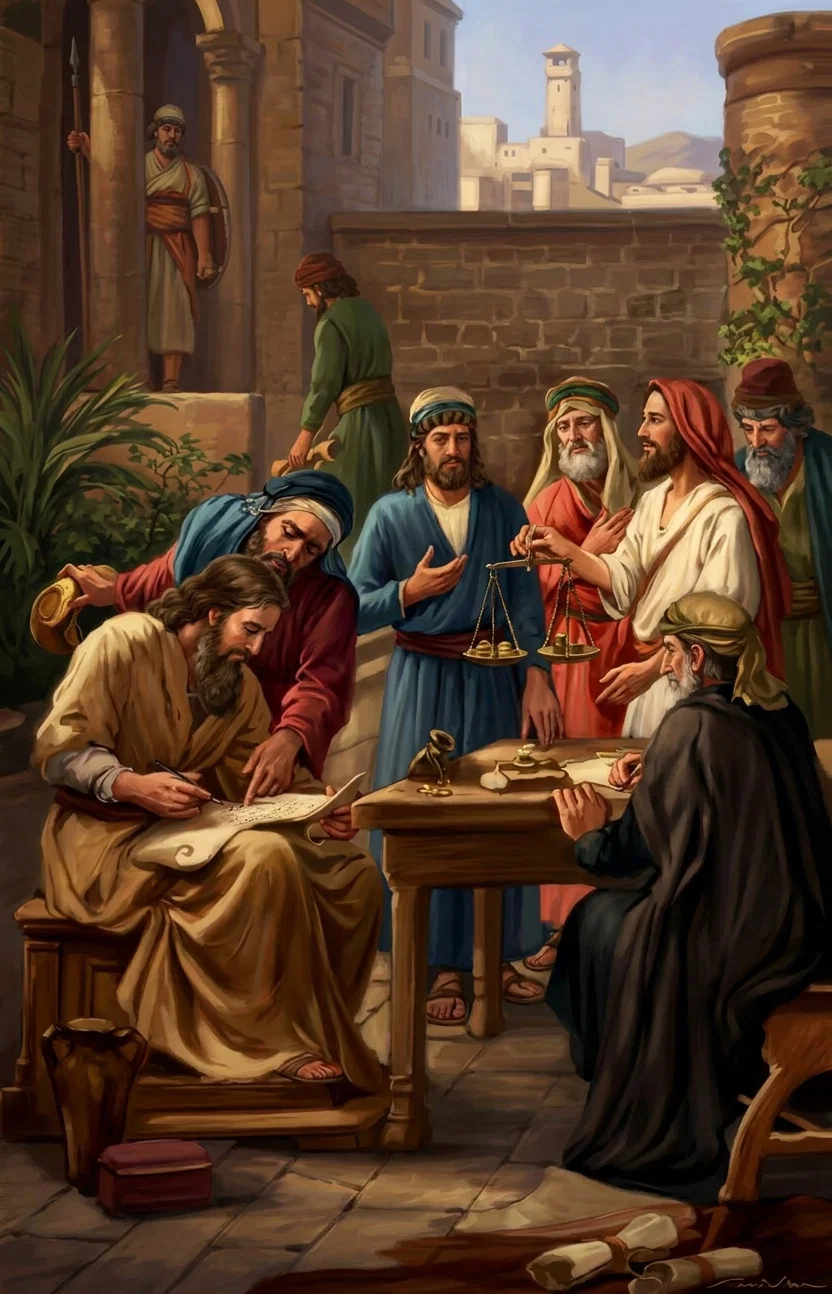
Laying fast hold on the promises of God, Jeremiah, by means of an acted parable, illustrated before the inhabitants of the fated city his strong faith in the ultimate fulfillment of God’s purpose for His people. In the presence of witnesses, and with careful observance of all necessary legal forms, he purchased for467seventeen shekels of silver an ancestral field situated in the neighboring village of Anathoth.
JEREMIAH PURCHASING A FIELD
“In the presence of witnesses, and with careful observance of all necessary legal forms, he purchased an ancestral field.”
From every human point of view, this purchase of land in territory already under the control of the Babylonians, appeared to be an act of folly. The prophet himself had been foretelling the destruction of Jerusalem, the desolation of Judea, and the utter ruin of the kingdom. He had been prophesying a long period of captivity in far-away Babylon. Already advanced in years, he could never hope to receive personal benefit from the purchase he had made. However, his study of the prophecies that were recorded in the Scriptures, had created within his heart a firm conviction that the Lord purposed to restore to the children of the captivity their ancient possession of the land of promise. With the eye of faith, Jeremiah saw the exiles returning at the end of the years of affliction, and reoccupying the land of their fathers. Through the purchase of the Anathoth estate, he would do what he could to inspire others with the hope that brought so much comfort to his own heart.
Having signed the deeds of transfer and secured the countersignatures of witnesses, Jeremiah charged Baruch his secretary: “Take these evidences, this evidence of the purchase, both which is sealed, and this evidence which is open; and put them in an earthen vessel, that they may continue many days. For thus saith the Lord of hosts, the God of Israel; Houses and fields and vineyards shall be possessed again in this land.”
So discouraging was the outlook for Judah at the time of this extraordinary transaction, that immediately after perfecting the details of the purchase470and arranging for the preservation of the written records, the faith of Jeremiah, unshaken though it had been, was now sorely tried. Had he, in his endeavor to encourage Judah, acted presumptuously? In his desire to establish confidence in the promises of God’s word, had he given ground for false hope? Those who had entered into covenant relationship with God had long since scorned the provisions made in their behalf. Could the promises to the chosen nation ever meet with complete fulfillment?
Perplexed in spirit, bowed down with sorrow over the sufferings of those who had refused to repent of their sins, the prophet appealed to God for further enlightenment concerning the divine purpose for mankind.
“Ah Lord God!” he prayed, “behold, Thou hast made the heaven and the earth by Thy great power and stretched out arm, and there is nothing too hard for Thee: Thou showest loving-kindness unto thousands, and recompensest the iniquity of the fathers into the bosom of their children after them: the great, the mighty God, the Lord of hosts, is His name, great in counsel, and mighty in work: for Thine eyes are open upon all the ways of the sons of men: to give every one according to his ways, and according to the fruit of his doings: which hast set signs and wonders in the land of Egypt, even unto this day, and in Israel, and among other men; and hast made Thee a name, as at this day; and hast brought forth Thy people Israel out of the land of Egypt with signs, and with wonders, and with a strong hand, and with a stretched out arm, and with great terror; and hast given them this land, which Thou didst swear to their471fathers to give them, a land flowing with milk and honey; and they came in, and possessed it; but they obeyed not Thy voice, neither walked in Thy law; they have done nothing of all that Thou commandedst them to do: therefore Thou hast caused all this evil to come upon them.”
Nebuchadnezzar’s armies were about to take the walls of Zion by storm. Thousands were perishing in a last desperate defense of the city. Many thousands more were dying of hunger and disease. The fate of Jerusalem was already sealed. The besieging towers of the enemy’s forces were already overlooking the walls. “Behold the mounts;” the prophet continued in his prayer to God; “they are come unto the city to take it; and the city is given into the hand of the Chaldeans, that fight against it, because of the sword, and of the famine, and of the pestilence: and what Thou hast spoken is come to pass; and, behold, Thou seest it. And Thou hast said unto me, O Lord God, Buy thee the field for money, and take witnesses; for the city is given into the hand of the Chaldeans.”
The prayer of the prophet was graciously answered. “The word of the Lord unto Jeremiah” in that hour of distress, when the faith of the messenger of truth was being tried as by fire, was: “Behold, I am the Lord, the God of all flesh: is there anything too hard for Me?” The city was soon to fall into the hand of the Chaldeans; its gates and palaces were to be set on fire and burned; but notwithstanding the fact that destruction was imminent, and the inhabitants of Jerusalem were to be carried away captive, nevertheless the eternal purpose of Jehovah for Israel was472yet to be fulfilled. In further answer to the prayer of His servant, the Lord declared concerning those upon whom His chastisements were falling:
“Behold, I will gather them out of all countries, whither I have driven them in Mine anger, and in My fury, and in great wrath; and I will bring them again unto this place, and I will cause them to dwell safely: and they shall be My people, and I will be their God: and I will give them one heart, and one way, that they may fear Me forever, for the good of them, and of their children after them: and I will make an everlasting covenant with them, that I will not turn away from them, to do them good; but I will put My fear in their hearts, that they shall not depart from Me. Yea, I will rejoice over them to do them good, and I will plant them in this land assuredly with My whole heart and with My whole soul.
“For thus saith the Lord; Like as I have brought all this great evil upon this people, so will I bring upon them all the good that I have promised them. And fields shall be bought in this land, whereof ye say, It is desolate without man or beast; it is given into the hand of the Chaldeans. Men shall buy fields for money, and subscribe evidences, and seal them, and take witnesses in the land of Benjamin, and in the places about Jerusalem, and in the cities of Judah, and in the cities of the mountains, and in the cities of the valley, and in the cities of the south: for I will cause their captivity to return, saith the Lord.”
In confirmation of these assurances of deliverance and restoration, “the word of the Lord came unto Jeremiah the second time, while he was yet shut up in the court of the prison, saying,
“Thus saith the Lord the Maker thereof, the Lord that formed it, to establish it; the Lord is His name; Call unto Me, and I will answer thee, and show thee great and mighty things, which thou knowest not. For thus saith the Lord, the God of Israel, concerning the houses of this city, and concerning the houses of the kings of Judah, which are thrown down by the mounts, and by the sword; . . . Behold, I will bring it health and cure, and I will cure them, and will reveal unto them the abundance of peace and truth. And I will cause the captivity of Judah and the captivity of Israel to return, and will build them, as at the first. And I will cleanse them from all their iniquity, whereby they have sinned against Me; and I will pardon all their iniquities. . . . And it shall be to Me a name of joy, a praise and an honor before all the nations of the earth, which shall hear all the good that I do unto them: and they shall fear and tremble for all the goodness and for all the prosperity that I procure unto it.
“Thus saith the Lord; Again there shall be heard in this place, which ye say shall be desolate without man and without beast, even in the cities of Judah, and in the streets of Jerusalem, . . . the voice of joy, and the voice of gladness, the voice of the bridegroom, and the voice of the bride, the voice of them that shall say, Praise the Lord of hosts: for the Lord is good; for His mercy endureth forever: and of them that shall bring the sacrifice of praise into the house of the Lord. For I will cause to return the captivity of the land, as at the first, saith the Lord.”
“Thus saith the Lord of hosts; Again in this place, which is desolate without man and without474beast, and in all the cities thereof, shall be an habitation of shepherds causing their flocks to lie down. In the cities of the mountains, and in the cities of the vale, and in the cities of the south, and in the land of Benjamin, and in the places about Jerusalem, and in the cities of Judah, shall the flocks pass again under the hands of him that telleth them, saith the Lord.
“Behold, the days come, saith the Lord, that I will perform that good thing which I have promised unto the house of Israel and to the house of Judah.”
Thus was the church of God comforted in one of the darkest hours of her long conflict with the forces of evil. Satan had seemingly triumphed in his efforts to destroy Israel; but the Lord was overruling the events of the present, and during the years that were to follow, His people were to have opportunity to redeem the past. His message to the church was:
“Fear thou not, O My servant Jacob; . . . neither be dismayed, O Israel: for, lo, I will save thee from afar, and thy seed from the land of their captivity; and Jacob shall return, and shall be in rest, and be quiet, and none shall make him afraid. For I am with thee, saith the Lord, to save thee.” “I will restore health unto thee, and I will heal thee of thy wounds.”
In the glad day of restoration, the tribes of divided Israel were to be reunited as one people. The Lord was to be acknowledged as ruler over “all the families of Israel.” “They shall be My people,” He declared. “Sing with gladness for Jacob, and shout among the chief of the nations: publish ye, praise ye, and say, O Lord, save Thy people, the remnant of475Israel. Behold, I will bring them from the north country, and gather them from the coasts of the earth, and with them the blind and the lame; . . . they shall come with weeping, and with supplications will I lead them: I will cause them to walk by the rivers of waters in a straight way, wherein they shall not stumble: for I am a Father to Israel, and Ephraim is My first-born.”
Humbled in the sight of the nations, those who once had been recognized as favored of Heaven above all other peoples of the earth were to learn in exile the lesson of obedience so necessary for their future happiness. Until they had learned this lesson, God could not do for them all that He desired to do. “I will correct thee in measure, and will not leave thee altogether unpunished,” He declared in explanation of His purpose to chastise them for their spiritual good. Yet those who had been the object of His tender love were not forever set aside; before all the nations of earth He would demonstrate His plan to bring victory out of apparent defeat, to save rather than to destroy. To the prophet was given the message:
“He that scattered Israel will gather him, and keep him, as a shepherd doth his flock. For the Lord hath redeemed Jacob, and ransomed him from the hand of him that was stronger than he. Therefore they shall come and sing in the height of Zion, and shall flow together to the goodness of the Lord, for wheat, and for wine, and for oil, and for the young of the flock and of the herd: and their soul shall be as a watered garden; and they shall not sorrow any more476at all. . . . I will turn their mourning into joy, and will comfort them, and make them rejoice from their sorrow. And I will satiate the soul of the priests with fatness, and My people shall be satisfied with My goodness, saith the Lord.”
“Thus saith the Lord of hosts, the God of Israel; As yet they shall use this speech in the land of Judah and in the cities thereof, when I shall bring again their captivity; The Lord bless thee, O habitation of justice, and mountain of holiness. And there shall dwell in Judah itself, and in all the cities thereof together, husbandmen, and they that go forth with flocks. For I have satiated the weary soul, and I have replenished every sorrowful soul.”
“Behold, the days come, saith the Lord, that I will make a new covenant with the house of Israel, and with the house of Judah: not according to the covenant that I made with their fathers in the day that I took them by the hand to bring them out of the land of Egypt; which My covenant they brake, although I was an husband unto them, saith the Lord: but this shall be the covenant that I will make with the house of Israel; After those days, saith the Lord, I will put My law in their inward parts, and write it in their hearts; and will be their God, and they shall be My people. And they shall teach no more every man his neighbor, and every man his brother, saying, Know the Lord: for they shall all know Me, from the least of them unto the greatest of them, saith the Lord: for I will forgive their iniquity, and I will remember their sin no more.”