A mighty prophecy of the kingdoms of men is the image of the dream of Nebuchadnezzar, the great and ambitious king of Babylon. He longed to know what should come to pass hereafter; and in the dream of the image, which no human could interpret, God made known what should come to pass.
God gave to Nebuchadnezzar, who believed that Babylon would stand forever, the dream. By His prophet, He gave to Nebuchadnezzar the interpretation of the dream, that Nebuchadnezzar might know that Babylon would not stand forever, and that the king might learn that truth was more than the ambitions of patriotism. God gave the dream and its interpretation to Nebuchadnezzar, not alone that the Babylonian king might know, but that every king who followed him might know, that earthly kingdoms are all temporal at best, and must pass away, and that the only eternal kingdom, which shall never pass away, is the kingdom of the Living Stone, Christ Jesus.
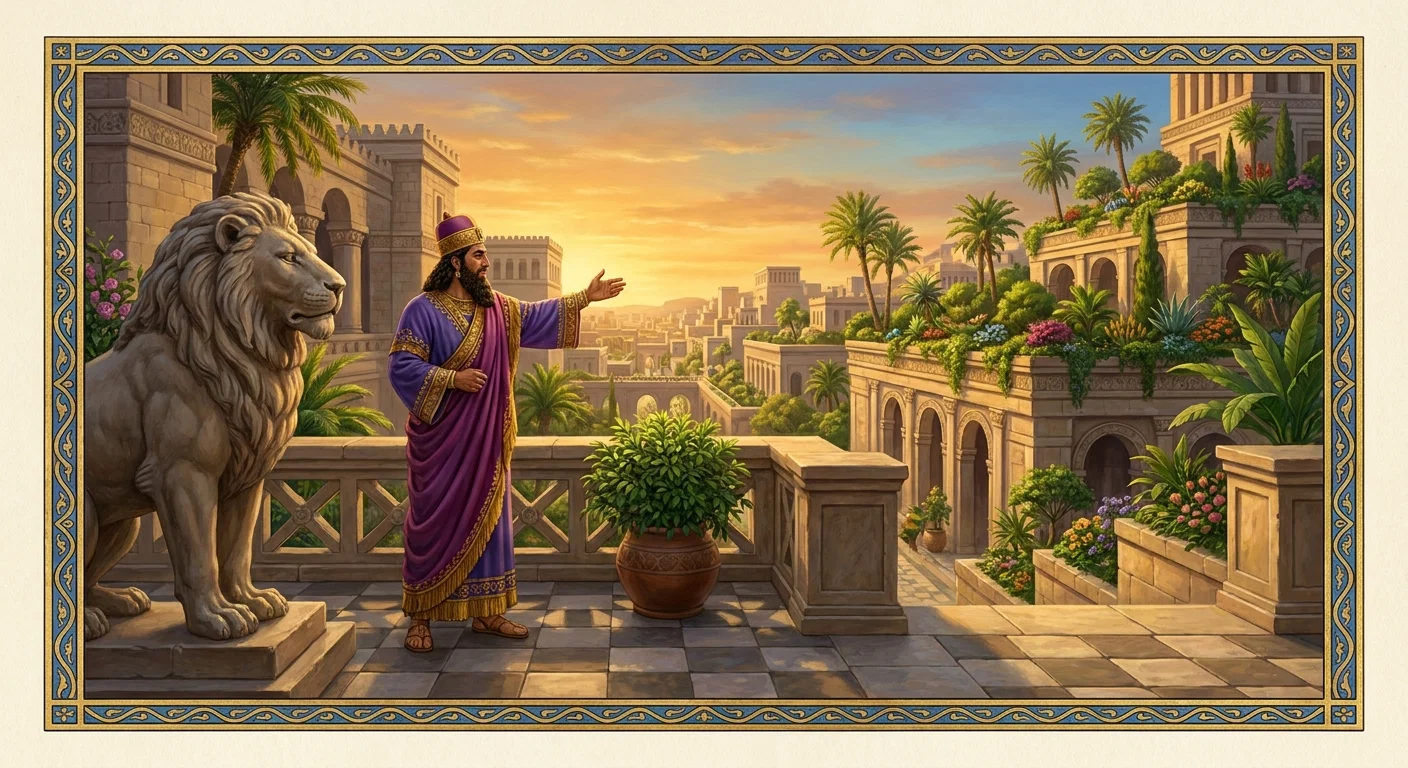
The whole image of a man represented the kingdom of man; but the divisions of the image, the metallic symbols, represent the four great world-moulding empires which earth should know before the close of man’s reign upon the earth. These begin with Babylonia, then at the height of its glory under Nebuchadnezzar, the kingdom preeminently which has moulded the world. Sayce says: “In populousness and antiquity, Assyria was far exceeded by the southern kingdom of Babylonia. Here496were the center and starting-point of the civilization which afterwards spread through western Asia.”—“Ancient Empires of the East,” by Sayce, page 93.
Says the Schaff-Herzog Encyclopædia, “The earliest religious, scientific, and artistic traditions of our present civilization were cradled in Babylonia.”—Article “Babylonia.”
Says Rogers, “No capital in the world has been the center of so much power, wealth, and culture for a period so vast.”—History of Babylonia and Assyria, volume 1, page 397.
It was fitting that the revelation and warning from God should be given to the first and greatest world-moulding empire; but Babylonia, the great and golden, passed away under weaker rulers, Nabonadius and his son Belshazzar, in 538 B. C., in the same generation the revelation was given.
Babylonia was succeeded by Medo-Persia under Cyrus the Great, who placed Astyages as local ruler upon the throne. Astyages is known by the general term “Darius,” meaning maintainer or ruler, a title used by various Persian kings. For 207 years, Persia, symbolized by the silver, held the throne of the world.
In 331 B. C., another Darius (Codomannus) fought the issue of power with Alexander the Great at the battle of Arbela, and Alexander of Greece became the world’s ruler. Grecia’s symbol is the brass. Alexander died in B. C. 323; and in a few years his kingdom was hopelessly divided, and left a prey to the rising war power on the Tiber.
Rome conquered the Syrian division of the Greek Empire in B. C. 190, the Macedonian division of that empire in B. C. 168, Egypt acknowledging the suzerainty of the iron monarchy of Rome the same year. Rome was united in her beginning, although a republic. Later she became an empire. Into the Roman Empire came division, symbolized by the mixture of iron and clay, through incursions of barbarians from the north and east of Europe in the fourth century; and Rome, the iron monarchy, became broken forever. There have been mighty efforts put forth to weld the nations of Europe, the divisions of Rome, into one homogeneous whole by intermarriage, referred to in the prophecy as mingling themselves with the seed of men, but they have failed. Charlemagne and Napoleon sought by force of arms to build a united kingdom; but they failed. The prophecy declared that these divisions would not unite, even as iron cannot mix with clay. They are all in fearful warfare now. The word, “They shall not cleave one to another,” is stronger than diplomacy or force of arms.
In the days of the last divisions of Rome, the God of heaven shall set up His kingdom, never to be destroyed, never to be given to another people than His own, who shall inhabit it forever. “And the dream is certain, and the interpretation thereof sure.”
“Thy dream,” Daniel declared, “and the visions of thy head upon thy bed, are these; As for thee, O king, thy thoughts came into thy mind upon thy bed, what should come to pass hereafter: and He that revealeth secrets maketh known to thee what shall come to pass. But as for me, this secret is not revealed to me for any wisdom that I have more than any living, but for their sakes that shall make known the interpretation to the king, and that thou mightest know the thoughts of thy heart.”
“Thou, O king, sawest, and behold a great image. This great image, whose brightness was excellent, stood before thee; and the form thereof was terrible. This image’s head was of fine gold, his breast and his arms of silver, his belly and his thighs of brass, his legs of iron, his feet part of iron and part of clay.
“Thou sawest till that a stone was cut out without hands, which smote the image upon his feet that were of iron and clay, and brake them to pieces. Then was the iron, the clay, the brass, the silver, and the gold, broken to pieces together, and became like the chaff of the summer threshing-floors; and the wind carried them away, that no place was found for them: and the stone that smote the image became a great mountain, and filled the whole earth.
“This is the dream,” confidently declared Daniel; and the king, listening with closest attention to every particular, knew it was the very dream over which498he had been so troubled. Thus his mind was prepared to receive with favor the interpretation. The King of kings was about to communicate great truth to the Babylonian monarch. God would reveal that He has power over the kingdoms of the world,—power to enthrone and to dethrone kings. Nebuchadnezzar’s mind was to be awakened, if possible, to a sense of his responsibility to Heaven. The events of the future, reaching down to the end of time, were to be opened before him.
“Thou, O king, art a king of kings,” Daniel continued, “for the God of heaven hath given thee a kingdom, power, and strength, and glory. And wheresoever the children of men dwell, the beasts of the field and the fowls of the heaven hath He given into thine hand, and hath made thee ruler over them all. Thou art this head of gold.”
“And after thee shall arise another kingdom inferior to thee, and another third kingdom of brass, which shall bear rule over all the earth.
“And the fourth kingdom shall be strong as iron: forasmuch as iron breaketh in pieces and subdueth all things: and as iron that breaketh all these, shall it break in pieces and bruise.
“And whereas thou sawest the feet and toes, part of potters’ clay, and part of iron, the kingdom shall be divided; but there shall be in it of the strength of the iron, forasmuch as thou sawest the iron mixed with miry clay. And as the toes of the feet were part of iron, and part of clay, so the kingdom shall be partly strong, and partly broken. And whereas thou sawest iron mixed with miry clay, they shall mingle themselves with the seed of men: but they shall not499cleave one to another, even as iron is not mixed with clay.”
“In the days of these kings shall the God of heaven set up a kingdom, which shall never be destroyed: and the kingdom shall not be left to other people, but it shall break in pieces and consume all these kingdoms, and it shall stand forever. Forasmuch as thou sawest that the stone was cut out of the mountain without hands, and that it brake in pieces the iron, the brass, the clay, the silver, and the gold; the great God hath made known to the king what shall come to pass hereafter: and the dream is certain, and the interpretation thereof sure.”
The king was convinced of the truth of the interpretation, and in humility and awe he “fell upon his face, and worshiped,” saying, “Of a truth it is, that your God is a God of gods, and a Lord of kings, and a revealer of secrets, seeing thou couldest reveal this secret.”
Nebuchadnezzar revoked the decree for the destruction of the wise men. Their lives were spared because of Daniel’s connection with the Revealer of secrets. And “the king made Daniel a great man, and gave him many great gifts, and made him ruler over the whole province of Babylon, and chief of the governors over all the wise men of Babylon. Then Daniel requested of the king, and he set Shadrach, Meshach, and Abednego, over the affairs of the province of Babylon: but Daniel sat in the gate of the king.”
In the annals of human history, the growth of nations, the rise and fall of empires, appear as if dependent on the will and prowess of man; the shaping of events seems, to a great degree, to be determined by his power, ambition, or caprice.500But in the word of God the curtain is drawn aside, and we behold, above, behind, and through all the play and counterplay of human interest and power and passions, the agencies of the All-merciful One, silently, patiently working out the counsels of His own will.
In words of matchless beauty and tenderness, the apostle Paul set before the sages of Athens the divine purpose in the creation and distribution of races and nations. “God that made the world and all things therein,” declared the apostle, “hath made of one blood all nations of men for to dwell on all the face of the earth, and hath determined the times before appointed, and the bounds of their habitation; that they should seek the Lord, if haply they might feel after Him, and find Him.”
God has made plain that whosoever will, may come “into the bond of the covenant.” In the creation it was His purpose that the earth should be inhabited by beings whose existence would be a blessing to themselves and to one another, and an honor to their Creator. All who will may identify themselves with this purpose. Of them it is spoken, “This people have I formed for Myself; they shall show forth My praise.”
In His law God has made known the principles that underlie all true prosperity, both of nations and of individuals. To the Israelites Moses declared of this law: “This is your wisdom and your understanding.” “It is not a vain thing for you; because it is your life.” The blessings thus assured to Israel are, on501the same conditions and in the same degree, assured to every nation and to every individual under the broad heavens.
Hundreds of years before certain nations came upon the stage of action, the Omniscient One looked down the ages, and predicted the rise and fall of the universal kingdoms. God declared to Nebuchadnezzar that the kingdom of Babylon should fall, and a second kingdom would arise, which also would have its period of trial. Failing to exalt the true God, its glory would fade, and a third kingdom would occupy its place. This also would pass away; and a fourth, strong as iron, would subdue the nations of the world.
Had the rulers of Babylon—that richest of all earthly kingdoms—kept always before them the fear of Jehovah, they would have been given wisdom and power which would have bound them to Him and kept them strong. But they made God their refuge only when harassed and perplexed. At such times, failing to find help in their great men, they sought it from men like Daniel,—men who they knew honored the living God, and were honored by Him. To these men they appealed to unravel the mysteries of Providence; for though the rulers of proud Babylon were men of the highest intellect, they had separated themselves so far from God by transgression that they could not understand the revelations and the warnings given them concerning the future.
In the history of nations the student of God’s word may behold the literal fulfillment of divine prophecy. Babylon, shattered and broken at last, passed away because in prosperity its rulers had regarded themselves as independent of God, and had502ascribed the glory of their kingdom to human achievement. The Medo-Persian realm was visited by the wrath of Heaven because in it God’s law had been trampled underfoot. The fear of the Lord had found no place in the hearts of the vast majority of the people. Wickedness, blasphemy, and corruption prevailed. The kingdoms that followed were even more base and corrupt; and these sank lower and still lower in the scale of moral worth.
The power exercised by every ruler on the earth is Heaven-imparted; and upon his use of the power thus bestowed, his success depends. To each the word of the divine Watcher is, “I girded thee, though thou hast not known Me.” And to each the words spoken to Nebuchadnezzar of old are the lesson of life: “Break off thy sins by righteousness, and thine iniquities by showing mercy to the poor; if it may be a lengthening of thy tranquillity.”
To understand these things,—to understand that “righteousness exalteth a nation;” that “the throne is established by righteousness,” and “upholden by mercy;” to recognize the outworking of these principles in the manifestation of His power who “removeth kings, and setteth up kings,”—this is to understand the philosophy of history.
In the word of God only is this clearly set forth. Here it is shown that the strength of nations, as of individuals, is not found in the opportunities or facilities that appear to make them invincible; it is not found in their boasted greatness. It is measured by the fidelity with which they fulfill God’s purpose.
“WALKING IN THE MIDST OF THE FIRE”
THE FIERY FURNACE—41
The dream of the great image, opening before Nebuchadnezzar events reaching to the close of time, had been given that he might understand the part he was to act in the world’s history, and the relation that his kingdom should sustain to the kingdom of heaven. In the interpretation of the dream, he had been plainly instructed regarding the establishment of God’s everlasting kingdom. “In the days of these kings,” Daniel had declared, “shall the God of heaven set up a kingdom, which shall never be destroyed: and the kingdom shall not be left to other people, but it shall break in pieces and consume all these kingdoms, and it shall stand forever. . . . The dream is certain, and the interpretation thereof sure.”
The king had acknowledged the power of God, saying to Daniel, “Of a truth it is, that your God is a God of gods, . . . and a revealer of secrets.” For a time afterward, Nebuchadnezzar was influenced504by the fear of God; but his heart was not yet cleansed from worldly ambition and a desire for self-exaltation. The prosperity attending his reign filled him with pride. In time he ceased to honor God, and resumed his idol-worship with increased zeal and bigotry.
The words, “Thou art this head of gold,” had made a deep impression upon the ruler’s mind. The wise men of his realm, taking advantage of this and of his return to idolatry, proposed that he make an image similar to the one seen in his dream, and set it up where all might behold the head of gold, which had been interpreted as representing his kingdom.
Pleased with the flattering suggestion, he determined to carry it out, and to go even farther. Instead of reproducing the image as he had seen it, he would excel the original. His image should not deteriorate in value from the head to the feet, but should be entirely of gold,—symbolic throughout of Babylon as an eternal, indestructible, all-powerful kingdom, which should break in pieces all other kingdoms, and stand forever.
The thought of establishing the empire and a dynasty that should endure forever, appealed very strongly to the mighty ruler before whose arms the nations of earth had been unable to stand. With an enthusiasm born of boundless ambition and selfish pride, he entered into counsel with his wise men as to how to bring this about. Forgetting the remarkable providences connected with the dream of the great image; forgetting also that the God of Israel through His servant Daniel had made plain the significance of the image, and that in connection with this505interpretation the great men of the realm had been saved an ignominious death; forgetting all except their desire to establish their own power and supremacy, the king and his counselors of state determined that by every means possible they would endeavor to exalt Babylon as supreme, and worthy of universal allegiance.
The symbolic representation by which God had revealed to king and people His purpose for the nations of earth, was now to be made to serve for the glorification of human power. Daniel’s interpretation was to be rejected and forgotten; truth was to be misinterpreted and misapplied. The symbol designed of Heaven to unfold to the minds of men important events of the future, was to be used to hinder the spread of the knowledge that God desired the world to receive. Thus through the devisings of ambitious men, Satan was seeking to thwart the divine purpose for the human race. The enemy of mankind knew that truth unmixed with error is a power mighty to save; but that when used to exalt self and to further the projects of men, it becomes a power for evil.
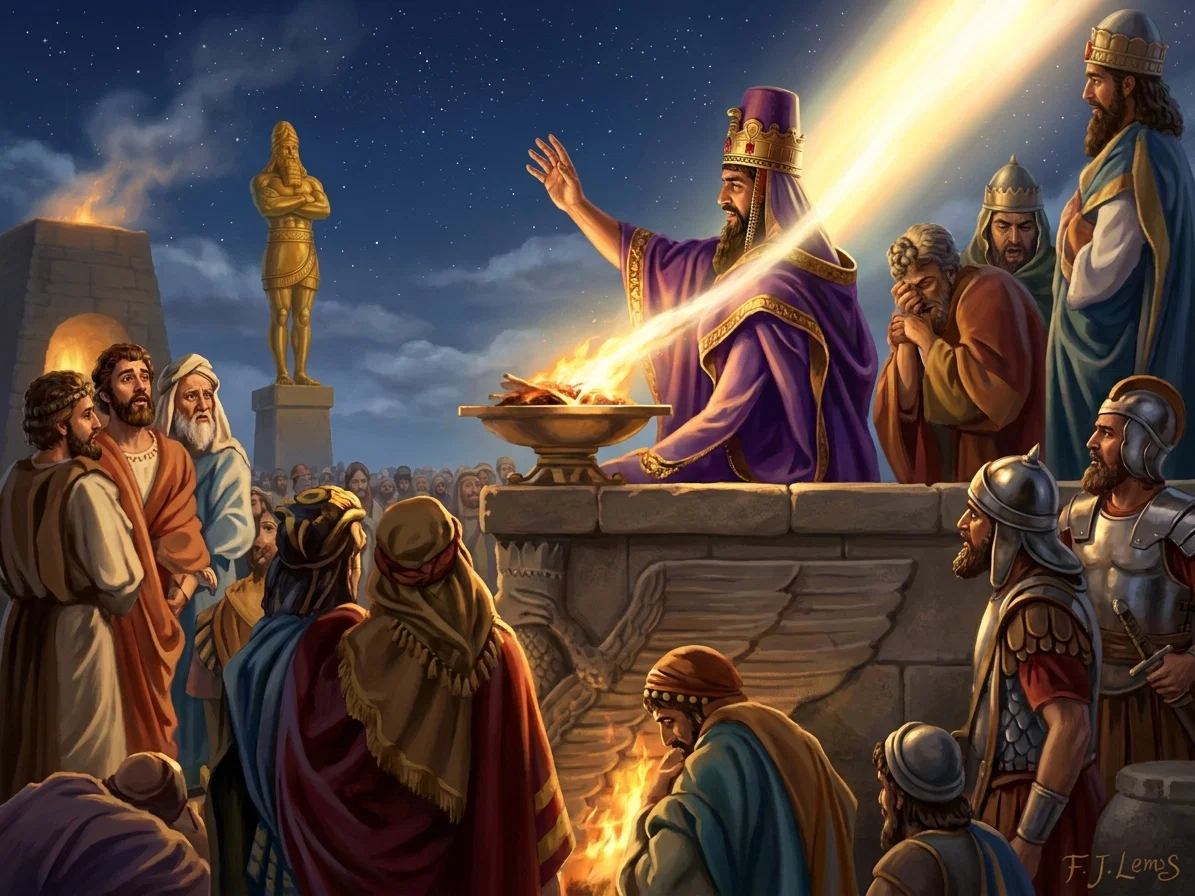
From his rich store of treasure, Nebuchadnezzar caused to be made a great golden image, similar in its general features to that which had been seen in vision, save in the one particular of the material of which it was composed. Accustomed as they were to magnificent representations of their heathen deities, the Chaldeans had never before produced anything so imposing and majestic as this resplendent statue, threescore cubits in height and six cubits in breadth. And it is not surprising that in a land where idol-worship506was of universal prevalence, the beautiful and priceless image on the plain of Dura, representing the glory of Babylon and its magnificence and power, should be consecrated as an object of worship. This was accordingly provided for, and a decree went forth that on the day of the dedication all should show their supreme loyalty to the Babylonian power by bowing before the image.
The appointed day came, and a vast concourse from all “people, nations, and languages,” assembled on the plain of Dura. In harmony with the king’s command, when the sound of music was heard, the whole company “fell down and worshiped the golden image.” On that eventful day the powers of darkness seemed to be gaining a signal triumph; the worship of the golden image bade fair to become connected permanently with the established forms of idolatry recognized as the state religion of the land. Satan hoped thereby to defeat God’s purpose of making the presence of captive Israel in Babylon a means of blessing to all the nations of heathendom.
But God decreed otherwise. Not all had bowed the knee to the idolatrous symbol of human power. In the midst of the worshiping multitude there were three men who were firmly resolved not thus to dishonor the God of heaven. Their God was King of kings and Lord of lords; they would bow to none other.
To Nebuchadnezzar, flushed with triumph, was brought the word that among his subjects there were some who dared disobey his mandate. Certain of the wise men, jealous of the honors that had been bestowed upon the faithful companions of Daniel, now507reported to the king their flagrant violation of his wishes. “O king, live forever,” they exclaimed. “There are certain Jews whom thou hast set over the affairs of the province of Babylon, Shadrach, Meshach, and Abednego; these men, O king, have not regarded thee: they serve not thy gods, nor worship the golden image which thou hast set up.”
The king commanded that the men be brought before him. “Is it true,” he inquired, “do not ye serve my gods, nor worship the golden image which I have set up?” He endeavored by threats to induce them to unite with the multitude. Pointing to the fiery furnace, he reminded them of the punishment awaiting them if they should persist in their refusal to obey his will. But firmly the Hebrews testified to their allegiance to the God of heaven, and their faith in His power to deliver. The act of bowing to the image was understood by all to be an act of worship. Such homage they could render to God alone.
As the three Hebrews stood before the king, he was convinced that they possessed something the other wise men of his kingdom did not have. They had been faithful in the performance of every duty. He would give them another trial. If only they would signify their willingness to unite with the multitude in worshiping the image, all would be well with them; “but if ye worship not,” he added, “ye shall be cast the same hour into the midst of a burning fiery furnace.” Then with his hand stretched upward in defiance, he demanded, “Who is that God that shall deliver you out of my hands?”
In vain were the king’s threats. He could not turn the men from their allegiance to the Ruler of the508universe. From the history of their fathers they had learned that disobedience to God results in dishonor, disaster, and death; and that the fear of the Lord is the beginning of wisdom, the foundation of all true prosperity. Calmly facing the furnace, they said: “O Nebuchadnezzar, we are not careful to answer thee in this matter. If it be so [if this is your decision], our God whom we serve is able to deliver us from the burning fiery furnace, and He will deliver us out of thine hand, O king.” Their faith strengthened as they declared that God would be glorified by delivering them, and with triumphant assurance born of implicit trust in God, they added, “But if not, be it known unto thee, O king, that we will not serve thy gods, nor worship the golden image which thou hast set up.”
The king’s wrath knew no bounds. “Full of fury,” “the form of his visage was changed against Shadrach, Meshach, and Abednego,” representatives of a despised and captive race. Directing that the furnace be heated seven times hotter than its wont, he commanded the mighty men of his army to bind the worshipers of Israel’s God, preparatory to summary execution.
“Then these men were bound in their coats, their hosen, and their hats, and their other garments, and were cast into the midst of the burning fiery furnace. Therefore because the king’s commandment was urgent, and the furnace exceeding hot, the flame of the fire slew those men that took up Shadrach, Meshach, and Abednego.”
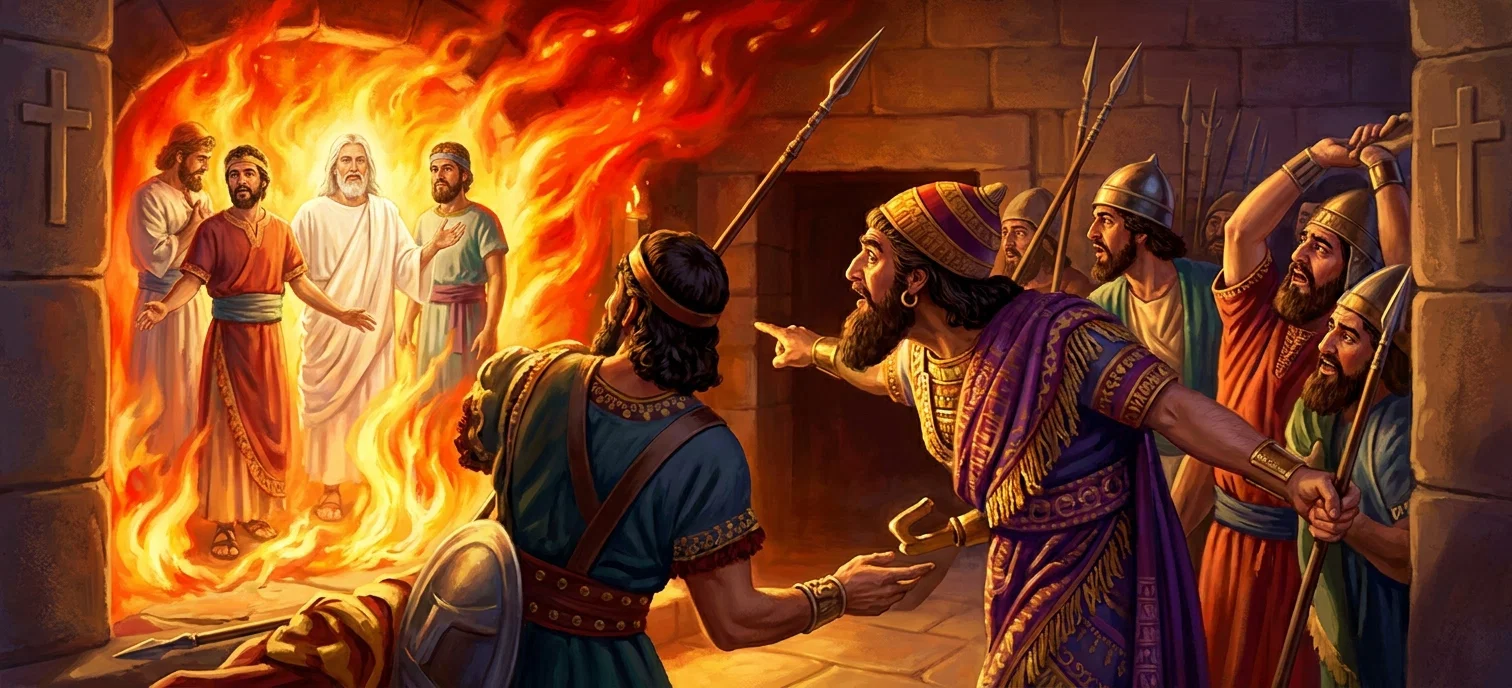
But the Lord did not forget His own. As His witnesses were cast into the furnace, the Saviour revealed509Himself to them in person, and together they walked in the midst of the fire. In the presence of the Lord of heat and cold, the flames lost their power to consume.
From his royal seat the king looked on, expecting to see the men who had defied him utterly destroyed. But his feelings of triumph suddenly changed. The nobles standing near saw his face grow pale as he started from the throne, and looked intently into the glowing flames. In alarm the king, turning to his lords, asked, “Did not we cast three men bound into the midst of the fire? . . . Lo, I see four men loose, walking in the midst of the fire, and they have no hurt; and the form of the fourth is like the Son of God.”
How did that heathen king know what the Son of God was like? The Hebrew captives filling positions of trust in Babylon had in life and character represented before him the truth. When asked for a reason of their faith, they had given it without hesitation. Plainly and simply they had presented the principles of righteousness, thus teaching those around them of the God whom they worshiped. They had told of Christ, the Redeemer to come; and in the form of the fourth in the midst of the fire the king recognized the Son of God.
And now, his own greatness and dignity forgotten, Nebuchadnezzar descended from his throne, and going to the mouth of the furnace, cried out, “Ye servants of the most high God, come forth, and come hither.”
Then Shadrach, Meshach, and Abednego came forth before the vast multitude, showing themselves unhurt. The presence of their Saviour had guarded510them from harm, and only their fetters had been burned. “And the princes, governors, and captains, and the king’s counselors, being gathered together, saw these men, upon whose bodies the fire had no power, nor was an hair of their head singed, neither were their coats changed, nor the smell of fire had passed on them.”
Forgotten was the great golden image, set up with such pomp. In the presence of the living God, men feared and trembled. “Blessed be the God of Shadrach, Meshach, and Abednego,” the humbled king was constrained to acknowledge, “who hath sent His angel, and delivered His servants that trusted in Him, and have changed the king’s word, and yielded their bodies, that they might not serve nor worship any god, except their own God.”
The experiences of that day led Nebuchadnezzar to issue a decree, “that every people, nation, and language, which speak anything amiss against the God of Shadrach, Meshach, and Abednego, shall be cut in pieces, and their houses shall be made a dunghill.” “There is no other god,” he urged as the reason for the decree, “that can deliver after this sort.”
In these and like words the king of Babylon endeavored to spread abroad before all the peoples of earth his conviction that the power and authority of the God of the Hebrews was worthy of supreme adoration. And God was pleased with the effort of the king to show Him reverence, and to make the royal confession of allegiance as widespread as was the Babylonian realm.
It was right for the king to make public confession, and to seek to exalt the God of heaven above all other511gods; but in endeavoring to force his subjects to make a similar confession of faith and to show similar reverence, Nebuchadnezzar was exceeding his right as a temporal sovereign. He had no more right, either civil or moral, to threaten men with death for not worshiping God, than he had to make the decree consigning to the flames all who refused to worship the golden image. God never compels the obedience of man. He leaves all free to choose whom they will serve.
NEBUCHADNEZZAR'S DECREE
“There is no other god that can deliver after this sort.”
By the deliverance of His faithful servants, the Lord declared that He takes His stand with the oppressed, and rebukes all earthly powers that rebel512against the authority of Heaven. The three Hebrews declared to the whole nation of Babylon their faith in Him whom they worshiped. They relied on God. In the hour of their trial they remembered the promise, “When thou passest through the waters, I will be with thee; and through the rivers, they shall not overflow thee: when thou walkest through the fire, thou shalt not be burned; neither shall the flame kindle upon thee.” And in a marvelous manner their faith in the living Word had been honored in the sight of all. The tidings of their wonderful deliverance were carried to many countries by the representatives of the different nations that had been invited by Nebuchadnezzar to the dedication. Through the faithfulness of His children, God was glorified in all the earth.
Important are the lessons to be learned from the experience of the Hebrew youth on the plain of Dura. In this our day, many of God’s servants, though innocent of wrong-doing, will be given over to suffer humiliation and abuse at the hands of those who, inspired by Satan, are filled with envy and religious bigotry. Especially will the wrath of man be aroused against those who hallow the Sabbath of the fourth commandment; and at last a universal decree will denounce these as deserving of death.
The season of distress before God’s people will call for a faith that will not falter. His children must make it manifest that He is the only object of their worship, and that no consideration, not even that of life itself, can induce them to make the least concession to false worship. To the loyal heart the commands of sinful, finite men will sink into insignificance beside the word of the eternal God. Truth will be513obeyed though the result be imprisonment or exile or death.
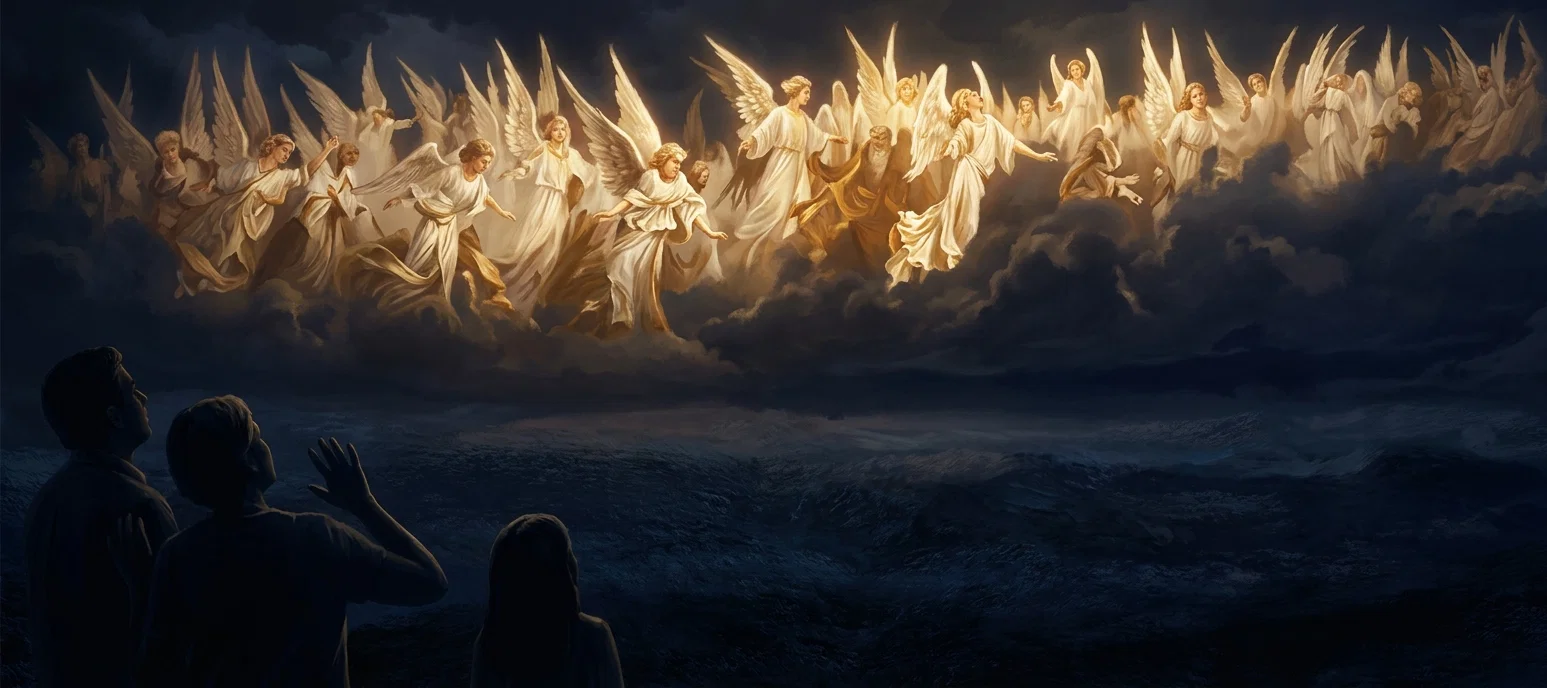
As in the days of Shadrach, Meshach, and Abednego, so in the closing period of earth’s history the Lord will work mightily in behalf of those who stand steadfastly for the right. He who walked with the Hebrew worthies in the fiery furnace will be with His followers wherever they are. His abiding presence will comfort and sustain. In the midst of the time of trouble,—trouble such as has not been since there was a nation,—His chosen ones will stand unmoved. Satan with all the hosts of evil cannot destroy the weakest of God’s saints. Angels that excel in strength will protect them, and in their behalf Jehovah will reveal Himself as a “God of gods,” able to save to the uttermost those who have put their trust in Him.