Your ShelfYour Projects

Signs of the Times, Vol. 36, No. 40.

OUR BIBLE BAND

Signs of the Times

Oct 13, 1909

Pacific Press Publishing Association · Mountain View, California · Oct 13, 1909

OUR BIBLE BAND

Schedule for Week Ending October 23

Day Date Morning Evening
Su. Oct. 17 Isa. 50, 51, 52 1 Thess. 5
Mo. " 18 " 53, 54, 55 2 Thess. 1
Tu. " 19 " 56, 57, 58 " 2
We. " 20 " 59, 60, 61 " 3
Th. " 21 " 62, 63, 64 1 Tim. 1
Fr. " 22 " 65, 66 " 2
Sa. " 23 Jer. 1, 2 " 3

Suggestive Notes

Our Old Testament lessons conclude Isaiah, beginning at the 50th chapter, and include also the first two chapters of Jeremiah. Very rich and full indeed are the prophecies of Isaiah, oftentimes noting events in the prophet’s own day, but ever and again pointing forward to the times of our Lord and the glorious triumph of God’s children in the end of the Christian age.
Jeremiah is a later prophet than Isaiah, prophesying in the closing days of Israel, before the Babylonian captivity. His prophecies begin with Josiah and end with Zedekiah, the last king of Judah, who was carried away into Babylon. The first chapter is a graphic account of how God called him—a very young man. Jeremiah does not take kindly to the honor; calls himself a child, and tells God that he is not able to go; and yet the Lord encourages him with the assurance that He would be with him, and that by the very words which he would speak, nations would be plucked up and broken down, or builded and planted. He set before the prophet a very hard task. There would be plenty to dismay him, but he must not be dismayed. He was to go out and do his work before a rebellious and gainsaying people, and stand as a fortified city, an iron pillar, and brazen walls. They would fight against him and he would suffer, but they would not be able to prevail. Then begin the declarations of the prophet concerning the awful backsliding of Judah.
Our New Testament lessons begin with 1 Thessalonians 5, and close with 1 Timothy 3. The fifth chapter of 1 Thessalonians contains splendid instruction for the generation of God’s children who are looking for His coming. The second epistle was written to correct a wrong idea that the brethren at Thessalonia had obtained from the first epistle; namely, that the Lord was coming in their day. The apostle plainly tells them that that is not the case, nor must they so understand what he has written; for the Lord would not come until the great apostasy had been manifested and the man of sin revealed in the very church itself, and that condition of things would continue until the Lord came the second time, when the glory of His presence would destroy apostasy. The only hope of salvation was the love of the truth of God.
The epistle to Timothy consists of a personal letter to Paul’s own disciple, the son of a faithful Jewish mother, and through him to ministers of God in all the centuries that follow. It was written about the year A.D. 64, and is full of necessary instruction to the Gospel laborer, and also contains prophetic warnings of the evils which the church must meet.

Question Corner

[To Our Inquirers.— (1) The name and address of all who ask questions must accompany questions, not necessarily for publication, in token of good faith, and that we may reply by letter if thought best. All communications will be considered confidential if so desired, and no name will be published unless requested. But we have no time to give to anonymous or unsigned epistles or articles. (2) Let the questions be to the point. Do not say, “Explain Josh. 7:1-8;” but state the thing upon which help is desired. (3) Questions can not be answered immediately in this department. Sometimes it will mean a month or more of waiting. We can not reply to the same question frequently. Read answers to other questions; you may find reply to yours. (4) Members of the Bible Band will kindly enclose stamp if answer is desired by letter. Others will please enclose ten cents. This does not begin to meet expenses oftentimes. (5) “Foolish . . . questions avoid.”

2953.—Under the Law

What is it to be “under the law”?
B. B.
This is quite clearly shown in the passages where it occurs, as for instance Rom. 6:14, Gal. 5:18: “For sin shall not have dominion over you; for ye are not under the law, but under grace;” “but if ye are led by the Spirit, ye are not under the law.” In the first scripture we are told that sin does not have dominion over those who are not under the law, and that those who are not under the law are under grace. God’s object of grace is the forgiveness of sins. This is shown in an abundance of passages. See Rom. 5:1, 2; 3:20-31. Grace is unmerited favor. By the unmerited favor of God our sins are taken away. The one thing which points out sin, is the law. “Nay, I had not known sin,” declares the apostle, “except the law had said, Thou shalt not covet.” Rom. 7:7; “Where no law is, there is no transgression.” Rom. 4:15. “By the law is the knowledge of sin.” Rom. 3:20. Therefore, grace brings us into harmony with God’s law: first, by forgiving all the sin which the law points out, for which the law condemns us; and, secondly, by placing within us God’s Holy Spirit in harmony with His law to enable us to keep His law, not in our strength, but in the strength of the Spirit. Those then who are “under the law” are those who are condemned by the law, who are still in their sins. Those who are not “under the law” are those whose sins are forgiven and who by the power of the Spirit of God are keeping the law. “For this is the love of God, that we keep His commandments; and His commandments are not grievous.” 1 John 5:3. And that love is born within our heart by the Holy Ghost which He has given us. Rom. 5:5.
It is one of the saddest things in this world to hear a Christian say, when confronted with the duty of doing God’s commandments, “I am not under the law,” using an expression which shows liberty from sin, as an excuse or license to disobey. The only thing in this world which leads the soul to disobey is “the carnal mind,” which “is enmity against God;” is “not subject to the law of God, neither indeed can be.” Rom. 8:7. Therefore the man who declares, as an excuse for disobedience to God, that he is not under the law, is confessing by that very thing that he has the carnal mind; while, on the other hand, those who walk in the Spirit and fulfil the fruits of the Spirit, the apostle assures us in Galatians 5 are not under the law, for “against such there is no law.” Why?—Because they are keeping the law of God.

2954.—Is It a Contradiction?

In Gen. 1:31 it is said that God saw everything that He had made, and behold, “it was very good.” In Gen. 2:18 we read that “it is not good.” Here is a positive contradiction. What have you to say upon it?
G. L.
Genesis 1 is an epitome of the work wrought by the Creator during the six days. The 31st verse expresses in human language God’s satisfaction at the work wrought. It was complete. Gen. 2:4-25 is a particularized account of the work of God in the Garden of Eden, and in the creation of the first pair. That account is summarized in the 27th verse of the first chapter. Man was created on the sixth day, and woman was created on the same day, immediately after. It was after the man alone was created that God said, “It is not good that the man should be alone,” and therefore He created the woman. “Male and female created He them.”
There is absolutely no contradiction at all. Gen. 2:18 has reference to an act prior to the expression of Gen. 1:31. When God said, “It is not good that the man should be alone,” He meant that man was not complete. The great plan of God had not been filled out. That was filled out when the woman was made; and both man and woman were made before God said of all His work, “It is very good.” Consecutive chapters do not always mean consecutive time. That is indicated all through the Holy Scriptures.

2955.—Loving Everybody: Matt. 12: 46-50

Did Jesus mean that we should love everybody as we do our own brothers and sisters? See Matt. 12:46-50.
M. C. A.
In the very nature of the case this is not possible. Yet we are to love everybody. He has told us that. We are even to “love our enemies.” We are to bless them that persecute us, pray for them that despitefully use us. We are to have the same spirit that our Lord Jesus Christ had, who gave Himself for those who hated Him. That is the love which is based on faith, and which sees in every soul the purchase of Christ’s blood and the possibilities of immortality in the kingdom of God; but a personal love is a different matter.
There are souls who are more congenial to the Christian than others. Even our Lord found rest in the society of some while He seemingly did not in that of others. John was the “beloved disciple,” and Jesus was often found at the house of Lazarus and Martha and Mary. That does not mean that He would have died for these quicker than He would for others in His great divine view of things; but in personal friendship He preferred their society to others, altho that never in any way took Him from His duty or turned Him from the mission given Him of God. In the sense of laboring to save others and counting their souls precious because they belong to Christ, we should love every one; but that does not forbid personal friendship.
There are bonds, however, that are stronger than the ties of blood. Our Lord tells us, in the fourteenth chapter of Luke, that love to Him is so important that it will lead us to forsake all earthly relationship, that we may cleave to Him. Living for Him sometimes separates the child of God from his kindred, so that his greatest foes are those of his own household, and they hate him with a bitterer hatred than those who are of no blood kinship at all. In such cases that bond of fellowship in Jesus Christ becomes stronger than any mere human tie can become; but union with Jesus Christ never leads the individual to hate his relatives who are not in Christ. He will still love and labor and pray for them. The hatred, if such there be, is on their part, not on his. Here is something to think over: We may love and not like, we may like and not love, we may both love and like.

2956.—What Is the Lord’s Day?

What day of the week is the Lord’s day? Rev. 1:10.
W.
The question is an important one, yet the answer is very simple if we will stay by the Word. The text itself—“I was in the Spirit on the Lord’s day”—does not tell us what day the Lord’s day was; neither are we to suppose for one moment that John would expect us to find out what day was meant by the use of the term a hundred years later by Tertullian, the first of the fathers of the Catholic Church that unquestionably applies the term “Lord’s day” to the first day of the week. John believed in the Word and he used the language of the Word. To the Word of the Lord must we turn to find out what the Lord’s day was. This is easily settled by two or three scriptures.
First, the Lord’s Word tells us in Ex. 20:10 that “the seventh day is the Sabbath of the Lord thy God.” The Lord through Isa. 58:13 teaches that the Sabbath is His “holy day.” “If thou turn away thy foot from the Sabbath, from doing thy pleasure on My holy day.” In Mark 2:28 Jesus declares, “The Son of Man is Lord also of the Sabbath.” Then according to the Lord’s Word the Lord’s day is the seventh day of the week, the Sabbath of the Lord our God. This is absolutely conclusive, if we hold to the Word rather than human tradition.

2957.—Rev. 20: 5

I enclose a detached slip containing a statement concerning Rev. 20:5 in which it is stated that the words are spurious. Will you please explain?
E. B. D.
Explanation of this will be found in the answer to the first question on page 2 of the SIGNS of Sept. 15, 1909.

Our Preparation for the End

By Mrs. E. G. White

What That Preparation Must Be

To us has been given the message of Christ’s soon coming. At the ascension of our Lord, angels stood beside the disciples, and with them watched the Saviour as He passed into the heavens. Then they turned to the disciples with the word, “This same Jesus which is taken up from you into heaven, shall so come in like manner as ye have seen Him go into heaven.”
Are we preparing for this great event? Are we preparing to meet the Saviour in peace, or are we absorbed in worldly business and pleasure? In the judgment, the question will not be, What profession did you make? but, What have you done for Me? What fruit have you borne to My glory? Now is the time to prepare for the coming King.
As John saw the multitude standing around the throne of God, the question was asked, “What are these which are arrayed in white robes? and whence came they?” The angel answered, “These are they which came out of great tribulation, and have washed their robes, and made them white in the blood of the Lamb.” At infinite cost a fountain has been prepared for our cleansing. If we now wash our robes of character at this fountain, God will give us a place in the mansions prepared for those who love Him.

His Robe of Righteousness

Only the covering which Christ Himself has provided, can make us meet to appear in God’s presence. This covering, the robe of His own righteousness, Christ will put upon every repenting, believing soul. “I counsel thee,” He says, “to buy of Me . . . white raiment, that thou mayest be clothed, and that the shame of thy nakedness do not appear.”
This robe, woven in the loom of heaven, has in it not one thread of human devising. Christ in His humanity wrought out a perfect character, and this character He offers to impart to us. “All our righteousnesses are as filthy rags.” Everything that we of ourselves can do is defiled by sin. But the Son of God was “manifested to take away our sins; and in Him is no sin.” Sin is defined to be “the transgression of the law.” But Christ was obedient to every requirement of the law. He said of Himself, “I delight to do Thy will, O My God; yea, Thy law is within My heart.” When on earth He said to His disciples, “I have kept My Father’s commandments.” By His perfect obedience, He has made it possible for every human being to obey God’s commandments. When we submit ourselves to Christ, the heart is united with His heart; the will is merged in His will; the mind becomes one with His mind; the thoughts are brought into captivity to Him; we live His life. This is what it means to be clothed with the garment of His righteousness. Then, as the Lord looks upon us, He sees, not the fig-leaf garment, not the nakedness and deformity of sin, but His own robe of righteousness, which is perfect obedience to the law of Jehovah.

What the Judgment Will Reveal

Sad will be the retrospect in that day when men stand face to face with eternity. The whole life will present itself just as it has been. The world’s pleasures, riches, and honors will not then seem so important. Men will then see that the righteousness they despised is alone of value. They will see that they have fashioned their characters under the deceptive allurements of Satan. The garments they have chosen are the badge of their allegiance to the first great apostate. Then they will see the results of their choice. They will have a knowledge of what it means to transgress the commandments of God.
There will be no second probation in which to prepare for eternity. It is in this life that we are to put on the robe of Christ’s righteousness. This is our only opportunity to form characters for the home which Christ has made ready for those who obey His commandments.
The days of our probation are fast closing. The end is near. Solemnly there come down to us through the centuries the warning words of our Lord from the Mount of Olives: “Take heed to yourselves, lest at any time your hearts be overcharged with surfeiting, and drunkenness, and cares of this life, and so that day come upon you unawares.” Beware lest it find you unready. Take heed lest you be found at the King’s feast without a wedding garment. “In such an hour as ye think not the Son of Man cometh.” “Blessed is he that watcheth, and keepeth his garments, lest he walk naked, and they see his shame.” “Watch ye therefore, and pray always, that ye may be accounted worthy to escape all these things that shall come to pass, and to stand before the Son of Man.”

His Word Fails Not

TRADITION brings us this story of two rabbis: As they were approaching Jerusalem, they observed a fox running upon the hill Zion; and Rabbi Joshua wept, but Rabbi Eliezer laughed.
“Wherefore dost thou laugh?” said he who wept.
“Nay, wherefore dost thou weep?” demanded Rabbi Eliezer.
“I weep,” replied the Rabbi Joshua, “because I see what is written in the Lamentations fulfilled: ‘Because of the mountain of Zion, which is desolate, the foxes walk upon it.’”
“And therefore,” said Rabbi Eliezer, “do I laugh; for when I see with mine own eyes that God has fulfilled His threatening to the very letter, I have thereby a pledge that not one of His promises shall fail; for He is ever more ready to show mercy than judgment.”

Helping Others Heals a Stricken Heart

“It is the best thing for a stricken heart to be helping others.”

A Threefold Purpose

By R. A. Underwood
THE unfailing word of prophecy is given as a beacon light in a dark, sinful world. It is designed to be a guide, a source of comfort, and a faithful warning to all upon the sea of time.
Never can we prize the Bible as we should, never can we appreciate God’s plan and purpose, never can we meet the assaults of the enemy against the citadel of truth, till prophecy is given its proper and pre-eminent place in Christian study and teaching.
The purposes God had in giving the prophetic parts of the Bible, are of sufficient importance to cause the reverent believer who “trembles” at the Word, the patient student who has searched the records of time, the uncompromising witness who fears not the faces of men, to lift the fallen lamp, which men have cast down to earth, and give it its place as a kingly radiance shining out from the Word of truth, a light indeed to men. Prophecy is unerring history given in advance. It has been said that “history unveils prophecy.” But a clearer statement of truth is that prophecy unveils history before it is made.

1. Revealing God

The prophetic part of the Bible is one of the strongest proofs of its divine authorship. It reveals the true God in contrast to the claim of false gods. Listen: “I am God, there is none else; I am God, and there is none like Me, declaring the end from the beginning, and from ancient times the things that are not yet done.” Isa. 46:9, 10. “I am the Lord; that is My name; and My glory will I not give to another, neither My praise to graven images. Behold, the former things are come to pass, and new things do I declare; before they spring forth I tell you of them.” Isa. 42:8, 9.
To the Athenians, in the presence of more than thirty thousand false gods, the great apostle Paul presents as the climax of his argument the foreknowledge of the Creator, of time and events, as the manifest witness of the true and only God. He said: “Him declare I unto you. God that made the world, and all things therein, . . . seeing He giveth to all life, and breath, and all things; and hath made of one blood all nations of men for to dwell on all the face of the earth, and hath determined the times before appointed, and the bounds of their habitation.” Acts 17:23-26.

2. Warning of Evils to Come

The unveiling of the future in prophecy is designed as messages of warning to the children of men, who would otherwise be unable to escape danger and ruin. We have marked examples of this all through the Bible. One or two citations will illustrate this object of God in giving to His chosen people the events of time in advance of their fulfilment.
Christ gave warning of the awful destruction of Jerusalem in A.D. 70, as follows: “When ye, therefore, shall see the abomination of desolation, spoken of by Daniel the prophet, stand in the holy place, (whoso readeth, let him understand);” or, as Luke records it: “When ye shall see Jerusalem compassed with armies, then know that the desolation thereof is nigh. Then let them which are in Judea flee to the mountains.” The prophet Daniel (chapter 9:26) foretold the awful siege of Jerusalem by the Romans, during which many of the Jewish mothers ate their own offspring. The disciples acted upon the warning given by their Master, and all escaped to places of safety.
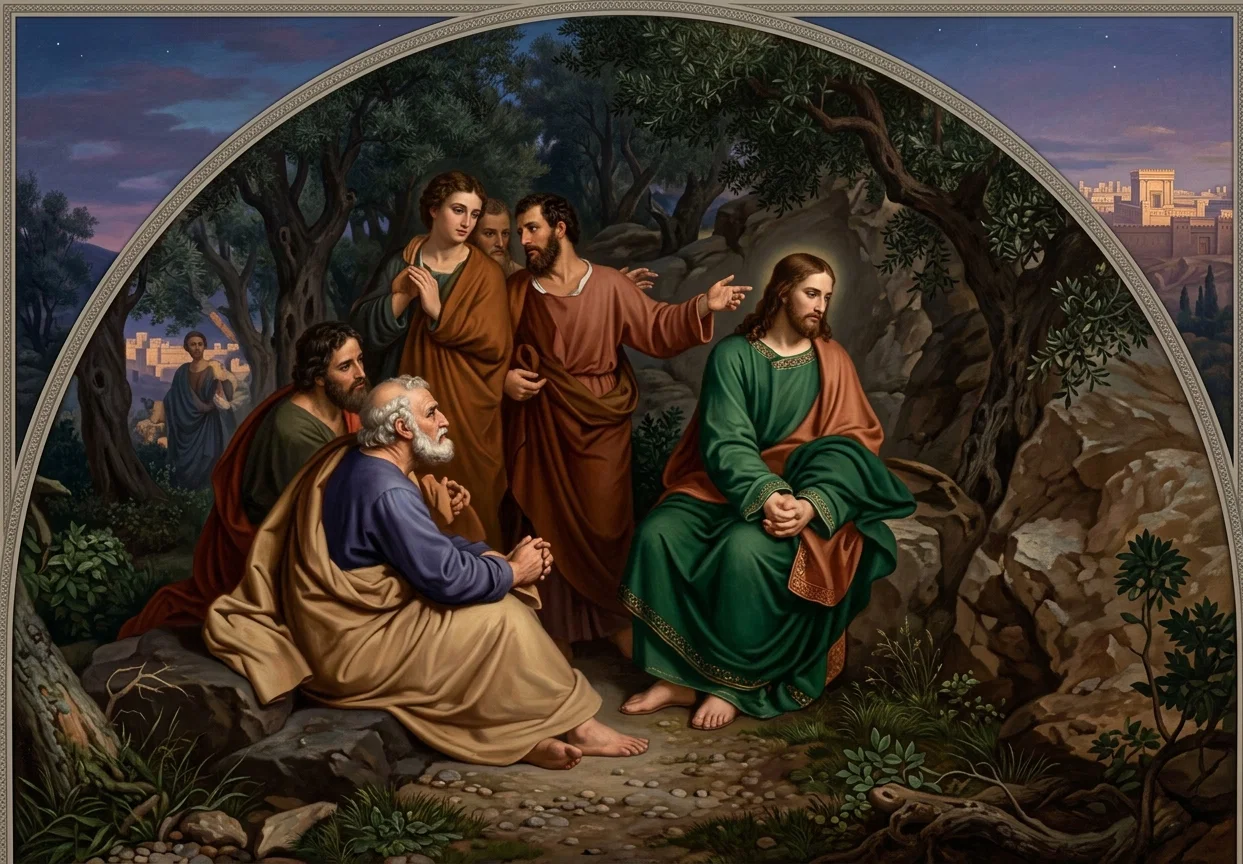
Jesus on the Mount of Olives Predicting the Destruction of Jerusalem and His Second Coming

A Warning for Our Day

Prophecy fulfilling in our day has been given by Christ and His apostles to protect the church against the deceptions of Satan concerning the character of Christ’s second advent to this world, and the dream of the world’s conversion before the coming of Christ. Note the warning:
“Then if any man shall say unto you, Lo, here is Christ, or there; believe it not. For there shall arise false Christs, and false prophets, and shall show great signs and wonders; insomuch that, if it were possible, they shall deceive the very elect. Behold, I have told you before. Wherefore, if they shall say unto you, Behold, He is in the desert; go not forth; behold, He is in the secret chambers; believe it not. For as the lightning cometh out of the east, and shineth even unto the west; so shall also the coming of the Son of Man be. . . . The powers of the heavens shall be shaken; and then shall appear the sign of the Son of Man in heaven; and then shall all the tribes of the earth mourn, and they shall see the Son of Man coming in the clouds of heaven with power and great glory.” Matt. 24:23-30.
“And as it was in the days of Noah, so shall it be also in the days of the Son of Man. They did eat, they drank, they married wives, they were given in marriage, until the day that Noah entered into the ark, and the Flood came, and destroyed them all. Likewise also as it was in the days of Lot; they did eat, they drank, they bought, they sold, they planted, they builded; but the same day that Lot went out of Sodom, it rained fire and brimstone from heaven, and destroyed them all. Even thus shall it be in the day when the Son of Man is revealed.” Luke 17:26-30.
“This know also, that in the last days perilous times shall come. For men shall be lovers of their own selves, covetous, boasters, proud, blasphemers, disobedient to parents, unthankful, unholy, without natural affection, truce-breakers, false accusers, incontinent, fierce, despisers of those that are good, traitors, heady, high-minded, lovers of pleasures more than lovers of God; having a form of godliness, but denying the power thereof; from such turn away. . . . But evil men and seducers shall wax worse and worse, deceiving, and being deceived.” 2 Tim. 3:1-13.
Heed the warning, and be not deceived.

3. Comfort to God’s People

The Bible presents promises and statements of unfulfilled events which are the prophetic landmarks of time, reaching into eternity. These prophecies form a large part of the written Word of God. The church has ever been called to look for the fulfilment of prophecy, and take comfort in its recognition.
Good old Simeon had long waited and looked, with many others, for the Saviour and the fulfilment of the promise made to Adam in Gen. 3:15, and to Abraham in Gen. 12:1-3. When he saw this partial fulfilment, he could but say, “Lord, now lettest Thou Thy servant depart in peace, according to Thy word; for mine eyes have seen Thy salvation, which Thou hast prepared before the face of all people; a light to lighten the Gentiles, and the glory of Thy people Israel.” Luke 2:29-32. Simeon saw but the beginning of the fulfilment of these promises. The hope of the full realization of this prophecy has been the goal for which the faithful of all ages have waited with expectancy. The mission of Christ to this world has only in part been fulfilled. The promise to Mary was that she should bring forth a Son whose name should be Jesus. “He shall be great, and shall be called the Son of the Highest; and the Lord God shall give unto Him the throne of His father David. And He shall reign over the house of Jacob forever; and ofHis kingdom there shall be no end.” Luke 1:31-33. This prophecy will be fulfilled when Christ shall take the throne of David, to reign on this earth forever.
  • (Continued on page 6.)*

Object of Prophecy

(Continued from page 4.)
Then, and not till then, will the purpose of God as foretold by the lone seer on the Isle of Patmos be realized. Then the sad experiences of this world associated with such expressions as “failure,” “deception,” “disappointment,” “jealousy,” “envy,” “bondage,” “hatred,” “oppression,” “disease,” “sorrow,” “war,” and “death,” must give place to the experiences known by “victory,” “righteousness,” “peace,” “joy,” “equity,” “riches,” “love,” and “life” unending, in the kingdom of Christ, and “glory.” Prophecy unveils the eternal world, and brings hope, which is an anchor to the soul, both sure and steadfast.

As God Sees Man’s View

By Abdiel
(Read Daniel 2 Carefully)
The second chapter of Daniel is preeminently a disclosure to man of God the Revealer.
Babylon was one of the mightiest empires of earth. She was great in extent, great in wealth, great in education, but far greater in her religious influence upon all the nations of earth then and thereafter. She has “made all the earth drunken; the nations have drunk of her wine.” Jer. 51:7; Rev. 18:3.
She reached the height of her glory under Nebuchadnezzar, one of earth’s greatest rulers, a mighty warrior, a great scholar, a wise statesman, a devout religionist. He took pride in the enlargement and establishment of the later Chaldean empire. He determined it should stand forever, yet questioned as to “what should come to pass hereafter.” Dan. 2:28–30. God, in answer to his longing desire, revealed it to him in a dream, which none of the wise men could tell or interpret. God gave through His servant Daniel—who gave to God all the glory—the dream and its interpretation.

This Is the Dream

**“Thou, O king, sawest, and, behold, a great image. This image, which was mighty, and whose brightness was excellent, stood before thee; and the aspect thereof was terrible. As for this image, its HEAD was of fine GOLD, its BREAST and its ARMS of SILVER, its BELLY and its THIGHS of BRASS, its LEGS of IRON, its FEET part of IRON, and part of CLAY. Thou sawest till that a STONE was cut out without hands, which smote the image upon its feet that were of iron and clay, and brake them in pieces. Then was the iron, the clay, the brass, the silver, and the gold, broken in pieces together, and became like the chaff of the summer thrashing-floors; and the wind carried them away, so that no place was found for them; and the STONE that smote the image became a GREAT MOUNTAIN, and filled the whole earth.” Verses 31–35, A.R.V.

Here Follows the Interpretation

“Thou, O king, art king of kings, unto whom the God of heaven hath given the kingdom, the power, and the strength, and the glory; and wheresoever the children of men dwell, the beasts of the field and the birds of the heavens hath He given into thy hand, and hath made thee to rule over them all; THOU ART THE HEAD OF GOLD. And after thee shall arise another kingdom inferior to thee; and another third kingdom of brass, which shall bear rule over all the earth. And the fourth kingdom shall be strong as iron, forasmuch as iron breaketh in pieces and subdueth all things; and as iron that crusheth all these, shall it break in pieces and crush. And whereas thou sawest the feet and toes, part of potters’ clay, and part of iron, it shall be a divided kingdom; but there shall be in it of the strength of the iron, forasmuch as thou sawest the iron mixed with miry clay.
“And as the toes of the feet were part of iron, and part of clay, so the kingdom shall be partly strong, and partly broken. And whereas thou sawest the iron mixed with miry clay, they shall mingle themselves with the seed of men; but they shall not cleave one to another, even as iron doth not mingle with clay. And in the days of those kings shall the God of heaven set up a kingdom which shall never be destroyed, nor shall the sovereignty thereof be left to another people; but it shall break in pieces and consume all these kingdoms, and it shall stand forever.”
“Forasmuch as thou sawest that a stone was cut out of the mountain without hands, and that it break in pieces the iron, the brass, the clay, the silver, and the gold; the great God hath made known to the king what shall come to pass hereafter; and the dream is certain, and the interpretation thereof sure.” Verses 37–45, A.R.V.
It needs but a few words of comment. The succeeding kingdoms are not symbolized by the anatomical parts of the image, butby the various metals. The head of gold represented Babylon, for which Nebuchadnezzar then stood; the golden kingdom of a golden age, but which closed its career of glory in B.C. 538, when it was succeeded by the Medo-Persian empire, the breast and arms of silver. Dan. 5:28, 30, 31.
The Medo-Persian empire lasted until B.C. 331, and was succeeded by Grecia, the “belly and thighs of brass.”
Grecia was, after years of struggle, in her divided state, finally conquered by the imperial iron monarchy of Rome, represented by the legs of iron. The mixing of the clay with the iron, representing the coming in of socialistic and republican principles, symbolized the breaking up of the Roman empire into various divisions. The same four powers are symbolized in Daniel 7 by cruel wild beasts.

Weakness of Human Government

Babylon was a unit. Medo-Persia became one. But Grecia, launched as one under Alexander, became later divided into four. Rome, beginning as one, represented by the strongest of metals, crumbled into numerous divisions, so to remain till the end of all earthly power.
That great image of a man represented the kingdom of man in this world. It tells us in a simple way just what all history demonstrates, that man has not within himself, however great or wise, the cohesive power, the principle of integrity, to hold together for long any kind of rule or government.
Charlemagne tried to unite the discordant elements of Western Rome, but he failed. Napoleon tried it, and failed. It has since been tried by means of intermarriage and diplomacy, but all its union and peace are as fragile as a spider’s web. God’s prophecy declares that so it will continue till He sets up His everlasting kingdom on the thither side of all the wreck of nations, at the glorious coming of the King of Kings and Lord of Lords. “And the dream is certain, and the interpretation thereof sure.”

As Man Sees God’s View

By Abdiel
(Read Daniel 3 Carefully)
WHEN God revealed to Nebuchadnezzar that the kingdom of Babylon and all that followed it would eventually crumble into dust, the mighty king could not have it so. He saw Babylon the head of gold, but he saw that head covering, controlling, transmuting all the future. It would be all gold; it must be all gold. It was unpatriotic, nay, it was treason, to think that Babylon, Babylon the rich, the great, the beautiful, the seat of learning and religion, would not stand forever.

A Monument to Patriotism

This Babylonian view must be left to posterity. Therefore Nebuchadnezzar made a great image, reaching to the height of one hundred and ten feet, all of gold in appearance, and set it up in the plain of Dura where all could see it as it reflected the dazzling splendor of the sun. It proclaimed Babylon forever. It was Babylon’s fetish of patriotism. Then the king made this proclamation:
“Then the herald cried aloud, To you it is commanded, O peoples, nations, and languages, that at what time ye hear the sound of the cornet, flute, harp, sackbut, psaltery, dulcimer, and all kinds of music, ye fall down and worship the golden image that Nebuchadnezzar the king hath set up; and whoso falleth not down and worshipeth shall the same hour be cast into the midst of a burning fiery furnace.” Verses 4-6, A.R.V.
Read the story. There were those in Nebuchadnezzar’s dominion who had seen God’s view of the nations. They could not fall down to the human or the human idea against God’s truth, however beautifully clothed, or howsoever much of earthly power there might be behind it. They must stand as the representatives of the God of truth and right.
And they did stand. The proclamation was kindly repeated for their sakes. Nebuchadnezzar knew somewhat of their worth, but he divorced it from God, the one thing only which made them the men they were. The great assembly again bows in worship; the men of God — Shadrach, Meshach, and Abednego — remain erect.
They are called before the haughty and enraged monarch. They quail not; they have seen a Greater in His love. They are cast into the fiery furnace, and lo, the Greater goes with them and delivers them unharmed, while the minions of the promoter of patriotism against God perish in the fierce flames which would not touch the worshipers of the Most High.
Continue reading: An Enemy of Truth