Your ShelfYour Projects

Signs of the Times, Vol. 26, No. 23.

THE LESSON OF THE RUINS

Signs of the Times

Jun 6, 1900

Pacific Press Publishing Company · Oakland, California · Jun 6, 1900

THE LESSON OF THE RUINS.
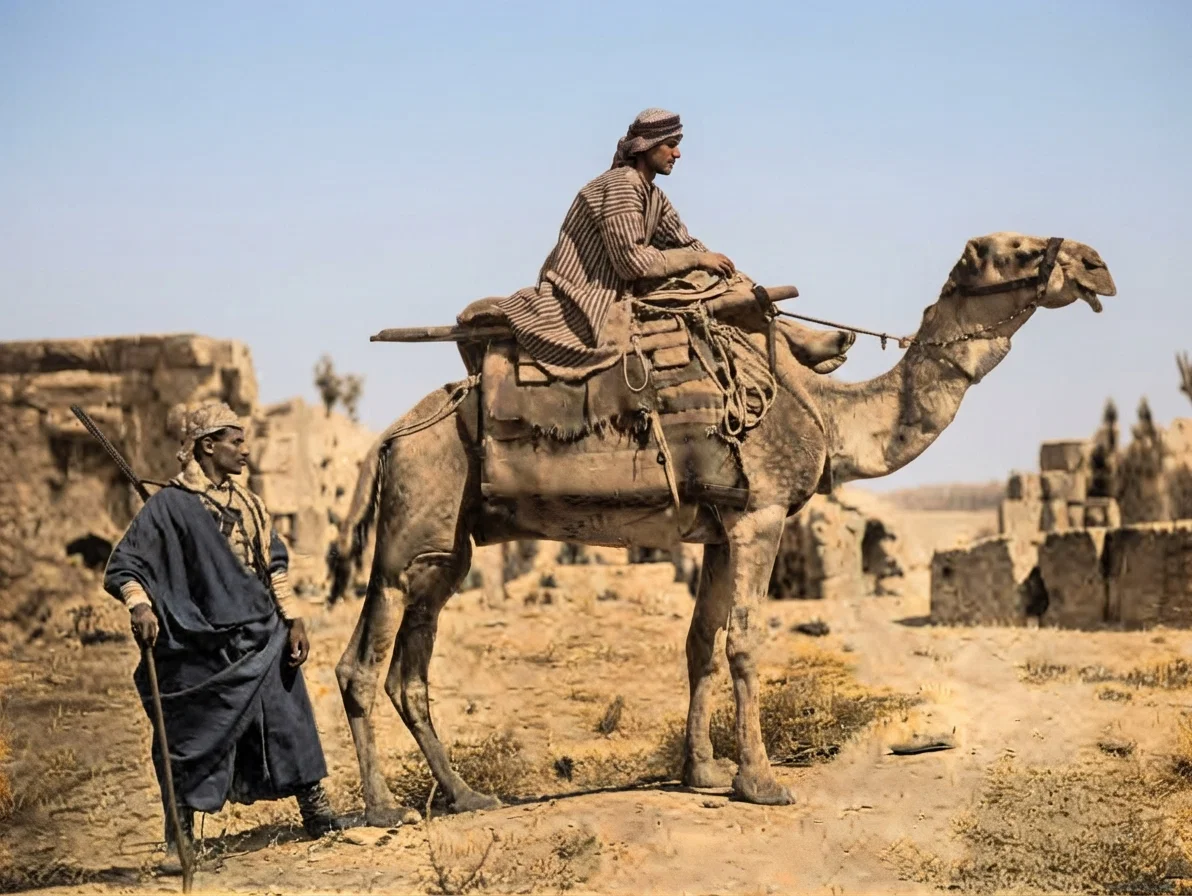
THE hand of sin has written death around the circle of the world. The owl and bittern are droning the epitaph of human greatness on the sites of ancient cities. Where once the cohorts of kings clanked through marble halls, the shifting sands are deepening now under the feet of desert winds. "Passing Away" is graven with the finger of Time on all that man's hands have reared since the flowers of Eden faded and fell under the blistering touch of sin.
The winding-sheet has covered Nineveh, and her sun-baked bricks have crumbled back to the dust from whence they came. The marble temple of Karnak—most magnificent monumental structure ever reared by man—is humbled in the dust, and her pillars rise out of a sea of sand like the masts of sunken ships. The pyramids of Ghizeh, built to defy time and tempest, are yielding reluctant witness to the transitory existence of man and all that man has made.
ARABS ROAMING AMONG EGYPTIAN RUINS.
But these are not all. Every country in the world has its prehistoric records, in crumbling ruins, or chisel tracings in time-worn stone, translated or still unread. The architecture of Egypt is contemporaneous with the bramble-covered and tree-capped ruins of Central America. The mound-builders and the cliff-dwellers were busy with their pottery and their idols when the Cymri were roaming over ancient Europe; when Gog and Togarmah were powers in the earth, and when the Incas and the Aztecs were reveling in riches and idolatry, sacrificing human beings to the Molechs of the western world. While the American Indian was creating poetic legends for his posterity, the people of ancient Memphis and Babylon were reading their horoscopes and studying the secrets of the stars from pyramid and Babel tower.
Now the Turk, the Arab, the Egyptian, the Maya, the Navajo, and the white man, roam over the ruined temples of their ancestors, and learn, if they will, the lesson which the ruins teach. It is the lesson of the thorn and the bramble, the thistle and the tare. Disobedience to the Architect of the universe has strewn the ruins of human architecture over the surface of the earth. As Adam read the result of the fall in the weariness of the flesh through his combat with the thorn and thistle, so do his posterity read it in the wrecks of human handiwork from Mexico to Nineveh, in Tyre and Memphis, in Thebes and Carthage.
The curse of sin hangs heavy on the world. All that art and wealth could bring were lavished on the idol temples of Thebes and Memphis, of Carthage, Tyre, and Babylon, wherein immorality deified lust, and the human worshiped the human through Baal, Molech, and Ashtaroth. The beautiful mosaics in the temples of ancient Carthage (older than Tyre and Rome) were executed to the honor of heathen gods; the beautiful sculpture exhibited in the marble ruins of Karnak ascribe worshipful praise to the sun-god, the crocodile, and the sacred beetle.
But God declared: "I am against Pharaoh king of Egypt, and will break his arms;" "The sword shall come upon Egypt, and great pain shall be in Ethiopia;" "They also that uphold Egypt shall fall;" "They shall be desolate in the midst of the countries." "I will also destroy the idols, and I will cause their images to cease out of Noph [Memphis]; . . . and will execute judgments in No [Thebes]. . . . I will pour My fury upon Sin, the strength of Egypt." Ezekiel 30. "I will punish the multitude of No, and Pharaoh, and Egypt, with their gods, and their kings." Jer. 46:25. "I will make the land of Egypt utterly waste and desolate, from the tower of Syene even unto the border of Ethiopia." Eze. 29:10.
And her punishments came in fire and sword from the delta to Ethiopia, as God had declared. God had set Himself against her idols and her idol temples, and she has become the "basest of kingdoms;" and now the cry of her people for bakshish is heard wherever a stranger sets foot upon her soil. From glory to dishonor, from wealth to beggary, she has fallen through devotion to her idols.
Babylon, her sister in sin, the patron of Baal, the envy of the nations,—Babylon, the "glory of the Chaldees' excellency," has sunk into forgotten mounds, crushed beneath the ponderous idols Jehovah has overthrown. Babylon would build to heaven a gateway of her own; but God smote her tower and confounded the tongue of her people. Babylon would trust in gods of her own creation; and Jehovah buried her among their shattered ruins. In pronouncing woe upon Babylon for her wickedness, the Lord had said, "I will also make it a possession for the bittern, and pools of water; and I will sweep it with the besom of destruction." Isaiah 14:23.
The besom of destruction has swept the site of that ancient city; for God has punished Babylon, as He said He would do. Jehovah said, "Thou shalt have no other gods before Me;" but Babylon was filled with idols and wickedness. Jehovah said, "Thou shalt not bow down thyself to them nor serve them;" but Babylon's service was wholly in her idol temples—she had forgotten God, or "glorified Him not as God;" but changed His glory "into an image made like to corruptible man, and to birds, and four-footed beasts, and creeping things." Rom. 1:21, 23. Thus suffered the idolatrous nations for forsaking God and turning from His commandments to the commandments of men.
The lesson of the ruins is this: God will not permit the breaking of His law. The nations who have thus trespassed have fallen among the ruins of their temples. God is the same yesterday, to-day, and forever. The law of His kingdom is as immutable as the kingdom itself is eternal. The nations and peoples who forget Him now and turn from His law will perish as did the nations of old. The Lord tells us plainly that all His "commandments are righteousness;" that that "righteousness is an everlasting righteousness;" "and every one of Thy righteous judgments endureth forever." Ps. 119:172, 142, 160. "All His commandments are sure. They stand fast forever and ever." Ps. 111:7, 8.
If "every one" of those judgments, or commandments, endure forever, then "every one" of those "ten words" are as binding upon the people of this age as they were upon the condemned and executed ancients. If God "visited" them for their transgressions, He will not pass over the breaking of His law by their remote descendants of the present day. The ancients are telling us this through the ruins of their overturned temples. God's declaration of their punishment and their mute witness to its execution, leave us without excuse in tampering with His law, or breaking even one of its precepts.
Destruction is still decreed for "the nations that forget God," the destruction of the last day. Ps. 9:17. It is the destruction of the "day of the Lord," "in the which the heavens shall pass away with a great noise," and "the earth also and the works that are therein shall be burned up." 2 Peter 3. Then will the earth in its entirety lie as desolate as Carthage and Nineveh now are (Isaiah 34), until the New Jerusalem descends "from God out of heaven, prepared as a bride adorned for her husband," to become the capital of a renewed, re-created earth. Then will the curse be wiped away. The ruins of the temples of sin will be seen no more. The deserts will blossom as the rose (Isaiah 35); and those who have yielded to God, and have obeyed His Word, will dwell in that land forever.
Let us learn the lesson which God has for us in the destruction He has brought upon the nations that trampled on His law.
C. M. SNOW.

LOVE FULFILS THE LAW.

IN point of obedience does God require more of a fallen world than He does of the unfallen worlds?—Inasmuch as God is no respecter of persons, and He changes not, and is "the same yesterday, to-day, and forever," His requirements must be the same throughout the universe. Supreme love to God is one of the conditions—we may say, is the condition—of our salvation. Does God require less of the sinless inhabitants of the celestial worlds? Can He require less of any being, and be God? The answers must be self-evident. But let us test the question by the never-failing Word.
"Master," said an ancient Pharisee, "which is the great commandment in the law? Jesus said unto him, Thou shalt love the Lord thy God with all thy heart, and with all thy soul, and with all thy mind." Matt. 22:34-40. Does God require less of sinless beings? Can He ask for more?
Now consider further what saith the Master: "This is the first and great commandment." "First," that is, before all others—the first, no other before this one. Not only first in importance, but first in point of time as well; for just as soon as there was a created being in the universe, there existed certain relations between the Creator and the created. And with these relations came certain obligations, resting upon both the Creator and the created. Upon the first rested the obligation of giving all needed blessings for the happiness of the created; and upon the second, the obligations of supreme love, for his very existence, and for all these needed blessings. Hence the one "first and great commandment."
But, coupled with this "first and great commandment," we find another, "Thou shalt love thy neighbor as thyself." Let us consider them together. Then let the mind go back to the first created being. Suppose this to be an angel; for they are created beings. The angels were placed on probation. This is so, because some of the angels have fallen. They could not have fallen if they had not been placed on probation.
What was the test of their loyalty to the Creator?—Evidently, obedience to the "first and great commandment," and to the other which "is like unto it." This is certainly so; for the very moment an angel was brought into existence, that moment there existed the relations between the Creator and the created; and when there was more than one angel, there came also the relation between the created ones. And out of these relations there came the duty to love the Creator with all the heart and with all the soul, and the duty to "love thy neighbor as thyself."
Further, when, out of that relation between the Creator and the created there came the divine principle of supreme love to the Creator, it was only the returning to God that which He had given. God loved the creature with the greatest of love, even supreme love, which is evidenced in His love for a fallen world: for nothing less than supreme love could consent to redeem a fallen world at such a fearful cost, even the death of the Creator Himself. Calvary is the measure of the supreme love of God for His creatures. "I have loved thee with an everlasting love" (Jer. 31:3), is the testimony of the Holy Spirit. "Behold, I have graven thee upon the palms of My hands" (Isa. 49:16), are the words of the Man of Calvary. Those scars upon those sacred hands will attest throughout all eternity the depths of the love of God and of Christ for created beings. Hence, supreme love to God is a most sacred obligation resting upon the creature, whether angel or man.
As before stated, at the moment that there were two or more angels, there were other relations—relations between created beings who were upon a plane of equality between themselves, under the Creator. Out of these relations came the obligations of the second commandment: "And the second is like unto it, Thou shalt love thy neighbor as thyself." Thus is seen the relation of neighbors. And all were under equal obligations to love the Creator, who bestowed all things, and under equal obligations one to another,—"love thy neighbor as thyself." Each one needed all these things. And God has so arranged these relations that each can minister to the other in unselfish devotion.
Thus, first in importance and first in point of time, are these two great commandments. No wonder that Christ said, "On these two commandments hang all the law and the prophets."
Here, again, we see that God deals with all alike, for "there is no difference." God requires no more of the one who has sinned than He does of the one who never sinned. And He does require the same obedience from the sinless beings as from the one who is all stained with sin. The sinless ones have always been obedient, and ever live by faith, and are saved by faith. But of the sinner it is said, "For by grace are ye saved through faith." The sinner, having been disobedient, must repent of his disobedience, and live by faith; for it is written, "Now the just shall live by faith." Heb. 10:38. And so, repenting of sins, and living by faith, the sinner is elevated to the same plane as the sinless ones who have always lived by faith, and always been obedient. And, living by faith, he can be just as obedient as the angels of God. Praise the Lord for the provisions of His grace.
H. F. PHELPS.

DID CHRIST CHANGE THE SABBATH?

[This is the twelfth article in the series.]
BUT the question will be asked, Did not Christ change the Sabbath? Let another question be raised, Why should He change it? We have seen that He instituted it, making it for man, declaring that He, man's Lord, is Lord also of the day which was made for man. Mark 2:27, 28.
We have seen also that it was the sign of His sanctifying power, which is His power to create. But the sign of His power to create must remain the seventh-day Sabbath; for the reason of its institution is that "in six days the Lord made heaven and earth, the sea, and all that in them is, and rested the seventh day; wherefore the Lord blessed the Sabbath day, and hallowed it." Hence the Saviour said: "Till heaven and earth pass, one jot or one tittle shall in nowise pass from the law, till all be fulfilled." "Heaven and earth shall pass away, but My words shall not pass away." Matt. 5:18; 24:35; Luke 16:17.
It is not within the scope of this writing to note extensively the attitude which Christ and the apostles maintained toward the Sabbath, but the following points, with Scripture citations, are given for the reader's consideration:—
1. Christ Himself observed the seventh-day Sabbath. Luke 4:16; John 15:10.
2. After His crucifixion, and the ratification of the new covenant, the disciples still kept the "Sabbath day according to the commandment," which is the seventh day. Luke 23:56.
3. Looking forward to the destruction of Jerusalem, A.D. 70, the Saviour recognized the seventh-day Sabbath as an existing institution. Matt. 24:20.
4. Near the close of the first century of the Christian era (A.D. 97) John wrote his Gospel, and the Spirit of inspiration recognized then the existence of the seventh-day Sabbath. John 9:14, 16.
5. The "beloved disciple," a Christian, writing, in the Christian dispensation, to Christians, the Christian faith of the new covenant, identifies the "Christian" Sabbath with that instituted at creation on the seventh day. John 9:14, 16; 5:9, 10.
6. The same writer, under the same circumstances, speaks of the first day of the week in precisely the same manner as did the Creator in the beginning, when, having performed labor thereon, He constituted it one of "the six working days." John 20:1, 19; Gen. 1:5; Eze. 46:1.
7. On the evening of the "first day," on which occurred the resurrection of our Lord, the disciples were not assembled in honor of the event, as the following considerations will show: (a) The disciples "sat at meat." Mark 16:14; Luke 24:41, 42. (b) They were at home; for they had a common dwelling. Acts 1:13. (c) They did not believe that the resurrection had really taken place. Luke 24:37-41; Mark 16:11-14.
8. The apostle Paul expressly states that he believed in the seventh-day Sabbath, that being a part of the law. Rom. 2:17-20.
9. His faith was made perfect by works (James 2:22); for in His life He observed the seventh day (Acts 17:2; 18:1-11).
10. The only day which the Bible anywhere recognizes as the "Lord's day" (Rev. 1:10), or in any sense as sacred, is "the Sabbath of the Lord," the Lord's (rest) day, the Lord's (holy) day (Ex. 20:8-11; Isa. 58:13). Of this day, which was "made for man," Christ (man's Lord) is Lord. Mark 2:27, 28.
11. Redemption needs no celebration as yet; for it is still incomplete. Rom. 8:23; Eph. 1:14.
12. Redemption is a work of creation (Eph. 2:10); hence its sign will ever be that of creation, the Sabbath of the Lord (Ex. 31:13). The seventh-day Sabbath, therefore, will be observed by the redeemed. Isa. 66:23.
13. Christian baptism is a symbol of Christ's burial and resurrection; hence, these, commemorated thus by baptism, need no other memorial. Rom. 6:3-5.

The Change Made Later Than Apostolic Times.

Having briefly noted the Scripture evidence, the reader will now be interested to observe the testimony of uninspired writers respecting the origin of the observance of the first day of the week:—
SABBATH.—These arguments [for the change of the Sabbath], it is true, are not satisfactory to some, and it must be confessed that there is no law in the New Testament concerning the first day.—Schaff-Herzog Encyclopedia.
When, why, and by whom was the day of rest changed from the seventh to the first day? Answer.—The Sabbath was changed from the seventh to the first day of the week, not by any positive authority, but by a gradual process.—Christian Union, Question Corner, June 11, 1879.
SABBATH.—No formal decree changed the Sabbath from the seventh to the first day.—Englishman's Critical and Expository Bible Encyclopedia.
SABBATH.—At what date the Sunday, or first day of the week, began to be generally used by the Christians as a stated time for religious meetings, we have no definite information either in the New Testament or in the writings of the fathers of the church. By none of the fathers, before the fourth century, is it identified with the Sabbath, nor is the duty of observing it grounded by them either on the fourth commandment, or on the precept or example of Jesus or His apostles, or on any ante-Mosaic law, promulgated at creation, and continuing in force after the coming of Christ. Unquestionably the first law, either ecclesiastical or civil, by which the sabbatical observance of the day (Sunday) is known to have been ordained, is the edict of Constantine, 321 A.D.—International Cyclopedia.
Note the above carefully. "No definite information" is had concerning the origin of the Sunday sabbath "either in the New Testament or in the writings of the fathers of the church." Why the "fourth century" marked an epoch in the development of Sunday sacredness, will appear later. The first "law" in favor of Sunday was Constantine's edict of 321 A.D.
SABBATH.—There is no indication that He [Christ] engaged in any secular toil on that day [the seventh] or encouraged His disciples to do so. . . . On the contrary, Christ habitually attended the synagogue with His disciples, and thus bore His testimony to the value of the day as one both of religious observance and of rest. . . . The whole tenor of the teaching of the apostle Paul, whatever opinion may be entertained respecting the interpretation of particular passages, looks in the same general direction. At first the Christians observed the Jewish Sabbath, tho with increasing irregularity, as the Gentile element more and more predominated. But they also observed the first day of the week as a commemoration of the resurrection of our Lord. This they therefore called the Lord's day, and, later, Sunday, borrowing this name from the heathen, by whom the first day of the week was dedicated to the sun. At length the change from the seventh to the first day of the week was officially recognized and embodied in an edict of Constantine, 321 A.D. Custom, however, added to this law, and the church soon embodied these customs in more stringent provisions.—Abbott & Conant Dictionary of Religious Knowledge.
Observe in the foregoing that Christ "habitually" kept the seventh day, and likewise also the disciples. "The whole tenor of the teaching of the apostle Paul" is to the same effect: The name of the first-day sabbath is borrowed "from the heathen," which name, after "law" had recognized it, and "custom" adopted it, was taken up by a popular and world-loving church.
SABBATH.—Even after the death of Christ there is no formal abrogation of the Sabbath. The apostles seem still themselves to have kept it in the Jewish manner. . . . And the Ebionites insisted on the keeping of the Sabbath. Nor is there anywhere in the New Testament any express statement that the first day of the week was to be kept in place of the seventh, or that the Lord's day represented, or was in any way, the Sabbath. . . . A large body of Christians maintain that with the death of Christ the seventh-day Sabbath ceased for Christians, and that the first day, or Christian sabbath, naturally and inevitably took its place. Without citing any explicit authority for the substitution, they insist that the fourth commandment was a perpetual obligation as regards keeping holy one day in seven. . . . It must certainly be admitted that the earliest Christian writers do not identify the Sabbath and Lord's day; none of the fathers before the fourth century ground the duty of observing Sunday upon the fourth commandment, or on the precepts or example of Jesus or the apostles.—Chambers' Encyclopedia.
Thus do we see that no less an authority than "Chambers' Encyclopedia" is unable to find any "formal abrogation of the Sabbath," even the apostles keeping it "in the Jewish manner." Not "anywhere in the New Testament" is there a warrant for the Sunday sabbath. Those who accept the change do so "without citing any explicit authority for the substitution." Not until the "fourth century" was any effort made to "ground the duty of observing Sunday" on any Bible foundation. We shall in due time see what occurred in the "fourth century," to give prestige to the observance of Sunday. "The Ebionites insisted on the keeping of the Sabbath." Who were they?
EBIONITES.—A term applied, probably, at the beginning of the Christian church to all Christians; afterwards the general name by which all Jewish Christians who remained outside the Catholic Church were designated, after the apostolic age, down to the time of Jerome.—Chambers' Encyclopedia.
In this connection note two points: (1) The Ebionites were Christians who kept the Sabbath. (2) They remained outside the Catholic Church. The full significance of this will appear later. H. C. GILES.

OPPORTUNITY.

Broom-corn first grew in India. From there it was carried to Europe. Dr. Benjamin Franklin was once examining a whisk-broom that had been brought over from England in the days before we had any broom-corn of our own. He found a single seed on the broom, picked it off, planted it, and raised a stock of corn, from which is descended all the broom-corn of the United States. Franklin was one of the men whose eyes were always alert for possible opportunities to enrich his time and the world. The people of the observing eye and the alert mind and heart are those to whom opportunities do not come in vain.—Homiletic Review.

THE FUTURE OF SPIRITISTIC WORSHIP.

[This is article twelve of the series.]
THERE is a diversity of opinion as to the outcome of spiritistic developments.
Some have felt inclined to make light of the whole thing, as tho it were one of those incidents which succeed each other, to be popular for a time, and then vanish out of sight. If it were a new thing in the world, this might be the case. But, inasmuch as, in one form or another, it has been prominent since the meeting with Satan and the first pair in Eden, there is no such a prospect. The foundation principle on which the whole thing is built is the falsehood told by Satan to the woman to induce her to turn against the authority of God, namely, "Ye shall not surely die." Gen. 3:4. The belief of this sentiment, which was in direct opposition to God's earlier instruction, placed the first pair in the ranks of heaven's enemies. It is therefore not surprising to learn that this same sentiment has ever since been the belief of all heathen nations.
The singular part of the account is that a great portion of the religious world,—those who profess to be loyal to Jehovah,—should adopt as a fundamental doctrine the very sentiment that first placed man on the side of God's enemy, and which is now maintained by the worshipers of stocks and stones. On this ground, if on no other, Christians should question the stability of the doctrine. The Bible very clearly points out that in olden times God visited severe punishments upon those of His people who were found believing this doctrine of the heathen around them. Among other words of caution given the people of Israel, as they were about to enter the land of Canaan, after their bondage in Egypt, the Lord said: "The soul that turneth after such as have familiar spirits, . . . I will even set my face against that soul, and will cut him off from among his people." Lev. 20:6. This was the law against following after spirit mediums then. Now for the reason: "Ye shall not walk in the manners of the nation, which I cast out before you; for they committed all these things, and therefore I abhorred them." Verse 23.
Consulting persons having familiar spirits was one of the "all these things" mentioned as having been practised by the former heathen dwellers in Palestine, and which made them so abhorrent to God. It was, in fact, one of the prominent signs of heathenism. For this reason God would have none of it among His chosen people. It was partly for this cause that Saul, the first king of Israel, was deserted of God, and permitted to be slain by the enemies of Israel. Instead of inquiring of God for direction in guiding the people committed to his care, he went by night to counsel with a woman of Endor, who claimed to be endowed with the power to receive messages from the dead to the living. 1 Sam. 28:7-17. Soon Saul fell in battle, and the record is that he "died for his transgression which he committed against the Lord, . . . and also for asking counsel of one that had a familiar spirit, to inquire of it." 1 Chron. 10:13.
Heathen nations have ever had their conjurers, seers, and medicine-men, of whom all members of their tribes have stood in fear, because of their supposed connection with departed spirits. But until the present generation the prominent features of this heathen cult, outside of its basic principle, were confined to those outside of Christianity. In 1848, however, there appeared what was then known as the "Rochester knockings." These raps on tables and other articles of furniture came in response to questions asked by the mediums, and varied in the number of distinct sounds each time, according to whether the question propounded demanded an affirmative or negative reply. Leading men, like Judge Edmonds, of New York, investigated and reported that the table-rapping came from some intelligent source, which they believed to be the spirits of the dead. Some believed, and others scoffed. Meanwhile other features developed, such as slate-writing, table-tipping, and trance communications. Next, undoubted miracles of various sorts were announced, and thousands were drawn toward the wonderful movement.
But for one thing it seemed as tho the whole world would go after it. Its success seemed so nearly achieved that its prominent advocates began to speak and write against the Bible, against Christ, and against God. This was too much for some staid church-members and others, who, while endorsing the doctrinal basis of the thing, that the dead can return to converse with and so influence the life-work of the living, halted at the verge of its noisy infidelity; and so the tide was for a time turned.
Later, however, Spiritistic believers changed their tactics. They ceased berating Christianity, talked more rationally about God and the Bible, and even adopted forms of Christian worship in opening and closing their meetings. The infidelity contained in the practise of spirit inquiry has been covered as best it could be, until many are again looking favorably upon Spiritism, while yet retaining their formal connection with some branch of the Christian church. This state of things has called out a prediction from Mr. J. J. Morse, of England, which was printed in Borderland of January, 1894, and is as follows:—
Practically my conclusion is that presently Spiritualism will be a concrete term covering and embodying the best and truest thought and practise conducive to a new religious life, a truer moral impetus, a loftier social ideal, and a better political estate, for us here on earth. It will rest on the rights and nature of man, the facts of existence, and the laws of being. The pulpit will cease to denounce, the press to sneer, society to ostracize. For the present let us remember that no happy future is ours unless it rises from a virtuous and earnest living present. Let us labor to help our cause to future greatness by our present earnestness.
This very thing is now being fulfilled, and Spiritism, once everywhere spoken against as an ism, is now being accorded a place among the recognized religions of the day. At the present rate of progress it is making, there is no reason to dispute the statement that it will sometime be considered blasphemy to speak against the work of Spiritism. But this can only prove true upon the fulfilment of another prediction given in the Word of God.
Referring to the closing scenes of earth's history, and that which is to lead the whole world into a position where it will not only be unprepared for the coming of the day of God, but will actually be arrayed against Christ, to oppose His triumphant coming to earth (Rev. 19:11-20), the prophet lets out the secret of this spirit of opposition. He says: "I saw three unclean spirits like frogs come out of the mouth of the dragon, and out of the mouth of the beast, and out of the mouth of the false prophet [expressions applying to Satan and the persecuting nations of earth]. For they are the spirits of devils, working miracles, which go forth unto the kings of the earth and of the whole world, to gather them to the battle of that great day of God Almighty." Rev. 16:13, 14.
By this it will be seen that the whole world, including heathen, is to be involved in this terrible catastrophe, and the cause of the dreadful finishing stroke is the work of unclean spirits which issue from the mouths of Satan and those nations under his direction and control. This being true, there must issue from the depths of heathen doctrines some form of Spiritism which, with other phases of it, will take its place among the religions of the civilized world. The initial step in this direction has already been taken, and soon the world may expect to see a close fellowship between an ancient heathen cult bearing a modern name, and that phase of Spiritism so readily endorsed by many who think themselves Christians of an advanced class. But the consideration of that point must be reserved for a following paper.
[The next article in this series will be "The Connection between Theosophy and Spiritism."]
Continue reading: "GO, WORK TO-DAY IN MY VINEYARD." No. 2.