The first verse of Second Timothy, third chapter, reads, "This know also, that in the last days perilous times shall come." And the thirteenth verse of the same chapter says, "Evil men and seducers shall wax worse and worse, deceiving, and being deceived." Not only are these "evil men and seducers" acting as deceivers, but they are "being deceived" themselves. They are deceived by the same deceptions with which they deceive others. And this gives an earnestness to their work that will greatly conduce to the production of the "perilous times" in these "last days."
THE FIRE-WALKERS OF FIJI.
By J. E. Fulton
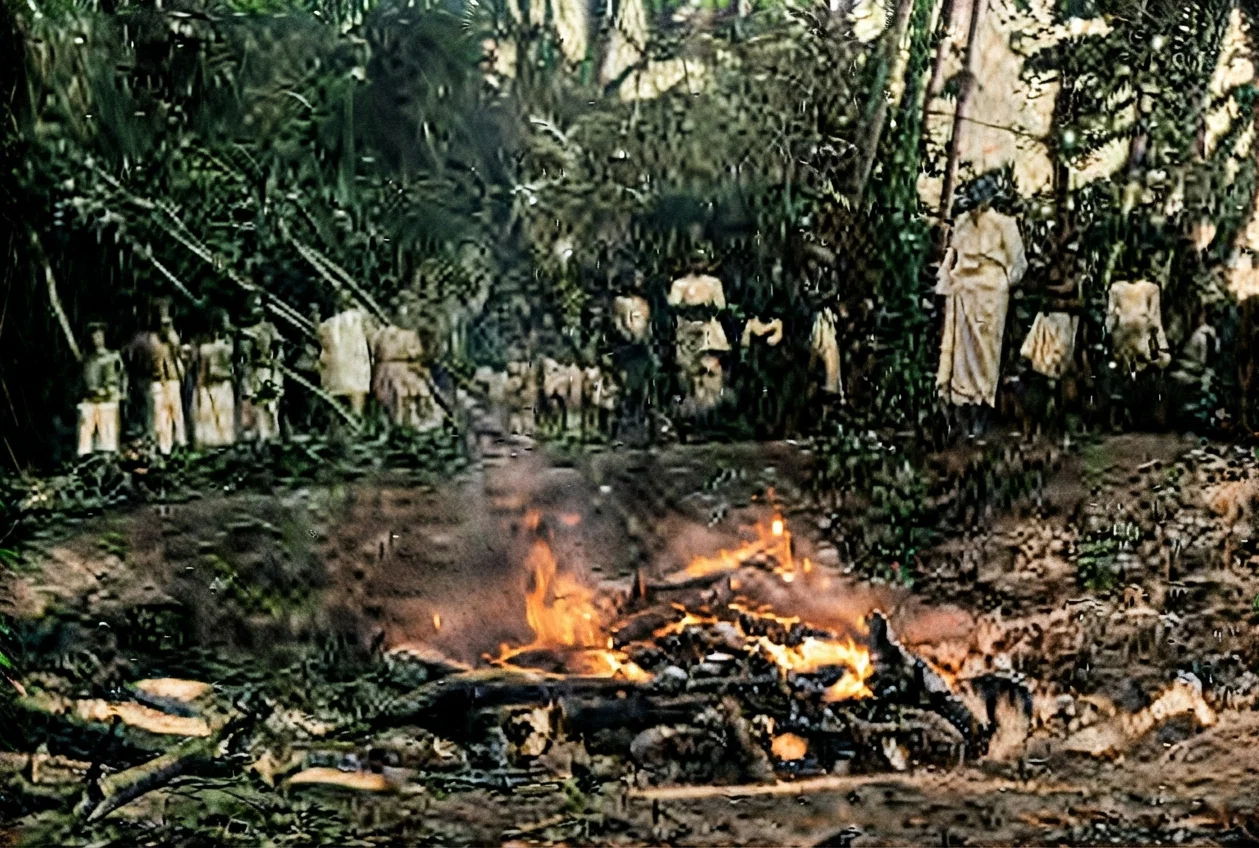
THERE are many strange sights in Fiji, but perhaps the most wonderful is walking over rocks heated to a white heat. This power is by no means universal among the Fijians, being confined to a tribe on the island of Beqa (Benga). For this fire ceremony a native oven, or pit, twenty or twenty-five feet in diameter and four or five feet deep, is dug out of the earth. This pit is paved with hard, smooth stones of various sizes. Over these logs are placed, and a fire is kindled which burns till the stones are intensely hot.
Some idea of the heat will be gained from these facts: Visitors are compelled to stand at a distance from the bank of the pit, because of the great heat; handkerchiefs thrown on the rocks, which are naturally black, but now white with heat, almost immediately blaze; just before the performance takes place, green poles are cut with which to level the rocks in the bottom of the pit, and soon after coming in contact with the rocks, these sappy sticks blaze. A thermometer suspended over the pit registered 280° F., when it had to be removed, as the solder of the tin covering began to melt.
HEATING THE STONES.
Says Mr. F. C. Eddy, who witnessed the ceremony a few months ago:—
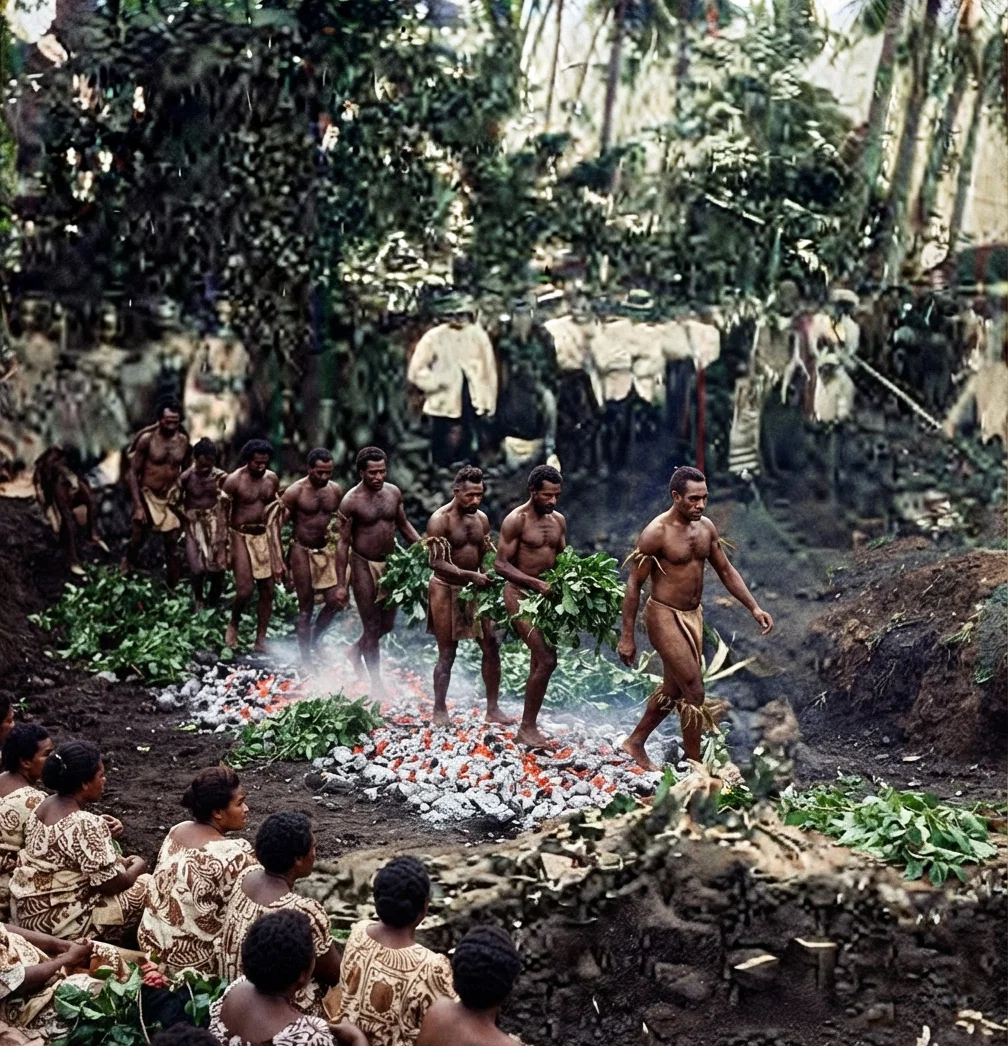
The heat of the stones at this time would probably be 400° F., when the embers were dragged away, and the stones were leveled in native fashion, and at a given signal ten men, almost nude and with bare feet, first two deep, with their arms clasped round one another's shoulders, stepped across the white-hot stones, walked round the pit, and advanced again in single file without being harmed. As soon as the last man had passed over, armfuls of branches and freshly-plucked leaves of the hibiscus were thrown on the oven, and the performers either stood or squatted amongst them. A dense cloud of steam and smoke and a curious smell of burning at once arose.
Amongst the party of spectators were four medical men, three clergymen, and several missionaries. The doctors examined the feet of some of the fire-walkers both before and after the performance. There did not appear to have been any special preparation for the ceremony. The heat had not affected their feet, nor did the men show any signs of distress after the fiery ordeal to which they had subjected themselves.
WALKING THROUGH THE FIRE ON THE HOT STONES.
In discussing the matter afterwards, none of the visitors could furnish any scientific explanation as to how the people accomplish the feat without injury, nor have I since been able to obtain any practical solution of the seeming miracle. No one ventured to suggest at the time that there was any deception on the part of the performance.
This feat has been attempted by other tribes of the Fijian race, but with disastrous results. It is said, however, that in the Society Islands and in Central Africa there are tribes who possess this power.
One of the Fijian legends with reference to this ceremony is to the effect that a supernatural being gave one of the chiefs this power, which has descended to posterity.
J. E. FULTON.
WEST INDIA FIELD.
By C. A. Hall
[From our missionary in the West Indies.]
THE hundreds of islands lying off our southern coast have been brought into prominence by the events of the past few months, and the attention of statesmen, capitalists, and missionaries is now especially called in that direction.
The history of these islands is a peculiar one, embracing as it does discovery, wars, conquest, and oppression in varied forms.
At the present time their territory is divided among the five powers of Great Britain, France, Denmark, Holland, and the United States, with the island of Haiti as an independent republic. Their area is about 95,000 square miles, or nearly that of Michigan and Ohio combined, with a population of over 5,000,000, or nearly equal to that of the State of New York. Of this number two-thirds are black and the remaining one-third consists of whites, Chinese, Coolies, and the colored or mixed people.
Cuba, with its 1,500,000, has 1,250,000 of blacks and colored, the others being of Spanish descent. Haiti is credited with but a few whites, while Porto Rico is about equally divided between the two races. In Barbadoes the whites average one in eighty-five, while Jamaica is credited with three per cent. of whites in her population of 700,000.
The blacks in the British island were liberated in 1838, and at that time the London Missionary Society, sending its missionaries among them, reaped a bountiful harvest.
A significant item of that work is that a single ship brought a load of 59 tons of Bibles to the West Indies at that time. The after results have been large congregations, with immense churches, but left without pastoral attention, so that the moral condition of the masses is but little improved from their aboriginal state.
One evidence of that fact is that the official10record of births in the island of Jamaica shows that over 60 per cent. are illegitimate.
The great need of a message that will change men's hearts and lives, and of pastoral work that will bring preacher and people into closer relationship, is everywhere apparent.
The message of a soon-coming Saviour, and the call to obey all God's commandments, altho much opposed by the clergy, are well received by the people; and, tho it is but a few years since they have been proclaimed here, yet many are rejoicing in a new-found hope and a changed life.
And now, with wide-open doors, all these islands demand at our hands the saving message that God has intrusted to us.
Brethren and sisters, "come over and help us." Never mind your pleasant homes and agreeable surroundings while here there are thousands going to perdition for want of the message that has warmed your hearts. God's promises to the workers are worth more than houses or friends, and never was there greater need of consecrated labor than now, and never was there a people more needy or more eager for the message of the Lord's soon coming than these. Churches must be built. Schools must be established, and God-fearing men and women are needed who know no discouragement and will shirk no labor that has for its object the salvation of this downtrodden race.
C. A. HALL.
SPEECH.
By Ella Wheeler Wilcox
TALK happiness. The world is sad enough
Without your woe. No path is wholly rough;
Look for the places that are smooth and clear,
And speak of those to rest the weary ear
Of earth, so hurt by our continuous strain
Of human discontent and grief and pain.
Talk faith. The world is better off without
Your uttered ignorance and morbid doubt.
If you have faith in God or man or self,
Say so; if not, push back upon the shelf
Of silence all your thoughts till faith shall come;
No one will grieve because your lips are dumb.
Talk health. The dreary, never-changing tale
Of mortal maladies is worn and stale;
You can not charm or interest or please
By harping on that minor chord, disease.
Say you are well, or all is well with you,
And God shall hear your words and make them true.
—Ella Wheeler Wilcox.
IN THE DESERT WITH GOD.
In these days of hurry and bustle we find ourselves face to face with a terrible danger, and it is this: no time to be alone with God. The world, in these last days, is running fast; we live in what is called "the age of progress," and "you know we must keep pace with the times." So the world says. But this spirit of the world has not confined itself to the world. It is, alas! to be found among the saints of God. And what is the result?—The result is, no time to be alone with God; and this is immediately followed by no inclination to be alone with God. And what next? Surely the question does not need an answer. Can there be any condition more deplorable than the condition of a child of God who has no inclination to be alone with his Father?
This "desert life," as many call it, is of an importance that can not be overvalued; and as if with a trumpet we would sound it in the ears of brethren. Let us turn to the pages of God's Book; for we can turn nowhere else if we are seeking light on this or any other subject. On scanning its precious pages we find that the men of God—God's mighty men—were those who had been in "the school of God," as it has well been called; and His school was simply this: "In the desert alone with Himself." It was there they got their teaching. Far removed from the din and bustle of the haunts of men, distant alike from human eye and ear, there they met alone with God; there they were equipped for the battle. And when the time came that they stood forth in public service for God, their faces were not ashamed—nay, they had faces as lions; they were bold and fearless, yea, and victorious for God; for the battle had been won already in the desert alone with Him.—London Christian
OUR WORK AND WORKERS.
By Editor
WORK has been commenced on a new sanitarium at Des Moines, Iowa.
A COMPANY of twelve persons is a partial result of labor by Brother C. C. Webster at Richmond, Ohio.
FOR the year 1898 the increase in church membership in Wisconsin Conference was 265, making a total of 3,080.
AT Miltonvale, Kansas, under the labors of Brother I. A. Crane, six persons have begun the observance of the Lord's Sabbath.
AS A result of labor by Brother W. H. Granger, at Deshler, Ohio, a Sabbath-school of about thirty members has been organized.
AT Lane, Neb., seven adults and six children have taken their stand on the Lord's side as a result of labor by Brother F. A. Dewolf.
A FEW meetings held at Kickapoo, Wis., by Brother W. S. Shreve, have resulted in five young people making a start for the kingdom of God.
DECEMBER 25 a new house of worship was dedicated at Eureka, Wis., Brother Wm. Covert officiating. A church school is in progress at this place.
THE new church edifice at Dexter, Minn., was dedicated December 25, free from debt. The services were conducted by Brother Daniel Nettleton.
A REPORT in the Recorder notes encouraging progress in the mission at Peoria, Ill., and the addition of seven members to the church in that city.
AS A result of meetings held at Wayne City, Ill., Brother Charles Thompson reports twelve persons deeply interested in the truths presented from the Word.
THE mission in Buffalo, N. Y., is pressed to the full extent of its capacity in caring for the unfortunate victims of poverty and vice with which all large cities abound.
FROM the Reaper we learn that a lot of first-class machinery for the Walla Walla College bakery is on the ground, ready to be placed in position and set to work.
AT the quarterly meeting of the church in Harrisburg, Pa., held January 7, thirteen new members were added. Brother W. H. Smith has charge of the work there.
SIX persons were recently baptized at Spokane, Wash., by Brother G. W. Reaser, president of the conference. He reports that both the church and mission work in that city are in a "very encouraging condition."
AT Holdrege, Neb., a Sabbath-school of eighteen members has been organized, and cottage meetings are being held with encouraging success. Brethren F. Anderson, A. J. Howard, and Daniel Mauk are laboring there.
WORD comes from the Orient that Brother Baharian is holding two schools this winter—one in Turkey and one in Syria. Also that two Armenians, one from Constantinople and the other from Egypt, will go to Basel, Switzerland, to fit themselves for the work.
MEETINGS held in Chickering Hall, New York City, on Sunday evenings, under direction of Brother E. E. Franke, are drawing large audiences. On the opening night the main floor and gallery were both well filled, and the next Sunday night (January 15) they were crowded.
"MRS. ROSE DANN, of Omaha, has been meeting with excellent success in selling the special number of the SIGNS. On a recent week's trip in Iowa she sold 415 of the special SIGNS and 125 of the regular issue. We have also received some encouraging reports from others engaged in the work." So says the Reporter.
MRS. E. G. WHITE, now in New South Wales, strikes the key-note of woman's work for the Master, in the following practical utterance: "There certainly should be a larger number of women engaged in the work of ministering to suffering humanity, uplifting, and educating them how to believe—simply believe—in Jesus Christ our Saviour."
IN the Kansas Worker we note a report from Brother C. A. Hall to the effect that 144 persons have been received into church membership in Jamaica, and over 200 have covenanted to keep the commandments of God. Brother Hall has a native to assist him in visiting. His present address is Greenvale, Mile Gully P. O., Jamaica.
A LETTER from Brother E. Hilliard, who writes from Tonga, Friendly Islands, to the Minnesota Worker, says their last Sabbath-school report showed a membership of thirty-two. "The memory verse is duplicated on a typewriter in the English and Tongan languages, and given to each pupil to commit to memory during the week. At the close of last quarter one of the teachers had the children recite in concert all the memory verses of the past two quarters."
BESSIE F. STOWELL reports to the Review that "the church school opened in Toledo [Ohio] with six pupils; now, at the end of two and one-half months, it has nineteen, and more are expected.
For our manual training work we pieced a quilt for the mission that is just being started in Toledo. The children are young, all being under fourteen; but they did nearly every stitch, even the tying and finishing. The day we tied the quilt, a hygienic dinner was prepared for the children, to which they did ample justice."
A RATHER WEAK CHAIN.
SOMETIMES missionary reports take on a little of the character of boasting. Here is the way in which Rev. T. W. Woodside punctures one of this class of reports from Africa: 'I read a short time ago, in one of the leading missionary magazines, of the new mission station at Lake Moero, and there it was remarked that 'now there is a chain of mission stations right across the Dark Continent.' Let me explain just what that means: From Benguela inland for two hundred and fifty miles (twelve days' journey) there is not a station, not a missionary. There a station, with two families, then four days, and you come to another station; again three days, and you come to a third station. From there you make forty camps, or forty days' journey, to the little station Kavungu, of the English mission. From there another jump of fifteen days to the Garaganze mission, where you find two lone men, missionaries; another leap of fifteen or more days to Lake Moero. And this is the 'chain of mission stations.' These stations are mere points, lone links; and then to the north and south are large tracts where there is not a missionary.'
WAITING FOR THE WORD.
"Over and over the cry is heard,
'Come, and bring us the saving Word.'
Over and over the message rings,
From the loving lips of the King of kings,
'Go and tell them; 'tis My command;
Go and tell them in every land.'
And while one soul of the sons of men
Waits for the Word from the lips or pen,
We who have heard it must tell it again."
HOW THE SABBATH CAME TO US.
By Mrs. N. E. Good
I WAS living, so far as I knew, a holy, consecrated life, with all on the altar, believing that the altar sanctified the gift. My heart was open to conviction, believing the words of our dear Lord, that the Holy Spirit would lead me into all truth.
In this state I became dissatisfied concerning the Sabbath. I first tried to believe that Sunday was the Sabbath, but soon saw that I could not establish that by the Word of God; then I tried to believe that we should keep every day alike, but could not do this. The dear Lord knew that in my heart it was the truth I needed and longed for. He sent me, therefore, not Ananias, but a servant of His to tell us what to do; and, bless the Lord, how gladly we received the present truth! What a blessing those precious truths have been to us!
MRS. N. E. GOOD.
West Fork, Ark.
Lessons by Mail on Medical Electricity or How to Use the Battery
By Prof. G. L. Abell
By Prof. G. L. Abell
Member of the Board of Directors of the Electro-Medical Society of San Francisco.
Learn how to use the battery and treat yourself. Many diseases are quickly cured by the proper application of electricity. The course embraces the treatment of every organ and part of the body. The lessons are written in plain language and are illustrated. Course, five dollars. Send for circular. Address,
PROF. G. L. ABELL, School of Chemistry and Electro-Therapeutics. 22½ Geary St., San Francisco, Cal.
1 "THEN was Jesus led up of the Spirit into the wilderness to 2 be tempted of the devil. And when He had fasted forty days 3 and forty nights, He afterward hungered. And the tempter came and said unto Him, If Thou art the Son of God, command 4 that these stones become bread. But He answered and said, It is written, Man shall not live by bread alone, but by every 5 word that proceedeth out of the mouth of God. Then the devil taketh Him into the holy city; and he set Him on the 6 pinnacle of the temple, and saith unto Him, If thou art the Son of God, cast thyself down; for it is written,
He shall give His angels charge concerning Thee;
And on their hands they shall bear Thee up,
Lest haply Thou dash Thy foot against a stone.
7 Jesus said unto him, Again it is written, Thou shalt not tempt 8 the Lord thy God. Again, the devil taketh Him into an ex-ceeding high mountain, and sheweth Him all the kingdoms 9 of the world, and the glory of them; and he said unto Him, All these things will I give Thee, if Thou wilt fall down and 10 worship me. Then saith Jesus unto him, Get thee hence, Satan; for it is written, Thou shalt worship the Lord thy God, 11 and Him only shalt thou serve. Then the devil leaveth Him; and behold, angels came and ministered unto Him."
12 "And straightway the Spirit driveth Him forth into the 13 wilderness. And He was in the wilderness forty days tempted of Satan; and He was with the wild beasts; and the angels ministered unto Him."
6 "And the devil said unto Him, To Thee will I give all this authority, and the glory of them; for it hath been delivered unto me; and to whomsoever I will I give it."
NOTE.—The texts inclosed in marks of parentheses, while not essential to the lesson study, will be found to throw much light upon the lesson, and are suggested for those who wish to study further.
SUGGESTIVE QUESTIONS.
Immediately following His baptism, where did the Spirit lead Jesus? Matt. 4: 1. Note 1. (Luke 4: 1.)
On what condition did Satan promise all these to Christ? Matt. 4: 9.
What reply was made to this offer? and what was its effect? Verses 10, 11. Note 7. (Deut. 10: 20; 1 Sam. 7: 3.)
Who then came to minister to the Saviour? (Luke 22: 39-44.)
Side Lights.—"Desire of Ages," pp. 114-131; "Spirit of Prophecy," vol. 2, pp. 85-98.
NOTES.
1. Led up of the Spirit.—Every movement of Christ was controlled by the Spirit, of which He was "full." John 1: 16. He was conceived of the Holy Spirit. Luke 1: 35. The Spirit was not given to Him by measure. John 3: 34. The Holy Spirit was the source of His power. Acts 10: 38. Through this He was spotless. Heb. 9: 14. By the same He gave directions to His apostles concerning their work, after His resurrection. Acts 1: 2.
2. To be tempted.—The object must have been twofold: (1) He must undergo temptation in its most direct and potent way, in order that He might reach the depth of human suffering in that line, and so know how to sympathise with those whom He came to save. (2) These days were also to serve for Him as a season of meditation and preparation for the great work before Him. It proved to be a season of triumph, not only over Satan in his direct attacks, but also a triumph over the flesh, by absorbing, elevating communion with God—a lesson for all who have been intrusted with responsibilities in the work of salvation.
3. An hungered.—He was probably so absorbed by His devotions in the face of a persistent enemy, that He did not feel the need of food. It will be noticed that both Mark and Luke imply that the Saviour was being tempted at every stage of the forty days' fast. It may be that during that time the question was being revolved, from His human side, as to whether He was really having God's protection, while being left in so desolate a place. This is suggested by the attack of Satan after Christ became so sensible to hunger.
4. If thou be.—Forty days before, at His baptism, a voice from heaven had said, "Thou art My beloved Son." Now, in the solitude of the wilderness, with only wild beasts for companions, pale and emaciated from a long fast, with the pangs of hunger gnawing at His vitals, will His faith rest on that Word spoken to Him a few days before? Satan seizes the opportunity to insinuate a doubt of the truthfulness of that statement, hoping thereby to cause a failure of the plan of salvation. To doubt would be to disprove His Sonship. If this plan does not carry, Christ may attempt to prove His Sonship by obeying the dictates of Satan, and so take Himself out of the keeping power of God. He feels quite sure that on one or the other of these lines Christ will fail.
5. It is written.—Satan virtually said to Christ: Now You have assumed to depend on God's Word for support and protection; let me, and all these worshipers in the court below, see God care for You when you cast Yourself out into space; then all will believe You are the Messiah. Has not God said, He shall give His angels charge over You, to bear You up in their hands, to preserve You from being dashed against the stones? Now trust this part of the Word if You depend so much on it.
6. Again it is written.—Christ does not in this case attempt to argue the matter. That would be to step down on a level with His tormentor. He quietly said, "Thou shalt not tempt the Lord thy God." It is one thing to trust Him while doing His will, another to try Him while presumptuously taking a course He has not prescribed. God can rescue me from this position, and I still trust Him.
7. Get thee hence.—These words, spoken by way of command to Satan, when he openly revealed himself, gave him the evidence he pretended to be disinterestedly seeking for. In them was manifested the power which he feigned to doubt was with Christ. The effect of their power was quickly felt by Satan, and he slunk away without another attack upon the Son of God.
1 "AFTER these things Jesus went away to the other side of the Sea of Galilee, which is the Sea of Tiberias. And a great multitude followed Him, because they beheld the signs which He did on them that were sick. And Jesus went up into the mountain, and there He sat with His disciples. Now the Passover, the feast of the Jews, was at hand. Jesus therefore lifting up His eyes, and seeing that a great multitude cometh unto Him, saith unto Philip, Whence are we to buy bread, 6 that these may eat? And this He said to prove him; for He Himself knew what He would do. Philip answered Him, Two hundred pennyworth of bread is not sufficient for them, 8 that every one may take a little. One of His disciples, Andrew, Simon Peter's brother, saith unto Him, There is a lad here, which hath five barley loaves, and two fishes; but what are these among so many? Jesus said, Make the people sit down. Now there was much grass in the place. So the men sat down, in number about five thousand. Jesus therefore took the loaves; and having given thanks, He distributed to them that were set down; likewise also of the fishes as much as 12 they would. And when they were filled, He saith unto His disciples, Gather up the broken pieces which remain over, 13 that nothing be lost. So they gathered them up, and filled twelve baskets with broken pieces from the five barley loaves, 14 which remained over unto them that had eaten. When therefore the people saw the sign which He did, they said, This is of a truth the Prophet that cometh into the world."
(1) "After these things" where did Jesus go? V. 1. (2) After what things? Note 1. (3) Who followed Him? Why? V. 2. Note 2. (4) After crossing the sea, where did Jesus go? What did He do there? V. 3. (5) What feast was near at hand? V. 4. (6) Whom did Jesus see coming toward Him? What then did He say to Philip? V. 5. Note 3. (7) Why did He say this to Philip? What did He Himself know? V. 6. Note 4. (8) What was Philip's answer? V. 7. (9) What did one of the disciples say to Jesus? Vs. 8, 9. (10) What then did Jesus say? How many men were there? V. 10. Note 5. (11) When all were seated, what did Jesus do? V. 11. Note 6. (12) When the people had eaten, what did Jesus say to His disciples? V. 12. (13) How much remained of the food? V. 13. (14) Then what did the people say of Jesus? V. 14.
NOTES.
1. "After these things."—Besides the arraignment of Christ on a charge of Sabbath-breaking, and His complete refutation of the charge, as recorded in chapter 5, there are two other incidents connected with the "these things." Matthew tells that when Jesus heard of the death of John the Baptist, "He departed thence by ship into a desert place apart." Matt. 14:13. Mark says, in addition to the incident related by Matthew, that the apostles, having returned from a special tour of labor, "gathered themselves together unto Jesus, and told Him all things, both what they had done, and what they had taught. And He said unto them, Come ye yourselves apart into a desert place, and rest awhile; for there were many coming and going, and they had no leisure so much as to eat." Mark 6:30, 31.
2. "Great multitudes followed Him."—He did not get an opportunity to rest. He could not hide from the people, because of His compassion for them in their great need. See Matt. 14:13, 14.
3. The day's work.—From Mark we learn that Jesus taught the people a part of the time (chap. 6:34), and from Matthew that "He healed their diseases" (chap. 14:14) before feeding them. It was a very hard day's work, and still He did not rest, altho that was the purpose of the journey. He spent part of the night in prayer, and then walked half way across the sea to relieve the distress of His disciples, who had started across in a boat. See Matt. 14:22-33.
4. "To prove him."—Every disciple of Christ has to be proved on the point of faith. It is through faith in His name that we must be saved. See Acts 4:10-12. "Abraham believed God, and it was imputed unto him for righteousness; and he was called the friend of God." James 2:23. The disciples never learned the lesson until they were baptized with the Holy Spirit. Hence the importance of receiving the Spirit, which God is so anxious to give. See Luke 11:13.
5. "Much grass."—That "there was much grass in the place," shows that it was not "desert" in the sense of being barren, but rather as being uninhabited, a country place. "The men sat down."—Mark says that "they sat down in ranks, by hundreds and fifties." This was for convenience of service, and to prevent disorder, that all might be served. The Lord's work is always characterized by order, and therefore is always thorough.
6. "Having given thanks."—Giving thanks over so small a quantity of food in the presence of so great a company was a marked proof of the faith of Jesus, and that "He Himself knew what He would do."
THE YOUNG CHRISTIAN
will find "Steps to Christ" one of the most instructive and precious volumes he has ever read.
Its object is to trace the different steps necessary to "rejoicing in the Lord," which is the title of the last chapter. It has enjoyed an enormous circulation, and is now published in ten different languages.
PRICE, 50 Cents
Post-paid
We have a few copies of the original Presentation Edition, bound in white with silver edges. Price, $1.00, post-paid.