Your ShelfYour Projects

Signs of the Times, Vol. 25, No. 5.

EVERLASTING LOVE

Signs of the Times

Feb 1, 1899

Pacific Press Publishing Company · Oakland, California · Feb 1, 1899

EVERLASTING LOVE.
THE dividing line between love and emotional attachment is often lost sight of, so that the two are confounded one with the other; yet they are quite different in nature. The last is the fugitive growth of passion, or the response to some kindly office performed, and may wane, or cease altogether under changed circumstances. It is but the human power operating by the feeble promptings of the sin-decayed remnant of God's love originally given to man. But unadulterated love lives and acts with the same energy under all circumstances. Lack of appreciation does not dim its luster or retard its operation. It is deeper than mere sympathy, yet embraces it all. It is not confined to simple friendship, but reaches out to the rescue of the bitterest enemies.
Such love has its origin in Divinity,—in the Infinite One, the I AM. He is love itself; that is His nature, His being. So long as He is, so long will love be manifested, because His life is the manifestation of love. Man may do a good turn for another in appreciation of some benefit received, but God commends His love to us in this, that while we were yet sinners,—rebels against His government,—He provided for us an escape from the penalty of our disobedience. Rom. 5:7, 8.
This provision involved more than many have stopped to consider. First of all, when man had fallen, God gave His word of promise, in order that man might hope for mercy. Gen. 3:15; Rom. 15:4. All the angels of God were commissioned to assist man in his struggles with the power of evil. Heb. 1:14; Ps. 34:7. But this was not all; that connecting link between Father and Son,—the Holy Spirit,—was permitted to descend from above, and become a cord to bind helpless, finite man to the throne and power of the infinite God of love. In all these gifts there was loving service and sacrifice. Heaven afforded but one more offering in all its resources. God had an only Son, the very image of His own purity and goodness, on whom infinite love had bestowed the government of the universe. Col. 1:15-17. If necessary, will He yield up this Son to save poor lost man, sunken to the entire depths of degradation and vileness? Can He love the debased and worthless remnant of manhood enough to give up for him His highly-honored and much-beloved Son? The answer is plain: "For God so loved the world, that He gave His only-begotten Son, that whosoever believeth in Him should no perish, but have everlasting life." John 3:16.
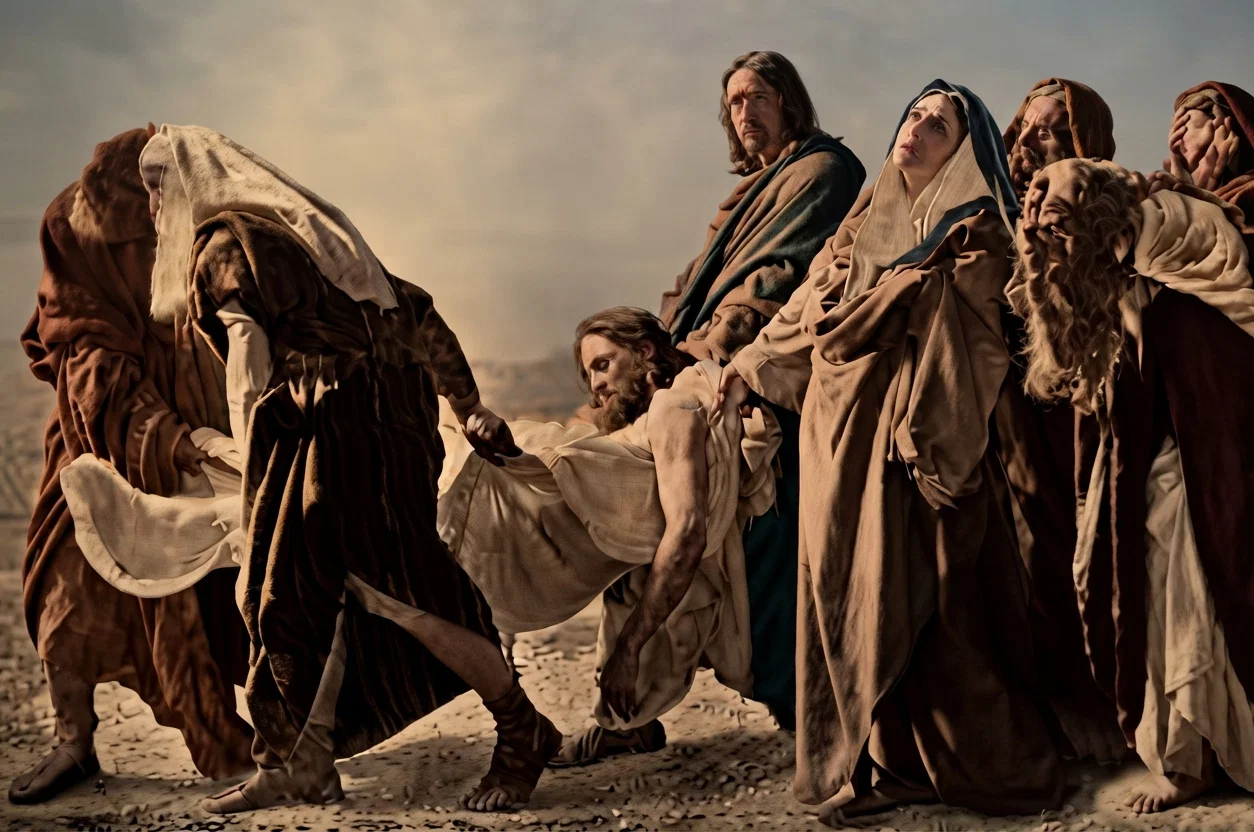
TAKING JESUS TO THE SEPULCHER.
And the Son consented to this plan. He who was rich in all that is valuable in the universe, descended to the lowest level of poverty, in order to supply with true riches those who had lost all through sin. 2 Cor. 8:9; Matt. 8:20. But when He came to earth, He had no form of beauty to commend Him to human desire; He was filled with sorrow at man's condition; He was despised for His goodness; He was oppressed on every hand, and dragged as an innocent lamb to the slaughter; yet no one was found to pity or comfort Him; and He died on the cross with a broken heart. Isa. 53:2-7; Ps. 69:20.
This treatment was not, however, because Christ failed to manifest God-given power. He rebuked the stormy winds and the angry waves, so that they instantly subsided. Matt. 8:22-27. He healed all manner of disease with His word alone. Matt. 15:30, 31. He made glad the hearts of the afflicted by raising their dead friends, in one case where the taint of corruption had begun its work of dissolution. Luke 7:12-16; John 11:36-44. And yet the opportunity was sought by those whom He loved and came to save, to put Him away from their midst. After His betrayal by one who professed to love Him, He was mocked, derided, and spit upon in the house of the high priest; was falsely condemned, and led to execution, surrounded by a howling mob.
Nailed to the cross as a malefactor, He was not only taunted by His enemies, but those who had sat at His feet as disciples for three years, fled away in fear, leaving Him without a comforter in His expiring agony. What love of God to suffer such indignities heaped upon His only-begotten Son! "Why was it?" we ask in wonder. The answer is found in the declaration that "God so loved the world." Only for this love, God could easily have withdrawn His Son from the earth and let vile man perish. But with His infinite love for the fallen, He must let the drama be enacted to the bitter end.
The Son of God was spared but one outrage, tho not this till after He had passed life's boundary. It seems that Jewish criminals were buried with ignominy in the Valley of Hinnom, in the midst of the unclean dust heaps of the city of Jerusalem and the ashes of the burned offal of the temple sacrifices. As culprits they were not permitted to be laid in the common burial-place of the community.
This, however, was not permitted to befall the divine Saviour. Two rich and honorable men, Joseph and Nicodemus, were impressed to brave the public sentiment, and give the dear Lord a decent burial. Waiting on Pilate, Joseph asked for the body and procured it, possibly by offering money for the same. He had a new tomb cut out of the rock, at no great distance away, which had never been used, and to this a few of the near friends of Jesus tenderly bore Him, sacredly depositing there the hallowed burden.
It was a hurried burial, for already the deepening shadows of the Sabbath were drawing on; yet some lingered before the tomb as mourners until the Sabbath requirements drew them to their homes, and they reluctantly left their charge to sleep through God's appointed rest, after having, through unfathomable love, won for the world the way into eternal joy.
JOHN ORR.

HOW TO BECOME UGLY.

HAVE you ever watched the deteriorating effects of sin even upon the personal appearance? Take a youth of extreme beauty, and let him, little by little, be led into wicked practises; in proportion as he is so led, will the register of his descent be written upon his face and upon his whole attitude and manner, quite imperceptibly, I admit, but with awful exactness and depth. The eye, once so clear and so steady in its look, will be marked by suspicion, uncertainty, or timidity of movement. Its glances will not be like sun rays darting through thick foliage, but rather like a dark lantern, turned on so skilfully to see what is happening here and there, but throwing no light on the man who holds it. And strange lines will be woven around the mouth; and the lips, so well cut, so guileless and generous, will be tortured into ugliness and sensual enlargement. And the voice, once so sweet, so ringing, the very music of a character unstained and fearless, will contract mocking tones, and give itself up to a rude laughter, partly deceitful and partly defiant.
All this will not happen in one day. Herein is the subtlety of evil. If you do not see the youth for years, you may be shocked when you miss the fine simplicity and noble bearing which you associated with his name. This is a part of the man's punishment. It is the spot of leprosy on a forehead once so open and unwrinkled; and it will grow, and spread, and deepen until there is no place left for him but the silent and inhospitable wilderness.—Dr. Parker.

WHOLE-HEARTED SERVICE.

"BEHOLD, what manner of love the Father hath bestowed upon us, that we should be called the sons of God. . . . And every man that hath this hope in him purifieth himself, even as He is pure. Whosoever committeth sin transgresseth also the law; for sin is the transgression of the law. And ye know that He was manifested to take away our sins; and in Him is no sin."
Christ made a complete sacrifice in our behalf, when He gave Himself as an offering for sin; and He asks us to give ourselves entirely to Him. He asks for the whole heart; He will accept nothing less than the undivided affections. "God is a Spirit, and they that worship Him must worship Him in spirit and in truth."
What is it to serve God?—It is to resemble Him in character, to imitate Him. To serve God is to obey Him, to keep His commandments, to make an open confession of standing, not under the black banner of the great apostate, but under the blood-stained banner of Prince Emmanuel. Those who serve God strive earnestly to obey His will. Thus they show to what army they belong.
But since sin entered the world, men have been serving self. The world to-day takes much satisfaction in talking of the progress of the age. But in this God does not delight. In the antediluvian world there were many wonderful works of art and science. Fresh from the hand of the Creator, these descendants of Adam possessed capabilities that we do not now see. But they forgot God; and so it is to-day. Men have sought out many inventions; but what is the influence exerted by the improvements and the abundant facilities for intercourse that are everywhere seen? Men have not kept God's commandments, and therefore the railways, the telegraph wires, the cables that connect the nations and kingdoms of the earth, have not brought the fallen world any nearer the higher world.
Obedience to God's law brings men into harmony with heavenly intelligences. It is the duty of each human being to offer God whole-hearted service, to strive to find the right path, the narrow way, that leads through the gate of self-denial into the city of God. The road that leads to death is broad, and full of indulgence; but at the end thereof is no city whose builder and maker is God. The road that leads to heaven is narrow, and few there be that find it; for by no device can this path be made smooth or easy. "I am the Way, the Truth, and the Life," Christ declared. "If any man will come after Me, let him deny himself, and take up his cross, and follow Me."
Christ came from heaven to pass through the strait gate and travel in the narrow path, and He calls upon us to follow Him. As we do this, we should remember at every step that we are honored. Those who walk in the narrow way must daily receive God's restoring grace. This is given to heaven-bound travelers as they become worn by continual conflicts, and are tempted to cease making progressive movements. Those who do not receive this grace faint by the way, but those who do receive it are strengthened and encouraged.
Jesus is the ladder to heaven. Angels ascend and descend this ladder of shining brightness; and God calls upon us to mount this ladder. But we can not do this while we load ourselves down with earthly treasures. We wrong ourselves when we place our convenience and personal advantages before the things of God. There is no salvation in earthly possessions or surroundings. A man is not exalted in God's sight, or accredited by Him as possessing goodness, because he has earthly riches. If we gain a genuine experience in climbing, we shall learn that as we ascend we must leave every hindrance behind. Those who mount must place their feet firmly on every round of the ladder.
The church is Christ's instrumentality in this world. By it He seeks to represent the divine character. It is the privilege of each one to show that Christ has not disappointed him, but has given him refreshment by the way. We may not all be able to preach the Word, yet we all may minister. But this we can not do unless we receive Christ's grace, for we can not give what we do not possess. The faith that works by love and purifies the soul is the only true faith. The faith that does not produce fruit, that does not reveal the Christlikeness, is a false faith.
God is love, and all who truly serve Him will reveal His purity of character. They will be transformed into His image. Their form of speech will be changed. Hasty words of censure, a passionate spirit, are inspired by the enemy of all good. The children of God are patient. They are merciful, even as Christ is merciful. They are kind, pitiful, tender-hearted, and firm as a rock to principle.But until men see their defects in the mirror of God's law, until they realize that they must meet that law in character, they can not truly serve God. They will manifest a spirit that is opposed to the way of the Lord. They will not feel it essential to be free from sin. Such can not offer to God acceptable service. The Son of God came to our world in human form to show man that divinity and humanity combined can obtain the victory over sin. Through Him we may be partakers of the divine nature, having escaped the corruption that is in the world through lust. "Whosoever abideth in Him, sinneth not; whosoever sinneth hath not seen Him."
"Yet saith the house of Israel, The way of the Lord is not equal. O house of Israel, are not my ways equal? are not your ways unequal? Therefore I will judge you, O house of Israel; every one according to his ways, saith the Lord God. Repent, and turn yourselves from all your transgressions; . . . whereby ye have transgressed; and make you a new heart and a new spirit; for why will ye die, O house of Israel? For I have no pleasure in the death of him that dieth, saith the Lord God; wherefore turn yourselves, and live ye."
"Then will I sprinkle clean water upon you, and ye shall be clean; from all your filthiness, and from all your idols, will I cleanse you. A new heart also will I give you, and a new spirit will I put within you; and I will take away the stony heart out of your flesh, and I will give you an heart of flesh. And I will put My Spirit within you, and cause you to walk in My statutes, and ye shall keep My judgments, and do them."
God calls for complete consecration, and anything short of this He will not accept. A love for spiritual things should be encouraged, yea, must be encouraged, if we would grow in grace. Desires for goodness and true holiness are right so far as they go, but if we stop here, they will avail nothing. Good purposes are right, but they will prove of no avail unless resolutely carried out. Many professed Christians have no sense of the spiritual strength they might obtain were they as ambitious, zealous, and persevering to gain a knowledge of divine things as they are to obtain the perishable things of this life. Many are satisfied to be spiritual dwarfs. They have no disposition to make it their object to seek first the kingdom of God and His righteousness; hence godliness is a hidden mystery to them; they can not understand it. They know not Christ by experimental knowledge.
Many will be lost while hoping and desiring to be Christians. They made no earnest effort, and therefore they will be weighed in the balance and found wanting. The will must be exercised in the right direction. We must say, I will be a Christian. I will know the length and breadth, the height and depth, of perfect love. Listen to the words of Jesus: "Blessed are they which do hunger and thirst after righteousness; for they shall be filled." Ample provision has been made by Christ to satisfy the soul that hungers and thirsts for righteousness.
MRS. E. G. WHITE.

GRATITUDE AND PRAISE.

AWAKE, my grateful heart, and praise The Lord most high with joyous lays, For changing darkness into day, And leading me without delay His threefold message to obey.
What am I, Lord, that I should be, Brand from the burning, saved by Thee, One of thy remnant people small To hear and heed thy last great call, While others hearken not at all.
I know it is at love's behest That light and hope glow in my breast, For Thy great word all things obey, Sun, moon, and stars, the night and day, Why not a creature made of clay?
I scarce can praise, I am so weak; O, let the Christ within me speak And laud that righteousness I seek! All other ways are strewn with sin, So wear His yoke, and work, and win.
Yea, Lord, my heart within me burns, That man Thy love, so wondrous, spurns. Give me, I pray, Thy Spirit's grace, And fearless then Thy foes I'll face, By Thee made strong to run the race.
The Holy Spirit's mighty power Fit weapon is, thy servant's dower. Without His aid I'm weak and frail, Soon overcome when foes assail; But with His help I shall prevail.
Thy glories meet my every view; Thy mercies great are ever new; To Thy loved name is homage due. Glory and praise to Christ belong; This is my theme, my joy, my song. MRS. J. B. GOLDSBOROUGH.
STUDIES IN GALATIANS

REDEEMED FROM THE CURSE.

THE third and fourth chapters of Galatians have to do with Abraham as the typical Christian. That which God gave him and promised him is precisely what He gives and promises to all. We say "gives and promises," instead of promises and gives, since giving is the first thing that God does. It is His nature to give. Without respect to persons, He gives to every man. He is not content with simply promising, and then leaving circumstances to determine whether or not anything shall be given. No, He gives, and in His gift is a promise. "Much more" is the description of every gift of God. If those who receive God's gifts receive them joyfully and thankfully, then the very reception of them is the assurance of much more to come. God "giveth to all life, and breath, and all things" (Acts 17:25); if they care for these things, and show appreciation of them, then God will give "more abundantly." So again we say, Every gift of God is a promise of more.
God blessed Abraham, not because of Abraham's goodness, but in order that he might become good. Abraham believed God, and accepted the blessing, and so became good. The Gospel was preached to Abraham in the words, "In thy Seed shall all the kindreds of the earth be blessed;" and this blessing comes to us through Christ; who, having been raised from the dead, has been sent to turn every one of us away from our iniquities. Acts 3:25, 26. This is what is presented in the portion of Galatians that we began to study last week. "They which be of faith are blessed with faithful Abraham."
"For as many as are of the works of the law are under the curse; for it is written, Cursed is every one that continueth not in all things which are written in the book of the law to do them. But that no man is justified by the law in the sight of God, it is evident; for, The just shall live by faith. And the law is not of faith; but, The man that doeth them shall live in them. Christ hath redeemed us from the curse of the law, being made a curse for us; for it is written, Cursed is every one that hangeth on a tree; that the blessing of Abraham might come on the Gentiles through Jesus Christ; that we might receive the promise of the Spirit through faith." Gal. 3:10-14.

Good Works.

The Bible does not disparage good works. On the contrary, they are exalted. "This is a faithful saying, and these things I will that thou affirm constantly, that they which have believed in God might be careful to maintain good works. These things are good and profitable." Titus 3:8. The charge against the unbelieving is that they are "unto every good work reprobate." Titus 1:16. Timothy was exhorted to "charge them that are rich in this world, . . . that they do good, that they be rich in good works." 1 Tim. 6:17, 18. And the apostle Paul prayed for us all, that we might "walk worthy of the Lord unto all pleasing, being fruitful in every good work." Col. 1:10. Still further, we are assured that God has created us in Christ Jesus "unto good works," "that we should walk in them." Eph. 2:10.

Good Works Only by Faith.

"If Abraham were justified by works, he hath whereof to glory; but not before God. For what saith the Scripture? Abraham believed God, and it was counted unto him for righteousness." Rom. 4:2, 3. Altho good works are required of us, they are not the "works done in righteousness, which we did ourselves" (Titus 3:5, R.V.), but the "good works, which God afore prepared, that we should walk in them" (Eph. 2:10, R.V.). These good works God has "laid up" for them that fear Him, He Himself having "wrought" them for those who trust in Him before the sons of men. Ps. 31:19. "This is the work of God, that ye believe in Him whom He hath sent." John 6:29.

"The Just Shall Live by Faith."

This is proof that no one is justified by the law; for if one were righteous by works, then it would not be by faith. There is no exception, no dividing up. It is not said that some of the just shall live by faith, or that they shall live by faith and works, but, "The just shall live by faith." All of the just shall live by faith alone. The law and the works of the law have nothing whatever to do in the work of justifying men, altho the law itself "is holy, and the commandment holy, and just, and good." Rom. 7:12.

Who Are the Just?

In other versions than the English, as, for instance, the German and Danish, these texts are made much plainer, because they use the word which conveys the idea more perfectly than the word "just" does to us. This is the way it is: "But that no man is made righteous by the law in the sight of God it is evident; for, the righteous shall live by faith." The words "just" and "righteous" really mean the same thing, but in the word "justify" the majority of readers do not readily recognize the phrase "to make righteous." We see, therefore, that righteousness is the end to be attained. Righteousness means right-doing, and the law is the standard of right-doing. The only question before us is how this desired object is to be attained. How is the sinner to be made righteous—to be made a doer of the law?—Not by the law itself, for that does nothing; it simply points out the right way; but we ourselves are "without strength." Righteousness therefore must come from without, from some living thing, and when attained in genuineness will be "witnessed by the law and the prophets." Rom. 3:21.

Life Is Doing.

"The man that doeth them shall live in them." The law calls for action, deeds, and nothing else. If good deeds are manifested, the law is satisfied. "The law is not of faith;" it cares nothing for faith; works, and works alone, commend themselves to it. How those works are obtained is of no consequence to it, provided they are present. There is life in the doing of them, for only he who is alive can do them. Notice the word "them." It indicates the fulness of the law. "Cursed is every one that continueth not in all things which are written in the book of the law to do them." But "all have sinned;" and since all are "dead in trespasses and sins" (Eph. 2:1), it is very evident that no one can of himself be in the position described by the words, "The man that doeth them shall live in them." The man must first be made alive before he can do them. Do not forget, however, that in all this the law is exalted and honored, instead of discredited. There is life in obedience to it, and death in disobedience. The curse is only on those who do not do it."In keeping of them there is great reward." Ps. 19:11.

Sin and Death the Curse.

That death is the curse is evident from the last part of verse 13, "Cursed is every one that hangeth on a tree." Christ was made a curse for us in that He hung on a tree, that is, was crucified. So we have the substance of verse 10 thus, that those who do not continue in the things written in the law are dead; that is, disobedience is death. And this is what the Scripture says: "When lust hath conceived, it bringeth forth sin; and sin, when it is finished, bringeth forth death." Sin contains death, so that when by one man sin entered into the world, death came by sin. Rom. 5:12.

Christ Made a Curse for Us.

That "Christ died for the ungodly" is evident to all who read the Bible. He "was delivered for our offenses." Rom. 4:25. The death that was deserved, came on Him. "He was wounded for our transgressions, He was bruised for our iniquities; the chastisement of our peace was upon Him; and with His stripes we are healed." Isa. 53:5. But death came by sin. Death is the curse that has passed upon all men, simply because "all have sinned." So as Christ was "made a curse for us," it follows that Christ was "made to be sin on our behalf." 2 Cor. 5:21, R.V. He "bore our sins in His own body" up to the tree. 1 Peter 2:24, margin. Note that our sins were "in His own body." It was no superficial work that He undertook. The sins were not merely figuratively laid on Him, but they were actually in Him. He was made a curse for us, made to be sin for us, and consequently suffered death for us. To some this truth seems repugnant; to the Greeks it is foolishness, and to the Jews a stumbling-block, but "to us who are saved, it is the power of God." For bear in mind that it was our sins that He bore in His own body, not His own sins. The same scripture that tells us that He was made to be sin for us, assures us that He "knew no sin." The same text that tells us that He carried our sins "in His own body," is careful to let us know that He "did no sin." The fact that He could carry our sin about with Him, and in Him, being actually made to be sin for us, and yet not do any sin, is to His everlasting glory and our eternal salvation from sin.

Redeemed from Sin and Death.

Christ has redeemed us from that which He suffered; for "with His stripes we are healed." So He has redeemed us—brought us back—from sin and death. He has redeemed us from death in redeeming us from sin, since death is but the result of sin. But sin is wrong-doing—the transgression of the law. 1 John 3:4. So it is from our "vain manner of life" that we are redeemed with the precious blood of Christ. 1 Peter 1:18, 19, R.V. By becoming sin for us, and carrying our sin up to and on the tree, Christ has redeemed us from the transgression of the law; that is, He has redeemed us from committing sin. This is the glorious reality of the Gospel, present salvation from the commission of "the sin that doth so easily beset us." In this is contained the sum of all things. And this great blessing comes to us through faith.

The Revelation of the Cross.

In verse 13 we are brought back to the subject presented in Gal. 2:20 and 3:1,—the ever-present, universal cross. We can not go into the subject in detail, for it is inexhaustible; but note the following facts, which may suggest many more things to your minds:—
1. The redemption from sin and death is accomplished through the cross. Gal. 3:13.
2. The Gospel is all contained in the cross; for the Gospel is "the power of God unto salvation to every one that believeth" (Rom. 1:16); and "unto us which are saved" the cross of Christ is "the power of God" (1 Cor. 1:18).
3. Christ crucified is the only way Christ is revealed to fallen men. There is none other name under heaven given among men whereby salvation may be obtained (Acts 4:12), and therefore it is all that God sets forth before men, since He does not wish to confuse them. "Christ and Him crucified" is all that Paul wished to know; it is all that any man needs to know. Thus the one thing that men need is salvation; if they get that, they get all things; but salvation is found only in the cross of Christ; therefore God puts before the eyes of men nothing else; He gives them just what they need. Jesus Christ is by God set forth openly crucified before the eyes of every man, so that there is no excuse for any to be lost, or to continue in sin.
4. Christ is set forth before men only as the crucified Redeemer, and since that from which men need to be saved is the curse, He is set forth as bearing the curse. Wherever there is any curse, there is Christ bearing it. We have already seen that Christ bore, and still bears, our curse, in that He bears our sin. He also bears the curse of the earth itself, for He bore the crown of thorns, and the curse pronounced on the earth was, "Thorns also and thistles shall it bring forth." Gen. 3:18. So the whole creation, which now groans under the curse, is to be redeemed through the cross of Christ. Rom. 8:19-23.
5. It is only on the cross that Christ bears the curse, for His being made a curse for us was indicated by His hanging on the cross. The cross is the symbol of the curse, but also of deliverance from the curse, since it is the cross of Christ the Conqueror and Deliverer. The very curse itself, therefore, presents the cross, and proclaims our deliverance.
6. Where is the curse? Ah, where is it not? The blindest can see it, if he will but acknowledge the evidence of his own senses. Imperfection is a curse, yea, that is the curse; and imperfection is on everything connected with this earth. Man is imperfect, and even the finest plant that grows from the earth is not as perfect as it might be. There is nothing that meets the eye that does not show the possibility of improvement, even if our untrained eyes can not see the absolute necessity of it. When God made the earth, everything was "very good," or, as the Hebrew idiom has it, "good exceedingly." God Himself could see no chance, no possibility, for improvement. But now it is different. The gardener spends his thought and labor trying to improve the fruits and flowers under his care. And since the best that the earth produces reveals the curse, what need be said of the gnarled, stunted growths, the withered and blasted buds and leaves and fruits, and the noxious, poisonous weeds? Everywhere "hath the curse devoured the earth." Isa. 24:6.
7. What, then, is the conclusion of the whole matter? Is it discouragement?—Nay; "for God hath not appointed us to wrath, but to obtain salvation by our Lord Jesus Christ." 1 Thess. 5:9. Altho the curse is visible everywhere— "Change and decay in all around I see;" yet things live, and men live. But the curse is death, and no man and no thing in creation can bear death and still live. Death kills. But Christ is He that liveth, and was dead, and is alive forevermore. Rev. 1:18. He alone can bear the curse—death—and still live. Therefore the fact that there is life on the earth and in man, in spite of the curse, is proof that the cross of Christ is everywhere. Every blade of grass, every leaf of the forest, every shrub and tree, every flower and fruit, even the bread that we eat, is stamped with the cross of Christ. Everywhere is that cross; and as the preaching of the cross is the power of God, which is the Gospel, so it is that the everlasting power of God is revealed in all things that He has made. Rom. 1:16-20, compared with 1 Cor. 1:17, 18, amounts to a plain declaration that the cross of Christ is seen in the things that God has made—even in us.

Courage and Despair.

"Innumerable evils have compassed me about; mine iniquities have taken hold upon me, so that I am not able to look up; they are more than the hairs of mine head; therefore my heart faileth me." Ps. 40:12. But not only may we with confidence cry unto God out of the depths, but God in His infinite mercy has so ordered it that the very depths themselves are a source of confidence. The fact that we are in the depths of sin, and yet live, is proof that God Himself, in the person of Christ on the cross, is present with us to deliver us. So everything, even the curse—for everything is under the curse—preaches the Gospel. Our own weakness and sinfulness, instead of being a cause of discouragement, are, if we believe the Lord, a pledge of redemption. Out of weakness we are made strong. "In all these things we are more than conquerors through Him that loved us." Rom. 8:37. Truly, God has not left Himself without witness. "He that believeth on the Son of God hath the witness in himself." 1 John 5:10.

The Blessing from the Curse.

Christ bore the curse in order that the blessing might come to us. He bears the curse now, being crucified before us, and we with Him, that we may continually experience the blessing. Death to Him is life to us. He was made to be sin for us, "that we might be made the righteousness of God in Him." 2 Cor. 5:21. What is the blessing that we receive through the curse that He bears?—It is the blessing of salvation from sin; for as the curse is the transgression of the law (Gal. 3:10), the blessing consists in turning away every one of us from our iniquities (Acts 3:26). Christ suffered the curse, even sin and death, "that the blessing of Abraham might come on the Gentiles through Jesus Christ." Gal. 3:14. And what is the blessing of Abraham?—That we have already seen, but we may well read it again. Having stated that Abraham was justified, made righteous by faith, the apostle adds: "Even as David also describeth the blessedness of the man, unto whom God imputeth righteousness without works, saying, Blessed are they whose iniquities are forgiven, and whose sins are covered. Blessed is the man to whom the Lord will not impute sin." Rom. 4:6-8. And then he shows that this blessing comes on the Gentiles as well as the Jews who believe, because Abraham received it when he was circumcised, "that he might be the father of all them that believe." The blessing is freedom from sin, even as the curse is the doing of sin; and as the curse reveals the cross, so we find that the very curse is by the Lord made to proclaim the blessing. The fact that we live, altho we are sinners, is the assurance that deliverance from sin is ours. "While there's life there's hope," says the adage. Yes, because the Life is our hope. Thank God for the blessed hope.

"The Promise of the Spirit."

Christ hath redeemed us, "that we might receive the promise of the Spirit through faith." Do notmake the mistake of reading this as tho it were "that we might receive the promise of the gift of the Spirit." It does not say that, and it does not mean that, as a little thought will show. He has redeemed us, and that fact proves the gift of the Spirit, for it was only "through the eternal Spirit" that He "offered Himself without spot to God." Heb. 9:14. But for the Spirit, we should not know that we were sinners; much less should we know redemption. The Spirit convinces of sin and of righteousness. John 16:8. "It is the Spirit that beareth witness, because the Spirit is truth," 1 John 5:6. "He that believeth hath the witness in himself." Christ is crucified in every man. That, as we have already seen, is shown in the fact that we are all under the curse, and Christ alone, on the cross, bears the curse. But it is through the Spirit that Christ dwells on earth among men. Faith enables us to receive the testimony of this witness, and rejoice in that which the possession of the Spirit assures.

The Spirit the Pledge of Inheritance.

Look ahead in our epistle and see what is said of redemption and the Spirit: "God sent forth His Son, made of a woman, made under the law, to redeem them that were under the law, that we might receive the adoption of sons. And because ye are sons, God hath sent forth the Spirit of His Son into your hearts, crying, Abba, Father." Gal. 4:4-6. "The Spirit itself beareth witness with our Spirit, that we are the children of God; and if children, then heirs; heirs of God, and joint heirs with Christ." Rom. 8:16, 17. Thus we see that the gift of the Spirit, which assures us of our redemption through the cross, is itself a promise. As we said at the beginning, all God's gifts are promises of more. Now read how God's purpose in the Gospel is to gather together in one all things in Jesus Christ: "In whom also we have obtained an inheritance, being predestinated according to the purpose of Him who worketh all things after the counsel of His own will; that we should be to the praise of His glory, who first trusted in Christ. In whom ye also trusted, after that ye heard the Word of truth, the Gospel of your salvation; in whom also after that [or when] ye believed, ye were sealed with that Holy Spirit of promise, which is the earnest of our inheritance until the redemption of the purchased possession, unto the praise of His glory." Eph. 1:10-14.
Of this inheritance we must speak further later on. Suffice it now to say that it is the inheritance promised to Abraham, whose children we become by faith. The inheritance belongs to all who are children of God through faith in Christ Jesus; and the Spirit that marks our sonship is the promise, the pledge, the first-fruits of that inheritance. Those who accept Christ's glorious deliverance from the curse of the law,—redemption not from obedience to the law, for obedience is not a curse, but from disobedience to the law,—have in the Spirit a taste of the power and blessing of the world to come. E. J. WAGGONER.

Abram’s Altar and Tent

The altar and the tent give us the two great features of Abram's character—a worshiper of God, a stranger in the world. Most blessed characteristics. Having nothing on earth—having our all in God, Abram had "not so much as to set his foot upon," but he had God to enjoy, and that was enough.—C. H. McIntosh.

Crime and Bloodshed

I ASSERT my conviction that crime will never be purged from our midst—horrid, brutal, terrible crime—till man be purged from contact with blood and slaughter and the shambles, and all their necessarily incidental cruelty be swept from our midst.—Dr. Josiah Oldfield, M.A., M.R.C.S., L.R.C.P.
Continue reading: Can I Sleep?
